Introduction
Major depressive disorder (MDD) is a highly heterogeneous disorder, with large inter-individual differences in symptom, illness course and treatment response profiles. The research agenda for the National Institute of Mental Health (NIMH) emphasizes a translation of basic and clinical neuroscience research findings into a new classification system for all psychiatric disorders based upon biomarkers that reflect pathophysiological and etiological processes (Charney et al. Reference Charney, Barlow, Botteron, Cohen, Goldman, Gur, Lin, Lopez, Meador-Woodruff, Moldin, Nestler, Waton, Zalcman, Kupfer, First and Regier2002; Hasler et al. Reference Hasler, Drevets, Manji and Charney2004, Reference Hasler, Drevets, Gould, Gottesman and Manji2006; Phillips & Frank, Reference Phillips and Frank2006). Despite years of research, however, the search for reliable, consistently present biomarkers of MDD has proven elusive.
Perhaps the best-established neuroimaging marker of MDD is abnormally elevated amygdala activity to negative emotional information (Fitzgerald et al. Reference Fitzgerald, Laird, Maller and Daskalakis2008; Peluso et al. Reference Peluso, Glahn, Matsuo, Monkul, Najt, Zamarripa, Li, Lancaster, Fox, Gao and Soares2009; Kessler et al. Reference Kessler, Taubner, Buchheim, Munte, Stasch, Kachele, Roth, Heinecke, Erhard, Cierpka and Wiswede2011), including fear (Sheline et al. Reference Sheline, Barch, Donnelly, Ollinger, Snyder and Mintun2001) and sadness (Fu et al. Reference Fu, Williams, Cleare, Brammer, Walsh, Kim, Andrew, Pich, Williams, Reed, Mitterschiffthaler, Suckling and Bullmore2004; Suslow et al. Reference Suslow, Konrad, Kugel, Rumstadt, Zwitserlood, Schoning, Ohrmann, Bauer, Pyka, Kersting, Arolt, Heindel and Dannlowski2010; Victor et al. Reference Victor, Furey, Fromm, Öhman and Drevets2010). Despite broad agreement that abnormalities in amygdala function are associated with MDD, these findings are not always obtained (e.g. Fitzgerald et al. Reference Fitzgerald, Laird, Maller and Daskalakis2008). For example, some researchers report an absence of abnormally elevated amygdala activity to negative emotional stimuli in depressed individuals with MDD (Surguladze et al. Reference Surguladze, Brammer, Keedwell, Giampietro, Young, Travis, Williams and Phillips2005; Almeida et al. Reference Almeida, Versace, Hassel, Kupfer and Phillips2010), while others describe heterogeneity in amygdala activity in depressed groups (Canli et al. Reference Canli, Cooney, Goldin, Shah, Sivers, Thomason, Whitfield-Gabrieli, Gabrieli and Gotlib2005; Siegle et al. Reference Siegle, Carter and Thase2006, Reference Siegle, Thompson, Carter, Steinhauer and Thase2007; Abler et al. Reference Abler, Erk, Herwig and Walter2007; Dannlowski et al. Reference Dannlowski, Ohrmann, Bauer, Kugel, Arolt, Heindel, Kersting, Baune and Suslow2007; Lee et al. Reference Lee, Seong Whi, Hyung Soo, Lee, Choi, Lyoo and Ham2007). Abnormal amygdala activity to positive emotional stimuli is less consistently observed, with some researchers (Sheline et al. Reference Sheline, Barch, Donnelly, Ollinger, Snyder and Mintun2001) reporting abnormally elevated amygdala activity to happy faces in depressed individuals with MDD, others (Surguladze et al. Reference Surguladze, Brammer, Keedwell, Giampietro, Young, Travis, Williams and Phillips2005) failing to find this association, and still others (Suslow et al. Reference Suslow, Konrad, Kugel, Rumstadt, Zwitserlood, Schoning, Ohrmann, Bauer, Pyka, Kersting, Arolt, Heindel and Dannlowski2010; Victor et al. Reference Victor, Furey, Fromm, Öhman and Drevets2010) finding the opposite pattern.
The inconsistent findings regarding abnormal amygdala activity in MDD may reflect the heterogeneity of affective psychopathology among individuals diagnosed with the disorder. Standard measures of current symptom severity, however, may not be sufficiently sensitive to explain the large inter-individual variation in neural activity among individuals with MDD. Individual differences in neural circuitry function may, instead, be more strongly associated with measures that assess the full continuum of lifetime manifestations of affective psychopathology.
Recognizing the need to develop a clinical, lifetime measure capturing the full range of symptoms and associated features across the spectrum of mood disorders, Cassano and colleagues developed the Mood Spectrum Self-Report instrument (MOODS-SR; Dell'Osso et al. Reference Dell'Osso, Armani, Rucci, Frank, Fagiolini, Corretti, Shear, Grochocinski, Maser, Endicott and Cassano2002). The instrument, and the model of psychopathology from which it originated, posits that subtle, subthreshold signs and symptoms experienced over one's lifetime may represent a clinically meaningful underlying diathesis that is shared with individuals meeting diagnostic criteria for the relevant disorder. This approach assumes that individuals with a particular diagnosis, e.g. MDD, may nevertheless have an underlying pathology that is on a continuum with other, traditionally separate illnesses, e.g. bipolar disorder, panic disorder, obsessive-compulsive disorder, etc. The MOODS-SR measures dimensions of affective psychopathology, including manic and depressive symptoms, that characterize the lifetime presence of affective dysregulations comprising both fully syndromal and subthreshold mood disturbance (Dell'Osso et al. Reference Dell'Osso, Armani, Rucci, Frank, Fagiolini, Corretti, Shear, Grochocinski, Maser, Endicott and Cassano2002).
Using a structured interview version of the MOODS instrument, Cassano et al. (Reference Cassano, Rucci, Frank, Fagiolini, Dell'Osso, Shear and Kupfer2004) observed substantial heterogeneity among adults with MDD regarding the presence of lifetime mania-related psychopathology, despite careful clinical screening to ensure that no individual diagnosed with MDD met diagnostic criteria for any bipolar disorder. Depressed individuals with higher levels of lifetime mania-related psychopathology had earlier onsets of depression, were more likely to experience suicidal ideation, and experienced increased paranoia (Cassano et al. Reference Cassano, Rucci, Frank, Fagiolini, Dell'Osso, Shear and Kupfer2004). These findings suggest that differences in underlying pathology may exist among individuals with MDD and that some depressed individuals may have an underlying pathology that is closer to that of bipolar disorder. Given this, it is possible that those individuals with MDD with higher levels of lifetime mania-related pathology may show patterns of amygdala activity reported more consistently in individuals with bipolar disorder than in individuals with MDD: e.g., abnormally elevated amygdala activity to positive emotional (happy) faces (Lawrence et al. Reference Lawrence, Williams, Surguladze, Giampietro, Brammer, Andrew, Frangou, Ecker and Phillips2004; Blumberg et al. Reference Blumberg, Donegan, Sanislow, Collins, Lacadie, Skudlarski, Gueorguieva, Fulbright, McGlashan, Gore and Krystal2005; Pavuluri et al. Reference Pavuluri, O'Connor, Harral and Sweeney2007).
The primary goal of the present study was to examine individual differences in abnormal amygdala functioning among depressed adults with MDD as a function of a dimensional measure of lifetime affective psychopathology. To do this, we first ascertained under which conditions amygdala functioning was abnormal for the depressed adults with MDD by comparing amygdala activity in depressed and healthy control (HC) adults. All participants performed an implicit emotion-processing task in which they labeled a color flash that was superimposed upon negative (fear, sad, anger) and positive (happy) dynamically changing emotional face stimuli. Given the findings reviewed above, we expected to observe that adults with MDD would show functional abnormalities in the amygdala, specifically, significantly elevated amygdala activity relative to HC adults to both positive and negative emotional faces. We also expected to observe substantial heterogeneity among adults with MDD in the level of abnormal amygdala activation. We hypothesize that for those emotional conditions during which adults with MDD displayed abnormal amygdala activity: (1) individual differences in the magnitude of amygdala activity to the negative emotional stimuli will be associated with levels of lifetime depression-related psychopathology; and (2) individual differences in the magnitude of amygdala activity to positive emotional stimuli will be associated with levels of lifetime mania-related psychopathology.
Method
Participants
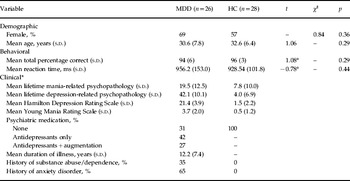
We recruited 63 right-handed, native English-speaking individuals: 32 currently depressed adults diagnosed with MDD and 31 HC participants with no personal or family history of psychiatric illness. Adults with MDD were carefully screened to ensure that they did not meet diagnostic criteria for bipolar disorder. Psychiatric diagnoses were made using the Structured Clinical Interview for Psychiatric Disorders (SCID-P; First et al. Reference First, Spitzer, Gibbon, Willians and Benjamin1995). Exclusion criteria were: history of head injury (from medical records and participant report), systemic medical illness, cognitive impairment (score <24 on the Mini-Mental State Examination; Folstein et al. Reference Folstein, Folstein and McHugh1975), pre-morbid IQ estimate <85 (National Adult Reading Test; Blair & Spreen, Reference Blair and Spreen1989), Axis-II borderline personality disorder, and standard magnetic resonance imaging (MRI) exclusion criteria (e.g. presence of metallic objects in the body). Adults with MDD were also excluded if they met criteria for an alcohol/substance-use disorder within 2 months before the scan. For HC, additional exclusion criteria included current/previous alcohol or substance abuse/dependence (determined by Structured Clinical Interview for DSM-IV Axis I Disorders, saliva and urine screen), and any personal or family history of Axis I disorder. The two groups were age- and gender-matched. Six depressed patients were excluded from the analyses (three for movement >2 mm between two successive scans; two for <75% color labeling accuracy during the scan; one for scoring 2.5 s.d. above the mean level of depression severity) and three HC were excluded because of motion >2 mm between two successive scans. The final sample included 26 adults with MDD and 28 HC (Table 1). The study protocol was approved by the University of Pittsburgh Institutional Review Board. After complete description of the study to participants, written informed consent was obtained.
Demographic, behavioral and clinical variables

MDD, Major depressive disorder; HC, healthy controls; s.d, standard deviation.
a The Satterthwaite method was used to correct for unequal variances between groups.
* The two groups differed on all clinical variables (p < 0.001).
Measures
Current depression severity was assessed using the 17-item Hamilton Rating Scale for Depression (HAMD; Hamilton, Reference Hamilton1960). Current manic symptoms were assessed using the Young Mania Rating Scale (YMRS; Young et al. Reference Young, Biggs, Ziegler and Meyer1978). Clinical and demographic information was collected through self-report questionnaires and clinical interview using the SCID-P. Of the adults with MDD, 65% had a history of anxiety disorder and 35% had a history of substance abuse. Lifetime depression-related and mania-related psychopathology was assessed using the MOODS-SR–Lifetime Version (Dell'Osso et al. Reference Dell'Osso, Armani, Rucci, Frank, Fagiolini, Corretti, Shear, Grochocinski, Maser, Endicott and Cassano2002). This 161-item questionnaire assesses the presence of symptoms and features for periods of at least 3–5 days during one's lifetime. The measure is organized into three domains for mania-related psychopathology and three domains for depression-psychopathology (mood, energy and cognition), and a seventh domain assessing disturbances in rhythmicity. In the present study, because the three domain scores for depression and for mania were highly correlated with their respective total scores (all r's >0.90), the total scores for depression and mania were used.
Paradigm
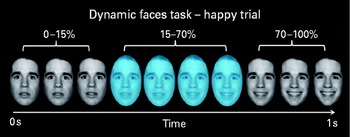
Participants completed a 12.5-min emotional dynamic faces task during functional MRI. Stimuli comprised faces from the NimStim set (Tottenham et al. Reference Tottenham, Tanaka, Leon, McCarry, Nurse, Hare, Marcus, Westerlund, Casey and Nelson2009) that were morphed in 5% increments, from neutral (0% emotion) to 100% emotion for four emotions: happy, sad, angry and fear (Fig. 1). Morphed faces were collated into 1 s movies progressing from 0% to 100% emotional display. In control trials, movies comprised a simple shape (dark oval) superimposed on a light-gray oval, with similar structural characteristics to the face stimuli, which subsequently morphed into a larger shape, approximating the movement of the morphed faces. There were three blocks for each of the four emotional conditions, with twelve stimuli per block, and six control blocks with six stimuli per block. Emotional and control blocks were presented in a pseudorandomized order so that no two blocks of any condition were presented sequentially. Participants were asked to use one of three fingers to press a button indicating the color of a semi-transparent foreground color flash (orange, blue or yellow) that appeared during the mid 200–650 ms of the 1 s presentation of the dynamically changing face. The emotional faces were task-irrelevant and processed by the participants implicitly.
A single happy trial of the dynamic emotional faces task. Over a 1 s duration, the participants viewed a movie of a face that changed in 5% increments from neutral (0% emotion) to a happy, sad, angry or fearful (100% emotion) face. Participants were asked to identify the color flash presented in the middle of the dynamic change.

Data acquisition
Neuroimaging data were collected using a 3.0 Tesla Siemens Trio MRI scanner (Siemens, USA) at the Magnetic Resonance Research Center in the University of Pittsburgh Medical Center. Structural three-dimensional axial MPRAGE images were acquired in the same session [repetition time (TR) = 2200 ms; echo time (TE) = 3.29 ms; flip angle = 9°, field of view (FOV) = 256 × 192 mm2; slice thickness = 1 mm; matrix = 256 × 256; 192 continuous slices). Blood oxygen level-dependent (BOLD) images were then acquired with a gradient echo EPI (echo planar imaging) sequence during approximately 13 min (378 successive brain volumes) covering 39 axial slices (3.2 mm thick; TR = 2000 ms; TE = 28 ms; FOV = 205 × 205 mm2; matrix = 64 × 64; flip angle = 90°).
Functional neuroimaging data analyses
Data were preprocessed and analysed with statistical parametric mapping software (SPM8; http://www.fil.ion.ucl.ac.uk/spm). During preprocessing, data were corrected for differences in acquisition time between slices, co-registered, realigned, re-sampled to 2 × 2×2 mm3 voxels, spatially normalized into standard stereotactic space (Montreal Neurologic Institute, MNI) and spatially smoothed using a 6 mm FWHM (full width at half maximum) Gaussian kernel. A first-level fixed-effect model was constructed in which each of the four emotion conditions (anger, fear, sad and happy) were entered as separate conditions in a block design and contrasted with the shape condition, which served as the baseline in the design matrix. Movement parameters from the preprocessing procedure were entered as covariates of no interest to control for subject movement. Trials were modeled with the canonical hemodynamic response function. The four emotion contrasts (i.e. anger minus shape, fear minus shape, sad minus shape and happy minus shape) were entered into second-level analyses.
Between-groups region of interest (ROI) analyses
ROI analyses were conducted to examine the effect of group in left and right a priori amygdala ROIs, as defined in the Wake Forest Toolbox PickAtlas Talairach Daemon template (Maldjian et al. Reference Maldjian, Laurienti, Kraft and Burdette2003). (No filter was used in the construction of these ROIs.) To control for multiple statistical testing we maintained a cluster-level false-positive detection rate at p < 0.05 by using a voxel threshold of p < 0.05 with a cluster (k) extent empirically determined by Monte Carlo simulations implemented in AlphaSim of 26 voxels, computed separately for left and right amygdalae. This well-validated technique accounts for spatial correlations between BOLD signal changes in neighboring voxels (Ward, Reference Ward2002). We utilized the between-groups analysis to identify those conditions in which the MDD and HC adults differed (that is, in which the adults with MDD demonstrated abnormal amygdala function) so as to guide the within-group analyses described below.
Within-group ROI analyses
To examine the extent to which abnormal amygdala activity was associated with dimensions of mood-related psychopathology, we extracted amygdala BOLD response for each emotion condition associated with abnormal activity in adults with MDD relative to HC. Rather than extracting only those voxels for which significant MDD-HC differences were observed, we extracted all voxels from the amygdala ROI and averaged them. Thus, mean BOLD responses in the entire anatomically defined amygdala masks were used as the dependent variables. Within adults with MDD, we examined associations between neural activity and lifetime mania-related and lifetime depression-related psychopathology. Mean amygdala response was modeled as a function of mania-related and depression-related MOODs spectrum scores, controlling for scores on the YMRS, HAMD, gender, age, illness duration, history of prior substance abuse/dependence, history of anxiety disorder and current medications [three categories: no psychiatric medication (n = 8), antidepressant medication only (n = 11) and antidepressant medication and benzodiazepines, mood stabilizer, and/or antipsychotic medication (n = 7)]. Owing to the large number of variables for which we were controlling, we adopted a strategy by which we tested the effect of mania-related and depression-related psychopathology in the full model (all 10 variables), and in a final model that was reduced using backwards stepwise regression (using a significance criterion for variable retention of p = 0.10). Regression analyses were performed using SAS 9.2 (SAS Institute, Inc., USA).
Exploratory whole-brain analyses
We conducted exploratory whole-brain analyses to identify those regions in which adults with MDD displayed greater activity than HC to the four emotion-minus-shape contrasts. To control for multiple voxelwise tests, we set a voxelwise threshold of p < 0.001 and a minimum cluster (k) extent of 20 voxels.
Results
Task performance
Mean color labeling accuracy and mean reaction time were calculated for each participant across all conditions. Overall, task accuracy was high (HC = 96%, MDD = 94%) and there were no significant differences between groups in accuracy or reaction times [between-groups variances were unequal for both comparisons, thus the Satterthwaite method was used: t(39.7) = 1.08, p = 0.29 for accuracy; t(43.0) = −0.78, p = 0.44 for reaction times].
Activity
Between-groups ROI analysis
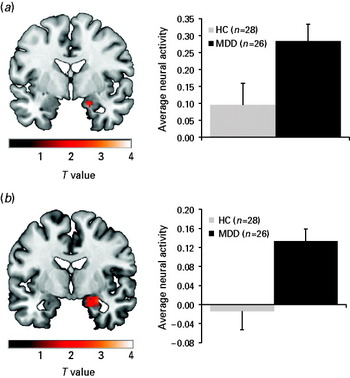
A significant main effect of group was observed in the right amygdala, by which activity was higher for adults with MDD than for HC [t(208) = 2.40, p = 0.009, k = 26 voxels].Footnote 1Footnote † Subsequent contrasts revealed that this effect resulted from significantly greater activity for adults with MDD during the anger [t(208) = 2.35, p = 0.01, k = 31 voxels] and happy [t(208) = 3.19, p = 0.001, k = 83 voxels] conditions relative to HC (Fig. 2; Supplementary Table S1). To test for a possible effect of medications on these findings, we compared right-amygdala activity for the anger and happy conditions between those adults with MDD taking psychiatric medication (n = 18) and those not taking medication (n = 8). Neither between-group contrast met the pre-specified criteria for significance (both t's ⩽1.9, k's ⩽1 voxel).
Between-group differences in adults with major depressive disorder (MDD, n = 26) compared with healthy controls (HC, n = 28) in right-amygdala activity during processing of angry (a) and happy (b) emotional conditions. The bar graphs represent the mean activity from the clusters within the amygdala region of interest that showed greater activity for adults with MDD relative to healthy controls. Error bars represent standard error.

Within-group ROI analysis
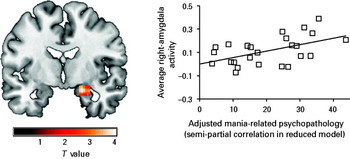
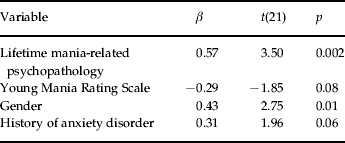
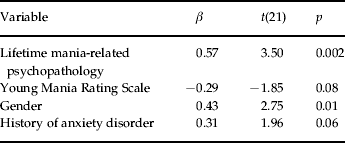
To investigate the extent to which abnormally elevated right-amygdala activity to the anger and happy conditions in adults with MDD was associated with individual differences in levels of lifetime affective psychopathology, the mean amygdala BOLD signal during each of these conditions was extracted from the anatomically defined right amygdala mask. Separate regression models were estimated for each emotion condition. To correct for the two parallel tests (one regression model each for the right amygdala to happy and anger conditions), a corrected p value of 0.025 was used. In each model, mean right-amygdala activity was modeled as a function of depression-related and mania-related MOODS spectrum scores, age, gender, illness duration, HAMD scores, YMRS scores, history of substance abuse/dependence, history of anxiety disorder and psychiatric medication. To the happy condition only, there was a significant relationship between lifetime mania-related psychopathology and right-amygdala activity in adults with MDD in both the full model that controlled for all of the covariates [F(1, 14) = 8.77, p = 0.01; Supplementary Table S2] and in the final, reduced model (four variables) for which a backwards-stepwise regression framework was applied [F(1, 21) = 12.26, p = 0.002; Fig. 3; Table 2]. In the final reduced model, there was also a significant effect of gender: women with MDD displayed greater amygdala activity to the happy condition than men with MDD [F(1, 21) = 7.57, p = 0.01] (see Supplementary Material for additional regression model details).
Activity in the right amygdala during the happy emotional condition among adults with major depressive disorder. The line graph represents mean activity in the right amygdala (anatomically defined) as a function of adjusted lifetime subthreshold mania-related psychopathology. These values have been adjusted by first regressing out the following covariates identified for inclusion in the final regression model: Young Mania Rating Scale scores, age and history of anxiety disorder. The graph thus represents the semi-partial correlation (i.e. the unique contribution) of mania-related psychopathology to activity in the right amygdala accounting for all of the covariates. The squared correlation coefficient from this relationship (R 2 = 0.29) is equivalent to the change in R 2 obtained by adding mania-related psychopathology to a regression model that has already accounted for the variance that could be explained by the covariates. Without mania-related psychopathology, R 2 for the covariates = 0.21. The change in R 2 obtained by adding mania-related psychology = 0.29, which is significant (p = 0.002), resulting in a model R 2 = 0.50.

Reduced regression model of right-amygdala activity in response to the happy condition
We conducted two additional analyses to assess the robustness and specificity of findings regarding the association between elevated right-amygdala activity during the happy condition and lifetime subthreshold mania. First, we divided adults with MDD into two groups of 15 patients (Here, we increased the sample of adults with MDD from 26 to 30 by relaxing the conservative exclusion criteria described above and including the participant with the high HAMD score and additional participants whose movement during the scan was <6 mm.) Previous research (Fagiolini et al. Reference Fagiolini, Frank, Rucci, Cassano, Turkin and Kupfer2007; P. Rucci, personal communication 9 February 2011) identified a cut-off score of 22 on this measure as reflecting clinically significant subthreshold mania. This value was used to divide adults with MDD into low- and high-mania subgroups. The mean mania score for the low-mania subgroup (n = 15, mean = 10.1, s.d. = 5.7, range = 1–18) was two standard deviations below the cut-off. The mean score for the high-mania subgroup (n = 15, mean = 32.0, s.d. = 7.5, range = 23–48) was one standard deviation above the cut-off. Right amygdala activity to the happy condition was higher in the high-mania versus the low-mania subgroup [t(112) = 2.48, p = 0.007, k = 43 voxels].
Second, to examine whether the results reported above were specific to the happy condition, we calculated the degree to which activity in the right amygdala was correlated among the four emotional conditions for adults with MDD and for HC. For HC, right-amygdala activity to the happy condition was uncorrelated with activity to any other emotion (all r's <0.25, p's >0.20). For adults with MDD, right-amygdala activity was uncorrelated with activity during the anger and sad conditions (all r's <0.10, p's >0.63), and correlated at the level of a non-significant trend with activity to the fear condition (r = 0.37, p = 0.06).
Regarding individual differences in amygdala activity in response to the anger condition, neither the effect of lifetime depression-related psychopathology [|β| = 0.05, |t|(14) = 0.20, p = 0.84], mania-related [|β| = 0.04, |t|(14) = 0.13, p = 0.90] psychopathology, nor any of the other variables entered into the regression model (all F's ⩽1.60, p's >0.22; Supplementary Table S3) were significantly associated with right-amygdala activity to the anger condition.
Exploratory whole-brain analysis
There was a significant positive effect of group in bilateral occipitotemporal, frontal and parietal regions, resulting from adults with MDD showing significantly greater activity than HC in these regions to anger and happy – but not fear or sad – conditions (Supplementary Table S4).
Discussion
The goal of the present study was to examine the extent to which continuous measures of lifetime depression-related and mania-related psychopathology could explain individual differences among adults with MDD in abnormal amygdala activity to negative and positive emotional stimuli. We observed abnormally elevated amygdala activity to angry and happy faces in adults with MDD relative to HC. Furthermore, the level of endorsed lifetime, subthreshold mania-related psychopathology was positively associated with greater amygdala activity to happy faces in depressed adults.
Few previous studies of emotion processing in MDD examined amygdala activity to angry faces. Many studies (Sheline et al. Reference Sheline, Barch, Donnelly, Ollinger, Snyder and Mintun2001; Almeida et al. Reference Almeida, Versace, Hassel, Kupfer and Phillips2010) examined responses to other negative emotional faces (e.g. fearful or sad), and those that did include angry faces typically did not parse the results as a function of the individual emotional condition (Hariri et al. Reference Hariri, Mattay, Tessitore, Kolachana, Fera, Goldman, Egan and Weinberger2002) or did not include a control group (Dannlowski et al. Reference Dannlowski, Ohrmann, Bauer, Kugel, Arolt, Heindel, Kersting, Baune and Suslow2007). Other studies reported functional abnormalities to angry faces in orbitofrontal cortical regions in individuals with MDD (Lee et al. Reference Lee, Seok, Lee, Cho, Yoon, Lee, Chae, Choi and Ham2008) and in participants with a prior history of both MDD and suicide attempt relative to individuals with a history of MDD alone (Jollant et al. Reference Jollant, Lawrence, Giampietro, Brammer, Fullana, Drapier, Courtet and Phillips2008). To our knowledge, the present study represents the first report of abnormally elevated amygdala activity to angry faces in individuals with MDD.
It is not clear why individuals with MDD in the present study did not demonstrate abnormal activity to the fear or sad conditions. These findings are consistent with at least one prior study that likewise observed no statistical difference between depressed and healthy individuals to these stimuli (Almeida et al. Reference Almeida, Versace, Hassel, Kupfer and Phillips2010); however, they are inconsistent with other published findings in which such abnormalities have been reported (e.g. Sheline et al. Reference Sheline, Barch, Donnelly, Ollinger, Snyder and Mintun2001; Fu et al. Reference Fu, Williams, Cleare, Brammer, Walsh, Kim, Andrew, Pich, Williams, Reed, Mitterschiffthaler, Suckling and Bullmore2004; Suslow et al. Reference Suslow, Konrad, Kugel, Rumstadt, Zwitserlood, Schoning, Ohrmann, Bauer, Pyka, Kersting, Arolt, Heindel and Dannlowski2010; Victor et al. Reference Victor, Furey, Fromm, Öhman and Drevets2010). Although we cannot say with certainty why we did not observe abnormalities in the MDD group during these two conditions, we concur with Mayberg (Reference Mayberg2003) that inconsistent reports regarding abnormalities among depressed patients require further study. Furthermore, we believe that the presence of inconsistent findings like these underscores the need for efforts to explicitly examine individual differences among individuals with depression that might help to resolve discrepancies regarding abnormal neural function. Indeed, a recent report by Grant et al. (Reference Grant, Cannistraci, Hollon, Gore and Shelton2011) found that the association between depression and amygdala activity to sad facial displays was driven largely by the prior experience of childhood maltreatment. Those depressed individuals in the study who did not also have a history of childhood maltreatment did not differ from HC in response to sad facial expressions. We were not able to examine this association in the present study. Future work should examine other possible patient characteristics that could help both to resolve discrepant findings in the literature and to explain the heterogeneity of abnormal amygdala function among depressed patients in response to fearful and sad facial displays.
Our finding of abnormally elevated amygdala activity in adults with MDD to the happy condition is consistent with one prior report (Sheline et al. Reference Sheline, Barch, Donnelly, Ollinger, Snyder and Mintun2001). In the present study, this functional abnormality was strongly and positively associated with the level of lifetime subthreshold mania/hypomania symptoms. Furthermore, when we relaxed our strict inclusion criteria, thus rendering the sample more representative of the patients who presented to the study, and divided the sample into those with substantial subthreshold lifetime mania-related pathology and those with minimal mania-related psychopathology, the same pattern emerged: those with high lifetime mania displayed greater amygdala activity to happy faces than those with low lifetime mania. Previous studies of adults and youth with bipolar disorder similarly reported abnormally elevated amygdala activity to happy faces (Lawrence et al. Reference Lawrence, Williams, Surguladze, Giampietro, Brammer, Andrew, Frangou, Ecker and Phillips2004; Blumberg et al. Reference Blumberg, Donegan, Sanislow, Collins, Lacadie, Skudlarski, Gueorguieva, Fulbright, McGlashan, Gore and Krystal2005; Pavuluri et al. Reference Pavuluri, O'Connor, Harral and Sweeney2007). Thus, increased amygdala activity to happy faces may represent a potentially important biomarker, reflecting individual differences in pathophysiology among individuals with MDD. The present findings support the Research Domain Criteria initiative of the NIMH (Insel et al. Reference Insel, Cuthbert, Garvey, Heinssen, Pine, Quinn, Sanislow and Wang2010) and other commentators who have argued for the need to move beyond a categorical classification system for psychiatric disorders, and instead to identify continuous dimensions of psychopathology that are more closely linked to underlying neural mechanisms that cut across the defined categories (Charney et al. Reference Charney, Barlow, Botteron, Cohen, Goldman, Gur, Lin, Lopez, Meador-Woodruff, Moldin, Nestler, Waton, Zalcman, Kupfer, First and Regier2002; Hasler et al. Reference Hasler, Drevets, Manji and Charney2004, Reference Hasler, Drevets, Gould, Gottesman and Manji2006; Phillips & Frank, Reference Phillips and Frank2006).
It is unclear why lifetime depression-related psychopathology was not significantly related to abnormal amygdala function in adults with MDD. One possibility is that, by definition, all depressed adults met criteria for MDD. This design feature no doubt restricted the range of scores on this measure, which could be expected to have reduced the power of our statistical tests of this relationship. Furthermore, it is possible that the presence of current depressive symptoms may have interfered with our ability to detect a relationship between lifetime depressive features and amygdala function, although it should be noted that lifetime depressive features were unrelated to amygdala activity whether or not current symptoms were controlled in the statistical model. Future work on this topic should recruit participants from across the normal and pathological range who present with different levels of lifetime depression-related pathology.
Limitations
Features of the present study may limit the generalizablity of some of the findings. No remitted depressed participants took part. Thus, we were unable to determine whether abnormalities in amygdala function represented trait or state effects. Despite this, within-group analyses that used dimensional measures of lifetime psychopathology suggested that elevated amygdala activity to the happy condition was associated with lifetime, trait-like subthreshold mania-related psychopathology. Many depressed adults were taking psychotropic medications. We were not able to control for medication load (or any other clinically relevant variable) in between-group analyses, as all clinical variables were co-linear with group membership. We did, however, examine the effect of medications among the depressed individuals. There were no significant relationships between medications and amygdala activity. The lack of association between psychiatric medication and neuroimaging markers associated with mood disorders is common (see Phillips et al. Reference Phillips, Travis, Fagiolini and Kupfer2008 for a more detailed discussion of the issues involving neuroimaging research with actively medicated participants).
Because this was the first study to examine associations between continuous, lifetime measures of affective psychopathology and neural activity to emotionally salient stimuli, our analyses intentionally focused on the amygdala. Exploratory whole-brain analyses did, however, reveal that adults with MDD showed greater activity than HC in occipitotemporal, frontal and parietal regions, supporting visual attentional processing to the anger and happy conditions. These results parallel the right-amygdala findings. An additional limitation to our analysis of the amygdala is that we were not able to control for other variables that have been shown to affect amygdala activity, such as genetic polymorphisms of the serotonin transporter gene (Hariri et al. Reference Hariri, Mattay, Tessitore, Kolachana, Fera, Goldman, Egan and Weinberger2002) and abuse experienced in childhood (Dannlowski et al. Reference Dannlowski, Stuhrmann, Beutelmann, Zwanzger, Lenzen, Grotegerd, Domschke, Hohoff, Ohrmann, Bauer, Lindner, Postert, Konrad, Arolt, Heindel, Suslow and Kugel2012). Finally, there were relatively few male participants. Despite this, we found that women with MDD demonstrated greater right-amygdala activity than men with MDD to the happy condition. Future studies with larger samples should examine gender differences in relationships between amygdala activity and lifetime measures of subthreshold affective psychopathology in MDD.
Conclusions
The present findings suggest that neural mechanisms underlying mood disorders may be more nuanced than the current categorical diagnostic system captures. Our finding of greater amygdala activity to positive emotional stimuli in adults with MDD may represent one biomarker that reflects individual differences in the extent to which underlying affective pathophysiology overlaps with that of bipolar disorder. These findings challenge conventional mood disorder diagnostic boundaries, and this knowledge may help to inform more personalized approaches to the treatment of MDD based upon a better understanding of individual differences in underlying pathophysiological processes.
Supplementary material
For supplementary material accompanying this paper, visit http://dx.doi.org/10.1017/S0033291712000918.
Acknowledgements
The present study was supported by grant no. MH076971 and no. T32 MH018269 from the NIMH, Bethesda, MD, USA. All work was carried out within the Department of Psychiatry, University of Pittsburgh. Neuroimaging data were collected at the Magnetic Resonance Research Center (MRRC), University of Pittsburgh. We thank Dr Fernando Boada and his staff for their help acquiring neuroimaging data. We also thank Satish Iyengar for providing statistical advice and guidance.
Declaration of Interest
E.F. has served as a consultant to Servier and Vanda Pharmaceuticals, has received grant/research support from The Fine Foundation, The Pittsburgh Foundation and Forest Research Institute, and has received royalties from Guilford Press and the American Psychological Association.