Any family who has experienced stroke is well aware of the surprise it imposes and the sudden adaptation required. For many people, stroke brings unexpected changes to physical, cognitive, or emotional functioning, which can manifest as temporary or permanent disability. The permanency of the impacts are often not known for years, as each person and each stroke is unique.Reference Cameron and Gignac 1 , 2 The World Stroke Organization 3 launched a “1 in 6” campaign to raise global awareness that 1 in 6 persons will experience a stroke during their lifetime. With an aging population, more stroke survivors will be living with functional limitations and will require supportive care. 4 This demographic shift, combined with the limited capacity of residential and home care services in many countries, is creating environmental press, requiring many families to manage care at home while waiting for placement in a care facility.Reference Michael and Yen 5 Many people prefer to age in place; therefore, long-term solutions for care are needed to ensure continued support as people remain at home as long as possible.Reference Fast 6
Persons living with functional limitations tend to be at higher risk of negative impacts during disasters.Reference Levac, Toal-Sullivan and O’Sullivan 7 While essential service organizations acknowledge the need to provide appropriate and timely support, families also need to be aware that multi-jurisdictional emergency planning frameworks emphasize personal and family readiness as a responsibility.Reference Bloodworth, Kevorkian, Rumbaut and Chiou-Tan 8 , Reference O’Sullivan, Ghazzawi and Stanek 9 Household preparedness, however, can be difficult for families coping with stroke; immediate support needs and feelings of vulnerability can be overwhelming, particularly during the early months of providing care at home.Reference Cameron and Gignac 1 , Reference O’Sullivan, Ghazzawi and Stanek 9
In our previous work, we have advocated for an upstream, asset-based approach to disaster management.Reference O’Sullivan, Kuziemsky, Corneil, Lemyre and Franco 10 An asset-based approach, which has its roots in salutogenesis,Reference Antonovsky 11 focuses on the resources or assets within each individual, family unit, organization, and community that can contribute to adaptive capacity, while recognizing the areas where support is needed.Reference McKnight and Kretzmann 12 - Reference Moser and Satterthwaite 14 In adopting this approach, it is important to create opportunities to enhance asset literacy, which we define as an understanding of what assets are and their potential contribution, knowing how to mobilize or access different types of assets, and having self-efficacy and motivation to move from awareness to action. Reference O’Sullivan, Kuziemsky, Corneil, Lemyre and Franco 10
The theoretical underpinnings of asset literacy are based on Social Cognitive TheoryReference Bandura 15 and self-efficacy.Reference Bandura 16 The foundation is that human behavior is a function of the reciprocal influence of personal characteristics, the environment, and past behavior (or experience). Self-efficacy, which is a person’s belief in their capability to do a given task, is a determinant of intention to take action and is also directly associated with persevering in the face of obstacles.Reference Bandura 16 Awareness of personal assets and how they may be beneficial in a disaster or emergency is an essential component in determining whether someone feels capable of responding to, or recovering from, an adverse event.Reference Hrostowski and Rehner 17
Adverse events can occur at multiple levels. Examples within a family include a subsequent stroke or illness of the caregiver. At the community level, examples could include an extended heat wave, flooding, evacuations due to wildfire, and pandemic influenza. When individuals can mobilize their assets and have a strong sense of self-efficacy, they are more likely to take action, confident that they will be able to do what is needed.Reference Bandura 16
The United Nations International Office for Disaster Risk Reduction (UNISDR) Sendai Report provides a global framework for disaster risk reduction. 18 Central recommendations include an “all-of-society approach” that encourages inclusive engagement of citizens in activities to promote community resilience. A human development and capability approach is essential to implementing this type of recommendation. This approach recognizes the capabilities of individual citizens and the impact these capabilities have on independent functioning and community contribution.Reference Alkire and Deneulin 19 With this in mind, the primary purpose of this study was to explore which assets stroke survivors and informal caregivers identify as useful in supporting household resilience both after the stroke and in the event of a community disaster. The secondary purpose was to present a conceptual model of how asset literacy can be applied to promote household resilience.
METHODS
In this study we used a multi-phase qualitative design, combining data from 2 sources, to explore asset literacy related to stroke and household resilience. In this section, we provide a description of the data sources and steps used to identify emergent themes in the qualitative content analysis. Table 1 summarizes the participants’ characteristics and the data available from each source. Participants for each dataset were recruited via a combination of purposeful and snowball sampling. Each protocol received approval by the University of Ottawa Research Ethics Board, and all participants provided consent before participating in the study.
Summary of Each Dataset.

Stroke Survivor Interviews
The first data source for this study consisted of in-depth semi-structured interviews with women (n=6) over the age of 55 years who had survived a stroke. Each participant was interviewed once, and the interviews lasted approximately 1 hour. All 6 interviews were audio-recorded and transcribed verbatim. The interview questions focused on the stroke survivors’ experiences living with the impact of stroke and on identifying the assets and strategies they would use to promote resilience during an emergency or disaster. The data were from a study funded by the Ontario Stroke Network.
Family Caregiver Interviews
The second data source for this study consisted of in-depth semi-structured interviews with men (n=4) over the age of 55 years who were the primary caregivers for their wives who had experienced a stroke. For this data source, we specifically selected male caregivers for female stroke survivors to provide a complementary perspective to the stroke survivors from the first dataset. Each caregiver was interviewed 1 month after his spouse returned home from the hospital or rehabilitation facility, and again at 3 months and 6 months. In total this dataset consisted of 11 interview transcripts; one caregiver did not complete the third interview because his wife was readmitted to the hospital. Each interview was approximately 1 hour in duration and was audio-recorded and transcribed verbatim. The interview guide focused on their experiences providing care at home for their spouse within the first 6 months of being discharged from the hospital or rehabilitation facility and household preparedness for a community disaster or scenario in which they would be unable to provide care for their spouse (eg, caregiver illness or injury). The data were from a larger study on caregiving funded by The Drummond Foundation.
Data Analysis
Data analysis for this study consisted of coding the transcripts from each data source according to assets that were believed to support household resilience following stroke. This included resiliency in the stroke recovery process as well as elements that would support household resiliency in a subsequent family or community disaster. The assets identified were categorized according to 4 classes (social, physical, energy, and personal characteristics). The classes were labeled according to the types of assets identified by Moser and SatterthwaiteReference Moser and Satterthwaite 14 and Hobfoll et al,Reference Hobfoll 20 who provide categories that span individual-, household-, and community-level assets. The 2 datasets enabled triangulation of the results, identification of emergent themes using content analysis, and development of a conceptual model of asset literacy for household resilience.
RESULTS
The results section is organized into 2 parts. First we provide a description of the assets identified by the participants according to 4 classes (social, physical, energy, and personal characteristics), with supporting quotations. Second, we present 2 household maps, explaining how asset mapping can be applied at the household level.
Assets to Support Household Resilience
Social Assets
Most stroke survivors who were married identified their spouse as an important social asset, providing company, care, and encouragement and managing the household. One participant described her husband as her “‘Superman.’ He does everything...he drives me everywhere and picks me up....I’m not used to this no independence” (SS2). Stroke survivors who lived alone referred to being on their own as a challenge. The caregivers referenced activities they did to support their spouses with daily activities, such as driving, shopping, personal care, and subtle supports that ease independent living.
[For my wife] caregiving is subtle little things as opposed to be something that you can look at and measure…things that I’m doing for her that are just minor. Getting things for her when she can’t reach them or I’ll say: ‘You stay put because you’re too wobbly. I’ll get it.’…[I] look over her shoulder and [to see] how can I ease things for her (CG2)
Participants highlighted the important role of family, particularly adult children, in providing social stimulation (eg, interacting with grandchildren), assisting with care, and in some cases providing respite for the caregiver. One stroke survivor said, “They kept me going. I love to see my grandkids and my son and daughter” (SS2). One caregiver explained, “[Our son] likes to have us over on a Saturday. Sometimes he’ll pick her up earlier and that’ll give me a couple of hours….We have dinner there….She visits with the grandchildren” (CG1). However, participants emphasized their hesitation to ask adult children for assistance, acknowledging their busy lives and in some cases the reluctance of family members to assist with respite.
One caregiver was hesitant to confide in his family about his challenges with caregiving because his children were pressuring him to move into residential housing, and he did not feel ready for that transition. His wife’s challenges with incontinence after the stroke were a deterrent for the family to provide respite care, thereby limiting his options for establishing a backup care plan. This has important implications for a disaster or emergency where there are systemic expectations that family will be available and willing to step in when a spousal caregiver is unable to maintain care at home.
Several participants referred to friends as an important source of social support. One stroke survivor expressed gratitude for her friend and neighbor who comes over each day for tea. “She is always there for me and my family are grateful for her….That means a lot when you have a friend like that, you can never repay that friend. [She is] right next door” (SS4).
In some cases, they mentioned they would call a friend for assistance before calling adult children who have busy lives. Several stroke survivors cited close friends who had also “been through a lot” as people who were important sources of social support.
She’s had problems herself and she knows what it’s like to be alone. She knows what it’s like not to have anybody….I have a real stubborn streak when it comes to kids. I’ve always wanted to show them that I can be strong. (SS3)
Participants emphasized the importance of knowing their neighbors. One stroke survivor has an arrangement with her neighbors to come and check on her if she did not pick up her paper first thing in the morning, an arrangement that was prompted by her stroke, which left her alone and lying on the floor for 4 days before help arrived.
I get the [paper] delivered and when I had my stroke the papers piled up. A couple of my neighbors got worried and spoke to the building superintendent to check on me….Now I get up early in the morning to get my paper so my neighbors don’t worry….[They know if the paper is not there] everything is fine. (SS6)
Caregivers highlighted the importance of home care and rehabilitation services for the recovery and well-being of the stroke survivor and as a source of respite for them, which allowed them to leave the house, run errands, or rest. The social assets included under care services were personal care and home care, occupational therapy, physiotherapy, speech therapy, medical care, social work, nurses, pharmacists, and community care access centers.
I have a girl [who] comes on Mondays, Wednesdays, and Fridays [for 3 hours]. She gets me up, and we do my teeth and we go have a shower, and she washes my hair and we come down, she gives me breakfast, and she gives me my lunch before she leaves and then [my husband] takes over. (SS2)
Networks and opportunities for social participation were identified as important social assets that contribute to household resilience (eg, Stroke Survivors Association, support groups, community programs, work colleagues). Networks are sources of social capital that open opportunities for social participation. One stroke survivor explained, “[The Stroke Survivors Association] meets once a month….We also meet once a month a different day and we have a meal and play darts” (SS1).
Physical Assets
The participants highlighted various attributes of housing that make it an essential asset supporting their autonomy and independent living. These attributes included a central location in the community, accessibility to stores and public transportation, and availability of support (such as a building manager in an apartment complex). One stroke survivor highlighted her capacity to be independent at home, despite her limited vision: “I can actually even close my eyes and find my way around my apartment.…Being in this building makes a big difference” (SS1).
One couple moved from a house to an apartment during the first 6 months after she returned home following her stroke. Modifications to their housing were essential for safety and to alleviate accessibility concerns: “We’ll be moving. It’s got a walk-in shower instead of a bathtub.…She needs that because if she goes for a shower I have to be there” (CG5).
Assistive devices (eg, mobility assists, handrails, walk-in showers) were physical assets considered to be important for resilience because they promote autonomy in daily living and independent functioning during a disaster. One stroke survivor cited her bathroom renovations as the reason she can do independent personal care: “One of the things I did first off was to get my bathroom renovated. It’s more of a walk-in shower now, so I can have a shower by myself” (SS6). One caregiver installed a lift outside the front door to the house: “She can start to get around by herself a little bit, I need to push her and do things like that but we can go out now with the ramp outside, we can get out” (CG17).
One stroke survivor chose her apartment based on proximity to amenities (grocery store, bus route, sidewalks). She highlighted her need for independence and how she continues to venture out in inclement weather: “My balance is not good….I don’t need a walker or anything, but sometimes in winter I use a cane because it’s icy and I don’t want to fall” (SS3).
Discussion about assistive devices was twofold: (1) enabling stroke survivors to function as independently as possible, and (2) acknowledging that independence would be compromised in a disaster if their devices were inaccessible. For example, a stroke survivor who uses a wheelchair and has minimal difficulty with mobility around her house can manage in the community with accessible transportation. However, if she is evacuated without the wheelchair (such as when the chair cannot be decontaminated from toxic chemicals), her mobility will be limited and support required.
The stroke survivors mentioned alarm systems (eg, Lifeline personal alarms [Philips]) as an asset they use while living on their own. Several participants expressed their fear of having another stroke and being unable to call for help. Personal alarms can be worn on the body (eg, lanyard or wristband), allowing wearers to call for assistance without having to use a phone. “I have it on my wrist. I can press a button…and they check on me once a month to make sure it is working. At first I was like ‘I don’t need this’ but now it is comforting” (SS6).
Accessible transportation (eg, adapted transportation services) was identified as a physical asset. Caregivers cited driving as an important support they provide for their spouse. One stroke survivor mentioned how valuable her license was to her for her independence: “If I didn’t have my license, I would be devastated” (SS4).
The stroke survivors who use Para Transpo (City of Ottawa) had different reactions. One participant explained how she valued the autonomy support that the service provides, whereas another avoided using the service when possible.
Energy Assets
Money and supplies are energy assets that support household resilience in daily living and during a disaster. HobfollReference Hobfoll 20 clarifies the importance of energy resources in that they are “typified not by their intrinsic value so much as their value in aiding the acquisition of other kinds of resources” (p 517). Money can be applied toward stocking of household emergency supplies, such as food, water, batteries, medication. One stroke survivor mentioned she buys 3 months of medication in advance: “that’s only because I have federal government insurance. If I was doing it myself I probably wouldn’t” (SS5). For another household, “We’ve got enough food in the freezers to last us 3 months or more.…We’ve got the food, we’ve got the generator. She couldn’t run the generator but [our son] could, so that is not a problem” (CG2).
Having access to money provides autonomy for decisions to hire additional care providers or making alterations to living environments to make them more accessible, as exemplified in the following quotation from a caregiver:
If something happened to me…we have a lease with the apartment so there would be my pension continuous to her. My old age and CPP [Canadian Pension Plan] don’t continue of course, but she’d have enough, there should be enough there to look after her. That’s the reason I wanted to build the business, to make sure there’s enough money to look after her. (CG5)
Time, which is an energy asset, was referred to in terms of 2 themes. The first is physical time, such as the time it takes to get from Point A to Point B using Para Transpo or transporting a wheelchair in the car. The second is processing time, such as slowing down to take more time to process information or to respond. One stroke survivor said, “[Learning to adapt is] what took the most time. Learning how to write with my left hand and learning how to walk, things like that” (SS5). One caregiver explained:
Other than changing your own time schedule to accommodate your spouse’s time table, that’s not hard to do - you just dig in and simply adapt to it….it takes more time to do what you would normally do now because you have to be ready or available to do things for [your spouse]. (CG17)
Knowledge, experience, and tangible skills are invaluable energy assets that were evidently developing over time as stroke survivors learned, often by trial and error, what they could do without support and what assistance was needed. Caregivers also referred to knowledge as an evolving process that had become an asset in daily living and could assist during a disaster. One stroke survivor described new knowledge she had accumulated by helping her husband who had had heart surgery the previous year:
They gave him a bottle, and a piece of paper, and we had to fill it all out, what is wrong with him, what medicine he’s on, so if he had a heart attack, I’d phone 911, they come and then all his information is in this bottle, so they open up the freezer and it’s there.…I’ve never heard of that in my whole life!…It came from the Heart Institute. (SS4)
One caregiver learned when to provide assistance for his wife and when he needed to let her work through the process herself: “[When] I see her struggling [my] inclination is to go and help. You can’t do that now because it is therapy now….to try and do it herself so, the norm now is, ‘if you need help holler.’ That works” (CG17).
Several participants mentioned flexibility and adaptability are essential. One stroke survivor explained, “sometimes I move too quickly and I’ll bump into something.…I have to be careful not to rush” (SS1). One caregiver emphasized how he has adapted to a different lifestyle, while another described his biggest challenge as “reading her mind and knowing when I’m needed and when I am being overly protective” (CG2).
There was a willingness among the study participants to share their expertise, with hopes that it might ease the transition for another family or help to train health professionals. One caregiver offered to come speak to a group of university students: “I could come in as a guest speaker.…I’m not your typical caregiver [because] our situation is a little different.…There’s a lot of subtle things you don’t think of that you’re doing” (CG2).
Personal Characteristics as Assets
While not completely controllable, health and well-being (and the absence of health problems) were identified as personal characteristics that contribute to household resilience: “You can’t be the caregiver unless you are in a position physically and mentally to do the care, so that is the hardest thing I think for a person to get their head around” (CG2).
An overarching theme within the personal characteristics class of assets was having a positive lens, or positive outlook. As evident by the following quotations, many participants believed their positive lens is what has helped them be resilient and would help them during a disaster. “I’ve always said if you can’t control it and can’t do anything about it, then, you don’t worry about it” (CG17).
My husband and I do a lot of things together, because we’re just in retirement. We have similar interests, and after the stroke, we’re conscious of the fact that we have to seize the moment, in terms of being together, and enjoying our grandchildren. (SS1)
Moser and SatterthwaiteReference Moser and Satterthwaite 14 refer to aspirational assets that drive action, such as motivation and determination. The following quotation expresses the role of motivation and determination:
They told me I’d probably never walk again. I’m very rebellious. So, if you want me to do anything, just tell me I can’t do it.…So I learned to walk pretty quickly. (SS6)
Coping strategies were discussed as assets to manage what many participants described as their “new normal.” Some reflected on the need for simplicity, whereas others cited creativity as important for coping. Also, cited was anticipating where issues may come up or what contexts might be problematic.
I think you have to make someone aware that there’s always another way of doing something. It’s not something you can teach because each situation is different so you just have to be able to say: “Okay, I can’t get over this wall. So, let’s take a step back and see what options are out there.” (CG2)
Patience was identified as a very important asset in daily living, which would also be helpful in a disaster. One stroke survivor mentioned that she has to be careful not to rush in unfamiliar surroundings. As described by a caregiver, “You have to realize…people with strokes get very impatient. I had to realize that she’d snap, ‘You are not doing it right.’ I said, just cool down let’s take it slower. Patience, patience, patience” (CG17).
Self-efficacy is linked to a sense of mastery and competence and helps people push through obstacles when they encounter them.
If I had a fire here, I’m on the fourth floor, but I tell you, if I couldn’t get out any other way I’d go out [the balcony] and I’d shimmy down somehow. I’ve done it once before and there was a big fire in a building....I was healthy but you know, even in this condition I can do it. I just climbed down the balconies and we were up on the 20 th floor!…I was scared to death but you know, it was that or die. (SS3)
Household Asset Mapping: Orienting the Lens
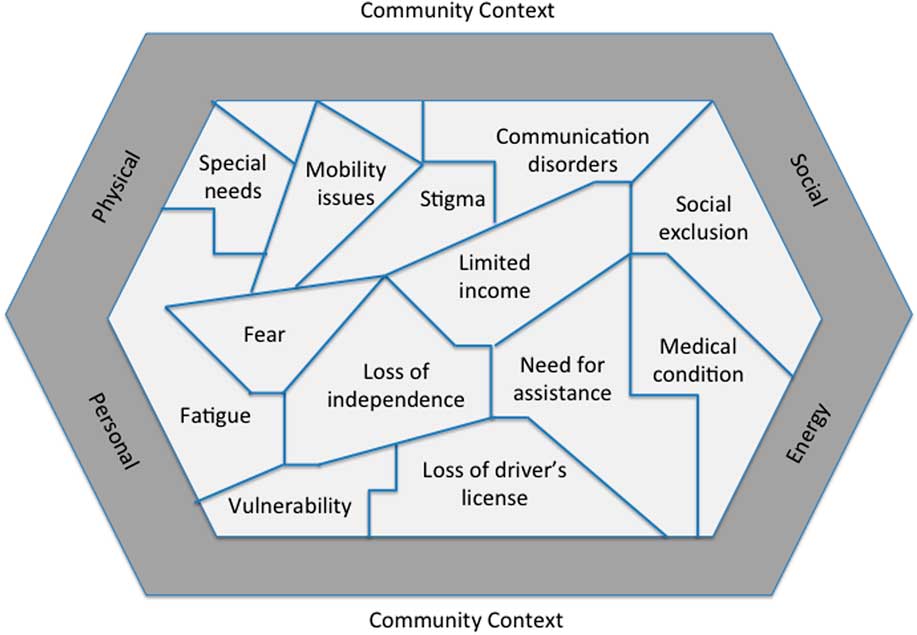
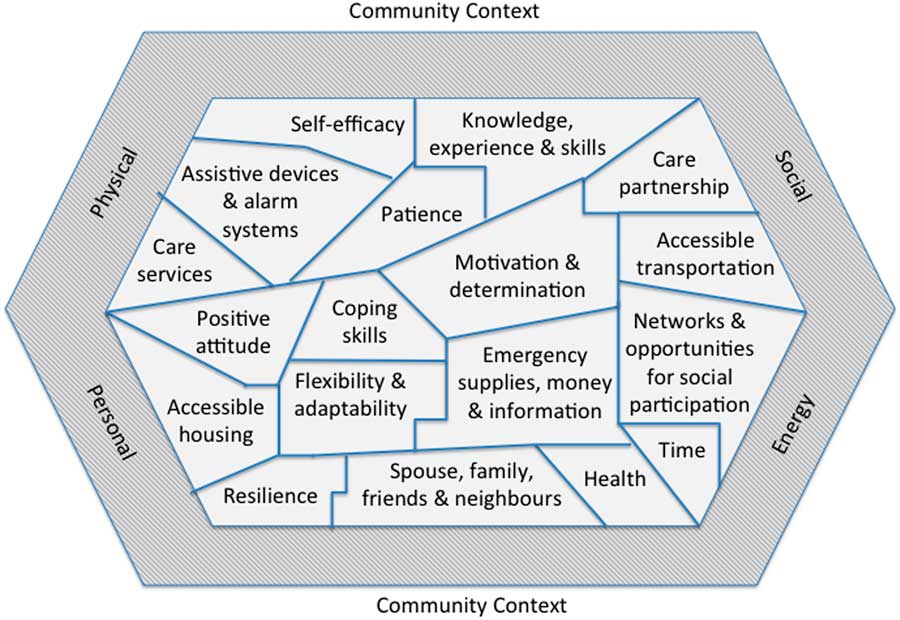
Discourse around vulnerability is oriented around deficits. McKnight and KretzmannReference McKnight and Kretzmann 12 explain how deficit-oriented thinking is often presented as a whole truth, when it is only part of the picture. In contrast, a capability-oriented lens where discourse focuses on assets shows another truth, one more supportive of resilience. This paradigm aligns well with a person-centered, human capability approach.Reference Alkire and Deneulin 19
McKnight and KretzmannReference McKnight and Kretzmann 12 show an example of a deficit-oriented community map focused on needs and problems. They emphasize how a focus on needs and problems reinforces vulnerability and dependence. In contrast, they also present an asset map for the same community, highlighting instead the attributes that support resilience. The context is the same for each map, but the community profile is completely different, depending on the lens used. In Figures 1 and 2, we provide a similar comparison showing how households living with the impacts of stroke can be viewed through a deficit- or asset-oriented lens. This lens orientation is the essence of asset literacy, which has implications for community resilience.
Deficit-Oriented Household Map.

Asset-Oriented Household Map.

DISCUSSION
Asset literacy is a process and an outcome, influenced by the interaction between a person, their environment, and their behavior. Similar to health literacy, asset literacy is a relational concept influenced not only by personal characteristics, but also by the demands and complexities of social and physical environments and community context. 21 , Reference Nutbeam 22 Through knowledge, skills, motivation, and supportive contexts, people can be empowered to participate in life and maintain autonomy, which in turn supports disaster resilience.Reference O’Sullivan, Kuziemsky, Corneil, Lemyre and Franco 10
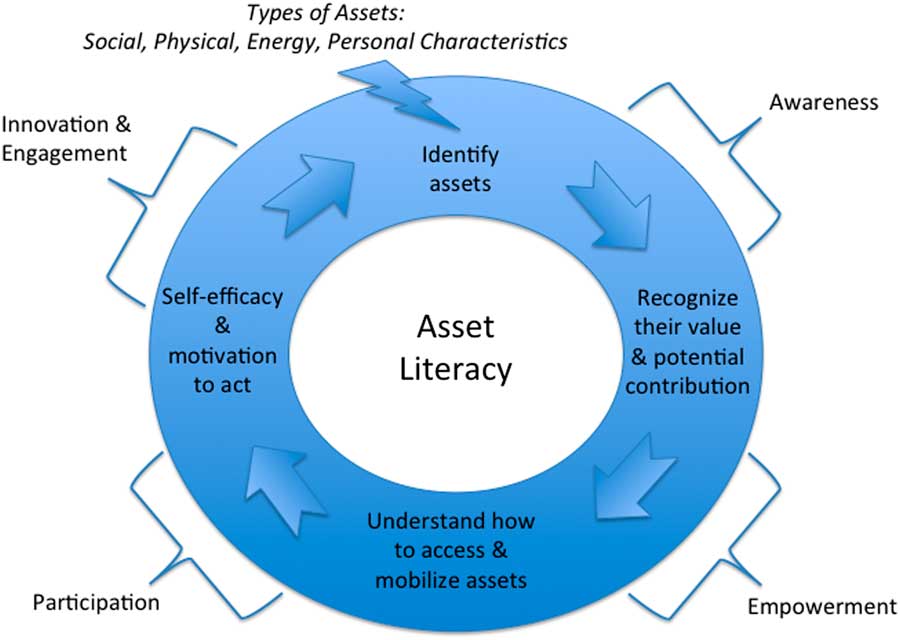
In Figure 3, we present asset literacy as a cyclic, dynamic process. The first component is identification of assets. This is where individuals gain awareness by applying an asset lens to identify the resources or capabilities within and around them. The second component is to recognize the value and potential contribution of the identified assets to support household resilience. Understanding the potential contribution of various assets facilitates empowerment. The third component of asset literacy is developing an understanding of how to access and mobilize different assets when needed. At this point in the asset literacy process, people recognize opportunities for social participation in their community and how to leverage needed resources within the community. The fourth component of asset literacy contributes to a higher level of critical reflection and decision-making power. It is having self-efficacy and motivation to act on the awareness. When people have a strong belief in their capacity to respond or contribute to their community, it influences motivation toward engagement.Reference Levac, Toal-Sullivan and O’Sullivan 7 A community context that promotes engagement and motivation provides the foundation for innovative approaches to support disaster risk reduction and resilience.Reference Edwards 23
Conceptual Model of Asset Literacy for Household Resilience.

UNISDR recommendations 18 emphasize a need for an all-of-society approach to promote disaster resilience, acknowledging the importance of inclusive engagement strategies. This is an important step forward in building resilient communities, but one that depends on developing a culture of household preparedness.Reference Levac, Toal-Sullivan and O’Sullivan 7
Asset-based approaches are used in other fields to emphasize the importance of building on existing strengths within families, organizations, and communities.Reference McKnight and Kretzmann 12 , Reference Israel, Eng, Schulz and Parker 24 The use of asset mapping in disaster management is an initial step in this regard.Reference Lemyre and O’Sullivan 25 However there remains a pervasive emphasis on vulnerabilities and gaps,Reference Hrostowski and Rehner 17 particularly in discourse surrounding people with disabilities, with use of terms such as “vulnerable populations.” Implementation of an all-of-society approach to disaster risk reduction must include a paradigm shift—toward an asset-oriented lens.Reference O’Sullivan, Kuziemsky, Corneil, Lemyre and Franco 10
Several limitations are important to acknowledge. The interview questions were different for each dataset; however, all participants were asked about assets they believed would support household resilience. The assets identified are based on the experiences of 10 households in the Ottawa area. Future studies examining the specific components of asset literacy with survivor/caregiver dyads would be beneficial to build on this preliminary model. In addition, it would be useful to explore the evolution of asset literacy across the stroke recovery trajectory.
CONCLUSION
The World Stroke Organization “1 in 6” campaign 3 provides important context for global disaster risk reduction. One in 6 people will experience a stroke in their lifetime, and stroke impacts whole families. The daily challenges presented by stroke puts families at disproportionate risk during community disasters. It is important to understand how resilience can be supported, and asset literacy contributes to this understanding.Reference O’Sullivan, Kuziemsky, Corneil, Lemyre and Franco 10
In this study, we mapped household assets that support families living with the impacts of stroke. Asset mapping is a first step toward enhancing asset literacy; however, it is necessary to go beyond and recognize the value of different assets and how to access or mobilize them. This is essential for empowerment and participation. Finally, having self-efficacy and motivation to move from awareness to action in household preparedness is ultimately what is needed to build adaptive capacity and support resilience.
An all-of-society approach to disaster risk reduction necessitates the use of an asset lens. Inclusion and participation of all levels of society, including families living with the impacts of stroke, must be based on an understanding of (1) what people are capable of, (2) assets that support their resilience, and (3) types of supports that can fill the gaps and support independence.
Acknowledgments
The authors would like to acknowledge the support of Darene Toal-Sullivan, Jeff Jutai and Hillel Finestone, Bev Donovan, Janet McTaggart, and the participants who took part in the interviews.
Funding
This study was funded by the Ontario Stroke Network and The Drummond Foundation.