INTRODUCTION
Radiocarbon (14C) is a naturally occurring radioisotope continuously produced in the atmosphere by the interaction between cosmic ray neutrons and nitrogen. It is also produced mostly as a by-product in nuclear reactor systems and reprocessing plants. 14C has a half-life of about 5730 yr and its residence time in the atmosphere and hydrosphere is long enough in order to be transferred and distributed worldwide. Its radiological impact is therefore not limited to the region of release, and it may be distributed globally in a nearly uniform manner (IAEA 2004).
The terrestrial biological components which are not affected by the local anthropogenic activities were of the order of 0.250 Bq/g of carbon (Kotzer and Watson Reference Kotzer and Watson1999; Hua et al. Reference Hua, Barbetti and Rakowski2013) in tree rings for radiocarbon produced between 1990 and 1997, whereas for more recent samples, from 2009, the value of 14C specific activities were around 0.238 Bq/g of carbon (IRSN 2018), indicating that those recent specific activities values, similar to CO2-in-air values (Wu Reference Wu2017), tend to reach the pre-nuclear testing levels (0.226 Bq/g of carbon).
The main chemical forms of 14C released from nuclear installations are 14CO2 and hydrocarbons. The released 14CO2 is more critical because it is easily incorporated into the carbon cycle in the natural environment and consequently, and can enter the food chain, causing an increased dose to the population through ingestion of organic 14C. Therefore, the amount of 14C assimilated in vegetation should be precisely evaluated in the dose assessment around nuclear sites (Galeriu et al. Reference Galeriu, Melintescu, Beresford, Crout, Peterson and Takeda2007; Ota et al. Reference Ota, Nagai and Koarashi2012). The radiation dose from 14C is attributed almost entirely (99%) to the 14C concentration in foodstuffs, with only a minor amount (1%) entering the human body via inhalation (UNSCEAR 2000). In terms of the collective radiation dose, 14C is the most significant radionuclide released by nuclear power plants (Saxen and Hanste Reference Saxen, Hanste, Eikenberg, Jäggi, Beer and Baehrle2009). Therefore, the determination of 14C in foodstuffs is important, especially in areas where levels can be elevated, due to the influence of nuclear activities.
In Romania, the Cernavodă Nuclear Power Plant (NPP) operates two CANDU (Canada Deuterium Uranium) type reactors, and it is unique in Europe. The reactors are pressurized heavy water reactors (PHWR) fueled with natural uranium and moderated and cooled with heavy water. Cernavodă NPP can produce increased 14C levels in the environment, thus requiring continuous 14C monitoring in the biosphere.
Variations of 14C activity concentrations have been registered worldwide based on various analytical methods. Radiocarbon measurements of foodstuff items or other vegetable matrices (like cellulose or leaves from trees, grass, etc.), usually involved the use of liquid scintillation counting (LSC). The first step in sample preparation was combustion, using different types of devices: combustion bombs, catalytic ovens or oxidizers. The combustion was followed by CO2 purification, as a separate step in preparation, and direct absorption in an amine (obtaining a carbamate), or by benzene synthesis from the purified CO2. Both obtained compounds, carbamate and benzene, were measured using LSC, in order to determine 14C specific activity (Burchuladze et al. Reference Burchuladze, Pagava, Povinec, Togonidze and Usačev1980; Moore et al. Reference Moore, Noakes, Spaulding, Noakes, Schönhofer and Polach1993; Kotzer and Watson Reference Kotzer and Watson1999; Singleton et al. Reference Singleton, Sanchez and Woods2002; Horvatinčić et al. Reference Horvatinčić, Barešic, Krajcar Bronić and Obelić2004; Molnár et al. Reference Molnár, Nagy, Svingor, Svetlik, Chalupnik, Schönhofer and Noakes2006; Varlam et al Reference Varlam, Stefanescu, Varlam, Popescu and Faurescu2007; Krajcar Bronić et al. Reference Krajcar Bronić, Horvatinčić, Baresić and Obelić2009; Saxen and Hanste Reference Saxen, Hanste, Eikenberg, Jäggi, Beer and Baehrle2009). Comparing the CO2 direct absorption method with benzene synthesis method, some advantages and disadvantages for each of them can be highlighted. The CO2 direct absorption method has the advantage of less working time and less equipment for the preparation stage, it is accurate enough to be used for environmental monitoring and fast enough for determination of increased 14C levels, in case of nuclear accidents. The benzene synthesis method has the advantage of lower background and higher efficiency, it is used for studies of high precision radiocarbon variations in the atmosphere and in tree rings, for radiocarbon dating of archeological and geological samples or other samples that require high precision (Horvatinčić et al. Reference Horvatinčić, Barešic, Krajcar Bronić and Obelić2004).
Considering all these aspects, in this paper we present a quick method of 14C analysis in environmental samples. The method is based on the combustion of environmental samples in a Parr bomb, and bubbling of the produced gas mixture through two homemade scintillation cocktails. The step of CO2 purification was made in the same time as bubbling by introducing two traps (the first with chromic acid solution and the second with silver nitrate solution), in order to remove impurities, present in the combustion gas mixture that might interfere with the CO2 absorption process or in the LSC. In order to evaluate the reproducibility of the method for the two scintillation cocktails used, the second set of similar experiments was carried out in parallel with the described experiments. In these experiments, a separate CO2 purification step was introduced by absorbing CO2 from the combustion gas mixture into a sodium hydroxide aqueous solution and its release by acidification, when pure CO2 is obtained.
MATERIALS AND METHODS
Sample
The sample used in the experiments was chosen to be similar to some vegetable environmental samples, considering that the method was mostly developed for environmental monitoring. The chosen sample was cellulose from IAEA (Vienna, Austria) and it can be used as a quality control material, IAEA-C3 (IAEA 2014). The IAEA recommended value for the 14C activity of this material is 129.41 ± 0.06 pMC (0.2925 ± 0.0001 Bq/g of carbon). The IAEA recommendation is also to use cellulose as a quality control material, since the preparation steps carried out before are similar to the steps for other types of biological or vegetable samples.
Method
The direct absorption method uses the 14CO2 resulted from either acidification of carbonates (shells, carbonates from water, etc.) or combustion of different types of organic samples (foodstuffs, tree leaves or grass, cellulose, nuclear organic wastes, etc.) (Kotzer and Watson Reference Kotzer and Watson1999; Molnár et al. Reference Molnár, Nagy, Svingor, Svetlik, Chalupnik, Schönhofer and Noakes2006; Krajcar Bronić et al. Reference Krajcar Bronić, Horvatinčić, Baresić and Obelić2009; Saxen and Hanste Reference Saxen, Hanste, Eikenberg, Jäggi, Beer and Baehrle2009). Scintillation cocktails usually used contain 2-methoxyethil amine (MEA), also known under commercial name of Optisorb 1 (Singleton et al. Reference Singleton, Sanchez and Woods2002; Vagner et al. Reference Vagner, Varlam, Faurescu, Faurescu and Bucura2017) or 3-methoxyprolyl amine (MPA), also known under commercial names of Carbo-Sorb E® (PerkinElmer), CarbonTrap (Meridian Biotechnologies) or Carbamate-1 (National Diagnostics) (Horvatinčić et al. Reference Horvatinčić, Barešic, Krajcar Bronić and Obelić2004; Saxen and Hanste Reference Saxen, Hanste, Eikenberg, Jäggi, Beer and Baehrle2009; Canducci et al. Reference Canducci, Bartolomei, Magnani, Rizzo, Piccoli, Tositti and Esposito2013). In our experiments we used two home-made scintillation cocktails containing mixtures of one of the two amines mentioned above (2-methoxyethyl amine for synthesis from Merck, Germany, and 3-methoxyprolyl amine—CarbonTrap from Meridian Biotechnologies, UK) as CO2 absorbents, toluene, methanol, and scintillation reagents.
The direct absorption method applied in our experiments involved the combustion of the sample in a Parr bomb type 1121. This type of bomb was chosen because of its large quantity of the sample used, being a versatile device used also for determination of organically bound tritium (OBT) in environmental monitoring (Vagner et al. Reference Vagner, Varlam, Faurescu and Faurescu2015). The quantity of sample used in combustion was of 15 g, and from each combustion we carried out four experiments. Two of them are based on the absorption of the CO2 in the two scintillation cocktails, directly from the combustion gas mixture and the other two are based on the bubbling of the remaining combustion gas mixture in sodium hydroxide (NaOH) aqueous solution 5M, followed by acidification with hydrochloric acid (HCl) aqueous solution 16% and absorption of the released CO2 in the two scintillation cocktails. The detailed working procedure is described in the following.
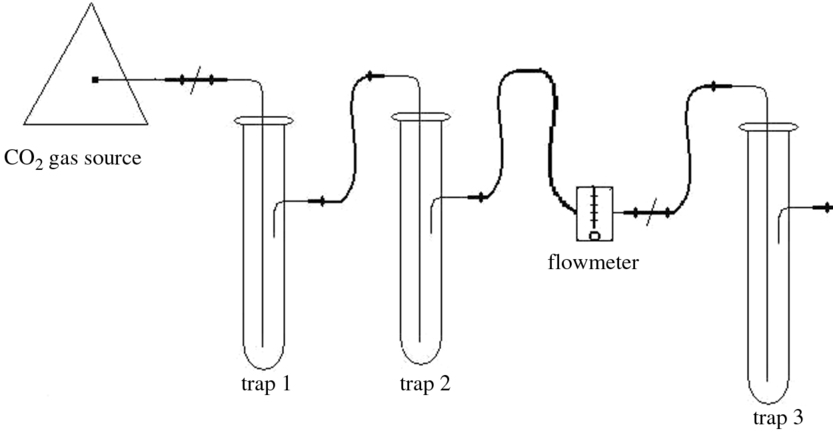
The first set of two experiments, each of them with five replicates, are based on the bubbling of the resulted combustion gas mixture, containing CO2 and O2 directly through the scintillation cocktails. The combustion of vegetable or biological samples using the Parr bomb produces a gaseous mixture which can contain, besides CO2 and unreacted O2, sulfur oxides SOx, nitrogen oxides NOx, and other impurities, depending on the elemental composition of the combusted sample (Verrezen et al. Reference Verrezen, Loots and Hurtgen2008). After combustion of the sample, using O2 under pressure (17 atm), the bomb was cooled down in cold water for an hour under continuous circulation of the cold water, in order to condensate all the resulted water vapours on the bomb vessel. After cooling down, the bomb filled with combustion gas mixture was connected, using a pressure reducer to the purification system, connected in-line with the bubbling system of the CO2 into the scintillation cocktail (Figure 1). The purification system consisted of two bubblers filled with aqueous solutions of chromic acid (H2CrO4)—trap 1, and silver nitrate (AgNO3)—trap 2, respectively. The role of the aqueous solution reagents used for combustion mixture purification is to oxidize (H2CrO4) and to detain (AgNO3) the previously mentioned impurities, in our case as traces, due to the sample used for combustion, containing only cellulose (carbon, hydrogen and oxygen). A flowmeter was coupled also in-line with the system and the bubbling was conducted at a flow rate of 0.2 L/min. The combustion gas mixture was bubbled for 15 min. The amount of CO2 absorbed was determined by the difference between the initial and the final scintillation cocktail masses from trap 3.
Preparation line for CO2 absorption method, including purification system: CO2 gas source includes Parr bomb—pressure reducer system (for the first set of experiments) or the gas bag—bubbling pump system (for the second set of experiments).

The second set of two experiments, each of them with five replicates, are based on the bubbling of the resulted combustion gas mixture in the NaOH solution and acidification. After acidification and collection of pure CO2 in a gas bag, this was connected to an installation (see Figure 1) using the same purification and bubbling experimental setup as the first set of experiments, the only difference being that the CO2 is bubbled from the gas bag using a pump and the purification traps (trap 1 and trap 2) contain both aqueous solution of AgNO3 to detain the traces of acid vapours that might be in the bubbled CO2. For these experiments, we kept the same bubbling flow rate, of about 0.2 L/min, and the same bubbling time (15 min) and the amount of CO2 was established similar to the first set of experiments.
For all experiments 20 mL of scintillation cocktail was used for each replicate prepared for measurement, and for each standard and background. The measuring vials used were 20 mL low-potassium glass vials (PerkinElmer). The background samples were prepared from combustion of fossil diesel, for the experiments carried out by bubbling of the combustion gas mixture and from marble by acidification, for the experiments carried out by bubbling of the pure CO2 using the corresponding scintillation cocktail. The standard samples were prepared from an identical sample of CO2 as the one used for background, in which an internal standard (PerkinElmer capsule with known 14C activity of 98,300 dpm ± 0.97%, reference date September 8, 2016) was dissolved. For each set of experiments and for each of the amine used in the scintillation cocktail (MEA and MPA), a corresponding standard and a background was prepared, following the same preparation procedure as in the corresponding set of experiments.
Sample Measurement
The samples were measured with a Quantulus 1220™ (Wallac) and the counting time for each sample and blank was 1000 min, and 100 min for the standards, divided in 10 cycles. Due to the fact that the method is intended for environmental monitoring where uncontaminated samples have no more than 0.250 Bq/g of carbon (IAEA 2010), we chose to use the internal standard method to establish counting efficiency. It was around 59% for cocktail scintillator containing MEA and 57% for cocktail scintillator containing MPA, at the best figures of merit. The quench of prepared samples, blank and standards were checked for each batch, using the spectral quench parameter of the external standard, SQP(E). The uncertainty due to background variation and radioactive decay was reported at 1 σ.
RESULTS AND DISCUSSIONS
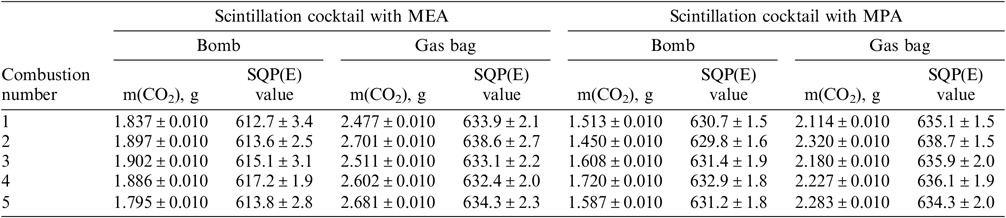
The masses of CO2 retained in each of the two cocktails for each of the two experimental sets can be seen in Table 1, together with the corresponding values of the spectral quench parameter of the external standard SQP(E) determined by the 152Eu external source in the liquid scintillation counting using Quantulus 1220 (Wallac).
Mass of CO2 absorbed in scintillation cocktails containing MEA and MPA, both from the bomb (combustion gas mixture) and from the gas bag (pure CO2), and the corresponding SQP(E) values.

The mass of captured CO2 directly from the combustion gas mixture is lower than the one captured from the bubbling of pure CO2 for both scintillation cocktails, because during bubbling of the combustion gas mixture, the CO2 capture is impeded by the existence of other gasses like the excess of O2 used in combustion. The use of scintillation cocktail with MEA, also conducted to higher masses of captured CO2 for both combustion gas mixture and pure CO2 bubbling. The values of the spectral quench parameter SQP(E) registered were within the range of ± 1%, specific for each of the scintillation cocktails used and for each set of experiments. The lowest SQP(E) values were registered for samples prepared with scintillation cocktail containing MEA where bubbling of the combustion gas mixture was used.
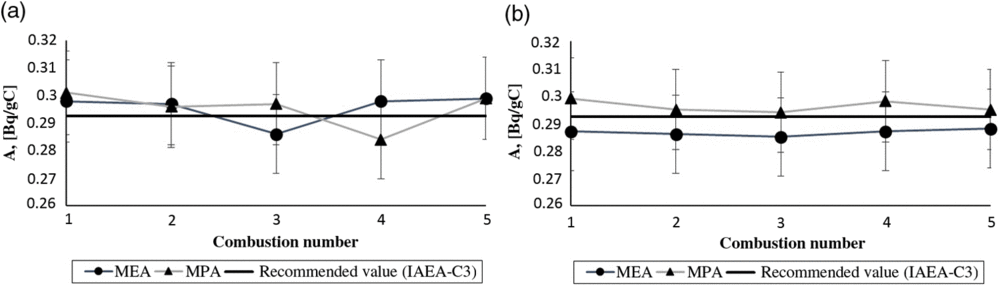
The 14C activity measured in the studied sample and the values obtained for the two scintillation cocktails and for each set of experiments are given in Figure 2.
14C specific activity values obtained for IAEA-C3 Cellulose (quality control material) combustion, following the two sets of experiments: (a) bubbling of the combustion gas mixture directly through scintillation cocktails; (b) bubbling of the pure CO2 in scintillation cocktails.

For the experiments based on the bubbling of the combustion gas mixture directly through the scintillation cocktails with MEA and MPA (Figure 2a), the measured 14C activity has a mean value of 0.296 ± 0.012 Bq/g of carbon and 0.295 ± 0.014 Bq/g of carbon, respectively.
As a result of sample preparation using the method described in the second set of experiments, the average values of the 14C specific activity registered for the cocktail with MEA and MPA were 0.287 ± 0.012 Bq/g of carbon and 0.296 ± 0.012 Bq/g of carbon, respectively.
The results obtained for 14C specific activity of the studied material were evaluated using a zeta-score test, using the recommended value of 14C activity of the sample as assigned value. The mean values of zeta-score for the first set of experiments and for the two types of scintillation cocktails were 0.26 and 0.21 for cocktail containing MEA and MPA, respectively. For the second set of experiments and the two scintillation cocktails the mean values of zeta-score were –0.49 and 0.31, respectively. The individual values of zeta-score for both sets of experiments were between –0.61 and 0.60. All the zeta-score values, both individual and mean values, can be considered “in agreement” (Harms and Gilligan Reference Harms and Gilligan2009) for the application described above, although the sample used for this study was a quality control material, not a certified reference material.
The values for the counting efficiencies were between 57.8% and 59.4%. Comparing the two preparation methods, the method involving direct bubbling from the Parr bomb is less time-consuming, being more suitable, especially for environmental monitoring. Regarding the two amines used for scintillation cocktail preparation, MEA is more volatile and for elevated flow rates, the risk of scintillation cocktail losses and errors in 14C measurements can appear. The MEA is also much more expensive than MPA.
CONCLUSIONS
The preparation methods applied gave good reproducible values of 14C specific activity for both trapping agents used in scintillation cocktail composition. The method involving bubbling of pure CO2 conducted to higher values for the mass of absorbed CO2 compared to the bubbling of the combustion gas mixture directly from the Parr bomb. The cocktail scintillation mixture containing MPA can be considered more stable to bubbling of combustion gas mixture or CO2 considering that MEA is more volatile than MPA and can conduct to losses of some scintillation cocktail reflected in the overestimation of the CO2 mass and also in the underestimation of the 14C specific activity.
All radiocarbon measurement values obtained were around the IAEA recommended value, the applied preparation steps involving both direct bubbling of the combustion gas mixture and bubbling of the pure CO2, being reproducible and suitable for cellulosic materials. The 14C specific activity values obtained using the cocktail with MEA had an average of 0.296 ± 0.012 Bq/g of carbon for bubbling of the combustion mixture directly from the combustion bomb and of 0.287 ± 0.010 Bq/g of carbon, for bubbling of pure CO2 after absorption in NaOH solution, acidification and collection in a gas bag. The 14C specific activity values obtained using the cocktail with MPA had an average of 0.295 ± 0.014 Bq/g of carbon for bubbling of the combustion mixture directly from the bomb and of 0.296 ± 0.010 Bq/g of carbon, for bubbling pure CO2 from the gas bag.
Due to the fact that the quality control material recommended by IAEA (IAEA-C3 Cellulose) and used in our experiments is similar with the most of the vegetable materials, the preparation methods described may be considered as appropriate for monitoring of 14C from environment, especially the one less time-consuming, involving direct bubbling of the combustion gas mixture from the combustion Parr bomb.
ACKNOWLEDGMENTS
This paper was prepared in connection with the work done for project PN 18 12 03 04, part of the Core Program ICSI 4E supported by the Romanian Ministry of Research and Innovation, and monitoring program of Tritium Removal facility PESTD. We would like to thank the two anonymous reviewers for their helpful comments and suggestions in reviewing this manuscript.