

Introduction
The ‘Endangered’ Green Peafowl Pavo muticus, a South-east Asian dry forest specialist (Brickle Reference Brickle2002) and a good indicator of the habitat status (Savini et al. Reference Savini, Namkhan and Sukumal2021), has seen its historical range decline by more than 80% over the past century (BirdLife International 2018) due primarily to the extraction of commercially valuable timber species such as teak (Sodhi et al. Reference Sodhi, Koh, Brook and Ng2004) and extensive agricultural expansion (Ratnam et al. Reference Ratnam, Tomlinson, Rasquinha and Sankaran2016). Most of the remaining suitable habitats over the species’ range, recently grouped into six strongholds, large areas of suitable habitats with a high probability of Green Peafowl occurrence (Sukumal et al. Reference Sukumal, Dowell and Savini2020a), remain under threat of habitat degradation (logging, excessive free-range grazing, and extended bushfires) and persistently high hunting pressure (Sukumal et al. Reference Sukumal, McGowan and Savini2015).
The species’ population status has now been estimated in five of those strongholds: eastern Cambodia/south-central Vietnam (Sukumal et al. Reference Sukumal, McGowan and Savini2015, Nuttall et al. Reference Nuttall, Nut, Ung and O’Kelly2016, Tak et al. Reference Tak, Crouthers, Sukumal, Chhin and Savini2022), north-eastern Cambodia (Loveridge et al. Reference Loveridge, Kidney, Ty, Eames, Borchers, Kidney and Borchers2017), western Thailand (Sukumal et al. Reference Sukumal, Dowell and Savini2017), northern Thailand (Saridnirun et al. Reference Saridnirun, Sukumal, Grainger and Savini2021), and the Bago Yoma range in Myanmar (Lay Win et al. in Reference Win, Sukumal, Shwe and Savinireview). Due to a lack of data on the species’ presence and status, the sixth stronghold, located along the Salawin River and consisting of dry forest patches between the north-west of Thailand and the states of Kayah and Kayin in Myanmar, was classified as an “expected stronghold” based on the predicted high probability of its occurrence (Sukumal et al. Reference Sukumal, Dowell and Savini2020a). On the Thai side, the dry forest patches are covered by five protected areas considered highly suitable for the species, despite the history of human encroachment and logging concessions, especially before their official designation (Delang Reference Delang2005). On the Myanmar side, a large amount of dry forest along the border falls partly under eight reserve forests, three wildlife sanctuaries and 34 community forests protected at the state level under the Salawin Peace Park initiative (Paul Reference Paul2018). The rest of the area is covered by small-scale agriculture and villages.
Therefore, the aim of this study was to determine the current status of the sixth stronghold. We started by estimating the Green Peafowl’s status in all five protected areas on the Thai side of the Salawin River using line transect surveys and distance sampling, proven to be suitable for the species (Sukumal et al. Reference Sukumal, McGowan and Savini2015). Second, using remote-sensing data, we measured the extent of the remaining suitable habitat in light of the encroachment activities going on within protected areas. Third, using available data from Spatial Monitoring and Report Tool (SMART, see Methods), collected systematically by park rangers during patrols, for each of the protected areas investigated, we assessed the spatial distribution of threats to the species.
Methods
Study area
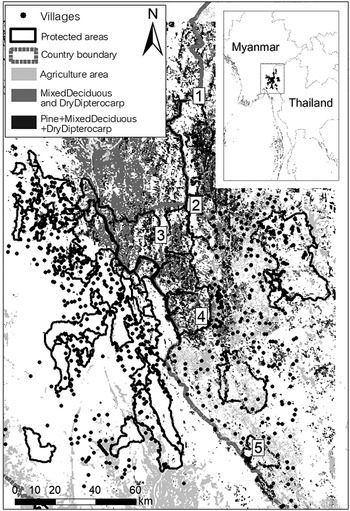
Overall, the study focused on dry forest habitats found along the Salawin River (also spelled as Salween River) in north-west Thailand and neighbouring Myanmar. The survey of Green Peafowl was conducted in five protected areas in north-western Thailand: 1) DoiWiangLa Wildlife Sanctuary (WS) (18°54’ N 97°54’ E) covering a total area of 467 km2, 2) MaeYuamFangKwa WS (18°23’ N 97°54’ E), 292 km2, 3) Salawin WS (18°18’ N 97°51’ E), 875 km2, 4) Salawin National Park (NP) (18°10’ N 97°44’ E), 721 km2, and 5) MaeMoei NP (17°28’ N 98°04’ E), 1, 142 km2, with an altitudinal range of 200 to 1,000 m. The area is covered by dry dipterocarp forest and mixed deciduous forest, which includes teak and isolated patches of mostly evergreen forest at a higher elevation (Figure 1). Villages are found in relatively high numbers both around and within the protected areas (Figure 1). The area has a dry season from November to April and a wet season from May to October.
The study site, focusing on dry forests both inside and outside protected areas. The transect survey was conducted inside and around five protected areas in the north-west of Thailand, consisting of 1) DoiWiangLa Wildlife Sanctuary (WS), 2) MaeYuamFangKwa WS, 3) Salawin WS, 4) Salawin National Park (NP) and 5) MaeMoei NP.

Line transects surveys and density estimation
Green Peafowl density was estimated using 19 line transects set along accessible trails and roads (forest interior) in all five protected areas. Because of the difficulty in accessing the large study area, we focused on areas where Green Peafowl had been reported both by rangers and villagers in the last five years. At each selected site, we set 2–3 transects 500 m apart (from the end of one and the beginning of the other). We mainly focused on the density estimate for the whole study area but also provided stratified density estimates of each transect, bearing in mind the possibility of bias as some of the detections may originate from overlapping areas between the transects. Transects were monitored during the breeding season (January–March 2021) when the birds frequently call. Only vocal detections were recorded (i.e. not visual detections) within 1 km on both sides of the transects. Of the 19 transects, seven were set in DoiWiangLa WS, three in MaeYuamFangKwa WS, two in Salawin WS, four in Salawin NP, and three in MaeMoei NP. Each transect was 2 km in length with the exception of one transect of 1.5 km in MaeMoei NP and another 3 km transect in DoiWiangLa WS. Each transect was walked by different observers during the daily peak calling periods, 06h30–08h30 in the morning and 16h45–18h45 in the evening, for a total of six times per transect (twice a day for three consecutive days) (Sukumal et al. Reference Sukumal, McGowan and Savini2015, 2017). Observers walked the transects together at the beginning of the survey in order to standardize their data collection, in particular to estimate the distance to calling birds and minimize detection errors between observers. The distance to each calling bird was assigned to 100-m distance intervals, or 50-m distance intervals for closer records. Double counting of individual calling birds within the same location was corrected by removing calls from the same location during one survey to estimate the species’ occurrence.
Density was estimated using DISTANCE version 6.0 by pooling the detections along all transects in each protected area. The data were controlled for outliers, which were not found, before conducting the analysis. All key functions, namely uniform, half-normal, hazard rate, and negative exponential functions, with series adjustments, cosine, simple polynomial, and hermite polynomial, were examined to select the best detection function and model with the lowest AIC following Buckland et al. (Reference Buckland, Anderson, Burnham, Laake, Borchers and Thomas2001).
Defining suitable habitat for Green Peafowl and areas with high predicted occupancy
We predicted the probability of Green Peafowl occurrence over our study site by using species distribution modelling techniques, which associate environmental variables with known species’ occurrence records to identify environmental conditions that are suitable for the species, enabling the identification of suitable environments in space and estimation of the species’ probability of occurrence across a study region. Species distribution modelling requires two types of data: 1) biological data that describe the known distribution or occurrence localities of a species, mostly obtained from occurrence records or field surveys, and 2) environmental data consisting of either continuous or categorical data within a certain range (Pearson Reference Pearson2007). We gathered location records of Green Peafowl from both villagers and patrolling rangers, combined them with data from the line transect survey using the ArcGIS 10.3.1 program (Esri, Redlands, USA), and plotted the distance and bearing of calling birds along the transects. In total, 19 locations were recorded, six from villagers, four from patrolling rangers and nine from our line transects. For each location point, we created a 500-m radius circular plot based on an average of the effective strip width (ESW) of detection along the transects (see Table 1), obtained from density estimation using the DISTANCE 6.0 program (Thomas et al. Reference Thomas, Buckland, Rexstad, Laake, Strindberg, Hedley, Bishop, Marques and Burnham2010). When two circular plots overlapped by >5%, we selected only the location of the latest record to represent the area. We finally derived 13 locations for habitat assessment and probability of occurrence modelling over our study site. We constructed the probability of occurrence models using a generalized linear model (GLM) with logit link and binomial error distribution to study the relationship between a given variable and the probability of occurrence, using the presence/absence of Green Peafowl as the response variable. Presence data were derived from 13 locations of Green Peafowl recording, while absence data were derived from random locations along the transects, at least 1 km apart, where we did not detect any Green Peafowl during the survey. We created 500-m radius circular plots around the presence and absence locations and determined the habitat types, altitude, distance from the center to the village, and distance from the center to the country’s border, which were used as the predictor environmental variables. Habitat types were obtained from Climate Change Land Cover (CCI-LC) year 2000, downloaded from http://maps.elie.ucl.ac.be/CCI/viewer/download.php. We started with 38 original habitat types; firstly we eliminated unsuitable habitats such as bare areas, urban areas, water bodies, and secondly we reclassified and renamed the remaining 19 habitat types into 14 major habitat types (Table S1 in the online supplementary material). We combined the habitat type map with the land use type map 2018, obtained from Land Development Department, Thailand (available at http://dinonline.ldd.go.th/Default.aspx), to update the remaining 14 habitat types. All predictor variables were tested for multicollinearity using a pairwise-correlation matrix (Spearman rho, p). All the variables had a correlation coefficient of <0.6 (Zuur et al. Reference Zuur, Ieno and Elphick2010) and were included in the model. Each predictor variable was standardized by dividing the value by the standard deviation in order to transform the data to the same scale. The best GLM model was selected based on the lowest Akaike’s Information Criterion (AIC) value (Burnham and Anderson Reference Burnham and Anderson1998). A confidence interval of 85% was used to consider variables influencing the probability of peafowl occurrence. The analysis was conducted using program R (R Development Core Team 2014).
Density estimates for Green Peafowl in the north-eastern part of DoiWiangLa Wildlife Sanctuary during the breeding season of February–March 2021.

Spatial distribution of threats
Threats to Green Peafowl were defined based on data entered in the Spatial Monitoring and Reporting Tool (SMART) available for the five protected areas. SMART is an integrated conservation management system using data collected by rangers while patrolling to inform management plans in each protected area (Cronin et al. Reference Cronin, Dancer, Long, Lynam, Muntifering, Palmer, Bergl, Wich and Piel2021). Data were collected at least twice a month on defined routes covering over 90% of the protected area by rangers on patrol during 2019–2021 and other records of threats along patrolling routes within the protected areas between October 2013 and January 2017. We categorized threats to Green Peafowl into three categories: 1) Activities linked with hunting, which included direct hunting records and presence of camping sites; 2) habitat disturbance, which included free-ranging cattle, logging, and forest fire; and 3) presence of humans, which included data on non-timber forest product (NTFP) collection, presence of human tracks, garbage dumps, and fishing.
Results
Density estimation
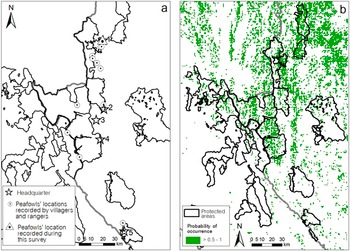
A total of 49 detections were recorded after walking 19 transects 118 times, totalling 241 km (See triangle in Figure 2a). The density estimate for the whole area was of 0.27 calling males/km2 (CI = 0.07–1.01). However, we detected Green Peafowl only along the two transects in DoiWiangLa WS, namely one 3-km transect denoted by transect 1 and one 2-km transect hereafter denoted by transect 2. To meet the recommended minimum number of 40 detections for reliable density estimation (Buckland et al. Reference Buckland, Anderson, Burnham, Laake, Borchers and Thomas2001), both transects were walked eight times rather than six times as we did for other transects. From the 49 independent calling birds detected after eliminating double counts, 18 detections were found on transect 1 and 31 on transect 2. The overall density estimated for this protected area was 1.76 calling males/km2 (CI = 0.17–17.76), while the stratified density estimates for transects 1 and 2 were 0.71 calling males/km2 (CI = 0.51–0.98) and 2.27 calling males/km2 (CI = 1.94–2.64), respectively (Table 1).
a) Recorded locations of Green Peafowl during the survey (triangle with dot as the center), and outside the survey period by villagers and rangers; b) predicted probability of occurrence of Green Peafowl from modelling, based on line transect surveys and detection records of Green Peafowl in the study site.

Since January 2019, a total of 10 locations were recorded outside the survey period based on reliable reports from villagers (photos were provided) and rangers (See circles in Figure 2a). Eight detections were within protected areas, while two were in the agricultural landscape surrounding them.
Remaining dry forest habitat over study site
Over the range of our study site, the remaining dry forests covered an area of 9,154 km2 and comprised mixed deciduous and dry dipterocarp forests, 5,005 km2, and pine with mixed deciduous and dry dipterocarp forests, 4,149 km2. Only 1,951 km2 or 39% of the dry forests over our study site were in protected areas both in Thailand and Myanmar (Figure 1).
Suitable habitat and probability of occurrence
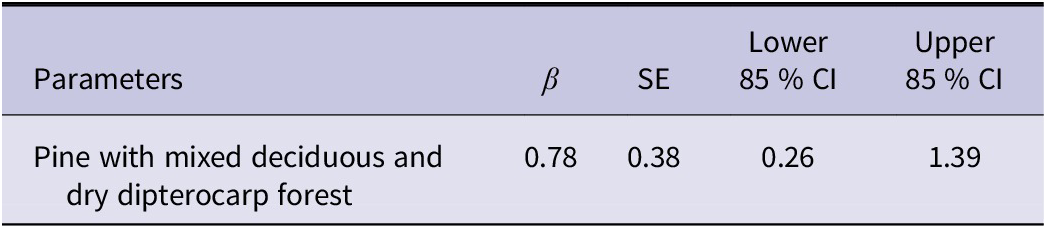
The best model (lowest AIC) of suitable habitat had only one variable of dry forest containing pine, mixed deciduous (including teak) and dry dipterocarp forests. The probability of occurrence was higher when the area of pine, mixed deciduous and dry dipterocarp forests increased (Table 2).
Parameters that influence the probability of occurrence model based on line transect surveys and detection records of Green Peafowl in the study site.

The predicted suitable habitat (probability of occurrence >0.5) for Green Peafowl over our study site both in Thailand and Myanmar (17°09’–19°23’ N, 96°54’–98°28’ E) was 5,693 km2 in size, and just 22% of this area (1,275 km2) fell inside protected areas (Figure 2b).
Threats to Green Peafowl
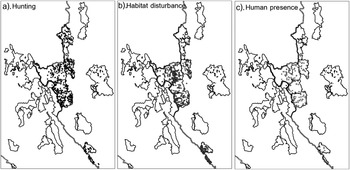
The threat data revealed an extensive distribution of threats to the species over the five protected areas (Figure 3a, b, c); habitat disturbance presented the highest number of threats with 795 records, followed by 649 records of hunting and 191 records of human presence.
Occurrence of different disturbance types across all five protected areas: a) direct hunting records and presence of camping sites; b) free-ranging cattle, logging, and forest fire; and c) presence of non-timber forest product (NTFP) collection, presence of human tracks, garbage dumps, and fishing.

Discussion
Overall, the detections of Green Peafowl within the five protected areas were low resulting in a low estimated density of 0.27 calling males/km2. This density estimate mirrors that of YokDon National Park in south-central Vietnam (0.25 calling males/km2), considered heavily disturbed primarily by extensive fire and high cattle grazing (Sukumal et al. Reference Sukumal, McGowan and Savini2015). Although some villagers and rangers reported encountering the birds nearby during the survey, we were unable to detect any calling males along most of the transects, except for a cluster found in DoiWiangLa WS, most likely due to a combination of a low population number and high disturbance from human settlements (Swaddle et al. Reference Swaddle, Francis, Barber, Cooper, Kyba, Dominoni, Shannon, Aschehoug, Goodwin, Kawahara and Luther2015). The Bago Yoma range in central Myanmar had a density estimate of 0.8 calling males/km2 in a dry forest mixed with teak (Lay Win et al. in Reference Win, Sukumal, Shwe and Savinireview). DoiWiangLa WS alone had an estimated density of 1.76 calling birds/km2 (ranging from 0.71 to 2.27), within the range (1.13–11.34 calling males/km2) reported for the dry dipterocarp and mixed deciduous forests in the species’ stronghold of HuaiKhaKhaeng Wildlife Sanctuary in western Thailand (Sukumal et al. Reference Sukumal, Dowell and Savini2017). However, the value is much lower than the density of 13.55–19.87 calling males/km2 estimated in a similar mixed habitat structure in the nearby northern Thailand stronghold (Saridnirun et al. Reference Saridnirun, Sukumal, Grainger and Savini2021). The relatively high density recorded in the northern stronghold could be a natural consequence of the relatively few predators found in the area (G. Saridnirun unpubl. data). As predators are also rare in our study site, the low estimated density could be a consequence of ongoing anthropogenic disturbance in the area.
Suitable dry forest habitats along the Salawin River cover an area of 9,154 km2 and comprise all the main habitat types selected by the species over its range, in particular mixed deciduous, including the suitable mixed teak forest, and dry dipterocarp forests (5,005 km2) and pine with mixed deciduous and dry dipterocarp forests (4,149 km2). The size and habitat composition of the area can potentially hold a Green Peafowl population large enough to guarantee its long-term survival (Sukumal et al. Reference Sukumal, Grainger and Savini2020b), notwithstanding the surrounding agricultural landscape (Figure 1). In the northern stronghold, Saridnirun et al. (Reference Saridnirun, Sukumal, Grainger and Savini2021) estimated 15 calling birds/km2 in the dry dipterocarp forest, 19 calling birds/km2 in the mixed deciduous forest, and 24 calling birds/km2 in the mixed pine forest similarly surrounded by agricultural landscapes encroaching on the protected areas (Figure 1). With effective management, farmland in proximity to the natural habitat can hold viable populations, with densities ranging from 1.83 birds/km2 in areas surrounding small forest fragments (Shwe et al. Reference Shwe, Sukumal, Oo, Dowell, Browne and Savini2021) to 14.29 calling males/km2 in areas surrounding large continuous forest patches (Saridnirun et al. Reference Saridnirun, Sukumal, Grainger and Savini2021).
Our results show clearly the extensive distribution of threats such as habitat disturbance, especially by free-ranging cattle, logging, forest fire, and high hunting pressure over the species’ suitable dry forest habitats. Habitat disturbance and hunting pressure can drastically reduce Green Peafowl populations even in highly suitable habitats. In the 1,155 km2 of dry dipterocarp forest in YokDon National Park, southcentral Vietnam, the estimated density was as low as 0.25 calling males/km2 (ranging from 0.03 to 0.7) due to heavy grazing, forest fire, and hunting (Sukumal et al. Reference Sukumal, McGowan and Savini2015).
Importance of the area as a stronghold for Green Peafowl
The area was defined as an “expected stronghold” for Green Peafowl by Sukumal et al. (Reference Sukumal, Dowell and Savini2020a) due to the large extent of suitable habitats and the high predicted probability of occurrence of the species therein, despite a lack of prior confirmation of its presence in the area. The extent of suitable habitat is considered a major limiting factor for the species’ long-term survival. Green Peafowl is currently listed as ‘Endangered’ mainly due to habitat loss as a consequence of agricultural expansion over its range (BirdLife International 2018). Despite the relatively low estimated density, most likely a consequence of ongoing anthropogenic disturbance, the amount of suitable habitat, the main factor limiting the species over its whole range, arguably justifies considering the area along the Salawin River as an area with a good opportunity for the Green Peafowl population recovery. However, as management implementation is urgently needed, we can currently suggest the area be considered as a “potential stronghold pending management implementation.” Green Peafowl have shown high resilience to extreme population decline by recovering to large numbers within a relatively small amount of time once disturbances are limited with management (Sukumal et al. Reference Sukumal, McGowan and Savini2015, 2017). Reducing anthropogenic pressure in the area could therefore guarantee the recovery of the species to the level of >10 calling males/km2, as estimated in well-established populations in similar habitats (Sukumal et al. Reference Sukumal, Dowell and Savini2017; Saridnirun et al. Reference Saridnirun, Sukumal, Grainger and Savini2021), which could guarantee its long-term survival (Sukumal et al. Reference Sukumal, Grainger and Savini2020b). For instance, focusing on the Green Peafowl populations around the headquarters of DoiWiangLa WS (number 1 in Figure 2a) and MaeYuamFangKwa WS (number 2 in Figure 2a) might facilitate its recovery and expansion to other protected areas nearby. The recovery recorded in HuaiKhaKhaeng Wildlife Sanctuary shows the species’ ability to disperse from a source population and repopulate areas up to 15 km away following an increase in the protection level (Simcharoen et al. Reference Simcharoen, Thongnamchaima, Sukmasuong, Thobmongkol, Khoothong, Sunthran, Mheesangpraew, Thongooppagarn and Singkram1995; Sukumal et al. Reference Sukumal, Dowell and Savini2017). Data on sporadic detections during the actual survey showed dispersing juveniles up to 22 km away from the only recorded large population (number 1 in Figure 2a). Moreover, the species can adapt well to agricultural areas around the stronghold if well managed. A density estimate of 1.13–2.63 males/km2 was reported in agricultural fields surrounding a 30-ha forest fragment protected by resident monks (Shwe et al. Reference Shwe, Sukumal, Oo, Dowell, Browne and Savini2021), whereas 14.2 calling males/km2 were estimated in an agricultural landscape surrounding protected areas managed by local communities for ecotourism (Saridnirun et al. Reference Saridnirun, Sukumal, Grainger and Savini2021).
Myanmar and Thai authorities should take concerted actions to protect and manage the transboundary dispersal of the species, which could help its recovery, especially on the Thai side. Sporadic detections, probably, of birds dispersing from the Myanmar side occurred near the border (i.e. the Salawin River) in areas where no resident populations were detected in this survey. Reducing anthropogenic impact in the area by limiting agricultural expansion, cattle grazing, and fire and preventing poaching could increase the population in the mid- to long-term. Unfortunately, data on the species’ presence on the Myanmar side are sparse and only available as fragmented secondary data from general wildlife surveys. Due to recent political instability, specific surveys cannot hold in the near future, and implementation of any management activity may prove challenging.
Acknowledgements
This research was supported by King Mongkut’s University of Technology Thonburi, Thailand and Thailand Science Research and Innovation (TSRI) (Project ID: 42904). Special thanks to Harit Juntong, chief of DoiWiangLa Wildlife Sanctuary, Saksit Butudom, chief of MaeYuamFangKwa WS, Jirasak Tippayawong, chief of Salawin WS, Navy Silasupakul, chief of Salawin National Park, and Veera Korkaew, chief of MaeMoei NP. Jakapan Nglangjai, Somphong Kaikham, Phichai Taweeporn, Chalermchai Ouchan and Piyanat Pintakool assisted in coordinating the logistics during the data collection. Ghan Saridnirun assisted with the fieldwork. O. Nnaemeka edited the English. Peter Garson, Richard Fuller and one anonymous reviewer provided valuable comments on the early draft of the manuscript. The research permit was granted by the Department of National Parks, Wildlife and Plant Conservation.
Supplementary Material
To view supplementary material for this article, please visit https://doi.org/10.1017/S0959270922000338.