Introduction
The present study examined perceptions of old age and aging among recent residents of continuing care retirement communities (CCRCs) and their adult children. The CCRC is defined as a residential community that older adults move to for the remainder of their lives. In Israel, there are 184 CCRCs. These constitute a ratio of 31 units per 1,000 individuals over 65 years of age or 64 units per 1,000 individuals over the age of 75 (Brodsky et al., Reference Brodsky, Shnoor and Be’er2012).
Because the CCRC represents the “last stop” in older adults’ lives, it often includes additional units that provide more intensive levels of care, such as assisted living or skilled nursing units (Shippee, Reference Shippee2009; Shippee, Reference Shippee2012; Ball et al., Reference Ball, Kemp, Hollingsworth and Perkins2014). Nevertheless, the CCRC is intended for older adults who are functionally independent upon entering the CCRC. As such, although the CCRC shares some features with total institutions (Goffman, Reference Goffman1961), such as the fact that all residents live and operate in a single place that is separated from the general community, it still strives to maintain and support its residents’ autonomy (Doron and Lightman, Reference Doron and Lightman2003). As such, the CCRC offers housing and services such as home maintenance and security, health care, meals, and other amenities.
There has been a great deal of interest in perceptions of old age and the aging process in the general population as well as among older adults (Rippon et al., Reference Rippon, Kneale, de Oliveira, Demakakos and Steptoe2013; Ayalon, Reference Ayalon2013b; Gilligan et al., Reference Gilligan, Loui, Mezdo, Patel and Lee2014). In a comprehensive meta-analysis of 232 effect sizes, researchers found that across five categories, including evaluation (e.g. generous, friendly), competence (e.g. intelligent, good memory), attractiveness (pretty, wrinkled), behavior/behavior intention (e.g. willingness to interact with, make phone call), and age stereotypes (e.g. old fashioned, talks about past), older adults were more likely to be rated negatively when compared to younger adults (Kite et al., Reference Kite, Stockdale, Whitley and Johnson2005). Moreover, negative perceptions of old age are common not only among the general population, but also among older adults. A qualitative study has shown that older adults often perceive themselves as a burden and as less competent than younger adults (Minichiello et al., Reference Minichiello, Browne and Kendig2000).
Research in long term care (LTC) has revealed high levels of age-related stigma (Minichiello et al., Reference Minichiello, Browne and Kendig2000; Bodner et al., Reference Bodner, Cohen-Fridel and Yaretzky2011a; Bodner et al., Reference Bodner, Cohen-Fridel and Yaretzky2011b). In assisted living facilities, the stigma is highly present in a variety of activities and structures. Stigma is directed primarily at individuals who experienced disease and disability (Dobbs et al., Reference Dobbs2008) and those who transition from an independent living unit to more intensive levels of care (Shippee, Reference Shippee2009).
To date, only limited attention has been given to the perceptions of old age and the aging process among CCRC residents (Ayalon and Green, Reference Ayalon and Green2012; Shippee, Reference Shippee2012). CCRC residents represent a unique population compared with the general population of community dwelling older adults or with other LTC residents. This is because the CCRC represents a mixture in terms of migration styles (Litwak and Longino, Reference Litwak and Longino1987; Groger and Kinney, Reference Groger and Kinney2007). On the one hand, individuals move to a CCRC in an attempt to improve their access to services and their general lifestyle (Groger and Kinney, Reference Groger and Kinney2007). Hence, the transition can be viewed within the more general framework of an amenity migration (Litwak and Longino, Reference Litwak and Longino1987). On the other hand, the CCRC is seen as the “last stop” and as such, many older adults move in an effort to secure future care needs in the face of an expected decline (Groger and Kinney, Reference Groger and Kinney2007; Ayalon and Green, Reference Ayalon and Green2012).
Assessing perceptions of old age and the aging process is important because these perceptions have shown to predict both morbidity and mortality among older adults (Levy et al., Reference Levy, Hausdorff, Hencke and Wei2000; Levy et al., Reference Levy, Slade, Kunkel and Kasl2002). For instance, a study found that older adults who were exposed to positive age stereotypes improved their gait speed and swing time. No such improvements were observed for those who were exposed to negative age stereotypes (Hausdorff et al., Reference Hausdorff, Levy and Wei1999). Moreover, older adults who held positive self-perceptions of aging had a lower mortality risk (Levy et al., Reference Levy, Slade, Kunkel and Kasl2002), whereas negative age stereotypes served as direct stressors that increased the risk for cardiovascular stress (Levy et al., Reference Levy, Hausdorff, Hencke and Wei2000).
Theoretical framework
According to Nydegger (Reference Nydegger1986), individuals operate within several timetables. A general timetable represents normative milestones associated with age and aging. For instance, individuals are expected to marry or to obtain their first job by a certain age. Specialized timetables are thought to operate within the broader social context. As such, gender, age or economic inequalities are thought to shape time perceptions. Women for instance, might be perceived as aging at an earlier age and as such might strive to conceal blatant signs of aging (Clarke and Griffin, Reference Clarke and Griffin2008). Personalized timetables, on the other hand represent time perceptions that are not necessarily normative or shared by other social groups, but instead are unique to the individual at stake and result from his or her particular characteristics. Finally, interdependent timetables represent the mutual influences and shared perceptions among individuals in an intimate relationship (Nydegger, Reference Nydegger1986). Using this conceptualization, the study examines how older adults and their adult children perceive old age and the aging process and how these perceptions correspond with the general, personalized, specialized and interdependent timetables.
Assessing perceptions of old age and aging among older CCRC residents and their adult children is important, given past research that has stressed the importance of these perceptions in shaping older adults’ aging process (Rivlin and Wiener, Reference Rivlin and Wiener1988) and given the unique characteristics of the CCRC compared with other LTC settings (e.g. the fact that it caters to independent older adults who have full autonomy over the decision to move, yet are likely to eventually transition to other more intense levels of care) (Ayalon and Green, Reference Ayalon and Green2012). This is particularly important because of the increasing popularity of CCRCs in Israel (Mirovsky, Reference Mirovsky2008) as well as worldwide (Kornadt and Rothermund, Reference Kornadt and Rothermund2011; Kotter-Grühn and Hess, Reference Kotter-Grühn and Hess2012).
Methods
Procedure
The study was approved by the Helsinki committee of Maccabi healthcare as well as by the ethics committee of Bar Ilan University. In an attempt to reach maximum variations in terms of CCRCs and older adults’ and adult children characteristics, we approached CCRCs of diverse socio-demographic characteristics (e.g. varied average monthly payment, age range of residents etc.), located in the North, South and Center of the country. Table 1 presents the characteristics of the 11 CCRCs that participated in this study (in an additional site, no dyads were interviewed). We analyzed 70 interviews. This amounts to 34 interviews with adult children [mean age [SD] = 54[9], 65% women] and 36 interviews with older adults [in two cases both partners were interviewed together; mean age [SD] = 80 [5], mean education [SD] = 12[3], 84% women, 65% widowed]. Of 11 activities of daily living/instrumental activities of daily living evaluated, residents reported an average of 2.3 [standard deviation = 3.6] impairments. Additional interviews with older adults and family members who were not part of a dyad were not included in this analysis. CCRC workers made the first contact with residents, inviting them to participate. Only older adults who spoke Hebrew or English and moved to the CCRC within the past year were invited to participate in the study. Upon their agreement, an adult child was also invited to participate in the study, provided he or she spoke Hebrew or English.
CCRCs’ characteristics

aNot including nursing department rooms.
bIn Israeli Shekels, not including initial deposit.
NPO = Non-profit organizations.
Interviews
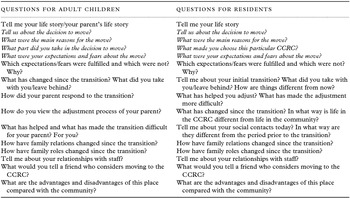
Information about the study was provided to participants prior to participation. All participants signed an informed consent prior to the interview. Interviews were conducted between 2010 and 2014. Interviews occurred in the preferred time and place of the interviewee. Interviews lasted between one and one and a half hours. All interviews were recorded and verbally transcribed. Interviews were conducted by trained interviewers, who were graduate students in the social sciences. Interviewers received training in qualitative research including the conduct of a mock interview. Ongoing monitoring was provided by the principal investigator who is a clinical psychologist with over 10 years of experience in qualitative research. The interview guide followed a funnel approach, starting with broad questions about the decision to move to the CCRC and advantages and disadvantages associated with the move followed by more specific questions, such as changes in family relations following the move. Following the analysis of some of the interviews, the interview guide was revised to include a very broad opening question about one's life history, followed by more specific questions, as detailed above. Several questions were slightly modified following the analysis of some of the interviews (see Appendix 1).
Analysis
Analysis followed several stages. First, a line-by-line open coding was conducted (Strauss and Corbin, Reference Strauss and Corbin1998), using no preconceived themes. Instead, themes emerged directly from the data (Creswell, Reference Creswell1998). Next, constant comparisons within and across interviews were conducted to identify major themes that repeated across the various interviews (Strauss and Corbin, Reference Strauss and Corbin1998). At the stage of selective coding, central themes were identified to represent a coherent story-line (Strauss and Corbin, Reference Strauss and Corbin1998). For the present study, the topic of old age and aging perceptions was selected and related themes were identified. Other topics that emerged in the analysis, such as grief, autonomy, adjustment or social relations are discussed elsewhere (Ayalon and Green, Reference Ayalon and Green2012; Reference Ayalon and Green2013). At the final stage, dyadic analysis was conducted (Eisikovits and Koren, Reference Eisikovits and Koren2010). Interviews of older adults and their adult children were compared and contrasted to identify thematic overlaps and diversions across dyads. ATLAS.ti was used for the purpose of data management (Friese, Reference Friese2012). The overall analysis was conducted by the principal investigator (PI). This was supported by open-coding analysis by a graduate student in social work and dyadic analysis of selected dyadic interviews by two other graduate social work students.
Sources of trustworthiness
Several interviewers conducted the interviews. This allows for obtaining a broader range of responses which are less directed by the unique characteristics of a single interviewer (Tietel, Reference Tietel2000). In addition, the open-coding analysis and dyadic analysis were conducted by several people, as outlined earlier. The use of two different sources of interview and the dyadic analysis are forms of triangulation that further enhance the trustworthiness of the data (Breitmayer et al., Reference Breitmayer, Ayres and Knafl1993). An audit trail (Rodgers and Cowles, Reference Rodgers and Cowles1993) was maintained to thoroughly document all stages of analysis.
Results
Three major themes related to old age and aging were identified. The first theme concerned expectations for multiple losses that occur in old age. In general, both older adults and their adult children reported negative expectations for old age, including reduced physical functioning and pain, loss of independence, loneliness, unattractive physical appearance, and even elder maltreatment. These expectations for negative changes were perceived as inevitable. A second theme concerned different views and definitions of old age. Respondents struggled with various definitions of old age and attempted to explain their adjustment process to the CCRC as a result of discordance or concordance in these various definitions. A third theme addressed perceptions of the CCRC. Respondents vacillated between presenting the CCRC as a luxurious hotel to portraying it as the “last stop.” The CCRC was seen as a place for potential growth on the one hand, and inevitable decline on the other hand. To present discordant and concordant views of older adults and their adult children, their linked perceptions are discussed in relation to these three themes. Detailed illustrations from the interviews are provided.
Expected losses in old age
Both older adults and their adult children discussed old age primarily from a negative stand. Losses of autonomy, health, cognitive abilities and attractiveness were perceived as being inevitable in old age. In most interviews, but not all, there was a general low spirit, representing very limited expectations about old age, as expressed by one of the residents, “we checked the place (CCRC) and they (management) said I would be okay. I assume that over time, age takes its toll and eventually I will need (a more intensive level of care).” Her daughter expressed modest hopes for a potential improvement prior to the transition, but she too, admitted that such an improvement did not occur, “we didn't expect that she would turn into a 16 year-old girl (following the move to the CCRC), but I thought that maybe being active would improve things. But, she didn't return to what she was 2, 3 years ago.”
Having limited expectations about old age often resulted in reducing older adults’ ability to function independently. The following quote demonstrates how a son actively reduced his mother's autonomy by discouraging her from renewing her driving license solely due to her old age, “Up until now she was still driving, recently I stopped her, because her age is a little problematic.”
The mother corroborates her son's account. However, she first describes the decision not to renew her license as being her own. She subsequently discusses her decision as being partially due to her children's concerns and partially due to fears of having her physical decline announced in public:
Simply, I didn't renew the license. And the kids influenced me. They said, “mom, it's enough.” I didn't have any car accidents, but they said it was enough. So I decided, okay. “If I need,” I told them, “I will be a burden on you. You will have to drive me. To take me to places.” “No problem mother, we are next to you.” I want to give my daughter the car and that's it. I also needed to go to an eye exam (to renew the driving license). I was afraid that they would tell me that I needed to do a cataract operation. I just decided to take this off my shoulders.
Even though the intentions behind the decision not to renew her driving license are viewed as positive, the decision carries deleterious effects on the independence of this resident. These accounts illustrate how expectations about decline and losses in old age are perceived as being inevitable and fully accepted. These expectations clearly impair the ability of the older resident to meet his or her full potential.
In addition to perceived internal losses associated with old age, respondents also identified external losses which impact one's internal sense of security. The loss of safety in one's environment received considerable attention. Most respondents explicitly spoke about a strong sense of insecurity as a result of living in the community in old age. The following is a direct quote from an interview with an older resident,
I think that sense of security is unstable. As you hear, they attack an elderly here and rob an elderly there. Knocked on the door, presented themselves as. . .I don't know who and then attacked people. So, with these things, I think that here (CCRC) I am protected.
His daughter too spoke about elder abuse as a major risk at old age. Unlike her father, however, she perceived the risk for abuse as being higher in the CCRC because it puts her parents at the mercy of formal care takers: “I will not let a stranger take care of my parents. No way. I do not want to put my parents in this situation. An impatient care taker who will not speak nicely to my father or hit him or something. No way. This was my first reaction (to parents’ expressed wish to move to a CCRC).” Taking both perspectives into account, this older resident is seen as being vulnerable in the community as well as in the CCRC. In this dyad, old age is seen as almost synonymous with high risk for elder abuse and exploitation.
Views and definitions of old age
In general, respondents had a hard time defining what old age constitutes and who should be defined as old. The following quote demonstrates how an adult daughter used multiple terms to describe old age. The use of so many terms in a single sentence serves as a good illustration of her uncertainty and ambivalence about what old age constitutes: “all the time, I used to tell her (mother), ‘there is golden age, there is retirement age, there is whatever age you call it in the community center. Go to classes, do things.’”
Although her mother does not use multiple terms to describe old age, she too does not refer to old age directly, but instead uses the term, “third age” to refer to her aging process, “I told her (daughter), ‘look, I have always wanted to go to a CCRC. I think this is the best thing for the third age.’”
Many distinguished between chronological old age and physical or mental age. The following example demonstrates how neither the daughter nor her father agreed with the view of her father as an old person. The daughter stated, “you will see, they (parents) do not look their age. And my father, he is a child. He has the soul of a child. And he likes adventures, moving around, the best in the world.”
Consistently, her father described his attempts to maintain a young image in the eyes of his children, “I just do not give them (children) a reason to think that their father is no longer young. I am interested in things. They know. My daughter enjoys the fact that I deal with computers in her office. That I know what to do. Because some people are afraid of computers at this age. I am not afraid.” These attempts to conceal or disassociate from one's old chronological age serve as another indication of the negative views towards old age in both generations.
The question of what chronological age constitutes old age was also raised, as the age range within the CCRC is so wide that individuals in their 60's are considered as being too young for entering a CCRC. In the following quote, an older resident explicitly describes the management's concerns about accepting young residents to the CCRC: “I thought about going to a CCRC, but they didn't accept me two years ago, because I was too young. She (manager) said I wouldn't be able to get along”. Consistently, the daughter articulates her own concerns about her mother's young chronological age and young appearance as potential barriers for adjustment: “In the beginning, I had concerns, ‘what will you (mother) do there (CCRC)? what are you searching for over there? It (CCRC) has nothing to do with you.’ Everyone who heard about this said, because of her spirit or the way she looks, ‘she doesn't match the population there, just does not connect.’”
Other interviewees stressed the fact that in addition to a lower age limit, many CCRCs also have an upper age limit for entrance. Hence, even though the age range of CCRC residents is quite wide, there is a limited age period at which new residents are admitted to the CCRC. According to respondents, there also is a limited age period at which residents can actually enjoy the CCRC. This is due to functional decline that occurs in old age. The following quote from an interview with a resident demonstrates this perspective, “it's better to move (to a CCRC) before you get too old, then you can enjoy the place. I moved when I was too old, I wasn't well. When I planned to move I wasn’t, it was only after I fell that I became like this. Before that I was much healthier and stronger and could drive and was bringing my car and everything and it just worked out that I couldn’t.”
Her son reported a similar perspective. In his accounts, he did not refer to chronological age, but rather to functional abilities as being part of the eligibility requirements to enter a CCRC. His reasoning for moving to a CCRC when physical functioning was still adequate was attributed to the eligibility criteria of the CCRC and not to the fact that the CCRC had more activities to offer to functionally independent older adults:
They (management) went to her (mother’s) place, and checked her in her own living apartment, because here they accept only independent older adults. You do not have to die independent, but you have to be independent upon entering the CCRC. By the way, she was so independent that when we came here to check out the place, one of the advantages of the place was the parking lot. This was one of the advantages. And I talk about almost a year ago. And then something happened. She fell down. She broke her tailbone and she was almost paralyzed for three months. She had a Filipino worker at home, daily care, my visits –twice a day in her apartment. We hid her true situation from the CCRC. I came over to sign all the contracts, transferring paper work, everything. I couldn't send her physically (to the CCRC) because I was really afraid that they would discover her true situation.
Perceptions of the CCRC
Most respondents explicitly stated that their first image of the CCRC was that of decline and death. The term nursing home was used as a synonym of CCRC and most respondents expected to see the physical and mental declines associated with old age within the CCRC:
She (a friend) thought that this (CCRC) is like a nursing home, and all these things and I told her, “come see.” And she avoided coming here. She came to see the place, myself, six months after I was already here. And then she saw the place and she asked for my forgiveness.
Consistently, her daughter stated, “I had a client who has a nursing home, I knew this was an amazing place, a real treat, but there is always a concern that what you see on the outside is not what you see on the inside.”
Just as the image of old age was that of loss and decline, so was the CCRC portrayed as a place of decay and death. The following is an illustration from interviews with an older resident, “I have no problem with the CCRC. Look there are people here who are very sick, very needy. Sometimes it interferes with the lectures (at the CCRC). But who knows how I will be in a few years.”
Her son expressed a similar view of the CCRC, but at the same time, discussed other features of the CCRC, which make it a “fancy hotel”, rather than merely a place of decay and decline. The various terms used to describe the CCRC along with its both positive and negative qualities clearly demonstrate the ambivalence felt towards the CCRC, which on the one hand, serves people on the verge of functional decline, and thus, represents decay and death, but on the other hand, also provides older adults with ample opportunities for rejuvenation, which they lack in the community:
I didn't think (about CCRC). I didn't know a thing. I thought this would be more for sick people. I didn't think more in the spirit of a hotel. But both sides exist (in the CCRC). There are people that go with walkers- and this is the place, what can you do? So, she (mother) says there are many people, in the morning she sits with him (a resident) and the next day, the person is hospitalized or turns very ill.
Despite concerns that living in a place full of older adults would exacerbate decline among its residents, several respondents believed that the CCRC, because of the various amenities, services and activities it provides, actually helps older adults find a meaning in their life and even makes them feel younger than their chronological age, “all three of us (siblings) have the feeling that now they (parents) have become younger since they moved there (CCRC). To a place full of older adults. We laugh about it.”
Her father shares a similar perspective,
I didn't know much (about CCRCs) and you may say that I was surprised for the better by all the activities. Because, when people spoke about it in the past, they spoke about nursing homes. You go to a nursing home to finish your life. Here you do not come to finish, you come to live. Continue living, under some supervision and in very comfortable living arrangements.
Discussion
The present study addressed interdependent perceptions of old age and the aging process among older adults who transitioned to the CCRC within the past year and their adult children. Although much has been written about subjective perceptions of old age by both older and younger age groups (Ayalon, Reference Ayalon2013a; Kite et al., Reference Kite, Stockdale, Whitley and Johnson2005), only very few studies have addressed this topic in the context of the CCRC (Gamliel and Hazan, Reference Gamliel and Hazan2006; Bodner et al., Reference Bodner, Cohen-Fridel and Yaretzky2011b; Ayalon and Green, Reference Ayalon and Green2012). This is important given the increasing popularity of this LTC setting as well as the image of old age as a time of success and prosperity that the CCRC is trying to promote (Gamliel and Hazan, Reference Gamliel and Hazan2006).
Using Nydegger's (Reference Nydegger1986) conceptualization of various timetables in the perception of age and aging, the present study points to a prominent general view of old age as a sign of decline and decay. This negative view of old age was prominent among adult children as well as their older parents. The almost unquestionable acceptance of negative views of old age brought further decline and loss of independence to older adults.
This study adds to the growing body of knowledge on the negative perceptions of old age among individuals of different age groups (Kite et al., Reference Kite, Stockdale, Whitley and Johnson2005) by demonstrating interdependence between the generations. The notion of interdependent timetables suggests that views of old age are partially determined through relations with intimate others (Nydegger, Reference Nydegger1986). One of the indicators of solidarity between the generations is similarity in values and opinions across the generations (Bengtson and Roberts, Reference Bengtson and Roberts1991). The present study demonstrates how solidarity exists and is perpetuated also in relation to views of old age.
The specialized timetable refers to the perception of age in interaction with other socio-demographic characteristics, such as gender or poverty level (Nydegger, Reference Nydegger1986). The different aspects of old age referred to in the present study clearly demonstrate how the construction of specialized timetables takes place. In addition to chronological age, functional age, subjective age, mental age and appearance play a role in determining one's self image and perceived aging process. Older adults were not only evaluated/self-evaluated by their chronological age, but also by these other age-related characteristics. This multidimensional perspective of old age is beneficial as it allows even very old individuals, who are often the subjects of negative views of old age, to incorporate positive aspects into their self-image.
The multiple terms used to refer to old age and to the CCRC reflect the ambivalence felt towards these concepts (Ayalon and Green, Reference Ayalon and Green2012). Both old age and the CCRC have primarily negative connotations (Gamliel and Hazan, Reference Gamliel and Hazan2003; Ayalon and Green, Reference Ayalon and Green2012). However, the CCRC also represents an opportunity to age respectfully and to maintain one's autonomy even in decline (Shippee, Reference Shippee2012). Consistently, in addition to negative perceptions of old age, it is also seen as an opportunity for wisdom and growth (Kite et al., Reference Kite, Stockdale, Whitley and Johnson2005; Kornadt and Rothermund, Reference Kornadt and Rothermund2011). Possibly, the challenges older adults experienced in incorporating the various dimensions of the CCRC into a coherent perception are due to very active attempts to present the CCRC as a one-dimensional LTC setting for affluent, independent older adults and to disregard or even conceal less attractive aspects of the CCRC (Shippee, Reference Shippee2009).
An important finding of the present study concerns not only the multiple dimensions of age, but also the wide range of these age-related dimensions within the CCRC. The CCRC is defined as an LTC alternative to functionally independent older adults. Although old age is generally perceived as starting around the age of 64 (Ayalon et al., Reference Ayalon, Doron, Bodner and Inbar2014), the present study suggests that this cut-off is rather young by CCRC standards, with most older adults entering a CCRC after the age of 70 or even 80. This still allows for a very wide range of chronological ages as well as functional, mental and physical ages to be present within the CCRC. Viewing diversity and differences within the CCRC is encouraged as it promotes less stigmatizing views of old age.
Past research has stressed the highly segregated nature of the CCRC not only with regard to the community at large, but also with regard to levels of care within the CCRC (Shippee, Reference Shippee2009). This is largely fueled by attempts to homogenize the characteristics of the population within the CCRC. These efforts might be driven by fears of the inevitable decline and decay associated with old age (Martens et al., Reference Martens, Greenberg, Schimel and Landau2004) as well as by the general age division so prevalent in our society (Hagestad and Uhlenberg, Reference Hagestad and Uhlenberg2005). Given the inevitable changes in chronological age as well as in other dimensions of age over time, these attempts are deemed futile in a setting such as a CCRC, which is designed to provide lifelong services.
The present study provides important insights about old age and aging among CCRC residents and their adult children. With the relative popularity of the CCRC as an LTC alternative and its portrayal as a viable alternative to independent older adults (Gamliel and Hazan, Reference Gamliel and Hazan2006; Shippee, Reference Shippee2009), the present study addresses a topic that has received only limited attention thus far. The findings point to the shared perspectives of old age and aging among older adults and their adult children. In general, both groups share similar views of old age and aging, which tend to be negative. Interventions aimed to target negative age perceptions or negative perceptions about the CCRC should focus not only on the older residents, but also on their adult children. One such intervention might focus on reducing the social divide based on chronological age (Hagestad and Uhlenberg, Reference Hagestad and Uhlenberg2005), which at the present time is being promoted by CCRCs. The multiple terms used to describe old age and the CCRC reflect the ambivalence towards these concepts. Given the potential negative impact of negative internal age stereotypes on both morbidity and mortality (Levy et al., Reference Levy, Hausdorff, Hencke and Wei2000; Levy et al., Reference Levy, Slade, Kunkel and Kasl2002), a more balanced portrayal of these concepts might result in an easier acceptance of old age and the CCRC as an LTC alternative. This could potentially also ease the transition of older adults into CCRCs.
Despite its noteworthy strengths, the study has several limitations that should be noted. First, the study relied on a matched-sample of older adults and their adult children. As such, the opinions of older adults who do not have adult children or adult children with no older adults were not part of this study. In addition, the qualitative and cross sectional nature of the study does not allow for assumptions about cause and effect or about the representativeness of the findings. Future research will benefit from evaluating perceptions about old age and aging within the CCRC using survey methods.
Conflict of interest
None.
Acknowledgments
The study was supported by a grant from the Israel Science Foundation and from COST (European Cooperation in Science and Technology)-IS1402 on Ageism, a multi-national, interdisciplinary perspective
Interview guide