Voice behavior refers to employees' expression of ideas and concerns about the working issues, which is a form of citizenship behavior (Liang, Farh, & Farh, Reference Liang, Farh and Farh2012). Although employees who engage in voice behaviors experience some benefits (e.g., McClean, Martin, Emich, & Woodruff, Reference McClean, Martin, Emich and Woodruff2018; Weiss & Morrison, Reference Weiss and Morrison2019), voice may be a tough thing when they are facing a narcissistic leader (Huang, Krasikova, & Harms, Reference Huang, Krasikova and Harms2020; Liao, Zhou, Guo, & Li, Reference Liao, Zhou, Guo and Li2019). Leader narcissism refers to narcissistic leaders who are principally motivated by their own egomaniacal needs and beliefs (Hochwarter & Thompson, Reference Hochwarter and Thompson2012; Rosenthal & Pittinsky, Reference Rosenthal and Pittinsky2006). Research has indicated that employees' voice behaviors are likely to be inhibited when they perceive high levels of leader narcissism (Ding, Li, Quan, & Wang, Reference Ding, Li, Quan and Wang2018; Liu, Chiang, Fehr, Xu, & Wang, Reference Liu, Chiang, Fehr, Xu and Wang2017).
However, some scholars argue that perceived leader narcissism may also increase subordinate's career-building (Volmer, Koch, & Göritz, Reference Volmer, Koch and Göritz2016), psychological empowerment (Sosik, Chun, & Zhu, Reference Sosik, Chun and Zhu2014), engagement and performance (Owens, Wallace, & Waldman, Reference Owens, Wallace and Waldman2015), which demonstrate a potential of positive effect on subordinates' voice behaviors. This raises the questions of how perceived leader narcissism influences subordinates' voice behaviors and in what conditions subordinates are willing to speak up to narcissistic leaders. Although researchers have provided some empirical evidence on the relationship between perceived leader narcissism and voice behaviors (e.g., Ding et al., Reference Ding, Li, Quan and Wang2018; Huang et al., Reference Huang, Krasikova and Harms2020), the extant scholarship might not provide a fully satisfactory answer. Our study aims to provide an alternative perspective by building on the social exchange theory. The reasons are as follows.
Firstly, by drawing from the social exchange theory, this study highlights the sense of reciprocity norm as a theoretical pathway linking perceived leader narcissism and voice behavior, which complements the resource-based explanation illustrated by previous studies (Huang et al., Reference Huang, Krasikova and Harms2020; Yao, Zhang, Liu, Zhang, & Luo, Reference Yao, Zhang, Liu, Zhang and Luo2019). For instance, Yao et al. (Reference Yao, Zhang, Liu, Zhang and Luo2019) found that leader narcissism leads to a series of losses of employees' resources so that employees do not have sufficient resources to engage in voice behavior. However, employees do not speak up not only because they run out of resources, but may also because they are unwilling to (Liang et al., Reference Liang, Farh and Farh2012). Given an emphasis on an individual's sense of reciprocity norm and feeling of obligation, social exchange theory may serve as a useful lens for explaining employees' unwillingness to engage in voice behavior in response to perceived leader narcissism.
According to the social exchange theory, when employees appreciate how they are treated at work, they are likely to feel obligated to reciprocate with kind actions (Cropanzano & Mitchell, Reference Cropanzano and Mitchell2005; Cropanzano, Anthony, Daniels, & Hall, Reference Cropanzano, Anthony, Daniels and Hall2017). Conversely, employees who received unfair treatment from others may feel that the reciprocity norm between them has been undermined (Kim, Moon, & Shin, Reference Kim, Moon and Shin2019). Narcissistic leaders are likely to create the impression of being ‘deceptive, hostile, and intimidating’ (Hochwarter & Thompson, Reference Hochwarter and Thompson2012), which may harm the interpersonal relationship with their followers (Ong, Roberts, Arthur, Woodman, & Akehurst, Reference Ong, Roberts, Arthur, Woodman and Akehurst2016). When employees feel devalued and exploited by their leader, their perception of justice will be decreased (Koopman, Matta, Scott, & Conlon, Reference Koopman, Matta, Scott and Conlon2015), and as the leader is the agent of the organization (Uhl-Bien & Arena, Reference Uhl-Bien and Arena2018), this study induces organizational justice as a mediating link between perceived leader narcissism and voice behaviors.
Organizational justice refers to employees' subjective sense of how fairly they are treated by the organization (Greenberg & Colquitt, Reference Greenberg and Colquitt2013). According to social exchange theory, employees who perceive organizational justice will comply with the reciprocity norm, thus engaging more voice behaviors (Zhang, LePine, Buckman, & Wei, Reference Zhang, LePine, Buckman and Wei2014). However, employees who perceive high leader narcissism feel their leaders are principally motivated by their interests, superseding the needs and interests of subordinates (Hochwarter & Thompson, Reference Hochwarter and Thompson2012). Also, leaders who are high in narcissism cannot objectively evaluate the talents and contributions of employees (O'Reilly, Doerr, Caldwell, & Chatman, Reference O'Reilly, Doerr, Caldwell and Chatman2014). Thus, this study suggests that perceived leader narcissism has a negative effect on employees' perception of organizational justice, which in turn reduces their voice behaviors.
Secondly, based on the social exchange theory, our study can explore the boundary condition of the relationship between perceived leader narcissism and voice behavior while explaining the previously contested terrain on this relationship. Indeed, Liao et al. (Reference Liao, Zhou, Guo and Li2019) has explained the relationship between perceived leader narcissism and voice from the perspective of social exchange. They argued that when employees perceive the leader's narcissism, the exchange relationship between the leader and employees becomes strained, which will reduce employees' voice behaviors. However, the boundary condition is still an important question that remains unanswered and requires addressing. Moreover, recent studies have provided some indirect evidence on the ‘bright sides’ of leader narcissism (e.g., Owens et al., Reference Owens, Wallace and Waldman2015; Sosik et al., Reference Sosik, Chun and Zhu2014; Volmer et al., Reference Volmer, Koch and Göritz2016), which also illustrates implicit moderators between leader narcissism and voice behavior.
To provide a more complete explanation of the relationship between perceived leader narcissism and voice behavior, the present study, based on the social exchange theory (Cropanzano et al., Reference Cropanzano, Anthony, Daniels and Hall2017), proposes that when employees trust their leaders, their sense of reciprocity norm being violated is likely to be weakened. Trust makes employees more vulnerable to the leader's behavior because they believe that the rights are not abused by the leader (Boies, Fiset, & Gill, Reference Boies, Fiset and Gill2015; Samian, Riantoputra, & Budihardjo, Reference Samian, Riantoputra and Budihardjo2020). Employees who trust in leaders have a strong emotional bond with their leaders (McAllister, Reference McAllister1995). Cropanzano et al. (Reference Cropanzano, Anthony, Daniels and Hall2017) specifically suggest the investigation of the functioning of trust in the social exchange theoretical framework. Thus, we propose that trust in leaders may buffer the negative relationships between perceived leader narcissism and voice behaviors, as well as buffer the indirect effect of perceived leader narcissism on voice behaviors via organizational justice.
This study makes two primary contributions to the leader narcissism literature and the social exchange theory. Firstly, based on the social exchange theory, we identify a different mechanism linking perceived leader narcissism and employees' voice behavior. We suggest that when employees perceive high levels of leader narcissism, they are likely to feel unfairly treated because of the violation of the reciprocity norm. Employees in turn feel no obligation to contribute to the organization with positive behaviors such as voice behaviors. In doing so, we extend leader narcissism and voice behavior research that has predominantly focused on resource-based explanations for why employees do not speak up in response to leader narcissism (Huang et al., Reference Huang, Krasikova and Harms2020; Yao et al., Reference Yao, Zhang, Liu, Zhang and Luo2019).
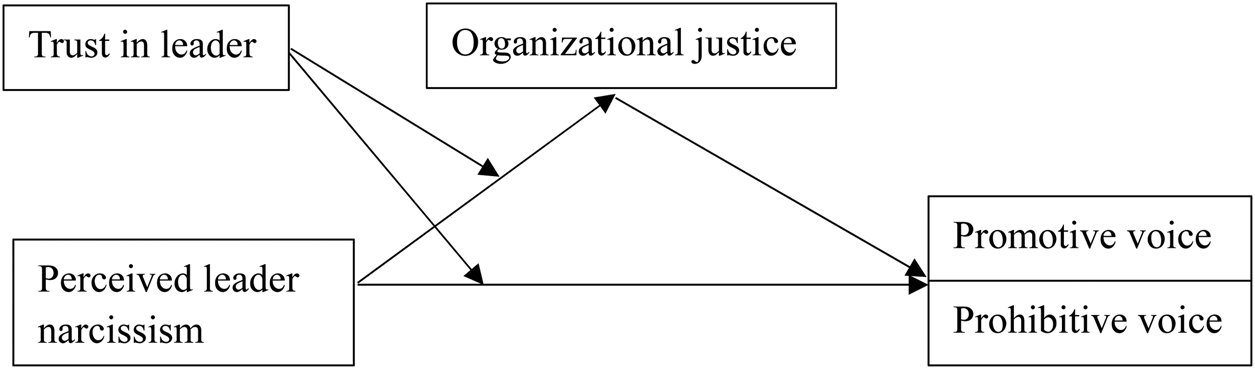
Secondly, this study extends the literature on leader narcissism and voice behavior. Although the relationship between leader narcissism and voice behavior has been empirically tested (e.g., Ding et al., Reference Ding, Li, Quan and Wang2018; Huang et al., Reference Huang, Krasikova and Harms2020), the extant scholarship still needs to make advances by explicating its boundary conditions. We draw on the social exchange theory to highlight how trust in leader can influence the extent to which subordinates engage in voice behaviors in response to leader narcissism. We underscore that individuals' sense of reciprocity norm violation can be weakened by individuals' trust in their narcissistic leaders. In making this case, we also contribute back to the social exchange theory by illustrating trust in the partner in exchange relationships as a boundary condition of norm reciprocity violation. The findings also help to disentangle previous controversial findings on the relationship between perceived leader narcissism and voice behaviors. A summary of our model is presented in Figure 1.
The hypothesized model.

Theory and hypotheses
Perceived leader narcissism and employee voice
Studies about the relationship between leaders and narcissism started when three narcissistic configurations including reactive, self-deceptive, and constructive were found among leaders (Vries & Miller, Reference Vries and Miller1985). Leader narcissism refers to narcissistic leaders who are principally motivated by their own need for power and admiration (Rosenthal & Pittinsky, Reference Rosenthal and Pittinsky2006). Employees who perceive leader narcissism feel their leaders are principally motivated by their own egomaniacal needs and beliefs, superseding the needs and interests of the constituents and institutions they lead (Hochwarter & Thompson, Reference Hochwarter and Thompson2012; Rosenthal & Pittinsky, Reference Rosenthal and Pittinsky2006). Prior research on leader narcissism revealed that its effects were more negative than positive. For example, because of over-confidence, over-dominance, and self-focused tendency, leader narcissism will lead to unethical behavior (Carnevale, Huang, & Harms, Reference Carnevale, Huang and Harms2018), abuse of power for personal interest (Nevicka, Van Vianen, De Hoogh, & Voorn, Reference Nevicka, Van Vianen, De Hoogh and Voorn2018), and detrimental to subordinates' outcomes (Judge, Piccolo, & Kosalka, Reference Judge, Piccolo and Kosalka2009). When employees perceive the leader's narcissism, they most likely doubt their openness of leadership and may think leaders will not pay attention to their suggestions, hence the relationship between leader and employee becomes strained.
According to social exchange theory, when employees are positive about their work environment, they tend to deliver benefits to the organization because of the norm of reciprocity (Cropanzano & Mitchell, Reference Cropanzano and Mitchell2005). Perceived leader narcissism often creates the impression of ‘deceptive, hostile, and intimidating’ by the leader (Hochwarter & Thompson, Reference Hochwarter and Thompson2012). Employee's negative perceptions from this leader may undermine the norm of reciprocity. A prior study also suggested that narcissistic leaders frequently fail to develop and maintain social relationships with their subordinates (Ong et al., Reference Ong, Roberts, Arthur, Woodman and Akehurst2016).
Voice behavior refers to employees' expression of ideas and concerns about the working issues and has two dimensions comprising promotive voice and prohibitive voice, which is a form of citizenship behavior (Liang et al., Reference Liang, Farh and Farh2012). Two theoretically based arguments support a negative relationship between perceived leader narcissism and voice behavior. First, based on social exchange theory (Cropanzano & Mitchell, Reference Cropanzano and Mitchell2005), when the reciprocity norm and social relationship are undermined by perceived leader narcissism, employees are less likely to feel obligated to benefit the leader and organization. Morrison (Reference Morrison2011) has argued that the desire to help the organization can enhance voice behavior. Second, narcissistic leaders are sensitive to other's suggestions and hostile to negative feedback (Barry, Chaplin, & Grafeman, Reference Barry, Chaplin and Grafeman2006). While employees perceive that their supervisor devalues and is not open to such behavior, they are less likely to engage in voice behavior (Detert & Burris, Reference Detert and Burris2007). Thus, we argue that perceived leader narcissism is negatively related to subordinates' voice behavior.
More definitely, we discuss the effect of perceived leader narcissism on promotive voice and prohibitive voice separately. Promotive voice refers to employees' expression of new ideas or suggestions about improving the existing function of their organization (Lin & Johnson, Reference Lin and Johnson2015). Because it is associated with improving suggestions, the promotive voice is focused on the organization's future ideal state. Even if employees fail to achieve desired outcomes by using promotive voice, leaders will not blame them (Wei, Zhang, & Chen, Reference Wei, Zhang and Chen2015). However, a narcissistic leader manifests self-interest, which damaged employees' interests and their exchange relationship. Because of the trait of over-confidence, narcissistic leaders always believe in themselves and do not listen to others. As a result, employees may lose the courage and motivation to speak up. Thus, we argue that perceived leader narcissism is negatively related to employee promotive voice.
Prohibitive voice refers to employees' calls for changing or stopping work-related issues that are harmful to the organization (Liang et al., Reference Liang, Farh and Farh2012). The prohibitive voice often represents a direct challenge to the organizational status quo and leaders regard this as a challenge to their authority (Chamberlin, Newton, & Lepine, Reference Chamberlin, Newton and Lepine2017), which means the prohibitive voice takes more risks, and the prohibitive voice is seen as more valuable and has more positive effects on the organization than the promotive voice (Lin & Johnson, Reference Lin and Johnson2015). However, narcissistic leaders are likely to threaten or pressure subordinates who offer ideas different from theirs (Grijalva, Harms, Newman, Gaddis, & Fraley, Reference Grijalva, Harms, Newman, Gaddis and Fraley2015). Thus, this perception is difficult for employees to overcome the risks to offer prohibitive voice, and employees are more likely to keep silent to avoid the risks. Thus, we argue that leader narcissism is negatively related to employee prohibitive voice. We thus hypothesize the following:
Hypothesis 1a Perceived leader narcissism will be negatively related to employees' promotive voice.
Hypothesis 1b Perceived leader narcissism will be negatively related to employees' prohibitive voice.
The moderating role of trust in leader
Thus far, we have argued that perceived leader narcissism negatively impacts subordinates' promotive voice and prohibitive voice. Nevertheless, we suggest that perceived leader narcissism may not always make employees feel less obligated to reciprocate toward organizations. Researchers argued that the rational basis of social exchange cannot exclusively and solely explain behavior (Clark & Mills, Reference Clark and Mills1979). In other words, though employees were mistreated in the organization, their ‘tit for tat’ motives may not always be evoked (Thau & Mitchell, Reference Thau and Mitchell2010).
Previous research has suggested that leader narcissism made employees feel less obligated to return in kind (Liao et al., Reference Liao, Zhou, Guo and Li2019), mainly because narcissistic leaders tend to be self-serving and harm employees' interests (Grijalva et al., Reference Grijalva, Harms, Newman, Gaddis and Fraley2015). However, narcissistic leaders are not absolutely without merit. Recent research has increasingly focused on the bright sides of leader narcissism (e.g., Owens et al., Reference Owens, Wallace and Waldman2015; Rosenthal & Pittinsky, Reference Rosenthal and Pittinsky2006; Sosik et al., Reference Sosik, Chun and Zhu2014; Volmer et al., Reference Volmer, Koch and Göritz2016). For instance, narcissistic leaders are initially perceived as creative leaders, displaying a kind of charm (Rosenthal & Pittinsky, Reference Rosenthal and Pittinsky2006), and perceived leader narcissism can contribute to employees' career-building (Volmer et al., Reference Volmer, Koch and Göritz2016). Besides, as we all know, Steve Jobs was generally seen as a narcissistic leader, but employees in Apple are still willing to speak up (Isaacson, Reference Isaacson2011). This may be because employees trust his management and leadership skills and they believe that the leader's decisions are beneficial to the organization. As a result, employees are less likely to avoid behaviors that benefit their organization. Based on these, we propose that employees' trust in leaders will buffer the negative effect of perceived leader narcissism on voice behavior.
Trust in leader refers to a psychological state in which an individual accepts his or her vulnerability when they expect positive intentions or behavior of their leaders (Mayer & Gavin, Reference Mayer and Gavin2005). Prior studies also suggested that trust represents a strong emotional bond between leaders and their subordinates (McAllister, Reference McAllister1995). Employees who highly trust their leaders recognize the competence and responsibility of their leaders and consider them reliable (McAllister, Reference McAllister1995). Although narcissistic leader often exhibits negative traits such as deceptive, hostile, and intimidating (Hochwarter & Thompson, Reference Hochwarter and Thompson2012), it does not prevent employees from producing higher evaluations of their ability to work and their willingness to contribute to the development of the organization (Judge et al., Reference Judge, Piccolo and Kosalka2009). Thus, when employees trust their leader, they are less likely to see leaders' narcissism as a violation of the norm of reciprocity (Boies et al., Reference Boies, Fiset and Gill2015). Based on the social exchange theory, we propose that for employees who trust their leaders, their exchange relationship with the leader is less likely to be undermined by the perceived leader narcissism, which makes them less likely to avoid voice behavior. We thus hypothesize the following:
Hypothesis 2a Trust in leader will moderate the negative relationship between perceived leader narcissism and promotive voice, such that this negative relationship will be weaker in the presence of higher (vs. lower) employees' trust in leader.
Hypothesis 2b Trust in leader will moderate the negative relationship between perceived leader narcissism and prohibitive voice, such that this negative relationship will be weaker in the presence of higher (vs. lower) employees' trust in leader.
The mediating role of organizational justice
Leaders who are high in narcissism cannot objectively evaluate the talents and contributions of employees (O'Reilly et al., Reference O'Reilly, Doerr, Caldwell and Chatman2014). Due to the egocentric nature, this type of leader cannot maintain rationality and justice, thus reducing employees' perceived organizational justice (Wang, Lu, & Siu, Reference Wang, Lu and Siu2015). Employees who perceive organizational justice may reciprocate with more voice behavior (Zhang et al., Reference Zhang, LePine, Buckman and Wei2014). Thus, we propose the mediating role of employee organizational justice between perceived leader narcissism and employee voice behavior.
Organizational justice refers to employees' subjective sense of how fairly they are treated by the organization (Greenberg & Colquitt, Reference Greenberg and Colquitt2013). Although organizational justice has specific justice dimensions including distributive justice, procedural justice, informational justice, and interpersonal justice, scholars have increasingly argued that studying overall justice perceptions provided a more complete picture of how justice influences workplace outcomes (e.g., Ambrose & Schminke, Reference Ambrose and Schminke2009; Bobocel, Reference Bobocel2013). Thus, in this study, we focus on employees' perception of overall justice, termed organizational justice.
Driven by their psychological needs for authority, leaders with high narcissism tend to extrude their superiority by depreciating others' contributions. Such a tendency can also manifest in the form of behaviors that belittle their subordinates and strive for personal interest (Nevicka et al., Reference Nevicka, Van Vianen, De Hoogh and Voorn2018). Therefore, employees who perceived narcissistic leaders may feel that they were not treated fairly in terms of procedures and interpersonal relationships. Besides, leaders with high narcissism tend to display an exploitative and self-serving manner, striving for personal success and needs (Grijalva et al., Reference Grijalva, Harms, Newman, Gaddis and Fraley2015). Thus, they may not tailor the application of procedures or information communication to employees' specific needs. Moreover, narcissistic leaders may exaggerate employees' contributions by encroaching on their outcomes and blame failures on employees instead of reflecting on themselves. As a result, employees are likely to interpret this lack of interpersonal interest as a violation of distributive justice and interpersonal justice (Ouyang, Sang, Li, & Peng, Reference Ouyang, Sang, Li and Peng2015), while leaders act as organizational agents (Kurtessis et al., Reference Kurtessis, Eisenberger, Ford, Buffardi, Stewart and Adis2017). Thus, we argue that perceived leader narcissism may undermine employees' perception of organizational justice.
When employees feel devalued and exploited by their leader, the exchange relationship will be harmed by the perception of unfairness (Koopman et al., Reference Koopman, Matta, Scott and Conlon2015). Employees will emotionally disconnect from their leader. Besides, leader high in narcissism always acts in a self-centered way and do not listen to others, which may largely discourage employees from performing promotive voice that indirectly contributes to leaders and organization. Organizational justice can facilitate the formation of the social exchange relationship, which makes employees more likely to engage in voice behavior (Wayne, Shore, Bommer, & Tetrick, Reference Wayne, Shore, Bommer and Tetrick2002). However, when compared to those who are fairly treated, unfairly treated subordinates tend to have lower organizational justice and render less voice behavior (Colquitt, Conlon, Wesson, Porter, & Ng, Reference Colquitt, Conlon, Wesson, Porter and Ng2001). We thus argue that leader narcissism will have a negative effect on employees' promotive voice via their organizational justice. Narcissistic leaders always manifest arrogant and self-centered behavior, which strengths the feeling of being exploited and suffering unfairness (Ong et al., Reference Ong, Roberts, Arthur, Woodman and Akehurst2016). Employees who perceive the organization and leaders as unfair are in a worse exchange relationship. As a result, employees may lack the motivation and courage to challenge their leaders or engage in prohibitive voice behavior. Instead, they may choose to stay silent to avoid risks. Thus, we proposed the following hypothesis:
Hypothesis 3a Organizational justice will mediate the negative relationship between perceived leader narcissism and promotive voice.
Hypothesis 3b Organizational justice will mediate the negative relationship between perceived leader narcissism and prohibitive voice.
Thus far, we have argued that perceived leader narcissism threatens employees' organizational justice, which negatively impacts their voice behavior and trust in leader can lessen the negative influence between perceived leader narcissism and employee voice behavior. Colquitt et al. found a strong relationship between trust and justice through a meta-analytic review (Colquitt et al., Reference Colquitt, Conlon, Wesson, Porter and Ng2001). Therefore, combining trust's moderating role of leadership's effectiveness, we also discussed employees' trust in leader in lessening perceived leader narcissism's damaging effects on employee organizational justice and the distal outcomes.
Trust in leader should reduce the perception of unfairness employees experience from their narcissistic leader. Narcissistic leader principally acts in a self-centered way and sometimes may abuse of power for personal interest (Nevicka et al., Reference Nevicka, Van Vianen, De Hoogh and Voorn2018) and detrimental to subordinates' outcomes (Judge et al., Reference Judge, Piccolo and Kosalka2009). When employees feel devalued or exploited by their leader, such a strong perception of unfairness will motivate them to disconnect from the leader. This will reduce employees' perception of organizational justice (Wang et al., Reference Wang, Lu and Siu2015). However, when employees trust their leader, they are more vulnerable to the leader's behavior (Boies et al., Reference Boies, Fiset and Gill2015). Although leader narcissism has deviation, subordinates still believe the leader's behavior and decision are right and will not harm their interest. Therefore, the exchange relationship will be maintained better than lower trust in leader, and it is reasonable to assure that employees will feel less being devalued and damaged interest when employees' trust in leader is high. As a result, trust in leader may motivate subordinates to discount their narcissistic leader's devaluing and self-centered tendencies. The perception of unfairness from perceived leader narcissism will be weakened. Thus, we put forward hypothesis 4:
Hypothesis 4 Trust in leader will moderate the negative relationship between perceived leader narcissism and employee organizational justice, such that this negative relationship will be weaker in the presence of higher (vs. lower) employees' trust in leader.
Perceived leader narcissism will reduce employees' organizational justice. Then employees feeling unfairness and the exchange relationship being damaged will inhibit employees' tendency to engage in voice behaviors. However, when employees' trust in leader is high, they believe that the behavior of their leader is correct and that the leader will deal with fairly, to reduce the destructive effect of leader narcissism on the exchange relationship. High trust in leader will reduce the negative effects of perceived leader narcissism on voice behaviors via organizational justice. Thus, combining hypotheses 3a, 3b, and 4, we hypothesize the following:
Hypothesis 5a Trust in leader will moderate the negative indirect effect of perceived leader narcissism on employees' promotive voice via organizational justice, such that the negative indirect effect will be weaker in the presence of higher (vs. lower) employees' trust in leader.
Hypothesis 5b Trust in leader will moderate the negative indirect effect of perceived leader narcissism on employees' prohibitive voice via organizational justice, such that the negative indirect effect will be weaker in the presence of higher (vs. lower) employees' trust in leader.
Study 1 methods
Sample and procedure
We conducted an online survey to test our hypotheses in study 1. The data were collected from technological, manufacturing, and other institutions in Jiangxi, Hunan, and other cities in China. We briefly told the participants about the purpose and voluntariness of our survey. Then, we entered the questionnaire into a website named Questionnaire Star and sent the questionnaire link to the participants. Participants answer the questionnaire anonymously. We set the items as necessary to complete the survey so that if the participants omitted any of the items, they could not submit the questionnaire.
Of the 295 questionnaires distributed, 257 questionnaires have been completed (a response rate of 87.12%). Among the 257 participants, 46.7% were male. Their average age was 25.06 (SD = 4.42), and their average organizational tenure was 1.87 years (SD = 2.83). In total, 73.1% of them have got a bachelor's degree, 18.3% of them got a master's degree, and 8.6% of them got a college degree. In total, 88.7% were employees while 11.3% were management layer, respectively.
Measures
Following the standard translation and back-translation procedures (Brislin, Reference Brislin1986), we translated all of the scales from English to Chinese to ensure a high degree of accuracy. We used 5-point Likert-type scales (1 = ‘strongly disagree’ to 5 = ‘strongly agree’) in the study and every scale had enough reliability.
Perceived leader narcissism
Six items from the scale developed by Hochwarter and Thompson (Reference Hochwarter and Thompson2012) were used to measure perceived leader narcissism. Sample items include ‘My leader is a very self-centered person’ and ‘My leader will go out of his/her way to cause me to harm to get ahead.’ This scale yielded a reliability of α = .89, which was well accepted (DeVellis, Reference DeVellis2016).
Organizational justice
Organizational justice was measured using the 20-item scale developed by Colquitt (Reference Colquitt2001), which includes four specific justice perceptions, i.e., distributive justice, procedural justice, informational justice, and interpersonal justice. Four items constituted the distributive justice measure (sample item: ‘My outcome reflects the effort I have put into my work’; α = .89), seven items constituted the procedural justice measure (sample item: ‘The procedures have been applied consistently’; α = .82), five items constituted the informational justice measure (sample item: ‘The procedures have been explained thoroughly’; α = .88), and four items constituted the interpersonal justice measure (sample item: ‘I was treated in a polite manner’; α = .91). The Cronbach's α for the whole scale is .92.
Voice
Promotive voice and prohibitive voice were measured using the 10-item scale (5 items for each) developed by Liang et al. (Reference Liang, Farh and Farh2012). The sample items include ‘I will make constructive suggestions to improve the unit's operation’ and ‘I will proactively report coordination problems in the workplace to my leader.’ A previous study indicated that this scale is reliable in the Chinese context (Liang & Farh, Reference Liang and Farh2008) and the Cronbach's α = .88 and .77 in our study.
Trust in leader
Eleven items from the scale developed by McAllister (Reference McAllister1995) were used to measure trust in leader. A sample item was my leader approaches his/her job with professionalism and dedication. This scale yielded a reliability of α = .91.
Control variables
Previous study has shown that subordinates' gender (0 = female, 1 = male) and organizational tenure (in years) may affect voice behavior (Detert & Burris, Reference Detert and Burris2007; Liang et al., Reference Liang, Farh and Farh2012). We also measured education and position (0 = nonmanagerial position, 1 = managerial position) as control variables (Li & Sun, Reference Li and Sun2015). We created two dummy variables, named education 1 (0 = other degrees, 1 = college degree) and education 2 (0 = other degrees, 1 = bachelor degree).
Analytical strategy
To test our hypotheses, we analyzed mediation and moderated mediation effects using the PROCESS macro (Hayes, Reference Hayes2013a, 2013Reference Hayesb) in SPSS. We use PROCESS as an analytic tool for the following reasons. First, PROCESS is an advanced regression-based approach focusing on moderated mediation models testing via bootstrapping, which is also typically used in recent literature (e.g., Philip, Reference Philip2021; Woehler et al., Reference Woehler, Floyd, Shah, Marineau, Sung, Grosser and Labianca2021). Second, compared with Baron and Kenny's (Reference Baron and Kenny1986) traditional multistep method, PROCESS does not assume a normal distribution and accounts for asymmetries in a sampling distribution by employing a bootstrapping procedure.
Our research model is a first-stage moderated mediation model in which the main effect is also moderated. Thus, we used Model 8 of the PROCESS macro (Hayes, Reference Hayes2013a, Reference Hayes2013b) that allowed us to test both direct and indirect effects of our mediation and first-stage moderated mediation models. In the analysis, the independent variable and moderator were standardized to build the interaction term. All the indirect and conditional indirect effects were tested using 20,000 bias-corrected bootstrapped samples while 95% bias-corrected confidence interval (CI) was estimated for these effects. The estimates were significant when 95% CI did not contain zero.
Study 1 results
Descriptive statistics, validity, and reliability
Before testing our hypotheses, we performed a series of confirmatory factor analyses using Amos 21 to assess the discriminant validity of the perceived leader narcissism, organizational justice, trust in leader, promotive voice, and prohibitive voice. Following a previous study (Grant, Berg, & Cable, Reference Grant, Berg and Cable2014), we performed item parceling. We created four facet-based parcels (procedural, distributive, interpersonal, and informational) for organizational justice and two facet-based parcels (affective and cognitive) for trust in leader (Little, Cunningham, Shahar, & Widaman, Reference Little, Cunningham, Shahar and Widaman2002). We created three parcels for perceived leader narcissism. Because this measure did not have facets, we adopted an unplanned aggregation strategy for item parceling (Little, Rhemtulla, Gibson, & Schoemann, Reference Little, Rhemtulla, Gibson and Schoemann2013). The five promotive voice items and the five prohibitive voice items were not parceled.
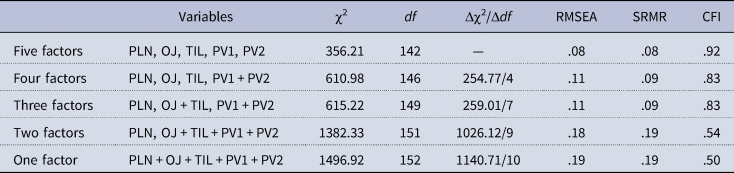
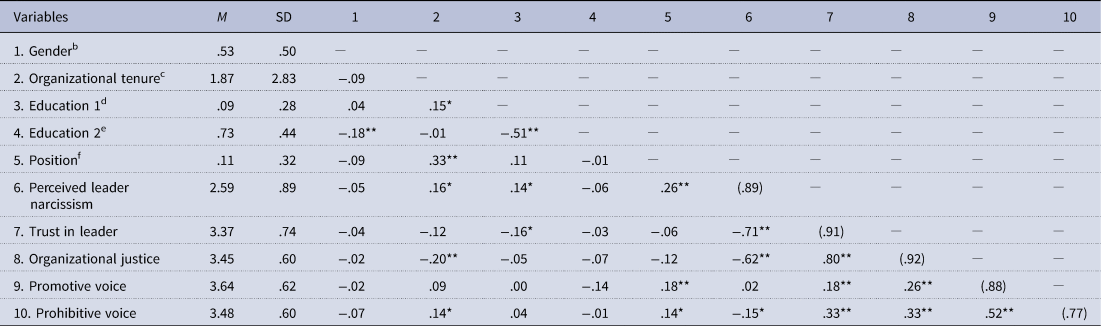
As presented in Table 1, the five-factor nested model had the best fit (χ2[142] = 356.21, RMSEA = .08, SRMR = .08, CFI = .92) over the four-factor model in which promotive voice and prohibitive voice were combined (Δχ2/[4] = 254.77, p < .01), and superior to a series of alternative models. Thus, we retained our five-factor baseline model and proceed to test the proposed hypotheses. Table 2 presents the descriptive statistics, reliabilities, and correlations of variables. Besides, we conducted Harman's one-factor test (Podsakoff, MacKenzie, Lee, & Podsakoff, Reference Podsakoff, MacKenzie, Lee and Podsakoff2003) to check the common method bias. The factor explained 33.26% of the variance, thus common method bias was not an issue.
Results of confirmatory factor analysis

PLN, perceived leader narcissism; OJ, organizational justice; TIL, trust in leader; PV1, promotive voice; PV2, prohibitive voice; RMSEA, root mean square error of approximation; SRMR, standardized root mean square residual; CFI, comparative fit index.
Descriptive, reliabilities, and correlationsa

*p < .05; **p < .01.
a N = 257.
b 0 = female, 1 = male.
c In years.
d 0 = other degrees, 1 = college degree.
e 0 = other degrees, 1 = bachelor degree.
f 0 = nonmanagerial position, 1 = managerial position.
Hypotheses testing
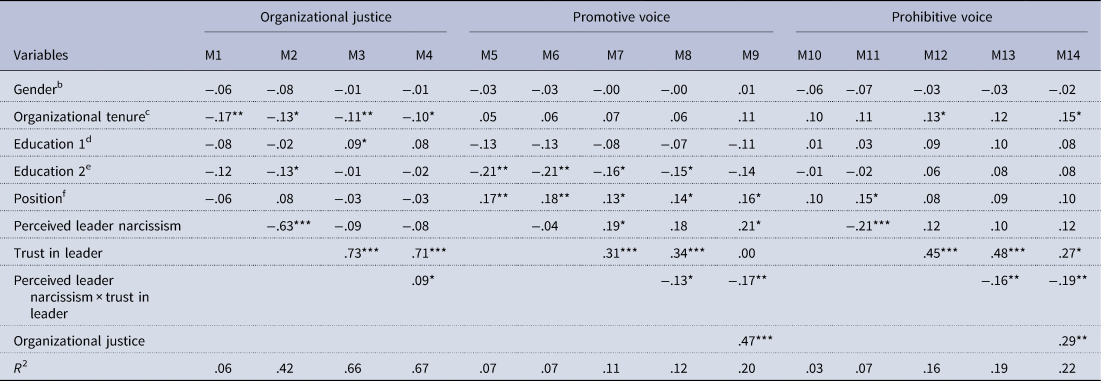
Results of the PROCESS (Hayes, Reference Hayes2013a, 2013Reference Hayesb) were shown in Table 3. As shown in model 6 and model 11 of Table 3, perceived leader narcissism was unrelated to promotive voice (r = −.04, n.s.), thus hypothesis 1a was not supported. However, perceived leader narcissism was significantly related to prohibitive voice (r = −.21, p < .001), thus supporting hypothesis 1b.
Results of regression analysisa

Values are standardized β coefficients. *p < .05, **p < .01, ***p < .001.
a N = 257.
b 0 = female, 1 = male.
c In years.
d 0 = other degrees, 1 = college degree.
e 0 = other degrees, 1 = bachelor degree.
f 0 = nonmanagerial position, 1 = managerial position.
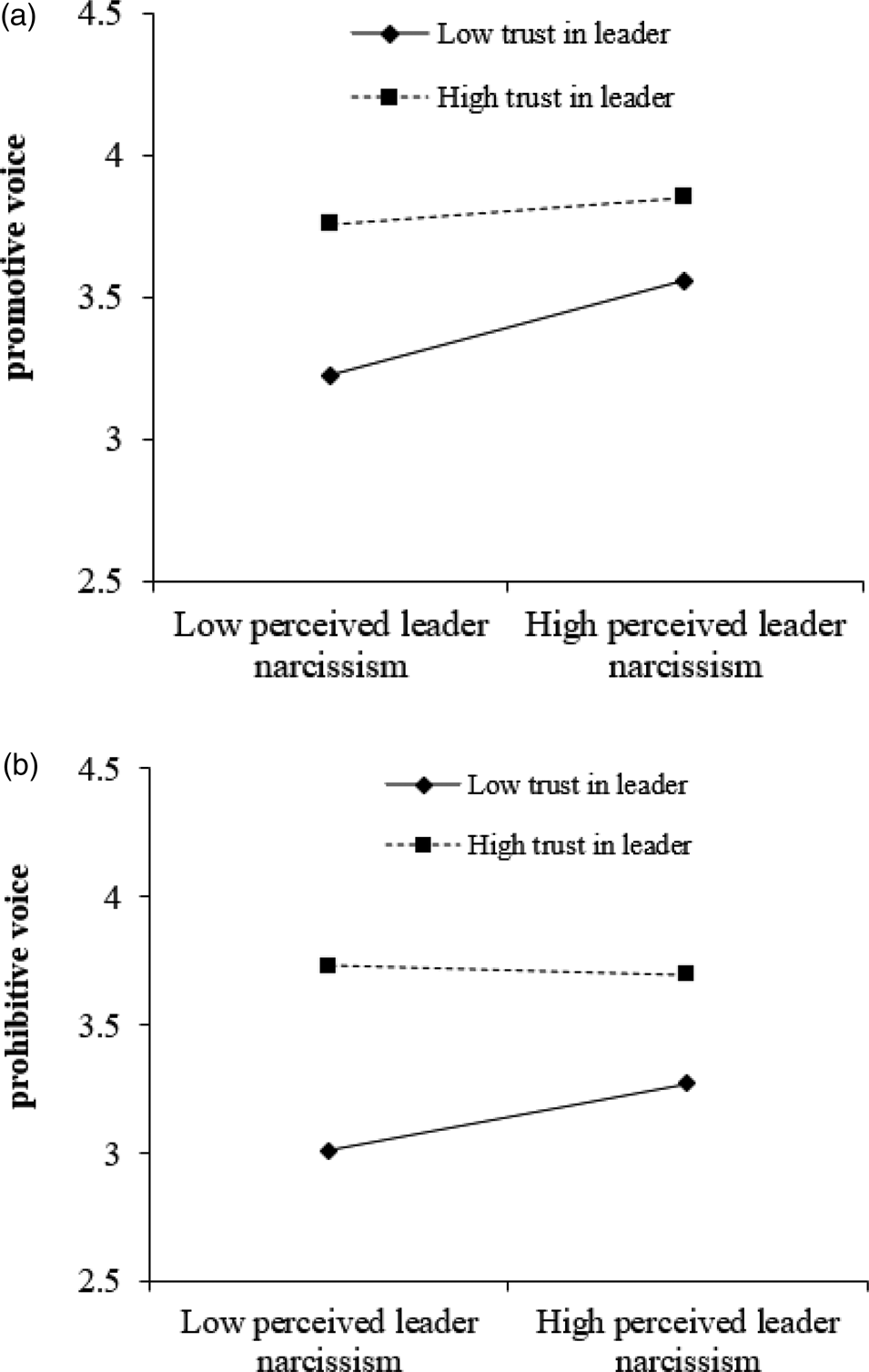
We tested hypotheses 2a and 2b by examining the interactive effects of perceived leader narcissism and trust in leader on employee promotive and prohibitive voice. As shown in model 8 and model 13 in Table 3, results indicated support for the predicted effect, with promotive voice (r = −.13, p < .05) and prohibitive voice (r = −.16, p < .01). The interactions were plotted in Figure 2a and b. Simple slopes test about promotive voice indicated that perceived leader narcissism was unrelated to promotive voice when trust in leader was high (B = .05, SE = .07, n.s.), and positively related to promotive voice when trust in leader was low (B = .19, SE = .07, p < .01), partially supporting hypothesis 2a. Simple slopes test about prohibitive voice indicated that perceived leader narcissism was unrelated to prohibitive voice when trust in leader was high (B = −.02, SE = .07, n.s.), and positively related to prohibitive voice when trust in leader was low (B = .15, SE = .06, p < .05), partially supporting hypothesis 2b.
(a) Interaction between perceived leader narcissism and trust in leader on promotive voice (study 1). (b) Interaction between perceived leader narcissism and trust in leader on prohibitive voice (study 1).

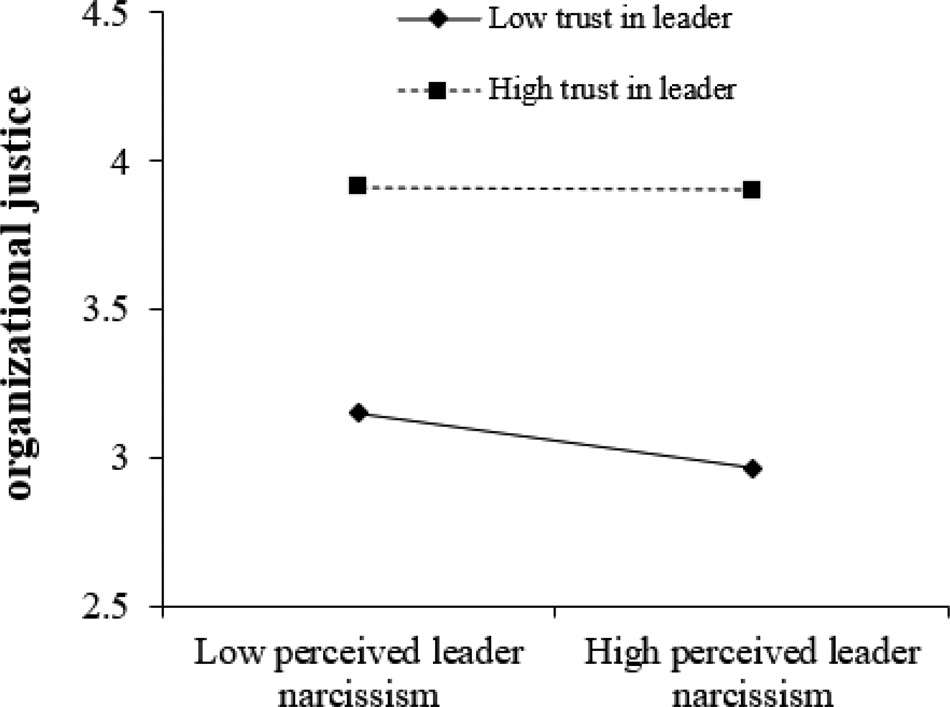
By conducting a bootstrapping procedure using PROCESS (20,000 resamples), we found that the indirect effect for perceived leader narcissism on promotive voice via organizational justice was −.19 (95% CI [−.26, −.12]). The indirect effect for perceived leader narcissism on prohibitive voice via organizational justice was −.17 (95% CI [−.24, −.10]). These results supported our hypotheses 3a and 3b. As shown in model 4 of Table 3, hypothesis 4 (r = .09, p < .05) was supported. The interaction was plotted in Figure 3. Simple slope test indicated that perceived leader narcissism was unrelated to organizational justice when trust in leader was high (B = −.01, SE = .04, n.s.), and negatively related to organizational justice when trust in leader was low (B = −.10, SE = .04, p < .05).
Interaction between perceived leader narcissism and trust in leader on organizational justice (study 1).

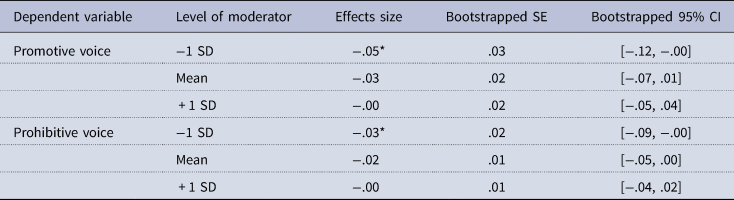
As shown in model 9 and model 14 of Table 3, hypothesis 5a (r = .47, p < .001) and hypothesis 5b (r = .29, p < .01) were supported. We further conducted analyses with 20,000 bootstrapping resamples to test our moderated mediation model using PROCESS (Hayes, Reference Hayes2013a, 2013Reference Hayesb). As shown in Table 4, the results supported hypothesis 5a. The indirect effect of perceived leader narcissism on promotive voice was not significant when trust in leader was high (indirect effect = −.04, SE = .02, CI [−.05, .04]), and significant and negative when trust in leader was low (indirect effect = −.05, SE = .03, CI [−.12, −.00]), and results supported hypothesis 5b. The indirect effect of perceived leader narcissism on prohibitive voice was not significant when trust in leader was high (indirect effect = −.00, SE = .01, CI [−.04, .02]), and significant and negative when trust in leader was low (indirect effect = −.03, SE = .02, CI [−.09, −.00]).
Bootstrapping results for test of conditional indirect effects

N = 257; CI, confidence interval. Results are based on 20,000 bootstrapped samples.
*p < .05.
Study 2 method
Sample and design
Although study 1 supported some of the hypotheses, the data design was a single source and at a one-time point, thus reducing our ability to draw the causal inference. To address these limitations, we conducted a second study in a highly controlled laboratory context where we manipulated the perceived leader narcissism as well as trust in leader. In study 2, we designed four scenarios and investigated the participants. Scenario studies are useful in exploring processes and providing evidence of causality in tightly controlled situations (Aguinis & Bradley, Reference Aguinis and Bradley2014). A total of 72 MBA students participated in the study. Their ages ranged from 25 to 41, with an average age of 30 (SD = 3.89). In total, 47.2% of the participants were male. To test hypotheses 2a and 2b, we designed two scenarios concerning trust in leader (low and high), and two scenarios concerning perceived leader narcissism (low and high). Our design was a between-subjects experimental condition. Every participant was randomly allocated to a condition and there were four groups in total.
The participants in each group read two scenarios about the perception of a supervisor. After reading each scenario, they appraised the perception. First, the participants read the scenario about trust in leader and appraised their perception of the supervisor. Second, they read the scenario about leader narcissism, and then appraised their perceived leader narcissism and their extent to engage in voice by combining the scenarios concerning trust in leader. The scenarios and manipulations are listed below.
Manipulations
The high scenario texts are below, with the wording of the low scenarios in parentheses.
Trust in leader
Xiao Liu has just graduated and works in the marketing department of an Internet company. The company has recently started to expand overseas market and arranged for Xiao Liu to join the overseas project team. It is a challenge for Xiao Liu who lacked overseas project experience. After working in the project team for some time, Xiao Liu's business ability has been improved [has not been improved]. His new boss is very experienced [inexperienced] in market development and full of motivation [lack of motivation]. The supervisor is friendly and welcomes Xiao Liu to ask questions at any time. [Xiao Liu usually asks him for advice, but ignored.] The members of the team trust [did not trust] him.
Perceived leader narcissism
Currently, the project team is developing the market, and Xiao Liu tries to offer advice to the team and point out the shortcomings. However, the project team encounters a problem, whether to prioritize market A or B. Market A has a lower rate of return, but a higher success rate, which is a good start for a company that is exploring the market overseas. Market B has a high rate of return but a lower success rate and would be difficult to develop, with members working long overtime hours. Most of the members (including Xiao Liu) suggest developing market A. However, Xiao Liu's supervisor ignores his staff's suggestions and insists on choosing market B, because he thinks he is capable enough, and developing market B will significantly improve his performance. [After considering the suggestions of the members, the supervisor decides to choose market A.] After 3 months of hard work, the project team successfully develops market B [the market A]. When reporting to the company's senior management, Xiao Liu's supervisor said that the success of the project team was attributed to his judgment at that time. [Xiao Liu's supervisor fully affirmed his subordinates' efforts.]
Measures
Unless noted, the scales used in this study were all 5-point Likert-type scales, ranging from 1 = ‘strongly disagree,’ to 5 = ‘strongly agree.’
Trust in leader
To check the effectiveness of the trust in leader manipulation, we asked participants how they feel about the leader in the scenario, using the 11-item trust in leader scale used in study 1 (sample item: ‘the leader approaches his/her job with professionalism and dedication,’ α = .95).
Perceived leader narcissism
To check the effectiveness of the perceived leader narcissism manipulation, we asked participants how they feel about the leader in the scenario, using the six-item perceived leader narcissism scale used in study 1 (sample item: ‘The leader is a very self-centered person,’ α = .90).
Voice
The same 10-item scale in study 1 was used to measure promotive voice and prohibitive voice (Liang et al., Reference Liang, Farh and Farh2012). Five items constituted the promotive voice measure (sample item: ‘I will make constructive suggestions to improve the unit's operation’; α = .86), and five items constituted the prohibitive voice measure (sample item: ‘I will proactively report coordination problems in the workplace to my leader’; α = .77).
Study 2 results
As a manipulation check, a one-way ANOVA indicated that participants in the low trust in leader condition reported lower trust (M = 2.07; SE = .11) than those in the high trust in leader condition (M = 3.89; SE = .06); F (1, 70) = 223.18, p < .001, η2 = .76. A similar one-way ANOVA showed that participants in the low perceived leader narcissism (M = 2.04; SE = .12) condition reported lower than those in the high perceived leader narcissism condition (M = 3.23; SE = .10); F (1, 70) = 56.70, p < .001, η2 = .45. Therefore, both manipulations were successful.
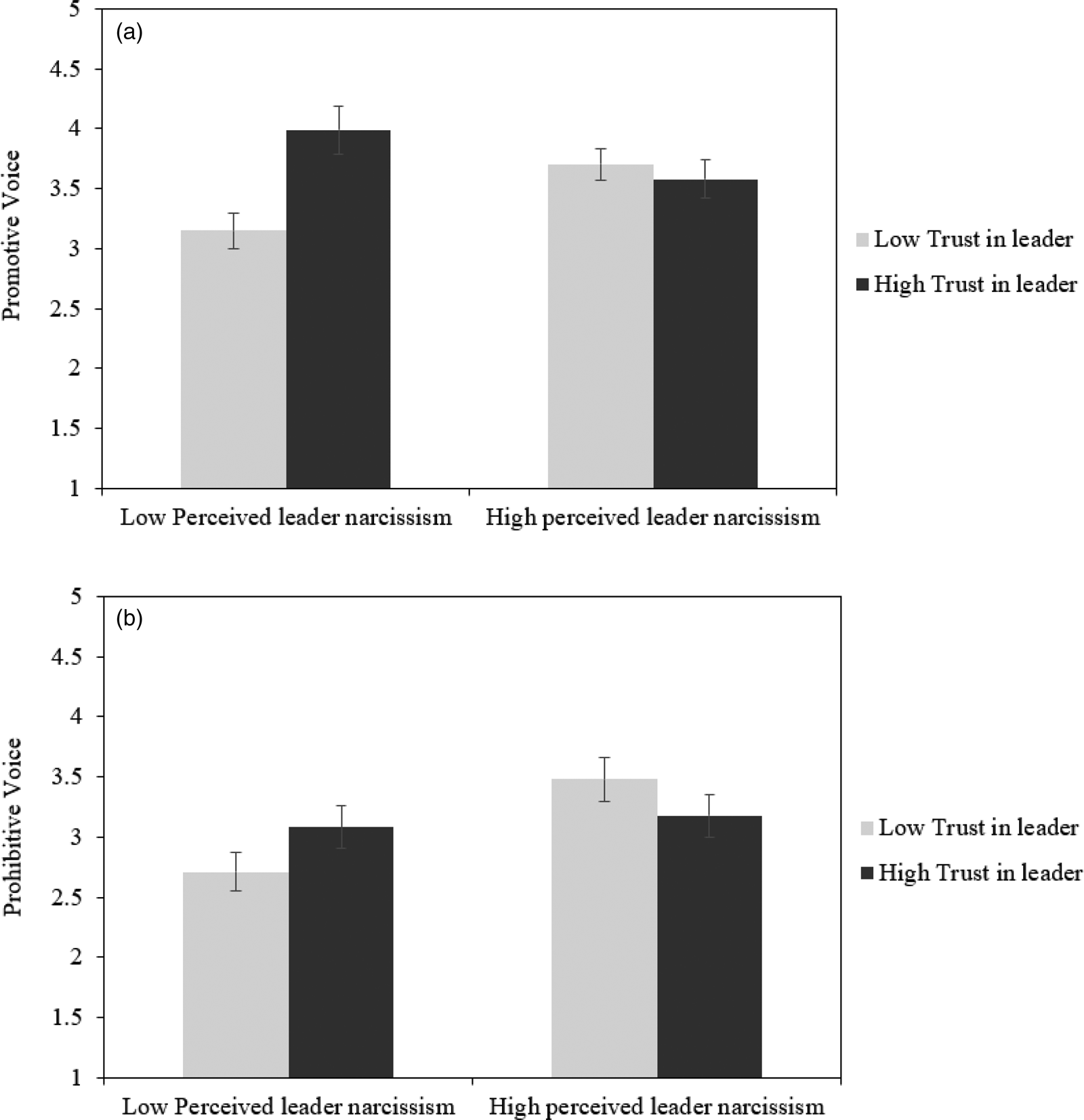
We predicted that trust in leader will moderate the negative relationship between perceived leader narcissism and promotive voice, such that this negative relationship will be weaker in the presence of higher (vs. lower) employees' trust in leader. Results from a 2 (trust in leader: high vs. low) × 2 (perceived leader narcissism: high vs. low) ANOVA on promotive voice revealed that there was a significant interaction effect between the trust in leader and the perceived leader narcissism on participants' promotive voice ratings, F (3, 68) = 4.25, p < .01, η2 = .16, indicating that the effect of perceived leader narcissism on promotive voice was moderated by trust in leader.
The interaction is depicted in Figure 4a. In support of our hypothesis, simple effects analysis showed that the perceived leader narcissism significantly enhanced promotive voice in the low trust in leader condition (M = 3.15, SD = .59 for the low perceived narcissism condition vs. M = 3.71, SD = .54 for the high perceived narcissism condition), t(30) = −2.83, p < .01. Moreover, the perceived leader narcissism has no significant effect on promotive voice in the high trust in leader condition (M = 3.99, SD = .87 for the low perceived narcissism condition vs. M = 3.58, SD = .73 for the high perceived narcissism condition), t(35) = 1.59, p > .10. Overall, these findings are consistent with study 1, partially supporting hypothesis 2a.
(a) Interaction between perceived leader narcissism and trust in leader on promotive voice (study 2). (b) Interaction between perceived leader narcissism and trust in leader on prohibitive voice (study 2).

We predicted that trust in leader will moderate the negative relationship between perceived leader narcissism and prohibitive voice, such that this negative relationship will be weaker in the presence of higher (vs. lower) employees' trust in leader. Results from a 2 (trust in leader: high vs. low) × 2 (perceived leader narcissism: high vs. low) ANOVA on prohibitive voice revealed that there was a significant interaction effect between the trust in leader and the perceived leader narcissism on participants' prohibitive voice ratings, F (3, 68) = 3.00, p < .05, η2 = .12, indicating that the effect of perceived leader narcissism on prohibitive voice was moderated by trust in leader.
The interaction is depicted in Figure 4b. In support of our hypothesis, simple effects analysis showed that the perceived leader narcissism significantly enhanced prohibitive voice in the low trust in leader condition (M = 2.71, SD = .63 for the low perceived narcissism condition vs. M = 3.48, SD = .75 for the high perceived narcissism condition), t(30) = −3.19, p < .01. Moreover, the perceived leader narcissism has no significant effect on prohibitive voice in the high trust in leader condition (M = 3.08, SD = .78 for the low perceived narcissism condition vs. M = 3.18, SD = .79 for the high perceived narcissism condition), t(36) = −.38, p > .10. Overall, these findings are consistent with study 1, partially supporting hypothesis 2b.
Discussion
In the present study, we proposed a moderated mediation model linking perceived leader narcissism with employees' voice behavior (promotive voice and prohibitive voice) via employees' organizational justice, depending on conditions of employees' trust in leader. We tested the model through study 1 (Survey study) and study 2 (Scenario experiment).
Not exactly consistent with our prediction, the results show that perceived leader narcissism negatively relates to prohibitive voice, which is mediated by organizational justice, but unrelated to promotive voice. Prior studies mainly focused on the negative effect of perceived leader narcissism on employee's voice (Huang et al., Reference Huang, Krasikova and Harms2020; Liao et al., Reference Liao, Zhou, Guo and Li2019), but did not distinguish promotive voice from prohibitive voice. We suspected that under certain situations can the perceived leader narcissism affect the promotive voice. The present empirical study shows that under different levels of trust in leader, perceived leader narcissism's influence on employees' promotive voice is different. Thus, we supposed that the existence of a moderator may be the reason why the effect was nonsignificant.
Our results further reveal that employees' trust in leader can moderate the relationship between perceived leader narcissism and voice (promotive voice and prohibitive voice). Perceived leader narcissism was unrelated to promotive voice when trust in leader was high, and positively related to promotive voice when trust in leader was low. The reasons were discussed. When employees' trust in leader was low, subordinates hardly trust their leader can make fair and rational decisions. Employees worry about their leader will harm their and the organization's interests to pursue the leader's power. From the perspective of self-serving (Kunda, Reference Kunda1987), employees will put forward some new ideas beneficial to the organization to seek breakthroughs in the status quo, hoping to promote the development of the organization by their effort rather than only relying on the decision of their leader. Moreover, the promotive voice is easier to be accepted by narcissistic leaders (Jones & Paulhus, Reference Jones and Paulhus2010), because it takes fewer risks and consumes fewer resources. Thus, under low trust in leader, perceived leader narcissism will stimulate employees' promotive voice due to their motivation for self-serving.
Besides, perceived leader narcissism was unrelated to prohibitive voice when trust in leader was high, and positively related to prohibitive voice when trust in leader was low. The reasons were discussed. When employees do not trust their leader, faced with some improper decision of narcissistic leader, employees will suffer negative psychological states (Higgs, Reference Higgs2009), and when the interests of subordinates are infringed upon by their narcissistic leader, subordinates may put forward more prohibitive voice, hoping to inhibit the misconducts of their leader from the motivation of self-serving. Although prohibitive voice often combines with risks, especially faced with narcissistic leaders, who exactly reject opposing views (Brunell et al., Reference Brunell, Gentry, Campbell, Hoffman, Kuhnert and DeMarree2008), employees still choose to speak up after comparing the gains and losses.
This study also found that trust in leader will moderate the negative indirect effect of perceived leader narcissism on employees' voice (promotive and prohibitive) via organizational justice, such that the negative indirect effect will be weaker in the presence of higher (vs. lower) employees' trust in leader.
Theoretical implications
Our study makes several contributions to the literature. First, we contribute to the leader narcissism literature by expanding scholars' understanding of how perceived leader narcissism influence employees' voice behavior. The results show that perceived leader narcissism negatively relates to prohibitive voice, but unrelated to promotive voice. The reasons why perceived leader narcissism was unrelated to promotive voice are discussed. First, the low risk of promotive voice. Narcissistic leaders like to listen to supportive remarks and are far less sensitive to promotive voice than prohibitive voice. The leader may feel a sense of accomplishment and vanity, when subordinates put forward promotive voice, believing it is his charm that encourages employees to speak up, which satisfies the leader's pursuit of power. Thus, employees perceive that promotive voice will not harm their and others' interests, will not damage the relationship between them, and take fewer risks, compared to prohibitive voice (Kakkar, Tangirala, Srivastava, & Kamdar, Reference Kakkar, Tangirala, Srivastava and Kamdar2016). Therefore, perceived leader narcissism will have a negligible effect on employee promotive voice. Second, there may exist a moderator between perceived leader narcissism and promotive voice. We suspected that under certain situations can the perceived leader narcissism affect the promotive voice. Thus, we supposed that the existence of a moderator may be the reason why the effect was nonsignificant.
Second, our findings expand the leader narcissism and voice literature by demonstrating organizational justice as a novel mechanism linking perceived leader narcissism and subordinates' voice behavior. Researchers have suggested that leader narcissism is an impact factor for employees to speak up and called for more studies on why this effect occurs in the workplace (Ding et al., Reference Ding, Li, Quan and Wang2018). Prior research has mainly focused on resource-based mechanisms between perceived leader narcissism and voice behavior (Huang et al., Reference Huang, Krasikova and Harms2020; Yao et al., Reference Yao, Zhang, Liu, Zhang and Luo2019). Our finding extends prior research by highlighting a mechanism based on the social exchange theory and, therefore, underscores the importance of the sense of reciprocity norm violation in shaping one's response to leader narcissism in the context of work. Our findings suggest that perceived leader narcissism and voice behaviors are connected through a cognitive process in which subordinates identify whether the supervisor has violated the reciprocity norm to determine whether it is necessary to follow the reciprocity norm to contribute to the organization. The uncovering of this cognitive process complements previous research that suggests that leader narcissism hinders subordinates' voice behaviors by draining their resources (Huang et al., Reference Huang, Krasikova and Harms2020; Yao et al., Reference Yao, Zhang, Liu, Zhang and Luo2019). Our results go one step further by suggesting that not only the availability of resources required for voice behavior is important, but also their sense of obligation to voice is critical if organizations seek to increase employees' voice behaviors.
Third, our study contributes to the leader narcissism literature by identifying trust in leader as one key factor in determining perceived leader narcissism's effect on employee voice behavior. Specifically, this study found that perceived leader narcissism can provoke employees' voice behaviors when employees do not trust their leader. From the perspective of Game theory, the potential benefits outweigh the risks. Similar to bottom out, when employees are negatively affected by both distrust in leader and narcissism, they are motivated by self-serving and eager to change the status quo to protect their rights and interests. Thus, when employees' trust in leader is low, the more severe the narcissistic tendency of the leader, the more it stimulates the generation of employees' voice behavior.
Our findings on the moderating role of trust in leader also help to disentangle previous controversial findings on the relationship between leader narcissism and subordinates' voice behaviors. Previous studies prominently found a negative effect of leader narcissism on subordinates' voice behaviors (e.g., Carnevale et al., Reference Carnevale, Huang and Harms2018; Liu et al., Reference Liu, Chiang, Fehr, Xu and Wang2017). However, some recent studies provided indirect evidence that leader narcissism may also benefit employees on their psychological empowerment and performance which is highly relevant to employees' voice behaviors (Owens et al., Reference Owens, Wallace and Waldman2015; Sosik et al., Reference Sosik, Chun and Zhu2014). Our study joins this emerging research stream by identifying the moderating role of trust in leader and provides explanations on the controversial findings of leader narcissism on voice behaviors.
Finally, the findings contribute to the social exchange theory by illustrating trust in the partner in the exchange relationship as a boundary condition of norm reciprocity violation. The interaction hypotheses are noteworthy as they illustrated that it is necessary to consider if employees trust their leaders to best understand the impact of perceived leader narcissism. Social exchange theory suggests that employees tend to develop distinct exchanges with different parties at work and that they direct their actions toward the focal party in response to their evaluation of social exchange relationships (Rupp & Cropanzano, Reference Rupp and Cropanzano2002). Consistent with this, previous studies on perceived leader narcissism noted that when employees perceived their leaders as narcissistic, they sense a violation of reciprocity norms caused by the leader, develop negative exchange cognitions, and engage in negative behaviors (Liao et al., Reference Liao, Zhou, Guo and Li2019). Although this seems logical, our findings showed that when employees trust their leaders, perceived leader narcissism had no significant effect on voice behaviors. In other words, our findings complement the social exchange theory by suggesting that if an employee trust the partner in the exchange relationship, he/she is unlikely to see the other person's negative behavior as a violation of the norm of reciprocity. Thus, employees do not necessarily decide to decrease voice to get even with their narcissistic leader.
Social exchange theory also suggests that employees are rational actors who maximize gains and minimize losses in exchanges with their organizations based on economic calculations. Thus, employees may engage in positive behaviors in response to negative exchange relationships to avoid losses caused by negative exchange relationships. In such a condition, this positive behavior is beneficial to the organization on the surface, but the deeper reason may be that employees are trying to protect themselves from more serious losses. In line with Thau and Mitchell (Reference Thau and Mitchell2010), our study indicated that employee reactions to negative organizational treatment are not always driven by a ‘tit for tat’ motive. Rather, their reactions may be influenced by the interpersonal trust or a ‘self-serving’ motive.
Practical implications
The present study also has several practical implications to mitigate the potentially negative effects of leader narcissism. First, our research further confirms the destructive effect of perceived leader narcissism on employee outcomes. Organizations may try to avoid hiring leaders with high narcissism if possible by having candidates fill out the NPI narcissistic personality test in the assessment section (Ames, Rose, & Anderson, Reference Ames, Rose and Anderson2006). However, narcissism is strongly associated with leader emergence (Brunell et al., Reference Brunell, Gentry, Campbell, Hoffman, Kuhnert and DeMarree2008). It may be difficult for an organization not to hire a leader with a narcissism tendency.
Second, the organization needs to ensure that talented narcissistic leaders are capable of maintaining exchange relationships and organizational justice. On the one hand, the organization can train these types of leaders to be aware of the importance of employees and their voice behaviors (especially prohibitive voice). Because, prohibitive voice is seen as more valuable and have more positive effects on the organization than promotive voice (Lin & Johnson, Reference Lin and Johnson2015), and often represents a direct challenge to the organizational status quo and leaders regard this as a challenge to their authority (Chamberlin et al., Reference Chamberlin, Newton and Lepine2017), which means prohibitive voice takes more risks. This study also reveals that perceived leader narcissism is negatively related to prohibitive voice, but unrelated to promotive voice. Using the training intervention may mitigate the narcissistic leader's egoistic tendencies and negative effects on employees. On the other hand, organizations should encourage their employees to express their opinions, especially to point out problems bravely. It will be promising for the organization to create a climate, which emphasizes justice and encourages employees to speak up in the workplace.
Finally, as our study confirmed, high trust in leader can alleviate the negative effect of perceived leader narcissism on voice behavior. But when employees have low trust in leader, leader narcissism can stimulate employee voice behavior instead. Thus, employees should not blindly trust their leaders, especially when it comes to leader narcissism. When leaders make improper behaviors, employees should learn to think from the perspective of organizational interests and dare to speak up.
Limitations and future directions
Although the present study has certain theoretical and practical implications for the research on leader narcissism and voice behavior, it still has some limitations. First, we tested our hypotheses using survey data from China. Concerning the high level of collectivism and power distance in Chinese organizations, the possible different effects of perceived leader narcissism on employee outcomes, compared to Western organizations, should be focused on (Liu et al., Reference Liu, Chiang, Fehr, Xu and Wang2017). For example, in China, we encourage harmonious social relationships and when employees communicate with their leader, both prohibitive voice and promotive voice will have greater risks in the Chinese cultural context (Qin, DiRenzo, Xu, & Duan, Reference Qin, DiRenzo, Xu and Duan2014). Thus, we call for future researches in leader narcissism to pay more attention to the role of culture, such as power distance and individualism.
Second, we validated only a partial mediating role of organizational justice and a moderating role of trust in leader from the perspective of social exchange theory. Future researchers could examine how perceived leader narcissism influence employee voice behavior from other perspectives. Third, all variables were self-reported by employees, and the cross-sectional study design was adopted in study 1, which may lead to bias and is not conducive to infer the causal relationship between variables. Although the deviation of the common method bias has been confirmed not serious (33.26%), the supervisor–employee dyads data can be adopted in the future study to improve the credibility of the results. Although this study added a scenario experiment to enhance the ability to draw the causal inference, future studies can better verify the hypothesis of this study utilizing a longitudinal survey section.
Conclusion
From the perspective of the social exchange relationship, the present study examines the effects of perceived leader narcissism on employees' voice behavior, which are mediated by employees' organizational justice, depending on conditions of employees' trust in leader. We find that while perceived leader narcissism can be detrimental to employees' organizational justice and the distal outcomes (employee voice behavior), the adverse effects of perceived leader narcissism can be offset by employees' trust in leader. Finally, we call for more researches focused on the negative effects of leader narcissism on subordinates' outcomes, and the factors which can weaken these negative effects.
Financial support
National Natural Science Foundation of China, Grant Number: 71772052.