


Introduction
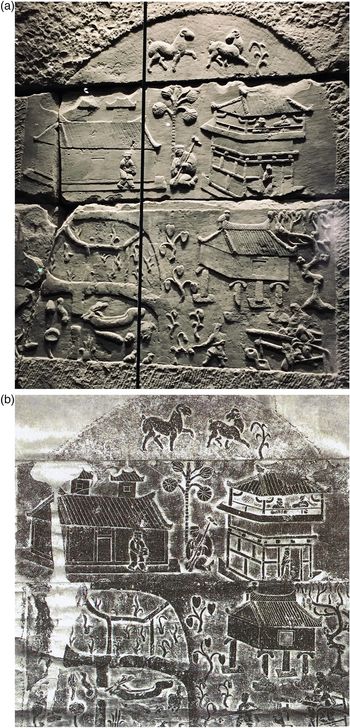
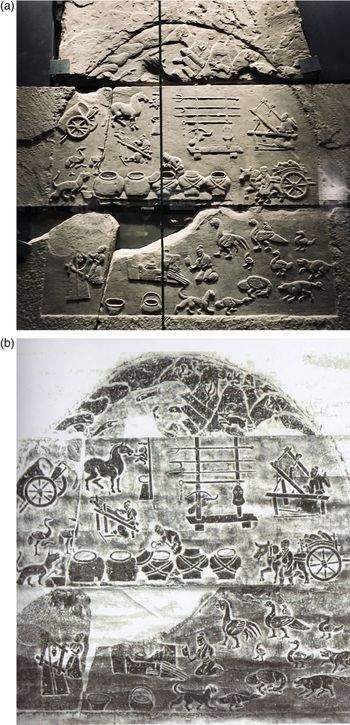
An Eastern Han dynasty (25–220 c.e.) tomb of stone and brick construction, comprising an ante-chamber, a main chamber and two rear-chambers, was unearthed in 1975 at Zengjiabao 曾家包, located in the outskirts of Chengdu city in Sichuan province. Labelled as the “east and west rooms” the two rear-chambers each housed a sarcophagus and were decorated with two large mural carvings, one titled by scholars as Yanglao tu 養老圖 (Picture of Nourishing the Old) and the other as Tianfu yinshi tu 天府殷實圖 (Picture of Heaven's Storehouse and Plenty).Footnote 1 These impressive mural carvings are now housed in the newly opened Chengdu Museum 成都博物館 on Guanghan Square 廣漢廣場 in Chengdu city. Of special interest to this article is the latter, which depicts women engaged in the activities of cloth and alcohol production. The only male figures included in the carving are the hunter on the top register and a farmer leading an ox-drawn cart loaded with sacks of grain in the middle. Zhang Tongbiao suggests that the rear-chamber with this decoration may have belonged to the deceased's wife, as textiles manufacture was typically a woman's occupation.Footnote 2 However, not remarked on by Zhang and others who have studied the Zengjiabao tomb, is that the scene of weaving is juxtaposed with a depiction of women engaged in the various tasks of brewing. In the composition, alcohol production is as prominent as the depiction of the women at their looms. The portrayal of women making alcohol in such a context suggests that, alongside cloth-making, it was an indispensable part of their daily activity and can be considered an essentially female undertaking. Among the wide range of women's responsibilities at home and on the estate, which included running the household, raising children, caring for the in-laws, and supporting their husbands, was an active role in the creation of essential economic commodities such as textiles and, as we see in the Zengjiabao mural carving, alcohol (Figures 1 and 2).
Stone carving and rubbing of “Picture of Nourishing the Old,” Zengjiabao, Sichuan (Photo by H. Elias, rubbing from Zhang, “Chengdu Zengjiabao Han mu huaxiang yishu tanwei,” 51).

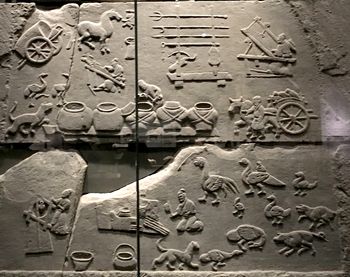
Stone carving and rubbing of “Picture of Heaven's Storehouse and Plenty,” Zengjiabao, Sichuan (Photo by H. Elias, rubbing from Zhang, “Chengdu Zengjiabao Han mu huaxiang yishu tanwei,” 50).

Scholarship on women in early China has typically focused on the former, with the act of weaving understood as a metaphor for the virtuous woman, while women's part in the making of alcohol remains unexplored.Footnote 3 Studies on women have primarily addressed their social role, with an emphasis on servitude and moral rectitude; yet their economic contribution, apart from involvement in textile production, has received little attention. Early texts typically distinguish men by the type of position and job they held, which defined their social status; however, women are generally referred to as someone's wife, mother, daughter, or daughter-in-law, implying that their role in the public sphere was largely defined by their relationships to men.Footnote 4 We assume that men were dominant in the social and economic domain, and that women played a negligible or even passive role. While this may well have been the case, we can achieve a more nuanced understanding by asking questions such as those posed by Lucia Nixon in her study of gender bias in early societies, “What was the division of labour and how can we study it using material evidence?”Footnote 5 Francesca Bray also notes that the household was the basic unit of production for women, yet the study of women's work within this “unit” has been neglected, and we know little about its basic composition, the division of labor, the control of skills, and women's managerial or earning power.Footnote 6 By examining information obtained from material culture and textual sources, this article aims to contribute to the study of women's participation in the household economy with a special focus on their role in the production of alcohol.
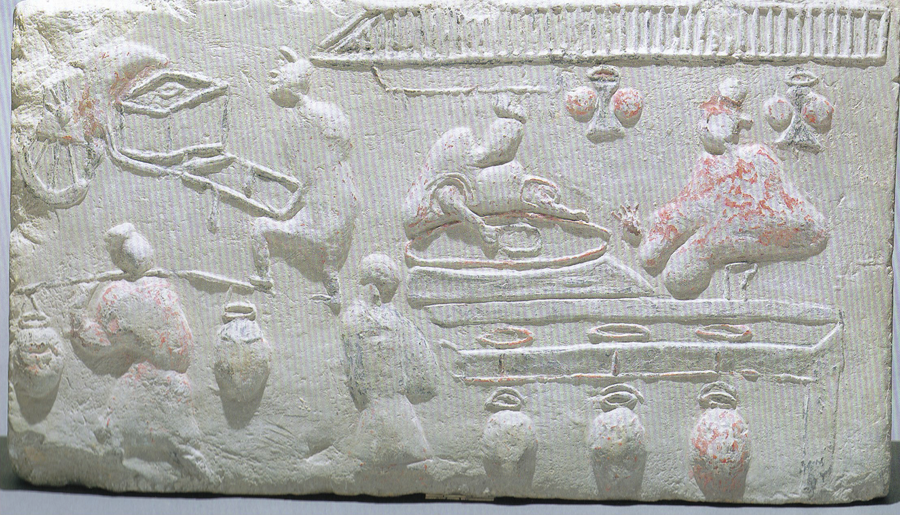
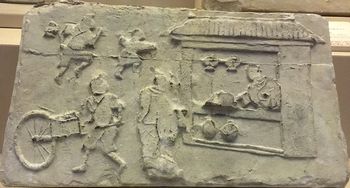
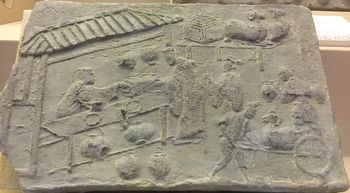
Following the introduction, the article examines the Zengjiabao mural carving in detail along with another contemporaneous pictorial brick tile known by the title “Picture of Alcohol-Making” (Niangjiu tu 釀酒圖) discovered at Xinlong village 新龍村 in Xindu county 新都縣, Sichuan. This tile, which complements our examination of women's engagement in alcohol production, shows three female figures engaged in the making of alcohol in a workshop setting (Figure 3).Footnote 7
Pictorial Brick Tile with “Picture of Alcohol-Making,” Xindu, Sichuan (Photo by H. Elias)

Our examination of material culture is supplemented with the introduction of early textual sources that record women's association with alcohol: its brewing and consumption, and their engagement in its sale on the market and in shops. Overall, it is suggested that while the social status of men and women in early China were very different, in the economic life women may have had a considerable role to play. Their contribution to the wellbeing of their families from cloth-making and alcohol production must have been substantial in the household or in the “inner” (nei 內) sphere.Footnote 8 Hence the “inner” quarters of the household may be identified not as a zone of dependence but as a site of essential productive activity that tied it into the social polity of the empire.Footnote 9 Our analysis of pictorial evidence documenting an important economic activity in the southwest, the production of alcohol, also helps shed light on a group in society who were intimately connected in their shared experiences and engagements.
Since this article focuses on women as depicted in the material culture of Sichuan, it is necessary to consider their status throughout the Han social hierarchy. As noted by Olivia Milburn, many aspects of an individual's life were affected by the rank he or she held, including the kind of house they could live in, the amount of land they could hold, the taxes they paid, and the kind of treatment they received if convicted of a crime. Although married women were normally legally disbarred from becoming heads of household, and hence did not hold rank or land in their own right, it is known that other women could hold rank and thus take possession of the designated allocation of land as designated heirs.Footnote 10 Naturally, there were multiple hierarchies or class differences among women during the Han, and Milburn refers to the salaried elite class of women who were part of the institutional structure of the hougong 後宮 or the “rear palace.” It is not always possible to identify clearly where in the social hierarchy the women depicted in Sichuan tomb art were positioned. We have no information on the identity of the tomb owners where the mural reliefs or the pictorial brick tiles were found, and we can only hypothesize on the social ranking of those depicted. Women shown brewing ale on the estate most likely did not belong to the elite class. Nor were they the head of the lineage or family, as they are clearly portrayed as laborers and may have been servants or even slaves. Although their skills may not fall into the same categories of moral responsibility or significance as those of noble birth, the primary audience of some of the homiletic texts for women such as the Lienü zhuan 列女傳 (Biographies of Exemplary Women), nevertheless, they had an essential role to play in society.Footnote 11 Regarding the three women engaged in the production of alcohol in a workshop setting, there is a visible hierarchical distinction made in the composition which will be explained in detail below. However, it is worth noting here that the workshop scene brings to our attention the level of urbanization in the Eastern Han period, when merchants gained enormous wealth supporting a thriving mercantile economy. Most manufacturing was undertaken privately and there was much profit to be made from products such as brewed beverages.Footnote 12
Another important aspect to note here is that the depictions of women examined in this article are not didactic in nature, as seen on the relief carvings from the Central Plains such as the former site of the Wu family shrines (Wu Liang ci 武梁祠) in Jiaxiang county 嘉祥縣, Shandong province.Footnote 13 They are not the patterned lienü figures carved on the walls of the shrine and tombs, but are images of “ordinary” women getting on with their daily lives. What is also evident from the images examined is that although women appear to be in charge of the production of alcohol itself, men are also shown as helpers or transporters of the raw material and the finished goods, and thus had a role to play. Although it is a collaborative process, it appears that women are in charge and men are assisting them. Therefore, this collaborative effort is based on two types of complex hierarchies—the hierarchy between women and between women and men.
The Tianfu yinshi tu
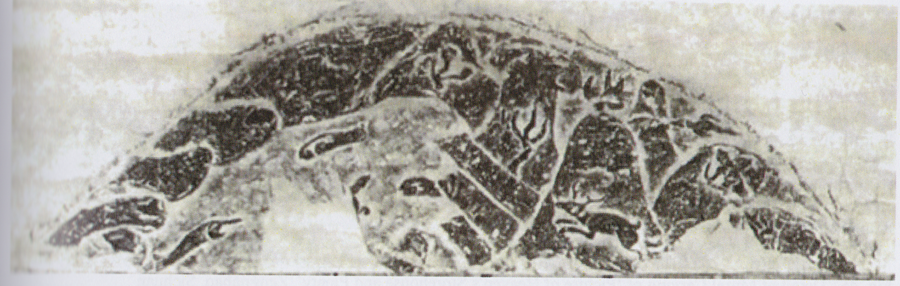
The Tianfu yinshi tu is an exceptionally large mural carving (approximately 5 m X 5m), which covered the entire wall space of the west rear-chamber at the Zengjiabao tomb. It is divided into three distinct compositions: a hunting scene in the top register, a scene of two women weaving in the middle, and three women engaged in making alcohol on the lower panel.Footnote 14 The hunt takes place in a mountainous landscape setting. We see a deer chased by a hunter who is drawing his arrow and aiming at the fleeing animal. There is also a large bird in flight and a pond is depicted containing plump fish (Figure 4).
Details of “Picture of Heaven's Storehouse and Plenty,” Zengjiabao, Sichuan (Rubbing from Zhang, “Chengdu Zengjiabao Han mu huaxiang yishu tanwei,” 50)

The hunt portrayed here does not appear to be the social or leisure activity undertaken by the wealthy, as generally seen on contemporaneous tomb carvings that show hunters on horseback pursuing their game.Footnote 15 Nor is it the hunt described by Sima Qian in the Shi ji, where we read about Zhuo Wangsun, who made his fortune by smelting iron in the southwest and enjoyed pursuing games on his vast lands.Footnote 16 Nor is it the royal hunt recounted in the Rhapsody on the Imperial Park (Shanglin fu 上林賦) by Sima Xiangru,Footnote 17 or the “pleasure hunt” (youlie 遊獵) narrated by Ying Shao 應劭 (d. c. 203 c.e.) in the Fengsu tongyi 風俗通義 when he writes that,
文帝代服衣罽, 襲氈帽, 騎駿馬, 從侍中, 近臣, 常侍, 期門武騎獵漸臺下, 馳射狐兔, 果雉刺彘.
Emperor Wen would change into his woven wool cloak and felt cap, mount his fine horse and hunt below the Terrace Bathed by Water with Attendants of the Palace, trusted officials, regular Attendants, Guardians of the Gate and military cavalry. They would shoot from horseback foxes and rabbits, long-tailed apes, pheasants and porcupines.Footnote 18
The depiction of the hunt on the Zengjiabao mural carving is that of the ordinary huntsman on foot seeking his next meal and, in this context, it reflects an essential economic component of the southwest. The scene is replete with references to abundance and wealth, with the deer alluding to longevity and the fish included as a symbol of plenty and abundance.Footnote 19 It reflects the rich landscape of the southwest, which, as we read in early texts, is naturally abundant in food sources.Footnote 20 Thus it is an iconographical element placed in the tomb that is specifically associated with the southwest's local practice.
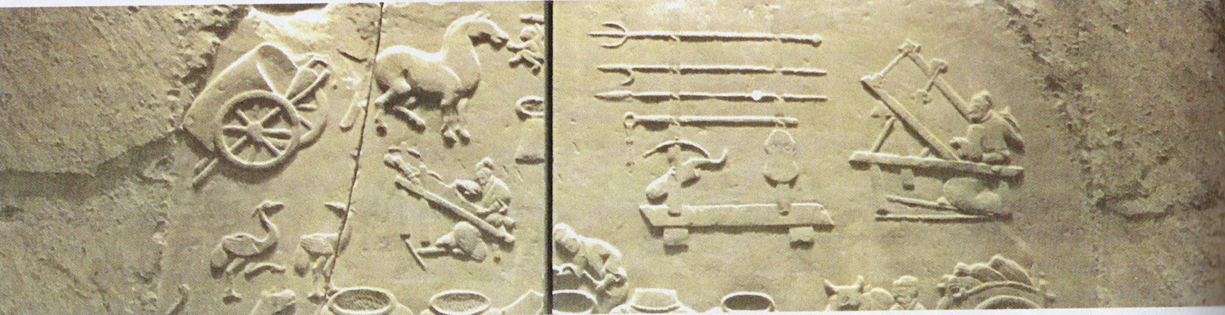
The middle register of the Tianfu yinshi tu is carved with a large weapon-rack to the right, stacked with a fork spear, a halberd, a lance, a ring-handle sword, a bow and arrow, and a shield. Left of the rack there is a monkey hanging from a pole mischievously holding out its left arm and playing with a horse standing in front of it. The horse is animated as if ready to bite the monkey's stretched out fingers. The weapon-rack, showing unused weapons, may represent strength, safety, and peace, while the monkey symbolizes the wish to protect horses on the estate from harm and disease.Footnote 21 A two-wheeled covered wagon can be seen behind the horse, perhaps waiting to transport the large guan 罐 form vessels, used for containing alcoholic beverages, to the market. The scene also shows two women seated at weaving looms, one positioned to the right of the weapon-rack and the other in front of the horse to the left. The looms are of treadle construction, also known as brocade or pattern looms, that were widely used in the southwest to make the region's famous “Shujin” 蜀錦 or the Shu brocade mentioned in a number of early texts.Footnote 22 A Western Han period chamber tomb discovered in 2013 at Laoguanshan 老官山, in the outskirts of Chengdu, provided the earliest known evidence of pattern loom technology employed for weaving the Shu brocade. The tomb contained four lacquered wooden miniature models of looms, together with figurines of women weavers and other artifacts. The models are similar to those depicted on the Zengjiabao relief, suggesting that the stone carver was familiar with the looms, and most probably based his work on actual examples (Figure 5).Footnote 23
Detail of Mural Carving of “Picture of Heaven's Storehouse and Plenty.” Zengjiabao, Sichuan (Photo by H. Elias)

The bottom register of the Tianfu yinshi tu depicts various tasks connected with the making of alcohol. On the left, a man is shown leading an ox-drawn two-wheeled cart. He is approaching five large earthenware guan jars, three strung up with ropes ready for lifting and transporting. His cart is laden with heavy sacks that possibly contain grains such as rice, millet, barley, or sorghum for the making of the brew. The jars are set in a row, partially embedded in the ground which was a method used for holding the containers in place and to regulate their temperature. A woman holding a stick in her left hand and a ladle in her right appears to be stirring and ladling the fermenting alcohol in one of the large vessels which is open with its cover placed hanging on the side. Four out of five jars are open while one is sealed with a lid. To the left of the jars a dog is shown with its front paw stretched out above a pan. Perhaps the pan contains discarded dregs or zao 糟 that has been filtered out during the fermentation process and was used for feeding animals. On the bottom left corner of the composition a woman is drawing water from a well and to her right another female figure is attending to the stove. The yard is populated by farm animals such as geese, ducks, chicken, pigs, rooster and even what may possibly be a domestic cat, continuing the theme of plenty.Footnote 24 All the women shown in this composition are clothed in the typical Han fashion of robes with their necklines covered with V-shaped collars and their hair tied up in a top-knot. There is no visible distinction made between them that would suggest a difference in their social hierarchy. They are possibly laborers, servants, or members of the extended household that provided labor on the estate in charge of a specific type of work (Figure 6).
Details of Mural Carving of “Picture of Heaven's Storehouse and Plenty” Zengjiabao, Sichuan (Photo by H. Elias)

The mural carving highlights a number of stages in the production of alcohol. Water from the well is used for the making of the qu 麴, a starter of molded grain, and for topping-up the fermenting brew. The making of alcohol required mixing qu with steamed rice and water which was then left to ferment over a day or for a longer period according to the type and strength of alcohol required.Footnote 25 The woman by the stove is preparing the fire for steaming rice, cooking the qu or keeping the fermenter warm. When it was necessary to cool the brew down or to slow fermentation the jar covers were removed.Footnote 26 The woman with the ladle is either stirring the ferment, adding more qu, or filtering the liquid from its dregs. No sources prior to the Qimin yaoshu 齊民要術 provide detailed information on the different stages of fermentation process and on the various types of ferments prepared.Footnote 27 Although the Li ji 禮記 lists the six essential ingredients and tools for making alcohol for ritual ceremonies, the fermentation process and the various types of ferments prepared,Footnote 28 Wang Chong's brief description in the Lunheng 論衡 possibly comes closest to describing the process of how alcohol was made and how this work was esteemed at the time. He wrote:
蒸穀為飯, 釀飯為酒. 酒之成也, 甘苦異味; 飯之熟也, 剛柔殊和. 非庖廚酒人有意異也, 手指之調有偶適也. 調飯也殊筐而居, 甘酒也異器而處, 蟲墯一器, 酒棄不飲; 鼠涉一筐, 飯捐不食.
[When] grain is steamed it becomes edible [food], [when] edible [food] is fermented it becomes alcohol. [When] alcohol becomes ripe [it may have] the differing taste [of being] sweet or bitter. When food is cooked [it may have] the differing blending of being broken or bound together. This is not because the cook and the alcohol maker have different intentions, but because the rhythm of their hands and fingers have a chance fit. Seasoned food is placed in different baskets, sweet alcohol is also placed in different vessels. [When] an insect falls into a vessel the alcohol [in it] is discarded and not drunk; [when] a mouse plods through a basket, the food [in it] is thrown away and not eaten.Footnote 29
Hence, the Tianfu yinshi tu is a valuable source for understanding the different operations involved and how alcohol was produced on the estate to support the needs of the household during the Eastern Han dynasty.Footnote 30
The seasonality of this mural carving is evident from the activities recorded. We know that the practice of killing animals for ritual sacrifices and hunting were strictly regulated to be conducted in the autumn and winter months.Footnote 31 Cloth-making was also organized during the winter when women were not busy with fieldwork. The Han shu records how in the winter people stayed indoors and women who dwelled in the same alley-way did their spinning together at nights, thereby economizing on the expense of light and heat.Footnote 32 For brewing, considerable care was taken to ensure that the temperature of the fermenting liquid was kept even, and as noted by Huang Hsing-Tsung, alcohol was primarily produced from late autumn to the early spring in the south and southwest regions.Footnote 33 This mural setting in autumn or winter, contrasts with its counterpart carved on the wall of the east rear-chamber of the Zengjiabao tomb which depicts the theme of “Nourishing the Old” with an emphasis on filial piety and charity in a lush landscape setting indicative of spring and summer.
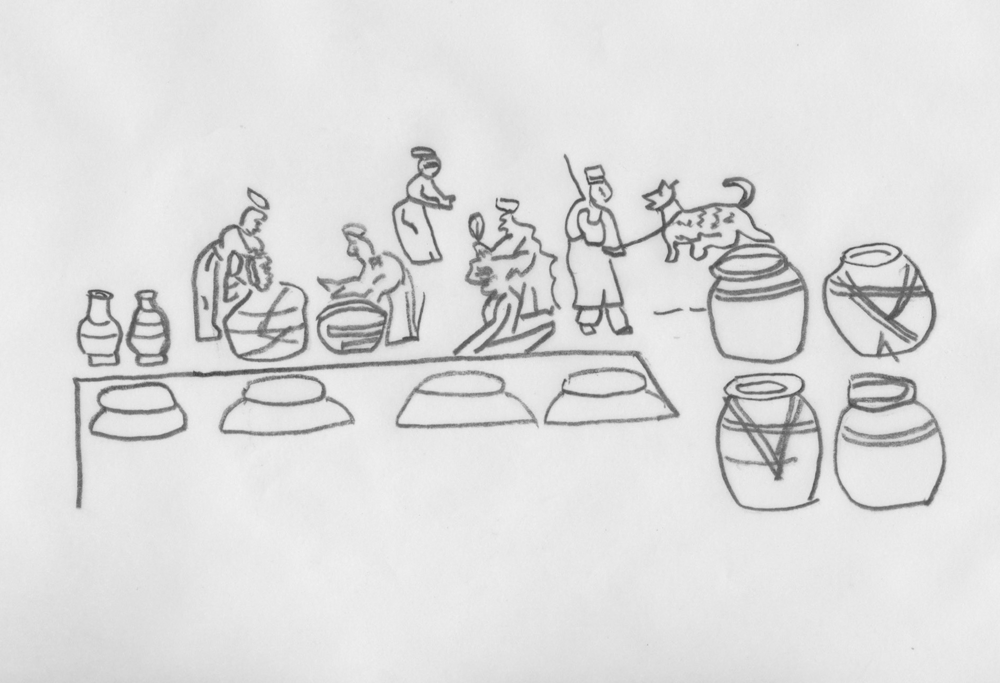
Although not from the southwest, two further stone carvings with images of women making alcohol warrant attention. One discovered in a tomb at Liangtai 涼台 in Zhucheng county 諸城縣, Shandong province, and another unearthed at Dahuting village 打虎亭村 in Mi county 密縣, Henan province. The former depicts a kitchen scene with images of brewing in the bottom register of the composition.Footnote 34 A number of large jars are lined up on the ground with two women bent over them ladling or mixing the ferment. Next to the woman on the left are two hu-form 壺 vessels which were typically used for storing alcohol (Figure 7).
Details of stone relief with a kitchen scene, Zhucheng, Shandong (Redrawn from Wang, “Shilun woguo zhengliu jiu zhi qiyuan,” 30)

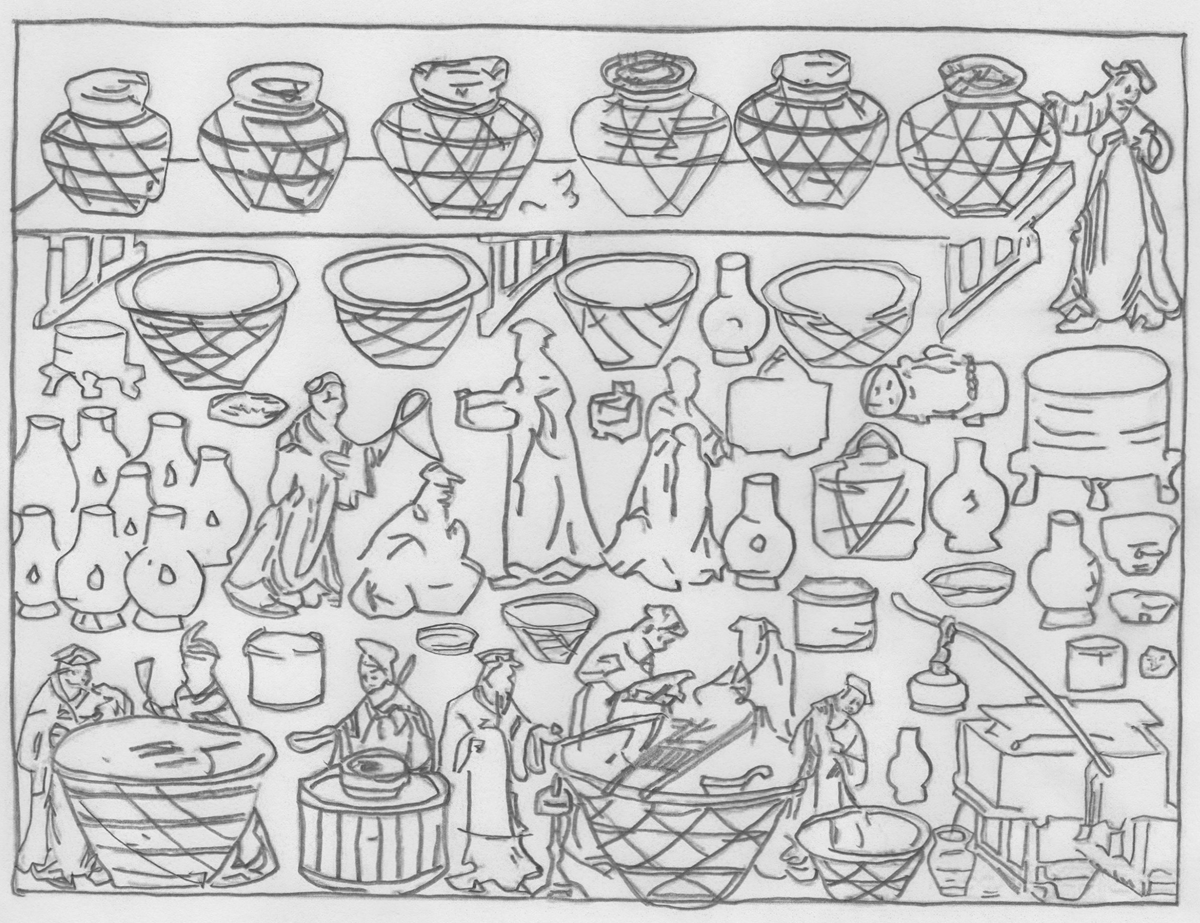
The relief carving from Henan is entirely dedicated to the illustration of alcohol production.Footnote 35 Twelve female figures are shown attending to the various tasks of brewing. This image is fascinating for its depiction of the different types of vessels used for storing alcoholic beverages at the time. Apart from large jars, there are also a number of different size hu and a large tripod cauldron that was typically used at banquets as seen on a number of Eastern Han period pictorial brick tiles from Sichuan.Footnote 36 Cauldrons were typically used for cooking and serving soups and stews, however, the appearance of a cauldron in this scene suggests that they were also used for holding alcoholic beverages, perhaps the type known as lao 醪 which was a thin and sweet alcoholic porridge that contained lees.Footnote 37 The women seen on these two reliefs appear to be part of the kitchen “staff,” however, it is interesting to note that in the former relief men and women are shown working together, while in the latter, not a single male figure is in sight (Figure 8).
Stone relief with picture of alcohol-making, Mi county, Henan province (Redrawn from Sun Ji 孫機, “Toufu wenti” 豆腐問題, Nongye kaogu 農業考古 1998.3, 294)

Alcohol Production in a Workshop: The Niangjiu Tu
Complementing the depiction of alcohol production on the estate, the Niangjiu tu from Xindu county shows women making alcohol in a workshop setting (see Figure 3).Footnote 38 According to some scholars, this brick tile may be the earliest depiction of alcohol distillation in China.Footnote 39 Until recently it was thought to represent only the process of alcohol fermentation. However, since the discovery of an Eastern Han period bronze boiler and a steamer with a drain tube attached to its side, in a tomb at Chuzhou 滁州 in Anhui province, scholars are now divided in their opinion, with some suggesting that the image on the Xindu brick tile is of alcohol distillation rather than fermentation.Footnote 40 In his examination of early alcohol production in China, Huang suggests that the discovery of the bronze boiler and steamer confirms that the technology for making distilled spirits from either clear alcohol or fermented mash has existed in China since the Eastern Han period.Footnote 41 Whether the Xindu pictorial brick tile depicts the process of brewing or distillation remains a matter of debate; what is certain, however, is that the Niangjiu tu depicts a group of women, and not men as erroneously attributed in the past, engaged in the making of alcohol.
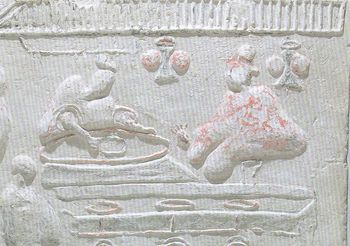
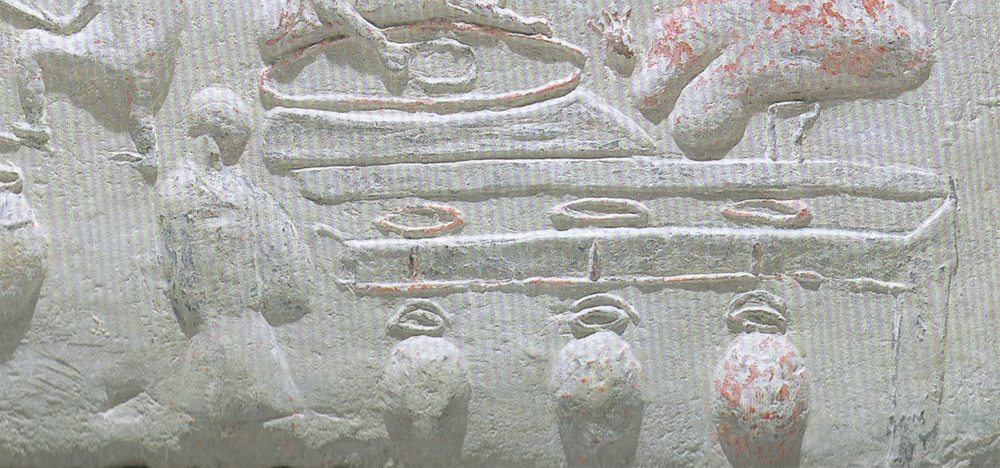
The Niangjiu tu depicts two female figures, with their hair pulled up in top-knots, seated under the extended roof of an open workshop.Footnote 42 The woman on the left, holding a round ladle in her right hand, appears to be either stirring or ladling the contents of a large open pan, while she steadies herself by grasping the edge of the vessel with her left hand. Her sleeves are tied up to facilitate her work and perhaps to keep her cool from the heat rising from the stove in front. Her right shoulder is raised slightly higher than her left which indicates that she is in motion, leaning into the pan while dipping the ladle. The woman seated next to her on the left appears to be supervising her. She has an arm extended towards the pan in a gesture of giving instructions. The artist has made her appear slightly taller and in a more prominent pose than her companion, a technique used by artists when they intend to emphasize elevated status. Above the heads of the two women are two alcohol jugs and four erbei 耳杯 drinking cups hanging from the eaves. To the left of the vessels is a rectangular structure used for storing distiller's grain.Footnote 43 In front of the two women is a large oven with three circular openings in the top (Figure 9). In the lower part of the scene a third woman stands next to the oven attending to its fire (Figure 10).
Detail of Niangjiu tu, Xindu, Sichuan (Photo by H. Elias).

Detail of Niangjiu tu, Xindu, Sichuan (Photo by H. Elias)

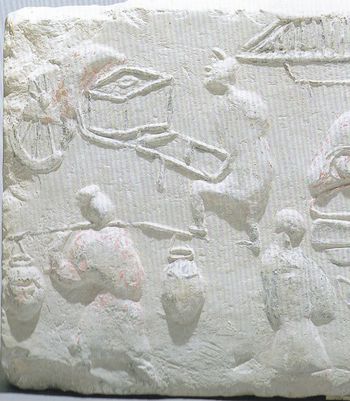
The three women in this composition are part of the workshop and appear to be in charge of its running. They may be laborers, servants, or family members in what appears to be a commercialized enterprise. Their depiction confirms their importance in the workshop and suggests that they may also be shopkeepers or merchants in charge of the sale of their product. Below the oven there are three pipes shown leading to three jars aligned in a row. If the scene is indeed that of a distillation process, then the pipes are used to conduct and convey the distilled spirit into jars. On the left bottom of the picture there is a man carrying two jars on a pole over his shoulder. He appears to be transporting the beverage to the market where it is sold in shops or stalls as seen depicted on a number of contemporaneous pictorial brick tiles from Sichuan, such as another tile from a different tomb in Xindu county.Footnote 44 On the top left corner of the alcohol production scene, a man is pushing a wheelbarrow loaded with a large square covered box that possibly contains the ready-made qu or starter (Figure 11).
Detail of Niangjiu tu, Xindu, Sichuan (Photo by H. Elias)

Similar boxes are also depicted on images of alcohol sellers on the Chengdu market suggesting that qu may have been sold in shops for home brewing (Figures 12 and 13).
Pictorial Brick Tile with “Picture of Alcohol Seller,” Xindu, Sichuan (Photo by H. Elias)

Pictorial Brick Tile with “Picture of Alcohol Seller,” Pengzhou, Sichuan (Photo by H. Elias)

In summary, the Niangjiu tu represents three vital areas of work involved with alcohol production: its making, its transportation and the supply of ingredients. Regarding the jars under the stove, Huang observes that they are simply too small for holding fermented alcohol and are therefore more probably containers for distilled spirits.Footnote 45 Indeed, the guan depicted on the Zengjiabao mural carving are much larger in size in proportion to the women standing next to them, suggesting that they are probably too heavy to carry on one's shoulders. It is worth noting that the process of distillation would more likely have been conducted in a commercial workshop rather than in a domestic setting because of the specialized equipment and expertise it required.
Early Textual Sources on Women and Alcohol
As seen from the material culture examined above, women feature prominently in the production of alcoholic beverages. They are depicted in the various stages of its making on the estate and in the workshop. The placement of these images in the tomb is evidence that alcohol production was an integral part of women's daily activities and that brewing was among the household work commonly expected from them at the time. Early instructional textual sources, examined below, also provide insight into expectations around women's dealings with alcohol, its brewing, drinking and sale in shops and on the market.
The Li ji lists the serving of alcohol and food at ritual ceremonies as one of a number of female responsibilities:
女子十年不出, 姆教婉娩聽從, 執麻枲, 治絲繭, 織紝組紃, 學女事以共衣服, 觀於祭祀, 納酒漿籩豆菹醢, 禮相助奠.
A girl ten years [of age] does not go out. [Her] governess teaches [her how to be] graceful, bear a child, listen and obey. [She is also instructed how to] take care of flax and hemp, manage silk and cocoons, weave and spin cords and ribbons. [She is to] learn women's work and thereby supply clothes and garments. [She is to] observe at ritual sacrifices, supply [them with] alcohol and sauces, [and with offerings of dried food] on bamboo tazzas, beans, pickled vegetables and pickled meats. [She also] assists and helps lay out the offerings [of food and alcohol for sacrifices] at ritual ceremonies.Footnote 46
Women's role in the preparation of alcoholic beverages is also mentioned in the Lienü zhuan, which tells the story of Mencius's mother who describes a wife's responsibilities as follows:
夫婦人之禮, 精五飯, 審酒漿, 養舅姑, 縫衣裳而已矣. 故有閨內之修, 而無境外之志.《易》曰: “在中饋,無攸Footnote 47遂.”《詩》曰: “無非無儀, 惟酒食是議.” 以言婦人無擅制之義, 而有三從之道也.
The rites of a wife [require her to] purify the five grains, examine alcohol and sauce, nourish [her] husband's parents, sew clothing and lower garments, and that is all. Thus she should devote herself to the inner quarters and should not have the intention of [cultivating that which is] outside the boundary. The Book of Changes says, “Inside [she] presents food and does not pursue [that which is] distant. The Book of Odes says, “[She has] no transgressions and no principles [to follow], [she is] to concentrate on satisfying [the making and preparation of] alcohol and food. By means of these [we can] talk [about] the righteousness of the regulations of women not usurping [authority] and [why] they have the Way of the Three Obediences.Footnote 48
A further reference may be found in Ban Zhao's 班昭 (45–116 c.e.) Admonitions to Women (Nüjie 女誡), in which she wrote, “[Women are to] spin and weave with wholehearted devotion. [They should] not love [engaging in useless] play and laughter. [They should make and prepare] pure millet cakes, alcohol and food, [and] thereby serve guests. This is called womanly work” (專心紡織, 不好戲笑, 潔齊Footnote 49酒食, 以奉賓客, 是謂婦功).Footnote 50
We are given an insight into the importance of making alcohol, especially li 醴, a sweet drink that was left to ferment overnight or for a very short period and used primarily for ritual purposes, in the chapter on the worthy and enlightened wife of Bao Su 鮑蘇 in the Lienü zhuan.Footnote 51 In this tale Bao Su's wife continues taking care of her mother-in-law despite knowing that her husband had a mistress whom he showered with many valuable gifts.Footnote 52 When asked by her sister-in-law why she does not leave her husband, she says:
婦人一醮不改, 夫死不嫁, 執麻枲, 治絲蠒, 織紝組紃, 以供衣服, 以事夫室, 澈漠Footnote 53酒醴, 羞饋食以事舅姑.
Once a woman offers a cup of alcohol at her husband's wedding, [she is] not to change [her mind]. [Even when her] husband dies [she is] not to remarry. [She is to] carry out [weaving] hemp fibers, managing [the making of] silk, weaving silk fibers and forming silk cords and thereby supplying [her husband with] clothing and attending to [her] husband's household. [She is to] purify alcohol and li and to present delicacies and food and thereby serve her in-laws.Footnote 54
The above passages have been translated and analyzed, most recently by Anne Kinney, with a focus on women's responsibility over the preparation and serving up of food and alcohol.Footnote 55 However, women were not only responsible for serving alcohol, as is generally understood, but, as reiterated in the story of Bao Su's wife, they were expected to be proficient in the know-how of its making. Women's responsibility for the preparation and serving of alcohol and food was fundamental to the proper execution of rituals and ceremonies.Footnote 56 However, their role was recorded selectively and although never completely excluded from descriptions of ritual practices, their participation was carefully defined.Footnote 57
Women's Work (nüshi 女事) and Gendered Roles
An examination of what constituted “women's work” (nüshi), as mentioned in the Li ji, is useful. Early writers identified textile manufacture as an idealized form of female occupation and saw it as a virtuous undertaking that not only assigned women an economic role but also supplied them with a moralizing identity. The biography of Gongsun Shu 公孫述 in the Hou Han shu records how the business of women's work is to provide clothing for those under heaven.Footnote 58 Women's labor at the loom is also directly linked to the state's prosperity, as recorded in the Huainanzi 淮南子, which warns that when the farm labor is abandoned and women's work is harmed, it becomes the root of hunger and the source of cold.Footnote 59 Cloth-making was elevated into a symbolic activity that imbued a woman's life with moral meaning, while in the economic domain its importance to the state's coffers was recognized as a necessity.Footnote 60 Yet, women's mastery of alcohol production, an equally important contribution to the household economy and one that also required specialized knowledge and skills, is not used as a trope for female virtue and identity in the same way as weaving.
An aspect worth addressing here is the notion of gendered work in early China. The term “men till and women weave” (nan geng nü zhi 男耕女織) emerges as an established social and political doctrine advocated from as early as the fifth century b.c.e. when it was formulated by philosophers and institutionalized in the tax system.Footnote 61 Angela Sheng notes how the division of labor was understood as necessary to sustain a subsistence living for commoners and for them to pay taxes to the state in an agricultural economy.Footnote 62 Thus men tilling and women weaving represented an idealized construct in which the general population was assigned with responsibility and was provided with moral purpose.Footnote 63 Early China's tax system imposed on society a gendered division of labor, men working the fields while women produced cloth, and at the same time assumed a productive female labor force that contributed to both the household and the state. The Yantie lun records how the ancients judged people according to what they produced; hence, farmers paid taxes with what they obtained from the land and women contributed with their work from the production of textiles.Footnote 64
Early writings also alert us to the fact that alcohol production was an integral part of agricultural labor which was seen as a male occupation. The medical classic, the Huangdi neijing 黃帝內經, documents how alcohol is the fluid of cooked grain (酒者, 熟穀之液也), and the Huainanzi notes how the beauty of clear alcohol begins with the plow and the spade, while the beauty of fine brocade begins with the shuttle and the loom (清醠之美, 始於耒耜; 黼黻之美, 在於杼軸).Footnote 65 Mu-chou Poo draws our attention to the dependence of brewing on grain production and how it was intimately related to field work.Footnote 66 Although women's participation in field work is evident from pictorial brick tiles from Sichuan, showing them planting, sowing and weeding, they are seldom elaborated on in texts.Footnote 67 One of the rare references may be found in the Hou Han shu that tells the story of Gao Feng 高鳳, a man from Nanyang 南陽, whose wife habitually worked the fields and attended to the airing of grain while he read the Confucian classics. Even when asked by his wife to help look after the chicken so they don't eat the drying grain, Gao is so enveloped in his studies that he does not notice the storm that completely washes it away.Footnote 68
The fact that alcohol was associated with agriculture, traditionally and almost exclusively identified as a male responsibility, may to a degree help explain why women's participation in its making is glossed over. While it is evident that women shared work in the fields, textile production appears to have remained an exclusively female task. In early writings, the image of women making cloth became synonymous with the virtuous female. Their work on cloth manufacture gave them an important economic role, along with status in the household. In can be argued to what extent these homiletic texts are directed at working women or at women higher in the social hierarchy, or simply represent a gendered moral ideal. Certainly, these passages emphasize the role of alcohol production in the context of wifely duties in the inner-sphere. We will see in the following section, however, that there are many other literary references to alcohol production which seem to relate to women in a laboring or commercial context.
Women in the “Wai” 外 Sphere
Despite the frequent reference of homiletic texts to women being restricted to the “inner” (nei) sphere, they did engage in business activities such as managing their own market stalls and workshops in the “outer” (wai) domain in early China, as is also evident from the pictorial brick tile examined earlier. A number of examples can be cited of narratives which refer to women's role in brewing and selling alcohol in the public sphere. One story specific to the southwest occurs in the Shi ji where we read about Sima Xiangru 司馬相如 and his wife, Wenjun 文君, who, after eloping together, opened an alcohol shop in Chengdu. The story is recorded as follows:
文君久之不樂, 曰:「長卿第俱如臨邛, 從昆弟假貸猶足為生, 何至自苦如此!」相如與俱之臨邛, 盡賣其車騎, 買一酒舍酤酒, 而令文君當鑪. 相如身自著犢鼻褌, 與保庸雜作, 滌器於市中.
After a while Wenjun grew unhappy with her new life and said to her husband, “The only thing for us to do is to go to Linqiong together. There we can borrow some money from my relatives and find a way to make a living. Why should we force ourselves to live in misery like this?” She and Xiangru accordingly went to Linqiong, where they sold their carriage and all their riding equipment and bought a wine-shop. Xiangru left Wenjun to mind the counter while he himself, dressed in a workman's loincloth, went off on errands with the other hired men or washed the wine vessels at the well in the marketplace.Footnote 69
From this passage it is evident that the sale of alcohol was a profitable business and one that was taken up by women. Wenjun is presented as the main caretaker of the shop, while her husband did manual work along with other laborers.
Another reference to a woman selling alcohol in the public sphere can be found in the Eastern Han poem “Gentleman of the Palace Guard” (Yulin lang 羽林郎) by Xin Yannian 辛延年 (fl. 2nd century c.e.). It narrates the story of a beautiful young maiden of Hu ethnicity who sells alcohol on the market.Footnote 70 One day, while she is keeping shop by herself, a young slave, using his master's powerful position, approaches and starts flirting with her. She rebuffs his advances, expressing her love for her husband, and tells him how “selfish love is just a bore!”Footnote 71 What is worth noting here is that the maiden is not only selling alcohol on the market, but is also managing the shop without any help.
Both the Shi ji and the Han shu document the story of Dames Wang 王 and Wu 武 whose alcohol shop was regularly frequented by the emperor, Gaozu, himself. The Shi ji describes events as follows:
好酒及色. 常從王媼, 武負貰酒, 醉臥, 武負, 王媼見其上常有龍, 怪之. 高祖每酤留飲, 酒讎數倍. 及見怪, 歲竟, 此兩家常折券棄責.
[Gaozu] was fond of wine and women and often used to go to Dame Wang's or old lady Wu's and drink on credit. When he got drunk and lay down to sleep, the old women, to their great wonder, would always see something like a dragon over the place where he was sleeping. Also, whenever he would drink and stay at their shops, they would sell several times as much wine as usual. Because of these strange happenings, when the end of the year came around the old women would always destroy Gaozu's credit slips and clear his account.Footnote 72
The Liexian zhuan 列仙傳, a Daoist hagiography of Han and pre-Han immortals, traditionally attributed to Liu Xiang 劉向 (c. 79–c. 8 b.c.e.), mentions Du Zi 犢子, who frequently passed by the alcohol shop of Yang Du 陽都. The story narrates how Yang's daughter sold alcohol on the market, had eyebrows that met in the middle and long and delicate ears. Her physical properties were remarked on as being extraordinary and belonging to a celestial being.Footnote 73 Another tale in the Liexian zhuan tells the story of Woman Ji 女几 who sold alcohol on the market at Chen 陳. Her liquor is described as consistently beautiful. An immortal who happens to pass by her house, drinks her fine brew and as collateral leaves five scrolls of silk books for payment.Footnote 74 This passage is revealing in its reference to Woman Ji's exceptional skills in making alcohol as well as the value of the collateral left for her product.
In the Hou Han shu we read the story of Mother Lü 母呂 (fl. c. 14 c.e.) from Haiqu 海曲, who was a wealthy woman with property amounting to several million cash and in the business of brewing and selling alcohol. Mother Lü gathers a large network of supporters around her by generously giving local young men alcohol on credit when they come to drink her fine liquor, and even clothes the needy among them.Footnote 75 Moved by her generosity, they promise to help her avenge the death of her son who was executed by the district magistrate for a petty crime. Declaring herself commander-in-chief of several thousand local peasants and young men, she forms and leads an army to Haiqu to capture and behead the magistrate. After her death, her followers join the Red Eyebrow movement that was largely responsible for defeating Wang Mang 王莽 (r. 9–23 c.e.) in 23 c.e.Footnote 76 Mother Lü's story reveals a woman with a talent for creating wealth through the production and sale of alcohol in considerable quantities, which allowed her to gather such a large troop of followers. Ironically, although she becomes an outlaw, she is recorded in history as a remarkable woman for her leadership in attracting support by appealing to traditional kinship values. However, her ability to produce wealth through her brewing or her ingenious yet cunning plan to provide liquor on credit to gain support is glossed over by early commentators who perhaps took a judgmental, moral view on a woman producing alcohol. Thus, her story gives an interesting insight into the significance of alcohol as a source of wealth and is an example of women's active and sometimes substantial involvement of its production and sale.
From these stories we can see that working women were active participants in the public “outer” or the “wai” sphere, acting as producers and sellers of alcoholic beverages and thus taking up a significant economic role in society. It is evident that women were able to make money not only through the sale of their cloth but also from alcohol. They must have been in charge of their accounts and indeed handled cash, as evident from the court case recorded in the legal documents unearthed from Zhangjiashan 張家山 Tomb no. 247. We read about a woman robbed of a fortune of 1,200 coins, a substantial sum for anyone to possess, and then stabbed in the back by the unknown assailant on her return home from the market.Footnote 77 Janet Johnson, in her examination of women's economic contribution in ancient Egypt, suggests that in early societies women who handled finances often held equal rights with men. Their financial earnings, typically gained by their own initiative, gave them public and social status which is of major importance to our understanding of ancient societies.Footnote 78 Whether this theory is applicable to women in early China remains to be examined; but it is an interesting comparison and worth our attention.
Government and Alcohol
The sale of alcohol was clearly lucrative, and early governments were keen to establish monopoly over it. In 98 b.c.e. the Western Han court introduced a monopoly on the production and distribution of alcoholic beverages that proved to be difficult to implement and was abandoned by 81 b.c.e. In 10 c.e., during Wang Mang's reign, a memorial was submitted by the Superintendent of Agriculture (Xihe 羲和), Lu Kuang 魯匡, urging the emperor to set up a government monopoly on salt and iron, as well as on the production and distribution of alcohol.Footnote 79 Interestingly, while Lu's intention was primarily an economic one, in his memorial he used ritual and moral conduct as a reason for alcohol monopoly. He wrote:
酒者, 天之美祿, 帝王所以頤養天下, 享祀祈福, 扶衰養疾. 百禮之會, 非酒不行. 故詩曰『無酒酤我』, 而論語曰『酤酒不食』, 二者非相反也. 夫詩據承平之世, 酒酤在官, 和旨便人, 可以相御也. 論語孔子當周衰亂, 酒酤在民, 薄惡不誠, 是以疑而弗食.
Alcohol is the beautiful gift of Heaven. It is the means by which [past] rulers have fostered and nourished [all] under Heaven, and have [conducted] sacrificial offerings and prayers for good fortune and [by means of which] they supported the physically weak and nourished the sick. Gatherings of the hundred rites will not be conducted [if there is] no alcohol. Although the Odes says, “[When there is] no alcohol we buy some” and the Analect says, “[Confucius] did not partake of alcohol bought [on the market],” these two [sayings] do not contradict each other. The Odes takes the era of inherited peace as its evidence, [when] the [rights of the] sale of alcohol was [controlled by] officials, when alcohol was mild and excellent, convenient for all and [when it could be] presented before one another. Confucius of the Analects [was active when] the [House of] Zhou [experienced] disorder and decline, [and when] the [rights of the] sale of alcohol was [controlled in the interest of the family or household by the] people. Alcohol was poor, deficient and adulterated, and for this reason [he] mistrusted it and did not drink it.Footnote 80
Lu Kuang's proposal not only invoked the past as a moral justification for a proposed policy, but also raised the issue of the different grading and quality of alcohol produced. As noted by Roel Sterckx, “at work here is the moral arbiter seeking to conciliate the ingestion of alcohol as a rule-guided and ritualised activity on the one hand, with drinking for pleasure on the other.”Footnote 81 However, home brewing was problematic to control, as was its sale on the market, and the monopoly was swiftly abandoned.Footnote 82 It appears that Han governments applied a “carrot and stick” policy towards the sale and consumption of alcohol by introducing prohibitions and then moderating any hardship caused by allowing a five day amnesty in the form of a celebration of feasting and drinking known as the pu 酺. The Shi ji records such an event as follows:
於是夜下詔書曰: 閒者諸呂用事擅權, 謀為大逆, 欲以危劉氏宗廟, 賴將相列侯宗室大臣誅之, 皆伏其辜. 朕初即位, 其赦天下, 賜民爵一級, 女子百戶牛酒, 酺五日.
On the same evening, [Emperor Wen] issued an edict saying, Recently, the members of the Lü clan, seizing control of the government and arbitrarily exercising power, plotted an act of major treason and sought to endanger the ancestral temples of the Liu family. But, through the efforts of the generals and ministers, the nobles, the members of the imperial family, and the high officials, they have been overthrown and the guilty have been brought to punishment. I, your ruler have newly ascended the throne. Let there be a general amnesty throughout the empire and let there be granted to the people one step in social grading [jue] and to women of 100 households oxen and wine. Let there be five days of drinking and feasting.Footnote 83
Twenty-two pu celebrations are recorded during the Han dynasty, with the earliest conducted in 180 b.c.e.Footnote 84 It is worth noting that while men were given a promotion of a grade in social ranking, one hundred female heads of households received alcohol and oxen as a gift.Footnote 85 The Shi ji documents the bestowal of one ox and ten shi 石 of alcohol (roughly equivalent of about 200 liters) to one-hundred households.Footnote 86 In his examination of this custom, Yu Kunqi suggests that while we do not know how the gift of oxen and alcohol was bestowed, its value was substantial and, in the case of alcohol, it may have been intended for women to re-sell on the market in exchange for cash. The value of an ox may have also been given as a lump sum in coins.Footnote 87 According to the records, pu celebrations were primarily conducted in winter and spring, coinciding with the period when alcohol was typically produced. The pu celebrations also reinforce our understanding of alcohol, its production and distribution, being within the sphere of women's duties and control.
It is evident that alcohol was a staple commodity for use in ritual ceremonies, banquets, and for daily consumption. Its worth is reflected in the high earnings one could make from its sale on the market, as recorded in the Han shu, which mentions the price of one sheng 升Footnote 88 of alcohol costing four coins (qian 錢) in 81 b.c.e.Footnote 89 We also read in the Jiuzhang suanshu 九章算術, in the context of a mathematical problem, that one dou 斗 of the finest and purest alcohol costs fifty coins, while one dou of the ordinary, so-called “circulating alcohol” (xingjiu 行酒), costs ten coins.Footnote 90 The price differential may indicate the range in quality of different types of beverages available or simply the difference between alcohol from a single or multiple fermentation process.Footnote 91 The “Biographies of the Money Makers” (Huozhi liezhuan 貨殖列傳) in the Shi ji lists brewing alcohol among the principal ways of making money and progressing from poverty to riches. In fact, Sima Qian goes as far as to say that secondary occupations, such as selling alcohol on the market, are the best source of wealth for a poor man and that there are various other occupations which bring in less than twenty percent profit, but they are not what he would call sources of wealth.Footnote 92 Whether his account suggests the production of alcoholic beverages on a wide commercial scale is debatable; however, it is evident that it was seen as a sure means to increasing one's wealth and fortune if produced on a private basis.
Government monopolies on the production and distribution of alcoholic beverages, introduced a number of times during the Han dynasty, also confirm the lucrative revenues earned from its sale.Footnote 93 However, unlike the production of textiles that gave women an important economic role and was seen as a highly virtuous feminine activity, women's mastery of alcohol production is rarely, if ever, recognized as connoting virtue. Brewing remained merely one among many domestic duties expected from women in their homes and on the estate.
Alcohol Consumption
Regarding the consumption of alcohol, while there is no shortage of references to men indulging in drinking, women are typically mentioned in the company of their husband, as is the case of Duke Tai 太公 (r. 386–384 b.c.e.) of Qi 齊, who drank with his wife at the Tan pavilion 檀臺.Footnote 94 Banquet scenes on pictorial brick tiles generally depict couples seated next to each other drinking and being entertained by dancers.Footnote 95 A rare textual reference to women drinking excessively may be found in the Yanzi chunqiu 晏子春秋:
晏子曰:「古之飲酒也, 足以通氣合好而已矣. 故男不群樂以妨事, 女不群樂以妨功. 男女群樂者, 周觴五獻, 過之者誅.
Master Yan said: “In the past when drinking wine, people took enough to get into a sympathetic mood and get on well with each other, and that is all. Men did not indulge themselves in pleasure to the point where it impeded official business; women were not so steeped in enjoyment that it prevented them from doing their proper work. When men and women entertained, they raised their goblets five times, and those who exceeded this were executed.Footnote 96
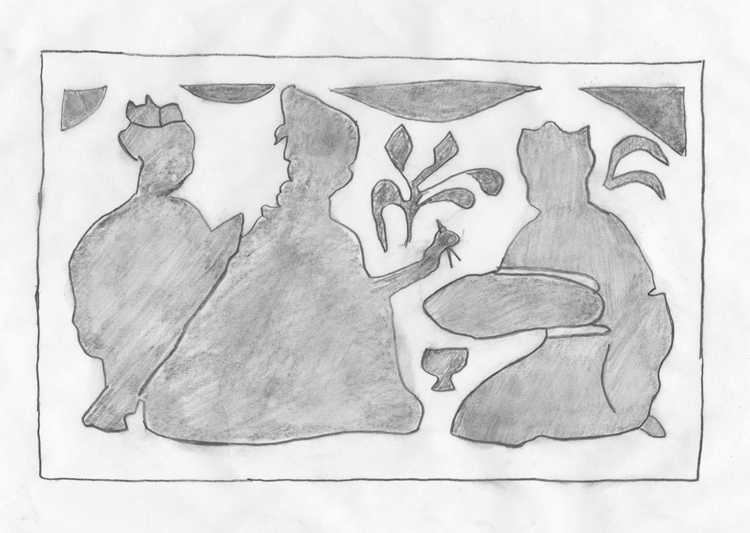
It is difficult to find any reference to women drinking by themselves, although what is not mentioned in textual sources may be found on pictorial images placed in tombs, such as the scene on a brick tile unearthed from Dayi county 大邑縣 near Chengdu city that depicts a lady with a stem-cup placed in front of her being served by a maid and in the company of another female figure (Figure 14).Footnote 97
Entertainment scene, rubbing of a stone relief from a tomb at Dayi county, Sichuan province (Redrawn from Xin and Yu, eds., Zhongguo huaxiang zhuan quanji, pl. 85)

The importance of drinking with moderation is addressed in the text from the Yanzi chunqiu mentioned above. As noted by Sterckx, “In assessing the past, early Chinese writers often judged rulers and their regimes based on the way they handled alcohol and ritualized drinking.”Footnote 98 Alcohol and its consumption served as a moral marker for men as weaving was for women. Men of all classes were judged by the amount they drank, rulers were assessed by how they handled alcohol, and sages by how they mastered moderation in drinking.Footnote 99 Admonition against excessive drinking in early China appears to have addressed the male population. It is a language imbued with moral values, with alcohol used as a tool to set down political assessments of the past and caution for the future. As women were not part of the governing elite they had no role to play in accounts that were motivated by judgements on alcohol consumption which were in reality, as noted by Sterckx, used to invoke or aggrandize the moral character and achievements of those in power.Footnote 100 Here we see the nei–wai dichotomy, prescribed in early instruction manuals, clearly upheld. Yet the material culture shows that reality and social practice may have been quite different with women extensively involved in the production and sale of alcohol in the outer sphere. However, unlike weaving, no status and identity was conferred on this activity, perhaps because of the ambiguous connotations of alcohol used as a means of performing ritual practices, but also as a source of drunkenness and moral weakness. As noted by Lisa Raphals, “the lacuna between prescriptive text and social practice raises questions about the prohibitions and restrictions on the activities of women.”Footnote 101 Thus gender division of labor seen in early texts may have been an idealized norm rather than representative of gender roles and social interaction between men and women taking place at the time.
Summary
The major problem with attempting to understand ordinary women's lives and their position in early China is that they are vastly underrepresented and perhaps even misrepresented in contemporaneous textual sources. Furthermore, the separation of the sexes in textual sources does not translate itself visually in scenes depicting domestic labor. Women are extensively depicted in material culture, especially on pictorial brick tiles and stone carvings unearthed from Sichuan, many of which carry scenes of peoples’ daily life activities. While women are shown engaged in weaving, an emblematic female occupation typically conducted in the nei, or inner quarters of the home or estate, women are also shown in other occupations outside of their homes. We see them working the fields together with their husbands, thus taking part in occupations typically assigned to the wai, or outer sphere.Footnote 102 While images placed in tombs are highly selective, perhaps chosen by the deceased and as such possibly biased, formulaic, or ideal, they remain vital to our understanding of what life may have been like for women at the time. Economic and farming necessities made it essential for men and women to labor together and to share professions regardless of gender roles and divisions typically described in early texts.
This article has focused on a hitherto little remarked activity of women: the production and sale of alcoholic beverages. Artistic representations show women engaged in making alcohol in their home environment, and textual sources provide corroboration of alcohol production as an important household duty of women and describe them selling it in shops which were often operated by them. Like textiles, alcohol was a vital commodity to the economy and it is evident that women had an important role to play in its production. However, while women were attributed a moral identity through their cloth-making and subservience, especially in homiletic texts, their contribution in the production of alcohol well evidenced in narratives and images, was not imbued with a similar moral characterization. Their making of the many different types of alcoholic beverages, which no doubt required distinctive skills and knowledge, remained a subject seldom elaborated upon. Despite alcohol being an important part of social relationships and ritual ceremonies, and an invaluable source of income for the family and the government, the moral ambiguity behind its consumption and early writers’ judgments on the use and abuse of it were typically addressed to men in society. Thus textiles and alcohol gave rise to two distinct identities for women and men in early China. While the former assigned women with a moral identity in the household, the latter was seen to illustrate male virtues of self-control in the public sphere.
There are still many questions which can be asked but remain difficult to answer. Further research might establish more precisely how women's contribution to the status and financial wellbeing of the family was regarded, and may explain why textual sources and early representations of women appear to have downplayed the jobs women held and the role they played in public life.Footnote 103 What remains difficult to explain through textual sources may be helped by the examination of material culture. The numerous archaeological discoveries in China are presenting new material evidence that warrant our close attention and help us understand society in early China.