Scholars have tended to locate the origins of modern notions of citizenship at the conjuncture of political, intellectual, and legal currents in early modern Europe,Footnote 1 looking at citizenship beyond the European world from a rather modular and diffusionist perspective. Just as colonies were once thought all to have adopted one or other of the European models of nationalism described by Benedict Anderson, so notions of citizenship are believed to have borrowed or adapted one of a small stock of European-authored ‘ideal types’. For more than sixty years, political science has been dominated by Hans Kohn's typology, which contrasts ‘ethnic’ and ‘civic’ models of nationhood,Footnote 2 the latter sub-divided into ‘liberal’ and ‘republican’, where influences of British subjecthood and French Jacobinism respectively hold sway.Footnote 3 The new nation-states which emerged in the twentieth century are all assumed to have based their own citizenship laws on one or other of these models, often drawing upon the traditions of their imperial rulers. In a new account of Indian citizenship, Ornit Shani argues that independent India drew, at different times and in different combinations, on all these components of the European tradition, but her revisions share certain diffusionist assumptions.Footnote 4
When non-Western citizenship has been a subject of research, much of that (mainly anthropological) work has focused, as Neeraja Jayal notes, on the distance between de jure and de facto citizenship.Footnote 5 Scholars have tended to take formal membership for granted, assuming that newly sovereign nation-states bestowed this automatically on all persons who inhabited their territories. Seeing the problem to be the failure of non-Western states properly to uphold their citizenship laws, they have concentrated on struggles by formal members to achieve substantive or ‘thick’ citizenship, understood as ‘the substantive distribution of the rights … to those deemed citizens’.Footnote 6 Yet, the question of whether full formal citizenship was actually extended to all members of these states, and how it was created, qualified, or denied in specific historic locations and circumstances, has not sufficiently been investigated.
In the scholarship on South Asian citizenship, two further themes are apparent. One is a persistent assumption that India and Pakistan adopted contrasting citizenship models, the former civic or liberal, the latter ethno-religious. Indeed, many academics regard the apparently ‘great divergence’ in their respective trajectories as a linear consequence of these different choices. Another powerful strand sees citizenship as a wholly alien concept, foisted from above upon an unsuspecting populace by the small elite minority that constituted civil society, with little purchase beyond it.Footnote 7
This article challenges, or qualifies, these assumptions. It suggests that distinctive forms of legal citizenship were pioneered in the subcontinent during the upheavals that followed independence and partition. Lawmakers and leaders were not the sole architects of these regimes, although they played a part in the story. South Asian citizenship was produced, on the contrary, as a result of complex interactions between a bewildering plethora of actors: above all, by the actions of millions of people who became stranded minorities as a consequence of partition and independence, and whose decisions to flee, stay on, or return to their homes were posited on notions of where they belonged and where they were entitled to protection. This article will argue that these actions – small but decisive acts of agency by countless ordinary people firmly convinced of the justice of their claims – posed new questions of the states whose protection they sought, and elicited novel answers from them.
This article will thus challenge the post-colonial view, recently forwarded by Vazira Zamindar, that the states of South Asia imposed citizenship from above upon the people of the subcontinent, forcing their fluid and multiple affiliations into neat national boxes, producing ‘with some force, bounded citizens of two nation-states’.Footnote 8 Instead, it argues that the process was complex, messy, and often ugly, and that refugees were active agents in it. They exerted considerable pressure on the functionaries charged with dealing with them, who were in their turn members of a bitterly divided society, and whose actions were shaped by their own norms and beliefs. In consequence, these men – local constables, non-commissioned soldiers, and spies, as well as railway guards and ships captains who handled the flow of migrants – often took steps that had no sanction from above, and that did not accord with any tenet of the official law.Footnote 9 As Taylor Sherman has shown in her study of Afghans in Hyderabad after the 1948 ‘police action’, these officials made their own assumptions about citizenship and belonging,Footnote 10 which in turn informed the ad hoc measures they devised to manage migrants and rehabilitate refugees. But while the Afghans in Sherman's story ducked, weaved, and evaded officialdom when policy contradicted their own sense of what was best for them – understandably since their place in India was at best precarious – the refugees discussed below robustly, even violently, resisted government. Hence, officials had to backpedal, to improvise and revise strategies to deal with rapidly changing realities on the ground.
This article will argue that the citizenship regimes which emerged out of these complex interactions were not only different from the leaders’ ‘original blueprints’,Footnote 11 they were distinct, in critical ways, from models derived from the West. It will show too that the citizenship regimes of India and Pakistan shared remarkably significant (and hitherto unnoticed) symmetries. Both produced the new figure of ‘the minority citizen’, neither citizen nor alien, but a hybrid subject of new national regimes of identification and law. This status, it will argue, is not simply a matter of the routine de facto deprivations of ‘inclusive’ but ‘inegalitarian citizenship’, in Holsten's cumbersome but useful phrase.Footnote 12 This was a de jure status of a new and particular kind. It will also suggest that practices of citizenship forged in the subcontinent travelled beyond the subcontinent through the South Asian diaspora, influencing norms and practices of citizenship in the wider world.
I
The processes by which South Asian citizenship was constructed can best be tracked by looking first at the ‘original blueprints’ for citizenship devised by the leaders of the new nation-states. When the Constituent Assembly of India first met in December 1946, it had immediately to take a view on who India's citizens were to be. Who were ‘the people of India’, in Nehru's uplifting prose, who were ‘giving themselves’ a constitution? Until this defining moment, the leaders of the all-India Congress had been wont to invoke ‘the people of India’ and even ‘the citizens of India’, but had taken a very broad-brush approach to who was to be included in that category.Footnote 13 Now that question demanded careful consideration since, to paraphrase Benhabib,Footnote 14 self-determination requires self-constitution.
The Constituent Assembly acted swiftly. On 24 January 1947, it set up an advisory committee on minorities and fundamental rights to examine the question. Its chairman was Sardar Vallabhbhai Patel, strong man of the Congress party, then home minister in the interim government. The very name of the committee reveals that when they began their deliberations, the lawmakers saw ‘minority rights’ and ‘fundamental rights’ as allied matters. Its minutes reveal that at this early stage, its members were unanimous in regarding minority rights as additional ‘safeguards’ that were to be enjoyed by certain communities, over and above the fundamental rights that all citizens would enjoy in equal measure.Footnote 15
On 23 April 1947, the committee reported back to the Assembly with a formula for Indian citizenship which was both simple and elegant. ‘Clause 3’ of its draft proposal suggested that ‘every person born in the Union or naturalised according to its laws and subject to the jurisdiction thereof shall be a citizen of the Union’.Footnote 16 The committee had taken the principle in English law of jus soli, or birth within the realm, as the basis for citizenship of independent India.
There is much to suggest that in proposing this formula, the committee had been influenced by the legacy of British subjecthood and imperial citizenship,Footnote 17 quite as much as by the Congress party's long-standing commitment to liberal constitutionalism.Footnote 18 Patel explained that the committee had deliberately eschewed the more ‘racial’ or ‘ethnic’ notions of citizenship of continental Europe; jus soli was, in its view, the most ‘democratic’,Footnote 19 ‘enlightened’, and ‘civilised’Footnote 20 model of citizenship to be found anywhere in the world.Footnote 21 Two world wars and the Holocaust also cast their long shadow over the constitution-makers in Delhi: Pandit Pant of the United Provinces reminded the Assembly that treaty arrangements by the Associated Powers had failed to protect minorities after the First World War.Footnote 22 It is no part of my argument, then, that in tackling the issue of citizenship, South Asia's leaders were parochial and ignorant of global intellectual currents. On the contrary, when the Assembly's distinguished constitutional adviser, Sir B. N. Rau, drafted his preliminary notes in September 1946, he drew upon an impressive range of international precedents.Footnote 23 Well before Rau launched on his tour to study constitutions in other parts of the world,Footnote 24 India's leaders were alert to the wider global contexts and implications of their deliberations.
Those who opposed Clause 3 were also aware of these considerations, albeit from a different angle of vision. They were led by Dr Rajendra Prasad, a leading figure in the Congress high command, president of the Constituent Assembly, and soon to be president of the new republic. ‘Suppose’, he bluntly enquired, ‘a Jap by birth is travelling through the country and while travelling a child is born to him. What happens?’Footnote 25 Others raised concerns about the position of children of Indian parents who had been born abroad. Would they be denied citizenship?Footnote 26 In their different ways, these questions derived from the notion that the claims of descent (jus sanguinus), of Indian ethnicity or blood, should determine citizenship. This ‘continental’ conception of Indian citizenship had vociferous supporters in the Assembly, some of whom – like Prasad – were powerful figures. But Patel stood firm against them. He pointed out that it would be inconsistent for the Congress leadership to push for ‘narrow nationality’ given that it had demanded full rights of citizenship for Indians born in South Africa. He rebuked Prasad for seeking to introduce ‘racial phraseology’ into the constitution on account of ‘a few foreigners coming here’.Footnote 27
Patel's remark shows, beyond a shadow of doubt, that at this point the Congress leaders had not entertained the possibility of admitting large and permanent migrant populations into India in the event of a partition that looked increasingly likely. By this stage, it had the imprimatur of the Congress high command. In March 1947, the Congress leadership had settled for a limited partition of India; and by the beginning of May, it had persuaded Mountbatten that partition on these terms was the only way out of the constitutional impasse. Even though it remained unclear which precise territories would be included in the Indian Union and which would go to Pakistan, some of the Assembly's members had begun to recognize the implications of partition for the citizenship question. Despite Patel's brisk attempts to cut short further debate on the matter,Footnote 28 they refused to be silenced. Significantly, it was R. K. Sidhwa, a Parsee member from Sindh – a Muslim majority province that would soon become part of Pakistan – who asked the critically important question: ‘I am born in Sindh. Supposing Sindh is not going to be part of the Union, what will be my position? Am I to lose my citizenship of the Union [of India]?’Footnote 29
After this, no one could ignore the proverbial elephant in the room. Sidhwa's question brought into the open, for the first time, the thorny issue of what would happen to non-Muslims who would be ‘stranded’, by virtue of their place of birth and domicile, in Pakistan. Were they entitled to Indian citizenship? If so, on what basis? Immediately it became apparent, as Pandey has also remarked, that many members of the Assembly strongly believed that these people were ‘obviously’ Indians, and hence ‘patently’ entitled to Indian citizenship.Footnote 30 In its turn, this notion ran a coach and horses through the tidy territorial definition of citizenship and nationality that Patel and his supporters had striven to impose. It soon became apparent that the issue could not easily be resolved, and so discussion of the citizenship clause was postponed. In consequence, on 15 August 1947, when India achieved independence, the vital decision of who its citizens were to be had not yet been settled.
On the other side of the fence, discussions about citizenship in Pakistan only began after Attlee's announcement of 3 June 1947 that British India would be divided into two successor states. It followed that a separate Constituent Assembly for Pakistan had to be set up, and that Assembly first met on 10 August 1947, just five days before partition and the transfer of power. Nevertheless, it immediately set to work to tackle the question of citizenship, and its deliberations are of great significance. Jinnah's historic speech of 11 August 1947, promising ‘equal rights, privileges and obligations’ to all citizens, regardless of their religion, is well known.Footnote 31 Yet, its inwardness has not been understood: Indian historians, in particular, have tended to question Jinnah's sincerity of purpose. In fact, Jinnah had come to see the logic of a territorial definition of citizenship immediately after Attlee's announcement. On 9 June 1947, addressing the general assembly of the All-India Muslim League, he had urged Muslims who would be left in India after partition to ‘stick to their respective homeland[s]’, live as Indian citizens, and avoid the ‘temptation’ to migrate.Footnote 32 He stuck to this position in the face of vigorous opposition from many members of the Pakistan Assembly who wanted the new nation's constitution to be based on Islamic foundations.Footnote 33 Jinnah underlined his seriousness of intent by setting up, and chairing, a committee on fundamental rights of citizens and minorities. Just as in India, Pakistan's lawmakers saw these two subjects as being intertwined; and just as in India, they regarded minority rights as additional protections that were to be enjoyed by certain minorities, over and above the fundamental rights enjoyed by all citizens.
It is not surprising that historians have struggled to make sense of Jinnah's apparent ‘U-turn’ on this vital question. They agree that Jinnah's conception of Pakistan (and indeed that of many of his followers) was imprecise and de-territorialized, and that until he was forced to accept the ‘moth-eaten’ Pakistan that partition gave him, his pronouncements on Pakistan had been deliberately vague. Jinnah's declaration in the Assembly reveals, however, that as soon as it became clear that Pakistan was to be a sovereign, territorial, nation-state, he concluded that its citizenship had to be defined on a territorial basis.
So contrary to the legend of their inherently different personalities, based, in turn, upon their distinctive nationalisms, both India and Pakistan started out with jus soli as the basis of citizenship. Both appear to have done so in response to the same imperatives: to restore confidence among their fearful minority populations and prevent mass migrations from one partitioned country to the other. But by the time their respective advisory committees came back with their recommendations on citizenship several months after partition, Jinnah was dead, and so was Gandhi; and mass migrations across the new borders had transformed the situation.
II
So far, this account of the debates on South Asian citizenship is compatible with received wisdom. Indeed, the story does appear to be one of ‘borrowing’ and ‘adapting’ existing European models. The leaders of India and Pakistan had looked at many constitutions and definitions of citizenship around the world, and decided that the British liberal conception of jus soli would work best for them. But it departs from conventional accounts in one important respect: it underlines the similarity, in the frantic weeks before partition, of Indian and Pakistani leaders’ responses to the question, emphasizing the pragmatic concerns that informed this common stance.Footnote 34 As the rest of this article will show, once the mass migrations had begun, and questions of citizenship in both countries were complicated by the problematic status, and the decisive actions, of refugees, emigrants, and stayers on, both countries responded to the crisis in surprisingly similar ways.
On 17 August 1947, violence on an unprecedented scale broke out in the divided province of Punjab and spread to many parts of north India and western Pakistan. Gripped by panic, countless people began to flee from their homes. Thousands tried to cross the new border to seek the protection of the ‘right’ nation-state, but found themselves vulnerable to attack in their refugee convoys and camps. Huge numbers abandoned their homes to cluster in localities on the same side of the border where their co-religionists tended to be concentrated, seeking safety in numbers. Many hoped to return home when ‘normality’ returned. But ‘normality’ never did return to the subcontinent. In the weeks and months after partition, officials on the ground devised a series of ad hoc administrative measures to deal with the pressing problems and exigencies which mass migration brought in its train. These measures, as much as the acts of migrants themselves, were informed by common-sense notions about citizenship, belonging, justice, and entitlement.Footnote 35 In a remarkable series of developments, these conceptions swiftly came to push, stretch and reshape policy, and eventually to inform law, constituting a new regime that, once put into place, could not be undone. The ‘state of exception’, to use Agamben's evocative phrase,Footnote 36 would become the new order.
The plight of ‘stranded refugees’ prompted the first of these emergency measures. Desperate to flee across the border but unable to do so for want of transport, many hundreds of thousands of migrants huddled together in makeshift camps, terrified at the prospect of being attacked by marauding gangs, or by refugees crossing in the opposite direction thirsty for revenge. Immediately after partition, social workers and local officials began to bombard ministers in India and Pakistan with telegrams warning that the very soldiers and policemen who were supposed to protect these refugees were implicated in the violence that had prompted their flight. On 24 August 1947, Sushila Nayyar, one of Gandhi's closest aides and disciples, sent an urgent message to Delhi from Wah near Rawalpindi in Pakistan, alerting India's leaders to the fact that ‘Muslim troops and police [were] cooperating in [the] disturbances’.Footnote 37 On 25 August 1947, as Ian Talbot has shown, soldiers of the 3rd Baluch regiment perpetrated what was perhaps the single most gruesome act of violence during partition, mowing down in cold blood 3,000 Hindu and Sikh refugees in Sheikhpura in West Punjab.Footnote 38 After this incident, Sampuran Singh, newly appointed deputy high commissioner for India in Pakistan, wrote to Patel predicting genocide: ‘Fifty thousand Hindus and Sikhs are daily butchered by the military and the police here. No high commissioner can save them. All Hindus and Sikhs in West Punjab will be finished.'Footnote 39 Evidently, there were slippages between Singh's official role as India's spokesman in Pakistan and his personal sense of obligation to ‘save’ his co-religionists in that country. But it is important to recognize that Singh was responding to floods of appeals from ‘stranded’ Hindus and Sikhs in West Pakistan who expected the Indian high commission to help them: the fortnightly reports from the commission in Karachi are full of references to members of these communities turning up at the commission's headquarters at Damodar Mahal, demanding help and protection.Footnote 40
On the Indian side of the border, the situation was much the same. On 28 August, Lt. Col. P. N. Kirpal told Mountbatten that ‘Indian officers and men had become … affected with the communal virus.’Footnote 41 During these terrible weeks, Jinnah too heard news that Indian policemen and soldiers had joined in the bloodletting against Muslims. On 22 August 1947, Salma Tasasaddaque Hussain,Footnote 42 social worker and secretary of the Central Punjab Muslim League, wrote of ‘the most gruesome, inhuman and brutal assaults by Sikhs and non-Muslim soldiers’ on ‘innocent Muslims’.Footnote 43 The Punjab Boundary Force, hastily put together in July 1947 specifically to keep the peace in the border districts,Footnote 44 had not only failed spectacularly in its task, some of its members had joined members of their own community in committing atrocities against the other.
This was the context in which, in September 1947, the two embattled prime ministers of India and Pakistan set up the Military Evacuation Organization (MEO). Its task was to protect refugees and escort them across the border. But since the army from which it was drawn (itself in the process of being partitioned) was largely recruited from the Punjab, and since its soldiers had apparently succumbed to the ‘contagion’ of communalism which had gripped that province, Nehru and Liaquat Ali Khan agreed that Muslim refugees should be protected and evacuated by Muslim troops, and that Hindu and Sikh refugees, would, in their turn, be protected by soldiers of the same faith. In consequence, early in September 1947, Muslim troops from Baluchistan (in Pakistan) were brought in to Delhi (in India) to protect Muslim Meo refugees who had fled from the unfolding carnage in Rajasthan (in India),Footnote 45 and were charged with the task of escorting them across the border those who wished to leave for Pakistan.Footnote 46 Within a month of achieving sovereignty, driven by similar concerns to protect minorities, both India and Pakistan had thus conceded that the troops of the other dominion could enter its territory to rescue and protect its ‘own’ refugees.Footnote 47 Initially intended to be restricted to disturbed areas in the Punjab and Delhi, the MEO's operations were soon extended to the Sindh, after representations to Patel from Sindhi Congressmen.Footnote 48 In October 1947, after the Sikh leader Baldev Singh urged Patel to mount an operation to rescue ‘non-Muslim girls’ abducted by Muslim youths in Pakistan, and suggested that ‘some dominion military might also be allowed in the other dominion for this work’,Footnote 49 the two dominions also took on the role of protectors of ‘their’ respective women in the other state.Footnote 50
Of course, much is already known about the work of the MEOFootnote 51 and the recovery of abducted women.Footnote 52 But what calls to be underlined here is that these measures had far-reaching implications for citizenship in South Asia. Until this point, India and Pakistan had recognized – indeed insisted upon – ground rules which placed the responsibility for ensuring the protection and welfare of minorities within their own territories upon themselves, not on the other. Each had expressed grave concerns about the fate of minorities in the other dominion, but had restricted its role to exhorting the other to do more effectively to protect them.Footnote 53 Establishing the MEO represented a decisive shift from this stance. Implicit in its remit was an admission that Hindus and Sikhs ‘stranded’ by virtue of their birth in Pakistan had to be protected by the Indian nation-state, and vice versa.
By December 1947, the MEO had evacuated most of the 5 million refugees in the two Punjabs, Sindh and Delhi,Footnote 54 and it appeared that the crisis was finally over. Yet, no sooner had things begun to settle down in the north-west than violence broke out in divided Bengal in the east, sparking off fresh exoduses across the eastern border between India and Pakistan. This was the context in which India and Pakistan held their first inter-dominion conference in Calcutta in April 1948. The fascinating details of how the two countries reached an agreement about the treatment of minorities in their respective dominions is the subject of another paper;Footnote 55 but what calls to be noted here is that at the Calcutta conference, both India and Pakistan accepted that the high commissioner of the other dominion should formally be deemed the ‘proper channel’ through which oversight over the protection of minorities was to be exercised.Footnote 56
What this meant in practice was the two countries agreed to adopt a bizarre procedure for the redress of the grievances of minorities. If, say, a Hindu girl was abducted in East Pakistan, her family had to report the matter to the deputy high commissioner for India in Dacca. This member of India's foreign service would then take the matter up with Pakistan's ministry of external affairs; which would pass the case on to Pakistan's interior ministry to investigate the charges. Whatever information the interior ministry gathered about the truth or falsity of the claim, and any action that had been taken by way of redress, would then be relayed, by the same circuitous route, back to India's high commission via its external affairs ministry in Delhi.Footnote 57 The impromptu, ad hoc actions of the first Indian high commissioners and their deputies, (the likes of Sampuran Singh, mentioned above) – who took it upon themselves to respond to urgent calls from refugees for help, and to agitate on their behalf – was now, by this agreement, given formal sanction.
By agreeing to these measures, India and Pakistan further compromised their stated commitment to the principles of jus soli and territorial citizenship. They did this, moreover, in tandem: responding to common pressures, with common aims and common purposes.
III
But these were only the first steps down a slippery slope, straying from the via tuta of jus soli. Once refugees moved across borders in large numbers (and indeed were assisted by ‘national’ troops in so doing), this raised the question of what was to happen to their property in the country they were leaving behind. Who was to protect it and by what means?
Once again, both nations started out with the firm intention of protecting the vacant properties of emigrants (designated ‘evacuees’) within their own territories. Both declared that they were determined to keep out looters and squatters, to preserve the ‘property and effects of evacuees’, and to guarantee their continued rights of ownership over these properties, whether moveable or immoveable. On 9 September 1947, by emergency ordinance, the West Punjab government in Pakistan appointed a custodian of evacuee property, charged with the duty of taking ‘possession of the property and effects of evacuees’ and ‘[taking] such measures as he considers necessary or expedient for preserving such property or effects’. Indian East Punjab followed suit.Footnote 58
In turn, this posed the urgent but intractable problem of how to deal with the innumerable refugees who had already occupied evacuee property in the first few weeks after partition. The problem was complicated by the fact that many thousands of these refugee squatters had left homes not in former British India but in princely territories. They had been ruled by Hindu rajas and Muslim nawabs who had distinctive ideas about the duties of king and subject, and had been governed by regimes of law and property that differed substantially from those of British India.Footnote 59 All over India, and indeed Pakistan, the refugees, who had by now grabbed and squatted in any vacant land or buildings they could findFootnote 60 held diverse views about their duties and entitlements, often at odds with the liberal policies of their respective governments.
By definition, in India, much of this illegally acquired property had previously been owned by Muslims who had abandoned their homes during the violence. Hindu and Sikh refugee squatters now refused, point blank, to vacate these properties. Instead, they displayed a ‘threatening’ attitude towards landlords, intimidated policemen charged with enforcing the ordinance, and cowed remaining Muslim families who tried to remonstrate with them.Footnote 61 In a letter to the district commissioner of Delhi, one Chandni Chowk, landlord, wrote of refugees squatting in his property: ‘They are not paying any attention towards my request of vacating … and are now threatening me and are causing … much anxiety in the entire mohalla [neighbourhood].’Footnote 62 In another case, a Muslim landowner wrote repeatedly to the custodian of evacuee property in Delhi, begging for his help to recover property that had been forcibly occupied by Sikh refugees:
All my buildings have been unauthorisingly [sic] trespassed by these trespassers and [I have] been deprived of my birthright, income and peaceful living … It will not be out of place to mention here that I am a peaceful, loyal and faithful citizen of Delhi and well-wisher of our Benign Government of India.Footnote 63
But policemen all over north India and Pakistan reported that when they tried to enforce the ordinance, they encountered fierce resistance in thousands of such cases. All too frequently, these confrontations ended in violence: refugees fighting pitched battles against the police and landlords.Footnote 64
In this pattern of action and response, the refugees’ powerful sense of entitlement comes across forcefully. Hindu and Sikh refugees plainly believed that they belonged in India, and that its government was obliged to protect them. They also felt that they had a moral claim to the property of Muslim evacuees. As Sarah Ansari's study of Karachi shows, Muslim refugees there felt similarly entitled.Footnote 65 Refugee squatters were remarkably effective, furthermore, at persuading ‘the public’ that they were so entitled. The manner in which the refugees stood their ground in the face of police action allows us to see these encounters as true ‘acts of citizenship’, which changed and shaped the political landscape from below. Engin Isin has described these as acts by which ‘subjects become claimants when they are least expected or anticipated to do so’, ‘under surprising conditions’; acts which over a ‘short period of time’ rupture existing notions of order, creating new norms that enable the actors ‘to remain at the scene’, standing their ground ‘rather than fleeing it’.Footnote 66 In the thousands of local battles refugees fought across India and Pakistan at this time, we see instances of such rapid but profound shifts, as illegal acts of forcible appropriation quickly gained legitimacy in the eyes of ‘a public’ that sided with intransigent refugees. Instead, it was usually the local havildar who had to flee, taking his eviction orders with him. One frightened constable in Calcutta, for instance, reported how his efforts to ‘eject’ Hindu refugees from Muslim-owned houses evoked a ‘threatening response’, with the refugees succeeding in gaining ‘public sympathy on their behalf. Their eviction’, he concluded, ‘would not be an easy task.’Footnote 67
The local policemen sent on these unenviable missions were themselves drawn from the very ‘public’ they confronted in these encounters; and, unsurprisingly, they soon showed signs of being swayed by its sympathy towards the refugees. Again and again, Hindu and Sikh policemen showed themselves to be reluctant to take any action to evict refugees of their own faith from Muslim-owned properties across north India. Increasingly, they dragged their feet about evicting refugees in any circumstances, even when they were squatting on public roads and footpaths. For example, when the Delhi municipal committee tried to get the police to remove refugee hawkers from pavements in the business areas of old Delhi, the superintendent of police told his boss that he was ‘not in favour of removing these hawkers who are at present earning their livelihood by fair means and they are putting no burden on the Indian Dominion’.Footnote 68 Here, he made explicitly normative claims, not only about the refugees’ absolute right to shelter in India, but also their right to livelihood ‘by fair means’.
Senior officers quickly came to be persuaded by these sentiments. Commenting on the continuing lawlessness in Delhi in the winter of 1947, the deputy inspector general of police warned his superiors that ‘unless a satisfactory solution of the refugees’ problems [could] be found there [could] be no permanent peace in Delhi’. He pointed out that ‘a large number of Muslim houses and shops [were] vacant and the general feeling amongst the public [was] that refugees should be permitted to occupy these houses and shops’. He put forward what he felt was the obvious solution: the refugees should be allowed to occupy vacant Muslim-owned properties instead of being prevented from so doing.Footnote 69
The temper and norms of ‘the public’ then – the refugees, their numerous sympathizers in local communities, as well as lower-level state functionaries drawn from those communities – were pitted against the official policies and laws of the sarkar. This climate of opinion began, with surprising speed, to influence the Indian government. Nehru, who six weeks before had been determined to protect all Muslim evacuee properties against all squatters, by October 1947 had begun to prevaricate on the issue. He began increasingly to draw a normative distinction between refugees and ‘ordinary looters’. Writing to Patel on 6 October 1947, he insisted that it was only the latter category, squatters who were simply looters ‘profiteering at the expense both of the original owner of the house and the Punjabi refugee’, who called to be evicted and punished.Footnote 70
However, these equivocations raised yet another conundrum. What would happen if Muslim evacuees came back home to India once order was restored? Many were known to want to return: Nehru himself estimated that perhaps half of old Delhi's Muslim evacuees wished to return to their own homes and neighbourhoods, and had no desire to migrate to Pakistan.Footnote 71 But where were they to go if their homes had been captured by refugees? And what would happen to Hindus and Sikh refugees who wanted, in their turn, to return to homes in Pakistan?
It was in response to this quandary that Nehru's government came to a historic conclusion: it had to prevent Muslim evacuees from returning to reclaim their homes. The ‘Influx from Pakistan (Control) Ordinance’, promulgated in January 1948, laid down that ‘no person shall enter India from any place in [West] Pakistan, whether directly or indirectly unless … he is in possession of a permit’.Footnote 72 These permits were to be issued by the Indian high commission in Karachi only if officials had satisfied themselves of one of two conditions: either that the applicant had never intended permanently to migrate to Pakistan, or that he was a Pakistani national wishing to make a short trip to India on legitimate business.Footnote 73 The intention was plain. Muslim refugees who had fled to Pakistan were not to be readmitted into India. In October 1948, Pakistan followed suit with its own ordinance laying down the same conditions.Footnote 74
Zamindar insists that the permit system was the product of a ‘bureaucratic discourse’ that ‘gathered force’ in 1948, driven by a ‘bureaucratic rationality’ that saw returning refugees as a challenge to governance.Footnote 75 This article argues, on the contrary, that while official concerns about law and order played a part in these events, it would be a mistake to ignore the relentless pressure that refugees themselves exerted on government from below. In fact, both India and Pakistan retreated from their liberal commitment to uphold the law and to protect the property of evacuees. But they did so because they recognized that they had already lost the argument on the ground.
IV
The permit system, however, proved impossible to administer. Not merely was it was liable to gross abuse, as Zamindar has shown: it was impossible to enforce. The governments of both India and Pakistan lacked the wherewithal to police the length of the western border, so the actual business of checking whether people had the right permit devolved to the petty functionaries who manned the transport networks in the border regions. Railway guards, ticket collectors, and ships’ captains now began to demand that passengers who, from their common-sense perspective, did not look like ‘bona fide nationals’ produce their permits for inspection, with all the inequities that make such stop-and-search procedures notorious. And for their part, the targets of their haphazard surveillance found plenty of ways of evading it. Holders of temporary permits simply tore them up, claiming never to have left India in the first place, leaving the police ‘with no means whatever to identify [them]’.Footnote 76 Very quickly, a flourishing trade sprang up in counterfeit permits. By October 1948, the intelligence agencies were reporting that ‘we suspect fake permits are being issued’, while pointing out how difficult it was to distinguish between fake and genuine papers.Footnote 77 As Kamal Sadiq has recently remarked, the ‘ways and means’ by which illegal immigrants acquire citizenship in developing countries are many and strange,Footnote 78 and countless people caught up in the permit system took recourse to them. In December 1948, the government of India was forced to instruct all state governments to stop issuing any permits for permanent resettlement. Stern reminders were sent in April 1949, and again in May, 1949, but to no avail.Footnote 79
Even where officials succeeded in catching ‘permit-dodgers’ and tried to deport them, their efforts often foundered. In India, the system provoked thousands of appeals from Muslims facing deportation who insisted that they had never intended permanently to migrate to Pakistan. Judges struggled to establish the required state of mind (animus manendi) to prove that the appellants had not intended to renounce their Indian citizenship by travelling to Pakistan, and for their part, appellants struggled to produce evidence sufficient to prove such a state of mind. Take the case of Fazal Dad (alias Sardar Khan Fateh Ali), who was arrested in 1953. Fazal Dad claimed to have lived in a village in Madhya Pradesh (central India) for forty years, where he owned ‘considerable immovable property’. According to his deposition, he went to Pakistan on a temporary visit in 1948 to attend a marriage and to bring his children back to India. He had to stay on in Pakistan until 1953 for reasons beyond his control, when he re-entered India using a Pakistani passport. In court, he argued that he ‘has always been a citizen of India and that he could not, on account of his allegedly temporary visit to Pakistan … be deemed to have lost his rights as a citizen of this country’. The case dragged on for almost a decade. Finally, in November 1962, Justices Krishnan and Sharma finally ruled that he was a Pakistani citizen and his petition to be allowed to stay in India was dismissed.Footnote 80 Of course, these rulings tended to be biased against the plaintiffs; and, of course, less fortunate Muslims who had no papers or property were seldom given the benefit of the doubt.Footnote 81 But the point here is that thousands of people charged with violating the permit rules challenged the system in the courts; and their appeals continued to clog the sclerotic arteries of the Indian judicial system long after the permit laws were repealed in 1952, when passports were introduced for travel between the two countries.
This was the context for the promulgation of the Evacuee Property Ordinance in June 1949.Footnote 82 This draconian ordinance effectively nationalized, at a stroke, all property vacated by Muslims in India, outside Bengal, Assam, and the north-eastern states.Footnote 83 Such property, the ordinance stated, was to be deployed by the government for the rehabilitation of refugees, and for other ‘public purposes’. Any property, or part of a property, which had been abandoned, or appeared to have been abandoned, by its Muslim owners was liable to be attached, on the presumption that its owners had migrated to Pakistan. Whether or not this was actually the case, the ordinance gave the custodian absolute authority to vest ownership of such property in the state.
As with the permit system, the identification of Muslims as evacuees depended on a subjective assessment by an official about their ‘state of mind’. A ruling by the custodian that a Muslim was ‘an intending evacuee’ would be virtually impossible to challenge. But now, with the bitter experience of being mired in the courts with thousands of permit cases, the Indian government decided to arm itself with more wide-ranging powers. Chapter 7 of the Evacuee Property Act expressly denied the jurisdiction of civil or revenue courts to adjudicate on whether or not ‘any property or any right to or any interest in any property is or is not evacuee property’. It also refused the courts the power ‘to question the legality of any action taken by the Custodian General or the Custodian under this Act’.Footnote 84
Evacuee property was thus made an area of governance outside the rule of law: a true state of exception where executive authority was wholly unchecked. The significance of this for the status and rights of India's Muslim citizens can hardly be exaggerated. Even as T. H. Marshall was writing his classic account of citizenship in 1950, which argued that access to courts was a vital attribute of ‘civil citizenship’,Footnote 85 in India this access was being denied to one category of citizen. As Keechang Kim has shown, access to ‘helpe and protection by the king's law’ was the very basis of jus soli since Calvin's case of 1608, which held that the plaintiff, once deemed to be a subject of the king, could not arbitrarily be deprived of his property.Footnote 86 The fact that Muslims were denied these protections by sweeping actions of the executive is a commentary on their legal status in India. When the constitution-makers first met early in 1947, they had agreed that minorities needed additional safeguards, over and above the fundamental rights enjoyed by all citizens. Now, less than three years later, the act stripped them of a key fundamental right – the right to property – and also of the right of appeal against their dispossession. This meant that they enjoyed substantially fewer rights and protections than ‘ordinary’ citizens.
Officials in Pakistan protested, with justification, that these harsh measures ‘disinherited’ India's Muslim ‘displacees’. But very soon, in October 1949, they followed with their own measures appropriating all evacuee Hindu and Sikh property abandoned in Pakistan.Footnote 87 In October 1954, India formalized its own arrangements with the Displaced Persons (Compensation and Rehabilitation) Act, which subsumed all Muslim evacuee property in a ‘compensation pool’ to pay for the rehabilitation of Hindu and Sikh refugees.Footnote 88 Pakistan followed suit with its own laws and rules to disappropriate Hindu and Sikh property.Footnote 89 Evacuee property was thus established as the cornerstone of refugee rehabilitation, and, by extension, of the new post-partition order.
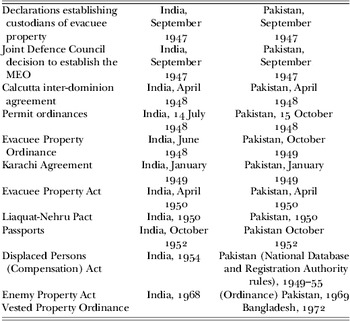
These regulatory regimes had a profound impact upon South Asia. In a region where mobility and circulation had for centuries been a way of life,Footnote 90 they stopped the legitimate movement of populations, forcing them into an unnatural stability. They sealed the western borders between India and Pakistan much more effectively than any wall or fence. A series of measures followed, which gradually extended their remit (see Table 1). In 1955, India enacted citizenship laws which created a hierarchy of rights, ruling out citizenship for persons who had at any point migrated to Pakistan or been domiciled there; Pakistan having legislated along the same lines in 1951. In 1965, India and Pakistan fought a brief war, and in 1968 both promulgated enemy property ordinances which gave the state draconian powers to seize property owned by an ‘enemy’. India defined ‘an enemy’ as any Muslim who had migrated from India to Pakistan in the wake of partition, and Pakistan, for its part, as any Hindu or Sikh who had migrated to India. Both governments extended the scope of the enemy acts to cremation and burial sites, temples, and shrines: sacred spaces which had hitherto been spared from the sweeping power of the custodians. The enemy acts applied, moreover, to all their territories, bringing East Pakistan, West Bengal, Assam, and Tripura within their remit. Long after the wars of 1965 and 1971 ended, the acts in both countries continued to be strengthened by amendment; they remain in force to this day. These new acts made it even more difficult than before for minorities to move. They also made it hazardous for people to maintain contact with relatives on the other side, since fraternizing with ‘the enemy’ across the border could render their property liable to seizure.Footnote 91 Just as the evacuee property acts before them, the enemy acts were deliberately placed outside the purview of the courts. In 1972, after its secession from Pakistan in a war that produced 10 million refugees, Bangladesh too enacted its own Vested Property Ordinance, mirroring the provisions of the evacuee and enemy property acts of its neighbours, with calamitous implications for its large Hindu populations, and also for its Urdu-speaking (so-called Bihari) minorities.Footnote 92
Key legislation and agreements regarding refugees and evacuees in India, Pakistan, and Bangladesh, 1947–1972

These developments had a ripple effect on the South Asian diaspora worldwide. By this time, over 3 million people of South Asian origin were scattered throughout the world, most of them descendants of earlier generations of indentured and kangani (assisted) labour migrants, and of merchants who had travelled across the British empire in search of new opportunities. Perhaps one in three was a Muslim.Footnote 93 Many came from parts of the subcontinent that after partition became a part of India, not Pakistan, and had family and property in India. Questions were now raised about their nationality. Mandarins in the external affairs ministry in Delhi urged government to enlarge the scope of the evacuee property act to apply it to overseas Muslims of ‘doubtful loyalty’. Their campaign failed because the law ministry would not support it;Footnote 94 but despite this, and despite the fact that the great majority of these people had migrated abroad many decades before the birth of Pakistan, the custodian went ahead and seized the properties in India of several overseas Indian Muslims.Footnote 95 Not surprisingly, scores of people in this position tried to register themselves as Indian citizens to protect their familial property in India. But this did them few favours in their host countries. In Ceylon, as in East and South Africa, the phenomenon was seen as proof that Indian migrants had no loyalty to their countries of adoption.Footnote 96 In South Africa, where the Afrikaner National Party had long been pressing for the repatriation of ‘Asiatics’, this issue had dangerous ramifications for South Asians long settled in the Republic. If South Africa's ‘Asiatics’ were Indian nationals, the National Party claimed, it was well within South Africa's rights to ask them to leave. If, on the other hand, they were South African citizens by virtue of birth and domicile, then India had no business interfering in South Africa's internal affairs and proselytizing, in the United Nations or elsewhere, on their behalf.
For its part, the Indian government began now to see compelling reasons why its diasporic peoples should be encouraged to take on the citizenship of their host countries. If it could not extend the evacuee property laws worldwide, it had to try and prevent by other means the return to India of ‘undesirables’ who might claim title to such property. It did so by setting its face against granting citizenship to overseas Indians on the basis of descent, and firmly rejecting any calls for dual nationality. This would allow the Indian government to sidestep the awkward question of who, among these 3 million or so people abroad, was entitled to Indian citizenship, who among them was a ‘closet’ Pakistani, and who, if they were allowed to return home, could disrupt the precarious arrangements arrived at about evacuee property.
This was another significant shift. Time was when Indian nationalists had loudly voiced their concerns about their brethren in other parts of the British empire, whether South Africa, Burma, Malaya, or Ceylon.Footnote 97 Now suddenly they were more muted. India's missions in these countries began actively to encourage the descendants of Indian migrants to register themselves as citizens of their host countries, to assimilate, and to settle for whatever terms – however unequal – the governments of their adopted countries offered them.Footnote 98 Pakistan's citizenship act of 1951, likewise, provided for an extremely narrow interpretation of citizenship by descent, extending this only to persons whose parents, at the time of their birth, were Pakistani citizens.Footnote 99
As the history of the late twentieth century has shown, this policy gave no guarantees that the ‘host’ countries would accept South Asian migrants as full citizens. But the point is that not only did India and Pakistan retreat from jus soli principles of citizenship, they set their face simultaneously against jus sanguinus, which would have transmitted citizenship of India and Pakistan to millions of persons of South Asian descent who had been born abroad. In consequence, a hitherto disparate and dispersed diaspora now shared a common predicament, and a liminal legal status, both in their ‘home’ country and their ‘host’ states. In these ways, forms of partial citizenship pioneered in the Indian subcontinent in the aftermath of partition travelled to many parts of the erstwhile British empire where there were significant populations of Indian origin, complicating and compromising their status, while producing news forms of quasi-citizenship in their wake.
V
After partition, minorities in South Asia emerged as a distinct legal category of citizens who were not fully protected by the states within which they lived. Their fundamental right to property was taken out of the jurisdiction of the courts. By executive action, they were deprived of their freedom of mobility. They were stripped of the right to return – a vital attribute of citizenship. They were rendered liable to lose their property if suspected of harbouring the intention of moving. Maintaining transnational networks was fraught with danger, since it laid them open to the charge of fraternizing with the enemy. The power of South Asia's nation-states over their ‘minority-citizens’ far exceeds their sovereignty over ordinary citizens, and the capacity of ‘minority-citizens’ to resist this power was broken, as this article has shown, by a series of draconian executive actions.
Ong has recently put forward the notion of ‘flexible citizenship’: the capacity of certain transnational groups to exercise their rights of membership flexibly and opportunistically so as to maximize advantage in the global market place.Footnote 100 The minorities of South Asia, by contrast, have a form of citizenship which is profoundly inflexible, a ‘bare citizenship’ which renders them uniquely immobile, and hence uniquely vulnerable, in an age of predatory global capitalism and ever-intensifying state power.
But minority citizenship was not simply a product of ‘bureaucratic rationality’, as some have suggested, or even of ‘governmentality’. On the contrary, it was produced by complex, often violent, interactions between government and a range of non-state actors, who forced their own ideas of nationality, justice, and entitlement on to the statute books. Citizenship in South Asia thus proves to have a complex parenthood, with ‘civil’ and ‘political’ more entangled, and mutually constituted, than some theorists would have us believe. India and Pakistan continued to be bound together by migrants and migration even as their discursive claims seemed to pull them ever further apart.
The striking similarities which this article has revealed in India's and Pakistan's citizenship practices challenge many stereotypes about the early history of the two states. But potentially they also help us better to understand the history of citizenship in the wider world. Since Brubaker argued that contrasting citizenship laws in France and Germany derived from their contrasting nationalisms – the one ‘civic’ and the other ‘ethnic’Footnote 101 – scholars have assumed that national movements determine the citizenship models nation states are likely to adopt. Our story suggests caution in assuming a simple linear connection. Just as many small acts of agency and much realpolitik intervened in South Asia to mould citizenship in surprising, and counter-intuitive, ways, it is likely that complex histories of agency, process, and politics helped to form European ‘models’ as well; and if this were the case, they cease to be models in any meaningful sense.
Finally, the brief discussion here of the ways in which South Asian citizenship practices travelled beyond the subcontinent, affecting the status of overseas Indians and having an impact upon the citizenship norms of the countries where they lived, suggests another conclusion. The diffusion of ideas and practices regarding citizenship have flowed in more than one direction. The history of citizenships in different parts of the world may be far more multi-sited, entangled, and inter-twined than historians have previously assumed.