INTRODUCTION
South Africa has a coastline of 2,798 kilometres. The Indian Ocean and Atlantic Ocean meet along the South African coast. South Africa has more than ten ports and a population of over 57 million people. It is among the most economically developed countries on the African continent and has experienced economic growth, as well as population growth in the last two decades from a population of 44.97 million in 2000. This has resulted in an increase in domestic demand for crude oil. With limited proven oil reserves, the rise in demand for oil as an energy source has resulted in South Africa's growing dependence on external sources to meet its domestic crude oil needs.Footnote 1 Hence, South Africa has increased its crude oil imports by sea, importing mainly from Saudi Arabia, Nigeria and Angola. In 2016, South Africa imported 416,531 barrels of crude oil per day;Footnote 2 between January 2018 and the end of May 2018, South Africa imported 8.96 billion kilograms of crude oil.Footnote 3 This high quantity of imported crude oil has resulted in an increased risk of vessel-source oil pollution in South Africa. Situated on one of the world's major shipping routes, South Africa is constantly subjected to contamination of its coastal waters by oil slicks emanating from passing traffic.Footnote 4 Oil pollution incidents often occur on the main routes used for crude oil shippingFootnote 5 and, since vessel-source oil pollution causes considerable adverse consequences, oil spills are a serious threat for all marine and coastal environments.Footnote 6 Although numerous international legal instruments and national laws have been put in place to address the problem of marine pollution, including vessel-source oil pollution, this problem is still rampant in coastal areas worldwide.Footnote 7 With its commitment to ensuring a sustainable marine environment, South Africa adopted the 1992 UN Agenda 21 for Sustainable Development (Agenda 21). South Africa launched a number of national programmes under Agenda 21, including Durban's Local Agenda 21 Programme, aimed at developing an environmental management system to ensure the integration of social, economic and ecological concerns into all planning and development processes within the coastal city of Durban.Footnote 8 Moreover, South Africa also adopted the UN Agenda 2030 for Sustainable Development (Agenda 30), which comprises 17 sustainable development goals (SDGs). Under Agenda 30, SDG 14 is to conserve and use sustainably the oceans, seas and marine resources for sustainable development, with a target of reducing marine pollution of all kinds by 2025. Despite these numerous achievements and commitments, South Africa still faces a high risk of vessel-source oil pollution. In addition to ecological considerations of vessel-source oil pollution damage, the issue of compensation for victims of such damage is essential.
Article 235(2) of the UN Convention on the Law of the Sea 1982 (UNCLOS)Footnote 9 requires states to provide a legal system for compensation in cases of vessel-source oil pollution incidents. However, while South Africa has acceded to certain relevant international conventions related to compensation for vessel-source oil pollution damage and has implemented certain provisions of those conventions in its domestic laws, several gaps remain in its legal system surrounding compensation for such damage.
This article first introduces the major vessel-source oil pollution incidents that have occurred in South Africa. Then it introduces the international laws related to the issue of vessel-source oil pollution damage. Thirdly, it introduces the relevant international conventions already acceded to by South Africa regarding this issue. The article analyses the extent to which South Africa has implemented the provisions of these international conventions in its domestic laws. Recent developments and current gaps and limitations in South Africa's legal system surrounding compensation for vessel-source oil pollution damage are also discussed. Finally, the article provides recommendations for improving South Africa's legal system for compensation for damage from vessel-source oil pollution.
VESSEL-SOURCE OIL POLLUTION INCIDENTS IN SOUTH AFRICA
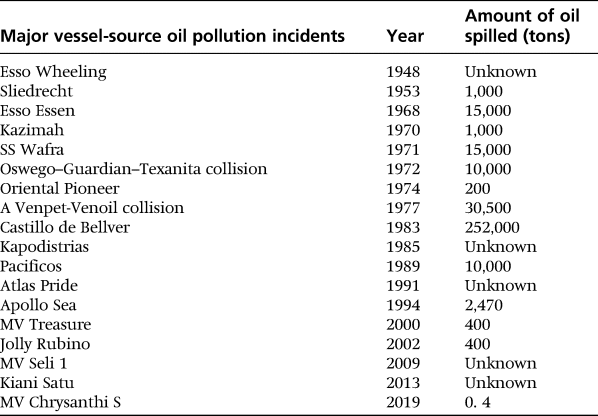
For the last 73 years, South Africa has been importing large quantities of oil. South Africa's coastline is visited by an estimated 12,000 vessels per annum, among which are many tankers collectively carrying a large quantity of crude oil.Footnote 10 Given the length of South Africa's exposed coastline and strong seas, the country faces a considerable threat of vessel-source oil pollutionFootnote 11 and its coastline is considered a global hotspot for oil pollution and tanker accidents with resulting oil spills.Footnote 12 A great number of vessel-source oil pollution incidents have occurred in South Africa over the last 73 years and have caused serious damage to the marine environment. Southern African waters are notorious for oil spills and particularly for their disastrous effects on African penguins.Footnote 13 This article sets out major vessel-source oil pollution incidents that occurred in South Africa, indicates their magnitude and identifies the vessels that caused the oil pollution damage in these incidents. From Table 1 below, it can be observed that numerous vessel-source oil spill incidents have already occurred in South Africa. In addition to large vessel-source oil spills, there have also been numerous small vessel-source oil spills. At the time of writing this article, the Castillo de Bellver oil spill incident of 1983 remains the largest vessel-source oil spill in South Africa and is considered among the major vessel-source oil pollution incidents in the world.
Major vessel-source oil pollution incidents in South Africa

Source: Author's compilation
It should be noted that the oil spills noted in Table 1 include spills of different types, including fuel oil, crude oil and bunker oil. The amount of oil spilled in some incidents is unknown, meaning that the South African authorities do not know the exact amount of oil released at sea during those incidents. Nevertheless, based on the data, it can be estimated that over 300,000 tons of oil have already been spilled in South African waters, affecting several thousand penguins, killing thousands of marine animals, causing economic impacts to the people living along the South African coast and damaging human health. Table 1 identifies 18 major vessel oil spills in South Africa over a period of 71 years. If the number of years (71) is divided by the number of major vessel-source oil pollution incidents (18), the result shows that, on average, a major vessel-source oil spill incident occurs in South Africa approximately every 4 years.
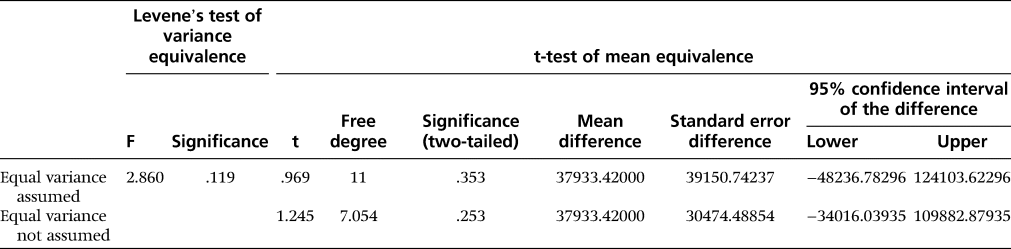
When the data provided in Table 1 are separated into two periods, the first representing the major vessel-source oil pollution incidents occurring in South Africa between 1948 and 1983 and the second representing incidents occurring between 1984 to 2019, it is noticeable that nine major incidents occurred during the first period and that nine also occurred during the second period. During the second period, four incidents resulted in an unknown quantity of spilled oil, while during the first period only one incident resulted in an unknown quantity of spilled oil. The author used the statistical software SPSS to test independent samples of the two groups of data. In this regard, it is first necessary to verify whether the quantities of oil pollution in 1948–83 and 1984–2019 agree with the homogeneity test of variance. For this, a descriptive analysis was applied and the results are shown in Table 2 below.
Descriptive Analysis

Source: Author's compilation
The results reveal that the quantities of oil pollution in the two groups of data (1948–83 and 1984–2019) agree with the homogeneity test of variance. With the results of the descriptive analysis, an independent sample t-test was carried out on the two groups of data to determine whether the difference in the quantity of oil pollution between these two groups is statistically significant. The findings in Table 3 below reveal that the difference in the quantity of oil pollution between the two groups is not statistically significant (sig = 0.353 > 0.05). Thus, it can be concluded that South Africa has faced a constant risk of vessel-source oil pollution since 1948. Therefore, a large vessel-source oil spill in South Africa may be considered imminent.
Independent sample t-test

Source: Author's compilation
Vessel-source oil spill incidents in South Africa not only damage the marine environment but also require significant financial resources for clean-up and impact minimization. Clean-up operations for these incidents have cost South Africa greatly. Data on clean-up costs for vessel-source oil spill incidents in South Africa are available dating back to 1994, the year that marks the end of apartheid in South Africa and the organization of the first democratic elections. Before 1994, data concerning oil in South Africa were not publicly available due to prohibitions of the apartheid system. The Apollo Sea oil spill incident that occurred in 1994 resulted in clean-up operations amounting to ZAR 27 million.Footnote 14 The MV Treasure oil spill incident that occurred in 2000 resulted in expenditure of more than ZAR 13 million on clean-up operationsFootnote 15 and the Jolly Rubino incident in 2002 resulted in more than ZAR 18.4 million for salvage and clean-up operations.Footnote 16 The MV Seli 1 oil spill incident that occurred in 2009 resulted in more than ZAR 40 million spent on salvage and clean-up operations, paid for by South African taxpayers as the MV Seli 1 had been abandoned by its owner.Footnote 17 The Kiani Satu oil spill incident in 2013 resulted in expenditure of more than ZAR 38 million for salvage and clean-up operations.Footnote 18
Clean-up operation costs for most vessel-source oil spill incidents in South Africa before 2014 have largely been paid for by South African taxpayers due to the lack of conformity of South African national law with international law concerning the liability of ship owners to pay compensation for damage and preventive measures to prevent or minimize damage. Between 1994 and 2019, South African taxpayers paid millions of South African Rand for these clean-up costs: money that could have been used to build schools or universities, or solve other national problems. Furthermore, victims of vessel-source oil spill incidents that occurred in South Africa before 2014 have been inadequately compensated.
INTERNATIONAL LAW GOVERNING COMPENSATION FOR VESSEL-SOURCE OIL POLLUTION DAMAGE
International laws play an important role in protecting the marine environment from damage from vessel-source oil pollution. In this regard, article 235(3) of UNCLOS requires states to implement international laws.Footnote 19 A number of international conventions have been adopted to address issues regarding compensation for damage from vessel-source oil pollution. One such convention is the International Maritime Organization Protocol of 1992 to amend the 1969 International Convention on Civil Liability for Oil Pollution Damage (CLC Protocol). This convention provides for first-tier compensation for vessel-source persistent oil pollution. The CLC Protocol imposes strict liability on the ship owner for oil pollution damage, with few exonerations, and limits liability according to the ship's tonnage.Footnote 20 The CLC Protocol was adopted in November 1992 and entered into force in May 1996. At that time, the maximum amounts to which the owner of a ship was liable were set as follows:
“(a) 3 million units of account for a ship not exceeding 5,000 units of tonnage;
(b) for a ship with a tonnage in excess thereof, for each additional unit of tonnage, 420 units of account in addition to the amount mentioned in subparagraph (a); provided, however, that this aggregate amount shall not in any event exceed 59.7 million units of account.”Footnote 21
In October 2000, the CLC Protocol was amended. Through this amendment, these amounts were increased as follows:
“(a) 4,510,000 units of account for a ship not exceeding 5,000 units of tonnage;
(b) for a ship with a tonnage in excess thereof, for each additional unit of tonnage, 631 units of account in addition to the amount mentioned in sub-paragraph (a); provided, however, that this aggregate amount shall not in any event exceed 89,770,000 units of account.”Footnote 22
These amendments entered into force in November 2003. The CLC Protocol requires the owner of a ship registered in a contracting state and carrying more than 2,000 tons of oil in bulk as cargo to maintain insurance or other means of financial security.Footnote 23
Second-tier compensation for pollution from vessel-source persistent oil is provided for by the CLC Protocol to amend the International Convention on the Establishment of an International Fund for Compensation for Oil Pollution Damage 1971 (the Fund Convention). This is a compensation regime for oil pollution that only covers pollution damage arising from spills of persistent oil from tankers.Footnote 24 The CLC Protocol and the Fund Convention have the same scope of application. The Fund Convention provides for compensation where the ship owner is not liable under the CLC Protocol, is incapable of fully meeting its financial liability or where damage exceeds the amount of compensation under the liability convention.Footnote 25 The Fund Convention established the International Oil Pollution Compensation Fund (IOPC Fund), which is financed by contributions paid by persons who, in the relevant calendar year, receive in excess of 150,000 tons of crude oil or heavy fuel oil in ports or terminal installations in a state that is a member of the relevant fund, following carriage by sea.Footnote 26 The total amount of compensation available under the Fund Convention is 203 million special drawing rights.Footnote 27
Third-tier compensation for vessel-source persistent oil pollution is provided for by the Protocol of 2003 to the International Convention on the Establishment of an International Fund for Compensation for Oil Pollution Damage 1992 (Supplementary Fund Protocol). The Supplementary Fund Protocol aims to increase significantly the levels of compensation if the compensation available through the CLC Protocol and the IOPC Fund is considered insufficient.Footnote 28 The Supplementary Fund limits special drawing rights to a combined total of 750 million for a single incident, including the amount of compensation paid under the CLC Protocol and the Fund Convention.Footnote 29 The Supplementary Fund is financed through contributions paid by persons who, in the relevant calendar year, receive at least one million tons of oil. In order for a state to join the Supplementary Fund Protocol, it must first be party to the CLC Protocol and the Fund Convention, as the three conventions are closely interrelated.Footnote 30
The International Convention on Civil Liability for Bunker Oil Pollution Damage 2001 (Bunker Convention) addresses liability and compensation issues arising from the spills of bunker oil from ships.Footnote 31 The Bunker Convention has many similarities with the CLC Protocol, including provisions imposing strict liability on the owner of the ship that has caused oil pollution damage and provisions allowing for the ship owner to be exonerated from that liability under certain conditions. However, there are also some differences between the Bunker Convention and the CLC Protocol. The Bunker Convention does not include oil tankers in its definition of the term “ship”. Other differences in the Bunker Convention are: it has a different definition of “oil”; there is no provision for second-tier compensation; claims are not only channelled to the registered ship owner; there is no civil responder immunity; and the compulsory insurance requirement is set at a gross tonnage of 1,001, rather than ships carrying a minimum of 2,000 tons of oil cargo.Footnote 32 Although there are no precise limits on the liability of the owner whose ship discharges bunker oil and causes damage to the marine environment, the Bunker Convention refers to the 1976 Convention on Limitation of Liability for Maritime Claims (LLMC), as amended.Footnote 33 The LLMC provides uniform rules relating to the limitation of liability for maritime claims.Footnote 34 It is widely assumed that liability for pollution damage caused by bunker spills will be limited under the LLMC in most jurisdictions where the Bunker Convention is in force.Footnote 35 The LLMC was amended by the 1996 Protocol to the LLMC (LLMC Protocol), which increased the limits of liability for maritime claims. The LLMC Protocol was also amended in 2012. The new amendment entered into force in 2015 and further increased the limits of a ship owner's liability.Footnote 36
The next section introduces relevant international conventions to which South Africa has acceded, and which relate to the issue of compensation for damage from vessel-source oil pollution.
INTERNATIONAL CONVENTIONS ACCEDED TO BY SOUTH AFRICA REGARDING COMPENSATION FOR VESSEL-SOURCE OIL POLLUTION DAMAGE
Vessel-source oil pollution is a serious threat to marine environments and compensation for vessel-source oil pollution damage is a key issue in protecting the interests of both victims and the marine environment, as well as in preventing oil pollution damage.Footnote 37 South Africa was a party to the 1969 International Convention on Civil Liability for Oil Pollution Damage (CLC). In 2004, South Africa acceded to the CLC Protocol to amend the CLC. South Africa is also a party to the Fund Convention.
The article now examines the first-tier of compensation for damage from vessel-source oil pollution provided by the South African legal system. It analyses the extent to which South Africa has implemented the relevant international conventions in domestic law.
DOMESTIC LEGISLATION ON COMPENSATION FOR FIRST-TIER VESSEL-SOURCE OIL POLLUTION DAMAGE
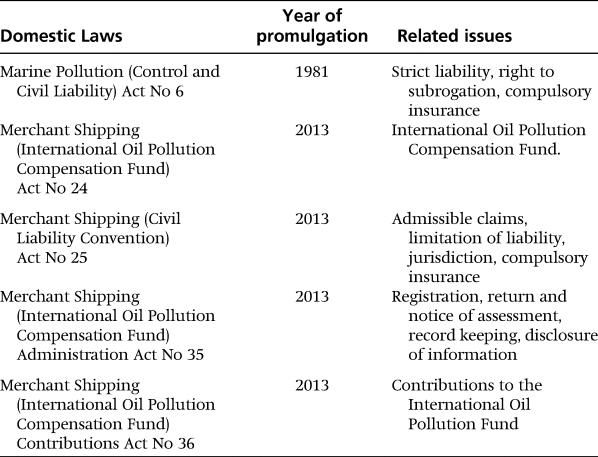
South Africa understands the importance of compensation for victims of damage from vessel-source oil pollution. South Africa has a dualist approach to implementing international laws and the provisions of international conventions in domestic law.Footnote 38 Under this approach, international conventions ratified and acceded to by South Africa become effective when Parliament enacts their provisions into domestic law. South Africa has acceded to relevant international conventions related to compensation for damage from vessel-source oil pollution and has implemented certain provisions of these conventions into its domestic laws, as indicated in Table 4 below. In this regard, South Africa has followed the recommendation provided in article 235(3) of UNCLOS, by establishing a legal system for compensation for damage from vessel-source oil pollution.
Laws on compensation for vessel-source oil pollution in South Africa

Source: Author's compilation
Progress made by South Africa
In South Africa, policies and legislation pertaining to the protection of the marine environment have improved markedly over the past few years.Footnote 39 South Africa acceded to the CLC in 1976 and enacted the Marine Pollution Control and Civil Liability Act No 6 of 1981 (MPCCLA).Footnote 40 As the CLC was replaced by the CLC Protocol, South Africa became a party to the CLC Protocol in 2004 and enacted the South Africa Merchant Shipping (Civil Liability Convention) Act No 25 of 2013 (Merchant Shipping CLC Act), which provides for first-tier compensation to claimants in respect of damage from vessel-source oil pollution. Nearly a decade after acceding to the CLC Protocol, South Africa fully implemented the provisions of the CLC Protocol, as amended, in its domestic laws. Nevertheless, the Merchant Shipping CLC Act is compatible with the MPCCLA, which also provides for liability and compensation for damage from vessel-source oil pollution; however, the Merchant Shipping CLC Act prevails.
When the Kiani Satu oil spill incident occurred in South Africa in August 2013, civil liability and compensation for such incidents were still governed in South Africa by the MPCCLA. Due to this outdated legislation, the owners of the Kiani Satu were able to limit the compensation they paid to just ZAR 33 million,Footnote 41 which was inadequate compared to the level of damage and was significantly lower than the compensation amounts provided for by the Merchant Shipping CLC Act, which was enacted in December 2013 and came into effect on 30 May 2014. The claimants in the Kiani Satu incident were thus inadequately compensated due to the time of their application under the MPCCLA, which did not conform with the standards of the CLC Protocol for first-tier compensation for victims of damage from vessel-source oil pollution. If the Merchant Shipping CLC Act had already been enacted and become operational before this incident occurred, it would have provided higher compensation for the claimants.
Implementation of the CLC Protocol provisions in the Merchant Shipping CLC Act has thus helped South Africa to conform with international standards for first-tier compensation in respect of vessel-source oil pollution damage and provide better protection and compensation to claimants in respect of future incidents.
Scope of application
The Constitution of the Republic of South Africa 1996 (the Constitution) provides that international conventions ratified and acceded to by South Africa can become law by enactment through domestic legislation.Footnote 42 The Constitution provides directives on how international conventions ratified and acceded to by South Africa should be implemented in the country. Moreover, article 2(1) of the Merchant Shipping CLC Act,Footnote 43 which serves as the main law in South Africa regarding first-tier compensation for vessel-source oil pollution damage, provides that the CLC Protocol has “the force of law in the Republic”. The Merchant Shipping CLC Act applies “in the Republic” and in “the Prince Edwards Islands”. However, the geographical scope covered by the Merchant Shipping CLC Act differs from the related provision provided by article 2 of the CLC Protocol, which covers:
“[P]ollution damage caused in the territory, including the territorial sea, of a contracting state, and in the exclusive economic zone of a contracting state, established in accordance with international law, or, if a contracting state has not established such a zone, in an area beyond and adjacent to the territorial sea of that State determined by that state in accordance with international law and extending not more than 200 nautical miles from the baselines from which the breadth of its territorial sea is measured.”
Fortunately, section 1 of the MPCCLA provides that the “area of the Republic includes the internal waters and the territorial waters, as well as the exclusive economic zone, as referred to in section 7 of the Maritime Zones Act 15 of 1994”. This allows South Africa to conform with the geographical scope of application of the CLC Protocol.
Strict liability
As the CLC Protocol is recognized under domestic law in South Africa, the terms “ship”, “owner”, “oil”, “pollution damage”, “preventive measures” and “incidents” are defined as prescribed by this convention. However, the definition of the term “pollution damage” is not in line with South African domestic realities. Indeed, in section 1(xxiv) of South Africa's National Environment Management Act 107 of 1998 (NEMA)Footnote 44 (which “provides a framework of principles that must be applied to all decision-making that may affect the environment and its biodiversity” in South Africa), “pollution” is defined as a change in the environment that has “an adverse effect on human health or wellbeing or on the composition, resilience and productivity of natural or managed ecosystems, or on materials useful to people, or [that] will have such an effect in the future”. The addition of this definition of “pollution” to the Merchant Shipping CLC Act would provide for better protection of the marine environment in South Africa as the two acts would then be aligned on the matter of marine pollution. The current misalignment creates a loophole, as pure environmental damage is not included in the definition of “pollution damage” under the Merchant Shipping CLC Act although it is in NEMA. Thus, in South Africa, people who are victims of pure environmental damage caused by vessel-source oil pollution may find an option in section 1 of NEMA, “which could jeopardize the relevance of the 1992 CLC”.Footnote 45 The definition of “pollution damage” provided by the CLC Protocol “does not satisfy modern environmental needs for protection and there is a need for a more nuanced and extensive liability for damage to the environment”.Footnote 46 It is thus necessary for the Merchant Shipping CLC Act to go beyond the definition of “pollution damage” provided by the CLC Protocol.
The CLC Protocol imposes strict liability on the ship owner in cases of vessel-source oil pollution incidents. The MPCCLA also provides for strict liability of the ship owner for damage caused by such incidents. In South Africa, the ship owner can be exempted from such liability if he meets the conditions stipulated in article III(2) of the CLC Protocol.Footnote 47 On the basis of the CLC Protocol, joint liability shall be applied in South Africa if oil pollution damage is caused by an incident involving two or more ships and their liability cannot reasonably be separated.
Limitation of liability
In South Africa, a ship owner's aggregate limit of liability is determined according to article V(1) of the CLC Protocol. However, if it is proven that the pollution damage resulted from a personal act or omission by the ship owner, was committed with the intent to cause that damage or was committed recklessly and with knowledge that such damage would probably result, the ship owner will not be allowed to limit his liability.
South Africa acceded to the CLC Protocol in June 2004.Footnote 48 Within a few months, the CLC Protocol amendments had entered into force and been implemented in the national laws of all the contracting states. However, as the Merchant Shipping CLC Act does not itself mention any exact limit of liability and only refers to the CLC Protocol, there may be some confusion as to whether it is the provisions of the CLC Protocol before its amendment or those of the CLC Protocol after its amendment that apply. Fortunately, the Gazette notice 1535 of 20 November 2009 makes it clear that the CLC Protocol has been approved in South Africa.Footnote 49 This notice recognizes the CLC Protocol and acknowledges its amendment in 2000 and that it, combined with the Merchant Shipping CLC Act, makes the most recent limits of liability provided in article V(1) of the CLC Protocol applicable in South Africa.Footnote 50 Furthermore, although the liability limits mentioned in the CLC Protocol are in “units of account”, section 9(8)(a) of the MPCCLA provides that “‘unit of account’ means a Special Drawing Right as defined by the International Monetary Fund, and the value of such Special Drawing Right in South African currency shall be calculated in accordance with the method of valuation applied by the International Monetary Fund and which is in effect at the time when payment is made”.
However, under South African domestic law, enactment of the various amendments of the CLC Protocol in general, and in particular the amendments of the limits of liability in the CLC Protocol, as provided by section 2(2) of the Merchant Shipping CLC Act,Footnote 51 is not automatic; this poses a serious problem. As mentioned above, although the CLC Protocol was amended in 2000 and South Africa acceded to the CLC Protocol in 2004, it was only in 2009, six years after these amendments entered into force, that South Africa issued a notice acknowledging the 2000 amendments to the CLC Protocol. This indicates that South Africa will need to publish an official notice to adopt future amendments to the CLC Protocol, particularly in relation to increases in the limits of liability. Knowing that South Africa must respect section 231(2) of the Constitution,Footnote 52 it may take years before any new amendment can be fully implemented in South African national law; unfortunately, this would be to the serious disadvantage of future claimants in respect of vessel-source oil pollution damage.
According to the Merchant Shipping CLC Act, the High Court of South Africa is the court that deals with cases of compensation for vessel-source oil pollution damage. This court has the duty to determine whether or not the ship owner can limit his liability. If he can, in order to benefit from the liability limits for vessel-source oil pollution, the ship owner must constitute a fund with the court and pay the compensation to the court. On the basis of the CLC Protocol and article 12(5) of the MPCCLA, there is a right to subrogation in South Africa. The compensation must be paid in South Africa's national currency, the South African Rand.
Compulsory insurance
The Merchant Shipping CLC Act and the MPCCLA require ships carrying cargoes of more than 2,000 tons of oil in bulk to maintain insurance, as stipulated in article VII(1) of the CLC Protocol. South Africa requires ships entering, leaving or attempting to enter or to leave any port in South Africa to carry on board relevant certificates of insurance. Ships registered in South Africa may acquire such certificates from the South African Maritime Safety Authority.Footnote 53 The Merchant Shipping CLC Act provides for details regarding the extension, cancellation and lapsing of insurance certificates. In South Africa, a claim for compensation for damage from vessel-source oil pollution can be brought directly against the insurer or the person providing financial security for the ship owner's liability in respect of such damage. Even in cases where the owner of the ship that caused the oil pollution damage is not allowed to limit his liability, the insurer can limit its liability for such damage based on the aggregate limits of liability provided by article V(1) of the CLC Protocol. According to article 15(2) of the MPCCLA, in cases where the insurer can “prove that the incident in question was caused by the wilful act or omission of the owner himself”, he can avail himself of the defences that the owner may have otherwise invoked. As stipulated by article VII(8) of the CLC Protocol, the insurer “may further avail himself of the defences (other than the bankruptcy or winding up of the owner) which the owner himself would have been entitled to invoke”.
Rights to compensation
On the basis of the CLC Protocol, which has force of law in South Africa, persons can claim their rights to compensation for damage from vessel-source oil pollution within a period of three years from the date on which the damage occurred.
Recognition and enforcement of foreign judgment
According to the Merchant Shipping CLC Act, the Minister of Transport may issue regulations to give effect to the recognition and enforcement of foreign judgments;Footnote 54 however, such regulations have not yet been made in South Africa. Nevertheless, the South Africa Enforcement of Foreign Civil Judgments Act No 32 of 1988 provides for foreign judgments from selected countries to be recognized and enforced in South Africa. It is also possible for a foreign judgment to be recognized and enforced in South Africa through an application to court.
THE LEGAL SYSTEM FOR COMPENSATION FOR SECOND-TIER VESSEL-SOURCE OIL POLLUTION IN SOUTH AFRICA
Does South Africa provide second-tier compensation?
South Africa is an upper middle-income country and therefore experiences a low financial burden from being a member of the IOPC Fund and tends to be in favour of the international compensation regime for tanker oil pollution damage.Footnote 55 South Africa is a party to the Fund Convention and provides second-tier compensation for victims of vessel-source oil pollution damage. As shown in Table 4 below, South Africa has implemented the provisions of the Fund Convention into its domestic law by enacting the Merchant Shipping (International Oil Pollution Compensation Fund) Act No 24 of 2013 (IOPCFA),Footnote 56 article 2(1) of which provides for the Fund Convention to have “force of law in the Republic”. The High Court of South Africa has jurisdiction to consider actions against the IOPC Fund for compensation for vessel-source oil pollution damage. The IOPCFA recognizes and enforces the IOPC Fund's right to intervene in proceedings. According to section 11(1) of the IOPCFA, South Africa's minister of transport is expected to make “regulations giving effect to Article 8 of the 1992 Fund Convention”.
In addition, South Africa has enacted the Merchant Shipping (International Oil Pollution Compensation Fund) Contributions Act No 36 of 2013 (Contributions Act),Footnote 57 which provides details regarding the imposition of a financial levy of a certain amount to be collected from persons who, within a calendar year, have received or imported an amount of oil exceeding 150,000 tons in the ports, terminal installations or any installations in South Africa. The total amount of money levied is collected by the South African government and given to the IOPC Fund.
Section 2(2) of the Contributions Act stipulates:
“[W]here the quantity of contributing oil received in the Republic by any person in the tax period when aggregated with the quantity of contributing oil received in the Republic by any associated person exceeds 150,000 metric tons, each person must pay contributions in respect of the actual quantity of oil received by that person, despite the fact that the quantity did not exceed 150,000 metric tons.”
The rate of the levy for a given calendar year is determined by the South African “minister” through an official notice in the Gazette. However, the Contributions Act does not provide a clear explanation as to whom or what the word “minister” refers in the act. Moreover, the Contributions Act provides that “the commissioner is authorized on behalf of the government to receive invoices for contributions issued by the director of the fund in respect of persons liable to pay the levy”.Footnote 58 However, the act does not define to whom “commissioner” refers. It should also be noted that unpaid amounts due to the IOPC Fund are subject to interest.
South Africa demonstrated policy innovation by further enacting the Merchant Shipping (International Oil Pollution Compensation Fund) Administration Act No 35 of 2013 (Administration Act), which provides “for administrative matters related to the levy imposed in terms of the Merchant Shipping (International Oil Pollution Compensation Fund) Contributions Act No 36 of 2013”.Footnote 59 In its article 3(1), the Administration Act requires persons who have received or imported a quantity of contributing oil exceeding 150,000 tons, “within 21 business days after meeting the criteria, to apply to the commissioner to be registered for the levy”. However, the word “commissioner” in this act is also not defined. The levy to be collected from persons receiving or importing oil in South Africa is assessed by the “commissioner”, who submits a notice of assessment to these persons. Persons receiving or importing oil in South Africa are thus required to keep relevant documents for proof of import into South Africa. According to article 6 of the Administration Act, the “commissioner” should disclose to the director of the IOPC Fund, “the minister and the minister of transport” of South Africa, information on the persons who have received or imported a quantity of contributing oil exceeding 150,000 tons. However, apart from the minister of transport, it is unclear to whom the word “minister” refers.
South Africa's domestic laws are now aligned with international standards regarding second-tier compensation for vessel-source oil pollution damage. This, however, was not the case before the enactment of the IOPCFA, the Administration Act and the Contributions Act. Although South Africa has been party to the Fund Convention since 2005, it did not contribute to the IOPC Fund for several years because the convention had not yet been domesticated into national law.Footnote 60 The provisions of the Fund Convention were fully implemented into South African national law after approximately eight years: a delay necessary to avoid and overcome potential conflicts between the provisions of the convention and those of the South African Petroleum Products Act No 120 of 1977.Footnote 61 This act specifically regulates all aspects of the oil industry in South Africa and, in its section 4 on secrecy, prohibits the disclosure of information on matters relating to oil.Footnote 62 This act therefore prohibited South Africa from publicly reporting the quantity of oil that it imported each year. Although South Africa repealed section 4 in the Petroleum Products Amendment Act 58 of 2003Footnote 63 in March 2006,Footnote 64 it then needed to prepare and legislate a number of bills in order to domesticate the Fund Convention. This process included drafting the Merchant Shipping (International Oil Pollution Compensation Fund) Bill, the Merchant Shipping (International Oil Pollution Compensation Fund) Administration Bill and the Merchant Shipping (International Oil Pollution Compensation Fund) Contributions Bill, all of which underwent a consultation period to solicit comments from the public, South African legal professionals, and government and parliamentary officials before being finalized and accepted. The bills received final acceptance by the National Assembly and the National Council of Provinces, as well as the assent of the president of the Republic, before being enacted. In South Africa, the time required for a bill to be enacted depends mainly on its level of perceived importance, its length, its complexity and how controversial it is. Thus, the enactment of a bill can be very time-consuming.Footnote 65
By the time these bills were enacted, South Africa was required to pay outstanding dues to the IOPC Fund, which had accumulated over the period since 2005. As shipping companies in South Africa refused to pay the accumulated debt, the state agreed to pay the outstanding contribution of ZAR 36 million to the IOPC Fund.Footnote 66 In this case, the long delay in implementing the provisions of the Fund Convention into domestic law had a negative financial impact on South Africa, which was responsible for making a considerable lump sum payment. However, this amount would have been much higher had South Africa not implemented the provisions of the convention into national law in 2013. Since enacting these bills, South Africa has made annual, timely payments and oil reports to the IOPC Fund, which indicate the total amount of oil received in the country within a calendar year.Footnote 67 Payments made by South Africa to the IOPC Fund are collected from companies importing oil into the country.Footnote 68 Although not named in the Contributions Act, the South African Revenue ServiceFootnote 69 is the institution responsible for collecting dues and for transferring payments to the IOPC Fund. The enactment of the IOPCFA, the Administration Act and the Contributions Act have allowed South Africa to be on good terms with the IOPC Fund.
Is a domestic compensation fund for vessel-source oil pollution needed?
After a vessel-source oil pollution incident occurs, affected persons expect to be able to claim compensation and to be compensated as soon as possible. However, within the international system, there are recurrent complaints about delays in compensation.Footnote 70 South Africa is a country in which vessel-source oil pollution incidents occur frequently. In this regard, having access to the compensatory funds within a short period of time is essential for victims of vessel-source oil pollution damage. At the moment, there is no urgency for South Africa to establish a domestic vessel-source oil compensation fund; however, in the coming years, establishing a domestic fund will be of benefit to the country as it will enable better access for claimants to second-tier compensation and to larger amounts of compensation. Indeed, a domestic fund would also be able to cover a larger scope than the Fund Convention. Certain countries in the world already have additional funds available; for example, Canada operates a Ship-source Oil Pollution Fund.Footnote 71 Countries are allowed to be party to the Fund Convention and have a domestic compensation fund for vessel-source oil pollution damage in order to provide claimants with additional compensation.
WILL THE COMPENSATION FOR VESSEL-SOURCE OIL POLLUTION DAMAGE BE ADEQUATE?
Will South Africa ratify the 2001 Bunker Convention?
The need for the Bunker Convention was highlighted in 1996 in a joint submission during the 75th session of the International Maritime Organization's Legal Committee by Australia, Canada, Finland, Norway, South Africa, Sweden and the UK.Footnote 72 This demonstrates that South Africa considers bunker oil pollution damage caused by vessels to be an important issue that deserves attention and that victims of such damage deserve to receive adequate compensation. However, at the time of writing this article, South Africa is the only country behind the joint submission not to have become party to the Bunker Convention.
Bunker oil pollution incidents have already occurred in South Africa and claimants have not been adequately compensated because of outdated legislation regarding claimant compensation for oil spills resulting from the escape or discharge of bunker oil from ships. That is because the provisions in the MPCCLA differ from those provided by the Bunker Convention regarding escaped and discharged bunker oil. For instance, article 1(5) of the Bunker Convention defines “bunker oil” as “any hydrocarbon mineral oil, including lubricating oil, used or intended to be used for the operation or propulsion of the ship, and any residues of such oil”, while the MPCCLA defines “oil” as “any kind of mineral oil and includes spirit produced from oil and a mixture of such oil and water or any other substance”.Footnote 73 It can be noted that the MPCCLA definition covers a broader scope.
Unlike article 1(3) of the Bunker Convention that defines the “ship-owner” as “the owner, including the registered owner, bareboat charterer, manager and operator of the ship”, section 1 of the MPCCLA defines the “owner” as “the person or persons registered as the owner of such ship or tanker or, in the absence of registration, the person or persons to whom such ship or tanker belongs”. Thus, in cases where the ship owner is financially unable to pay the compensation and clean-up costs, responsibility for clean-up costs shifts to the South African government and victims have no legal avenue through which to receive compensation. This occurred with the MV Seli 1 oil spill incident in 2009 in South Africa. The MV Seli 1 spilled bunker oil and caused significant damage to the marine environment; however, the ship owner abandoned the ship and evaded liability. This resulted in the South African government being responsible for the environmental clean-up costs and the victims not receiving compensation.
Section 9(5)(b) of the MPCCLA limits the liability for bunker oil pollution damage in South Africa to “fourteen million units of account”, which is a very small amount in comparison to the amount provided by the LLMC Protocol. This causes claimants in respect of such damage to be inadequately compensated. An incident of inadequate compensation occurred in 2019 with the MV Chrysanthi S spill, which resulted in 0.4 tons of oil (involving bunker fuel) being spilled in South African waters. The owner of the MV Chrysanthi S was found liable and was fined only ZAR 350,000 (USD 25,000) by the South African Maritime Safety Authority.Footnote 74 This level of fine is ridiculous compared to the amount provided for by the LLMC Protocol, as amended.Footnote 75 Although the quantity spilled involving bunker fuel was less than one ton of oil, the spilled quantity still caused damage to the marine environment and may result in disastrous environmental consequences. In this case, the owner of the MV Chrysanthi S should have been required to pay more compensation. Another incident of inadequate compensation occurred in the insurance claims for the seabird rescues during the Apollo Sea spill, in which the owner paid USD 589,000, and during the MV Treasure spill, in which the owner paid USD 1,459,000. In both of these cases, the payments were relatively small sums for the companies responsible for the pollution.Footnote 76 Furthermore, delays in the payment of compensation to claimants in respect of vessel-source bunker oil pollution damage are common in South Africa and often lead to the disappointment and desolation of claimants who are paid inadequate compensation and who may experience several years of delays in receiving compensation. For example, in the case of the Apollo Sea spill, compensation for pollution damage was paid to South Africa by the ship's insurer after claims were made; however, the insurer delayed the payments for several years before compensating the claimants.Footnote 77
Moreover, unlike article 4 of the LLMC, which provides that “a person liable shall not be entitled to limit his liability if it is proved that the loss resulted from his personal act or omission, committed with the intent to cause such loss, or recklessly and with knowledge that such loss would probably result”, section 9(5) of the MPCCLA provides that the ship owner is unable to limit his liability if the oil pollution damage resulted from the “owner's actual fault or privity”. This provides an option for claimants to ensure that ship owners are unable to limit their liability for bunker oil pollution damage. While this appears advantageous for claimants, it also allows ship owners to escape liability if the amount is so high that they are financially unable to compensate the claimants. This provision also poses a problem for South Africa.
With regard to the increasing risk of bunker oil spill incidents in South Africa, section 9(5) of the MPCCLA is outdated and does not provide adequate protection for the marine environment. By failing to ratify the Bunker Convention and maintaining outdated legislation that is not aligned with international law regarding vessel-source bunker oil damage, the government of the Republic of South Africa has failed adequately to protect the country's marine environment. Therefore, the outdated act does not comply with section 24 of the Constitution.Footnote 78
Furthermore, while article 7 of the Bunker Convention requires the “registered owner of a ship having a gross tonnage greater than 1000 registered in a state party to maintain insurance or other financial security”, the MPCCLA does not specify such a requirement. This type of provision would enable ship owners in South Africa to be financially prepared if found liable in incidents of vessel-source bunker oil pollution and would prevent ship owners from evading liability with regard to compensating claimants in respect of such damage.
In 2015, South Africa's Cabinet approved the submission of the Bunker Convention to Parliament in order to be ratified.Footnote 79 Ratification of a treaty by the national executive without approval by resolution in Parliament, ie without parliamentary consent, would violate section 231(2) of the Constitution.Footnote 80 At the time of writing this article, ratification of the Bunker Convention by South Africa thus awaits parliamentary approval for ratification. However, even if Parliament ratifies the Bunker Convention, there is no guarantee that it will enter into domestic law in a timely manner. Several years may be required before the provisions of the Bunker Convention are fully implemented into domestic law in South Africa.
Furthermore, South Africa is not yet a party to the LLMC Protocol. This creates a challenge, as the Bunker Convention and LLMC are interrelated. Since South Africa is not party to the LLMC Protocol, the compensation that victims of vessel-source bunker oil spill incidents in South Africa can claim is very low. This highlights the need for South Africa to give more attention to incidents of pollution by bunker oil, to accede to the Bunker Convention and the LLMC Protocol as soon as possible, and to implement the provisions of both conventions fully into domestic law in order to protect the marine environment and future claimants better. Until then, claimants in respect of vessel-source bunker oil pollution damage in South Africa may not be adequately compensated.
Furthermore, if South Africa ratifies the Bunker Convention and implements its provisions into domestic law, but does not accede to the LLMC Protocol, future claimants in respect of vessel-source bunker oil spill incidents will still be inadequately compensated. The LLMC Protocol has stronger provisions regarding the limits of liability for ship owners whose ships pollute the marine environment by spilling bunker oil. Therefore, it is critical for South Africa to accede to both international conventions in order to provide adequate compensation for victims of such damage.
Does South Africa provide for third-tier compensation?
Although South Africa is party to both the CLC Protocol and the Fund Convention, it is not yet party to the Supplementary Fund Protocol. A legal system for compensation for vessel-source oil pollution damage in a country is considered strong and robust if it is able to provide for three tiers of compensation for claimants in respect of such damage. Claimants in South Africa are thus unable to receive fully adequate compensation in cases of large vessel-source oil pollution incidents. Although developing countries, such as South Africa, would probably require only limited access to compensation from the Supplementary Fund, the country would benefit from the option of access to higher levels of compensation in the event of large pollution incidents that exceed the limits of the IOPC Fund.Footnote 81
CONCLUSION
In recent years, South Africa has been amending its domestic laws regarding the issue of compensation for vessel-source oil pollution damage. South Africa now has an existing legal regime for compensation for such damage and an adequate court designated to solve related matters. South Africa has made tremendous efforts to align its domestic laws with international standards by acceding to relevant international conventions and implementing their provisions into its national laws. The South African legal system now provides for first and second tiers of compensation for claimants in incidents of vessel-source oil pollution damage.
However, despite these efforts, South Africa's legal system of compensation for damage from vessel-source oil pollution still has some insufficiencies. South Africa has not moved beyond the CLC Protocol's definition of the term “pollution damage”. Including pure environmental damage in the definition of this term in the Merchant Shipping CLC Act would offer better protection of the country's marine environments and would ensure that adequate compensation is provided to claimants in respect of vessel-source oil spill incidents that result in pure environmental damage. Therefore, it is important that states fully apply the content of the CLC Protocol, but also that they combine the content of this convention with their respective domestic legal systems. This is precisely what South Africa has failed to do. Furthermore, non-automatic enactment of the various amendments to the CLC Protocol in domestic law leads South Africa to be late in conforming to the latest provisions of the CLC Protocol. This is to the disadvantage of claimants in respect of vessel-source persistent oil pollution damage in South Africa. Based on the findings of this article, it can be concluded that South Africa is a country that does not rush to implement the provisions of international law into its national laws. As international law advances, the delay in domestication of these advancements in South Africa results in the country being in a position of vulnerability and being unable to protect victims of vessel-source oil pollution damage completely.
As demonstrated by Table 1, since the enactment of the Merchant Shipping CLC Act, the IOPCFA, the Administration Act and the Contributions Act, South Africa has not yet experienced a vessel-source persistent oil pollution incident. The enactment of these laws has caused ship owners to be more cautious than in the past, due to the amounts that they may have to pay to claimants in South Africa as compensation for vessel-source persistent oil spill damage. While the enactment of these laws has strengthened the South African legal system to deal with future incidents of vessel-source oil pollution, the fact that the provisions of these national laws have not yet been applied in a real case means that questions on their applicability and effectiveness remain.
Finally, South Africa's legal system for compensation for vessel-source oil pollution damage is not yet complete, as South Africa has not yet acceded to the LLMC Protocol, the Bunker Convention and the Supplementary Fund Protocol. In South Africa, claimants in respect of large vessel-source persistent oil pollution and damage caused by vessel-source bunker oil pollution may therefore not receive adequate compensation under current national law.
South Africa's legal system for compensation for vessel-source oil pollution damage could become more robust if South Africa enacts the recommendations made in this article. Acceding to the LLMC Protocol, the Bunker Convention and the Supplementary Fund Protocol, enacting domestic laws to implement the provisions of these three international conventions, and establishing a domestic South African Vessel-Source Oil Pollution Compensation Fund would greatly improve the domestic legal system for compensation for damage from vessel-source oil pollution in South Africa.
CONFLICTS OF INTEREST
None