Introduction
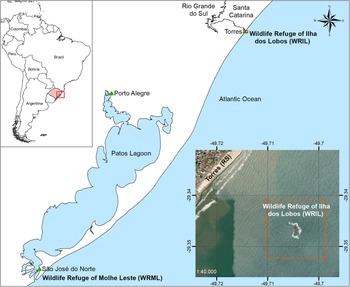
The presence of pinnipeds on the southern Brazilian coast can be considered seasonal, with the recorded presence concentrated mainly during the non-breeding season. Along this particular stretch of coastline, two South American species, the South American fur seal (Arctocephalus australis) and South American sea lion (Otaria flavescens), have been recorded annually (Pinedo, Reference Pinedo1990; Rosas et al., Reference Rosas, Pinedo, Marmotel and Haimovici1994; Simões-Lopes et al., Reference Simões-Lopes, Drehmer and Ott1995; Oliveira, Reference Oliveira, Weber, Roman and Cáceres2013; Procksch et al., Reference Procksch, Grandi, Ott, Groch, Flores, Zagonel, Crespo, Machado, Pavez, Guimarães, Veronez and Oliveira2020, Reference Procksch, Berchieri, Horota, Sales, Ott, Danilewicz, Guimarães, Guimarães, Veronez and Oliveira2023), whereas the Antarctic and Subantarctic species, such as Antarctic fur seal (Arctocephalus gazella), sub-Antarctic fur seal (Arctocephalus tropicalis), leopard seal (Hydrurga leptonyx), and southern elephant seal (Mirounga leonina) have occasionally been recorded (Oliveira et al., Reference Oliveira, Danilewicz, Martins, Ott, Moreno and Caon2001, Reference Oliveira, Machado, Alievi and Würdig2006; Oliveira, Reference Oliveira, Weber, Roman and Cáceres2013; Procksch et al., Reference Procksch, Grandi, Ott, Groch, Flores, Zagonel, Crespo, Machado, Pavez, Guimarães, Veronez and Oliveira2020). Although Brazil has no breeding colonies for any pinniped species, South American fur seals and sea lions are frequently sighted along the southern coast, including at two haulout sites: the wildlife refuge of Molhe Leste of São José do Norte (WRML) and the wildlife refuge of Ilha dos Lobos (WRIL). These are marine protected areas (MPAs) located on the coast of Rio Grande do Sul (Figure 1).
Map of the study area, showing the Wildlife Refuge of Ilha dos Lobos on the southern Brazilian coast.

South American pinnipeds found in Brazil arrive from their closest breeding sites in Uruguay and Argentina (Pinedo, Reference Pinedo1990; Rosas et al., Reference Rosas, Pinedo, Marmotel and Haimovici1994; Oliveira et al., Reference Oliveira, Gehara, Fraga, Lopes, Túnez, Cassini, Majluf, Cárdenas-Alayza, Pavés, Crespo, García, Castro, Hoelzel, Sepúlveda, Olavarría, Valiati, Quiñones, Pérez-Alvarez, Ott and Bonatto2017) after the breeding season, mainly during the austral autumn and spring months (Rosas et al., Reference Rosas, Pinedo, Marmotel and Haimovici1994; Simões-Lopes et al., Reference Simões-Lopes, Drehmer and Ott1995; Oliveira, Reference Oliveira, Weber, Roman and Cáceres2013; Pavanato et al., Reference Pavanato, Silva, Estima, Monteiro and Kinas2013; Bombau and Szteren, Reference Bombau and Szteren2017; Procksch et al., Reference Procksch, Grandi, Ott, Groch, Flores, Zagonel, Crespo, Machado, Pavez, Guimarães, Veronez and Oliveira2020). Both species have similar reproductive periods during the austral summer, beginning in December and continuing until February for South American sea lions (Campagna, Reference Campagna1985), and from November to mid-January for South American fur seals (Vaz-Ferreira, Reference Vaz-Ferreira1982a; Franco-Trecu et al., Reference Franco-Trecu, Costa, Scharam, Tassino and Inchausti2014). Once the breeding period ends, a small proportion of the population leaves their rookeries and then arrives at the Brazilian haulout sites. This corresponds with the dispersal period after the breeding season, which is the least understood period of their life cycle (Bastida and Rodriguez, Reference Bastida and Rodríguez1994; Sanfelice et al., Reference Sanfelice, Vasques and Crespo1999).
Pinniped counts conducted around 20 years ago presented information on the seasonal abundance of South American pinnipeds at the WRIL based on land and vessel counts (Sanfelice et al., Reference Sanfelice, Vasques and Crespo1999; Silva, Reference Silva2004; Pavanato et al., Reference Pavanato, Silva, Estima, Monteiro and Kinas2013; Silva et al., Reference Silva, Araújo, Crivellaro and Menezes2014). The most recently published data on the seasonal and spatial occupation of South American fur seals and sea lions in the WRIL (Procksch et al., Reference Procksch, Grandi, Ott, Groch, Flores, Zagonel, Crespo, Machado, Pavez, Guimarães, Veronez and Oliveira2020) was based on aerial photographic counts conducted from 2010 to 2018, but restricted to July and November of each year. The sampling for this study was opportunistic as it was undertaken during aerial censuses mainly for the southern right whale (Eubalaena australis) in the region. This is highly coincident with the breeding and calving season of this baleen whale (Groch et al., Reference Groch, Palazzo, Flores, Adler and Fabian2005; Danilewicz et al., Reference Danilewicz, Moreno, Tavares and Sucunza2017). For that reason, data for the months in which the greatest abundance of pinnipeds are known on the island were evaluated (see Procksch et al., Reference Procksch, Grandi, Ott, Groch, Flores, Zagonel, Crespo, Machado, Pavez, Guimarães, Veronez and Oliveira2020).
In this context, the aim of this study was to describe the seasonal and spatial occupation of the WRIL by South American fur seals and South American sea lions over the entire year through systematic aerial counts. Based on our findings, we provide insights and recommendations on when and where potential human activities could occur, such as marine wildlife tourism and/or on-land research. The findings of this study present relevant information for local managers, stakeholders, and users, considering that the region surrounding the WRIL is subject to human activity (Engel et al., Reference Engel, Marchini, Pont, Machado and Oliveira2014; Pont et al., Reference Pont, Marchini, Engel, Machado, Ott, Crespo, Coscarella, Dalzochio and Oliveira2016; Oliveira et al., Reference Oliveira, Pont, Machado, Engel, Ott, Crespo and Marchini2020; Ott et al., Reference Ott, Brandão, Sucunza and Oliveira2022). Monitoring this pinniped haulout site is relevant because this region can act as a gateway for new and emerging pathogens, as well as being a key area for assessing sea level rise in the context of global climate change (Schossler et al., Reference Schossler, Simões, Aquino and Viana2018; VanWormer et al., Reference VanWormer, Mazet, Hall, Gill, Boveng, London, Gellat, Fadely, Lander, Sterling, Burkanov, Ream, Brock, Rea, Smith, Jeffers, Henstock, Rehberg, Burek-Huntington, Cosby, Hammond and Goldstein2019; Procksch et al., Reference Procksch, Berchieri, Horota, Sales, Ott, Danilewicz, Guimarães, Guimarães, Veronez and Oliveira2023).
Methods
This study was based on aerial images taken with an unmanned aerial vehicle (UAV) flying over the WRIL (29°20ʹS; 49°42ʹW). The protected area is located at a distance of 1800 m from the city of Torres and consists of a coastal island with an area of 16,966 m2, and an additional 500 m around the island, resulting in 142 ha of MPA (Brasil, Reference Brasil1983; Brasil, Reference Brasil2005) (Figure 1).
The aerial images were taken with a DJI Mavic Pro II and DJI Mavic Platinum during 31 flights over the WRIL from July 2019 to November 2020, taking off from Praia Grande, Torres, northern Rio Grande do Sul state, southern Brazilian coast. No flights operated in November 2019 due to bad weather conditions (Table 1). To obtain accurate images of the study area, the UAV with the attached camera was operated at an altitude of approximately 100 m. This altitude was also chosen in order to avoid any impact or disturbance on the pinniped haulout site (adapted from Brazilian legislation for cetaceans – Silva-Jr et al., Reference Silva-Jr, Miranda, Attademo, Zanoni and Luna2019). Images of the pinnipeds on the WRIL were obtained under the Brazilian Biodiversity authorization and information system, SISBIO license number 54476-4.
Number of flights operated per month between July 2019 and November 2020 at the Wildlife Refuge of Ilha dos Lobos, southern Brazil

We used the software ArcMap 10.6.1 to obtain pinniped counts based on the best aerial image obtained during each flight. The individuals were classified according to their species, age, and sex (see details in Procksch et al., Reference Procksch, Grandi, Ott, Groch, Flores, Zagonel, Crespo, Machado, Pavez, Guimarães, Veronez and Oliveira2020). Assessments were based on external morphology, relative size between individuals, behaviour, body colour, size and shape of the head, presence of the mane in males, and its shape and development (Crespo, Reference Crespo1988; Procksch et al., Reference Procksch, Grandi, Ott, Groch, Flores, Zagonel, Crespo, Machado, Pavez, Guimarães, Veronez and Oliveira2020). In this context, South American sea lions were classified into five categories: adult males, subadult males, juveniles, potential adult females, and yearlings (i.e. individuals that will complete their first year of life in the same year that they were observed in the WRIL – King, Reference King1983) The South American fur seals were classified into four categories, based on the descriptions of Vaz-Ferreira (Reference Vaz-Ferreira1982a, Reference Vaz-Ferreira1982b), as follows: adult males, subadults, juveniles, and yearlings. The last three categories considered only the age class of individuals because of the difficulty in attributing sex to them from aerial images.
The abundance of each species was plotted and compared monthly from July 2019 to November 2020. For South American sea lions, we assess monthly differences in the number of individuals, since this species was found throughout the year. In the case of South American fur seals, we assess seasons’ differences due to their occurrence only in some specific months. We used a generalized linear model with a Poisson error distribution and the number of flights per month as an offset to control for the sampling effort effect for each species. The analyses were performed using the lme4 package (Bates et al., Reference Bates, Maechler, Bolker and Walker2005) within R 3.6.0 (www.R-project.org) (R Core Team, 2019).
To test for preferences for habitat use by pinnipeds, we performed a kernel density analysis for each month from July 2019 to November 2020. The best aerial image for each month taken during the 31 flights was georeferenced from the orthophotomosaic obtained in August 2019. The orthophotomosaic consists of a two-dimensional image in an orthogonal projection of all images, minimizing errors caused by camera distortion (Chandler and Buckeley, Reference Chandler, Buckeley, Carpenter and Keane2016; Aires, Reference Aires2020). The processing of the images and the cartographic product was performed using Agisoft Metashape. To better understand and visualize the spatial distribution of individuals, the island was digitally divided into three sectors (north, centre, and south) of equal area (~10,000 m2), as described by Procksch et al. (Reference Procksch, Grandi, Ott, Groch, Flores, Zagonel, Crespo, Machado, Pavez, Guimarães, Veronez and Oliveira2020).
The Kernel Density Estimator (KDE) (Silverman, Reference Silverman1986) was used to estimate the density of specimens and to analyse whether pinnipeds in the WRIL exhibited spatial preferences. KDE analyses and maps were generated for each flight using ArcGis 10.6.1, which were used to identify patterns of spatial distribution in the occupation by pinnipeds in the WRIL.
Results
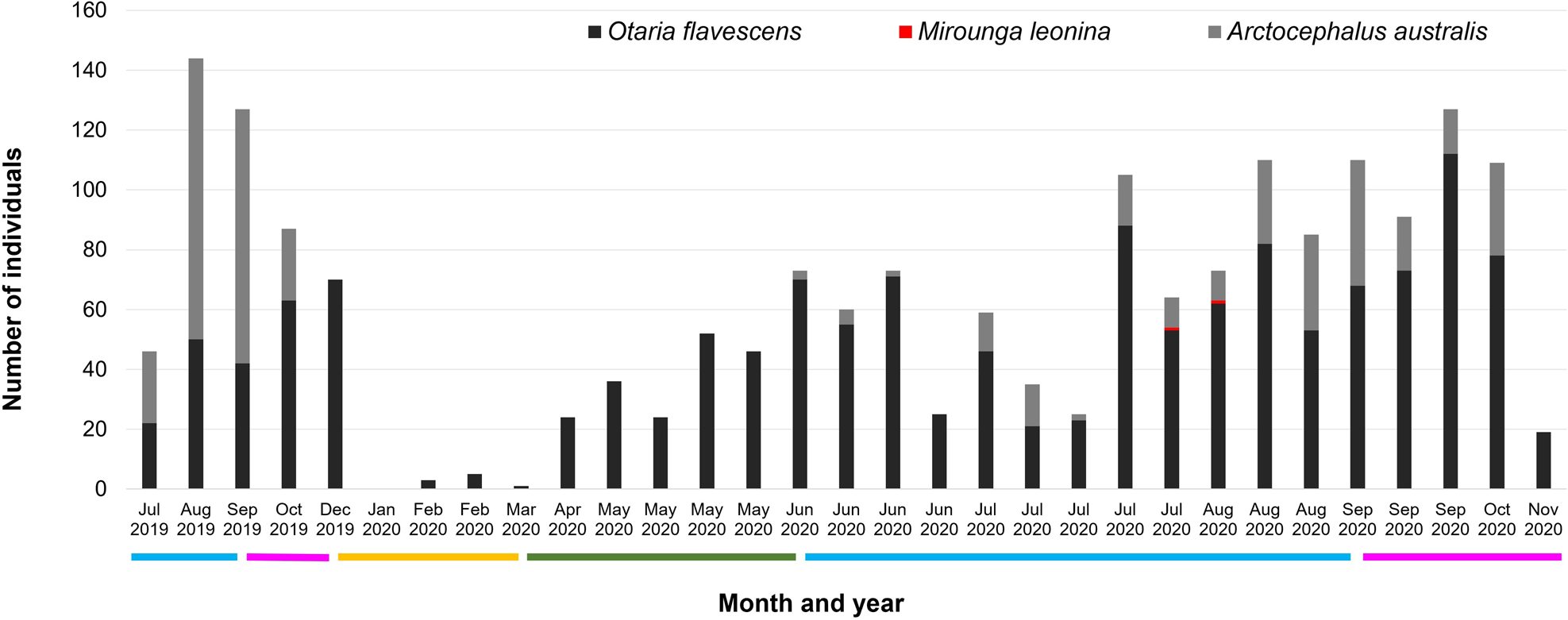
A total of 1908 records of pinnipeds were observed in the WRIL between July 2019 and November 2020, made up of 1437 (75.32%) South American sea lions, 469 (24.58%) South American fur seals, and two (0.10%) southern elephant seals. Due to the long sample period and the proximity of the months, the same individual may have been registered more than once. The highest monthly abundance of all species occupying the WRIL was in August 2019, with 144 individuals occurring simultaneously, including 94 South American fur seals and 50 South American sea lions (Figure 2). September 2019 and September 2020 were the months with the second highest abundance, with 127 specimens occupying the WRIL. From all aerial photographic counts (i.e., 31 surveys), September had the highest mean abundance (mean 113.75; SD: ± 8.58, n = 4, min = 91, max = 127), followed by August (mean 103.00; SD: ± 15.69, n = 4, min = 73, max = 144) and October (mean 98; SD: ± 11, n = 2, min = 87, max = 109). June (mean 57.75; SD: ± 11.34, n = 4, min = 25, max = 73) and July (mean 55.67; SD: ± 11.51, n = 6, min = 25, max = 105) showed a similar mean of individuals, followed by May (mean 39.5; SD: ± 6.13, n = 4, min = 24, max = 52) and February (mean 4; SD: ± 1.41, n = 2, min = 3, max = 5). The number of individuals’ observer in February, March, April, November, and December can be found in Figure 2.
Total number of pinniped individuals found during seasonal occupation of the Wildlife Refuge of Ilha dos Lobos on the southern Brazilian coast between July 2019 and November 2020. The lines indicate the corresponding season. Blue line: austral winter; pink line: austral spring; yellow line: austral summer and green line: austral autumn.

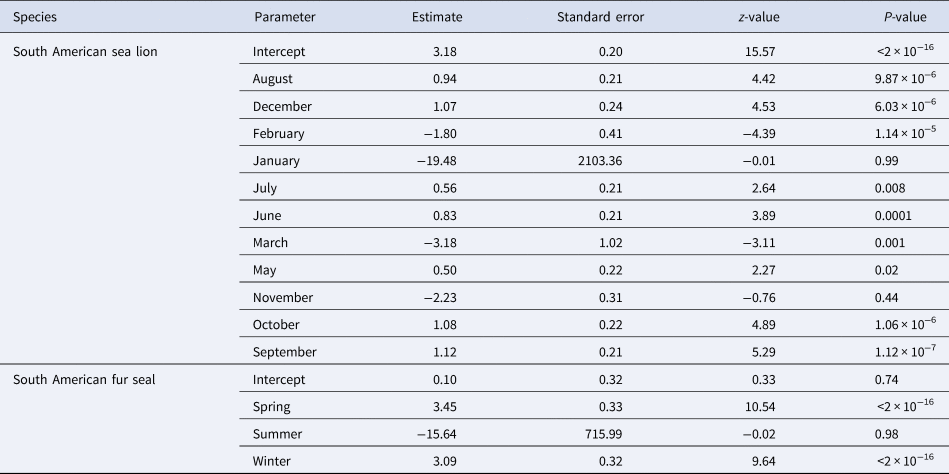
South American sea lions were present on WRIL in all surveys except in January 2020, when no pinnipeds were recorded. A much stronger seasonal fluctuation in numbers was observed for South American fur seals, with statistical differences in the average number of individuals between seasons (Table 2). This species was recorded only between July and October across the two years. During the 31 surveys, the abundance of South American fur seals was higher than that of South American sea lions on two occasions (August and September 2019). Moreover, the southern elephant seal, Mirounga leonina, was recorded only on two occasions: July and August 2020 (Figure 2).
GLM model results based on the Poisson distribution for pinniped counts

The intercept for the South American sea lion models corresponds to April and for South American fur seals to autumn.
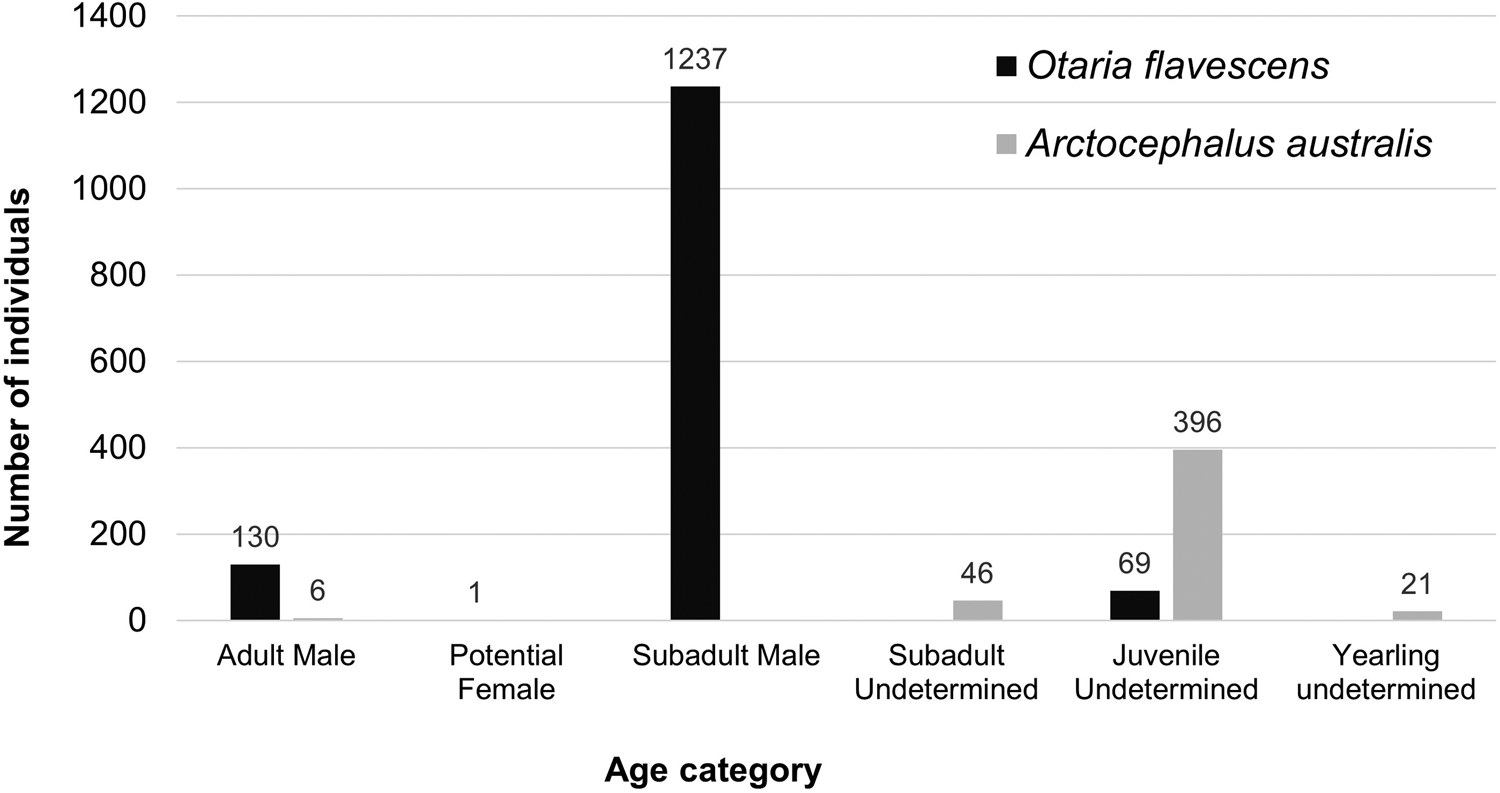
Concerning the sex and age categories over the years for the two main pinniped species, no distribution pattern was found along the studied months. Only one potential female was recorded during a survey in September 2019 for South American sea lions, and the subadult males were predominant (n = 1237; 86.08%), followed by adult males (n = 130; 9.05%) (Figure 3). Juveniles were observed in 19 of the 31 aerial counts, corresponding to 69 individuals (4.80%), and yearlings were not recorded during this study for this species. For South American fur seals, there was a predominance of juveniles (n = 396, 84.43%), followed by subadults (n = 46, 9.81%) (Figure 3). Adult males (n = 6, 1.28%) and yearlings (n = 21, 4.48%) were observed only in five occasions. The two southern elephant seals recorded during the study period (July and August 2020) were juvenile males.
South American sea lions (Otaria flavescens) and fur seals (Arctocephalus australis) grouped by age categories observed in the Wildlife Refuge of Ilha dos Lobos on the southern Brazilian coast between July 2019 and November 2020.

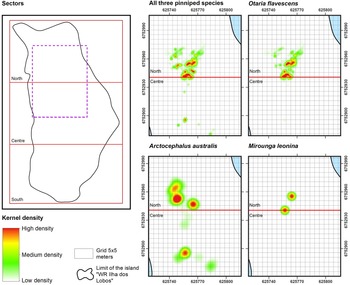
Regarding the spatial occupation of the animals, a total of 1908 individuals were plotted during the 31 surveys. Most of the sightings were recorded in the northern area of the island (1621; 85.10%), followed by the central area (286; 14.88%) and the southern area (1; 0.02%) (Table 3, Figure 4). However, South American sea lions appeared to form clusters, mainly in the northern part of the island (Figure 4), whereas the spatial occupation of South American fur seals was more dispersed, and in smaller groups mainly occupying the rocks all over the central and northern zones (Figure 4). The only record in the southern area corresponds to a South American fur seal resting on a rock. Both times, the southern elephant seal was recorded, and the individuals were grouped with South American sea lions, resting in the northern and central areas.
Summary of the spatial distribution of the cumulative records of pinnipeds across the three zones (north, centre, and south) of the Wildlife Refuge of Ilha dos Lobos, southern Brazil, between July 2019 and November 2020

Spatial occupation in the Wildlife Refuge of Ilha dos Lobos by pinnipeds estimated using Kernel Density Analysis for the 31 surveys between July 2019 and November 2020. The emerged area of the island is presented in the left part of the figure and the sectors analysed (north, centre, and south) are shown in red.

Discussion
This study demonstrates that South American sea lions are present throughout the year in the WRIL, although there are fewer individuals during the summer. However, South American fur seals showed a strong seasonal presence, occurring only in the austral winter and spring months. Southern elephant seals are infrequent and can be considered as an occasional visitor to this MPA area.
Although the presence of South American sea lions has been observed across the entire year, the statistical differences between months indicate higher concentrations in winter and spring. This pattern was observed in previous studies conducted in the WRIL, which also reported a higher concentration of South American sea lions during these seasons, with more than a hundred individuals in some observations (Sanfelice et al., Reference Sanfelice, Vasques and Crespo1999; Silva, Reference Silva2004; Procksch et al., Reference Procksch, Grandi, Ott, Groch, Flores, Zagonel, Crespo, Machado, Pavez, Guimarães, Veronez and Oliveira2020). The number of individuals at the WRIL increases during winter and spring months, because it is the second geographic resting site for pinnipeds along the Brazilian coast, taking into account that these animals came from Uruguay and Argentina, and find as a first haulout site the Wildlife Refuge of Molhe Leste de São José do Norte (WRML), which is located 400 km south of our study area (Rosas et al., Reference Rosas, Pinedo, Marmotel and Haimovici1994). In the WRML they concentrate in autumn and summer months, coinciding with the months of their arrival and departure from the Brazilian coast, respectively. In other words, the sea lions that use both Wildlife Refuges from Ilha dos Lobos and Molhe Leste de São José do Norte seem to exhibit a sequential occupation of these sites, after they leave their Uruguayan and Argentinean breeding colonies, characterizing the seasonal movements of South American sea lions (Rosas et al. Reference Rosas, Pinedo, Marmotel and Haimovici1994, Silva, Reference Silva2004; Procksch et al., Reference Procksch, Grandi, Ott, Groch, Flores, Zagonel, Crespo, Machado, Pavez, Guimarães, Veronez and Oliveira2020). Moreover, the present study provides further evidence of the presence of the South American sea lion during the summer months. The presence of a few individuals of this species during this period has been previously reported by Sanfelice et al. (Reference Sanfelice, Vasques and Crespo1999) and Silva (Reference Silva2004). These combined results indicate that not all individuals depart from the island after the peak of occupation during the winter and spring months.
According to Sanfelice et al. (Reference Sanfelice, Vasques and Crespo1999), the rare individuals observed during summer corresponded to subadult males. The presence of South American sea lions in summer was also reported by Pont et al. (Reference Pont, Marchini, Engel, Machado, Ott, Crespo, Coscarella, Dalzochio and Oliveira2016) during interviews conducted a decade earlier with local fishermen from Torres and Passo de Torres. Oliveira et al. (Reference Oliveira, Pont, Machado, Engel, Ott, Crespo and Marchini2020) also confirmed the occurrence of this species in the region during the summer based on records of interactions between South American sea lions and coastal gillnet fisheries in these same communities. The presence of these males throughout the summer in the WRIL could be associated with their non-participation in the reproductive season, possibly because they have not reached the sexual or social maturity to form harems, which means that they did not get females to copulate with (Vaz-Ferreira, Reference Vaz-Ferreira1982b; Grandi et al., Reference Grandi, Dans, García and Crespo2010).
Although the South American sea lion was the most frequent pinniped recorded on the island, its numbers were surpassed by the South American fur seals on two occasions. This occasional shift in the proportion of the two pinniped species on the island was also recently reported by Procksch et al. (Reference Procksch, Grandi, Ott, Groch, Flores, Zagonel, Crespo, Machado, Pavez, Guimarães, Veronez and Oliveira2020). In this study, an unexpected number of yearlings of South American fur seals were recorded during September (n = 199) and November (n = 102) in 2018. According to Procksch et al. (Reference Procksch, Grandi, Ott, Groch, Flores, Zagonel, Crespo, Machado, Pavez, Guimarães, Veronez and Oliveira2020), the increased abundance of South American fur seals could be related to population growth or to natural fluctuations in births and survival from year to year in the Uruguayan breeding colonies, which is potentially where the WRIL fur seals come from (Franco-Trecu et al., Reference Franco-Trecu, Drago, Grandi, Soutullo, Crespo and Inchausti2019). To further explore this hypothesis, it is necessary to continue the counts in a network of monitoring sites, including the WRIL and the breeding sites, mainly in Uruguay, which are closest to southern Brazil.
During the 31 aerial photographic counts in this study, southern elephant seals were recorded on only two occasions in the WRIL. Considering the individuals were both categorized as juvenile males, and the temporal proximity of the observations recorded, we believe that these records referred to the same individuals who remained resting on the island during this period. This species is considered less frequent on the Brazilian coast (Pinedo, Reference Pinedo1990; Simões-Lopes et al., Reference Simões-Lopes, Drehmer and Ott1995; Oliveira, Reference Oliveira1999; Silva, Reference Silva2004; Moura et al., Reference Moura, Di Dario, Lima and Siciliano2010) and probably came from the colonies on the Valdés Peninsula, Argentina, he closest southern elephant seal colonies to the Brazilian coast (Lewis, Reference Lewis1996; Moura et al., Reference Moura, Di Dario, Lima and Siciliano2010).
The spatial occupation of the WRIL by pinnipeds occurred mainly in the northern area of the island, in patterns similar to those found by Procksch et al. (Reference Procksch, Grandi, Ott, Groch, Flores, Zagonel, Crespo, Machado, Pavez, Guimarães, Veronez and Oliveira2020). South American sea lions preferred to stay in groups, forming clusters mainly in the flat areas of the northern area, whereas the fur seals remained dispersed on top of the higher rocks, located both in the north and in the central areas. Vaz-Ferreira (Reference Vaz-Ferreira1982b) briefly mentioned that in some Uruguayan islands, South American sea lions select sandy areas, whereas fur seals prefer to occupy areas with higher rocks (Vaz-Ferreira, Reference Vaz-Ferreira1982a). Although the central and southern areas of the WRIL present long periods of surface exposure, both species seem to prefer the northern part of the island, probably because it is the highest area of the relief, making the driest and most protected environment on the island during high tides (Procksch et al., Reference Procksch, Berchieri, Horota, Sales, Ott, Danilewicz, Guimarães, Guimarães, Veronez and Oliveira2023).
These results on the seasonal and spatial occupation of the island allow us to better understand the occurrence of pinnipeds in this MPA throughout the year. The information on monthly abundance can be used to plan management and conservation actions as well as scientific expeditions and the public use of this MPA. In this context, human activities that may be developed in the WRIL, such as research or tourism, should take into account the information on year-round occupation, as well as comply with the guidelines of this MPA. Procksch et al. (Reference Procksch, Grandi, Ott, Groch, Flores, Zagonel, Crespo, Machado, Pavez, Guimarães, Veronez and Oliveira2020), based on counts conducted exclusively from July to November, recommended that potential activities in the WRIL, such as island-based research, must occur in the summer. However, considering that some South American sea lions occupy the WRIL during the summer, we suggest that prior to the development of any activity, it is imperative to implement a plan for monitoring the presence of pinnipeds with the aim of minimizing any impact on the individuals present.
Finally, our study suggests that continuing studies both in the WRIL and in the breeding colonies of these species, mainly in Uruguay, are needed. These would establish whether the fluctuations in the abundance of pinnipeds observed in the WRIL, especially regarding the high number of yearlings of South American fur seals in some recent years, could be related to fluctuations in the number of births and survival of individuals during their first year of life. Studying the network of monitoring sites covering the Uruguayan breeding sites and Brazilian haulout areas during the same time frame is fundamental to understanding the dynamics between these habitats. Our data highlight the importance of the WRIL in the life cycle of South American pinnipeds and reinforce the understanding of the uniqueness of this area on the Brazilian coast.
Acknowledgements
The authors would like to thank to Aline Kellermann (Instituto Chico Mendes de Conservação da Biodiversidade – ICMBio) for local support and the anonymous referees for suggestions that significantly improved this manuscript.
Author contributions
L. R. O. developed the conceptualization of the study. L. R. O., N. P., M. Z. O., P. H. O., D. D. and M. V. designed the experiments. N. P., R. K. H. and N. B. B. conducted the aerial count and took the images. N. P. performed the countings. P. H. O. and L. R. O. performed the validation of species identification. N. P., M. G. and M. Z. O. performed the formal analysis. L. R. O., M. G. and M. V. conducted the general validation of the data. L. R. O., D. D. and M. V. were responsible for funding acquisition and project administration. L. R. O., N. P., P. H. O., M. Z. O, and M. V. wrote the original draft. L. R. O., N. P., P. H. O., M. Z. O, M. V., M. G., R. K. H., D. D. and N. B. B. reviewed and edited the final version of the manuscript.
Financial support
The authors would like to thank the organizations supporting this project: the Coordination for the Improvement of Higher Education Personnel (Coordenação de Aperfeiçoamento de Pessoal de Nível Superior – CAPES) that provided a scholar Master's grant (PROSUC) to NP, and the Brazilian National Council for Scientific and Technological Development (Conselho Nacional de Desenvolvimento Científico Tecnológico – CNPq) that provided the Research Productivity grants No. 303813/2011–3, 308650/2014-0, 310621/2017-8 and 315361/2021-2 to LRO. This study was financed in part by the Coordenação e Aperfeiçoamento de Pessoal de Nível Superior (CAPES)-Finance Code 001. This research was funded by PETROBRAS and ANP Grant numbers 4600556376 and 460058379.
Conflict of interest
The authors declare no competing interests.
Ethical standards
This study was based on aerial photographic counts with no animal caught or killed during the summarized research. The aerial photographs were collected under Brazilian Biodiversity authorization and information system (SISBIO number 54476-4) and by the Ethics Committee on the Use of Animals provided by University of Vale do Rio do Sinos (number PPECEUA05.2019) attesting that the authors did not violate any ethical rule for collecting aerial photos.
Data availability
Data will be available through requests and mediate by JMBA editors.