1. Introduction
Although macroscopic Ediacara-type fossils have been known from all major continents except Antarctica (Waggoner, Reference Waggoner2003; Narbonne, Reference Narbonne2005; Shen et al. Reference Shen, Dong, Xiao and Kowalewski2008; Xiao and Laflamme, Reference Xiao and Laflamme2009; Laflamme et al. Reference Laflamme, Darroch, Tweedt, Peterson and Erwin2013), current understanding of their body construction, palaeoecology and phylogenetic affinities remains incomplete. For example, there are divergent opinions about their phylogenetic affinities, with some Ediacara-type fossils compared with various animal groups (Glaessner, Reference Glaessner1984; Fedonkin, Reference Fedonkin, Sokolov and Iwanowski1990; Gehling & Rigby, Reference Gehling and Rigby1996; Fedonkin & Waggoner, Reference Fedonkin and Waggoner1997; Sperling & Vinther, Reference Sperling and Vinther2010), microbial colonies (Grazhdankin & Gerdes, Reference Grazhdankin and Gerdes2007), lichens (Retallack, Reference Retallack1994) and giant protists (Seilacher, Grazhdankin & Legouta, Reference Seilacher, Grazhdankin and Legouta2003) or assigned to completely extinct higher rank taxa (Seilacher, Reference Seilacher1989). These divergent and controversial interpretations are, in part, due to the poor understanding of the morphology of Ediacara-type fossils, which are typically preserved as casts and moulds in siliciclastic rocks (Gehling, Reference Gehling1999; Narbonne, Reference Narbonne2005; Antcliffe, Gooday & Brasier, Reference Antcliffe, Gooday and Brasier2011; Liu, Reference Liu2016). Internal structure and anatomy are often lost in cast and mould preservation, making it difficult to arrive at a full appreciation of the three-dimensional morphologies of Ediacara-type fossils. Therefore, alternative taphonomic windows in limestones and shales need to be explored in order to achieve a better understanding of the morphology, taphonomy and palaeoecology of the Ediacara biota (Grazhdankin et al. Reference Grazhdankin, Balthasar, Nagovitsin and Kochnev2008; Zhu et al. Reference Zhu, Gehling, Xiao, Zhao and Droser2008; Xiao et al. Reference Xiao, Droser, Gehling, Hughes, Wan, Chen and Yuan2013; Bykova et al., unpub. data 2017). Bituminous limestone of the upper Ediacaran Shibantan Member of the Dengying Formation in the Yangtze Gorges area offers a rare opportunity to explore the preservation of different Ediacara-type fossils (Sun, Reference Sun1986; Xiao et al. Reference Xiao, Shen, Zhou, Xie and Yuan2005; Shen et al. Reference Shen, Xiao, Zhou and Yuan2009; Chen et al. Reference Chen, Zhou, Xiao, Wang, Guan, Hua and Yuan2014).
The Shibantan Member is known to host Ediacaran soft-bodied fossils that are taxonomically similar to those from other Ediacaran localities in South Australia, Russia and Namibia (Chen et al. Reference Chen, Zhou, Xiao, Wang, Guan, Hua and Yuan2014); these taxa include Rangea Gürich, Reference Gürich1929, Pteridinium Gürich, Reference Gürich1933, Charniodiscus Ford, Reference Ford1958, Aspidella Billings, Reference Billings1872 and Hiemalora Fedonkin, Reference Fedonkin1982. It also yields several unique forms, including Paracharnia Sun, Reference Sun1986, Yangtziramulus Shen et al. Reference Shen, Xiao, Zhou and Yuan2009 and Wutubus Chen et al. Reference Chen, Zhou, Xiao, Wang, Guan, Hua and Yuan2014. Of these genera, Yangtziramulus and Wutubus have been studied in thin-sections, revealing three-dimensional internal structures (Xiao et al. Reference Xiao, Shen, Zhou, Xie and Yuan2005; Shen et al. Reference Shen, Xiao, Zhou and Yuan2009; Chen et al. Reference Chen, Zhou, Xiao, Wang, Guan, Hua and Yuan2014).
Among the diverse Ediacara fossils, Palaeopascichnus represents the most widespread genus in the world, and has been discovered from nearly all Ediacara fossil localities (Palij, Reference Palij and Ryabenko1976; Urbanek & Rozanov, Reference Urbanek and Rozanov1983; Narbonne et al. Reference Narbonne, Myrow, Landing and Anderson1987; Sokolov, Reference Sokolov, Sokolov and Fedonkin1990; Gehling, Narbonne & Anderson, Reference Gehling, Narbonne and Anderson2000; Haines, Reference Haines2000; Lan & Chen, Reference Lan and Chen2012; Grazhdankin, Reference Grazhdankin2014; Mángano & Buatois, Reference Mángano and Buatois2014). Although it has a wide range of variation in size, Palaeopascichnus consists of serially arranged, curved or crescent-shaped segments or modules (Shen et al. Reference Shen, Xiao, Dong, Zhou and Liu2007). It was originally interpreted as a trace fossil (Palij, Reference Palij and Ryabenko1976), and was used as an index fossil for upper Ediacaran – lower Cambrian strata (Narbonne et al. Reference Narbonne, Myrow, Landing and Anderson1987; Crimes, Reference Crimes1992). However, the trace fossil interpretation was rejected (Jensen, Reference Jensen2003), and later studies indicate that Palaeopascichnus is a body fossil instead (Seilacher, Grazhdankin & Legouta, Reference Seilacher, Grazhdankin and Legouta2003; Seilacher, Reference Seilacher2007b ). It has been further proposed that Palaeopascichnus and other modular Ediacara fossils might be affiliated to a type of giant protist, or xenophyophore (Seilacher, Grazhdankin & Legouta, Reference Seilacher, Grazhdankin and Legouta2003). The protozoan interpretation is further supported by Palaeopascichnus-type fossils from the upper Ediacaran Liuchapo Formation in South China, which preserve the connection between modular segments (Dong et al. Reference Dong, Xiao, Shen and Zhou2008). But the Liuchapo samples are an order of magnitude smaller than Palaeopascichnus materials from other localities. Antcliffe, Gooday & Brasier (Reference Antcliffe, Gooday and Brasier2011) analysed the growth pattern of Palaeopascichnus and confirmed its protozoan affinity, although these authors questioned the xenophyophore or foraminifer interpretation. It should be noted that all the aforementioned studies were based on fossils preserved in siliciclastic rocks, and no Palaeopascichnus fossils have been reported from carbonate rocks.
In this paper, we report a new Palaeopascichnus-type fossil, Curviacus ediacaranus new genus and species, from the Shibantan limestone. In order to reveal the internal structures, we used destructive thin-section techniques to analyse this taxon, which revealed a modular architecture with serially arranged, curved, narrow chambers that justify the establishment of a new taxon.
2. Geological setting
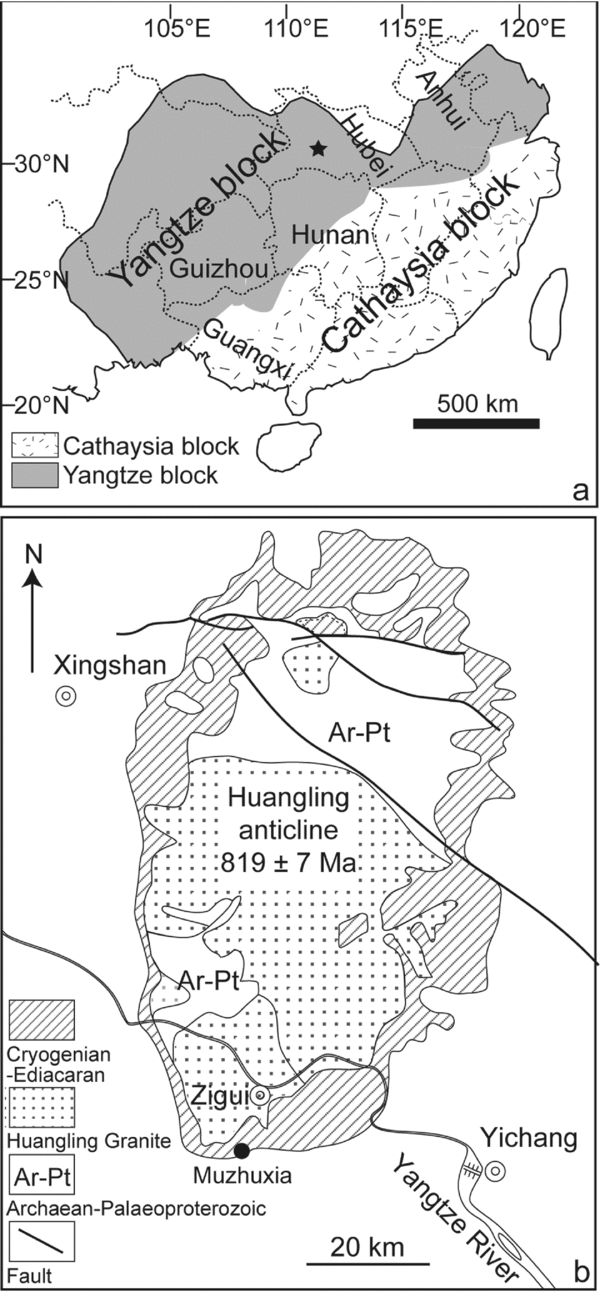
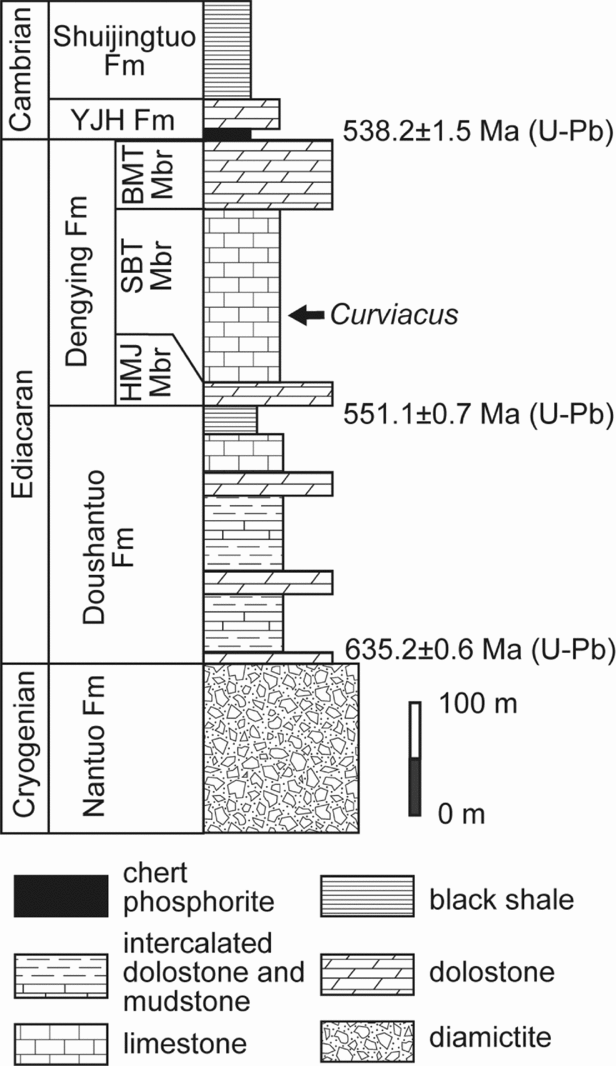
Fossils described in this paper were collected from the Shibantan Member of the Dengying Formation in the Muzhuxia section (30°45.03′N, 110°59.48′E) on the southern bank of the Yangtze River. The Yangtze Gorges area was located on the platform shelf of the Yangtze Block during the late Ediacaran Period (Jiang et al. Reference Jiang, Shi, Zhang, Wang and Xiao2011; Fig. 1). Here, the upper Ediacaran Dengying Formation overlies the Doushantuo Formation and underlies the basal Cambrian Yanjiahe Formation (Fig. 2). Based on currently accepted stratigraphic correlation and available radiometric dates from the uppermost Doushantuo Formation in the Yangtze Gorges area (Condon et al. Reference Condon, Zhu, Bowring, Wang, Yang and Jin2005) and from the Ediacaran–Cambrian boundary in Oman (Schmitz, Reference Schmitz, Gradstein, Ogg, Schmitz and Ogg2012), the Dengying Formation is likely 551–541 Ma in age; an alternative stratigraphic correlation suggests that the Dengying Formation might be older than 551 Ma (An et al. Reference An, Jiang, Tong, Tian, Ye, Song and Song2015), but the validity of this correlation has been questioned (Zhou et al. Reference Zhou, Xiao, Wang, Guan, Ouyang and Chen2017). The Dengying Formation is divided into three lithostratigraphic members, in ascending order, the Hamajing, Shibantan and Baimatuo members (Fig. 2). In the Muzhuxia section, the Hamajing Member is ~20 m thick and consists of dark grey, medium- to thick-bedded dolostone with late diagenetic chert nodules. In the Yangtze Gorges area, karstic features and teepee structures occur in the lower Hamajing Member, suggesting deposition in a peritidal environment. The fossiliferous Shibantan Member is ~160 m in thickness (variable at different sections) and composed of dark grey, thin-bedded bituminous limestone. The dominance of microlaminated limestone and the occasional presence of rip-up clasts indicate deposition below fair weather wave base but likely above storm wave base (Meyer et al. Reference Meyer, Xiao, Gill, Schiffbauer, Chen, Zhou and Yuan2014). In the Yangtze Gorges area, the Shibantan Member contains abundant microbial structures (Meyer et al. Reference Meyer, Xiao, Gill, Schiffbauer, Chen, Zhou and Yuan2014), algal fossils traditionally identified as Vendotaenia antiqua Gnilovskaya, Reference Gnilovskaya1971 (Zhao et al. Reference Zhao, Xing, Ding, Liu, Zhao, Zhang, Meng, Yin, Ning and Han1988), trace fossils including surface trails and horizontal under-mat tunnels with a vertical component (Ding, Xing & Chen, Reference Ding, Xing, Chen, Zhao, Xing, Ma and Chen1985; Chen et al. Reference Chen, Zhou, Meyer, Xiang, Schiffbauer, Yuan and Xiao2013; Meyer et al. Reference Meyer, Xiao, Gill, Schiffbauer, Chen, Zhou and Yuan2014), as well as at least seven types of macroscopic Ediacara-type fossils (Sun, Reference Sun1986; Xiao et al. Reference Xiao, Shen, Zhou, Xie and Yuan2005; Shen et al. Reference Shen, Xiao, Zhou and Yuan2009; Chen et al. Reference Chen, Zhou, Xiao, Wang, Guan, Hua and Yuan2014). The Shibantan limestone is overlain by up to 60 m thick, light grey, thick-bedded dolostone of the Baimatuo Member, which features abundant dissolution structures and is unconformably overlain by the lower Cambrian Yanjiahe Formation. The Baimatuo Member in the Yangtze Gorges area and its equivalent strata in southern Shaanxi yield the biomineralized tubular microfossils Sinotubulites and Cloudina (Zhao et al. Reference Zhao, Xing, Ding, Liu, Zhao, Zhang, Meng, Yin, Ning and Han1988; Hua et al. Reference Hua, Zhang, Zhang and Wang2000; Cai et al. Reference Cai, Hua, Xiao, Schiffbauer and Li2010, Reference Cai, Schiffbauer, Hua and Xiao2011, Reference Cai, Xiao, Hua and Yuan2015), while the Yanjiahe Formation bears basal Cambrian small shelly fossils, the tubular microfossil Megathrix longus Yin, Reference Yin1987 and acritarchs (Asteridium–Comasphaeridium–Heliosphaeridium assemblage) indicative of an early Cambrian Terreneuvian age (Chen, Reference Chen1984; Yao et al. Reference Yao, Xiao, Yin, Li and Yuan2005; Dong et al. Reference Dong, Xiao, Shen, Zhou, Li and Yao2009; Guo, Li & Li, Reference Guo, Li and Li2014; Shang et al. Reference Shang, Liu, Yang, Chen and Wang2016).
(a) Map showing the geographic location of the Yangtze Gorges area (star) in the Yangtze Block. (b) Geological map showing the location of the Muzhuxia section (solid circle) in the Yangtze Gorges area.

Stratigraphic column of the Ediacaran succession in the Yangtze Gorges area. Sample horizon is marked by an arrow. HMJ Mbr – Hamajing Member; SBT Mbr – Shibantan Member; BMT Mbr – Baimatuo Member; YJH Fm – Yanjiahe Formation; Fm – formation.

3. Systematic palaeontology
Genus Curviacus new genus
Type species. Curviacus ediacaranus new genus and species.
Diagnosis. As for type species.
Etymology. Genus name derived from Latin curvus- (curved) and acus (needle), with reference to the curved chambers bearing acute projections.
Occurrence. As for type species.
Curviacus ediacaranus new genus and species
Figures 3–6
Diagnosis. Macroscopic fossil preserved on bedding surface with millimetre-scale vertical relief and centimetre-scale width and length and consisting of serially to irregularly arranged chambers. Chambers are narrow and curved, with their convex sides pointing in the same direction. Some chambers are pierced by a conical projection on the convex side.
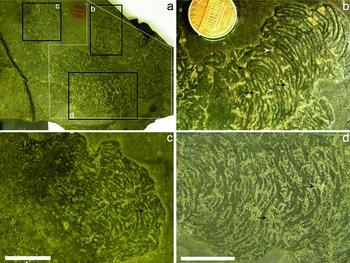
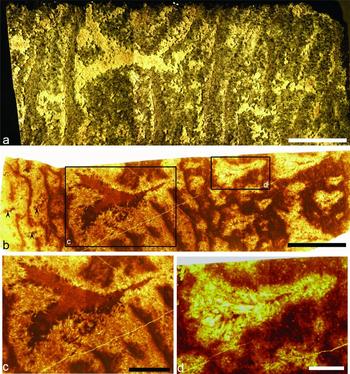
Descriptions. Fossils are found on the bedding surface of bituminous limestone. In a fresh limestone slab, two individuals are identified (Fig. 3a). The holotype is about 14 cm long and 12 cm wide (Fig. 3b, marked by white dotted lines in Fig. 3a). The second specimen is about 5 cm long and 4 cm wide (Fig. 3c). The fossils are slightly raised above the bedding surface, with a ~1 mm positive relief. In bedding plane view, the fossils consist of a series of narrow and curved ridges, with their convex sides pointing in the same direction (Fig. 3). The ridges are 0.77–1.39 mm in thickness (average 1.13 mm, n = 8), and are separated by an inter-ridge groove with slightly lower relief. The inter-ridge grooves are 0.99–1.66 mm in width (average 1.35 mm, n = 8). On a polished slab, it is clearly seen that the ridges are composed of calcispars, while the inter-ridge grooves are filled with micrite (Fig. 4a, b). Thus, each ridge is actually a chamber wall shared by two adjacent chambers. Such a reconstruction is supported by thin-section views perpendicular to the bedding plane along the fossil axis (Fig. 5). Because the calcispar of the chamber walls is more resistant than the chamber interiors filled with micrite, the chamber walls are preserved as ridges with a positive relief. The chamber interior is exposed on the bedding surface, probably due to erosion. The micritic filling of the chambers indicates that either the chambers were open to the exterior or micrite precipitated directly within the chambers.
Reflected light photographs of bedding surface views of Curviacus ediacaranus. (a) Overview of a slab containing Curviacus specimens, with labelled rectangles denoting areas magnified in (b–d). Specimen to the right (marked by white dotted line) is designated as the holotype (VPIGM-4675). (b) Enlargement of rectangle b in (a), showing dark-coloured ridges consisting of calcispars. (c) Enlargement of rectangle c in (a). (d) Enlargement of rectangle d in (a). White arrowheads indicate where multiple chambers converge laterally. Black arrows indicate conical projections. Scale bars are 1 cm and 2 cm for (c) and (d), respectively; coin is ~1.9 cm in diameter.

Reflected light (a) and transmitted light (b–d) photographs of bedding surface views of Curviacus ediacaranus on an unpolished slab and in thin-section. VPIGM-4676. (a) Unpolished slab. Calcispar is dark-coloured and micrite is light-coloured. (b) Same as (a) in thin-section. Under transmitted light, calcispar is more transparent and thus is lighter-coloured than micrite. Calcispar replicates chamber walls and grows into chamber and projection interiors. Labelled rectangles mark areas enlarged in (c) and (d). Arrowheads mark discontinuous carbonaceous trace within calcispar ridge. (c) Enlargement of (b) showing a conical projection pointing to the right. The projection interior is partially filled with calcispar while the residual void is filled with dark-coloured micrite. (d) Enlargement of (b) showing a projection pointing to the right. The projection interior is almost entirely filled with calcispar. Scale bars are 0.5 cm in (a–c), and 0.2 cm in (d).

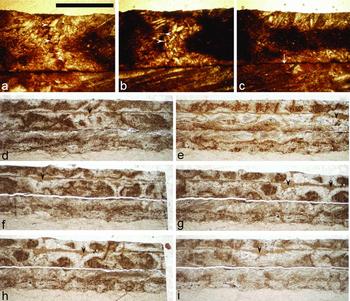
Transmitted light photomicrographs of Curviacus ediacaranus in thin-sections cut perpendicular to its longitudinal axis and perpendicular to the bedding plane. (a) and (b) show vertical chamber walls with traces of carbonaceous material. Note calcispar crystals (white arrowheads) growing towards each other (i.e. centripetally towards the carbonaceous residue), replicating a void that was formed after the degradation of the chamber wall. Calcispars can also grow into and partially fill the chambers. Serial thin-sections VPIGM-4677 and VPIGM-4679, respectively. (c) A chamber with calcispar crystals growing on roof and floor walls, which are truncated by weathering and a stylolite (white arrow). Thin-section VPIGM-4678 of the same hand specimen. (d–i) Three storeys of chambers stacking into at least three sedimentary layers. Black arrowheads point to micrite between two successive layers. Serial thin-sections: (d) VPIGM-4680, (e) VPIGM-4681, (f) VPIGM-4682, (g) and (h) VPIGM-4683, (i) VPIGM-4684, which are serial thin-sections of the same hand specimen. Scale bar is 1 mm for (a–c) and 5 mm for (d–i).

The chambers are tightly arranged, with two adjacent chambers sharing a single wall (Figs 4, 5a, b). The chambers are curved or arched on the bedding surface, with their convex sides pointing towards the same direction, but they are not regularly arranged in a single series. Instead, the chambers have unequal lengths of 14.5–26.7 mm (mean = 19.3 mm, n = 10; measured on the bedding plane but perpendicular to the arching direction), with some shorter than others and thus terminating before reaching the lateral margins of the fossil (white arrowheads in Fig. 3b). This relationship sometimes gives a false appearance of a branching series of chambers (Fig. 3b). The chambers are 1.7–2.9 mm in width (mean = 2.1 mm, n = 10; measured on the bedding plane along the arching direction). Some ridges can converge laterally, suggesting that the corresponding chambers can also converge laterally (black arrowheads in Fig. 3b).
In places, a conical projection emerges from a chamber. The projection typically points towards the convex side of the chamber and transects one or more chambers in that direction (black arrows in Fig. 4b–d). The projections are outlined by calcispar that surrounds micrite or discontinuous carbonaceous material in the centre (black arrowheads in Fig. 4b). This calcispar appears to grow centripetally towards the projection interior, as evidenced by the well-shaped crystal terminations oriented inside the projection (Fig. 4b, d). Thus, the projections are both outlined by and partially filled with calcispar, while their residual voids are filled with micrite and carbonaceous material. The projections may have functioned as connections between different chambers, or openings to the external environment.
Thin-sections cut perpendicular to the bedding plane, along the fossil axis, show that chamber walls are ~1 mm thick and consist of two layers of calcispar with a dark carbonaceous middle layer which is typically 0.05–0.1 mm thick (Fig. 5a, b). This middle layer possibly represents remains of the primary organic chamber wall. The calcispar cement lacks a distinct boundary with the chamber interior and has well-developed crystal terminations oriented towards the carbonaceous layer (white arrowheads in Fig. 5a), suggesting centripetal growth of calcispar into a void that appeared after the chamber wall degradation. In some specimens, however, this tripartite structure (a middle carbonaceous layer surrounded by centripetally growing calcispar crusts) is not well preserved (Fig. 4b–d), probably owing to recrystallization; but even in these specimens, a discontinuous carbonaceous layer is observed (arrowheads in Fig. 4b). In places, calcispar partially fills chamber and projection interiors (Fig. 4b–d). Unlike the tripartite structure of the vertical chamber walls, the roof and floor walls consist of calcispar only. It is possible that the partial preservation of the roof and floor is due to truncation related to weathering and stylolitization (Fig. 5d–i). Measured in vertical thin-sections, the chamber interior is 1.30–2.17 mm in width (average 1.66 mm, n = 8; the variation is partly related to whether the chamber is cut along the arching direction) and 0.38–0.88 mm in height (average 0.71 mm, n = 8), and calcispar crust in the roof wall is 0.19–0.33 mm in thickness (average 0.27 mm, n = 8). In one sectioned slab, there appear to be at least two and possibly three storeys of Curviacus ediacaranus fossils preserved in successive sediment layers separated by stylolites and fractures (Fig. 5d–i).
Etymology. Species name refers to the Ediacaran age of this taxon.
Holotype. VPIGM-4675, marked by white dashed lines in Figure 3a. Reposited in Virginia Polytechnic Institute Geosciences Museum (VPIGM).
Material. Two specimens on a slab from the Shibantan Member at the Muzhuxia section in the Yangtze Gorges area, South China. Reposited in Virginia Polytechnic Institute Geosciences Museum (VPIGM).
Occurrence. The upper Ediacaran Shibantan Member of the Dengying Formation in the Muzhuxia section, Yangtze Gorges area, P.R. China.
Remarks. The modular architecture of Curviacus ediacaranus is similar to other Ediacaran modular fossils such as Palaeopascichnus Palij, Reference Palij and Ryabenko1976, Yelovichnus Fedonkin, Reference Fedonkin, Sokolov and Ivanovskiy1985, ‘Neonereites’ Seilacher, Reference Seilacher1960, ‘Horodyskia’ Yochelson & Fedonkin, Reference Yochelson and Fedonkin2000, Shaanxilithes Xing, Yue & Zhang in Xing et al. Reference Xing, Ding, Luo, He and Wang1984, Harlaniella Sokolov, Reference Sokolov1972 and Orbisiana Sokolov, Reference Sokolov1976. Of these modular organisms, Palaeopascichnus is perhaps most similar to Curviacus.
Palaeopascichnus is a widespread genus that has been reported provisionally from Podolia (Ukraine), the White Sea coast, the Urals, Siberia (Russia), Newfoundland (Canada), Wales (UK), South and Western Australia, Norway, India, North China and South China (Cope, Reference Cope1982; Sokolov & Iwanowski, Reference Sokolov and Iwanowski1990; Gehling, Narbonne & Anderson, Reference Gehling, Narbonne and Anderson2000; Haines, Reference Haines2000; Grazhdankin et al. Reference Grazhdankin, Maslov, Mustill and Krupenin2005; Shen et al. Reference Shen, Xiao, Dong, Zhou and Liu2007; Dong et al. Reference Dong, Xiao, Shen and Zhou2008; Antcliffe, Gooday & Brasier, Reference Antcliffe, Gooday and Brasier2011; Parcha & Pandey, Reference Parcha and Pandey2011; Dong et al. Reference Dong, Song, Xiao, Yuan, Chen and Zhou2012; Lan & Chen, Reference Lan and Chen2012; Högström et al. Reference Högström, Jensen, Palacios and Ebbestad2013). Previously interpreted as a trace fossil, Palaeopascichnus has recently been reinterpreted as a body fossil consisting of serially arranged chambers (Jensen, Reference Jensen2003; Seilacher, Grazhdankin & Legouta, Reference Seilacher, Grazhdankin and Legouta2003; Seilacher, Reference Seilacher, Vickers-Rich and Komarower2007a ; Shen et al. Reference Shen, Xiao, Dong, Zhou and Liu2007; Dong et al. Reference Dong, Xiao, Shen and Zhou2008). Its chambers can also be curved or crescent in shape, but they are more regularly arranged than the modular chambers of Curviacus ediacaranus and they sometimes widen towards the convex direction. Palaeopascichnus specimens from the Wonoka Formation in South Australia and the Ranford Formation in Western Australia show evidence of dichotomous branching (Haines, Reference Haines2000; Lan & Chen, Reference Lan and Chen2012). In Palaeopascichnus minimum, the first chamber on the concave end of the chain seems to be spherical rather than crescentic in shape (Dong et al. Reference Dong, Xiao, Shen and Zhou2008), although Antcliffe, Gooday & Brasier (Reference Antcliffe, Gooday and Brasier2011) question the placement of this species in the genus Palaeopascichnus owing to the significantly smaller sizes of the Chinese materials. Compared with the type species of Palaeopascichnus (P. delicatus, whose chambers are 2~10 mm in length as measured perpendicular to the arching direction), the chambers of Curviacus are longer and more variable in shape and size, and they are more irregularly but tightly arranged. Furthermore, some chambers of Curviacus have been transected by conical projections pointing towards the convex direction (Fig. 4b–d). This feature has not been reported in Palaeopascichnus.
Like Palaeopascichnus, Yelovichnus is also composed of serially arranged chambers. Jensen (Reference Jensen2003) suggested that these two genera might represent two different styles of preservation of the same taxon. Yelovichnus is characterized by ovate chambers, which are different from the narrow and elongate chambers of Curviacus.
Similarly, ‘Horodyskia’, Shaanxilithes, Harlaniella and Orbisiana are also composed of serially arranged chambers. For example, chambers in ‘Horodyskia’ are normally spheroidal to ellipsoidal in shape, and are normally widely spaced (Grey & Williams, Reference Grey and Williams1990; Fedonkin & Yochelson, Reference Fedonkin and Yochelson2002; Shen et al. Reference Shen, Xiao, Dong, Zhou and Liu2007; Dong et al. Reference Dong, Xiao, Shen and Zhou2008; Grey et al. Reference Grey, Yochelson, Fedonkin and Martin2010). The ellipsoidal chambers might originate from the compaction of originally spheroidal chambers. Although it is debatable whether the Chinese fossils described in Shen et al. (Reference Shen, Xiao, Dong, Zhou and Liu2007), Dong et al. (Reference Dong, Xiao, Shen and Zhou2008) and Dong et al. (Reference Dong, Song, Xiao, Yuan, Chen and Zhou2012) can be assigned to Horodyskia (Antcliffe, Gooday & Brasier, Reference Antcliffe, Gooday and Brasier2011), they do resemble the Mesoproterozoic Horodyskia fossils in having serially arranged spheroidal or ellipsoidal chambers.
Shaanxilithes, previously interpreted as a trace fossil but now as a body fossil (Hua, Chen & Zhang, Reference Hua, Chen and Zhang2004; Shen et al. Reference Shen, Xiao, Dong, Zhou and Liu2007; Meyer et al. Reference Meyer, Schiffbauer, Xiao, Cai and Hua2012), is another common element in the Dengying Formation and equivalent strata in South China (Xing & Yue, Reference Xing, Yue, Xing, Ding, Luo, He and Wang1984; Xiao et al. Reference Xiao, Narbonne, Zhou, Laflamme, Grazhdankin, Moczydlowska-Vidal and Cui2016), as well as upper Ediacaran strata in the North China and Chaidam blocks (Shen et al. Reference Shen, Xiao, Dong, Zhou and Liu2007), India (Tarhan et al. Reference Tarhan, Hughes, Myrow, Bhargava, Ahluwalia and Kudryavtsev2014), Siberia (Zhuravlev, Gámez Vintaned & Ivantsov, Reference Zhuravlev, Gámez Vintaned and Ivantsov2009; Cai & Hua, Reference Cai and Hua2011) and Namibia (Darroch et al. Reference Darroch, Boag, Racicot, Tweedt, Mason, Erwin and Laflamme2016). It is composed of closely spaced annulations (Shen et al. Reference Shen, Xiao, Dong, Zhou and Liu2007) or serially arranged discoidal structures (Meyer et al. Reference Meyer, Schiffbauer, Xiao, Cai and Hua2012). In addition, the Ediacaran fossils Gaojiashania Yang, Zhang & Lin in Lin et al. (Reference Lin, Zhang, Zhang, Tao and Wang1986) and Conotubus Zhang & Lin in Lin et al. (Reference Lin, Zhang, Zhang, Tao and Wang1986) are also characterized by serially arranged modules (Cai et al. Reference Cai, Schiffbauer, Hua and Xiao2011; Cai, Hua & Zhang, Reference Cai, Hua and Zhang2013). However, Gaojiashania consists of serially arranged rings (Cai, Hua & Zhang, Reference Cai, Hua and Zhang2013), whereas Conotubus is composed of a series of nested tubes (Cai et al. Reference Cai, Schiffbauer, Hua and Xiao2011).
As another enigmatic Ediacaran modular organism, Harlaniella has been reported from the Ediacaran succession in Ukraine and Newfoundland (Sokolov, Reference Sokolov1972; Narbonne & Hofmann, Reference Narbonne and Hofmann1987). Harlaniella can be identified by its obliquely aligned chambers with irregular outline (Jensen, Reference Jensen2003) or alternatively reconstructed as a tubular body fossil (Ivantsov, Reference Ivantsov2013). Orbisiana, first reported from Russia and subsequently discovered from the Ediacaran Lantian Formation in South China, is composed of circular or cylindrical units (Sokolov, Reference Sokolov1976; Wan et al. Reference Wan, Xiao, Yuan, Chen, Pang, Tang, Guan and Maisano2014). Although all these genera are composed of serially arranged units or chambers, Curviacus is distinguished from these fossils by its elongated rather than spherical to ellipsoidal chambers, by its less regular arrangement of chambers and by the presence of conical projections.
4. Preservation and palaeoecology
The preservation style of Curviacus ediacaranus is very similar to Yangtziramulus zhangii from the same lithostratigraphic unit (Xiao et al. Reference Xiao, Shen, Zhou, Xie and Yuan2005; Shen et al. Reference Shen, Xiao, Zhou and Yuan2009). Like in Yangtziramulus, the three-dimensional preservation of Curviacus is achieved by the calcispar cement that grew centripetally to replace the chamber walls (Fig. 5a, b). It has been suggested that the precipitation of calcispar cement was facilitated by partial degradation of Yangtziramulus (Xiao et al. Reference Xiao, Shen, Zhou, Xie and Yuan2005; Shen et al. Reference Shen, Xiao, Zhou and Yuan2009), but the cement precipitation must have occurred before the complete collapse of the chamber walls of Curviacus to allow three-dimensional preservation. Because both sides of the vertical chamber walls are surrounded by centripetally growing calcispar, a tripartite structure (with a middle carbonaceous layer flanked by calcispar crusts) is apparent (Fig. 5a, b). The roof and floor walls appear to be replicated by calcispar cement only on the inner surface (Fig. 5d–i), but this could be related to truncation by weathering and stylolitization. Thus, the calcispar is basically void-filling cements that precipitated during or shortly after the degradation of the wall organic matter, whereas the chamber is filled with micrite. Essentially, the fossil is preserved owing to calcispar moulding of the chamber walls and micrite moulding of the chamber interior. Thus, Ediacaran fossil preservation in carbonate rocks is noticeably different from that in siliciclastic rocks, where early pyrite formation plays a key role (Liu, Reference Liu2016).
Also like in Yangtziramulus (Xiao et al. Reference Xiao, Shen, Zhou, Xie and Yuan2005), the preservation and exposal of Curviacus was facilitated by a thin-veneer of silts or clays, which may have buried the organisms and created a local microenvironment within the sediments where calcispar cementation occurred. This silty or clayey layer also creates a parting surface to facilitate fossil retrieval, because it is easily weathered relative to the crystallized limestone layers. Finally, stylolitization represents a destructive process that truncates the roof and floor walls of Curviacus chambers.
We infer that Curviacus was preserved in situ as a thin sheet on the bedding surface, without any evidence for distortion, rupture or folding, which would have occurred if the fossils were transported by water currents or sank from the water column. This taphonomic inference also implies that Curviacus was a possible procumbent benthic organism that lived near the water–sediment interface. However, whether it employed an epi-, intra- or under-mat lifestyle (Droser et al. Reference Droser, Gehling, Dzaugis, Kennedy, Rice and Allen2014) cannot be determined, because microbial mats in the Shibantan Member are often highly compacted and sometimes truncated by stylolites. Finally, we also speculate that, in living Curviacus, its chambers may have been filled with micritic sediments and perhaps chemoautotrophic bacteria. Alternatively, it may have been a saprotrophic or osmotrophic organism.
5. Possible phylogenetic affinities
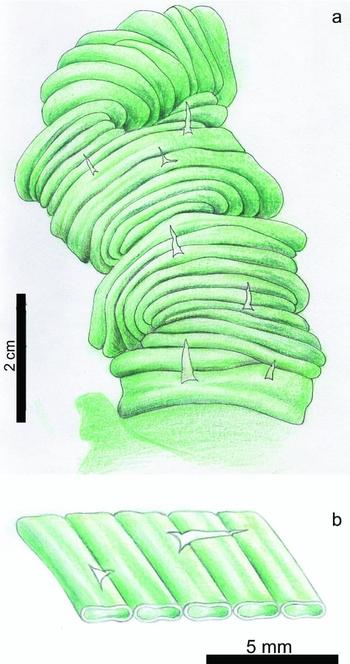
Based on its external morphology and internal structures, Curviacus can be reconstructed as an organism with narrow, elongate and curved chambers that are tightly but somewhat irregularly arranged into series, with conical projections occasionally appearing from the chambers (Fig. 6). This is a unique morphology that is not readily compared with any living organisms. Below, we examine the comparison of Curviacus with trace fossils, algae, fungi, xenophyophores and other modular Ediacaran fossils in very general terms.
Idealized reconstruction of Curviacus ediacaranus. (a) Bedding plane view showing an irregularly arranged series of chambers with the development of conical projections. Projections may have functioned as connections between chambers or as openings to the external environment. (b) Cut-away view illustrating modular chambers and conical projections.

5.a. Trace fossils
Palaeopascichnus and Curviacus superficially resemble feeding traces with a systematic meandering pattern. However, as pointed out by others, neither the ridges nor the chambers are laterally connected at their ends and thus do not form continuous meanders (Palij, Reference Palij and Ryabenko1976; Jensen, Reference Jensen2003). The chambers of Palaeopascichnus and Curviacus have been confirmed here and in previous studies (Jensen, Reference Jensen2003; Seilacher, Grazhdankin & Legouta, Reference Seilacher, Grazhdankin and Legouta2003). In Curviacus, the chambers are irregularly arranged, with some not reaching the lateral margin of the fossil (Fig. 3b, white arrow heads), casting further doubt on the meandering trace interpretation.
5.b. Algae or fungi
Curviacus can be compared with encrusting algae (e.g. coralline algae) or encrusting fungi. This hypothesis is attractive given that fungal growth can be indeterminate (Klein & Paschke, Reference Klein and Paschke2004). However, the chambers of Curviacus are much larger and have a much greater aspect ratio than coralline algal cells. These chambers are not easily reconciled with the filamentous mycelia of fungi. Although Curviacus could share certain ecological features with encrusting coralline algae or fungi, it is unlikely a crown group of these clades. However, whether Curviacus is a stem group coralline alga or fungus cannot be easily rejected.
5.c. Xenophyophores
Xenophyophores are a group of giant protists in modern deep sea environments (Tendal, Reference Tendal1972; Gooday, Reference Gooday1991). Seilacher, Grazhdankin & Legouta (Reference Seilacher, Grazhdankin and Legouta2003) proposed that some Ediacara-type fossils could be fossil xenophyophores, although this interpretation has been questioned by Antcliffe, Gooday & Brasier (Reference Antcliffe, Gooday and Brasier2011). Indeed, the modern xenophyophore Stannophyllum zonarium is remarkably similar to Curviacus in several aspects. Stannophyllum zonarium is an erect epibenthic organism with a stalk and a leaf-like test ranging from 3–19 cm in height and 1–2 mm in thickness (Tendal, Reference Tendal1972). The leaf-like test is internally compartmentalized, consisting of serially arranged zones that are somewhat similar to the chambers of Curviacus. Stannophyllum is made of agglutinated material, while its chambers are filled with various metabolic end-products, possessing distinct elemental and mineralogical signals (Tendal, Reference Tendal1972).
However, there are also fundamental differences between Curviacus and Stannophyllum that preclude a direct comparison. Unlike Stannophyllum, the chamber walls of Curviacus seem to be composed of carbonaceous material rather than agglutinated particles. Furthermore, Stannophyllum is an erect epibenthic organism with a stalk, whereas Curviacus is interpreted as a procumbent epibenthic organism. Finally, xenophyophores are likely phylogenetically derived from within the foraminifers and probably evolved in Phanerozoic time (Pawlowski et al. Reference Pawlowski, Holzmann, Berney, Fahrni, Gooday, Cedhagen, Habura and Bowser2003a ,Reference Pawlowski, Holzmann, Fahrni and Richardson b ). Thus, although there are some intriguing similarities between palaeopascichnids and modern xenophyophores (Seilacher, Grazhdankin & Legouta, Reference Seilacher, Grazhdankin and Legouta2003), it is possible that such similarities are superficial and convergent.
5.d. Comparison with other modular Ediacaran fossils
Modular fossils are very common in the Ediacaran Period (Jensen, Reference Jensen2003; Narbonne, Reference Narbonne2004; Laflamme & Narbonne, Reference Laflamme and Narbonne2008). For example, Yelovichnus, ‘Neonereites’, ‘Horodyskia’, Shaanxilithes, Harlaniella and Orbisiana are all characterized by a modular construction (Jensen, Reference Jensen2003; Shen et al. Reference Shen, Xiao, Dong, Zhou and Liu2007). In addition, all rangeomorphs are also modular (Narbonne, Reference Narbonne2004), although they also have a fractal-like aspect in their morphological construction. The morphology of the constructional modules can be variable among these taxa, ranging from spherical, crescent, cylindrical units to branching units. However, the serial or nearly serial arrangement of their modules is similar. Although a modular construction likely evolved independently among multiple clades, in future investigations it is useful to consider these Ediacaran fossils with serial modular construction as a possible morphogroup so that they can illuminate each other's functional morphology and palaeoecology.
6. Conclusions
Curviacus ediacaranus new genus and species from the Shibantan limestone of the Dengying Formation in the Yangtze Gorges area represents another Ediacaran taxon preserved in carbonate rocks. Our study of unpolished slabs and thin-sections shows that Curviacus ediacaranus consists of serially and tightly arranged, narrow and curved chambers. Some chambers bear a conical projection pointing towards the convex side of the chamber. Curviacus ediacaranus shares a similar preservational style with Yangtziramulus zhangii. Its chamber walls are preserved as residual carbonaceous material surrounded by calcispar cements. The chambers are either completely or partially filled with micrite. Curviacus ediacaranus is interpreted as a modular organism with a procumbent benthic lifestyle. Although its phylogenetic affinity remains unknown, Curviacus ediacaranus shares a serial modular construction with other Ediacaran fossils such as Palaeopascichnus, Harlaniella, ‘Horodyskia’, ‘Neonereites’, Orbisiana, Shaanxilithes and Yelovichnus, highlighting the ecological importance of modularity among Ediacaran organisms.
Acknowledgements
This study is supported by the National Natural Science Foundation of China (41272017, 41322021 and 41272011) and US National Science Foundation (EAR-1528553). We thank two anonymous reviewers for their constructive comments on an earlier version of this paper.