INTRODUCTION
Healthcare-associated infections (HAIs) remain a significant source of morbidity and mortality in the United States.Reference Magill, Edwards and Bamberg 1 Infection prevention and control (IPC) efforts are therefore vital to patient safety. Although many national recommendations for infection prevention practices are available, these recommendations are primarily directed toward adult facilities.Reference Siegel, Rhinehart, Jackson and Chiarello 2 Less emphasis is placed on children, but owing to changing developmental stages, social dependencies, differences in diagnostics, and difficulties in the performance of therapeutic and clinical studies, infants and children are at high risk for developing an HAI.Reference Balkhy and Zingg 3 Evidence-based pediatric infection prevention strategies are needed to optimize HAI prevention in children.Reference Sandora 4 Our objectives were to characterize the structure of IPC programs in children’s hospitals, examine specific practices, and identify areas of unmet need.
METHODS
We conducted a survey of hospital epidemiologists from member hospitals of the Children’s Hospital Association, a network of 44 freestanding children’s hospitals in the United States, between September 1, 2013, and January 31, 2014. The survey included questions about program structure, IPC personnel, antimicrobial stewardship program (ASP), employee vaccination policy, and practices around HAI surveillance and reporting. Several questions focused on infection prevention policies on screening, isolation, and discontinuation of precautions for respiratory viruses, methicillin-resistant Staphylococcus aureus (MRSA), and multidrug-resistant gram-negative rods. Additional items sought to determine key barriers to improved IPC practices and attitudes about current practice. The survey instrument, including definitions for key study terms, is available in Appendix 1 (online only). The survey was pilot tested and then administered using an online program (Qualtrics). We used descriptive statistics to summarize the results (R, version 3.02). This study was approved by the Children’s Hospital, Los Angeles Committee on Clinical Investigations.
RESULTS
Of the 44 Children’s Hospital Association hospitals queried, representatives from 28 (64%) completed the survey. All 28 hospitals are members of the Children’s Hospitals’ Solutions for Patient Safety. Respondent hospitals represented 20 states and all geographic regions in the continental United States. We did not identify regional variations between hospitals. The mean (range) number of hospital beds was 328 (78–539) (median, 309).
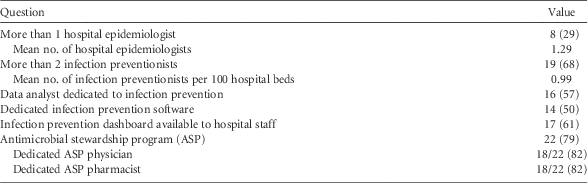
The IPC program structure was similar among children’s hospitals, with a few exceptions (Table 1). All 28 of the responding hospitals had an identified physician hospital epidemiologist; 8 identified more than one. Of the 28 primary hospital epidemiologists, only 15 had completed the Society for Healthcare Epidemiology of America training courses; 8 held advanced degrees or training in epidemiology or public health. The mean (range) number of infection preventionists per 100 hospital beds was 0.99 (0–2.56) (median [interquartile range], 0.97 [0.75–1.15]). Data analysts and computer software specifically dedicated to infection prevention activities were present in only 16 (57%) and 14 (50%) of the programs, respectively. The reporting structure varied between programs with most IPC teams presenting hospital epidemiology data quarterly to hospital, physician, and nursing leadership groups. ASPs were identified in 22 hospitals (79%). Of these 22 programs, 12 (55%) began after 2009. In 8 hospitals, the hospital epidemiologist also led the ASP.
Program Structure at 28 Children’s Hospital Association Member Hospitals

Note. Data are no. (percent) of hospitals unless otherwise indicated.
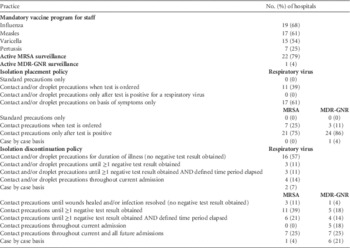
Specific IPC practices varied between hospitals (Table 2). Although 19 hospitals (68%) had mandatory influenza vaccine programs for staff, fewer required vaccination for measles (61%), varicella (54%), or pertussis (25%). Twenty-two hospitals (79%) reported active surveillance programs for MRSA; of these, 19 (86%) screened for MRSA only at time of admission to specific units, primarily intensive care units. In 1 hospital, active MRSA surveillance was performed for all hospital admissions. Active surveillance for multidrug-resistant gram-negative rods was identified in only 1 hospital, which performed this testing at admission to a specific unit.
Infection Prevention Practices at 28 Children’s Hospital Association Member Hospitals

Note. MDR-GNR, multidrug-resistant gram-negative rods; MRSA, methicillin-resistant Staphylococcus aureus.
In 11 hospitals (39%), children with respiratory symptoms were placed in isolation when a test was ordered whereas in 17 hospitals (61%), children were isolated on the basis of symptoms alone (Table 2). Patients with MRSA and multidrug-resistant gram-negative rod infections were identified and isolated at time of positive test result in 75% and 86% of respondent hospitals, respectively. We found broad variability in IPC practices around discontinuation of isolation.
Hospital epidemiologists identified a lack of awareness by healthcare providers of the role of infection prevention as the primary barrier to IPC efforts in the pediatric setting. A lack of funding and a lack of pediatric research in infection prevention were the second and third most frequently identified barriers to effective IPC practices. If given more funding, most respondents stated that they would use those resources for hiring additional infection preventionist staff. Nineteen respondents (68%) felt that mandatory HAI public reporting policies were of benefit to pediatric infection prevention efforts. Fifteen pediatric hospital epidemiologists (54%) felt that policies holding hospitals financially accountable for HAI have improved IPC efforts at their institution.
DISCUSSION
In this study we describe features of IPC program structure and practices across 28 freestanding children’s hospitals. Although all surveyed institutions have established programs, we found substantial variability in practices. This highlights the need for strong evidence to identify best practices in IPC and pediatric-focused guidelines.
The IPC program structure among responding hospitals appears robust with hospital epidemiologist support and approximately 1 dedicated infection preventionist per 100 hospital beds. Recent attention has focused on the need for ASPs in children’s hospitalsReference Newland, Gerber and Weissman 5 and these activities frequently are complementary with infection prevention. Most hospitals surveyed in our study had multidisciplinary ASPs already in place that included dedicated pharmacy support. Nonetheless, we identified potential areas where programs could be strengthened, including a potential need for more widespread implementation of dedicated data analyst support and software for infection prevention duties.Reference Masnick, Morgan and Wright 6
We observed substantial variability in IPC practices among responding hospitals. This was notable for policies regarding healthcare worker vaccination and discontinuation of isolation precautions for respiratory viruses, MRSA, and multidrug-resistant gram-negative rods. This lack of consistency is likely a result of the dearth of pediatric infection prevention research. Further variability may be related to different levels of resources and state requirements for surveillance and reporting. Unfortunately, there are few pediatric-specific guidelines for the prevention of HAIs. Guidelines have recently been published for influenza 7 and Clostridium difficile infectionReference Schutze and Willoughby 8 prevention in children. Notably, neither of these guidelines emphasizes inpatient isolation procedures. Although recent MRSA treatment guidelines do not address infection prevention practices,Reference Liu, Bayer and Cosgrove 9 with greater accumulation of evidence, this topic was recently presented in a joint Society for Healthcare Epidemiology of America/Infectious Diseases Society of America practice recommendation.Reference Calfee, Salgado and Milstone 10 However, many key questions, such as isolation discontinuation, remain unanswered. We further identified an important opportunity to improve IPC by improving vaccination policies for staff. Effective vaccination policies have the potential to decrease nosocomial transmission of vaccine-preventable infections and decrease the costs and time burden of contact investigations for measles and pertussis.
The biggest challenge to improving pediatric IPC programs identified was a lack of understanding of how IPC efforts protect pediatric patients. IPC teams historically have not played pivotal roles in hospital leadership. With continued emphasis on patient safety, public reporting, and family-centered care, IPC will need to play a much larger role in children’s hospitals. Some of this work to strengthen IPC programs has already begun. Collaborative efforts such as Children’s Hospital Association and Children’s Hospitals’ Solutions for Patient Safety are providing a national forum for sharing knowledge about and implementation strategies for evidence-based HAI prevention practices.
Our study has certain limitations. IPC activities at nonresponding hospitals may differ from activities at hospitals that responded to our survey. This survey included only freestanding children’s hospitals, and IPC programs in other pediatric settings may differ. In summary, pediatric IPC programs are diverse and follow a variety of clinical practices. Further efforts in research and guideline development have the potential to standardize and improve infection prevention for hospitalized children.
Acknowledgments
Financial support. Children’s Hospital, Los Angeles (grant K12 HD052954-08 to J.M.B.).
Potential conflicts of interest. J.G.N. reports that he is partially supported by a grant from Pfizer to work on a separate project. All other authors report no conflicts of interest relevant to this article.
Supplementary material
To view supplementary material for this article, please visit http://dx.doi.org/10.1017/ice.2015.23