The regularization of paradigmatic verb forms is among the best-studied processes in English variationist sociolinguistics (Chambers, Reference Chambers2009; Tagliamonte, Reference Tagliamonte1998, Reference Tagliamonte2012; Wolfram & Schilling-Estes, Reference Wolfram and Schilling-Estes2003). Leveling of past be to was represents a vernacular universal in English, also called “default singulars” (Chambers, Reference Chambers and Kortmann2004:128) that belong to “the grammatical processes [that] recur in vernaculars wherever they are spoken” (ibid., 127), and is documented quantitatively in synchronic and diachronic varieties (Anderwald, Reference Anderwald2001; Britain, Reference Britain2002; Dubois & Horvath, Reference Dubois and Horvath2003; Hay & Schreier; Reference Hay and Schreier2004; Hazen, Reference Hazen2014; José, Reference José2007; Schreier, Reference Schreier2002; Tagliamonte, Reference Tagliamonte1998; Tagliamonte & Smith, Reference Tagliamonte, Smith and Poplack2000). Past be variation is context-sensitive and sociolinguistically diagnostic, occurring more frequently in rural and working-class varieties (e.g., Alabama: Feagin, Reference Feagin1979; Sydney: Horvath, Reference Horvath1985; North Carolina: Mallinson & Wolfram, Reference Mallinson and Wolfram2002; or West Virginia: Hazen, Reference Hazen2014). It has been discussed with reference to categorical language change (Schreier, Reference Schreier2003), accommodation processes and ethnolinguistic differentiation (Mallinson & Wolfram, Reference Mallinson and Wolfram2002), or potential for ongoing standardization/vernacularization in postinsular varieties (Hazen, Reference Hazen2014).
In contrast, present be leveling with pivot form is, I is, for example, occurs sporadically and is often mentioned in passing only. There are very few quantitative studies on this feature in English around the world, one of the exceptions being Walker (Reference Walker2007), who researched the existential + is (there's) construction with plurals in Canadian English and looked into its potential for lexicalization effects. As for regional variation, there is historical evidence that forms such as we is were common in English rural dialects and particularly frequent in the North (Studer, Reference Studer2006; Trudgill, Reference Trudgill1999), which was interpreted as analogical change in an unusually irregular verbal paradigm with three different allomorphs (Finegan, Reference Finegan and Romaine1999; Ihalainen, Reference Ihalainen and Burchfield1994).
With the exception of there's PL constructions (i.e., when a copula co-occurs with a preposed semantically void locative, as in there's no mice in the field), forms such as we is occur so infrequently that present be leveling is not even listed as a separate feature in the electronic World Atlas of Varieties of English (eWAVE, Kortmann & Lunkenheimer, Reference Kortmann and Lunkenheimer2013). Present is with non–third persons is documented for: Caribbean English (Saban English: “is leveling with first person,” Myrick [Reference Myrick2014:182]; Bahamian Creole: “How old you think I is?,” Shilling [Reference Shilling1978:35]; Trinidadian Creole: “I is a Trini,” “You is the one that who want to go,” Deuber and Youssef [Reference Deuber, Youssef, Kortmann and Lunkenheimer2013:325]), rural Eastern Newfoundland English (“I's, you's, they's,” Clarke [Reference Clarke, Kortmann, Schneider, Burridge, Mesthrie and Upton2004:315]), and Orkney and Shetland English (“What is du wanting?,” Melchers [Reference Melchers, Kortmann and Lunkenheimer2013:19]). Present be leveling is also reported in varieties of American English. In White Alabama English, Feagin (Reference Feagin1979:199) reported “cases in which is occurs where are would normally appear,” and in his descriptive profile of rural southern varieties, Wolfram (Reference Wolfram and Schneider2008:522) noted that “enclave dialects participate in the widespread vernacular pattern of be regularization for present and past forms of conjugated be; are and am level to is, as in The folks is home or Y'all is here and past tense be levels to was, as in The folks was there or Y'all was here. Regularization is much more common in past than in present tense, as it is in virtually all varieties of vernacular English having be leveling.”
According to José (Reference José2007:260), is leveling exists in very restricted syntactic contexts in Kentuckiana English, former Appalachian English transplanted to southern Indiana, with the notable exception of there/they existential constructions. In his detailed case study, José (Reference José2007:272) reported “very little plural verbal –s outside of existential constructions” and found that “only 2 of the 127 tokens (1.6%) of plural verbs are –s forms … and both of these are instances of plural is with an NP subject, produced by a single speaker in a single utterance.” Variation and change with regard to present be is also discussed in Tagliamonte (Reference Tagliamonte2012), who looked into the historical development of English features in the British Isles and beyond, and it is reported in African American Vernacular English (AAVE): “AAVE is much like the vast majority of other vernacular varieties of English in its use of be leveling; in the present tense, are and am level to is, as in The folks is home or Y'all is here, while past tense be levels to was, as in The folks was there or Y'all was here” (Wolfram, Reference Wolfram and Schneider2008:522). Similarly, Labov, Cohen, Robins, and Lewis (Reference Labov, Cohen, Robins and Lewis1968:221) reported very low overall leveling rates in AAVE (approximately 5% overall), noting that speakers “occasionally say they is, but almost never say he are—the disagreement is in one direction only.”
As for the South Atlantic, St. Helenian English (StHE) is one of the strongholds of present be leveling, since Schreier (Reference Schreier2008:196) reported that “present be is practically always leveled with the pivot is, so that first and second person singulars and all the plural pronouns and NPs agree with is.” The feature is also attested in earlier StHE (Schreier, Reference Schreier2008:137). As for TdCE (Tristan da Cunha English), Zettersten (Reference Zettersten1969:83) reported that, “as can be seen from the inflectional system, the s-ending is used in all persons in the Tristan speech. The s-forms are particularly noticeable in all persons of the verb be.” Furthermore, “the s-ending can be used in all persons in the present tense. Thus I is, we is, etc.” (ibid., 130; cf. Schreier, Reference Schreier2003).
Putting the picture together, is leveling occurs frequently with existential there constructions in Englishes around the world. Is in this environment is so common indeed that it can be described as a true universal feature of global English. Leveled is with personal pronouns and plural NPs, however, is generally limited to relic varieties and rural dialects in the British Isles, the Caribbean, easternmost Canada, regional and ethnic varieties associated with the US rural South, as well as to English in the South Atlantic.Footnote 1
THE SOCIOLINGUISTIC EVOLUTION OF TRISTAN DA CUNHA ENGLISH
The evolution of Tristan da Cunha English can be surveyed as follows (see Schreier, Reference Schreier2003, Reference Schreier2008, Reference Schreier, Buschfeld, Hoffmann, Huber and Kautzsch2014b for more detail). First of all, the setting is extraordinary for its geographic isolation: the island lies in the middle of the South Atlantic Ocean, roughly half-way between Cape Town and Montevideo, and almost 3000 km distant from the closest major land mass. The next permanently inhabited place is the island of St. Helena, some 2000 km to the north (Schreier, Reference Schreier2008), with which the Tristan population had close contacts. Second, the island has a population of 262 (April 2016) and is thus one of the smallest communities around the world in which English is spoken natively. Its sociohistorical development is unusual and complex in terms of contact origins. Originally discovered by the Portuguese in 1506, Tristan da Cunha remained uninhabited and was only settled in 1816, when the British admiralty dispatched a military garrison to the island (Brander, Reference Brander1940). When it withdrew the following year, some army personnel stayed behind: two stonemasons from Plymouth (Samuel Burnell and John Nankivel), a noncommissioned officer from Kelso, Scotland, named William Glass, accompanied by his wife, “the daughter of a Boer Dutchman” (Evans, Reference Evans1994:245), and their two children. The population increased when shipwrecked sailors and castaways arrived. From the diaries of a stranded artist, we know that in 1824, apart from the Glass family, settlers from various parts of England lived on Tristan (Wapping/East London, Hastings/Sussex, and Hull/Yorkshire; Earle, Reference Earle1966 [1832]). The late 1820s and 1830s saw the arrival of a group of women from St. Helena and three settlers from Denmark and the Netherlands, joined by American whalers in the 1840s. The population then grew rapidly. By 1832, there was a total of 34 people on the island, 22 of whom were children or adolescents.
After this high-contact phase and the inception of a local dialect, the second half of the 19th century witnessed a period of growing isolation. Very few settlers arrived, the exception being a weaver from Yorkshire (who left after a few years only) and two Italian sailors, shipwrecked in 1892 (Crawford, Reference Crawford1945). Extreme isolation lasted well into the 20th century. A missionary sent to the island in the 1920s reported that few of the innovations from the outside world had made it to Tristan da Cunha. When visiting the island in 1937, the Norwegian sociologist Peter Munch (Reference Munch1945) reported that the Tristanians basically lived in preindustrial conditions. The community was extraordinarily stable and immobile. The cartographer of an expedition that worked on Tristan in 1937 and 1938, Allen Crawford, noted that only 6 out of a total of 170 Tristanians had ever left the island (Crawford, Reference Crawford1999:151). This changed in April 1942, when the arrival of a British navy corps entailed far-reaching economic changes; a South African company employed the local workforce in the fishing industry and the traditional subsistence economy was replaced by a paid labor force economy.
Though sociodemographically and politically insignificant, TdCE has been referred to as the “sociolinguists' Galapagos” (Chambers, Reference Chambers and Kortmann2004:134). Two reasons can be advanced why it is indeed particularly suitable for studies on contact-induced language change and variationist sociolinguistics. First, it is an ideal research site because the community's founders settled under tabula rasa conditions. There was no contact with indigenous varieties: the island was practically uninhabited when the garrison arrived (Schreier, Reference Schreier2003). With its origins in the 1820s, TdCE is one of the youngest nativized Englishes around the world (approximately one generation or so older than New Zealand English; Gordon, Campbell, Hay, Maclagan, Sudbury, & Trudgill, Reference Gordon, Campbell, Hay, Maclagan, Sudbury and Trudgill2004). Second, the input varieties to TdCE are well-known, as is the development of the local population (an entire genealogical tree for the island community is produced by Crawford, Reference Crawford1982:90–91). The available sources suggest that the feature pool (Mufwene, Reference Mufwene2001:4–6) hosted dialects from the British Isles (the most important founders came from the Scottish Lowlands, East Yorkshire, East London, and Hastings), the United States (the most influential American resident being a whaling captain from Massachusetts), various second-language varieties (spoken by settlers with Danish, Dutch, Italian, and perhaps early 19th-century Afrikaans mother tongues) and StHE, a contact-derived variety itself that has undergone restructuring and creolization processes (Schreier, Reference Schreier2008).
As a result, multiple contact processes were operative during the genesis and formation periods of TdCE. Schreier (Reference Schreier2002, Reference Schreier2003) and Schreier and Trudgill (Reference Schreier and Trudgill2006) argued that TdCE primarily derives from varieties of British/late 18th-century American English and StHE and that it did not emerge via prima facie language contact, thus excluding pidginization effects on Tristan da Cunha. While some features most likely had a British English origin, the L2 forms spoken in the community had an impact on TdCE so that nonnative features were adopted (for instance TH sibilization, i.e., dental fricatives realized as /s/, as in think, throw; preterits with quasimodals such as useta, etc.; cf. Schreier, Reference Schreier2003:211). The existence of creole-type features in TdCE (such as high rates of consonant cluster reduction; absence of -ed past-tense marking, Schreier [Reference Schreier2005:152]; /v/ realized as [b]; copula absence with locatives and adjectivals, Schreier [Reference Schreier2008]; etc.) point to the legacy of a creolized form of English from St. Helena.
METHODOLOGY AND DATA
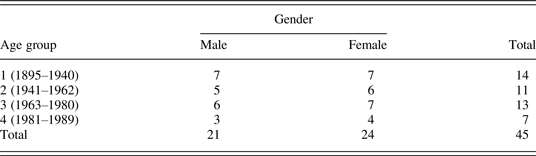
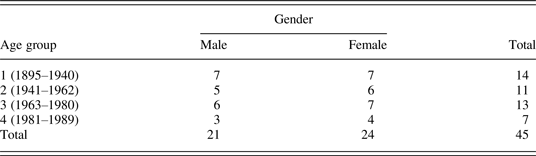
The population sample selected here includes 45 informants born between 1895 and 1988.Footnote 2 The 24 females and 21 males were subdivided into four age groups, classified by the most significant events in the 20th century: the installation of a naval garrison in World War II (WWII; 1942) and the wholesale evacuation of the population after a volcanic eruption in 1961 (Schreier & Lavarello-Schreier, Reference Schreier and Lavarello-Schreier2011) served as a demarcation to divide age groups 2 and 3. The youngest speakers, born in the 1980s, were dealt with separately as they were born into a phase when external schooling was promoted and off-island mobility for adolescents increased. The four age groups (1895–1940, 1941–1962, 1963–1980, 1981–1989) were further subdivided by gender, yielding a sample of eight groups in total (Table 1). A total of approximately 30 hr of tape-recorded speech, with at least 30 minutes of tape-recorded speech for each speaker, are analyzed.
Social profile of the 45 speakers
These data come from corpora that differ in terms of place and length of recording: the 1961–1962 BBC/UCL corpus, the Svensson/Munch corpus from the 1960s and 1970s, a set of recordings made by Scottish oral historians in 2006, and data collected by the author in 2010. The characteristics of these corpora—place of recording, speaker selection, interview techniques, and data compilation—are described briefly as they pose a challenge for comparative analysis (Schreier, Reference Schreier, Buschfeld, Hoffmann, Huber and Kautzsch2014b).
The first-ever linguistic description of TdCE comes from Zettersten (Reference Zettersten1969). Zettersten analyzed recordings made in the early 1960s by the British Broadcasting Corporation (BBC) in cooperation with the University College of London (UCL). Interviewers were radio journalists or linguists working for the UCL (among them Jan Svartvik), all of whom were highly educated and had Received Pronunciation accents (the exception being the technicians, who at times contributed to the conversation but were not in charge of leading the interviews). The interviews were conducted in Calshot (near Southampton), where the Tristanians were forced to live after volcanic activities endangered the settlement and enforced a full-scale evacuation. The corpus amounts to a total of about 4 hr of speech, about 25 recordings with some 30 Tristanians (single and group interviews, including interviews with seniors and children).
Second, there is the Svensson/Munch corpus, compiled by the Swedish painter Roland Svensson (1910–2003) and the Norwegian sociologist Peter A. Munch (1908–1984). Svensson was a painter and graphic artist with a passion for island life. He visited the island several times and developed a strong ethnographic interest. He collected material, shared the everyday experiences of the islanders and also carried out tape recordings (some in England in 1962, many more when visiting in the 1960s and early 1970s). The recordings were carried out in the Tristanians' homes in relaxed and informal contexts. Similarly, Peter Munch was highly familiar with life on Tristan da Cunha. He was a member of the Norwegian expedition that visited the island in 1937 and 1938), when he collected information to produce the most detailed account of social organization in the community. Munch's notes and sociological observations are priceless, since he studied the island for almost half a century (Munch, Reference Munch1945, Reference Munch1971). The recordings collected by Svensson and Munch comprise a total of approximately 23 hr of interviews with about 50 individuals, recorded alone or in groups. Svensson and Munch had the status of “informed outsiders”; they had close connections with the Tristanians and were well liked and respected on the island. In their interviews, they asked about local life, family histories, all sorts of incidents in the late 19th and early 20th centuries (including ghost stories, mysterious sightings of missing ships, information on the earliest settlers on Tristan, etc.), and collected reminiscences of islanders, fully immersed in the natural environment of the people whose speech they recorded.
Third, the Schreier corpus consists of recordings made in 1999, 2002, and 2010. The total length of the recordings is about 55 hr (approximately 80 Tristanians). For his doctoral project, Schreier initially spent six months on Tristan in 1999 (Schreier, Reference Schreier2003), and more recordings were conducted during follow-up visits in 2002 and 2010. On his last fieldwork trip, Schreier was joined by the local head of the Tourist Division, who developed a strong interest in the project and helped in the fieldwork activities, with the aim of collecting a body of oral history, to be housed in the local museum.
The Scottish corpus, finally, consists of 25 interviews (mostly single interviews) with 13 islanders (the rest being expatriates). Interviews were carried out in local homes and lasted between 45 and 60 min. The aim was to collect data that would eventually provide an oral history of Tristan da Cunha. The two fieldworkers were introduced into the community by a dentist, who was well familiar with the Tristanians and visited the island many times.
The study reported here uses data from three corpora (Schreier, Svensson/Munch, Scottish oral history project). Recordings from the BBC/UCL corpus were not considered, because they were short and very formal.Footnote 3 A total of 1137 tokens of present be were extracted. I coded for preceding and following material, intervening items (intensifiers, prepositional phrases, relative clauses, etc.), as well as for speaker gender/sex and age.
FINDINGS
Is pivots for am and are were found in speakers of all gender and age groups and with all grammatical persons (outside of third-person singular contexts, that is, where TdCE takes standard is categorically):
1st sg “I can barely remember how old I is” (male, b. 1988)
2nd sg “if you's goin’ over Nightingale” (male, b. 1968)
1st pl “we's goin to have a cup of coffee” (female, b. 1983)
2nd pl “cos you people is sensible” (male, b. 1928)
3rd pl “they's all in the same gang” (female, b. 1957)
NP pl “where Daphne and them is living” (female, b. 1895), “all the Saints is goin’ to Britain” (male, b. 1951), “because the straps is broken” (male, b. 1981)
Exist. pl “because there's like the waterpipes going underneath” (female, b. 1955), “it s about 500 cadets in that school” (male, b. 1935)
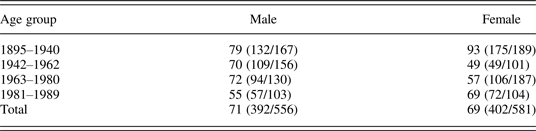
I present total frequencies first. Present be leveling in the corpus is remarkably high: 70% (794 of 1137). Gender differences are negligible; the average for female Tristanians is 69% (402 of 581), the one for males 71% (392 of 556). As for age, Table 2 and Figure 1 indicate that Tristanians born between 1895 and WWII have the highest leveling rates (males 79%, females 93%). There is a considerable drop in the 1942–1962 group but a phase of stabilization, even a small increase, in the younger female generation. Male speakers remain stable, yet there is a drop in the youngest group born in the 1980s (from 72% to 55%).
Percentage of present be leveling in TdCE by age group and sex.

Percentage of present be leveling in TdCE by age group and sex
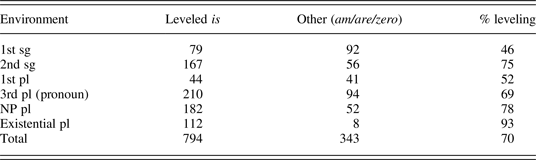
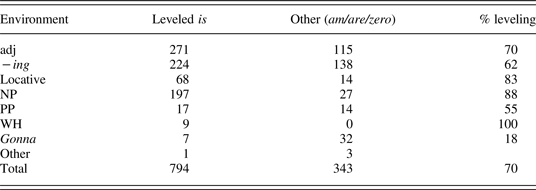
As for grammatical person and subject type effects, I note in Table 3 that the preceding environment strongly influences leveling. The highest rates are reported in plural existentials, yielding a constraint ranking Exist. pl > 2nd sg/plural NP > 3rd pl > 1st pl > 1st sg (note that in the category other, I include standard usage of am and are or copula absence). This ranking category is in line with other studies, where existential environments are nearly always reported to have stronger effects on nonstandard be agreement than other subject types. Following environment exerts the following effects. WH environments (question-type sentences, when a WH marker precedes the copula and there may be inversion of word order, as in “where’s the hooks?,” “where Larry dem is?”) have the highest is levels (though there are only 9 tokens, which is so low that they are excluded from the analysis). Gonna has the lowest rates (favoring copula absence). As seen in Table 4, the constraint ranking is WH > NP > loc > adj > -ing > PP > gonna (the category other refers to hesitation phenomena or end of clause).
Present be leveling in TdCE: Preceding environment (grammatical person/subject type)
Present be leveling in TdCE: Following environment
I also investigated the potential for intervening material effects, namely whether the placement of intensifiers (“they really is late now”), prepositional phrases (“the guys from South Africa is late”), or relative clauses (“the guys who left their stuff here is going to Nightingale Island”) between subject and be would have an effect (this was highly significant in New Zealand English; Hay & Schreier, Reference Hay and Schreier2004). Table 5 shows that intervening relativizers, intensifiers, etc., differ only slightly in terms of leveling rate (72% [171 of 237], as compared to 69% [623 of 900] when there was no intervening material), a difference that is not statistically significant (χ2 = 0.764, df = 1, p = .382).
Present be leveling in TdCE: Intervening material

The last point considered is individual variation. Figure 2 shows the leveling rates for all 45 individuals by their year of birth (x axis). The range of leveling is from 10% (for a male born in 1943) to a categorical 100% in two speakers (a male born in 1900 and a female born in 1916). It is remarkable that more than 25% of the speakers, born throughout the 20th century, have leveling rates of 90% or more. In general, Tristanians had highly advanced leveling in the early 20th century. In age group 2, there is an increase in community-wide variation, and it is striking that particularly the women born between 1942 and 1958 have 60% leveling or less. This contrasts with stabilization and even an increase in the speech of younger Tristanian women. Even in the youngest group, the men display significant variation (ranging from 12% to 91%).
Percentage of present be leveling in TdCE: Individual variation.
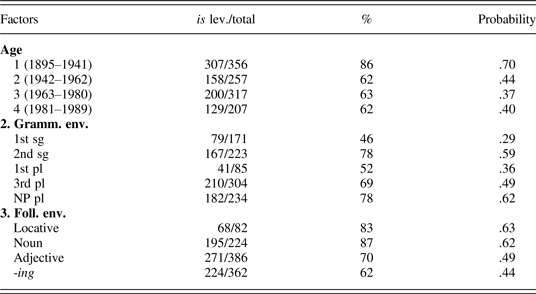
Table 6 shows a VARBRUL analysis conducted in GoldVarb Lion (Sankoff, Tagliamonte, & Smith, Reference Sankoff, Tagliamonte and Smith2012) with the following three factor groups: age group (1895–1941, 1942–1962, 1963–1980, 1981–1989), grammatical person and subject type (1st sg, 2nd sg, 1st pl, 3rd pl, NP pl), and following environment (adjective, NP, -ing, locative, PP, WH, gonna, other). Because leveled is occurred with nearly all the existential constructions in the corpus (112 of 120), these were excluded.
Multivariate (VARBRUL) analysis of is leveling (n = 1017), showing crossovers between percentages and probabilities
Note: Input .741. The following factors were not selected as significant: sex/gender, intervening material.
The GoldVarb analysis indicates that leveled is is favored by the generation born before WWII, plural NP, and 2nd sg subjects, as well as following locatives and nouns. There is a high degree of overlap between factors, as suggested by crossovers between percentages and factor weights, and one of the reviewers reminds me that this may be evidence that we are in fact not looking at a single linguistic system because there is a particularly big difference between age group 1 (1895–1941) and the other age groups (which is statistically significant: χ2 = 66.369, df = 3, p < .01). I return to this point in more detail when cross-tabulating effects of age and grammatical environment.
DISCUSSION
Two major questions emerge from the analysis and the data presented so far, namely: (a) what are patterns of variation and change in present be concord throughout the 20th century, including language-internal constraint reordering, and how does this reflect the social development of the community?; and (b) can we retrace how and by whom leveled is was brought to Tristan da Cunha and how this accounts for the high leveling rates in early 20th century TdCE? These issues are discussed in turn.
The origins of present be on Tristan da Cunha
The contact situation that gave rise to TdCE was heterogeneous and consisted of at least four main groups: a British dialect group (Lowland Scotland, Hull, London, Hastings); a St. Helenian (the group of at least 5 women who arrived in 1827); and an American one (a whaling captain from New Bedford, Massachusetts, lived on Tristan for almost 50 years); plus a rather heterogeneous group of sailors from various European locations (Denmark, Netherlands, Italy), for whom English was a second or foreign language and whose proficiency ranged from excellent to poor (logbook reports from the 1850s, quoted in Schreier, Reference Schreier2003).Footnote 4
The question is whether present is was brought to Tristan as such or whether it originated as an independent innovation. Previous research (Schreier, Reference Schreier2003, Reference Schreier, Schreier, Trudgill, Schneider and Williams2010, Reference Schreier, Buschfeld, Hoffmann, Huber and Kautzsch2014b; Schreier & Trudgill, Reference Schreier and Trudgill2006) has provided evidence that the British and St. Helenian groups were most influential in the formation period of TdCE and thus that there is a dialectological explanation for at least some distinctive local features.Footnote 5 This is not uncommon when English varieties form in colonial contexts (under conditions of dialect contact). A direct input hypothesis has been reported for the formation of Appalachian English, where Montgomery (Reference Montgomery1997:137, quoted in José Reference José2007:251) found a “remarkable retention of linguistic patterns and constraints across more than four centuries and two continents in the evolution of Scottish English into Scotch-Irish English into Appalachian English.” The possibility that the TdCE present be concord pattern can be directly traced to one of its St. Helenian or English donors might make for a likely explanation here too. Schreier (Reference Schreier2008) reported present be leveling on St. Helena and Trudgill (Reference Trudgill1999:107) noted “a gap for the Lower North, which has I is, with I am resuming in the North (and on into Scotland) … as a Scandinavian form.” This seems to indicate a direct input legacy (two founders of the community came from that area or its immediate vicinity—Hull, Kelso).
At the same time, there is reason for caution. Historical linguists such as Ihalainen (Reference Ihalainen and Burchfield1994) convincingly argued that I is is northern in origin. Studer (Reference Studer2006), in his digital analysis of the Survey of English Dialect records (Orton & Dieth, Reference Orton and Dieth1967, Orton, Sanderson, & Widdowson, Reference Orton, Sanderson and Widdowson1978), reported that leveling is particularly frequent with first person singular I (Figure 3). It would require a truly creative explanation for why the first-person environments (1st sg and 1st pl) are most variable (or standard-like) on Tristan da Cunha; as we saw, all speakers, regardless of how advanced their leveling is and how variable they are, show a strong first person > other grammatical person/subject type constraint, so am is particularly robust in our sample. If there was a northern English input and direct inheritance from this area (presumably via Alexander Cotton, though Hull is at the periphery of this dialect region), then we would expect I is to show up much more frequently than it actually does (and we would also expect to find more northern forms in TdCE than we do). As this is clearly not the case, a classical “dialectological” explanation is considerably weakened on the basis of these sociodemographic considerations.
Present be leveling to is (1st pers.) in the Survey of English Dialects (adapted from Studer, Reference Studer2006:35).
What about St. Helenian English? The quantitative analysis reported in Schreier (Reference Schreier2008:216) indicated that early 20th-century StHE did indeed have leveled is forms for first singular and all the plural persons. However, leveled is was a minority feature, occurring in no more than 14% of all possible cases (56 of 399). Copula absence was much more common and by far the majority variant, occurring in some 80% of all cases (320 of 399). This raises the intriguing question as to why TdCE should not be more closely related to StHE with regard to present be concord (having higher copula absence rates), particularly since Schreier (Reference Schreier, Buschfeld, Hoffmann, Huber and Kautzsch2014b) provided strong evidence of close morphosyntactic resemblances between the two varieties. Moreover, TdCE does have some copula absence, but it occurs at a low frequency in the present corpus: 8% (96 of 1137). A direct impact of StHE is therefore not really plausible either, simply because the overall pattern in the two varieties is so divergent: TdCE favors is with all persons, whereas copula absence predominates in StHE. This makes a direct legacy unlikely here was well.
What explanation, then, can we offer for the high frequency of present be leveling in TdCE? We know from earlier work (Schreier, Reference Schreier2002, Reference Schreier2003) that be allomorphs in TdCE were subject to unusually heavy analogical change. With regard to past be, for instance, Schreier (Reference Schreier2002) showed that particularly older, less mobile Tristanians had categorical leveling rates; 26 out of 35 speakers in the 1999 sample did not use were at all. The catalyzation of be leveling was attributed to strong social networks, limited outward mobility, and the absence of normative pressures, factors that lasted well into the 20th century and resulted in the favoring of “vernacular roots” such as we was (Chambers, Reference Chambers2009:258).
With regard to present be, the most likely scenario is multiple origins. Is concord with all singular and plural persons may at least to some extent have been present in (and brought to the island via) several inputs, to be more precise, Yorkshire English, possibly Lowlands Scottish English, St. Helenian English. The conclusion that there existed multiple sources triggered an initial contact scenario characterized by high diffuseness (Kerswill, Reference Kerswill1996:187).Footnote 6Is with all grammatical persons may have been present in all the donor varieties, though we have no evidence of the frequency with which this feature occurred. Following Mesthrie (Reference Mesthrie1993) and Siegel (Reference Siegel1985, Reference Siegel1987), minority forms present in several sources may have a selection advantage over majority variants that are found in one variety only (see also Hickey, Reference Hickey and Hickey2003; Trudgill, Reference Trudgill1986). This may be particularly strong in nativization and focusing processes that operate during koineization, namely when there is feature selection from the common pool of inputs spoken by a community's founders. I am not fully convinced, as one of the reviewers suggests, that in order to invoke koineization stemming from multiple minority sources (on Tristan or elsewhere), we need to first explain why the community founders, who spoke mutually comprehensible varieties, were in need of a koine. Feature selection and stabilization are not a matter of necessity but rather a consequence of contact between systems; or as Trudgill (Reference Trudgill2004:11) put it, “there seems to be a general consensus in the literature that the normal position is that colonial varieties are the consequence, at least in part, of dialect mixture.”
I would consequently argue that dialect mixture occurred on Tristan da Cunha also. Leveling must have been triggered early on and reached completion by the late 19th century, which would explain why leveled is occurs at such consistently high frequencies in the speech of Tristanians born around 1900. The amount of individual variation in this age group is small (with one exception), and this attests to focusing and strong trends toward analogical change under extensive contact conditions (in line with Trudgill's [Reference Trudgill2011:15–19] claims on simplification and reduction of irregularities). Moreover, the presence of English second-language speakers may have contributed to this particular process and reinforced a regular verb paradigm with pivot is, and the fact that there was no normative authority (no outsiders) certainly is to be taken into consideration as well. In any case, following Kerswill (Reference Kerswill1996), the origins of present is in TdCE can most likely be explained as the result of multiple adoption from several inputs, namely by children and adolescents upon nativization, and spread from restricted existential contexts to all grammatical environments. The result is a remarkably consistent (perhaps unprecedented) concord pattern I, you, we, they, NP, Existential p pl is in Tristanians born before WWII.
Variation and change in the 20th century
The development of present is matches the community's social history fairly well and can be subdivided into several periods. The age of “super-leveling,” in which nearly all speakers had leveling rates of 80% or more, lasted well into the 20th century and only ended when the military garrison was stationed on Tristan da Cunha in 1942. As a consequence, for the first time ever, a group of outsiders resided on the island, interacting frequently with the local population. Infrastructure had to be built and the local workforce was employed to work with the soldiers and crew, so that the community's lifestyle changed dramatically in the 1940s and 1950s (Schreier & Lavarello-Schreier, Reference Schreier and Lavarello-Schreier2011). This set off a new round of (dialect) contact for the adults, and a school was set up for the children. English teachers were employed to work on Tristan for periods of 2–3 years (Evans, Reference Evans1994), so that children born during and after WWII were exposed to outside varieties and taught by teachers speaking British English (ibid.). This certainly had an impact; as shown in Schreier (Reference Schreier, Auer, Schreier and Watts2015:270–274), is/am/are variation is found in (letter) writing, for example, the coexistence of spoken I is and his sugar are going down represents hypercorrection.
Figure 2 showed that Tristanians born in the early 1940s have higher usage of am and are with normative/standard grammatical persons (*I are or *we am are not found). This change is particularly prominent in the case of female Tristanians born between 1945 and 1955. They would have been girls educated at the local Tristan school and teenagers or young adolescents when the entire community was evacuated and spent the two “volcano years” in English exile (so it remains unclear which of these factors had a higher impact). However, four out of the five men sampled and born in this period continue to have high leveling rates (with one exception), so this represents the well-known change pattern where women are in the lead in adopting prestigious forms (Chambers, Reference Chambers2009).
In any case, this is not evidence of dialect loss or “dedialectalization” (Trudgill, Reference Trudgill2002:40–47); rather, variation with regard to present be concord increases on a community level so that there now is a leveling range from 10% to over 90%. I would like to refer to this process, which is remarkable for such a small, overall stable and endocentric community, as fraying-out. It can be explained as follows: the increasing contact patterns with outsiders and speakers of other dialects (endolocally on Tristan, exolocally in Southampton) saw an increase in the usage of standard-type I am and you/we/they etc. are forms. Following the return to Tristan in 1963, leveled is forms not only stabilized; as we saw in Figure 1, the overall percentages in age groups 2 and 3 remained stable and even increased marginally (70% to 72% [men] and 49% to 57% [women]). Women born in the 1980s more frequently use leveled is than the earlier group born after WWII (though this not statistically significant; p = .307). Still, it is remarkable that five out of nine Tristanians born in the 1980s have leveling rates of 70% or more.
How are we to interpret the developments that occurred from the 1940s onward? Large-scale variation in present be concord coincides with the presence of a garrison on Tristan (1942–1945), with the women in particular picking up am and are forms, whereas men trailed behind and continued to use high rates of a regularized present be paradigm with pivot form is (80% or more). A variable pattern stabilized in the speech of Tristanians born in the 1950s and later, and the return to the island in 1963 saw a gradual return to local patterns—even though community-wide variation has continued to the present day. There is little evidence of social pressures on vernacularization, as recently reported in Appalachian English (Hazen, Reference Hazen2014).
Such an increase of intercommunity variation is not uncommon at all, as a closer look at the literature suggests. Meyerhoff and Walker (Reference Meyerhoff and Walker2007:358) found that “urban sojourners,” inhabitants from the island of Bequia who returned home after extensive periods of time abroad, had consistently lower overall frequencies of zero copula than their peers who left the island less frequently. Hazen (Reference Hazen2002:240), in his work on local versus expanded identity residents of Warren County, found the same, approaching community-wide variation as a function of identity (see also Sankoff, Reference Sankoff, Ammon, Dittmar, Mattheier and Trudgill2005:1006–1008). While this is in line with the TdCE findings reported here, Meyerhoff and Walker (Reference Meyerhoff and Walker2007:346) emphasized that “the kinds of changes that can affect grammatical variables are more constrained than we might think. Raw frequencies of vernacular variants may fluctuate, but language-internal constraints persist,” and this raises the important question whether internal constraints on present be in TdCE remain stable in the light of community-based variation.
First of all, notwithstanding the individuals who have shifted away from local norms after WWII, the global frequencies indicate little (if any) weakening of present is. It is certainly the case, as one of the anonymous reviewers reminds me, that there is an overall decline in is leveling in 20th-century TdCE (as attested by the overall frequencies for all age groups and evidenced by the fact that 11 out of 17 women from our sample born after WWII have leveling rates lower than 70%, in contrast to the oldest female group, where all 7 have rates of 80% or more), but this is not really a sign of standardization in progress. Though the community is participating in a fraying-out process, the most recent trend in younger speakers is a gradual return to the is pattern (Figure 1, Table 6).
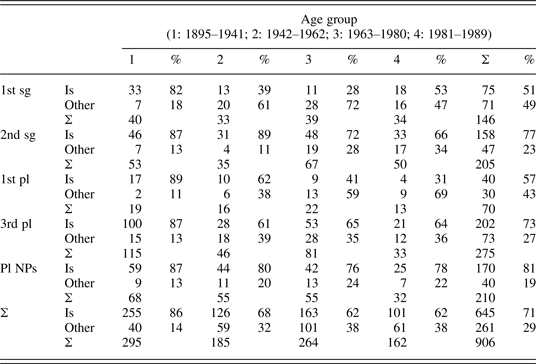
Finally, patterns of internal conditioning call for special attention, because these are as diagnostic as the presence of features. In other words, the “shared retention of variable conditioning that cannot be attributed to universal considerations constitutes evidence of a shared origin” (Van Herk & Walker, Reference Van Herk and Walker2005:127). The question then is to what extent the fraying-out process affects not only overall percentages but also internal constraints on variation: whether or not there is internal restructuring of the linguistic system. As Meyerhoff and Walker (Reference Meyerhoff and Walker2007:346) found in their Bequia study, “the ranking of language-internal constraints remain[s] largely unchanged. These results reaffirm the validity of modelling variable rules in a community grammar, rather than as an aggregation of idiolectal norms.” In order to check constraint rankings in the various age groups, a cross-tabulation of “speaker age” and “grammatical environment” was carried out (excluding existential constructions and all knockouts; total tokens = 906). Table 7 shows the following hierarchies for each age group. The constraint ranking of grammatical person and following environment is as follows:
Age group 1 (1895–1941) 2nd sg > 1st pl > 3rd pl/ Pl NPs > 1st sg (χ2 = 0.717, df = 4, p = NS)
Age group 2 (1942–1962) 2nd sg > Pl NPs > 1st pl/ 3rd pl > 1st sg (χ2 = 24.196, df = 4, p < .0001)
Age group 3 (1963–1980) Pl NPs > 2nd sg > 3rd pl > 1st pl > 1st sg (χ2 = 30.837, df = 4, p < .0001)
Age group 4 (1981–1989) Pl NPs > 2nd sg/3rd pl > 1st sg > 1st pl (χ2 = 10.504, df = 4, p < .05)
Percentage of present be leveling according to age group and grammatical environment (person/subject type; n = 906)
This suggests that the change did at least to some extent affect language-internal constraints. The most noteworthy change is that Pl NPs are leveled more frequently than 2nd sg environments in age groups 1 and 2. By the same token, restructuring seems to be partial only. Though the ranking is not identical for the groups, the general pattern is that 2nd sg and pl NPs consistently have higher leveling rates than 1st sg. The hierarchical trend of implicational scales here (Rickford, Reference Rickford, Chambers, Trudgill and Schilling2008) is that all age groups more frequently level 2nd sg than 1st pl, and plural NPs than 1st sg. I is is thus most variable (and least common in all age groups), whereas the dogs is occurs most frequently in speakers born after the super-leveling period. So an implicational constraint hierarchy still exists (in fact, the only group in which 1st sg is not last in ranking is age group 4, which is further evidence that leveled is forms are now more firmly entrenched in the local vernacular than they were a generation or two ago), and this suggests that restructuring was not advanced. For the time being, partial restructuring is the most plausible explanation; however, we need to have more in-depth quantitative studies of grammatical (perhaps also phonological) variables in order to substantiate this claim further.
Outliers and early adopters
Finally, we saw that the sociolinguistic behavior of some individual speakers with regard to present be concord falls well outside the established Tristan community patterns. It is striking that in three out of four age groups, it is the men who have the highest normative/standard am and are rates. A Tristanian male, born in 1933, is the only speaker in his age group with a low leveling rate (44%, the second lowest being 75%). In age group 2, a man born in 1943 has merely 10% (the lowest rate in the entire corpus) and one male born in 1983 has 12%, which is extremely low considering that all others in his cohort, born after 1965, have at least 60%. Combined, the three men have 24% leveling (26 of 109), which sets them apart from other speakers in the sample. This seems puzzling, considering that the women in age group 2 were in the lead, picking up am and are via schooling on Tristan and as a result of accommodation during the exile in Southampton (Table 2). How can we account for the fact that the three male TdCE speakers have the lowest leveling rates overall?
Chambers (Reference Chambers2009:96–100) referred to individuals who fall outside communal patterns as “outsiders.” Several explanations have been offered: they may be innovators or early adopters (Milroy & Gordon Reference Milroy and Gordon2005:116–133), being in the vanguard of language change and ahead of the bulk of the speech community that has not yet picked up new forms; or alternatively, they may be laggards, trailing behind and not picking up well-established innovations, or immigrants who failed to acquire and master the full complexity of language systems (see the case of “Mr J”; Chambers, Reference Chambers2009:106–108). Based on ethnographic information collected on the island, I would argue that all three outliers (a term I personally prefer) in our sample can be explained along these lines. The male speaker born in 1933, who is the only one in his age group (both men and women) to have leveling rates of <75%, actively sought contact with expatriates on the island and endorsed the opening up of the community (for which he was criticized on the island). He was an influential community member and supported the building of a new local fishing company, where he became the first locally born manager. He spent some time off the island for training (though, one should note, only when he was in his 30s; he had never left Tristan before the 1961 outbreak of the volcano). His sociolinguistic exocentricity and desire to embrace the opportunities of the “outside world,” combined with frequent interaction with expatriates on the island, suggests that he picked up the nonlocal concord pattern via extensive accommodation on Tristan.
The other two speakers represent similar cases. The speaker born in 1943, who has the lowest rates in the entire sample (10%), was born on Tristan but left the island in the 1960s. He spent almost four decades in the “outside world,” residing and working in England, Australia, and South Africa, where he picked up a standard concord pattern, which he continued to use after his return to the island upon retirement in 2005. The youngest speaker, born in 1983, spent several years as a child and adolescent off the island, and is now undecided whether to stay on Tristan or move elsewhere (at the time of writing, he just returned to the island after a lengthy period in South Africa). In the recordings, he mentions being torn between the two worlds—so his low leveling rates may in fact have an attitudinal grounding. In all three cases, in-depth ethnographic information is necessary to explain the unusual sociolinguistic behavior of individual speakers. Personal histories and attitudes may help explain divergent patterns (offered as an explanation by Labov [Reference Labov1963] already, who found that some of the most mobile and highly educated speakers in his Martha's Vineyard sample had extraordinarily high levels of centralized /ay/ and /au/ diphthong onsets; see also Hazen, Reference Hazen2002; Meyerhoff & Walker, Reference Meyerhoff and Walker2007).
CONCLUSION
TdCE is the only variety of English around the world known to have such extensive present be concord with pivot is. The process is so advanced that some individuals have leveled the verb paradigm completely (a trend even more pronounced in past be; Schreier, Reference Schreier2002). The correlation of leveling in our sample with the community's external history shows that several periods can be distinguished: first, there is the age of “super-leveling,” where nearly all speakers have leveling rates of 80% or more. This lasted well into the 20th century and came to an end when there was extensive (dialect) contact with the soldiers stationed on the island as well as when there were changes in infrastructure, perhaps most notably formal schooling, in the 1940s and 1950s. The children born in this period use a more standard/normative paradigm with am and are, the women in particular being in the lead. After the return from exile in Southampton, however, these trends did not continue and Tristanians born in the 1970s started using is more frequently again. There was stabilization, even a slow trend back to the local pattern, and the youngest speakers analyzed here use I is more often than the previous generations, which is particularly diagnostic since we saw that first persons are the most unstable and variable grammatical environments. Notwithstanding the increase of interindividual variation, there is no indication that leveled is might be in danger of disappearing from the local vernacular: though the community partakes in fraying-out and there is continuing diversification in how frequent is forms occur in speakers (cf. the discussion of outliers), only 10 out of 45 speakers have leveling rates of 50% or less. What we observe is an increase in community-wide variation, which we can date to WWII. Of the 10 speakers with <50% leveling, 9 were born after 1941, and the comparative study of the total sample indicates that there is almost maximal variation in the Tristan community now, ranging from a near standard am/is/are paradigm to a nearly categorical one with leveled is.
The close look at the male outliers suggested possible motivating factors in all three cases: strong exocentricity and intense contacts with expatriates on the island, from whom the nonlocal concord pattern would have been picked up via accommodation; long periods spent off the island, where a standard-type system would have been adopted; and an ambiguous feeling, confused sense of belonging or insecurity where home is, a sense of being undecided of whether to stay on the island or move to South Africa or England, with all its advantages and disadvantages.
As for origins, the most likely origin of this unusual concord system is multiple causation. Though there are no direct traces of the community's founders' speech, historical records would suggest that present be leveling was brought to the island via several inputs, most notably: Northern English, possibly Lowland Scottish English, and St. Helenian English, and of course in existential there's PL constructions from all other varieties. It is likely that the development of a regular paradigm with pivot is for all persons was also favored by the presence of settlers for whom English was a second language and who did not have native competence. These would arguably pick up the local concord system more readily than speakers of other English vernaculars (for instance from South Africa or Great Britain), and the fact that there were no language-minded authorities on the island until WWII may certainly have contributed also. The particularly high leveling rates of >90% can be explained by strong analogical change and leveling mechanisms in the formation phase of TdCE. Previous research has shown that past be leveling is categorical for many speakers as well (Schreier, Reference Schreier2002).
The internal constraint ranking, finally, though not uniform for all age groups, indicates that first-person singular and plural forms are most variable, for reasons that are not entirely clear. On the other hand, plural NPs and third-person plurals undergo leveling more often and existential constructions have by far the strongest effects, which is attested in varieties of English worldwide (Chambers, Reference Chambers2009; Britain & Sudbury, Reference Britain, Sudbury, Jones and Esch2002; Hay & Schreier, Reference Hay and Schreier2004; Walker, Reference Walker2007; Walker & Meyerhoff, Reference Walker and Meyerhoff2013; and many others). There is a change in internal constraint ranking in the younger generations (plural NPs leveled more frequently than second-person singulars), which suggests that the social changes in the community affected grammatical variables in the local system via partial restructuring.