

Introduction
Religion has long shaped individual and collective experiences, political decision-making and subsistence and economic practices (Bellah Reference Bellah2011). In medieval Europe (broadly between the fifth and late fifteenth centuries CE), identity was often shaped more by religion than by language or ethnicity (Nirenberg Reference Nirenberg2015). Following its conquest by the Umayyad Caliphate between 711 and 726 CE, most of the Iberian Peninsula came under Islamic rule (Kennedy Reference Kennedy1996). In the north, however, Christian kingdoms retained or gradually regained territorial control, expanding southwards during the following centuries (García Fitz Reference García Fitz2019). This process transformed Iberia into a diverse cultural, religious and sociopolitical landscape. Christians, Muslims and Jews coexisted within complex and often unequal social hierarchies, with substantial regional and chronological variation in rights, obligations and legal status (Nirenberg Reference Nirenberg2015). As Christian rule expanded south, some Muslim communities remained as legally recognised minorities, commonly known, although the term is debated, as Mudejares (from the Arabic mudajjan, literally ‘subdued’ or ‘tamed’, and often glossed as ‘those permitted to remain’; Maíllo Salgado Reference Maíllo Salgado and Carrete Parrondo1988). In practice, minority status could entail new legal restrictions, fiscal obligations and, in many cases, relocation from urban centres to peripheral neighbourhoods known as morerías, materially reshaping the lives of numerous individuals (Nirenberg Reference Nirenberg2015).
Knowledge of everyday life for medieval Muslim minorities under Christian rule in Iberia is limited but dietary reconstruction offers a way to examine how minority lifeways were maintained, adapted and reshaped under changing political and social conditions. Torre Monreal, in Tudela (Navarre, Spain) (Figure 1), provides an exceptional case study. Tudela was an important urban community in the Christian Kingdom of Navarre and the principal centre of the kingdom’s Mudejar population; Muslim inhabitants were central to social and economic life but remain only partially visible as individuals in the written record. Following the Christian conquest of 1119 and the relocation of the Muslim population from the urban core to an extramural area, Torre Monreal became the town’s main Muslim burial ground, replacing the earlier Andalusi-period cemetery on Herrerías Street (ninth–early twelfth century CE) (Bienes Calvo Reference Bienes Calvo2006). Between 2019 and 2021, excavations at Torre Monreal uncovered 439 graves dating to the eleventh–fifteenth centuries CE, spanning the period between the decades surrounding the Christian conquest and the eve of the forced conversions or expulsions of 1516 (Sola Torres et al. Reference Sola Torres2023).
Location of the studied site of Torre Monreal (Tudela, Navarre, Spain) and comparative reference sites mentioned in the text (figure by authors).

To examine how these historical transformations were reflected in everyday food practices, we selected 120 individuals from the cemetery assemblage for rib collagen dietary stable-isotope analysis, providing the largest and chronologically broadest isotopic dataset currently available for a medieval Muslim minority in Iberia. To support interpretation of the human data, we analysed 20 faunal specimens from the nearby medieval site of Cerro de Santa Bárbara, also in Tudela. Combined with statistical comparisons and Bayesian dietary mixing models, these data allow us to investigate continuity and change in foodways across several centuries of political, fiscal and environmental transformation. While previous isotopic studies have examined Muslim-minority contexts in Iberia (e.g. Alexander et al. Reference Alexander2015; Toso et al. Reference Toso2021; Olivé-Busom & López-Costas Reference Olivé-Busom and López-Costas2026), to our knowledge, none combines a comparable sample size and chronological depth with the analysis of local faunal baseline data. Our study therefore offers an unparalleled opportunity to explore how food access became part of the everyday negotiation of minority status, resilience and social change under Christian rule.
Materials and methods
Stable isotope analysis was conducted on 120 individuals from the Mudejar cemetery of Torre Monreal, comprising 49 males, 42 females and 29 individuals for whom biological sex could not be determined (see online supplementary material (OSM) 1). All burials adhered to Islamic funerary practices and were categorised into four grave types (A–D) based on grave architecture, stratigraphic relationships and absolute radiocarbon dates, the latter currently in preparation for publication (see Sola Torres et al. Reference Sola Torres2023). These categories are used as broad chronological phases rather than sharply bounded units (Figure 2). Grave type A (n = 32) is characterised by a simple pit with adobe covering, corresponding to the late eleventh to twelfth centuries CE; grave type B (n = 11) includes simple pit burials from the mid-twelfth to mid-thirteenth centuries CE; grave type C (n = 8) represents pits with sub-pits from the thirteenth to early fourteenth centuries CE; and grave type D (n = 69) is characterised by basin graves, corresponding to the fourteenth to fifteenth centuries CE, with late intrusions documented in early-sixteenth-century contexts. The analysed individuals derive from single graves with no evidence of reuse or commingling (Sola Torres et al. Reference Sola Torres2023); any chronological uncertainty therefore derives mainly from the broad duration and possible overlap of burial phases. Age at death was estimated for each individual based on osteological examination and used to group individuals into the following age categories (after Buikstra & Ubelaker Reference Buikstra and Ubelaker1994): infant (0–3 years); child 1 (4–6 years); child 2 (7–12 years); adolescent (13–20 years); young adult (21–35 years); mature adult (36–50 years); older adult (over 50 years); and indeterminate adult (over 20 years).
Grave typology at Torre Monreal, showing representative examples and schematic cross-sections of the four main burial types: A) simple pit with adobe covering (late eleventh–twelfth centuries CE); B) simple pit (mid-twelfth–mid-thirteenth centuries CE); C) pit with sub-pit (thirteenth–early fourteenth centuries); D) basin grave (fourteenth–fifteenth centuries CE) (figure by authors).

Collagen was extracted from rib samples following standard protocols and the carbon (δ13C) and nitrogen (δ15N) components were measured by elemental analyser-isotope ratio mass spectrometry at the Stable Isotope Laboratory at the Max Planck Institute of Geoanthropology (MPI-GEA), Jena, Germany. All samples met accepted collagen quality criteria, including atomic C:N ratios between 2.9 and 3.6 and collagen yield above 1% (van Klinken Reference Van Klinken1999). Full extraction procedures, analytical settings, standards and quality-control data are provided in OSM2.
To contextualise dietary values, we analysed 20 local faunal specimens from the archaeological site of Cerro de Santa Bárbara (thirteenth–fifteenth centuries CE; see OSM1), also in Tudela, and integrated published isotopic data from nearby sites, including human and faunae from Tauste (eighth–tenth centuries CE; Guede et al. Reference Guede2017) and Santa María de Arlas, Peralta (fourteenth–fifteenth centuries CE; Guede et al. Reference Guede2017; Pérez-Ramallo Reference Pérez-Ramallo2021; Pérez-Ramallo et al. Reference Pérez-Ramallo2023) (see OSM2, Table S2.3; OSM3, Code 3). Data from carnivores and other non-dietary taxa were retained to characterise baseline variation and for isospace visualisation, but excluded from the Bayesian mixing models, which used only dietary-relevant endmembers. Marine baselines were drawn from Iberian datasets selected for their chronological and geographic relevance (Alexander et al. Reference Alexander2015; Llorente-Rodríguez et al. Reference Llorente-Rodríguez2022).
Statistical analyses were performed in R versions 4.5.0 and 4.5.1 (R Core Team 2025), using RStudio version 2026.06.0+242 (Posit Team 2026). We tested for differences in δ13C and δ15N by grave type, sex and age-at-death using parametric or non-parametric tests depending on data distribution. Bayesian dietary mixing models were run using the simmr package (v.0.5.0; Govan & Parnell Reference Govan and Parnell2023; Govan et al. Reference Govan2023) to explore relative contributions of major protein sources and to contextualise the data from Tudela against two middle Ebro benchmarks: the Muslim riverside settlement of Tauste and the Christian agrarian cemetery of Santa María de Arlas, Peralta (fourteenth–fifteenth centuries CE; Pérez-Ramallo et al. Reference Pérez-Ramallo2023). Infants under three years of age were excluded from the models to remove any potential isotopic enrichment from breastfeeding (Toso et al. Reference Toso2025). Given baseline limitations and isotopic overlap among some food sources, mixing-model outputs are treated as heuristic trends rather than exact dietary shares. Full code, covering statistical tests and model settings, is provided in OSM3.
Results
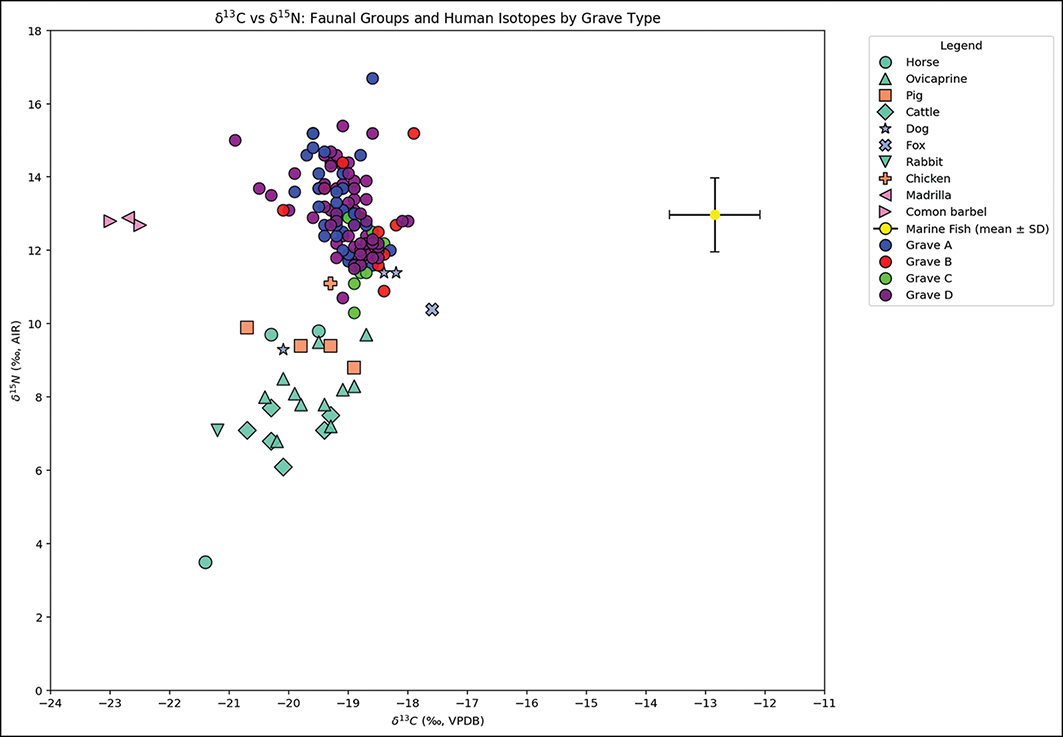
Overall, the faunal data reveal relatively elevated δ15N values, underscoring the importance of locally anchored baselines for interpreting human diet (Figure 3; OSM1 & 2, Table S2.3). Ovicaprines (sheep/goats) exhibit mean δ15N and δ13C values of 8.2‰ and −19.4‰, respectively, while values for cattle are lower (mean δ15N = 6.9‰, mean δ13C = −20.3‰). Horses present intermediate δ15N values (mean = 7.7‰) alongside variable δ13C. Dogs and foxes yield the highest δ15N values (mean around 10.7‰), consistent with carnivorous feeding behaviour.
Stable carbon and nitrogen isotopic values from faunal and human remains from Tudela (Navarre, Spain), with human individuals grouped by grave type. Faunal data derive from the present study as well as from published sources for Tauste (Guede et al. Reference Guede2017) and Santa María de Arlas (Pérez-Ramallo et al. Reference Pérez-Ramallo2023). Marine fish values, compiled from relevant Mediterranean and Atlantic datasets (Alexander et al. Reference Alexander2015; Llorente-Rodríguez et al. Reference Llorente-Rodríguez2022), are presented as a mean value ± one standard deviation (SD) (figure by authors).

Human samples were drawn from all grave types at Torre Monreal. Overall, δ15N values range from 10.3‰ to 16.7‰ (mean = 13.0‰; standard deviation (SD) = 1.1‰; interquartile range (IQR) = 1.5‰) and δ13C values range from −20.9‰ to −17.9‰ (mean = −19.0‰; SD = 0.5‰; IQR = 0.5‰) (Figure 3; OSM1 & 2, Table S2.1). Sex-based comparisons (two-sample t-tests) showed no significant differences in δ15N or δ13C between males and females in the overall dataset (p = 0.360 and p = 0.199, respectively) nor within grave types (all p > 0.1) (OSM2, Table S2.2). This indicates broadly comparable dietary access for males and females, with only limited variation in δ15N (approximately 1‰; OSM2, Table S2.1, Figures S2.1–S2.3). However, a significant difference in δ13C was observed in the older-adult age category, with females exhibiting more negative values than males (mean female δ13C = −19.3‰, mean male δ13C = −18.8‰, p = 0.029; OSM2, Tables S2.1 & S2.2). Together with lower δ15N in older females (mean of 13.1‰ compared with 14.1‰ for males), although this difference was not statistically significant (p = 0.233). Together, these patterns may be consistent with reduced access to δ15N-enriched protein sources and/or greater reliance on C3-based resources. Isotopic variation across age groups may be suggestive of life-course trends (Figure 4), though these do not reach statistical significance (see Table S2.2). Infants (0–3 years) display the highest δ15N (mean = 14.9‰), consistent with breastfeeding and the two-year period for complete nursing prescribed by Islamic law (Toso et al. Reference Toso2025). The δ15N values for all other groups range between 12.7‰ and 13.4‰ (Kruskal–Wallis p = 0.069) (Figure 4; OSM2, Tables S2.1 & S2.2, Figure S2.4).
Bone-collagen δ15N (top) and δ13C (bottom) values for the 120 individuals from Torre Monreal, Tudela, grouped by estimated age category. Boxes indicate the interquartile range, with the horizontal line indicating the median value; whiskers extend to values within 1.5 times the interquartile range, and points represent individual values. Age-at-death was estimated following Buikstra and Ubelaker (Reference Buikstra and Ubelaker1994): infant (0–3 years); child 1 (4–6 years); child 2 (7–12 years); adolescent (13–20 years); young adult (21–35 years); mature adult (36–50 years); older adult (>50 years); and indeterminate adult (>20 years) (figure by authors).

Isotopic values vary significantly between grave types (δ15N: Kruskal-Wallis p = 0.019; δ13C Kruskal-Wallis p < 0.001), indicating diachronic change. δ15N is highest in grave type A (late eleventh–twelfth centuries; mean = 13.3‰) and lowest in grave type C (thirteenth–early fourteenth centuries; mean = 11.8‰), with grave type D (fourteenth–fifteenth centuries; mean = 13.0‰) showing a subsequent increase; δ13C shows a broadly similar trend (A: −19.2‰; B/C: −18.8‰; D: −19.0‰) (Figures 3 & 5; OSM2, Table S2.1). Post hoc Dunn tests (Bonferroni-adjusted) identify significant δ15N contrasts between grave types A and B (p_adj = 0.004), grave types A and C (p_adj = 0.019) and grave types C and D (p_adj = 0.038), while δ13C differences are driven by the contrast between grave types A and C (p_adj = 0.026) (OSM2, Tables S2.1 & S2.2). Overall, the data support a decline in isotopic values from grave type A to C followed by a rebound in grave type D, consistent with changing access to δ15N-enriched protein sources through time. Although these differences reach statistical significance (p values of 0.05 or lower), uneven group sizes—particularly for grave type C (n = 8)—and overlapping individual values mean that these patterns are interpreted as shifts in group-level tendency rather than homogeneous dietary phases.
Bone-collagen δ15N (top) and δ13C (bottom) values for the 120 individuals from Torre Monreal, Tudela, grouped by grave type: A) late eleventh–twelfth centuries; B) mid-twelfth–mid-thirteenth centuries; C) thirteenth–early fourteenth centuries; D) fourteenth–fifteenth centuries. Boxes represent the interquartile range, horizontal bars show the median value and whiskers cover 1.5 times the interquartile range (figure by authors).

Comparison of bulk collagen values from the Tudela grave types with Tauste (eighth–tenth centuries CE) and Santa María de Arlas (fourteenth–fifteenth centuries CE) reveals a clear separation of the three settings: Tauste shows the highest mean δ15N (14.9‰) and Arlas the lowest (11.7‰), while the Tudela grave types occupy an intermediate but internally dynamic range (OSM2, Table S2.1). Inter-group differences are highly significant (Kruskal–Wallis: δ15N p < 0.001; δ13C p = 0.002), and post hoc tests confirm that Tauste differs from the other populations in δ15N (OSM2, Table S2.2).
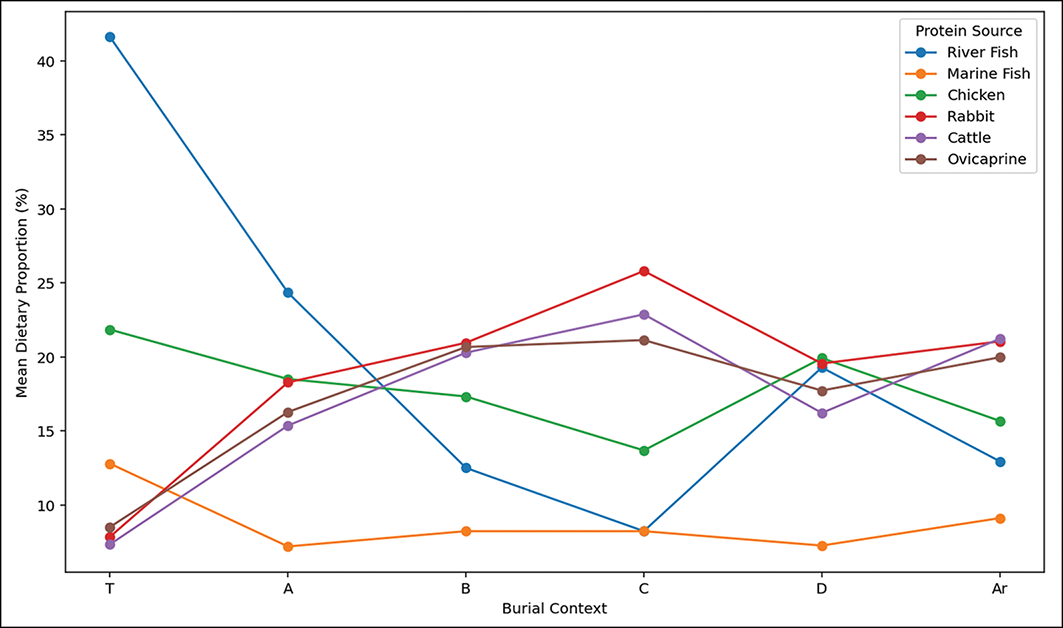
Within Tudela, simmr outputs broadly support the diachronic signal already visible in the isotope distributions. A higher relative contribution of freshwater resources is suggested in grave type A (around 25%), with a marked reduction by grave type C (11%) and a renewed increase in grave type D (19%), while marine resources are consistently minor contributors (less than 13%) and terrestrial resources remain important throughout (Figure 6; OSM2, Table S2.4, Figures S2.5–S2.16). The relatively high freshwater contribution at Tauste (42%) and relatively low freshwater contribution at Santa María de Arlas (13%) fit this general chronological trend (see Figure 6).
Mean dietary protein contributions estimated with simmr for each burial context across Tauste (eighth–tenth centuries), Torre Monreal: Tudela A) late eleventh–twelfth centuries; B) mid-twelfth–mid-thirteenth centuries; C) thirteenth–early fourteenth centuries; D) fourteenth–fifteenth centuries, and Santa María de Arlas (fourteenth–fifteenth centuries), illustrating the shifting balance of aquatic and terrestrial animal proteins across time and cultural settings (figure by authors).

Discussion
Food access under Christian rule
The isotope data from the Tudela grave-type sequence show that diet was not simply a matter of subsistence, but one of the everyday arenas through which a Muslim minority negotiated life under Christian rule. The isotopic results document a clear diachronic reorganisation of food access after the Christian conquest of 1119, followed by renewed reliance on flexible riverine and small-scale animal resources during the fourteenth-century crisis. The decline in isotopic values from grave type A to C (late eleventh–early fourteenth centuries CE) and the rebound in grave type D (fourteenth–fifteenth centuries CE) point to shifting access to δ15N-enriched protein sources, most plausibly involving freshwater foods (Figures 3 & 5; OSM2, Table S2.1). δ13C values vary more subtly across grave types (Figure 5), supporting a predominantly terrestrial baseline with possible low-level C4 inputs in some individuals contributing to less negative values, rather than a sustained marine signal. Rather than reading these changes as passive continuity or straightforward assimilation, we interpret them as evidence for changing access to food within a community whose provisioning was shaped by conquest, fiscal regulation, urban markets and environmental instability.
This interpretation necessarily remains cautious. Faunal data analysed in the present study and previously published for the nearby medieval sites of Tauste and Santa María de Arlas (Guede et al. Reference Guede2017; Pérez-Ramallo et al. Reference Pérez-Ramallo2023) indicate that the middle Ebro landscape is characterised by elevated δ15N baselines. This likely reflects multiple, non-mutually exclusive drivers, including manuring and other agrarian practices, local hydrology and soils, and potentially geological inputs (Guede et al. Reference Guede2017). For this reason, the aquatic component is interpreted cautiously, and primary emphasis is placed on diachronic patterning within the human isotope data rather than on absolute dietary percentages. Expanded faunal and environmental sampling is needed to further clarify baseline variation in the middle Ebro.
Riverine resources: permitted, but regulated
The decline in the potential freshwater fish component of diets between grave type A and grave types B and C does not necessarily imply the disappearance of fishing from Muslim life, but rather a change in the conditions under which riverine resources were accessed. Historical documentation indicates that, in 1127, Alfonso I (king of Aragon and Navarre from 1104–1134) confirmed access to the waters of the Ebro and other rivers for fishing, but reserved sturgeon (sollos) for the Crown (del Mar Agudo Romero Reference del Mar Agudo Romero2006). This suggests a hierarchy of aquatic access: common river fish may have remained available to all, while high-value species were drawn into royal and institutional control in favour of the Christian circuits of elite or majority consumption. Later documentation identifies specific fishing zones around Tudela, including areas on the Ebro, but does not clearly show the participation of Tudela’s Muslims in the lease or management of these zones (Alegría Suescun Reference Alegría Suescun2004). The isotopic decline in freshwater resources should therefore be read not as evidence that Mudejares stopped fishing, but as a sign that everyday access to riverine protein became increasingly mediated by royal rights, urban regulation and market channels.
This reading also clarifies why the results from Tudela do not simply replicate either of the two regional comparisons. The other two assemblages reflect different historical realities, and their isotopic patterns should therefore not be expected to match those observed at Tudela. Tauste, as an earlier Muslim riverside community, provides a useful contrast for a context in which riverine foods appear to have played a much stronger role, plausibly reflecting more direct household access to freshwater resources within an Islamic society, before the minority status and forms of Christian urban regulation documented in Tudela. Santa María de Arlas, by contrast, represents a late medieval Christian rural community where aquatic foods seem to have been shaped less by local river access or specific regulatory constraints affecting a Muslim minority community than by the circulation of preserved marine fish and Christian fasting practices. Tudela occupies a different position: it was neither an earlier Islamic riverside settlement nor a Christian rural community, but an urban Mudejar population whose access to freshwater fish was repeatedly renegotiated under Christian rule. The key change, therefore, was not a simple loss of ‘Islamic’ foodways, but a reorganisation of access within a Christian-ruled urban economy.
Urban provisioning and inter-religious food markets
The shift towards terrestrial protein should also be understood in the context of a regulated urban food economy. Navarrese historical evidence emphasises that Mudejares in Tudela formed a dense urban community, repeatedly visible in crafts, specialised occupations and commercial activity (Carrasco Pérez Reference Carrasco Pérez1986; Ozaki Reference Ozaki1986). The morería was not an isolated enclave, but an economically active space embedded within the wider town and this socioeconomic profile may have increased reliance on purchased foods and regulated supply chains rather than on primary production.
The evidence from butcheries is particularly revealing. Different religious prescriptions for animal slaughter meant that Muslim, Jewish and Christian butcheries were formally separated. Yet documentary evidence indicates that, in 1280, the Muslim and Jewish butcheries paid substantially more in tax than the Christian butcheries, a pattern interpreted as reflecting high sales volumes and the presence of Christian customers buying meat in the morería (García-Arenal & Leroy Reference García-Arenal and Leroy1984; Carrasco Pérez Reference Carrasco Pérez1986; Ozaki Reference Ozaki1986). Christians are even documented as paying fines for purchasing meat from Muslim butcheries, apparently to avoid municipal taxes in their own markets. This means that meat provisioning in Tudela operated at two interconnected levels: a wider urban market shared with the broader population, shaped by regional production and commercial practices, and a more specific Muslim provisioning circuit influenced by religious prescriptions, cultural preferences and communal organisation.
In this context, the rising contribution of terrestrial protein from grave type A to C may reflect not only household preference or ecological availability, but also the incorporation of Muslim food practices into a wider urban economy in which halal slaughter, taxation and inter-religious exchange intersected. Restrictions on the sale of live animals between Muslims and Christians show that religious difference structured provisioning, while documented exceptions, such as the sale of ten rams by Amet de Pedriz to Johan de Baronia in 1362, show that everyday practice could cross formal boundaries (Ozaki Reference Ozaki1986). The isotopic evidence therefore captures a community that was both constrained by minority status and economically entangled with the Christian town.
Terrestrial resources and adaptive household strategies
The simmr mixing model means are consistent with this broader reorganisation of provisioning. Terrestrial inputs, especially ovicaprines, cattle and rabbit, rise from grave type A to C, while chicken declines over the same interval, before both chicken and freshwater fish rebound in grave type D (Figure 6; OSM2, Table S2.4). Rather than implying straightforward economic improvement, these shifts are better understood as adaptive responses within an urban food system shaped by fiscal obligations, market access and household-scale provisioning. Rabbit may have offered a low-cost, halal and locally accessible alternative protein source, obtainable through small-scale practices and local exchange rather than through a single specialised market pathway (Morales Muñiz Reference Morales Muñiz2017).
Perhaps one of the most striking features of the Tudela sequence is the increasing contribution of cattle-derived protein between grave types A and C. This does not fit neatly with either a model of static Andalusian culinary continuity or a simple narrative of Christian assimilation. Instead, it points to local provisioning choices in the middle Ebro, where fiscal arrangements, market supply and possibly dairy consumption shaped the protein economy of Muslim households. The pattern also contrasts with the common emphasis on ovicaprines in many Al-Andalus and wider Islamic culinary traditions (Waines Reference Waines and Jayyusi1992; Huici Miranda & Marín Reference Huici Miranda and Marín2005), suggesting that food practice in Tudela was shaped less by fixed cultural preference than by local access and economic conditions.
This cattle signal should, however, be interpreted with caution. Contributions from meat and secondary products such as dairy cannot be distinguished in bone collagen, and the isotopic contributions attributed to cattle and ovicaprines may reflect a mixture of meat, milk, cheese or other animal products. This distinction matters because secondary products may have followed different fiscal and market pathways from meat. If milk, curd or cheese were subject to lighter fiscal obligations, part of the apparent increase in cattle-derived protein could reflect a shift towards dairy-based provisioning rather than increased beef consumption. A growing contribution of dairy products could also increase the apparent importance of cattle-derived protein without requiring a proportional rise in beef consumption. This complicates simple ‘meat versus fish’ narratives and reinforces the need to view food access as a flexible household strategy rather than as a direct ethnic or religious marker. Direct evaluation of this possibility would require tighter faunal, dairy-specific and environmental baselines.
Crisis-driven flexibility in the fourteenth century
The rebound in the contribution of freshwater fish and poultry in grave type D may reflect dietary flexibility during a period of recurrent crisis. The apparent long-term drift towards a more terrestrial protein base was disrupted in the fourteenth–fifteenth centuries, when river fish increased to 18.6±5.3% alongside a renewed contribution of chicken (Figure 6; OSM2, Table S2.4). Political instability, climatic deterioration and the Black Death pandemic precipitated wide-ranging economic impacts in this period, affecting labour, livestock, prices and market supply (Monteano Reference Monteano2001; Miller et al. Reference Miller2012). These disruptions may also have altered the bargaining position of minority communities. Labour shortages and fiscal pressure on the Crown and urban institutions could have created opportunities for Mudejar households to participate more actively in provisioning activities, including fishing, transport or market supply. Under these conditions, the renewed isotopic visibility of river fish and poultry may point to more flexible provisioning strategies, drawing on resources that were locally available, relatively accessible or easier to mobilise during periods of disruption.
The increased dietary contribution of river fish and chicken should therefore be interpreted as more than a simple return to earlier habits, suggesting instead that the community adjusted its protein economy by drawing on resources that could be accessed, exchanged or produced through different channels during periods of stress. Christian fasting and abstinence calendars may also have sustained regular demand for fish in the surrounding urban economy, helping to maintain supply networks for both fresh and preserved fish. In Tudela, this broader Christian demand should not be read as direct causation, but as part of the market environment in which Mudejar households accessed riverine resources. Likewise, poultry offered a low-investment household resource, made more attractive by the ability to rapidly reproduce, in post-plague economies marked by labour shortages and market disruption (Corbino et al. Reference Corbino2017). The grave-type-D rebound in freshwater fish may therefore reflect both substitution under crisis and changing opportunities to access or mediate riverine resources in a disrupted post-plague economy. This pattern is important because it shows resilience under constraint rather than simple impoverishment; minority households did not merely lose access to preferred foods, but repeatedly reorganised food practices around resources that remained available, licit and economically viable.
Shared vulnerability and internal difference
This community-level pattern of constrained resilience also helps contextualise intra-community variation. Burial groups were not internally homogeneous: individual isotope values overlap between chronological phases, and δ15N dispersion decreases from grave type A to C before widening slightly again in grave type D (Figure 5; OSM2, Table S2.1). This may indicate a narrowing of intra-community differences in access to enriched protein sources during the consolidation of Mudejar life. Rather than reflecting dietary uniformity, this pattern may point to the levelling effects of minority status, as relocation, fiscal regulation and the possible loss or weakening of Muslim elites brought households into a more constrained urban provisioning system. The results do not support a model of consistent male dietary privilege, as observed in some other Iberian Islamic contexts (Guede et al. Reference Guede2017; Jiménez-Brobeil et al. Reference Jiménez-Brobeil2021). Although male δ15N values are slightly higher on average, differences between the sexes are not statistically significant and the distributions overlap substantially (OSM2, Table S2.2). This suggests that access to protein was broadly shared or similarly constrained across much of the community.
Yet not all inequality was erased. Age-related differences are apparent among older individuals, especially females, consistent with historical evidence for the socioeconomic vulnerability of older Muslim women, particularly widows, in late medieval Iberia, who could be disadvantaged in inheritance and property transmission and reliant on household support or religious charity (Echevarría Arsuaga Reference Echevarría Arsuaga2017). The isotopic data may therefore capture the embodied consequences of both physiological ageing and gendered marginality within the minority community. In this sense, the Tudela data show that resilience was not evenly experienced: it operated at the level of the community but was lived differently depending on age and gender.
Interpretative scope and future directions
While the data presented here derive from a large sample and cover a broad chronological range their interpretation must remain attentive to several sources of uncertainty. Grave types A–D are treated as broad chronological phases rather than sharply bounded units, and group sizes are uneven. Individual isotope values also overlap between grave types, and each group contains internal variation, showing that dietary change was neither abrupt nor uniform. We therefore interpret the differences between grave types as shifts in group-level central tendencies and food-access patterns, not as discrete dietary populations. Faunal baselines are also still limited for key resources such as chicken, rabbit and freshwater fish, and middle Ebro δ15N enrichment complicates the estimation of aquatic inputs. Mixing models depend on user-defined source values that may not capture the full ecological or cultural breadth of medieval food webs.
Despite these limitations, the Tudela sequence provides a rare opportunity to examine how a Muslim minority community experienced Christian rule through everyday food access. The main pattern does not simply reflect dietary change, but the repeated reorganisation of provisioning under shifting political, fiscal, market and environmental conditions. Freshwater fish, terrestrial livestock, rabbit and poultry were not just food sources, they were resources whose availability was shaped by legal status, taxation, urban institutions and household strategies. In this sense, the data from Tudela show that minority status was lived not only through law, space and religious identity, but also through the daily negotiation of what could be obtained, prepared and consumed. Future work integrating additional faunal baselines, radiocarbon dates, dental isotopes, ancient DNA and comparative Christian and pre-conquest Muslim populations from Tudela and its hinterland will further refine these interpretations. Comparison with the earlier Andalusi Muslim population buried at Herrerías Street would also provide an important reference point for assessing the dietary consequences of relocation and the transition to Mudejar life after the Christian conquest.
Conclusions
This study shows that food access was one of the ways in which Tudela’s Muslim community experienced and negotiated life under Christian rule. Stable-isotope analysis, Bayesian dietary modelling and archaeological context together reveal a long-term reorganisation of diet from the late eleventh to the fifteenth centuries, wherein freshwater fish and poultry were more important around the time of the Christian conquest; terrestrial resources such as livestock and rabbit became more prominent during the consolidation of Mudejar life; and fish and poultry regained importance during the fourteenth–fifteenth centuries, a period marked by recurrent crises. Rather than indicating passive continuity or straightforward assimilation, this sequence reveals a community repeatedly adjusting its food practices to changing access, regulation, markets and environmental instability.
Torre Monreal therefore offers more than an unusually large isotope dataset: it provides a rare long-term view of how minority status was lived through everyday provisioning. Access to freshwater fish, terrestrial livestock, rabbit and poultry was shaped not only by ecology or preference, but also by royal rights, fiscal obligations, urban markets and household strategies. The narrowing of δ15N variability after the Christian conquest further suggests that minority status may have levelled some internal differences in protein access, even if inequalities persisted or re-emerged among older women. Although these interpretations remain necessarily cautious, the main pattern suggests marginality was not invisibility, but an active and embodied process of adaptation. Minority life under Christian rule was negotiated not only through law, space and religion, but also through the daily question of what could be obtained, prepared and consumed.
Acknowledgements
Patxi Pérez-Ramallo and Patrick Roberts thank the Max Planck Society for supporting and funding this research. Additional institutional support was provided by the Social History of Capitalism Research Group (SHOC) and the Archaeology, Environmental Changes & Geo-Chemistry Research Group (AMGC), Vrije Universiteit Brussel (VUB). The authors are especially grateful to the Comunidad Islámica de Navarra and the Unión de Comunidades Islámicas de España (UCIDE) for their endorsement and collaboration, which ensured that the research was conducted with full ethical consideration and respect for the cultural and religious significance of the Maqbara of Torre Monreal. The authors also extend their gratitude to Óscar Sola Torres, Jesús García Gozólaz, Javier Jiménez Gadea, Maitane Tirapu de Goñí and Aitor Pescador Medrano. Finally, the authors would like to thank the staff at Antiquity for their careful and constructive editorial assistance during the final preparation of the manuscript. ChatGPT (GPT-5.6 Sol; OpenAI) was used for minor language polishing and code troubleshooting; the final English was reviewed by a native speaker/co-author, and all analyses were designed, executed, and verified by the authors.
Funding statement
This project has been supported by grants to Patxi Pérez-Ramallo funded by the European Union-Next Generation EU (Margarita Salas Fellowship, Ministerio de Universidades, University of the Basque Country UPV/EHU) and the Barakat Foundation (G2025_A2_864_RamalloPatxi). Open access funding provided by Max Planck Society. The archaeological excavation and the general publication of the findings are being supported by the Directorate-General for Culture – Príncipe de Viana Institution of the Government of Navarre.
Online supplementary material (OSM)
To view supplementary material for this article, please visit https://doi.org/10.15184/aqy.2026.10449 and select the supplementary materials tab.
Author contributions: CRediT categories
Patxi Pérez-Ramallo: Conceptualization-Lead, Data curation-Lead, Formal analysis-Lead, Investigation-Lead, Methodology-Lead, Project administration-Lead, Software-Lead, Validation-Lead, Visualization-Lead, Writing - original draft-Lead. Jesús Sesma Sesma: Supervision-Equal, Writing - review & editing-Supporting. Olatz Villanueva Zubizarreta: Supervision-Supporting, Writing - review & editing-Supporting. Patrick Roberts: Supervision-Lead.






 Open access

