Introduction
While treatment of schizophrenia has focused on reduction of the clinical presence of positive symptoms, there has been increasing recognition of the importance of patients’ subjective experiences of illness as an important therapeutic target and key predictor of outcome (Karow et al. Reference Karow, Czekalla, Dittmann, Schacht, Wagner, Lambert, Schimmelmann and Naber2007). Approximately one-third of patients with schizophrenia treated with antipsychotic medication experience dysphoria (Voruganti et al. Reference Voruganti, Slomka, Zabel, Costa, So, Mattar and Awad2001), which can influence clinical and functional outcome and compliance (Naber et al. Reference Naber, Karow and Lambert2005). Patients’ subjective well-being (SW) can be measured with the Subjective Well-Being Under Neuroleptic Treatment Scale (SWN; Naber, Reference Naber1995), which assesses patients’ psychological and emotional state and can be differentiated from other related constructs such as depression and anhedonia. SW is a multidimensional construct that measures patients’ perceptions of social integration, self-control, emotional-regulation, mental and physical functioning. It is also a distinct outcome measure in schizophrenia (Lambert & Naber, Reference Lambert and Naber2004) and is a central predictor of medication compliance (Karow et al. Reference Karow, Czekalla, Dittmann, Schacht, Wagner, Lambert, Schimmelmann and Naber2007); however, the neural basis of poor SW remains unclear.
Subjective experience is intricately linked to dopaminergic functioning and reward processing. Alterations in dopaminergic tone manifest negative changes in subjective experience, such as increased dysphoria, and lower SW following consumption of antipsychotics (Voruganti & Awad, Reference Voruganti and Awad2004), the administration of which depletes dopaminergic transmission (de Haan et al. Reference de Haan, Lavalaye, Linszen, Dingemans and Booij2000). Accordingly, SW is generally higher in patients treated with atypical rather than typical antipsychotics despite similar efficacy in reducing positive symptoms (Naber et al. Reference Naber, Moritz, Lambert, Pajonk, Holzbach, Mass and Andresen2001; Karow & Naber, Reference Karow and Naber2002), probably because these compounds produce lower striatal D2 receptor blockade. The level of ventral striatal (VS) dopamine receptor binding is associated with SW in medicated patients with schizophrenia (Mizrahi et al. Reference Mizrahi, Rusjan, Agid, Graff, Mamo, Zipursky and Kapur2007). The ventral striatum is central to reward processing, and it has been widely shown that activation in the ventral striatum is elevated during reward anticipation (e.g. Schott et al. Reference Schott, Minuzzi, Krebs, Elmenhorst, Lang, Winz, Seidenbecher, Coenen, Heinze, Zilles, Düzel and Bauer2008). The VS signal reflects dopamine activity (Knutson & Gibbs, Reference Knutson and Gibbs2007) and this signal has been shown to be absent in healthy participants following dopamine depletion with alpha-methyl-para-tyrosine (AMPT; da Silva Alves et al. Reference da Silva Alves, Schmitz, Figee, Abeling, Hasler, van der Meer, Nederveen, de Haan, Linszen and van Amelsvoort2010).
This evidence then suggests that the relationship between SW and altered dopaminergic function may be underpinned by a central role of dopamine in reward-based learning. In this way, the antipsychotic olanzapine (a dopamine antagonist), which reduces reward-related brain activation in the reward network (Abler et al. Reference Abler, Erk and Walter2007), interferes with neural activation in reward areas during reward processing and reduces subjective experience in healthy participants after only a single dose (Schlagenhauf et al. Reference Schlagenhauf, Juckel, Koslowski, Kahnt, Knutson, Dembler, Kienast, Gallinat, Wrase and Heinz2007). Reduced anticipation of reward in schizophrenia is also associated with anhedonia (Gard et al. Reference Gard, Kring, Gard, Horan and Green2007). Dysfunction of the reward network in patients with schizophrenia will, therefore, negatively impact processing of, and motivation towards, environmental reward cues, which we propose forms the mechanism for low SW in schizophrenia.
SW has, however, been shown to improve with the antipsychotic aripiprazole despite high striatal D2 receptor blockade (Mizrahi et al. Reference Mizrahi, Mamo, Rusjan, Graff, Houle and Kapur2009) and strong correlations between SW and D2 receptor binding in cortical brain regions have been reported (Mizrahi et al. Reference Mizrahi, Rusjan, Agid, Graff, Mamo, Zipursky and Kapur2007). These findings suggest that SW is not just a function of striatal D2 receptor binding but may be related to functioning of extrastriatal brain regions. Consequently, in this study we aimed to investigate the neural correlates of SW in schizophrenia using functional magnetic resonance imaging (fMRI), specifically the relationship between SW and activation of the reward network in response to rewarding stimuli but also across the whole brain to investigate extrastriatal neural correlates. We hypothesized that, in schizophrenia patients, lower SW would be associated with attenuated reward-related activation in regions of the reward network and this would be confirmed by region of interest (ROI) analyses of these regions. In addition, SW-related changes in activation in these regions would be greater in the anticipatory phase than the outcome phase. Vothknecht et al. (Reference Vothknecht, Meijer, Zwinderman, Kikkert, Dekker, van Beveren, Schoevers and de Haan2012) suggested that the SWN, despite being designed for use in schizophrenia, may be valid in healthy volunteers; hence we carried out a subsequent exploratory analysis investigating whether there was a similar relationship between SW and brain activity in healthy participants.
Method
Design
Patients with schizophrenia and healthy control participants underwent fMRI during a modified Monetary Incentive Delay (MID) reward task (see Knutson et al. Reference Knutson, Adams, Fong and Hommer2001). Behavioural data were analysed to establish the degree to which performance and ratings of outcome were related to SW. The fMRI data were analysed to examine (a) brain activation during the anticipatory and consummatory phases of the reward task per se in patients and healthy participants; and (b) brain activity within areas of the reward network that correlated with SW scores using ROI analyses. Whole-brain analyses were also conducted to reveal areas of the brain other than reward regions that correlated with SW.
Participants
Twenty male dextral patients with a DSM-IV diagnosis of schizophrenia and 12 healthy participants took part. Patients were on average 36.5 years old (s.d. = 6.9) and had an average National Adult Reading Test-2 (NART-2; Nelson & Willison, Reference Nelson and Willison1991) IQ score of 101.6 (s.d. = 11.6). Healthy participants had a mean age of 30.7 years (s.d. = 7.3) and an IQ of 106.4 (s.d. = 9.2); thus patients were on average 5 years older than controls but neither IQ scores nor ages were significantly different.
Patients were moderately symptomatic [Positive And Negative Syndrome Scale (PANSS; Kay et al. Reference Kay, Fiszbein and Opler1987) mean total score = 57.5 (s.d. = 15.2); subscale mean (s.d.) score: positive scale = 15.8 (7.3), negative scale = 13.7 (5.6) and general scale = 28.1 (6.3)] and had low extrapyramidal side-effects [Simpson–Angus Scale (SAS; Simpson & Angus, Reference Simpson and Angus1970) mean score = 4.54 (s.d. = 3.2), Extrapyramidal Symptom Rating Scale (ESRS; Chouinard et al. Reference Chouinard, Ross-Chouinard, Annable and Jones1980) mean score = 2.14 (s.d. = 2.6) and Barnes Akathisia Rating Scale (BARS; Barnes, Reference Barnes1989) mean score = 1.33 (s.d. = 3.2, median = 0.0)]. None of the 20 patients had Parkinsonism.
Six patients received olanzapine (7.5–25 mg), four risperidone (2–6 mg; one patient: 37.5 mg/14 days of Risperidal Consta), two zuclopenthixol (400 mg), two clozapine (50–300 mg), one flupentixol (30 mg/14 days), two quetiapine (100/300 mg), one aripiprazole (20 mg), one combination of chlorpromazine (CPZ; 100 mg) and sulpride (600 mg) and one was unmedicated (mean CPZ-equivalent dose = 229.5 mg, s.d. = 145.72, range 75–600). After complete description of the study to the subjects, written informed consent was obtained. Ethical approval was provided by Camden and Islington Community Local Research Ethics Committee (ref.: 08/H0722/22).
Measures
All participants completed the short version of the SWN (Naber, Reference Naber1995), which has 20 items measured on a seven-point Likert scale. This scale provides an SW score out of 120 points and quantifies judgements on five factors: emotional regulation, mental functioning, physical functioning, self-control and social integration. The SWN is best interpreted as a total score (Vothknecht et al. Reference Vothknecht, Meijer, Zwinderman, Kikkert, Dekker, van Beveren, Schoevers and de Haan2012), as used here. The patients also completed the Beck Depression Inventory-2 (BDI-2; Beck et al. Reference Beck, Steer, Ball and Ranieri1996), and the SAS, ESRS and BARS as measures of medication side-effects.
fMRI procedure
Subjects completed a version of the MID task (Knutson et al. Reference Knutson, Adams, Fong and Hommer2001) in which visual cues predict potential outcome and performance (the reaction time of a button press to a target) determines reward outcome. The two phases examined in the study were the anticipatory phase (after cue presentation) and an outcome phase (trial outcome). All participants were trained before the scanning session to preclude measuring learning mechanisms. Each 18.5-s trial consisted of cue presentation (duration 2–8 s), followed by presentation of a brief ‘target’ square (initially 250 ms, then adjusted by the algorithm). Then, after a delay of 2–8 s, the outcome of the trial was displayed for 2–8 s.
There were five cue types: large win, small win, small loss, large loss and neutral (no financial reward or punishment). Each of three fMRI runs (Fig. 1) consisted of 24 trials each of high reward (HR; £5), low reward (LR; £0.5), small loss (SL −£0.5) and large loss (LL; −£5) trials and 48 control trials (where there was no potential for gain or loss), giving a total of 144 trials. Hitting the target that appears after the cue (button press reaction time within the target window) results in a positive outcome: financial gain in the ‘win’ trials and prevention of loss in the ‘lose’ trials. Missing the target (reacting too slowly) results in negative outcome: no gain in the ‘win’ trials and a loss in the ‘lose’ trials. An algorithm shifts the target reaction time window such that the participant ‘hits’ in 66% of trials and ‘misses’ in 34% of trials, ensuring sufficient data for ‘hit’ and ‘miss’ trials irrespective of relative absolute performance. Each of three runs lasted 14 m 48 s, producing a total scan time of 44 m 24 s.
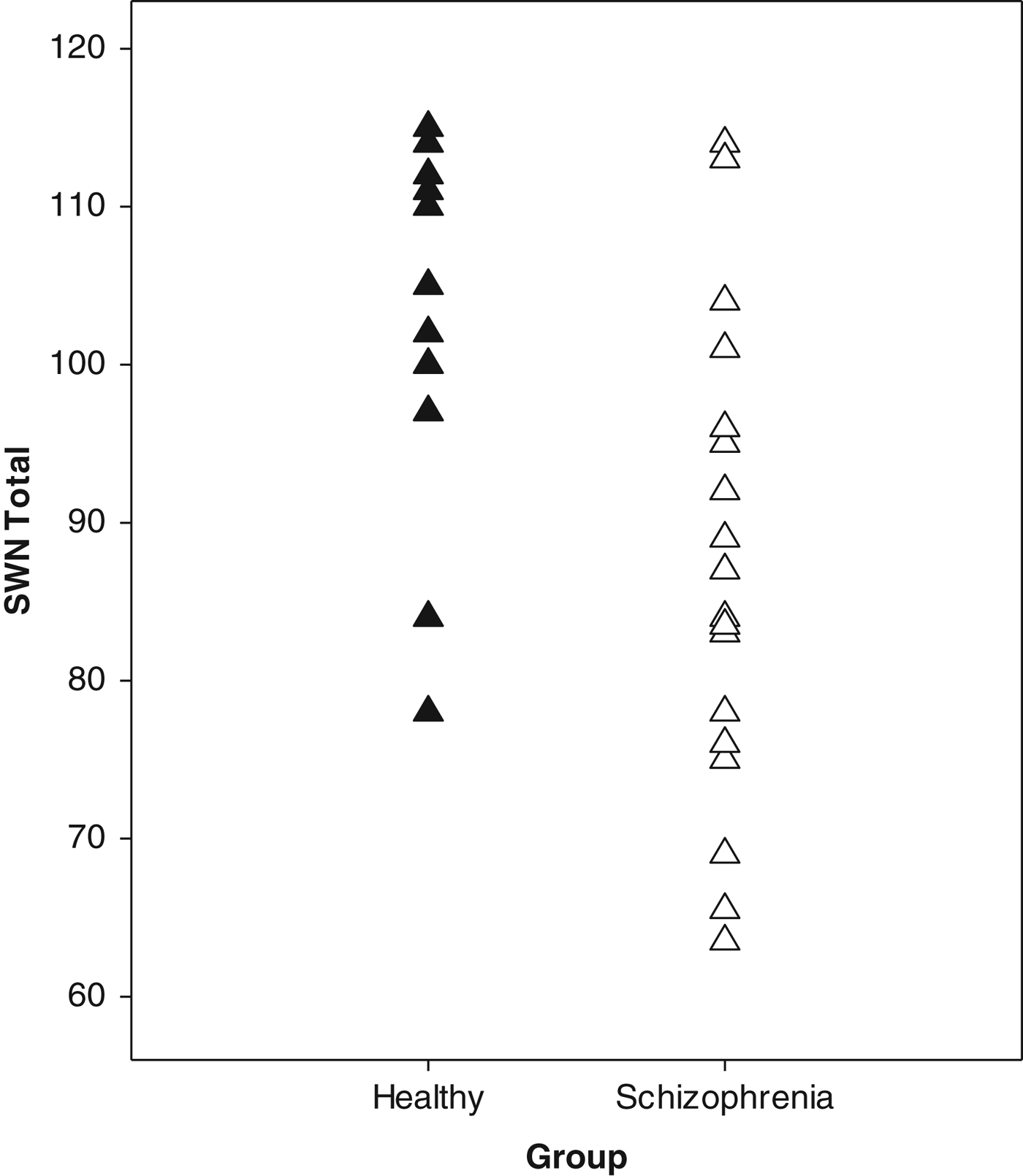
Distribution of subjective well-being (SW) scores on the Subjective Well-Being Under Neuroleptic Treatment Scale (SWN) for the healthy control (n = 12) and patient (n = 20) groups.

Participants then rated their satisfaction at the outcome on a nine-point Likert visual analogue scale (VAS) from ‘not satisfied’ to ‘very satisfied’ (duration 3 s). This was included to ensure that patients exhibited a range of subjective valences that reflected reward outcome differences to demonstrate that the task elicited subjectively rewarding responses. There was a final 0.5-s ‘fixation cross’. All money won and lost by the participant was representational; however, to ensure motivation, and anticipation and outcome effects, payment to participants was proportional to their game profits (between £15 and £25).
Scanning parameters
A total of 448 gradient-echo echo-planar blood oxygen level-dependent (BOLD) images [repetition time (TR)/echo time (TE) = 2000/25 ms, flip angle = 75°, matrix = 64 × 64, field of view (FOV) = 220] were acquired on a 3-T GE Excite II MR scanner (GE Healthcare, USA) during each run of the task. Each whole-brain image contained 38 non-contiguous slices of 2.4-mm thickness separated by a distance of 1 mm and an in-plane isotropic voxel resolution of 3.4 mm.
Analysis
Behavioural data analysis
Mean consummatory VAS scores of post-outcome satisfaction for each cue type and target response (hit and miss) were calculated. A repeated-measures ANOVA was conducted to reveal effects of valence (positive or negative outcome), magnitude of outcome, target response and group on VAS scores. Between-group ANOVAs of total money accrued by participants were conducted. Further correlation analyses were conducted to determine the relationship between VAS scores and SW and to examine the relationship between CPZ-equivalent dose and outcomes scores in the patients.
fMRI data processing and analysis
fMRI data were preprocessed and analysed using SPM5 (Statistical Parametric Mapping, Wellcome Department of Imaging Neuroscience, University of London, UK). Data were realigned across sessions to the first image of the first series, normalized to a standard-brain template and smoothed using an 8-mm full-width at half-maximum (FWHM) Gaussian kernel. Analyses were conducted in the context of the general linear model (GLM; Friston et al. Reference Friston, Fletcher, Josephs, Holmes, Rugg and Turner1998) to determine: (i) brain regions associated with reward processing (anticipation and outcome) to reveal any abnormalities in reward processing in the patient group in the first instance; (ii) whether ROI analyses of the reward network would reveal that SW in the patient group was associated with reward-related BOLD response in the reward network and whether whole-brain analyses would reveal whether activity in other, non-reward network areas correlated with SW; and (iii) whether the healthy participants showed a similar pattern.
Reward-related activations
First-level event-related GLMs were constructed for each participant. GLMs included a regressor predicting the BOLD response to each of two phases (anticipation/outcome), five cue types (high reward/low reward/control trials/low loss/high loss) by outcomes (win/lose) convolving a vector of delta functions for the onset of the stimuli for that condition with the canonical haemodynamic response function. Effects of head motion were minimized by the inclusion of six realignment parameter vectors as regressors of no interest. These first-level contrast images were entered into a second-level, random-effects 2 × 5 × 2 full-factorial analysis. The main effects of anticipation and outcome were then established [p < 0.05, family-wise error (FWE)-corrected] for the two groups to confirm that the task elicited reward-related activity; and group × reward interaction effects were investigated at p < 0.05 FWE-corrected to reveal any group differences. Montreal Neurological Institute (MNI) coordinates were converted to Talairach space using mni2tal (Brett; http://imaging.mrc-cbu.cam.ac.uk/imaging/MniTalairach).
SW analysis
For the patient group the principal covariate of interest, total SW score, was included in a full-factorial model to identify brain regions where activity correlated with SW scores. ROIs were chosen from four key a priori regions based on previous publications: the anterior cingulate cortex (ACC), cingulate gyrus, ventral striatum and caudate nuclei regions (see Haber & Knutson, Reference Haber and Knutson2010). The ventral striatum mask was taken from Mawlawi et al. (Reference Mawlawi, Martinez, Slifstein, Broft, Chatterjee, Hwang, Huang, Simpson, Ngo, Van Heertum and Laruelle2001), the remainder from Pickatlas software (Maldjian et al. Reference Maldjian, Laurienti, Kraft and Burdette2003). As multiple ROIs were being investigated, the significance level (α) for assessing effects from the ROI analysis was Bonferroni corrected to p < 0.0125 (FWE-corrected). Separate and combined analyses were conducted for the anticipation and outcome phases. A final whole-brain analysis was also performed to examine areas outside the reward network that correlated with SW. The significance threshold for the whole-brain analyses was set at p < 0.05 (FWE-corrected). These analyses were also conducted in an exploratory fashion in the healthy participants.
Ethical standards
All procedures contributing to this work comply with the ethical standards of the relevant national and institutional committees on human experimentation and with the Helsinki Declaration of 1975, as revised in 2008.
Results
SW
The patients (mean SWN score = 87.1, s.d. = 14.1) showed significantly lower SW than the healthy volunteers (mean SWN score = 100.5, s.d. = 13.6, p < 0.01). Figure 1 shows the distribution of SWN scores for the two groups. The patients showed mild levels of depression (mean BDI score = 11.8, s.d. = 9.2) that were significantly greater than those of the healthy controls (mean BDI score = 4.4, s.d. = 4.3, p < 0.01)]. SWN and BDI scores correlated significantly (r = − 0.7, p < 0.005).
Behavioural data
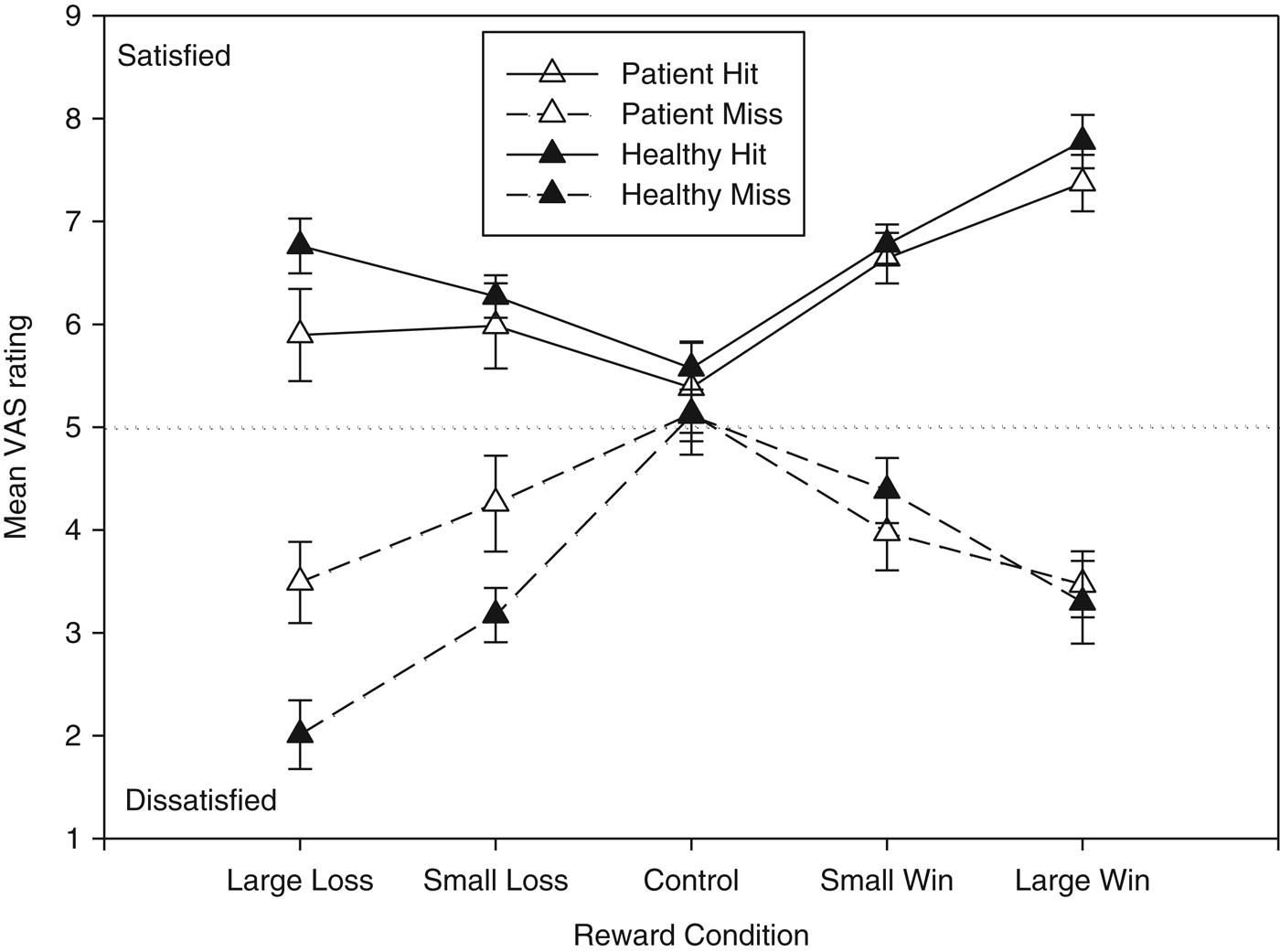
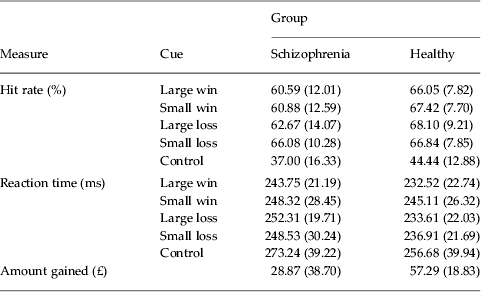
As expected, hit outcomes rated on the VAS were judged more satisfying than miss outcomes (F 1,31 = 109.4, p < 0.001), rewarding trials more satisfying that loss trials (F 1,31 = 39.30, p < 0.001) and larger rewards more satisfying than smaller rewards (F 1,31 = 8.55, p < 0.01). There were no group effects of hit rates or reaction times (Table 1). There was also no main effect of group on VAS scores with respect to either outcome or magnitude of reward. There was a modest difference on VAS scores between the groups with respect to trial valence (F 1,31 = 5.51, p < 0.05). Patients were less dissatisfied at missing an opportunity to avoid a loss than were controls (Fig. 2): this was evident as a trend for small losses and as a statistically significant effect for large losses (t 1,31 = 2.65, p < 0.05). Healthy participants (mean = 57.29, s.d. = 18.83) gained significantly more money than the patients (mean = 28.87, s.d. = 38.70, t 1,31 = 2.37, p = 0.024). The CPZ-equivalent dose did not correlate with VAS or hit rate performance measures but did correlate with mean reaction time (r = 0.48, p = 0.032).
Patient (n = 20) and healthy control (n = 12) subjective visual analogue scale (VAS) scores for each condition outcome, as rated after reward outcome.

Mean (s.d.) group hit rate and reaction times for each salient cue type and total amount gained

s.d., Standard deviation.
SW and VAS scores in the patient group
There were no significant correlations between average absolute hit or miss VAS scores, or VAS scores subtracting control trial VAS scores, with SWN scores in any condition. Neither the mean nor the condition-specific reaction times correlated with SW (all p > 0.05).
fMRI
Reward anticipation
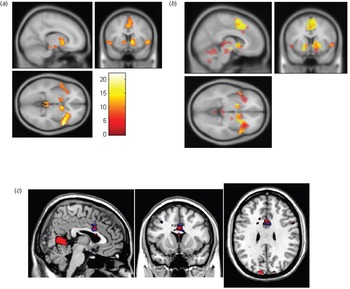
Reward anticipation for all participants was associated with activity in several clusters covering the bilateral inferior frontal and superior temporal gyri, insula and ventral striatum, in addition to the medial frontal and cingulate gyri, left pre- and postcentral gyri, thalamic medial dorsal nuclei, right parahippocampal gyrus and left and right brainstem (Fig. 3 a, p < 0.05, FWE-corrected; Fig. 3 b shows separate overlaid group maps). There were no voxels showing a significant group × reward interaction, even with a liberal threshold (p < 0.001, uncorrected) indicating no significant between-groups differences in brain region activation involved in reward anticipation.
(a) Activity related to anticipation of reward in all participants [p < 0.05, family-wise error (FWE)-corrected]. (b) Activation maps of common regions of activation for the two groups overlaid (threshold of p < 0.001 for illustration; yellow = healthy, red = schizophrenia). (c) The unique overlap of the SW-related anterior cingulate cortex (ACC) activation during anticipation (blue) and outcome (red) in the schizophrenia group. As shown, there is a clearly defined overlap at Talairach coordinates 2, 11, 27.

Reward outcome
There was a significant main effect (p < 0.05, FWE-corrected) of reward at outcome in the right inferior parietal lobule, right middle and inferior frontal gyri, bilateral thalamus and cerebellum/declive, and a small region within the right superior temporal gyrus. There was no group × condition interaction, even with a liberal threshold (p < 0.001), indicating that the patients and healthy participants were not significantly different in terms of the brain regions involved in processing reward outcome.
SW in schizophrenia
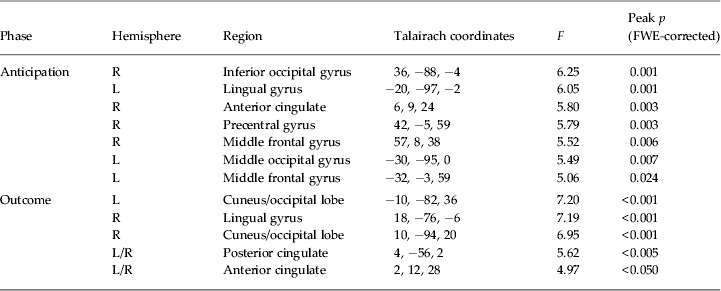
Within the patient group a single model incorporating both anticipation and outcome phases of the task revealed that SW was related to activation within the ACC in both ROI (p < 0.0125, FWE-corrected) and whole-brain analyses (p < 0.05, FWE-corrected; see conjunction image in Fig. 3 c). The relationship between brain activation and SW across phases was unique to the ACC and was not seen in any other brain region. This relationship was robust across phases of reward anticipation as shown by separate analyses of these phases.
Anticipation and SW
Several cortical areas were significantly associated with SW (p < 0.05, FWE-corrected), including the ACC (ROI level, p < 0.01, FWE-corrected; whole-brain analysis, all peak voxels p < 0.05, FWE-corrected; Table 2). In the whole-brain analyses significant associations were also apparent within the occipital lobe and bilateral middle frontal gyri.
Peak voxels and p values (p < 0.05, FWE-corrected) that held a significant association with the SW covariate during anticipation and outcome

FWE, Family-wise error, SW, subjective well-being; R, right; L, left.
Outcome and SW
ROI analyses revealed a significant associated with ACC activation (p < 0.01, FWE-corrected) but not cingulate gyrus, caudate or ventral striatum masks. In the whole-brain analysis, several regions were significantly associated with SW in the outcome phase (p < 0.05, FWE-corrected), including the ACC and the posterior cingulate (negatively, peak voxel p < 0.01, FWE-corrected). As these additional regions activated were not hypothesized, we list them in Table 2 but do not venture a further interpretation at this time. Subsequent post-hoc analysis showed that the β coefficients for the association of SW with miss outcomes were significantly greater than for hit trials (F 1,9 = 5.99, p < 0.05). To discount the possibility that reaction times to stimuli may impact on BOLD response in this study, a final analysis was conducted and showed that reaction times did not correlate with activity in the ACC region associated with SW scores. In addition, to show that the reward and SW effects are not confounded by medication, a further post-hoc analysis demonstrated that neither reward-related activity nor activity in regions that showed an association with SW were associated with CPZ-equivalent dose (p < 0.001, uncorrected). There was ample variation in CPZ-equivalent dose for a relationship to be detected had one been present.
Mood and reward processing
A final post-hoc analysis was conducted to investigate the relationship between mood (as measured by the BDI) and reward-related activation in the patient group to determine the specificity of SW to dACC activation. The SW vector was replaced by the BDI vector and the analyses were rerun. No regions within the ROIs correlated significantly with BDI score during the anticipation phase; however, during the outcome phase the dACC was significantly correlated with neural activation as shown by both ROI and whole-brain analyses (p < 0.05, FWE-corrected; locus at 2, 12, 26).
Healthy participants and SW
In healthy participants there were no significant associations with SW either in the whole-brain analysis in, or near, the dACC region, or in the ROI analyses. Between-group analyses confirmed that the relationship between SW and activity in the dACC was significantly greater in patients than in healthy participants (p < 0.0001).
Discussion
This study examined the neural correlates of SW in schizophrenia using an MID reward paradigm to test the hypothesis that reward network activity is associated with SW. As anticipated, the level of SW was significantly lower overall in the patients compared to the healthy controls. Reward-related neural activity in both groups during anticipation of reward was consistent with that seen in previous studies and involved the insula, ventral striatal and supplementary motor/motor area activity. Both healthy participants and patients demonstrated good discrimination of reward outcome as shown by VAS ratings, supporting the fact that cues and outcomes were rewarding in nature.
As expected, VS activity represented anticipation to rewarding stimuli, consistent with other studies (e.g. Knutson et al. Reference Knutson, Adams, Fong and Hommer2001), yet there were no significant differences in VS activity (whole-brain or ROI) between the patients and healthy volunteers. Previous studies have shown that patients treated with the newer atypical antipsychotics at appropriate doses show ‘normalized’ VS reward-related activity relative to healthy participants (Juckel et al. Reference Juckel, Schlagenhauf, Koslowski, Filonov, Wustenberg, Villringer, Knutson, Kienast, Gallinat, Wrase and Heinz2006; Schlagenhauf et al. Reference Schlagenhauf, Juckel, Koslowski, Kahnt, Knutson, Dembler, Kienast, Gallinat, Wrase and Heinz2007; Abler et al. Reference Abler, Kammerer, Frasch, Spitzer and Walter2008), potentially reflecting a putative normalizing effect of these medications on dopaminergic transmission.
We anticipated that activation of the reward network would underpin SW scores. In line with this, a dorsal region of the ACC was significantly associated with SW scores; however, contrary to expectation this was observed in both the anticipation and outcome phases rather than the anticipation period alone. The dACC has been linked to a range of cognitive processes, such as attention, cognitive control, conflict monitoring, response inhibition, self-reflection and set-switching capacity, and is also involved in the modulation of reward processing through its widespread projections to affective, cognitive and motor cortical areas (see Haber & Knutson, Reference Haber and Knutson2010). Critchley et al. (Reference Critchley, Mathias and Dolan2001) reported that a distinct region of the anterior cingulate (slightly more anterior than the locus reported here) was commonly activated by both uncertainty and arousal in a reward task, suggesting that the dACC represents both expected reward and motivation. Considerable evidence shows that the ACC is active during reward anticipation (e.g. Kirsch et al. Reference Kirsch, Schienle, Stark, Sammer, Blecker, Walter, Ott, Burkart and Vaitl2003; Knutson et al. Reference Knutson, Bhanji, Cooney, Atlas and Gotlib2008) and single-cell neurons in the dACC in humans have been shown to ‘code’ reward properties while dACC ablation disrupts reward-related behavioural adjustment (Williams et al. Reference Williams, Bush, Rauch, Cosgrove and Eskandar2004). The dACC thus plays a key role in forming associations between reward and appropriate action (Haber & Knutson, Reference Haber and Knutson2010). As activity in this region is associated with SW in both the anticipatory and outcome phases, it suggests that dACC may represent the motivational significance of current actions or cognitions (Ochsner et al. Reference Ochsner, Kosslyn, Cosgrove, Cassem, Price, Nierenberg and Rauch2001) and integrate rewarding environmental cues, behaviour and outcome.
Absent dACC activation has been reported in patients with schizophrenia during anticipation of reward (Quintana et al. Reference Quintana, Wong, Ortiz-Portillo, Marder and Mazziotta2004; Abler et al. Reference Abler, Kammerer, Frasch, Spitzer and Walter2008), and the effects of olanzapine in healthy participants reported by Abler et al. (Reference Abler, Erk and Walter2007) extend to include dorsal anterior cingulate activity (proximally located to the peak voxel that correlated with SW in this study), which was one of three regions, including the ventral striatum, reduced by olanzapine compared to placebo during reward-related processing. Healthy volunteers also show reduced anterior cingulate activity after AMPT-related dopamine depletion (da Silva Alves et al. Reference da Silva Alves, Schmitz, Figee, Abeling, Hasler, van der Meer, Nederveen, de Haan, Linszen and van Amelsvoort2010). Hence, these compounds, which act to reduce dopaminergic transmission, also reduce reward-related dorsal anterior cingulate activity.
ACC activity has also been linked with depression (Bench et al. Reference Bench, Friston, Brown, Scott, Frackowiak and Dolan1992) and more rostrally and ventrally with anhedonia in healthy participants (Keedwell et al. Reference Keedwell, Andrew, Williams, Brammer and Phillips2005; Harvey et al. Reference Harvey, Pruessner, Czechowska and Lepage2007). Patients with major depression have been shown to differ from healthy subjects in the relationship between valence of reward anticipation and ACC but not nucleus accumbens activity (Knutson et al. Reference Knutson, Bhanji, Cooney, Atlas and Gotlib2008); and those who respond clinically to antidepressant medication show increases in ACC D2 receptor binding that is greater than increases in VS binding (Larisch et al. Reference Larisch, Klimke, Vosberg, Loffler, Gaebel and Muller-Gartner1997). Hence, together there may be a strong link between ACC functioning and a broader sense of well-being.
The strong relationship between SW and dACC activation was not seen in the exploratory analysis in the healthy participants. In healthy individuals, although acute AMPT reduces reward-network activation, it had no significant effect on SWN scores (da Silva Alves et al. Reference da Silva Alves, Schmitz, Figee, Abeling, Hasler, van der Meer, Nederveen, de Haan, Linszen and van Amelsvoort2010) despite effects on dACC and striatal activation. The specificity of this association to patients may be attributable to the gross differences in dopaminergic reward system functioning in schizophrenia relative to healthy people per se, or alternatively or additionally through the further impact that antipsychotic medication has on these systems. It may also be the case that the scale is more ecologically valid in patient groups, following neuroleptic administration, the sequelae of which the scale has been designed to measure, or, with respect to the lack of association between dopamine changes and SW reported by da Silva Alves et al. (Reference da Silva Alves, Schmitz, Figee, Abeling, Hasler, van der Meer, Nederveen, de Haan, Linszen and van Amelsvoort2010), that the scale is not sensitive to drug effects over a short period of time. The sample size in the healthy group was also small, which may account for lack of positive association, and the SWN item questions are of a more general nature rather than would relate to acute and short-term ‘state’ effects. Further resolution of this discrepancy is beyond the scope of this paper, but future research should extend examination of the neural correlates of SW in the healthy population and in a larger group.
It was proposed that SW must have a dopaminergic foundation to account for the relationship between reduced SW and antipsychotic medication. Although there is no direct evidence linking the two in the present study, there is support for an effect of antipsychotic action on ACC function. Antipsychotic medication is associated with reduced ACC regional cerebral blood flow (rCBF) in patients with schizophrenia (Miller et al. Reference Miller, Andreasen, O'Leary, Rezai, Watkins, Ponto and Hichwa1997), whereas impaired activation in a similar dACC location in schizophrenia patients can be restored with administration of the D1/2 agonist apomorphine (Dolan et al. Reference Dolan, Fletcher, Frith, Friston, Frackowiak and Grasby1995), demonstrating that there is a significant neuromodulatory effect of dopamine on ACC functioning. Although, without data on receptor occupancy, it is not possible in the context of this study to report conclusively that low SW leads to attenuated engagement of the ACC in reward processing, the data suggest an association that warrants further investigation.
An association between estimated dopamine D2R occupancy (‘fitting’ medication dose to dopamine receptor occupancy data) and positive and negative affect in schizophrenia has been reported by Lataster et al. (Reference Lataster, van Os, de Haan, Thewissen, Bak, Lataster, Lardinois, Delespaul and Myin-Germeys2010) using a daily experiential sampling method. Greater estimates of receptor occupancy were associated with a worsening of feelings of positive and negative affect, supporting the link between dopamine and subjective experience and adding ecological validity to the present and other studies that investigated subjective experience using more general, ‘offline’ questionnaires.
We did not find the anticipated correlation between SW and VS activation based on earlier data linking antipsychotic medication with impairments in VS functioning. This may be due to the VS response to reward in the patient group being unimpaired. As patients had lower SW scores but unimpaired VS activity, this implicitly suggests that VS functioning does not underpin SW. Elsewhere, Mizrahi et al. (Reference Mizrahi, Mamo, Rusjan, Graff, Houle and Kapur2009) reported an association between VS dopamine D2 receptor blockade and SW but only in patients receiving conventional antipsychotics, and not those receiving aripiprazole. In patients taking aripiprazole, there was a wide range of SW scores (including low scores), at the same time as homogeneously high VS D2 receptor blockade across the group, again suggesting that SW is not simply reducible to VS D2 receptor blockade. Using positron emission tomography (PET), Mizrahi et al. (Reference Mizrahi, Rusjan, Agid, Graff, Mamo, Zipursky and Kapur2007) showed that temporal cortex D2 receptor blockade was more strongly associated with SW than striatal blockade, again indicating that the link between striatal function and SW is not encapsulated. Lastly, studies that find associations between SW and VS activity (e.g. Mizrahi et al. Reference Mizrahi, Mamo, Rusjan, Graff, Houle and Kapur2009) generally only investigated striatal (and cerebellar) regions in the first instance. Investigations of other extrastriatal regions, such as the ACC, may reveal that the activity in these regions provides a fuller account of SW. Despite previous links between SW and VS activity and other reward-network regional dopamine binding, and medication effects, this study has demonstrated a functional mechanism in SW reward processing per se.
Limitations
Although the SWN shows good inter-rater reliability and face validity, non-specific biases in completing self-relevant questionnaires may impact SW ratings. Monetary reward was only representational; participants received a (lower) amount than the trials indicated, which may have impacted on the rewarding saliency of the cues. However, there is little to suggest this was the case given that VS activity was linked to reward in the primary analysis and varied by magnitude and valence of reward. Although mean ages were not significantly different, an improvement would have been to better age match the groups. The CPZ-equivalent dose was associated with mean reaction time but this is most probably attributable to sedative effects of antipsychotic medication on speed of reactions. CPZ-equivalent doses were not associated with SWN, subjective VAS ratings or hit rates.
There was a moderate correlation between SWN and BDI scores. Subsequent analysis of the neural correlates of BDI scores revealed some of the pattern of findings that SW held with reward-related neural activity, although this was limited to the outcome and not the anticipation phase. Together this suggests that SW and depression may be overlapping constructs and that dACC activity may be related to a broader sense of well-being. However, SWN scores are not just reducible to BDI scores; a substantial proportion (46%) of the variance in SWN scores remained unexplained by BDI scores, supporting the utility of conducting independent analyses. Indeed, SW is the central predictor of medication compliance (Karow et al. Reference Karow, Czekalla, Dittmann, Schacht, Wagner, Lambert, Schimmelmann and Naber2007) and constitutes a distinct outcome measure in schizophrenia (Lambert & Naber, Reference Lambert and Naber2004); hence, investigating SW as a specific target of research is warranted. Examination of the items on these scales also reveals that they are founded on different constructs. The SWN focuses on social integration, self-control, emotional regulation, and mental and physical functioning, which differ from the cognitive and affective components measured by the BDI. Additionally, there may be a causal relationship between mood and SW and this could be in either direction, hence future research should further examine the precise relationship between these measures and the potential dissociation between mood and SW with respect to anticipation and consumption of reward.
Patients acquired significantly less financial gain than healthy participants. There were no significant group differences in hit rate or reaction time to account for this; however, as a large cue results in a £5 gain or loss, then attaining winning outcomes on only a few additional trials could mean a large difference in the final amount won. Between-group VAS ratings were not significantly different although patients were less sensitive than the healthy group to suffering large losses. Lower sensitivity to negative feedback requires further investigation; however, Schlagenhauf et al. (Reference Schlagenhauf, Sterzer, Schmack, Ballmaier, Rapp, Wrase, Juckel, Gallinat and Heinz2009) reported that patients but not healthy volunteers showed significantly attenuated VS signals in response to suffering loss outcomes compared to avoiding loss outcomes whereas there were no group differences after gaining or losing positive rewards. Patients with schizophrenia may be behaviourally and/or neurally less sensitive to negative outcomes and this may reflect disturbed error-signal processing, or speak to impairments in learning from feedback in schizophrenia (Averbeck et al. Reference Averbeck, Evans, Chouhan, Bristow and Shergill2011).
Conclusions
Patients with schizophrenia showed reduced SW. Activation within a dorsal region of the ACC held a significant relationship with SW over both anticipation and outcome phases of a reward task that was not seen in the healthy participants. This could be due to greater disturbance of the broader dopaminergic reward system in schizophrenia or to medication effects. The ACC is involved in the integration of action and reward and one interpretation is that poor SW may result from a reduced coupling and integration of reward, action and outcome. Intuitively, a state in which there is decreased functional association or learning between reward, action and outcome could manifest an attenuation of sense of well-being if actions within a personal repertoire are not linked in a routine way to reward. Future research should examine the interaction between reward processes, D2 receptor blockade and SW to further determine the anatomical and neurochemical pathways underlying SW and identify suitable interventional targets.
Acknowledgements
This research was funded by a Medical Research Council (MRC) Strategic Award to S. Kapur. S. S. Shergill was funded by a European Research Council (ERC) Consolidator Grant, and supported by the Mental Health Biomedical Research Centre at the South London and Maudsley (SLAM) National Health Service (NHS) Foundation Trust and King's College London.
Declaration of Interest
S. S. Shergill, in the past 3 years, has received research grants from the MRC, Wellcome Trust and Higher Education Funding Council UK, and grant support from Glaxo Smith Kline and Hoffman La Roche for supervising Clinical Trials and is an advisory board member of the website mentalhealthcare.org.uk. S. Kapur has financial associations with: (Grant Support) AstraZeneca, Bristol-Myers Squibb, Glaxo Smith Kline; and has had consultant/scientific advisor/speaking engagements with AstraZeneca, Bioline, Bristol Meyers Squibb, Eli Lilly, Janssen (Johnson & Johnson), Lundbeck, NeuroSearch, Otsuka, Pfizer, Roche, Servier and Solvay Wyeth. J. Gilleen has no financial interests to declare.