

BACKGROUND
In 1993, the World Health Organization defined quality of life as ‘an individual’s perception of their position in life, in the context of the culture and value systems in which they live and in relation to their goals, expectations, standards and concerns’ (WHOQOL Group, 1993). Therefore, we are dealing with a broad concept, which includes a series of dimensions that are related to each other in a complex way, such as physical health, psychological well-being, level of independence, social relations, the environment and personal beliefs.
In the field of psychiatry in general, and of schizophrenia in particular, the interest in quality of life, together with disability, as a measure of results began three decades ago. As a result of the appearance and generalized use of antipsychotic drugs, policies aimed at providing care for people suffering from chronic mental illness have shifted. Community support programs have proliferated, and with them, the need to measure results. From the outset of the de-institutionalization process, the treatment goals for schizophrenic patients have changed radically. The possibility of living a life integrated in the community has become a primary goal, so improving quality of life has begun to play an indicative role of results in these patients.
Publications linking quality of life and schizophrenia provide the following information: the quality of life of schizophrenic patients is worse than that of the general population as well as that of patients affected with physical ailments or other psychiatric disorders (Bengtsson-Tops & Hansson, Reference Bengtsson-Tops and Hansson1999). Young patients, women, married people and people with a poor educational background report having a better quality of life (Hofer et al., Reference Hofer, Baumgartner, Edlinger, Hummer, Kemmler, Rettenbacher, Schweigkofler, Schwitzer and Fleischhacker2005). The longer the evolution of the disease, the worse the quality of life (Caron et al., Reference Caron, Mercier, Diaz and Martin2005). At the psychopathological level, negative symptoms are inversely proportional to the quality of life (Barcia et al., Reference Barcia, Morcillo and Borgoñós1995). Patients integrated in the community report better quality of life than institutionalized patients (Caron et al., Reference Caron, Mercier, Diaz and Martin2005) and, finally, the combination of psychopharmacological and psychotherapeutic treatment improves quality of life (Glynn et al., Reference Glynn, Marder, Liberman, Blair, Wirshing, Wirshing, Ross and Mintz2002).
Moreover, weight gain among schizophrenic patients, in addition to being a major cause of therapeutic noncompliance, also undermines their quality of life, particularly in areas relating to physical functions, general health and emotional roles (Strassnig et al., Reference Strassnig, Brar and Ganguli2003).
Metabolic syndrome is an association of various risk factors for developing cardiovascular disease. In most patients this is found to be linked to abdominal obesity and insulin resistance (Grundy et al., Reference Grundy, Cleeman, Merz, Brewer, Clark, Hunninghake, Pasternak, Smith and Stone2004; von Hausswolf-Juhlin et al., Reference von Hausswolff-Juhlin, Bjartveit, Lindström and Jones2009). Although there is no universally accepted definition for metabolic syndrome at the present time, different groups of experts, in an effort to define this clinical entity, have proposed different criteria, the most widely accepted being those of the World Health Organization (World Health Organization, 1999) and those of the National Cholesterol Education Program (Grundy et al., Reference Grundy, Cleeman, Merz, Brewer, Clark, Hunninghake, Pasternak, Smith and Stone2004). The prevalence of this syndrome in the general population, according to NCEP-ATP III criteria, is estimated to be 23.7%.
Thus, the most recent proposals in the research of quality of life in schizophrenic patients advocate considering not only psychotic symptoms, but also possible side effects of psychopharmacological treatment, psychosocial adjustment, physical comorbidity, and subjective interpretations by the patient regarding his or her own illness.
We have conducted a cross-sectional observational study to assess the differences in quality of life between a group of schizophrenic patients with and without metabolic syndrome.
METHODS
The study population is composed of patients admitted in 2004 to the Short-Term Admissions Unit of the Gran Canaria Dr. Negrín University Hospital who met the inclusion criteria, consisting of a DSM-IV-TR diagnosis of schizophrenia or schizoaffective disorder, validated by the Structured Clinical Interview for Axis I Disorders (SCID-I) in its clinical version (First et al., Reference First, Spitzer, Gibbon and Williams1997), having an age between 18 and 75.
The study was approved by the hospital’s Scientific and Ethics Committee, and all patients included in the study gave written informed consent.
Of the 149 patients initially selected, ten were excluded because they refused to sign the informed consent, and three more were excluded because it was impossible to validate the diagnosis. Finally, the study population was made up of 136 individuals, 49 of them with metabolic syndrome.
The metabolic syndrome was defined according to NCEP-ATP III (Grundy et al., Reference Grundy, Cleeman, Merz, Brewer, Clark, Hunninghake, Pasternak, Smith and Stone2004) criteria (Table 1).
Metabolic syndrome criteria according to the NCEP-ATP III* (Grundy et al., Reference Grundy, Cleeman, Merz, Brewer, Clark, Hunninghake, Pasternak, Smith and Stone2004)

*A patient is considered to have metabolic syndrome when 3 or more criteria are met.
During the patient’s stay, researchers used a questionnaire specially designed for this study to collect socio-demographic (age; sex; civil status: single-married-other; cohabitation: alone-family-other; education: basic-elementary-high school graduate-university; pension beneficiary: yes-no; and family income in euros/month) and illness-related (age at onset of disorder; time of evolution in years; and number of previous psychiatric admissions) information, as well as information relating to psychopharmacological treatment. In relation to compliance with medication, we assessed the three months prior to the patient’s inclusion in the study and considered patients who had taken 70% or more of prescribed medication during the evaluation period to be medication-compliant. The information was obtained from the patients themselves and, where possible, checked with family members.
To measure quality of life, researchers used the EuroQol 5D (EuroQol Group, 1990), which is a generic and multidimensional measure of quality of life related to health as validated in schizophrenic patients (Prieto et al., Reference Prieto, Sacristán, Hormaechea, Casado, Badia and Gómez2004). The instrument was self-administered under the supervision of trained staff.
To facilitate the statistical processing of the data, the variables represented by some of the different dimensions of the EuroQol 5D were regrouped into dichotomic categories. Hence, for the mobility variable, which is composed of three categories (no problem walking; some problem walking; I have to keep still), since only one patient was included in the ‘still’ category, researchers opted to group the ‘some problem’ and ‘keep still’ categories into a new category of ‘problems walking. Likewise, and for similar reasons, in the personal care and daily life activities variables, the ‘some problem’ and ‘incapable’ categories were merged into a new category called ‘problems’. Finally, in the pain/discomfort and anxiety/depression variables, each comprising of three categories (no, moderate and significant), it was decided to group the ‘moderate’ and ‘significant’ categories into a single ‘yes’ category.
The statistical analysis of the data was performed using the SPSS 13.0 for Windows statistical package. The chi-square test was used for the categorical variables. The degree of association between the categorical variables was calculated using the odds ratio. In continuous variables, the student’s t-test was used after verifying a normal distribution (Bartlett variance homogeneity test). The confidence level was set at 95% for all the analyses. We also performed a multivariate analysis (logistic regression) with n = 136 patients, in order to construct a complex, explicative model of quality of life.
RESULTS
Sociodemographic, illness-related and psychopharmacological variables
The study population consisted of 136 individuals (89 men and 47 women) with an average age of 39.1 (± 9.2 SD). 81.6% of the patients were single, 77.9% lived with their birth family, and 71.3% were pension beneficiaries due to mental illness. As for educational background, the group with the highest number of members was basic (38%), and family income averaged €783.1 ± €688.2 per month (SD). The study patients had an average schizophrenia evolution time of 17.4 (± 9.1 years SD). Moreover, the average number of psychiatric admissions over the last 5 years was 3 (median), with a 1.5 lower-quartile and 5.1 upper-quartile. 69.8% of the study patients were being treated with antipsychotic drugs during the three months prior to admission.
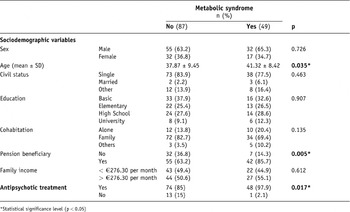
49 patients met the metabolic syndrome criteria. Significant differences were found in the different sociodemographic (age, p = 0.035; and pension beneficiary, p = 0.005), illness-related (time of evolution, p = 0.008) and psychopharmacological variables (antipsychotics treatment, p = 0.017) of the patients who suffer from metabolic syndrome and those who do not. Results are shown in Tables 2 and 3.
Relationship between metabolic syndrome and sociodemographic variables and antipsychotic treatment

*Statistical significance level (p < 0.05)
Relationship between metabolic syndrome and illness-related variables

*Statistical significance level (p < 0.05)
Variables related to quality of life
In relation to the different dimensions of the EuroQol 5D, we found that 80.9% of the study population did not present mobility problems, 77.2% reported no difficulty with regard to their personal care and 52.2% report some difficulty performing their daily activities. Furthermore, 50% of patients reported moderate pain or discomfort and 79.4% were depressed or anxious.
As for the ‘current health state compared to last 12 months’ variable, 38.2% of the study population reported no changes, 37.5% felt worse and only 24.3% reported feeling better. For the ‘health state today’ variable (range between 0 and 100), the average among study patients is 50.14 (± 15.91 SD).
Quality of life and metabolic syndrome
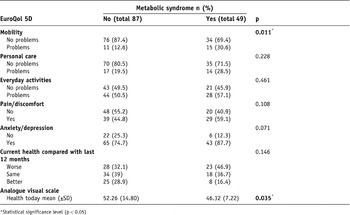
We found a statistically significant link between metabolic syndrome and worse mobility (p = 0.011), and a worse average score for the ‘health state today’ variable (p = 0.035). The link found between greater anxiety/depression and suffering from metabolic syndrome, although noteworthy, does not attain statistical significance.
No significant associations with metabolic syndrome were found with the ‘personal care’, ‘performing everyday life activities’, ‘pain/discomfort’ and ‘current health state compared with last 12 months’ variables. Results are shown in Table 4.
Relationship between metabolic syndrome and quality of life using EuroQol 5D dimensions

*Statistical significance level (p < 0.05)
Multivariate analysis (logistic regression)
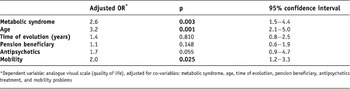
136 patients were included in the logistic regression. Age (OR = 3.2), metabolic syndrome (OR = 2.6) and mobility problems (OR = 2), were the main variables significantly associated with quality of life. Results are shown in Table 5.
Multivariate analysis (logistic regression); adjusted odds ratio (OR) for analogue visual scale of quality of life (EuroQol 5D)

*Dependent variable: analogue visual scale (quality of life), adjusted for co-variables: metabolic syndrome, age, time of evolution, pension beneficiary, antipsychotics treatment, and mobility problems
DISCUSSION AND CONCLUSIONS
Although different studies have linked anthropometrical measures and obesity with worsened quality of life in schizophrenic patients (Faulkner et al., Reference Faulkner, Cohn, Remington and Irving2007; Strassnig et al., Reference Strassnig, Brar and Ganguli2003), to date the only work we know of that has assessed quality of life in schizophrenic patients with metabolic syndrome is the work of Meyer et al. (2005). This study showed worse physical health, measured using the SF-12 quality of life questionnaire, and a greater somatic concern measured with item G1 of the PANSS, in schizophrenic patients suffering from metabolic syndrome (p<0.05). On the other hand, it did not find a significant link between the total score on the quality of life scale (QLS) and metabolic syndrome. We believe that perhaps the inability to find a link with the QLS scale score is due to the fact that this scale, in spite of its misleading name, does not appear to be an adequate instrument for measuring quality of life in schizophrenia, as noted correctly by Lehman (2000), since it was originally developed to assess insufficiency syndrome. In addition, there is not a current and uniform concept of quality of life. In the first-stage design process of assessment instruments for measuring health-related quality of life, the concept was centred on satisfaction and personal welfare. In a second generation of instruments, researchers also included ‘objective’ measures in relationship with daily-life functioning. In any case, quality of life is a complex, pluridimensional concept and there is a methodological school of thought that criticizes the measure of that concept by any simple method or score. An holistic view of quality of life must include both patients’and careworkers’ assessments, and touch on the following five points: personal or ‘subjective’ welfare; ‘objective’ functioning measures; material conditions (life-level); social support and stability of social networks; and treatment-related variables (Kastchnihg, Reference Kastchnihg, Kastchnig, Freeman and Sartorius2000).
On the other hand, using the EuroQol 5D, an instrument that has recently been validated in schizophrenic patients (EuroQol Group, 1990; Prieto et al., Reference Prieto, Sacristán, Hormaechea, Casado, Badia and Gómez2004), we have found worse scores in the ‘health state today’ and ‘mobility’ variables in patients suffering from metabolic syndrome, the link being significant. In addition, we also believe that the high number of study patients with metabolic syndrome who reported feeling depressed or anxious to be noteworthy.
At present, based on the studies, it can be concluded that, in general, the new antipsychotic agents improve the quality of life of schizophrenic patients, and in some cases the improvement is even greater than with traditional antipsychotic drugs (Awad & Voruganti, Reference Awad and Voruganti2004). However, different authors recommend caution when basing clinical decisions on some of these results, as the evidence is not clear and in some cases, even very limited (Minguez et al., Reference Minguez, González, Alonso, Sanguino and García2005; Killian & Angermeyer, Reference Kilian and Angermeyer2005). In fact, quality of life and schizophrenia have a highly complex inter-relationship where, as we have seen, various factors play a role, not only the psychopharmacological treatment used.
We must bear in mind that extrapyramidal symptoms, weight gain and sexual dysfunction (Dossenbach et al., Reference Dossenbach, Hodge, Anders, Molnár, Peciukaitiene, Krupka-Matuszczyk, Tatu, Bondar, Pecenak, Gorjanc and McBride2005) are among the main side effects of antipsychotics linked with worsened quality of life.
We are aware that schizophrenic patients have up to four times higher risk of suffering from metabolic syndrome than the rest of the population, with an estimated prevalence of metabolic syndrome ranging from 19.4% to 74% (Sánchez-Araña Moreno et al., Reference Sánchez-Araña Moreno, Touriño Gonzalez, Hernández Fleta and León Pérez2006). Some habits fostered by the negative symptoms, like sedentary lifestyle and unbalanced diet, as well as metabolic alterations associated with schizophrenia, such as increased resistance to insulin and cortisol, and increased blood glucose, are enhanced by the endocrine side effects of a large number of antipsychotic drugs (Thakore, Reference Thakore2005). Thus, the clinical importance of metabolic syndrome lies in its association with a high cardiovascular and diabetes risk, with a two- to fourfold increase in mortality with regard to the general population.
Consequently, without more studies that can clarify the complex interaction between schizophrenia, metabolic syndrome and quality of life, we must take into account comorbidity with metabolic syndrome in treating schizophrenic patients. However, we cannot forget that many variables affecting patients’quality of life, not only metabolic syndrome, are implicated. As our results show, illness factors (mobility problems, OR = 2), sociodemographic variables (age, OR = 3.2) and metabolic syndrome (OR = 2.6) determine the quality of life of schizophrenic patients. Further studies are needed in order to clarify the influence of these and other variables on the quality of life of our patients.