Patients with single-ventricle physiology have a poor outcome without surgical palliation. Reference Moodie, Ritter, Tajik and O’Fallon1 The introduction of the Fontan operation in 1971 Reference Fontan and Baudet2 ushered in a new and historic era of survival to adult life for such affected individuals. Reference Pundi, Johnson and Dearani3 During Fontan palliation, the surgeon separates the pulmonary and systemic circulations by re-routing the systemic venous blood directly to the pulmonary arteries without an interposed subpulmonary ventricle. Thus, the systemic venous bed is subject to chronic and obligatory hypertension and congestion with consequent overload on the lymphatic system. Such chronic venous pressure overload is believed to contribute to end-organ damage such as Fontan-associated liver disease. Reference Gordon-Walker, Bove and Veldtman4
Unlike in healthy patients, Fontan patients’ systemic venous pressures rise precipitously during exercise with poor associated cardiac output augmentation. Reference Navaratnam, Fitzsimmons and Grocott5 This is due to a relatively fixed pulmonary vascular resistance, which limits filling rates of the single ventricle, and can ultimately limit peak oxygen uptake (VO2peak). Reference La Gerche and Gewillig6,Reference Gewillig, Brown and Eyskens7 The lack of pulsatile flow also results in deprivation of nitric oxide and prostaglandin-mediated vasodilation. Locally delivered and locally active inhaled pulmonary vasodilator therapy, therefore, pose a potentially attractive target to improve Fontan haemodynamics by reducing systemic venous pressure and increasing systemic ventricular pre-load with better cardiac output. It has, therefore, been the subject of a number of acute and chronic trials in Fontan patients. Reference Tunks, Barker and Benjamin8–Reference Goldberg, Zak and Goldstein15
The aims of the present study were (i) to asses liver stiffness at rest and immediately following maximal exercise; (ii) to determine the acute venous pressure responses to maximal incremental and constant work rate exercise; and(iii) to assess the effects of an inhaled prostacyclin analogue, Treprostinil, on systemic venous pressure responses, exercise endurance, and aerobic capacity as well as ultrasound-derived liver stiffness pre- and post-exercise. Reference Puente-Maestu, Palange and Casaburi16
Materials and methods
Study description
This substudy was derived from a larger prospective randomised, double-blind, placebo-controlled, crossover trial examining the effects of inhaled Treprostinil in young adults with a non-failing Fontan circulation on exercise endurance. The study was performed at Cincinnati Children’s Hospital Medical Center between 2017 and 2018. Fifteen patients were recruited, and each gave written informed consent to participate. The trial was stopped after reaching the pre-specified number of patients for this substudy. The protocol was approved by the Institutional Review Board at Cincinnati Children’s Hospital Medical Center and was in accordance with the Helsinki declaration and International Conference on Harmonization Good Clinical Practice guidelines. The study was registered at ClinicalTrials.gov (NCT02769624).
Selection and recruitment of patients
Inclusion criteria were ≥18 years of age and a history of Fontan palliation. Exclusion criteria were clinically unstable patients, evidence of Fontan pathway, or intracardiac obstruction, ventricular dysfunction (ejection fraction < 40%), uncontrolled arrhythmias, or inability to perform exercise testing. Additional exclusion criteria were body mass index > 35 kg/m2, pregnancy or breast-feeding, inability to provide informed consent, and ongoing treatment with a pulmonary vasodilator. Three patients were on diuretics at the time of the study.
Outcomes
The primary outcome was a change in liver stiffness measured using ultrasound shear wave elastography following maximal exercise. The secondary outcomes included (i) venous pressure change at peak exercise and (ii) changes in venous pressure, liver stiffness, and exercise parameters (VO2peak, anaerobic threshold, and VE/VCO2 at anaerobic threshold) in response to inhaled Treprostinil during and following incremental maximal exercise. In addition, the effect of inhaled Treprostinil on constant work rate endurance time was assessed.
Study drug and application
Treprostinil is a prostacyclin analogue which was administered using the Tyvaso® inhalation system to vasodilate the pulmonary vasculature. A dose of 18 mcg (three breaths) or placebo (three breaths) was administered at rest, prior to the incremental exercise test and then again prior to the constant work rate exercise test. The study drug was supplied by United Therapeutics Corporation (Silver Spring, MD, United States of America). Patients and investigators were blinded for the study drug and placebo.
Study protocol
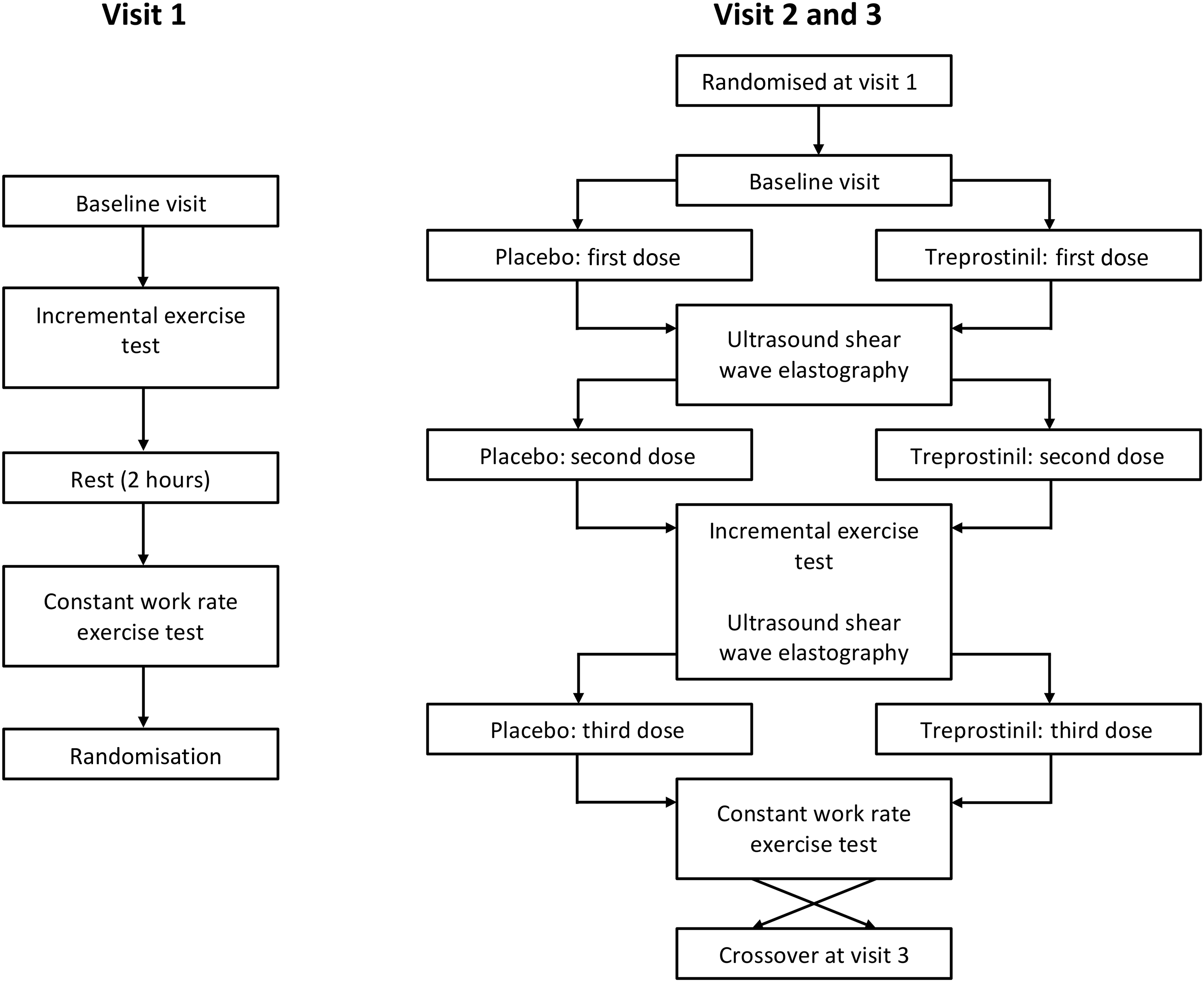
The study protocol is illustrated in Figure 1. Each patient attended three visits at 1–2 week intervals. Patients were instructed to fast for at least 8 hours prior to each visit. Systemic vasodilators were held on the day of each visit. A urine pregnancy test was performed if appropriate. Baseline vital signs were obtained, and an incremental cardiopulmonary exercise test including resting spirometry was performed. After a rest period of 2 hours following the incremental cycle ergometer exercise test, a constant work rate exercise test was performed at 80% peak incremental work rate for exercise endurance time. After finishing the constant work rate test, patients were monitored for adverse events (such as arrhythmias or hypotension) until they have reached their baseline vital signs and were randomised to one of the two treatment sequences of Treprostinil at visit 2 and placebo at visit 3 or placebo at visit 2 and Treprostinil at visit 3. A constant work rate exercise test was chosen since previous data suggest it to be a highly sensitive measure of functional outcome following pharmacological interventions. Reference Oga, Nishimura, Tsukino, Hajiro, Ikeda and Izumi17,Reference Borel, Provencher, Saey and Maltais18
Study protocol. At visit 1, patients performed an incremental exercise test and a constant work rate exercise test at baseline. Patients were then randomised to the Treprostinil or placebo study arm (visit 2). After inhalation of Treprostinil or placebo, liver stiffness was measured at rest. A second dose of the assigned drug was inhaled, and an incremental exercise test was performed with assessment of liver stiffness immediately after exercise. Finally, a constant work rate exercise test was performed after inhalation of a third dose. At visit 3, patients were crossed over to the Treprostinil or placebo study arm and were asked to repeat the study protocol.

At visit 2, a peripheral venous cannula was inserted in an antecubital vein to measure systemic venous pressures which are reflective of the pulmonary arterial pressure in Fontan patients and are concordant with central venous pressures. Reference Milhoan, Levy, Shields and Rothman19 This technique has been described previously. Reference Navaratnam, Fitzsimmons and Grocott5 The upper end of the cannula was positioned at the level of the right atrium, using anatomical landmarks. The cannula was connected to a venous pressure manometer via a transducer set. The transducer was flushed, de-aired, calibrated, and “zeroed” to atmospheric pressure at the level of the right atrium. Vital signs were obtained and the first dose of inhaled Treprostinil or placebo, as determined by the randomisation, was administered.
Ultrasound shear wave elastography was performed. A second dose of the assigned treatment was administered (at least 2 hours after the first dose). An incremental exercise test with systemic venous pressure monitoring was performed. Following the exercise test, ultrasound shear wave elastography measurement was repeated. The exercise test was followed by a 2-hour break for complete recovery. A third dose of the assigned treatment was administered. A constant work rate exercise test at 80% of peak incremental work rate with venous pressure monitoring was performed to intolerance and exercise endurance time recorded. Patients were monitored for adverse events for 60 minutes following medication administration.
At visit 3, patients were asked to repeat the study protocol described under visit 2, and at that time, they crossed over to the Treprostinil or placebo study arm, depending on their assigned treatment sequence. A follow-up phone call was performed 2 weeks after visit 3 to assess for adverse events.
Spirometry
Spirometry was performed prior to the incremental exercise tests. Dynamic and static parameters were obtained according to standard protocols. Reference Miller, Hankinson and Brusasco20 Forced expiratory volume in 1 second (FEV1), forced vital capacity (FVC), and FEV1/FVC were reported.
Incremental cardiopulmonary exercise test with venous pressure measurement
A standard cardiopulmonary exercise test on a stationary cycle ergometer was performed according to the American Thoracic Society/American College of Chest Physicians (2003) guidelines. Reference Society and Physicians21 Three minutes of rest in a sitting position were followed by 3 minutes of unloaded cycling. A maximum exercise test using a ramp protocol with an increase of 15 W/minutes was performed to intolerance and followed by a 5-minute recovery phase. Metabolic and ventilatory data were continuously assessed by breath-by-breath gas analysis throughout the study using a metabolic cart (Parvo Medics Exercise Cart, Sandy, UT, United States of America). Parameters assessed included VO2peak, the ventilatory equivalent for carbon dioxide output (VE/VCO2), and venous pressures. Anaerobic threshold was estimated by the V-slope method. Reference Beaver, Wasserman and Whipp22 Venous pressures were measured via an 18-gauge catheter in an antecubital vein and were monitored prior to beginning of the exercise test and then every minute during exercise and recovery period as previously described. Reference Navaratnam, Fitzsimmons and Grocott5
Constant work rate exercise test
Two hours after an incremental exercise test, a constant work rate cardiopulmonary exercise test was performed to determine exercise endurance time. After 3 minutes at unloaded cycling, the work rate was increased abruptly to 80% of the peak work rate achieved during the incremental exercise test and the patient was encouraged to continue for as long as possible. The endurance time at 80% peak work rate was recorded.
Liver stiffness by ultrasound shear wave elastography
Liver stiffness was measured using ultrasound shear wave elastography as described before. Reference DiPaola, Schumacher, Goldberg, Friedland-Little, Parameswaran and Dillman23 All measurements were performed using an Acuson S3000 US system and a 6C1HD transducer (Siemens Medical Solutions United State of America, Inc., Mountain View, CA, United States of America). Using Virtual Touch Quantification (VTQ), 10 consecutive point shear wave elastography shear wave speed measurements were acquired from the central right hepatic lobe (segment 6 or 7) at least 1 cm deep to the liver capsule. Patients were imaged in the supine position with the right arm in abduction. The ultrasound transducer was positioned either subcostal or in a lateral intercostal space adjacent to the right lobe of the liver, with measurements obtained during breath-holding while avoiding Valsalva.
Sample size calculation
Sample size calculations were based on published literature. Reference Oga, Nishimura, Tsukino, Sato, Hajiro and Mishima24 For the larger main trial which aimed to detect a change of 37 seconds in exercise endurance, a sample size of 26 patients was required to have 80% power using a two-sided test at α = 0.05. For the substudy presented in this manuscript, based on the primary endpoint, a sample size of 15 was calculated to provide 80% power to detect an approximate 0.6 m/second change in liver stiffness, representing a 30% increment which is clinically significant, assuming an SD of 0.75 m/second using the two-sided test at α = 0.05.
Statistical analysis
Continuous variables are reported in mean and standard deviation or median and interquartile range, as appropriate. Categorical variables are reported in frequency and percentage. Paired t-tests were used to compare variables between the two arms of this crossover study. Pearson’s correlation analysis was performed to assess the strength and direction of associations between different variables. p < 0.05 was considered significant. Statistical analyses were performed using SAS version 9.4 (Cary, NC, United States of America).
Results
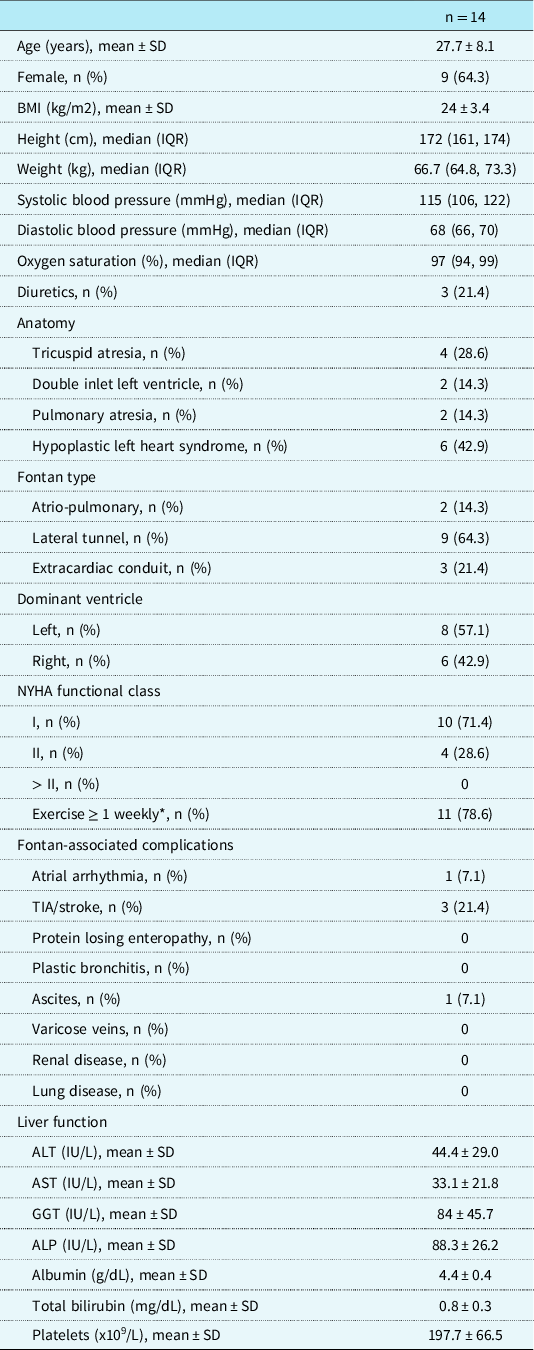
Fifteen patients (mean age 27.8 ± 7.9 years, 66% female) with Fontan circulation were recruited. Fourteen patients completed the study. Patient characteristics are shown in Table 1. Two patients had an atrio-pulmonary Fontan (14.3%), nine had a lateral tunnel (64.3%), and three had an extracardiac conduit (21.4%). Treprostinil was well tolerated without serious adverse events.
Patient characteristics.

ALP = alkaline phosphatase; ALT = alanine aminotransferase; AST = aspartate aminotransferase; BMI = body mass index; GGT = gamma-glutamyl transferase; TIA = transient ischemic attack
* Exercise was defined as more than 20 minutes organized exercise per week
Ultrasound derived liver stiffness
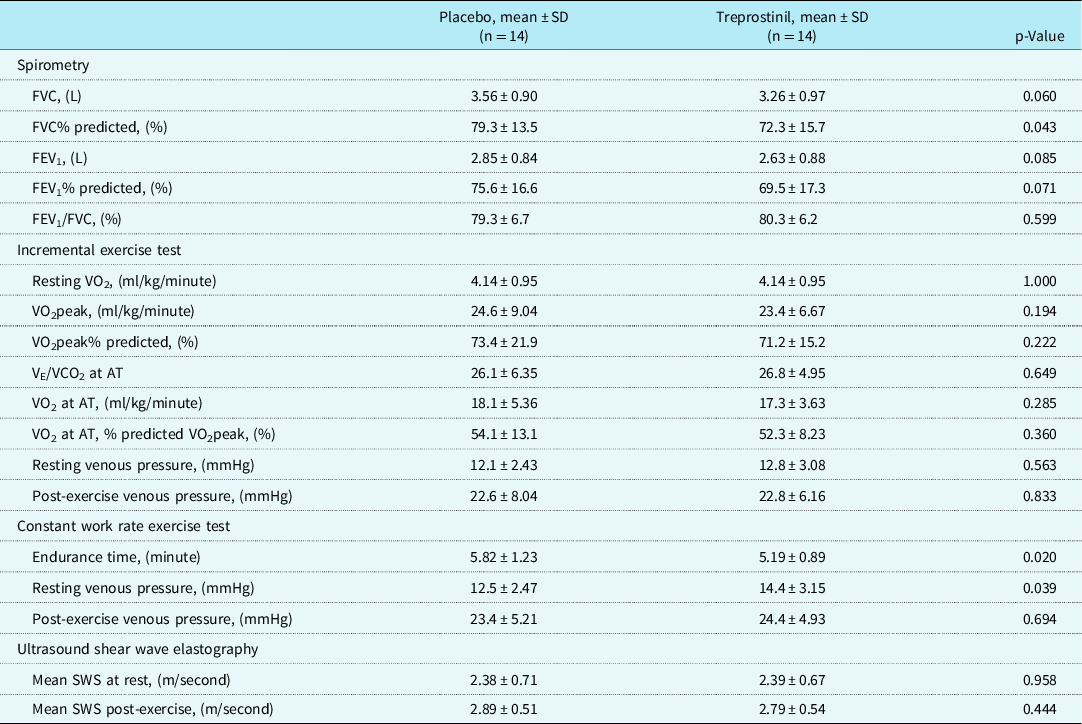
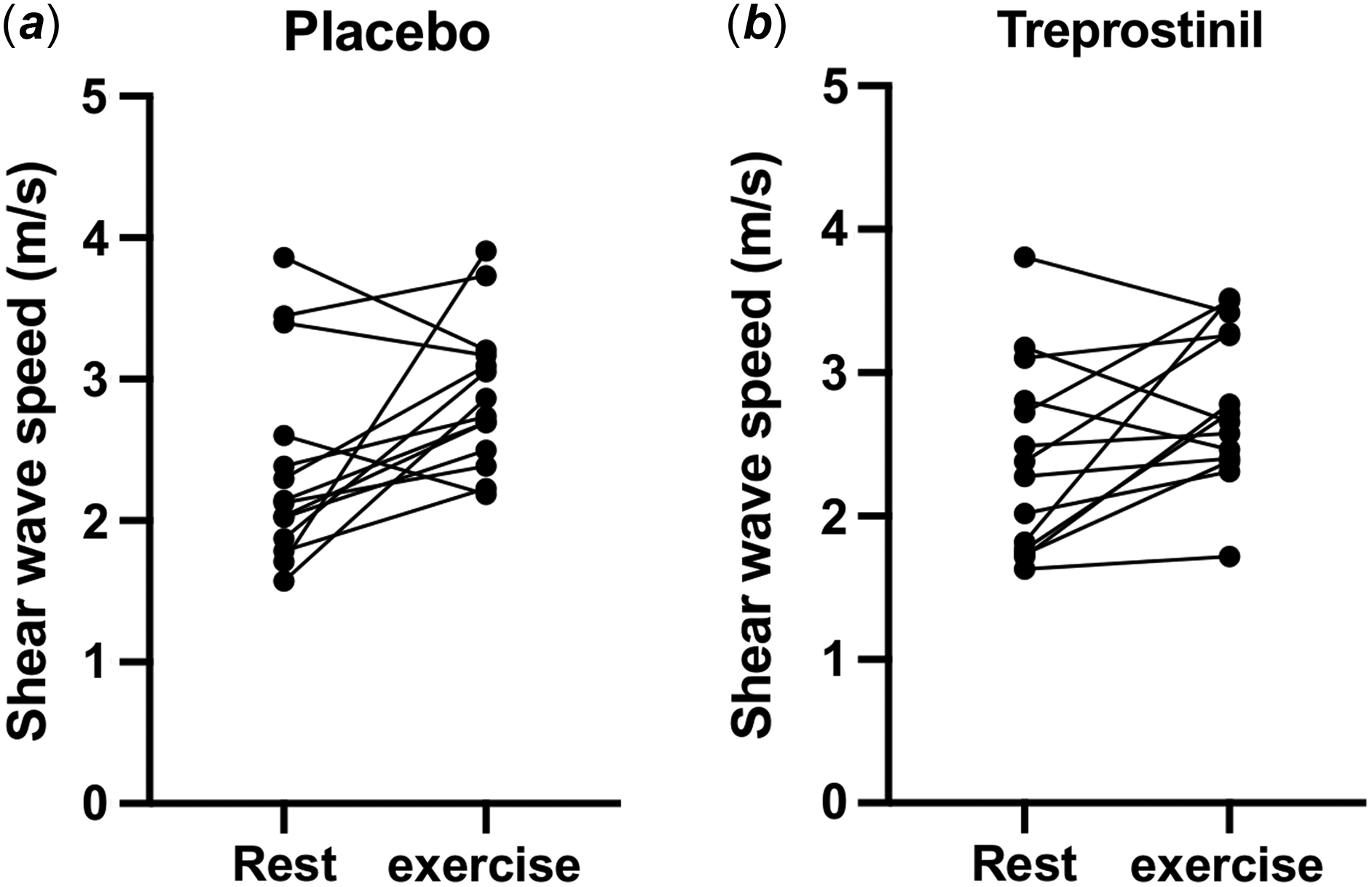
Liver shear wave speed increased immediately after the incremental exercise test on placebo in 11 of 14 patients. Overall, the mean increase in liver shear wave speed was 0.51 ± 0.73 m/second on placebo and 0.40 ± 0.64 m/second on Treprostinil, which is a relative increase in liver shear wave speed of 29 ± 40% on placebo and 22 ± 32% on Treprostinil (p = 0.54), respectively (Table 2, Fig 2). There was no significant correlation between liver shear wave speed and systemic venous pressure at peak exercise, after inhalation of either placebo or Treprostinil (r = −0.018, p = 0.95 versus r = −0.223, p = 0.49).
Outcome variables after inhalation of placebo and Treprostinil.

AT = anaerobic threshold; FEV1 = forced expiratory volume in 1 second; FVC = forced vital capacity; SWS = shear wave speed; VCO2 = CO2 output; VO2 = oxygen uptake; VE = ventilation; VE/VCO2 = ventilatory equivalent for CO2 output
Mean liver shear wave speeds at rest and immediately post-exercise in each individual patient, with placebo (a) and Treprostinil (b). Liver stiffness measured by ultrasound shear wave elastography has increased in the majority of the patients after exercise, both after inhalation of placebo (a) and Treprostinil (b).

Venous pressure measurements during incremental and constant work rate exercise test
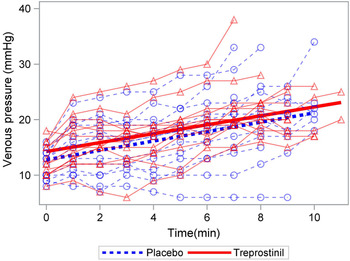
The results for the venous pressure measurements are summarised in Table 2 and Figure 3.
Systemic venous pressure changes measured during incremental exercise. Systemic venous pressure increased constantly during the incremental exercise test, both after inhalation of Treprostinil and placebo. However, inhalation of Treprostinil did not reduce venous pressures with comparable pressures at rest (p = 0.56) and peak exercise (p = 0.83). Symbols: triangle = Treprostinil. Circle = placebo. Regression line: red solid line = Treprostinil. Blue dotted line = placebo.

On placebo, the peripheral venous pressures increased acutely during both incremental (12.1 ± 2.4 versus 22.6 ± 8.0 mmHg, p < 0.001) and constant work rate exercise (12.5 ± 2.5 versus 23.4 ± 5.2 mmHg, p < 0.001). During the incremental work rate exercise test, inhalation of Treprostinil did not reduce venous pressures at rest (12.1 ± 2.43 versus 12.8 ± 3.08 mmHg, p = 0.56) nor at peak exercise (22.6 ± 8.04 versus 22.8 ± 6.16 mmHg, p = 0.83). There was no difference in the absolute rise of venous pressures between placebo and Treprostinil, neither during the incremental work rate exercise test (10.5 ± 6.24 versus 9.75 ± 4.73, p = 0.82) nor during the constant work rate exercise test (10.9 ± 3.52 versus 10.0 ± 4.07, p = 0.52).
Incremental and constant work rate exercise test
The results for the incremental and constant work rate exercise tests are summarised in Table 2. There was no significant difference in VO2peak with placebo or Treprostinil (24.6 ± 9.04 versus 23.4 ± 6.67 ml/kg/minute, p = 0.19). VE/VCO2 at anaerobic threshold was not different with placebo or Treprostinil (26.1 ± 6.4 versus 26.8 ± 5.0, p = 0.65). Exercise endurance was significantly lower after inhalation of Treprostinil compared with placebo (5.19 ± 0.89 versus 5.82 ± 1.23 minute, p = 0.02). While the absolute endurance time was less during the Treprostinil condition, the difference (-38 ± 54 seconds) was within the proposed minimally clinically important difference for this test of > 60–105 seconds. Reference Puente-Maestu, Palange and Casaburi16
Spirometry
FVC and FEV1 at baseline were 3.56 ± 0.90 L (79.3 ± 13.5% predicted) and 2.85 ± 0.84 L (75.6 ± 16.6% predicted), respectively. Mean FVC and FEV1 were lower after inhalation of Treprostinil compared with placebo (FVC: 3.26 ± 0.97 versus 3.56 ± 0.90 L, p = 0.06; FEV1: 2.63 ± 0.88 versus 2.85 ± 0.84 L, p = 0.08). Treprostinil resulted in lower per cent predicted FVC and FEV1 compared with placebo (FVC: 72.3 ± 15.7% versus 79.3 ± 13.5%, p = 0.04; FEV1: 69.5 ± 17.3% versus 75.6 ± 16.6%, p = 0.07). There was no difference in FEV1/FVC ratio between Treprostinil and placebo (Table 2).
Discussion
Fontan-associated liver disease is a near universal phenomenon in patients with a Fontan circulation. Although the underlying pathophysiology is not yet fully elucidated, chronic venous congestion consequent upon a relatively fixed pulmonary vascular resistance in the absence of a functioning right ventricle seems to be one of the main drivers in the development of Fontan-associated liver disease. Increased hepatic afterload, together with a relative reduction in cardiac output, may result in liver congestion and injury with progressive fibrosis Reference Kendall, Stedman and Hacking25 that may ultimately result in liver cirrhosis, portal hypertension, and hepatic masses, including hepatocellular adenomas and carcinomas. Reference Ghaferi and Hutchins26–Reference Asrani, Warnes and Kamath28 We, therefore, explored the relationship between exercise stress, venous pressures, and liver stiffness and hypothesised that the inhaled pulmonary vasodilator Treprostinil would attenuate any anticipated augmentation in venous pressures and liver stiffness.
In this substudy, we focused predominantly on venous pressure and liver stiffness responses during incremental symptom-limited maximal exercise. We demonstrated that exercise was indeed associated with a nearly twofold increase in venous pressures, but that liver stiffness was only increased by a factor of one-third following maximal exercise. This “uncoupling” between venous pressures and liver stiffness was surprising and suggests compensatory mechanisms that relatively protect the liver during exercise in Fontan patients. In the group as a whole, the absolute post-exercise liver stiffness increase was not significantly attenuated with Treprostinil as compared with placebo nor did Treprostinil change venous pressure responses during incremental maximal exercise.
Exercise and venous pressure responses
We demonstrated marked augmentation of baseline peripheral venous pressure in almost all Fontan patients with an average increase of 88% during incremental exercise testing. We and others have demonstrated similar increases in peripheral and central venous pressures in response to exercise stress. Reference Navaratnam, Fitzsimmons and Grocott5,Reference Shachar, Fuhrman, Wang, Lucas and Lock29 We believe that these pressures reflect an increase in pulmonary artery pressures. It is very likely that this increase occurs as cardiac output amplifies during exercise against a relatively fixed pulmonary vascular resistance, resulting in the observed higher venous pressures. Other contributing haemodynamic factors may also include rising diastolic pressures in the systemic ventricle or potentially occult pathway obstruction.
The reason why the resting peripheral venous pressure prior to the constant work rate exercise test was higher in the group that received Treprostinil compared with the group that received placebo remains unclear and warrants verification and further study.
Liver stiffness responses
In this investigation, we showed that Fontan patients had elevated liver shear wave velocity at rest and then had as much as 30% exercise-associated augmentation in liver stiffness, when measured immediately after maximal exercise. These preliminary observations imply that there may be transient patterns of liver stiffness increase during activities of daily living in Fontan patients. The striking dissociation between venous pressure augmentation and liver stiffness rise was intriguing. This non-linear rise in liver stiffness suggests a complex interaction between elevation in central venous pressures and alterations in splanchnic blood flow precipitated by exercise that is likely to protect the liver from acute haemodynamic shifts. Liver blood supply comprises a combination of hepatic arterial inflow and portal venous inflow. Though venous outflow resistance inherent to Fontan physiology is likely a key driver of congestion, it is entirely possible that exercise may acutely moderate hepatic inflow through diminished portal venous and hepatic arterial inflow and that this may relatively constrain acute hepatic congestion. Inherent liver compliance is also likely to vary from patient to patient, resulting in a multifactorial response in liver stiffness. This may be mediated by perisinusoidal fibrosis Reference Kendall, Stedman and Hacking25 simply limiting and containing the ability of increased blood flow to augment liver stiffness. We did not measure liver stiffness during the exercise phase, but liver congestion is very likely to persist for a few minutes post-maximal exercise. Reference Gersak, Sorantin, Windhaber, Dudea and Riccabona30 Despite the increase in liver stiffness and systemic venous pressure during exercise, we do think that the positive effects of exercise on muscle strength, cardiac output, and quality of life outweigh these potential negative effects, Reference Cordina, O’Meagher and Karmali31,Reference Cordina and d’Udekem32 particularly as the hepatic stiffness response is blunted despite rather acute rises in peripheral and central venous pressures.
A particular strength of our study was the direct measurement of systemic venous pressure during exercise and measurement of responses with a locally delivered pulmonary vasodilator. We were unable to demonstrate a significant effect of Treprostinil on systemic exercise venous pressures in this cohort. Treprostinil resulted in a minor reduction (˜200–300 ml) in FEV1 and FVC, and it is possible that the positive effects on venous pressure might have been offset by this alteration in pulmonary mechanics. The mechanism by which Treprostinil lowered FEV1 and FVC is unclear and needs further evaluation. We did not examine venous or liver compliance in this study, which will be an important subject for future investigations.
Limitations
This study has several limitations. The study protocol was labour-intensive, and the sample size was small. Furthermore, the inclusion and exclusion criteria may have introduced a selection bias towards well-functioning Fontan patients, who might benefit less from the use of pulmonary vasodilators. We did not directly assess the pulmonary vascular resistance, nor did we assess venous compliance in response to Treprostinil. Whether Treprostinil would have a different effect on the haemodynamics in a “sicker” Fontan population with poorer exercise capacity, worse systolic or diastolic single-ventricular function, significant atrioventricular valve regurgitation, increased pulmonary vascular resistance or those with a greater liver stiffness at baseline, remains to be determined. In addition, this substudy was powered for the primary endpoint of change in liver stiffness with exercise. The study was very likely underpowered for the secondary outcomes.
Liver stiffness is also affected by underlying cirrhosis, which is common in this population. We did not assess the degree of fibrosis in this pilot and proof-of-concept study. Nevertheless, we were able to demonstrate for the first time a marked increment in liver stiffness acutely post-exercise.
We assessed only acute, not chronic, effects of the inhaled pulmonary vasodilator on haemodynamics and exercise responses. Further studies are needed to assess whether the long-term use of pulmonary vasodilation might have a positive effect on systemic venous pressure, liver stiffness, pulmonary blood flow, cardiac output, exercise tolerance, or outcome.
Conclusions
This prospective, randomised, placebo-controlled, double-blind crossover trial demonstrated a striking increase in venous pressures and a relatively blunted augmentation in liver stiffness in response to incremental exercise in Fontan patients. This response was significantly uncoupled suggesting inherent protective mechanisms potentially involving the splanchnic circulation. Treprostinil failed to alter venous pressure as well as liver stiffness responses.
Acknowledgements
We would like to thank United Therapeutics Corporation (Silver Spring, MD, United States of America) for supplying the study drug.
Financial support
United Therapeutics Corporation (Silver Spring, MD, United States of America) supplied the study drug.
Conflicts of interest
None.
Ethical standards
The authors assert that all procedures contributing to this work comply with the ethical standards of the relevant national guidelines on human experimentation (United States Code of Federal Regulations) and with the Helsinki Declaration of 1975, as revised in 2008, and have been approved by the Institutional Review Board at Cincinnati Children’s Hospital Medical Center.