I. INTRODUCTION
As is well known, metal phthalocyanines are usually used for pigments and dyes. Besides intense color adsorption, many other remarkable properties have been developed mainly due to their symmetric planar structures, 18π-electron conjugated system, and stability toward light and heat. They exhibit a number of unique characteristics, which make them very significant for a variety of practical applications.Reference Cui, Lv, Dou and He1,Reference Zhu, Li, Chen, Wang, Zhang, Zhang and Blau2 Therefore, deep excavation of the applied characteristics of metal phthalocyanines and their derivatives has become a research focus for natural science researchers. It is found that the chemical and physical characteristics of the metal phthalocyanines vary with the central metal ions and the peripheral substituents of the ligands.Reference Arici, Arican, Uğur, Erdoğmus and Koca3–Reference Bayrak, Dumludağ, Akçay and Değirmencioğlu5 The research results are firmly convinced that the metal phthalocyanine compounds can be widely used in many high-tech fields, such as nonlinear optics,Reference Li, Zhao, Yang, Sun and Guo6 catalytic chemistry,Reference Jiang, Lu, Lv, Han, Zhang, Niu and Chen7 electrochemistry,Reference Cao, Guo, An, Zhu and Cui8–Reference Nombona and Nyokong11 and photodynamic therapy.Reference Liang, Ren, Su and Cai12,Reference Gao, Qian, Zhang and Zhang13
There is considerable interest in the electrochemistry applications of binuclear metal phthalocyanines.Reference Cardenas-Jiron, Leon-Plata, Cortes-Arriagada and Seminario14,Reference Claessens, Hahn and Torres15 Because the two macrocyclic units are spaced closely to each other in the binuclear compounds, some special properties that have not been discovered in mononuclear units often emerge in them easily. Inoue H systematically studied the catalysis of metal phthalocyanines in the reaction of aldehydes and elucidated that the catalytic activity of the binuclear metal phthalocyanines was obviously higher than that of the mononuclear ones.Reference Inoue, Kida and Imoto16,Reference Inoue, Kida and Imoto17 In this work, the binuclear transition metal phthalocyanines M2Pc2HnC (M = Mn(II), Fe(II), Co(II), Ni(II), and Cu(II)) which exhibited good electrocatalytic activity to Li/SOCl2 battery were synthesized and characterized.
Li/SOCl2 battery, a high energy electrochemical power source, has been widely applied in various fields.Reference Guidotti, Reinhardt and Odinek18,Reference Bernstein and Lever19 However, two extrusive problems—voltage delay and security—severely prohibit the wide application of the battery.Reference Guo, Li and Yang20 Considerable endeavors have been made to overcome the disadvantages and improve the performance of the battery.Reference Cordova, Johnson, Pereira, Badway, Amatucci and Abraham21–Reference Silva, Martins, Freitas, Valente, Freire, de Castro and Figueiredo24 Equations (1)–(3) describe the discharge reaction of the Li/SOCl2 battery. The discharge reaction involves the formation of sulfur and insulating LiCl. The precipitation of LiCl and S impedes the progress of the discharge reaction.
 $${\rm{Anode}}\!:\quad {\rm{Li - e}} \to {\rm{Li}}^ +$$
 $${\rm{Cathode}}\!:\quad {\rm{ }}2{\rm{SOCl}}_2 + 4{\rm{e}} \to {\rm{S}} \downarrow + {\rm{ SO}}_2 \uparrow + 4{\rm{Cl}}^ -$$
 $${\rm{Total}}\!:\quad 2{\rm{SOCl}}_2 + 4{\rm{Li}} \to {\rm{S}} \downarrow + {\rm{SO}}_2 \uparrow + 4{\rm{LiCl}} \downarrow \quad .$$
When the binuclear metal phthalocyanines are added to the Li/SOCl2 battery, on the one hand, they can act with Li+ by absorption or coordination because they are electron donor-acceptor systems, which can decrease the compactness of the LiCl film formed on the carbon electrode surface and hence speed up the diffusion of SOCl2 through the filmReference Lee, Pyun and Lee25; on the other hand, they can quicken the cathode reaction by easily transmitting electrons between the central metal ions and the phthalocyanine rings. Eventually these binuclear metal phthalocyanines can make the capacity and output voltage of the battery enhance enormously.
II. EXPERIMENTAL
A. Materials and characterization
Phthalic anhydride and 3,3′,4,4′-benzophenonetetracarboxylic dianhydride were obtained from Alfa Aesar Co. (Yantai, Shandong, China). All the reagents were of analytical grade and used without further purification. LiAlCl4/SOCl2 electrolyte (battery grade), lithium foil (battery grade), and carbon film (battery grade) were obtained from the Xi’an Institute of Electrical and Mechanical Services Information. Doubly distilled water was used to prepare all aqueous solutions. Elemental analysis (C, H, and N) of the obtained compounds was performed on a Vario EL III CHNOS analyzer (Elementar Analysensysteme GmbH, Hanau, Germany). IR spectrum was measured on an EQUINOX-55 spectrometer (Bruker Optics Inc., Karlsruhe, Germany). Ultraviolet-visible (UV-vis) absorption spectrum was recorded on a PE-40P UV spectrometer (Perkin-Elmer Corporation, Norwalk, CT). The thermal decomposition process was studied using TG-DSC technique on a NETZSCH STA449C thermal instrument (Netzsch-Gerätebau GmbH, Selb, Germany). The cyclic voltammetry (CV) study was performed on CHI660 electrochemical workstation.
B. Synthesis
1. Synthesis of phthalimide
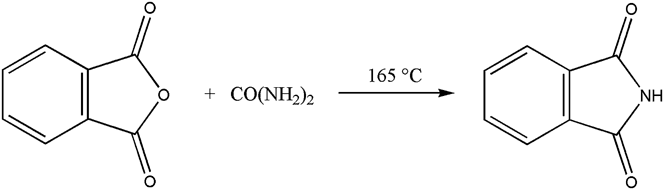
Phthalic anhydride (19.0 g, 0.13 mol) and urea (3.0 g, 0.050 mol) were mixed and ground evenly together (Scheme 1). Then, the uniform mixture was transferred into a 250 mL beaker and heated up to 165 °C. With the mixed reactants completely melting, large amount of solid generated and the volume of the solid was more than 2–3 times of the reactants. After being cooled to room temperature, the solid product was recrystallized with 300 mL distilled water. Finally, the white needle crystal compound was obtained. Yield: 13.2 g (70%), m.p. 234 °C; IR (KBr pellet, in centimeters): 1771, 1751 (C=O), 3197 (N−H), 3061 (C−H of benzene ring), 1604, 1557, 1467 (skeleton of benzene ring).
Synthesis of phthalimide.

2. Synthesis of 4-nitryl phthalimide
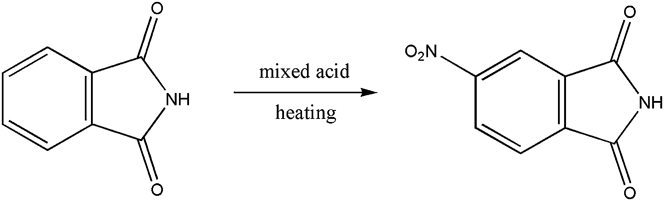
Concentrated sulfuric acid (56 mL) and fuming nitric acid (15 mL) were stirred continuously in a 250 mL three-neck flask, then phthalimide (10 g, 0.068 mol) was added to the mixed acid solution whose temperature was controlled under 15 °C (Scheme 2). When phthalimide was added completely, the flask was heated in a water bath with temperature rising to 35 °C. After 45 min, the color of the reacted solution became pale yellow. A yellow solid was generated when 250 g ice cake was added to the solution. The solid was filtered off and washed by plenty of distilled water. The product was recrystallized with ethanol and dried at 70 °C to obtain the pale yellow lamellar crystal compound. Yield: 8.5 g (65%), m.p. 191–193 °C; IR (KBr pellet, in centimeters): 1785, 1702 (C=O), 3321 (N−H), 3105 (C−H of benzene ring), 1541 (C−C), 1346 (NO2).
Synthesis of 4-nitryl phthalimide.

3. Synthesis of 4-nitryl phthalic diamide
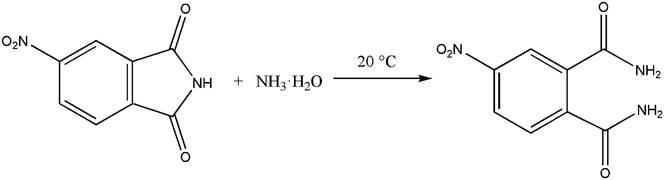
4-nitryl phthalimide (10 g, 0.052 mol) was put into a 200 mL flask and then 28% ammonia (aq; 40 mL) was added under incessant stirring (Scheme 3). Immediately, the raw material became into powder from lamella. After the reaction system was controlled at 20 °C for 3 h, the product was filtered off, washed by 5% ammonia (aq), and dried in a vacuum oven to obtain white powder compound. Yield: 6.8 g (62%), m.p. 194–195 °C; IR (KBr pellet, in centimeters): 1669 (C=O), 3435, 3314, 3197 (N−H), 1600, 1420 (C=C of benzene ring), 1521, 1345 (NO2).
Synthesis of 4-nitryl phthalic diamide.

4. Synthesis of 4-nitryl phthalonitrile
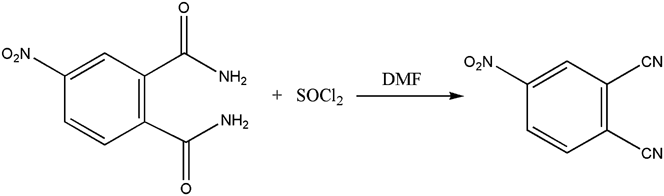
4-nitryl phthalic diamide (6.3 g, 0.033 mol) and DMF (13 mL) were stirred evenly in a 200 mL three-neck flask (Scheme 4). The reaction mixture became a light red suspension liquid with the temperature rising to 65 °C. Then, 6 mL of SOCl2 was added to the system in drops in 15 min by using constant pressure dropping funnel. The mixture was kept at 65–70 °C and then a glutinous liquid with a reddish brown and transparent appearance was generated. Subsequently, the liquid was poured into 30 mL ice water under stirring. Khaki deposition was separated out, filtered, and dried. The crude product was recrystallized with 25 mL ethanol and light yellow crystal compound was gained. Yield: 2.7 g (52%), m.p. 141–142 °C; IR (KBr pellet, in centimeters): 2240 (C=N), 3435, 3314, 3197 (N−H), 1610, 1586, 1455 (C=C), 3112 (C−H of benzene ring), 1537, 1335 (NO2).
Synthesis of 4-nitryl phthalonitrile.

5. Synthesis of M2Pc2HnC (M = Mn(II), Fe(II), Co(II), Ni(II), and Cu(II))
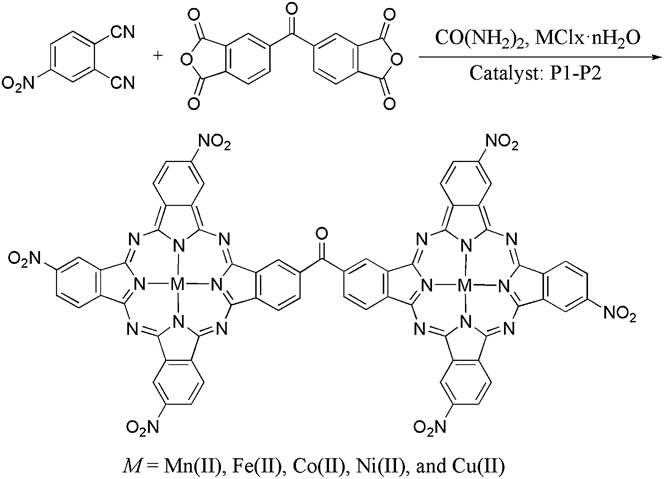
Binuclear metal phthalocyanines M2Pc2HnC (M 5 Mn(II), Fe(II), Co(II), Ni(II), and Cu(II), Scheme 5) were synthesized by using microwave technique. Each of these compounds is composed of two phthalocyanine rings as the electron donor and two metal ions as the electron acceptor, which is required for a compound to be successfully used as an electrocatalyst to Li/SOCl2 battery.Reference Stanley26
Synthesis of Mn2Pc2HnC: 4-nitryl phthalonitrile (1.0385 g, 6 mmol), 3,3′,4,4′-benzophenonetetracarboxylic dianhydride (0.3256 g, 1 mmol), urea (3.43 g, 0.057 mol), NH4Cl (0.1 g, 1.9 mmol), (NH4)2Mo2O7 (0.15 g, 0.44 mmol), and MnCl2·6H2O (0.485 g, 2 mmol) were mixed in a 100 mL mortar and ground evenly (Scheme 5). The mixture was irradiated in a microwave oven at 460 W for 10 min, and then at 800 W for 10 min. When being cooled to room temperature, the product was washed by distilled water, acetone, methyl alcohol, and diluted hydrochloric acid one after another for several times. After dried in a vacuum oven for 12 h, the resulting blue sample was refluxed with 150 mL acetone, methyl alcohol, and trichloromethane for about 4 h, respectively. Finally, the product was dried thoroughly to obtain Mn2Pc2HnC.
Synthesis of M2Pc2HnC (M = Mn(II), Fe(II), Co(II), Ni(II), and Cu(II)).

The synthetic method of M2Pc2HnC (M = Fe(II), Co(II), Ni(II), and Cu(II)) was the same as Mn2Pc2HnC. Only the corresponding inorganic metallic salts were changed. The results of IR spectra and elemental analyses of these products provide the evidence for the formation of the binuclear compounds.
Mn2Pc2HnC: blue powder, yield 0.53 g (37%), m.p. > 300 °C; IR (KBr pellet, in centimeters): 910, 1607, 1525, 1717, 1341, 1139, 1075, 744; Anal. Calcd. for C65H24Mn2N22O13: C 54.56, H 1.69, N 21.54; found: C 54.35, H 1.68, N 21.48.
Fe2Pc2HnC: navy blue powder, yield 0.61 g (43%), m.p. > 300 °C; IR (KBr pellet, in centimeters): 908, 1608, 1519, 1719, 1334, 1144, 1096, 754; Anal. Calcd. for C65H24Fe2N22O13: C 54.49, H 1.69, N 21.51; found: C 54.33, H 1.68, N 21.45.
Co2Pc2HnC: blue black powder, yield 0.59 g (41%), m.p. > 300 °C; IR (KBr pellet, in centimeters): 909, 1610, 1523, 1716, 1338, 1145, 1095, 756; Anal. Calcd. for C65H24Co2N22O13: C 54.26, H 1.68, N 21.42; found: C 54.07, H 1.67, N 21.37.
Ni2Pc2HnC: azury powder, yield 0.63 g (44%), m.p. > 300 °C; IR (KBr pellet, in centimeters): 911, 1610, 1528, 1716, 1342, 1145, 1094, 760; Anal. Calcd. for C65H24Ni2N22O13: C 54.27, H 1.68, N 21.42; found: C 54.03, H 1.67, N 21.34.
Cu2Pc2HnC: navy blue powder, yield 0.52 g (46%), m.p. > 300 °C; IR (KBr pellet, in centimeters): 912, 1608, 1524, 1718, 1339, 1142, 1091, 748; Anal. Calcd. for C65H24Cu2N22O13: C 53.91, H 1.67, N 21.28; found: C 53.67, H 1.66, N 21.21.
C. Electrochemistry
1. Cyclic voltammetry
The CV technique was carried out in a three-electrode system at room temperature. The simulated battery whose shell is made of polytetrafluoroethylene takes glassy carbon electrode as the working electrode with an effective area of 0.25 cm2, copper as a conductor wire, and Li foil as both the reference electrode and auxiliary electrode. The experiment was conducted with a scan rate of 100 mV s−1. Before the trial of CV began, the electrodes were polarized at least 3 min at 5 V to eliminate the LiCl film formed on the electrode surface. The i–E curves were generally recorded using a CHI660 electrochemical workstation equipped with a personal computer.
2. Electrochemical measurement
Cathode preparations: the cathode material was obtained via the blend of acetylene black and a conductive additive in a certain proportion (92:8 wt%) with diluted polytetrafluoroethylene emulsion. The mixture was churned into a paste and repeatedly rolled into an established film by a heated roller machine. Then, the film was dried at 150 °C for 48 h and shaped into coin-like slices with an area of 1.00 cm2.
Battery assemblies: the Li/SOCl2 battery was assembled in dry ambient conditions in which the relative humidity was kept below 3%. The performance of the battery with a 1.47 mol L−1 LiAlCl4/SOCl2 solution containing electrocatalyst of 2 mg was evaluated at an ambient temperature of 23–25 °C, with a constant resistance of 40 Ω, and an average current density of 70 mA cm−2 until the battery was discharged to 2 V continuously. In the process, relations between the output voltage (U) and the discharge time (t) were measured. Numerical analysis methods were used to quantify the electrocatalytic performance of M2Pc2HnC (M = Fe(II), Co(II), Ni(II), and Cu(II)) to the battery.
The capacity of the Li/SOCl2 battery is:
 $$C = \int {I{\mathop{\rm d}\nolimits} t} = \int {U/{\mathop{\rm Re}\nolimits} {\mathop{\rm d}\nolimits} t} = \sum {U/{\mathop{\rm Re}\nolimits} \Delta t} = 1/{\mathop{\rm Re}\nolimits} \sum {U\Delta t} \quad .$$
The rate capability (X) of the battery is:
 $$X = {{\left( {C - {C_0}} \right)} \mathord{\left/ {\vphantom {{\left( {C - {C_0}} \right)} {{C_0} \times 100\% }}} \right. \kern-\nulldelimiterspace} {{C_0} \times 100\% }}\quad .$$
The average voltage of the battery is:
 $${U_{{\rm{av}}}} = {{\sum {V\Delta t} } \mathord{\left/ {\vphantom {{\sum {V\Delta t} } {\sum {\Delta t} }}} \right. \kern-\nulldelimiterspace} {\sum {\Delta t} }}\quad .$$
In the above formulas, C stands for the capacity of the battery in the presence of the M2Pc2HnC, U stands for the output voltage of the battery, I stands for the discharge current of the battery, Δt stands for the discharge time of the battery, Re stands for the discharge resistance of the battery, and C 0 stands for the capacity of the battery in the absence of the metal phthalocyanines.
III. RESULTS AND DISCUSSION
A. IR Spectra
IR spectra are measured using KBr pellets in the region of 400–4000 cm−1. The IR spectra of the binuclear compounds M2Pc2HnC (M = Mn(II), Fe(II), Co(II), Ni(II), and Cu(II)) show typical absorption bands: the absorption peaks of coordination bond (M–N) between metallic ion and phthalocyanine ring inner N are at 908–912 cm−1. The absorption peaks at 1519–1528 and 1608–1610 cm−1 are caused by the stretching vibrations of C=C and C=N in phthalocyanine ring inner skeleton, respectively. The absorption peaks of the backbone of M2Pc2HnC are at 1139–1146, 1075–1096, and 744–760 cm−1, respectively. The characteristic absorption peaks of C=O that are adjacent to benzene ring are in the range of 1716–1719 cm−1. The strong absorption peaks of  ${v_{{\rm{N}}{{\rm{O}}_2}}}$ are in the range of 1334–1342 cm−1, which can expand the conjugative effect of the phthalocyanine rings and decrease the orbital energy, thus the wave number of the binuclear compounds are more likely to be enlarged. The stretching vibration peaks of C−H are in the range of 3000–3200 cm−1. These data reveal that the typical absorption peaks are in accordance with the accurate structures of these metal phthalocyanines.
B. UV-vis spectra
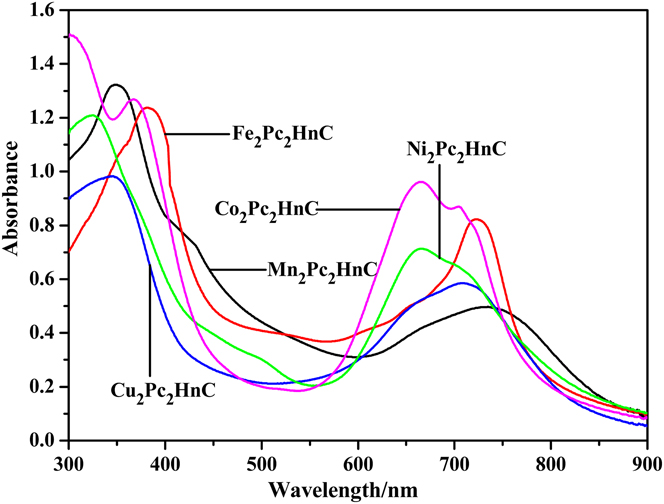
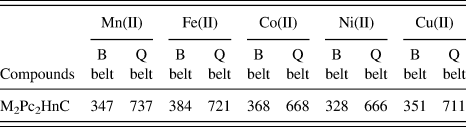
The UV-vis spectra of M2Pc2HnC (M = Mn(II), Fe(II), Co(II), Ni(II), and Cu(II)) are measured in DMF (Fig. 1; Table I).
UV-vis spectra of M2Pc2HnC (M = Mn(II), Fe(II), Co(II), Ni(II), and Cu(II)).

The UV-vis spectra of M2Pc2HnC (M = Mn(II), Fe(II), Co(II), Ni(II), and Cu(II)) (λ/nm).

The spectra exhibit two strong absorption bands both correlating to π–π* transitions, B belt at about 300–400 nm in the ultraviolet region and Q belt at about 600–800 nm in the visible region. The two bands are in agreement with the electronic spectra characteristics of the metal phthalocyanines, which demonstrate that the structures of the M2Pc2HnC are accurate with the microstructure. The absorption intensity of M2Pc2HnC is relatively strong, so the catalytic activity of the binuclear compounds to Li/SOCl2 battery should be fine.Reference Bayir, Hamuryudan, Gurek and Bekaroglu27,Reference Xu, Zhang, Cao, Zhao and Li28
C. Cyclic voltammetric analysis
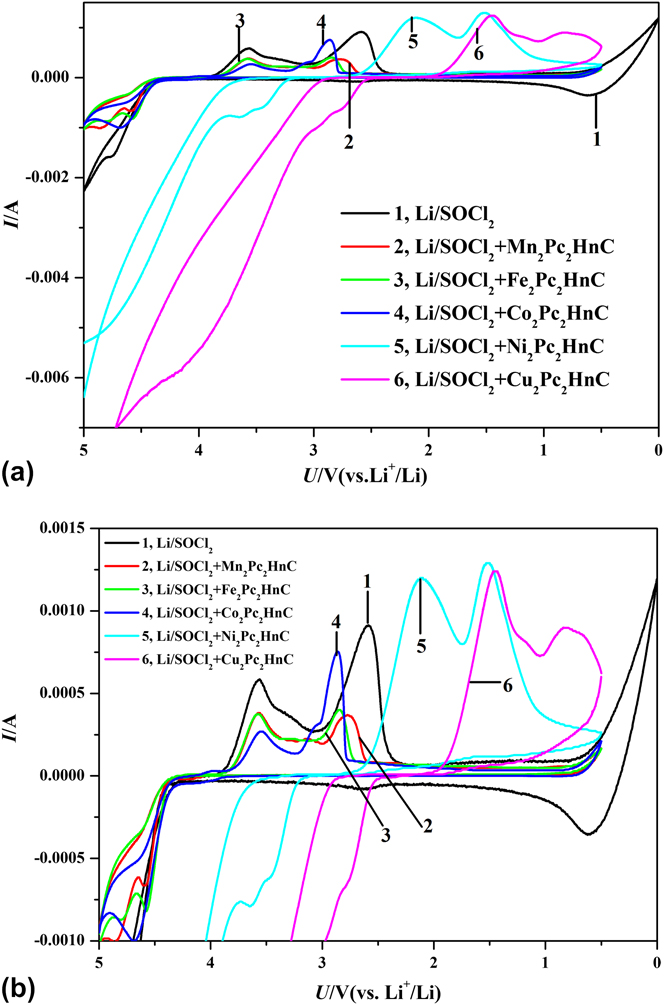
The CV curves of M2Pc2HnC in 1.47 mol L−1 LiAlCl4/SOCl2 electrolyte are shown in Fig. 2. Figure 2(a) is the complete CV curves. To show the changes of the peaks obviously, Fig. 2(b) was magnified by reselecting the coordinates of y-axis. When none of the electrocatalysts exists in the battery, two current peaks at 2.60 V and 3.57 V in the cathode curve are found in the potential range of 5–0 V (curve 1). The results indicate that the reductive reaction of SOCl2 in our three-electrode system was finished by two steps [shown in Eqs. (7) and (8)]. The two peaks may be assigned, respectively, to reductions of SOCl2 and SCl2. The assignments are in agreement with previous reports.Reference Abraham and Mank29 The high current peak at 2.60 V and the low current peak at 3.57 V mean that Eq. (7) is the rate-controlling step and Eq. (8) is the fast reaction step for the reductive reaction of SOCl2. There is no relevant oxidation peak in the reverse cyclic scanning process, which indicates that the reductive reaction of SOCl2 is irreversible.
 $$2{\rm{SOCl}}_2 + 2{\rm{e}} \to {\rm{SCl}}_2 + {\rm{SO}}_2 + 2{\rm{Cl}}^ - \quad .$$
 $${\rm{SCl}}_2 + 2{\rm{e}} \to {\rm{S}} + 2{\rm{Cl}}^ - \quad .$$
Cyclic voltammograms of the Li/SOCl2 battery recorded on the glassy carbon electrode. Scan rate was 100 mV s−1. The voltage scan direction was first from 5 to 0 V and then from 0 to 5 V. (a) the Complete CV Curves; (b) the CV Curves Magnified by Reselecting the Coordinates of y-axis.

As the metal phthalocyanine electrocatalysts were added in the electrolyte of the Li/SOCl2 battery, they caused the electrode potentials of the reduction peaks to be shifted or become higher, which demonstrate that these electrocatalysts have great electrocatalytic effects on the battery. Compared with curve 1, the high peak potentials of curve 2 (2.78 V), 3 (2.85 V), and 4 (2.87 V) are shifted toward positive direction by 0.18 V, 0.25 V, and 0.27 V, respectively. The shifted numbers of curves 3 and 4 are almost equal (the difference is only 0.02 V), which means that Fe2Pc2HnC and Co2Pc2HnC may have the similar electrocatalytic activity to the battery. The speculation is confirmed by the catalytic activity measurement of the compounds, which is discussed in the electrocatalytic activity section. The high peak potentials of curves 2–4 are shifted positively, which means that the compounds Mn2Pc2HnC, Fe2Pc2HnC, and Co2Pc2HnC show good electrocatalytic activities in our designed system.Reference Kim, Choi and Chjo30 Their good electrocatalytic activities are present because they can efficiently accelerate the reaction speed of the rate-controlling step [Eq. (7)] by the shift of the reduction potential for SOCl2 toward positive direction. The peak potentials of curves 5 and 6 shift negatively compared with curve 1, which means that the electrocatalytic reaction is relatively difficult to occur.Reference Zhang, Wang, Xu, Huang, Xu and Zhao31 But the magnitude of the reduction current caused by the electrocatalysts Ni2Pc2HnC and Cu2Pc2HnC indicates that the first step for the catalytic activity of the two compounds may be the adsorption of catalyst molecules on the electrode surface, followed by its own reduction at the electrode, which in turn reduces SOCl2 and also can accelerate the reaction speed of the rate-controlling step.Reference Kim, Choi and Chjo30 The results indicated that the Li/SOCl2 battery containing metal phthalocyanine electrocatalysts M2Pc2HnC (M = Mn(II), Fe(II), Co(II), Ni(II), and Cu(II)) is improved remarkably in the electrochemical point, namely that the electrocatalytic reactions of the battery including the binuclear compounds are easy to carry out. According to the reduction peak potentials of SOCl2, it is found that the difficulty level of electrocatalytic reactions catalyzed by the binuclear metal phthalocyanines with different central metal ions is as follows: Co(II) > Fe(II) > Mn(II) > Ni(II) > Cu(II), which is on the whole the same as the previous literature.Reference Wiesener, Ohms, Neumann and Franke32 The electrochemical results demonstrated that the central metal in the phthalocyanines play an important role in improving the electrochemical activity of the battery.
CV is induced as an important additional electrochemical testing method for the binuclear metal phthalocyanine electrocatalysts to Li/SOCl2 battery in this study. CV analysis makes the characterization methods for the electrocatalytic activity of the binuclear compounds M2Pc2HnC more comprehensive, which is conducive to explore more information for the electrocatalytic reaction mechanism of the binuclear electrocatalysts to Li/SOCl2 battery.
D. Electrocatalytic activity
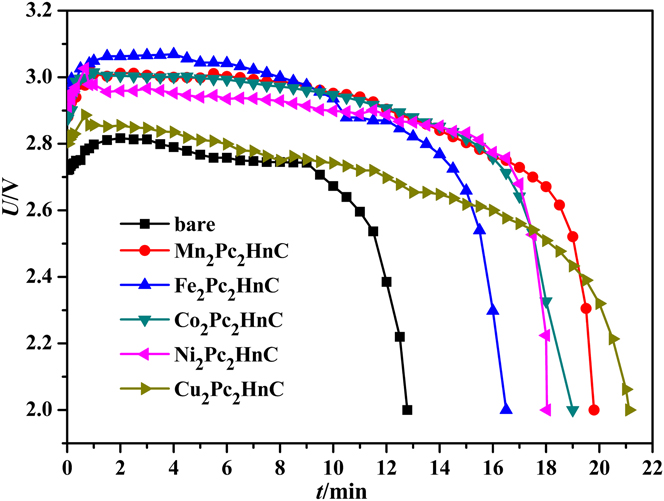
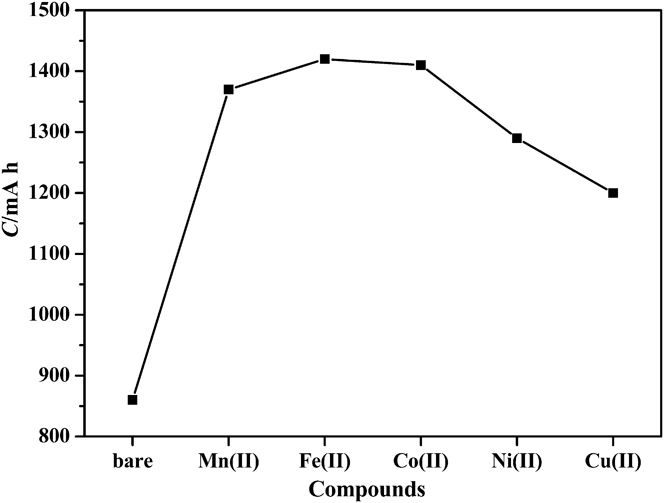
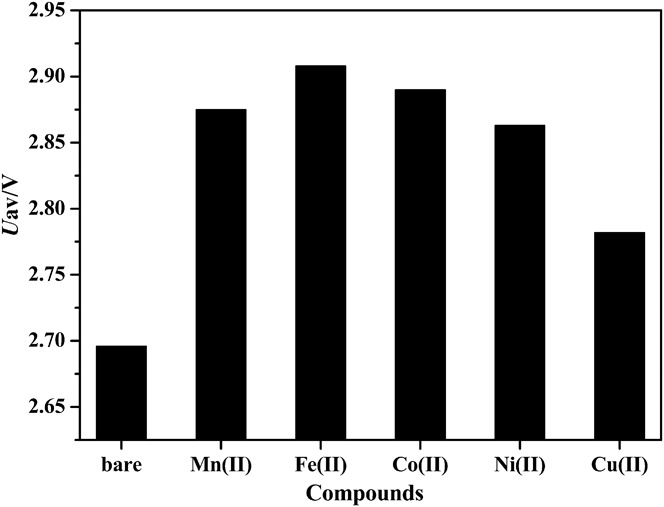
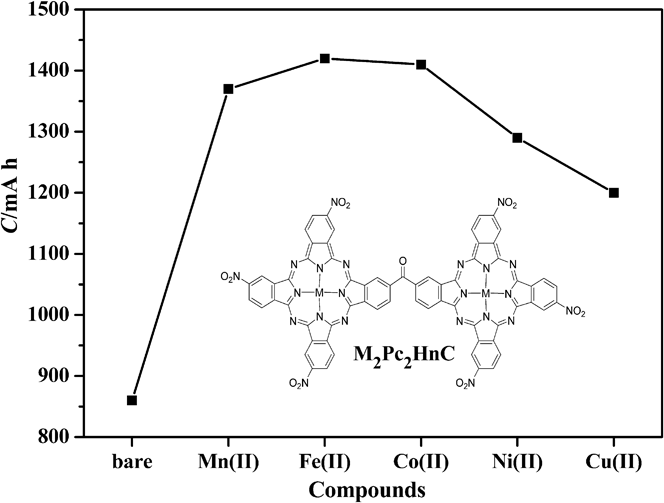
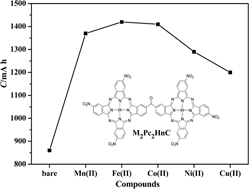
The discharge curves of Li/SOCl2 battery electrocatalyzed by M2Pc2HnC (M = Mn(II), Fe(II), Co(II), Ni(II), and Cu(II)) are shown in Fig. 3. The capacity of the battery that reflects the electrocatalytic activity of the binuclear metal phthalocyanines is shown clearly in Fig. 4. The average voltage of Li/SOCl2 battery relevant to different binuclear compounds is revealed in Fig. 5. The results indicate that all additives have wonderful influence on the battery, which can be demonstrated by the increasing capacity and the improving voltage of the battery when these additives were added. It is easy to find that the order of capacity for the binuclear compounds with diverse central metal ions is as follows: Fe(II) (65%) > Co(II) (64%) > Mn(II) (59%) > Ni(II) (50%) > Cu(II) (40%). Among the electrocatalysts, the capacity of the battery containing Fe2Pc2HnC and Co2Pc2HnC can be improved by 65% and 64% respectively, compared with the battery without the two electrocatalysts. The results are in favor of that Fe2Pc2HnC and Co2Pc2HnC may have the similar electrocatalytic activity to the battery, which is surmised by the CV results. By contrasting the average voltage of the binuclear compounds, the influence of the metal ions is displayed in the following sequence: Fe(II) (2.91 V) > Co(II) (2.89 V) > Mn(II) (2.88 V) > Ni(II) (2.86 V) > Cu(II) (2.78 V). Moreover, the discharge time of the Li/SOCl2 battery catalyzed by these binuclear compounds lengthened for 3–8 min (Fig. 3).
The relationship between the discharged voltage and the discharged time of Li/SOCl2 battery (SOCl2 solution containing about 2 mg M2Pc2HnC (M = Mn(II), Fe(II), Co(II), Ni(II), and Cu(II))).

The relationship between the capacity of Li/SOCl2 battery and metal phthalocyanines (SOCl2 solution containing about 2 mg M2Pc2HnC (M = Mn(II), Fe(II), Co(II), Ni(II), and Cu(II))).

The relationship between the average discharged voltage of Li/SOCl2 battery and metal phthalocyanines (SOCl2 solution containing about 2 mg M2Pc2HnC (M = Mn(II), Fe(II), Co(II), Ni(II), and Cu(II))).

A novel series of binuclear transition metal phthalocyanines M2Pc2HnC (M = Mn(II), Fe(II), Co(II), Ni(II), and Cu(II)) were developed for highly efficient electrocatalysts to lithium/thionyl chloride (Li/SOCl2) battery. The capacity of the battery can increase by approximate 40-65 % when the binuclear compounds are present in the electrolyte of the battery.

There exists a performance difference of partial electron transition from the metal ion to the ring during the formation of compounds, which gives rise to different electrocatalytic activities of these binuclear compounds.Reference Savy, Andro and Bernard33 The orders of capacity and voltage of the battery catalyzed by the binuclear compounds have minor differences from that of the cyclic voltammetric results. Only the order between Fe(II) and Co(II) is slightly different. There are many factors which can cause the order confusion, such as complicacy of electrode surface, concentration gradient of metal ions, and solubility of electrocatalysts. Several researchers tried to explain or predict the effect of central metal ions in terms of macrocycle molecules, nevertheless, no authoritative explanation has been proposed.Reference Kropf and Hofmann34,Reference Alt, Binder and Sandstede35 The deep relationship between the cyclic voltammetric analysis and discharging test will be further excavated in our laboratory. But all evidence testified that the binuclear metal phthalocyanines electrocatalysts in this study can improve the electrochemical properties of Li/SOCl2 battery dramatically. In this way, the peculiar performance of them will be of great use for special purposes, as in military field and aerospace industry.
In addition, the introduction of substituents into the phthalocyanine ring has great influence on the catalytic activity of binuclear metal phthalocyanines M2Pc2HnC (M = Mn(II), Fe(II), Co(II), Ni(II), and Cu(II)) to Li/SOCl2 battery, which affects the catalytic active center and properties of the metal phthalocyanine catalysts seriously. It is primarily embodied in two aspects: on one hand, substituents have an influence on the solubility of metal phthalocyanines, on the other hand, substituents can change the conjugation of phthalocyanine ring, and further affect the catalytic activity of metal phthalocyanines.Reference Xu, Zhao, Li, Li, Cao and Lu36 In this work, the electrocatalytic activity of the binuclear compounds M2Pc2HnC (M = Mn(II), Fe(II), Co(II), Ni(II), and Cu(II)) is improved by introducing the electron withdrawing group –NO2, rather than introducing an electron donating group just like that reported previously in the literatureReference Zhang, Wang, Xu, Huang, Xu and Zhao31,Reference Xu, Zhang, Wang and Zhao37 The electrocatalytic activity results show that the capacity of Li/SOCl2 battery in the presence of M2Pc2HnC (M = Mn(II), Fe(II), Co(II), Ni(II), and Cu(II)) can be improved greatly for the whole series. While the capacity of the battery that is electrocatalyzed by binuclear metal phthalocyanines with electron donating groups in our previous work is improved unevenly. Some are improved relatively high, some are low, and very few are not improved completely.Reference Zhang, Wang, Xu, Huang, Xu and Zhao31,Reference Xu, Zhang, Wang and Zhao37 The electrocatalytic performance of the related binuclear metal phthalocyanines with other electron withdrawing groups to the battery is studied underway in our laboratory. We expect to conduct an intensive study on binuclear metal phthalocyanines catalyzed reaction for Li/SOCl2 battery, and explore the authoritative catalytic mechanism further.
IV. CONCLUSIONS
A different and novel series of the binuclear transition metal phthalocyanines M2Pc2HnC (M = Mn(II), Fe(II), Co(II), Ni(II), and Cu(II)) have been developed in this work (Fig. 6). To study the electrocatalytic performance of M2Pc2HnC to Li/SOCl2 battery, the compounds were added to the electrolyte of the battery to investigate their electrochemical properties. The results show that the capacity of the battery containing these electrocatalysts in electrolyte is increased approximately by 40–65%, and the order of electrocatalytic activity with diverse central metal ions is: Fe(II) > Co(II) > Mn(II) > Ni(II) > Cu(II).
ACKNOWLEDGMENTS
The authors thank the National Natural Science Foundation of China (No. 21171139 and 21371143), the National Basic Research Program (973 Program, 2013CB934001), Key Laboratory Research and Establish Program of Shaanxi Education Section (No. 11JS112), and Special Foundation of Shaanxi Education Section (No. 12JK0603) for the financial support of this work.