1. Introduction
Can judges be biased in their judicial decision making? Given the role of the judiciary in modern democracies (e.g. Acemoglu and Robinson, Reference Acemoglu and Robinson2012; Gibler and Randazzo, Reference Gibler and Randazzo2011; Hammergren, Reference Hammergren2007), its role in checks and balances on state power, and its impacts on the economy (e.g. Sherwood, Reference Sherwood2004; Weder, Reference Weder, Rowat, Malik and Dakolias1995), this question deserves serious consideration. What if judges’ decisions are based mostly on randomness or ideology and not on the strict interpretation of the law? Many argue that uncertain and insecure judicial systems may be particularly harmful for economies.
That seems to be the case in Brazil: “The quality of enforcement of guarantees is poor because both the law and the jurisprudence are biased toward the debtor” (Arida et al., Reference Arida, Bacha, Lara-Rezende, Giavazzi, Goldfajn and Herrera2005, p. 16). According to these authors, that bias is the main reason for the absence of a long-term credit market and the presence of high interest rates in the country.
Other papers followed Arida et al. (Reference Arida, Bacha, Lara-Rezende, Giavazzi, Goldfajn and Herrera2005). Some provided further support for the claim of pro-debtor bias on the part of Brazilian judges (e.g. Castelar Pinheiro, Reference Castelar Pinheiro2005); others denied it (e.g. Gonçalves et al., Reference Gonçalves, Holland and Spacov2007; Ribeiro, Reference Ribeiro2006). However, none of this discussion has been accompanied by sound empirical evidence.
This paper aims at offering contributions to this discussion. Our first objective is to find more evidence of the so-called pro-debtor bias, by analyzing a larger sample than those found in previous papers. Second, we provide further evidence that the Brazilian judiciary is highly insecure, as the chances of amendments are significant when a case moves upwards in the courts. The combination of these two phenomena – bias and insecurity – coupled with judicial inefficiency – result in social losses and also high distrust on the judicial power. To demonstrate this process, we adopt a conceptual model in which we demonstrate the estimated social outcomes. Combined with empirical evidence, we relate it to the results of a nationwide survey and official statistics from the National Council of Justice. We attempt to show that courts characterized by bias, insecurity, and inefficiency, tend to have low levels of trustworthiness.
This paper has eight sections, including this introduction. We start section 2 by presenting some literature on the impact of the judiciary on the economy. Particular attention is given to empirical evidence, and also to the literature of “Legal Origins,” and later, “Law and Finance.” Discussion in this section provides the links between courts and judges to socio-economic outcomes. In the second part of this section we briefly discuss some theories on judicial decision making that try to answer questions such as “How do judges judge?” and “What affects judicial decisions?” In section 3, we present our conceptual model, based on an institutional approach. We explain the consequences, in terms of social losses and (un)trustworthiness. With this model in mind, we depart for the empirical analysis of the Superior Court of Justice (STJ) in Brazil. Before that, in section 4, we describe the structure and functioning of the Brazilian judiciary, specifically the role of the STJ. In section 5, we review the hypotheses to be tested, and present the methodology and database used in the empirical analysis. In section 6, we present and discuss the results of our empirical analysis. In section 7, we bring a secondary source of data, the Index of Trust in Justice (ICJBrasil), which offers preliminary confirmation of the results predicted by the conceptual model presented before. Finally, section 8 closes the paper with some concluding remarks.
2. Literature review
A broad literature – both theoretical and empirical – brings evidence that the judiciary does impact the economy. On the other hand, what does impact judicial decisions? We dwell on these two discussions below.
How do judges and legal institutions impact the economy?
The judiciary owns a special place in economic analysis. Coase (Reference Coase1960) and other “founding fathers” of the Law and Economics movement – such as Aron DirectorFootnote 1, Guido Calabresi,Footnote 2 and Henry Manne,Footnote 3 among others – showed how the courts and economic activities are directly related. Countless theoretical and empirical works have followed, offering evidence of the interconnection between the legal and the economic worlds.
If judges and courts are important to the economy, what would be considered a “good judiciary”? Linn Hammergren defines it:
Well-functioning judicial systems are supposed to control government abuses and protect basic human and civil rights; create an environment that fosters the development of market-based economies; deter crime and civil violence; reduce levels of societal conflict; support the development of legitimate democratic governance; and reduce social inequities by helping spread the benefits of development to marginalized groups. (2007, p. 4, emphasis added).
It is clear that courts in many underdeveloped countries do not meet some of the requirements above (or even, none of them). The idea that flaws in the functioning of the judiciary may be a major cause of underdevelopment became crystallized in the movement known as Law and Development. Although unrelated, this movement's ideas are linked to those of “Legal Origins” – which we will discuss later – since both claim that legal institutions are critical to long-run economic performance.
Since the beginning of the 1990s, with the advancement of empirical methodologies and other fields of studies, such as Law and Economics, the discussion of the role of the judiciary in developing economies gained additional impetus as more and more empirical works appeared: for example, Buscaglia and Ulen's (Reference Buscaglia and Ulen1997) focus on the case of Latin American countries. They show that a strong judiciary was a critical complement in the post-democratization and post-privatization processes that many of these countries went through during the 1980s and 1990s. Citizens and private entities started to demand greater clarity in the definition of their rights and duties, and also to demand effective and efficient enforcement of these new rules.
Based on data collected in interviews with entrepreneurs in Latin America, Weder (Reference Weder, Rowat, Malik and Dakolias1995) shows that 23% of the variation in per capita growth could be explained by the quality of judicial rules and their enforcement in a country. Conversely, Sherwood (Reference Sherwood2004) conducted a survey in seven countries (Argentina, Brazil, Canada, Peru, the Philippines, Portugal, and Spain), between 1996 and 2002. His results show that the malfunctioning of the judiciary was responsible for 20% of the lack of growth and for 10% of the reduction in credit in these countries. If the judiciary had functioned properly (using developed countries as a parameter), these countries would have observed an additional 14% increase in investments, 12% in employment, and 18% in sales.
A specific and well-known literature further provided a vast amount of evidence of the impacts of the judiciary on financial markets, and indirectly, on long-run economic outcomes. Let us see it next.
Legal origins
The question whether certain categories of legal families (or legal traditions) are superior to others – in terms of economic and social outcomes derived – is not a new one. Garoupa and Pargendler (Reference Garoupa and Pargendler2014) trace it back to Fortescue's opus in 1475, then to Jeremy Bentham, Max Weber, and Friedrich Hayek, among others. Richard Posner, one of the founders of Economic Analysis of Law, also made contributions to this debate in the 1970s. In his classical work (Reference Posner2003[1973]), Posner reached the conclusion that the Anglo-American legal system tends, historically, to achieve economic efficiency:
The common law helped promote economic development in the 19th century by adopting a permissive, even facilitative, stance toward entrepreneurial activity [. . .] it subsidized growth by failing to make industry bear all the cross that a genuine commitment to efficiency would have required it to bear [. . .] there is a sense, but a rather uncontroversial one, in which the common law, insofar as it has been shaped by a concern with efficiency, may be said to have fostered growth [. . .] (Reference Posner2003, p. 253, emphasis added)
Other pieces of research followed, presenting arguments either for or against this thesis. Yet a (noisy) revival of this discussion happened in the late 1990s, in the so-called “Law and Finance” literature. This time, differently from before, economists rather than legal scholars led the discussion and presented empirical evidence to support their arguments. Keefer (Reference Keefer2007) sums up the results and impacts of the Law and Finance movement:
A prominent approach, particularly in the finance literature, is to trace the financial development of countries back to their legal origins. The law and finance literature (the seminal contributors to which are La Porta, Lopez-de-Silanes, Shleifer and Vishny, e.g. Reference La Porta, Lopez-de-Silanes, Schleifer and Vishny1998) has presented substantial evidence that legal origin is significantly associated with a variety of aspects of government performance and that, specifically, countries of English, German or Scandinavian legal origin perform significantly better on numerous dimensions than countries with legal systems rooted in French or socialist legal traditions. To explain these outcomes this literature argues that, in contrast to French or socialist legal systems, the English common law tradition offered judicial protection of private property rights against predation by the state. The German legal system, though also in the civil law tradition adopted by the French, was consciously intended to be more amenable to change than the French . . . (Keefer, Reference Keefer2007, pp. 4–5)
Later on, the same authors published a summary of the findings made throughout the years (La Porta et al., Reference La Porta, Lopes‐de‐Silanes and Schleifer2008). With more evolved methodologies, the authors reaffirm their original findings, mainly that “differences in legal rules matter for economic and social outcomes” (p. 326).
Two decades later, a vast literature specifically devoted to supporting or denying the findings of Law and Finance was created, but the question remains: Are legal origins critical determinants of economic outcomes? On one hand, much work continues to emerge, offering evidence that common law countries have legal institutions more conducive to judicial independence, protection of property rights, and consequently, more financial and economic development. On the other hand, several authors deny these results by pointing to methodological errors of measurement. According to this second group of researchers, other factors may complement or even replace the explanations offered above. They claim, for instance, that one should (also) look at the manner in which judges make decisions.
What explains judicial behavior?
As a pioneer in this study, Pritchett (Reference Pritchett1968) developed in the 1950s several methodologies for analyzing judicial behavior. “Bloc analysis” used Supreme Court legislatures to evaluate reasons that led to non-unanimous voting. Pritchett, on the other hand, attempted through “attitude analysis” to include personal characteristics (or “personal policy attitudes”) as determinants of judges’ voting patterns.
Later on, Tate (Reference Tate1983) further developed methodologies for the study of judicial decision making, including both qualitative and quantitative approaches. Since then, the author believed in the potential of “standard statistical methods such as regression analysis” (p. 74) for this type of analysis.
Posner (Reference Posner2008) explains judges’ personal behavior in terms of “Bayesian preferences,” as defined by Bayes’ statistical theorem: it shows that future probabilities of a certain kind of behavior (or decision) may be explained by former probabilities of that same behavior. Thus, in order to predict the occurrence of a certain type of behavior, researchers should evaluate how previous decisions were made in the past.
Empirical evidence corroborates the thesis judges do not “simply” interpret the law, as legalists would argue. Internal factors – such as one's ideology – and external factors – such as pressures from public opinionFootnote 4 –strongly impact their decisions. Some of these factors may change throughout one's career (again, ideology would be an example), and others are constant (such as gender or race).Footnote 5 The outcome – i.e. how judges effectively judge – is a complex combination of all those factors. For this reason, empirically measuring the impact of a certain factor is not an easy task. Given the objectives of this current paper, we concentrate our discussion on the literature relating judges’ ideology to their decision making.
As mentioned above, since the first half of the 20th century Pritchett has attempted to study factors affecting judicial behavior. He found evidence that US Supreme Court Justices were influenced by political ideologies. Later on, Epstein, Landes and Posner (Reference Epstein, Landes and Posner2013) continued that exercise, showing that “judicial self-restraint [on personal ideology] has long been in decline [since the 1960s]” for US Supreme Court Justices. In other words, the impact of ideology has been growing over time. Moreover, the impacts of political ideology are not confined to Supreme Court justices.
Where does this paper stand in this literature?
Surely, the discussion about how judges impact the economy and how ideology and other variables impact judicial decision making encompasses several diverse and broad literatures. It presents different perspectives, approaches, and backgrounds. The purpose of our paper is not to review, nor specifically to test the hypotheses presented in these pieces of work. First, we attempt to make a contribution to the very limited empirical literature on judicial decision making in Brazil. Second, knowing that judicial behavior impacts the economy – as the literature above shows us – we attempt to link the trends of observed judicial behavior to the discussion of some socio-economic results: “Do biased judicial decisions lead to increased judicial insecurity? Does this combination increase social distrust on the part of citizens?” Finally, if judicial decision making could be explained by factors other than the strict interpretation of the law, we try to access what else determines it.
Before that, we present a conceptual model in the following section.
3. A conceptual model: judicial decision making in an institutional approach
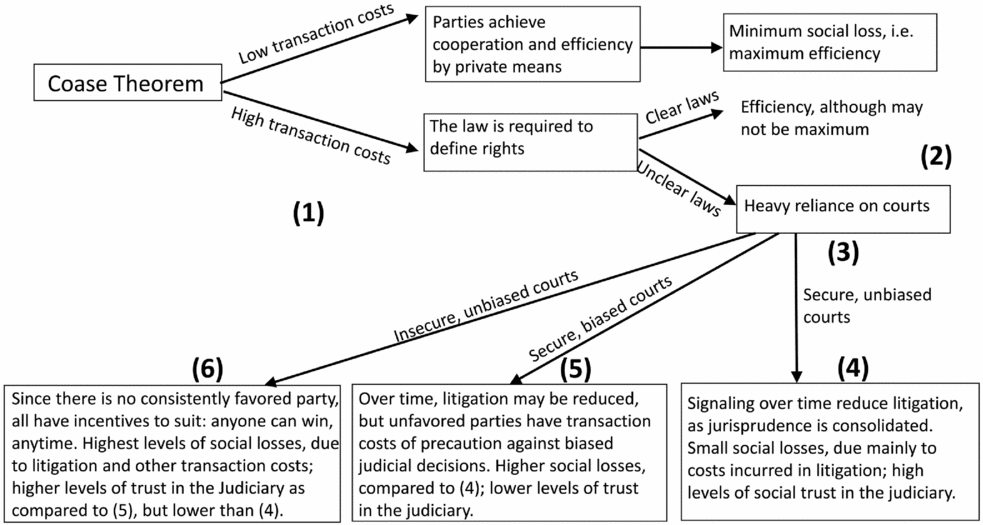
Our analysis starts with the Coase Theorem, as indicated by (1) in Figure 1. Coase predicts that, under insignificant transaction cost, parties might achieve cooperation and efficiency independently of the legal allocation of rights. This is the best of the situations: social losses are minimized, and efficiency is maximized in this case. However, transaction costs are usually high in the real world, and the legal allocation of rights does have an impact on the economy. Thus, in the presence of a transaction cost, the law is required to allocate property rights; but the quality of the law is not guaranteed, as indicated by (2). If the law is good, and legal rules are clear, a high level of economic gains might still be achieved. This is a situation in which property rights are guaranteed, contracts are legally enforced, and economic freedom available. Acemoglu and Robinson (Reference Acemoglu and Robinson2012) envisaged this scenario as one with “inclusive institutions.” If efficiency is not maximized, and if the (legislated) law is not good or is unclear, gloomier results emerge. As indicated by (3), there will be high reliance on courts, because judges are asked to help interpreting unclear laws. Litigation rates will be high, and this leads to significant levels of social losses. Under such circumstances, it is critical to understand how judicial decision making is done, because it directly influences the level of social losses.
Impacts of legal institutions and judicial decision-making on social losses and levels of trustworthiness of the judiciary

Under this conceptual model, judicial trustworthiness is determined by two factors: the presence or absence of bias, and the security or insecurity of decisions made by judges. Although bias may be hard to define, we assume that decisions that consistently favor certain types or groups of individuals are considered “biased.” Furthermore, we affirm that this definition is valid even when there might be selection bias of cases that are brought to the courts. Thus we call “bias” any consistent trend observed in decisions effectively made by judges – it does not matter whether cases brought to courts should or should not “by justice” be won by a particular group of people. Given the set of lawsuits judges are faced with, every time there is a consistent trend in their decisions, it is considered evidence of “bias.” From a social perspective, this definition is also valid, because what litigants do is to look at decisions effectively made in the courts. Judicial signaling does not come from estimations of contrafactuals, since agents look at real cases decided in the courts, evaluate the chances of winning, and make their own decisions to litigate or not based on those observations.
Therefore, under this conceptual model, if there are no clear trends in the chances of certain types of litigants winning cases, we will assume that there is no judicial bias.Footnote 6
As to security, or predictability, our definition is less controversial: secure courts make consistent decisions when dealing with similar matters. Insecure courts, on the other hand, decide “randomly”: different courts or different judges make diametrically different decisions on very similar matters. Even within the same timeframe, different justifications may be used to grant different judicial outcomes. This characterizes an environment permeated with “judicial insecurity.”
One might predict the outcomes achieved by the combination of different types of these two factors. In a “not so bad” combination (4), even when a society heavily relies on courts to define the allocation of property rights, judges decide in an unbiased and consistent manner, and social losses will be “not so high.” As a consequence, jurisprudence is consolidated. This serves as a clear signal to society, and the litigation rate decreases through time (parties learn from the signals and engage in more extrajudicial negotiation). Predictability and unbiasedness of courts bring efficient outcomes, so citizens have higher levels of trust in the judiciary, as it is “doing its job” of solving conflicts and bringing predictability to the environment.
If judicial decisions are marked by judicial bias, individuals learn through time who the courts usually “favor”; those who are consistently disfavored will avoid litigation and try private negotiations to solve disputes. But this may lead them to engage in inefficient bargaining just in order to gain acceptance by the other party, and avoid courts at all costs. These parties, who are discriminated against by biased judicial decisions, must incur higher transaction costs. Most importantly, although security and predictability is usually desired in society, in this situation, the existence of consistent judicial bias brings high levels of social distrust in courts (5). We claim that social losses will be high – although not the highest – and distrust in courts will be the highest in this situation.
Finally we have a situation in which courts are insecure (unpredictable), but unbiased, i.e. there are no clear trends in the manner by which judges make their decisions (6). Due to the lack of consistency, any party believes he/she have very high chances of winning; this is what Cooter (Reference Cooter1983) denominates the “optimism theory of trials.” Under such circumstances, the level of litigation will be very high, and because of that, social losses are also high. Furthermore, there is judicial insecurity. The Coase Theorem predicts that legal allocation is required to solve conflicts involving high transaction costs; if the law is unclear, the judiciary has to fill this gap. But if not even courts are able to offer clear signs of what the law means or implies, agents must make decisions under high levels of uncertainty. Thus, social losses and inefficiency are the highest; however, because judges are not perceived as biased toward particular types of individuals, social distrust in them does not reach the maximum level. Insecure – and even inefficient – courts are “bad,” but are not as “bad” as biased courts.
A special case: biased and insecure courts
By our definition, biased courts, or biased judicial decisions, are those that consistently favor particular types of individuals. Because of this consistency, everyone can guess who the winner will be. Conceptually, bias implies consistency and security, though a “bad” one (1). However, in practice, it is possible to have bias and insecure courts. The reason is that a biased court (or a biased judge) may face a high probability – although not a certainty – of having its decisions reformed by other courts, especially higher ones. If this is the case, social losses and social distrust will be the highest of all situations predicted by our conceptual model.
Thus, we were able to combine the Coase Theorem's predictions, and further match them with other factors related to the functioning of courts. Taking a normative perspective, one may suggest that, for potential institutional innovations, courts should seek secure (predictable) and unbiased decisions, since this is the situation in which social losses are minimized and judicial trust is maximized in society.
4. Structure and functioning of the Brazilian judiciary
It would be helpful to discuss briefly the structure of the Brazilian judiciary, so as to understand its basic functioning.
Structure of the Brazilian Judiciary

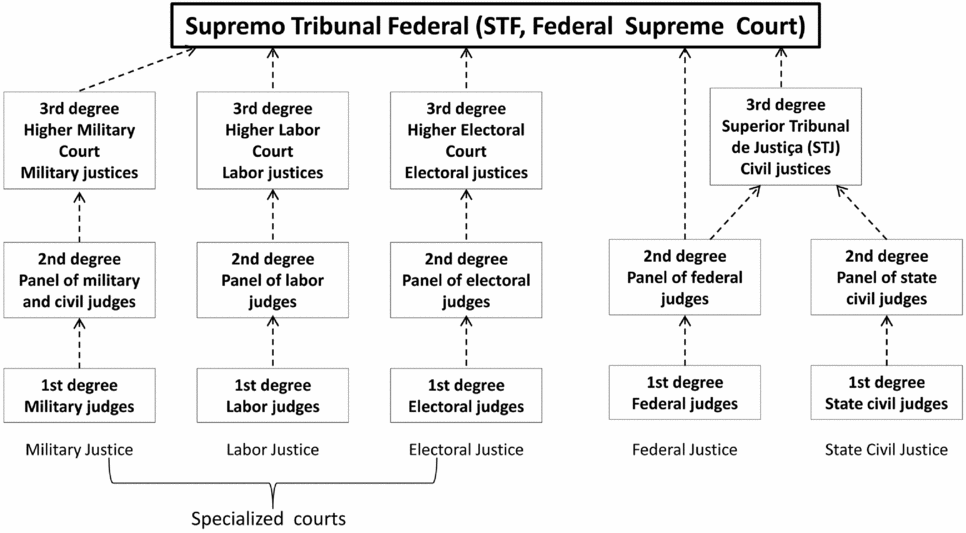
According to the 1988 Federal Constitution, the judiciary is made up of Federal Justice, State Civil Justice, Labor Justice, Military Justice, and Electoral Justice. For Federal and State Justice, the first-degree courts, with few exceptions, are the original receptors of lawsuits. Decisions in these courts are granted by individual judges. Appeals are judged by the tribunais, or second-degree courts. At the tribunais, decisions are usually made by a panel of judges.
In Federal Justice, besides the first-degree local courts there are five second-degree courts (covering different parts of the country) that make decisions over appeals or original lawsuits. Federal Justice is the destination of lawsuits involving federal matters.
Each state in the country rules its own State Justice in an independent manner. The World Bank (2004) states that “all institutions [of the Brazilian judiciary], including the courts, have a highly decentralized organization. This is not only the result of the federative structure of the country, but also of the Brazilian corporative tradition, which expanded the independence of many organizations, what is rarely seen in other Latin American countries” (p. 185, our translation).
The Superior Tribunal de Justiça (STJ) was created by the 1988 Federal Constitution, as a means of alleviating the heavy burden placed over the Supremo Tribunal Federal (STF), the highest court in the country. The main function of the STJ is to decide, as a final instance, over civil, commercial and administrative issues. It has no role in deciding over constitutional issues, or over so-called specific matters: labor, military criminal and electoral. The 33 magistrates at the STJ have the status of justices. Decisions at the STJ may be granted by small panels, or turmas (usually consisting of three justices, one of them leading the case), large panels, or seções (usually constituted of two turmas), or by the entire plenary.
The Supremo Tribunal Federal (STF) is the Brazilian Federal Supreme Court. The STF, by definition, decides over constitutional matters, original ones or appeals. It also decides over Recursos Extraordinários (Extraordinary Appeals) and criminal cases involving incumbent politicians. Decisions at the STF may be granted by the plenary, composed by 11 justices, or by the turmas (colleges composed of five justices). Justices at the STF and the STJ are both nominated by the president, although for the STJ, the presidential choice must come from a triple list created by the plenary of the STJ itself. Presidents have much more leverage on the indication of STF justices; however, in neither case are justices formally affiliated to political parties.
This paper analyzes only decisions made by STJ justices on appeals coming from lower state courts.
5. Hypotheses, methodology, database and variables
Hypotheses
Our first objective in this paper is to find evidence of the existence of pro-debtor bias on the part of Brazilian judges. Second, we try to provide evidence of judicial insecurity or unpredictability. Finally, we try to show that, when judicial bias exists, trust in courts will be very low, as compared to situations in which insecurity is coupled with unbiased judicial decisions. Thus, we have the following three hypotheses in mind:
Hypothesis #1: “Judicial decisions in Brazil are biased in favor of debtors.”
Hypothesis #2: “There are high levels of judicial insecurity in Brazilian courts.”
Hypothesis #3: “Judicial bias, if coupled with insecurity and inefficiency, diminishes the level of trust in the judiciary.”
Database
The sample analyzed is made up of judicial cases in which there was a conflict over a private commercial, contractual debt; thus only private litigants are involved in the sample. One exception refers to public enterprises (firms or financial institutions), because their activities are related to private enterprises, and because many of them were privatized sometime in the recent past. The timeframe goes from October 6, 1998 to October 5, 2008. These dates were not stipulated randomly: the current constitution in Brazil was promulgated on October 5, 1988, and the creation of the STJ resulted from it. We decided to start the analysis ten years after the promulgation of the new constitution, since usually a time lag is necessary for new laws and new organizations to be fully consolidated.
In this ten-year period, 1,412 judicial cases, with the characteristics described above, were decided by the STJ. More precisely, this is the whole population of recursos especiais or conflicts on the matter of private commercial and contractual debts solved by the STJ in this time period (at least those that are publicly available online). This is the database used in this paper.
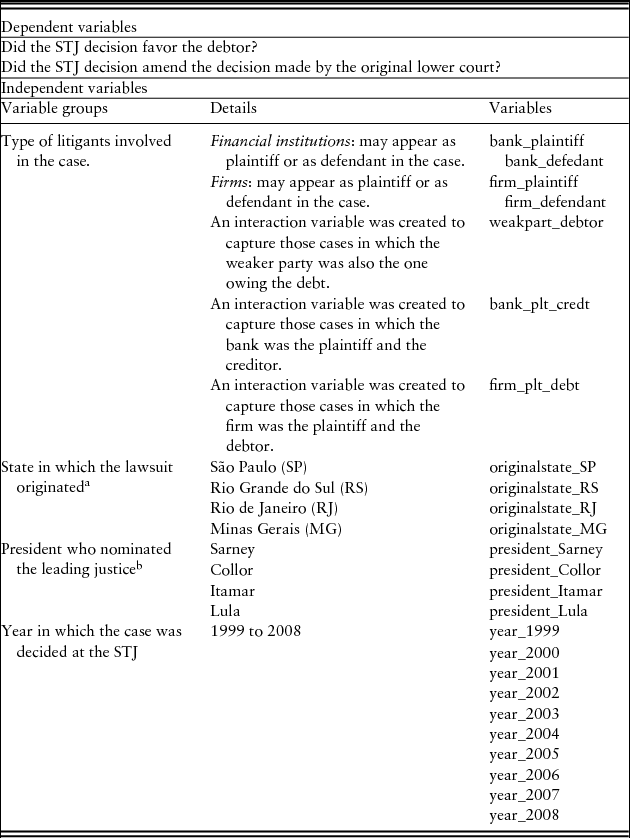
Construction of the variables and further explanation
Independent variables are also qualitative and/or binary:
1. Type of litigant involved in the case (i.e. whether litigants are individuals, firms, or financial institutions);
2. State in which the lawsuit originated;
3. President who nominated the leading justice;Footnote 7
4. Year in which the decision was made.
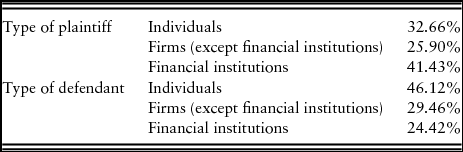
We created categorical variables and registered them by filling a form. Litigants (plaintiffs and defendants) were classified into three distinct groups: individuals, non-financial enterprises, and financial institutions. Commercial banks and credit-granting institutions (such as credit card companies, investment banks, credit cooperatives, etc.) were classified as “financial institutions.” Non-financial enterprises of any type, private associations, professional associations and trade unions were classified as “firms.” “Individuals” were set as the basis for this group of dummy variables.
Variables

a In Brazil, there are 26 states plus the Federal District. However, due to very high concentration of the population, economic activity and levels of litigation, we will focus solely on the four largest states, as indicated by the dummy variables. The “rest of the country” serves as basis for this group of dummy variables.
b President Fernando Henrique Cardoso was used as basis for this group of dummy variables.
6. Results and analysis
Descriptive statistics
Preliminary results indicate that 44.2% of the total number of cases were decided in favor of the debtor, and 53.6% were decided in favor of the creditor. Thus, at a first sight, there seems to be no evidence of any strong judicial bias in favor of the debtors, as argued by Arida et al. (Reference Arida, Bacha, Lara-Rezende, Giavazzi, Goldfajn and Herrera2005), but also no bias against them, as argued, for instance, by Ribeiro (Reference Ribeiro2006).
The second part of the evidence may also be assessed by descriptive results. The STJ changed, partially or entirely, 54.3% of the decisions made by second-degree courts. In other words, only 45.7% of the decisions made by the state courts and the regional federal courts were maintained entirely by the STJ Justices. Apparently, there seems to be a significant variability in the judicial decisions, at least when they move upwards from the second to the third (highest) level in the courts. Unfortunately, from our database, it is not possible to infer what happens to the decisions when the lawsuits move from the first to the second degree.
These are merely descriptive statistics. In order to assess the econometric significance, we must analyze the regression results of the logit models.
Econometric Results – Hypothesis #1: “Judicial decisions in Brazil are biased in favor of debtors”
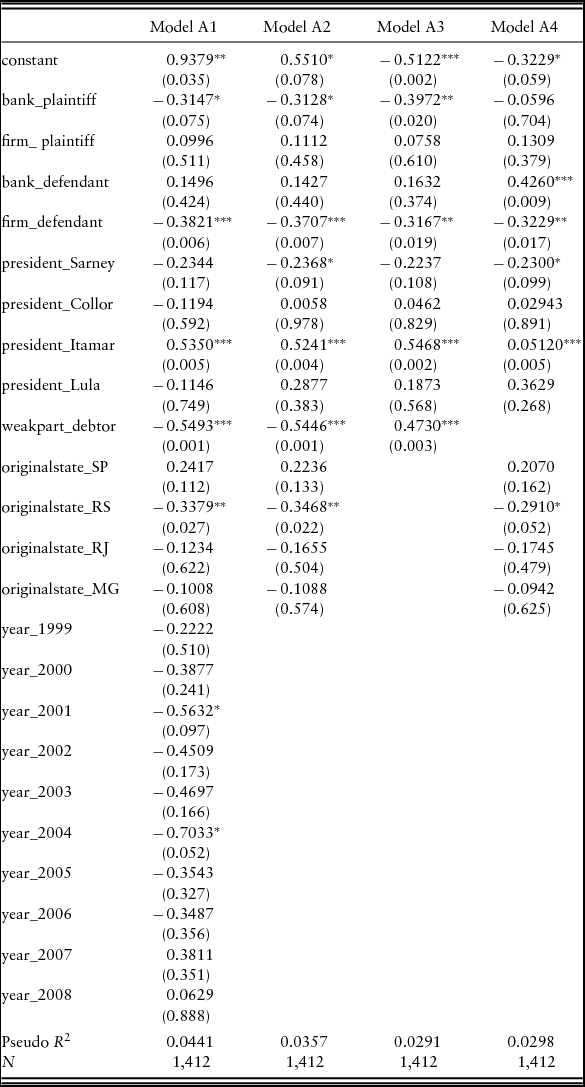
The first set of econometric results is shown in Table 3. Y in Table 3 represents whether STJ justices consistently favor debtors, in other words, the dependent variable in this case is “Does the court's decision favor the creditor (y = 0) or the debtor (y = 1)?”Footnote 8
Four models, with different sets of independent variables, were tested (A1, A2, A3, and A4). Cases in which financial institutions were plaintiffs (“bank_plaintiff”) and firms were defendants (“firm_defendant”) tend to be decided against the debtor (i.e. pro creditor). In model A4, cases in which banks were defendants were strongly and significantly decided pro debtor.
Dummy variables indicating the presidents who nominated the leading justice show that those nominated by President José Sarney (“president_Sarney”) tend to harm debtors (compared with those nominated by President Fernando Henrique Cardoso, FHC),Footnote 9 although results were statistically significant in only two models, and at the 10% level. Nominations by Itamar Franco (“president_Itamar”) result in highly significant impacts, and the direction of the impact is pro debtor. This means that the justices nominated by President Itamar consistently decide in favor of debtors. Finally, justices nominated by President Lula (“president_Lula”) seems to be slightly biased toward debtors, at least in three out of four models (again as compared to those justices nominated by FHC).
Dummy variables that identify the state where the judicial processes came from also showed interesting coefficients.Footnote 10 Compared to other states, cases coming from São Paulo (“originalstate_SP”) – the most populated and economically most active state in the country – tend to be decided in favor of the debtors. In other words, STJ Justices tends to favor debtors when the process comes from São Paulo. The contrary seems to happen with cases originating in Rio de Janeiro (“originalstate_RJ”) and Minas Gerais (“originalstate_RJ”). Yet the only statistically significant result comes from Rio Grande do Sul (“originalstate_RS”). This result is interesting for the following reasons: (1) this is the state, along with São Paulo, where the most number of processes come from, although it is not among the most economically active states in the country; (2) all coefficients for Rio Grande do Sul were significant, and all of them were against the debtor. In other words, STJ Justices tend to decide against debtors and in favor of creditors when the lawsuit comes from that southern state. This result becomes more interesting when one recalls that this is the state in Brazil with the strongest judicial activism movement. Independently of the issues of judicial independence and populist Presidents’ nominations, there are theoretical foundations showing that judges in Rio Grande do Sul are more ideologically inclined to social issues. Ballard tells the story:
Within [the] context of inequality . . . judges in the southern part of the country formed the Association of Judges for Democracy, known as the “movement of alternative judges.” This group, created in the second half of the 1980s, coalesced around the principle of “alternative use of law,” which advocated interpreting laws to serve the interests of oppressed classes. The movement became more well-known in the early 1990s, and adherents attributed a range of different meanings to the practice. A shared fundamental principle of the movement was to regard judicial impartiality and neutrality as a myth. A mild interpretation suggests that alternative law advises judges to consider the social and historical context in which they are applying the law . . . A more dogmatic interpretation posits that judicial power ought to be rallied to the service of the poor masses in their struggles. (Reference Ballard1999, pp. 244–5).
Bearing this in mind, one might interpret the results above as an attempt by the STJ to “mitigate” any political bias that may eventually derive from the judges in Rio Grande do Sul. We will discuss this case more in Table 4.
Year dummies did not have much statistical significance. Yet one can observe a slight tendency to disfavor debtors until the year 2006, and from 2007 onwards the decisions tend to favor them. Probably this is a result of increased politicization in President Lula's second term, in which the Minister of Justice changed from being a “technician,” i.e. a law practitioner or an attorney (Márcio Bastos) to a “politician,” a former state governor and congressman (Tarso Genro).
Therefore, with the results achieved by the first set of regressions, as presented in Table 2, we have some preliminary evidence to support our first hypothesis.
Data Frequency (N = 1,412)

Source: STJ and data organized by the authors.
Some additional variables seem to affect consistently and significantly the manner in which justices judge, in particular: who stands as plaintiffs and as defendants, and the state in which the lawsuit originated.
Econometric Results – Hypothesis #2: “There are high levels of judicial insecurity in Brazilian courts”
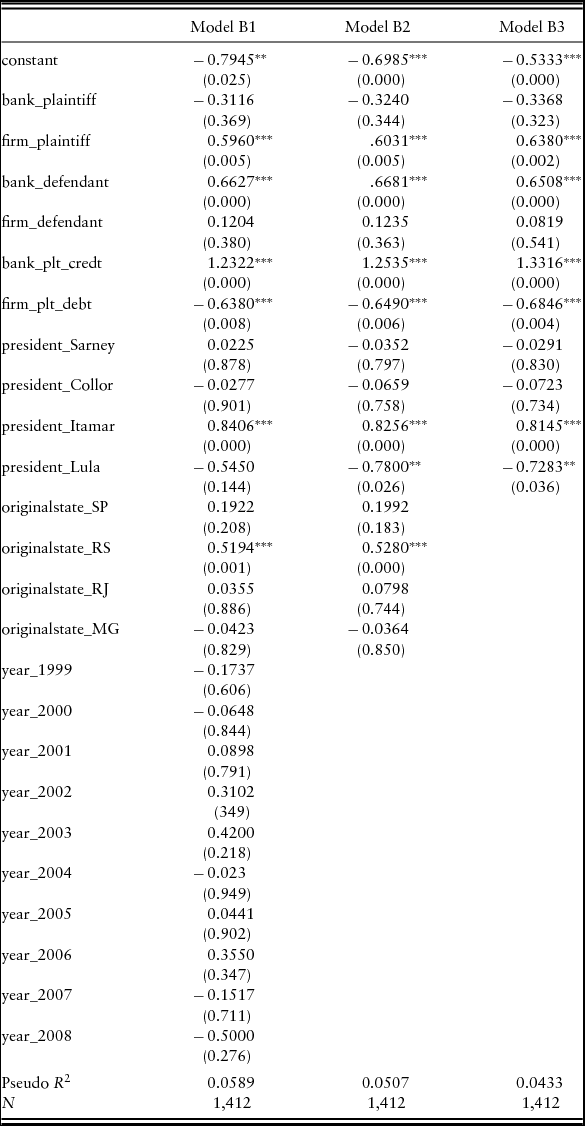
Let us now analyze another aspect of the judicial decisions made by STJ justices. Y in Table 4 is whether STJ justices amended cases coming from the second-degree state courts: the dependent variable in this case is “Did the STJ amend the case (y = 1) or not (y = 0)?” Three models, with different sets of independent variables, were tested (B1, B2, and B3).
Cases in which plaintiffs are firms (“firm_plaintiff”), and in which defendants are financial institutions (“bank_defendant”) tend to receive amendments by the STJ, with statistical significance.
Justices nominated by President Itamar Franco tend to amend second-degree decisions, and this impact is statistically significant. Apparently they tend to disagree more with lower court magistrates.Footnote 11 Justices nominated by other presidents do not show significant/consistent trends in amending (or not) lower court cases.
With regards to the geographical dummies, again there are interesting results. Cases coming from Rio Grande do Sul (“originalstate_RS”) tend to be amended by the STJ justices, and the effect is very significant. Apparently, justices tend to disagree with the manner in which magistrates in that state interpret the law. Probably, the former believe there is some kind of political bias in that state, and try to mitigate it by amending their decisions. We have discussed above the story that very probably lies behind this result: if we compare it with those results found in Table 2, it becomes clear that the STJ justices tend to amend decisions in the direction of minimizing the “distributive effects” caused by the judges in Rio Grande do Sul.
Finally, dummies referring to the year of judgment did not indicate any clear tendency to increase or decrease the probability of amendments by the STJ ministers through time.
7. Linking the empirical results and some secondary data to the conceptual model
Now, we will go back to the conceptual model described in section 3 and relate it to the statistics and econometric results found in the previous section. Under that model, if laws are unclear, society relies heavily on courts, because judges are needed to interpret them. Litigation rates are high and the quality of judicial decision making – as measured by the presence or absence of bias, and of predictability of decisions – has a direct impact on the level of social losses and the trust that society has in the judiciary. There are three possible outcomes. First, decisions are unbiased and predictable: social losses are low and citizens have a high level of trust in courts and judges. Second, judicial decisions are biased toward particular types of litigants or of issues, but in a predictable and secure manner: social losses are high (but not the highest) and distrust in courts will be the highest. Finally, there is the situation in which judicial decisions are insecure (unpredictable), but unbiased, i.e. there are no clear trends in the manner in which judges make their decisions: due to the “optimism theory of trials,” litigation rates and social losses are high, but social trust in the judiciary is higher than in the second situation, in which there is judicial bias. We also discussed a special case in which, though it seemed paradoxical, a biased court could also be considered insecure, because although it consistently favored certain types of litigants, its decisions had a high chance of being amended by higher courts.
With this in mind, and before proceeding, let us briefly discuss the “Index of Trust in Justice.”
Secondary data sources: The Index of Trust in Justice (“Índice de Confiança na Justiça – ICJBrasil”) and Justice in Numbers (“Justiça em Números”)
ICJBrasil was created by the Getúlio Vargas Foundation as an indicator of the trustworthiness of Brazilian judicial power. It is a survey answered by citizens aged 18 years and over, living in the metropolitan areas of eight capital cities: Manaus (state of Amazonas), Recife (state of Pernambuco), Salvador (state of Bahia), Belo Horizonte (state of Minas Gerais), Rio de Janeiro (in the same state), São Paulo (in the same state), Porto Alegre (state of Rio Grande do Sul) and the Federal District. The population of these cities comprises 60% of all the metropolitan populations in Brazil (according to the 2010 census). Basically, this survey assesses citizens’ perceptions of the judiciary, and also their behavior when confronted with disputes, in other words, their willingness to solve these conflicts in the courts. Thus, it measures the trustworthiness of judicial courts in the view of Brazilian citizens.
ICJBrasil was first published on the fourth quarter of 2009. Initially it was supposed to be a quarterly publication. Unfortunately, due to financial and operational difficulties, it was not published regularly; in 2015 it became officially a semi-annual publication, but its last publication was during the first half of 2016. In addition to that, although the organizers applied the same rules to guarantee statistical randomness of the sample, its size varied significantly over time: for most of the period observed, sample sizes averaged 1,500 to 1,600 respondents. However, it reached more than 6,600 respondents in some editions (for instance, in the second quarter of 2012), and peaked at close to 7,200 respondents in the second quarter of 2013. No clear explanations were offered as to why these variations occurred.
However, despite these deficiencies, it remains the only attempt to measure quantitatively Brazilian citizens’ perceptions of the judiciary, and their behavior to it.
We may further bring some statistics collected by the National Council of Justice (CNJ), and gathered in its annual report Justiça em Números (“Justice in Numbers”Footnote 12). This is a detailed official and publication with most of the nationwide statistics collected in judicial courts related to their productivity, resources, and general organization. Thus, combining the data found in these two secondary data sources with the econometric evidence found in section 6, we may shed some light on our original conceptual model.
Results and model
Heavy reliance on courts
“Justice in Numbers” tells us that, by the end of 2015, there were more than 101 million lawsuits on trial in Brazilian courts. At that time, the official number for the population was 206 million. In other words, there was approximately one lawsuit for every two persons in Brazil – a figure that can hardly be considered low by any standard. CNJ is not alone in offering hints of the very high litigation rates in Brazil. ICJBrasil also shows that among its respondents in 2016, approximately 40% had already had a chance to litigate in court (or had someone in his/her household who did). Interestingly, this figure does not change much according to educational level (31% for lower levels), age, gender, or race.
This is the situation illustrated by (3) in our conceptual model, Figure 1, in which society relies heavily on courts to interpret unclear laws.
Econometric Results – Hypothesis #3: “Judicial bias, if coupled with insecurity and inefficiency, diminishes the level of trust in the Judiciary”
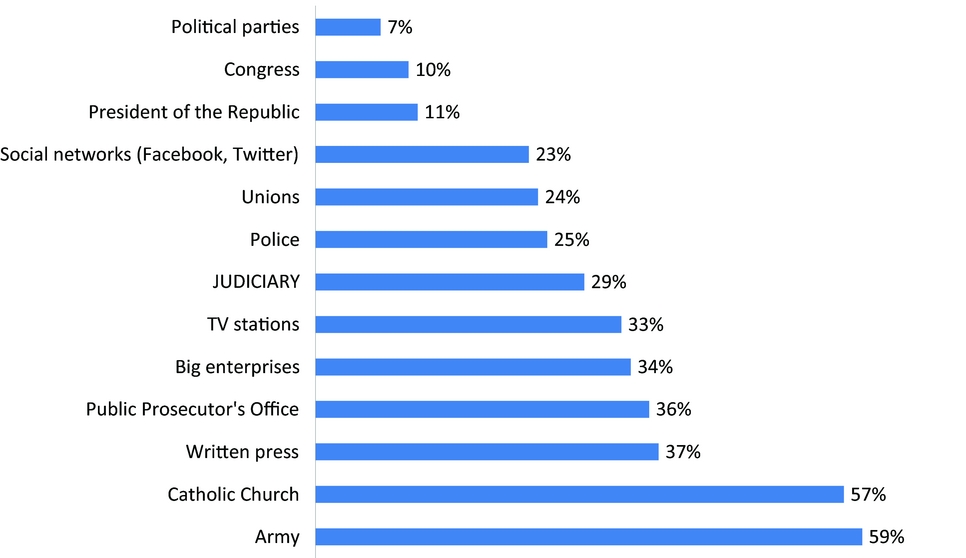
Descriptive statistics from section 6 show that more than 54% of all cases arriving at the STJ are, amended by its justices in some way. This being a third-instance, higher court, one would expect amendment rates to be lower than that. It is as if, despite having already been decided by two instances, 54% of these cases still contained some kind of judgment error. This is an indication of high inconsistency in judicial decision making.Footnote 13 This evidence, coupled with the high rates of litigation as indicated by the National Council of Justice above mentioned, lead us to conclude that the Brazilian judicial system is not in the situation indicated in (4) in our conceptual model (Figure 1), i.e. with secure and unbiased courts where litigation is gradually reduced over time. Yet another important piece of evidence also corroborates this view: the low levels of trust in the Brazilian judiciary, as indicated by the ICJBrasil survey. When asked plainly whether they trusted in the judiciary, only 29% of the respondents answered that they did – a score lower than for the army, the Catholic Church, the Public Prosecutor's Office and several other institutions in society.
Brazilian citizens’ trust in institutions

Additionally, ICJBrasil scores vary from 0 to 10 (absolutely untrustworthy to perfectly trustworthy); in the 2016 survey, the Brazilian average was 4.9. Again, this is a low score, which is consistent with our original conceptual model: owing to the high levels of social losses and insecurity incurred, courts are viewed as untrustworthy by the citizens.
The case of Rio Grande do Sul: biased and insecure
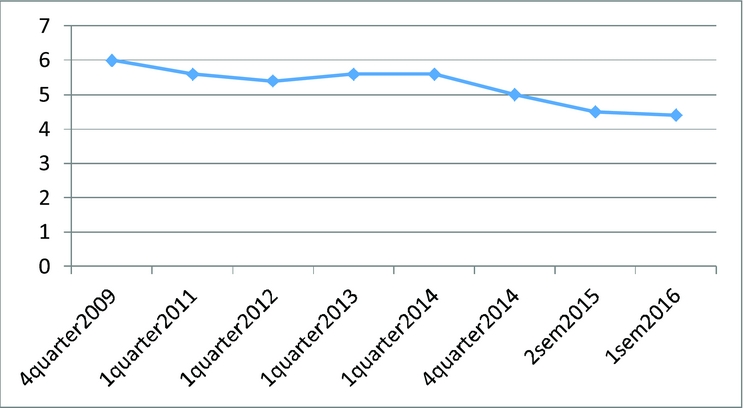
However, the most interesting result is the one that broke down the ICJBrasil score for the different capital cities/states. While the national average was 4.9, the state with the lowest score was Rio Grande do Sul, with a score of only 4.4. Our econometric results presented in section 6, and more precisely, Tables 3 and 4, indicate that Rio Grande do Sul is the only state in which the state court was consistently biased toward debtors, and whose decisions were consistently amended by the STJ Justices. In other words, it is a special case of a biased and insecure court. As discussed before, in these cases, social losses will be the highest of all situations predicted in the conceptual model, and this will result in distrust levels higher than those found in insecure but unbiased courts. This is the most undesired socio-economic outcome of all.
Y = Does the judicial decision favor the debtor?

*10% significance level, **5% significance level, ***1% significance level.
Y = Did the STJ amend the 2nd degree decision?

*10% significance level, **5% significance level, ***1% significance level.
Thus, the econometric results coupled with the numbers brought by ICJBrasil and Justiça em Números preliminarily corroborate the conceptual model presented in section 3 and hypothesis number 3, as defined in section 5.
Caveats
The linkage between the econometric results and the conceptual model is very preliminary. Some caveats make us cautious about the confirmation described above. Most importantly, measures by ICJBrasil do have some problems of consistency in sample size (as mentioned above), average scores, and other aspects. Even the results for Rio Grande do Sul, as the most untrustworthy court, are still inconsistent. Through time, scores for courts in this state have fallen almost consistently, but it is not certain that it will remain the least trustworthy of all courts in the country as our results and model would suggest. More results are awaited in the future in order to confirm this.
Evolution of ICJBrasil score for Rio Grande do Sul

8. Conclusions
Can judges be biased in their judicial decision making? Arida, Bacha and Lara-Resende (Reference Arida, Bacha, Lara-Rezende, Giavazzi, Goldfajn and Herrera2005) launched an academic controversy in Brazil by stating that judges in Brazil are biased when judging lawsuits involving breach of contracts and debts. This paper aimed at offering empirical contributions to this discussion. Also, it tried to assess judicial insecurity, measured as the probability of a lower court decision being amended by higher courts. Empirical results of these two phenomena – bias and insecurity – if observed, can result in social losses and, consequently, high distrust of the judicial power. We constructed a conceptual model that demonstrates and predicts these social outcomes.
For the empirical analysis, we gathered a set of 1,412 decisions made during the period of October 1998 to October 2008. At the level of the Superior Court of Justice (STJ), results do not show strong judicial bias, either toward the debtor, or toward the creditor. However, some variables significantly impact decisions by the justices in one direction or the other. For instance, the probability of a lawsuit being decided in favor of the debtor seems to be correlated with the type of the plaintiff who deposited the case at the STJ. Yet results show that STJ very often reforms decisions coming from lower state courts, leading to a high degree of insecurity in the Brazilian judiciary. There are also consistent results related to the original state of the lawsuit: cases coming from the state of Rio Grande do Sul, have a higher chance of being amended and reformed, implying significantly higher rates of unpredictability.
When confronted with the results from the nationwide Index of Trust in the Justice, ICJBrasil, we do have some preliminary confirmation of our conceptual model. Because Brazilian courts are unpredictable, with high levels of insecurity, on average, they receive low scores on trustworthiness. Yet the worst score goes to the state court that is insecure and biased at the same time: Rio Grande do Sul.
This article is one of the first attempts to analyze the judicial behavior in Brazil in an empirical manner, by analyzing a significant set of real judicial decisions. It is also coupled with a conceptual model for which some preliminary confirmation was found, as shown by nationwide surveys on judicial trustworthiness. Yet future research should address the consistency of these survey results, so as to obtain more robust confirmation of the conceptual model presented here. As for the empirical part, there seems to be clear evidence that judicial insecurity is an issue in the Brazilian judiciary, although bias seems to be more localized in certain type of variables, and in particular courts. Future work should keep assessing the results found in this paper. There is a whole new world in the field of judicial behavior to be evidenced in empirical studies. We hope others will join us in this challenge.
Appendix: Judicial bias and selection bias
In section 3, we showed that “judicial bias” is a concept that is hard to define, and susceptible to conflicting views. There, for the sake of simplification (but assuming no loss of generalization), we adopted a straightforward definition in which decisions that consistently favored certain types of litigants were considered “biased.” We did not check the fairness of the decisions and assumed that, given the total set of lawsuits brought to courts, consistent trends in favor of some particular type of party would be evidence of judicial bias. However, we understand that this may be a narrow definition that poses limitations to the outreach of our empirical results.
The greatest problem related to this issue is the possibility that there is selection bias in the cases we analyzed, since cases might not reach the STJ in a random fashion. It is expected that particular types of litigants (we do not know which) have higher chances of reaching the STJ, as compared to other litigants and, as a consequence, they have a higher chance of being favored by the justices.
Econometrically, this problem has long been solved (theoretically) by James Heckman's sample selection model. The idea, if applied to our problem, is to run a two-step regression model: in the first step, we would run a probit regression model in order to calculate the chances of particular types of litigants reaching the STJ; only in the second step, after knowing the coefficients for the different types of litigants, would we run the estimation, as we did in this paper.
The greatest difficulty in implementing the Heckman two-step model lies in the very first step: there are currently no databases, or even surveys, that assess the variables needed to run the probability function of reaching the STJ for the different types of litigants in Brazil. One would expect that this function depends on several personal characteristics of the litigants (for instance, age, sex, income, schooling, etc.). Therefore, a nationwide survey could very appropriately do this job. We propose that “ICJBrasil,” used for the analysis presented in section 7, would be a very good candidate for it.
Bearing these limitations in mind, the results and analysis we present in this paper can be read with guarded optimism.