Introduction
Anxiety about aging arises from concerns and worries about growing older, reflecting one's fear of anticipated threats and losses that may be experienced during the aging process (Watkins et al., Reference Watkins, Coates and Ferroni1998). Anxiety about aging is to be distinguished from general anxiety, and is strongly associated with physical and psychological well-being with age (e.g. Lasher and Faulkender, Reference Lasher and Faulkender1993; Lynch, Reference Lynch2000). Nevertheless, the dimensions and ramifications of anxiety about aging are poorly understood (Lasher and Faulkender, Reference Lasher and Faulkender1993; Lynch, Reference Lynch2000; O'Hanlon and Coleman, Reference O'Hanlon, Coleman, Nussbaum and Coupland2004). A number of scales have been designed to assess attitudes toward aging and the aged, which, according to Kafer and colleagues (Reference Kafer, Rakowski, Lachman and Hickey1980), give rise to some central issues such as the multidimensionality of attitudes, and the necessity to distinguish attitudes toward personal aging from the aged as a group. However, many of these measures did not consider the multidimensional nature of aging anxiety, and lacked empirical development (Lasher and Faulkender, Reference Lasher and Faulkender1993).
Anxiety about aging scale (AAS)
Lasher and Faulkender (Reference Lasher and Faulkender1993) designed an empirically based instrument to assess four dimensions of anxiety about aging, comprising Fear of Old People, Psychological Concerns, Physical Appearance Concerns, and Fear of Losses. The resulting AAS (Lasher and Faulkender, Reference Lasher and Faulkender1993) has been used extensively in research, including the investigation of the relationship between anxiety about aging and personality traits, death anxiety, and cultural attitudes in a wide range of age groups (e.g. Harris and Dollinger, Reference Harris and Dollinger2003; McConatha et al., Reference Mcconatha, Hayta, Rieser-Danner, Mcconatha and Polat2004). However, despite Lasher and Faulkender's (Reference Lasher and Faulkender1993) declaration that the AAS needed further validation and replication, there has been no research to date that has replicated the original AAS. Furthermore, it is unclear if the four dimensions of anxiety about aging, as measured by the AAS, are distinct but related constructs, or whether these constructs are better represented by an overarching higher order factor of “aging anxiety.” The second-order factor models are argued to be applicable when the lower order factors are highly correlated and a higher order construct may potentially explain this relationship between factors (Chen et al., Reference Chen, Sousa and West2005).
Group invariance
There is also a necessity to understand the effect of sample characteristics on responses to the AAS, as they are likely to influence response patterns, strength of item endorsement, and perhaps even the underlying factor structure of the AAS. Age has been proposed as possibly the most important factor affecting aging anxiety. Lynch (Reference Lynch2000) showed that anxiety about aging was highest in younger age (18–39 years), declines slightly in mid-life (40–49 years), and declines further in later life (50+ years). Abramson and Silverstein (Reference Abramson and Silverstein2006) confirmed that younger adults were more likely to express anxiety about the aging process with slightly different age groupings (18–34, 35–64, and 65+ years old). In contrast, Lasher and Faulkender (Reference Lasher and Faulkender1993), using more discrete age groupings (less than 25, 25–34, 35–44, 45–54, 55–64, 65–74, and 75+ years old), found that significant age differences were found only in concerns regarding physical appearance, which decreased from young to older age. Further discrepancies were shown by Yun and Lachman (Reference Yun and Lachman2006) who found a significant age difference in fear of the elderly among older Americans who reported higher anxiety than younger. These conflicting findings regarding the association between age groups and anxiety about aging indicate that more work is needed to confirm whether the four factors of the AAS hold for different age groups.
Gender has also been shown to impact the saliency of aging anxiety. The most relevant issues for females are the physical changes associated with aging (Cummings et al., Reference Cummings, Kropf and Deweaver2000; McConatha et al., Reference Mcconatha, Schnell, Volkwien, Riley and Leach2003; Barrett and von Rohr, Reference Barrett and Rohr2008). Females are socialized to place greater value on their appearance than males (McConatha et al., Reference Mcconatha, Schnell and Mckenna1999) and are considered “old” at a younger age (McConatha et al., Reference Mcconatha, Schnell, Volkwien, Riley and Leach2003). These gender differences have been found across cultures (McConatha et al., Reference Mcconatha, Schnell, Volkwien, Riley and Leach2003; Reference Mcconatha, Hayta, Rieser-Danner, Mcconatha and Polat2004), reflecting the “double jeopardy of ageism and sexism” in the experience of aging for females (Whitbourne and Sneed, Reference Whitbourne, Sneed and Nelson2004). The notion of gender and age differences in the endorsement of dimensions of anxiety about aging indicates that the four factors should be tested for gender and age invariance.
Objectives
Within the context of the above background, the substantive objective of the current study is to confirm the validity of the first-order four-factor AAS structure proposed by Lasher and Faulkender (Reference Lasher and Faulkender1993) using Confirmatory Factor Analysis (CFA). The first-order factor model will also be compared with the second-order model to examine whether the higher order factor of “anxiety about aging” accounts better for the pattern of relationships between the first-order factors. While Lasher and Faulkender's sample contained a broad age range, measurement invariance across gender and age levels was not undertaken. Previous research on age-group and gender differences in anxiety about aging indicates that the AAS factor structure may differ depending on group memberships. Therefore, our third aim is to use Multiple Group Analysis (MGA) to examine measurement invariance of the four-factor structure to test whether the AAS measures the same dimensions of anxiety about aging across age and gender groups.
Method
Participants
A random sample of 3,000 residents from the Australian Capital Territory (ACT) area was identified from a private sector agency, who used publically available ACT Residential Database information. Invitations to participate in a study on health and well-being were sent to the identified sample between July and September 2011. The invitations informed participants that the aims of the study were to measure health behaviors and attitudes, and evaluate health knowledge in the community. To participate, individuals could return a signed consent form to receive the questionnaire, or they could follow the provided website link to complete the questionnaire online. Of the 3,000 invitations, 783 persons responded by completing and returning the questionnaire (at a response rate of 23.5%). The majority of the respondents (84.3%) completed the paper questionnaire whereas the remaining 15.7% completed the questionnaire online. Those who completed the survey online were more likely to be younger (t(776) = –6.01, p < 0.001), male (χ 2(1) = 9.60, p = 0.002), and tertiary educated (χ 2(7) = 19.31, p = 0.007). No differences were found in employment status (χ 2(4) = 4.65, p = 0.325), accommodation (χ 2(5) = 2.59, p = 0.763), self-rated health status (t(773) = 0.723, p = 0.470), total anxiety of aging (t(781) = −0.814, p = 0.416), or any of the original sub-scales (Fear of Old People (t(781) = 0.670, p = 0.670); Fear of Losses (t(781) = −0.820, p = 0.413); Physical Appearance (t(781) = −1.221, p = 0.222); and Psychological Concerns (t(781) = −0.736, p = 0.462)).
The mean age of the final sample was 57.3 years (SD = 13.66, range 20–97 years). Females comprised 42.2% of the sample. The majority of the participants were married (65.8%), and had an undergraduate degree (24.1%) or higher (19.5%). Of those in the workforce (n = 462, 59%), 65.6% reported working full time, 26.8% in part-time or casual work, and 0.6% were unemployed. Fully retired individuals made up 32.7% of the sample.
The AAS was part of a larger questionnaire presented to participants as an investigation of health and health attitudes. The broader questionnaire included measures of health status and health behaviors, health literacy, positive and negative affect and locus of control, and age-stereotypes and expectations. The AAS was positioned as the final set of questions within the larger questionnaire.
Anxiety about aging scale
The AAS (Lasher and Faulkender, Reference Lasher and Faulkender1993) comprises 20 items that assess the following four dimensions (five items each) of anxiety about aging: (1) Fear of Old People measures external contact with others (e.g. “I feel very comfortable when I am around an old person”); (2) Psychological Concerns reflect more personal or internal issues (e.g. “I fear it will be very hard for me to find contentment in old age”); (3) Physical Appearance contains items relating to anxiety about changes in physical looks (e.g. “I have never dreaded the day I would look in the mirror and see gray hair”); and (4) Fear of Losses relates to the loss of social support and autonomy (e.g. “I fear that when I am old all my friends will be gone”). Respondents indicated their agreement with each item on a five-point Likert-type scale ranging from strongly agree (1) to strongly disagree (5). The scale was scored so that higher scores reflected higher levels of fear or anxiety.
Statistical analysis
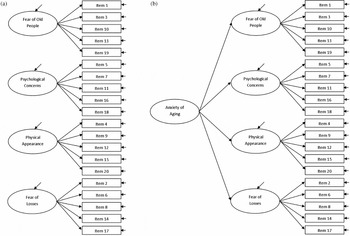
The first stage of analysis involved CFA that tested Lasher and Faulkender's (Reference Lasher and Faulkender1993) a priori first-order four-factor model of the AAS in Mplus using Maximum Likelihood parameter estimates with robust standard errors (MLM). Model fit for the first-order factor model (see Figure 1a) was assessed through indices of fit, including the Comparative Fit Index (CFI) and the Root Mean Square Error of Approximation (RMSEA). The CFI value of 0.90 or greater, and the RMSEA value near or below 0.05, with 90% confidence interval (CI) between zero and 0.08 reflect acceptable model fit (Kenny, Reference Kenny2011; Byrne, Reference Byrne2012). In the event that the model did not show good fit, the modification indices (MI) were examined for model improvement. Model changes were made based on MIs if they had face-validity and were consistent with Lasher and Faulkender's (Reference Lasher and Faulkender1993) theoretical basis for the AAS. Subsequent models were compared using model fit indices as well as χ 2 difference testing (MLM χ 2 – with Scaling Correction Factor – see Mplus website http://www.statmodel.com/chidiff.shtml).
Path diagram for (a) first-order, and (b) second-order factor AAS measurement model.

The second stage of analysis tested the second-order model of the AAS. CFA models, starting with Lasher and Faulkender's (Reference Lasher and Faulkender1993) original four factors as the lower order factors, were examined in a sequential fashion as described for the first-order factors, with models assessed based on model fit indices and MI.
In the final analyses, MGA examined factorial invariance between gender and three age groups (young adults: 20 to 44 years; mid-aged adults: 45 to 64 years; and older adults: 65 years and older), based on a lifespan development perspective of adulthood development (e.g. Heckhausen et al., Reference Heckhausen, Dixon and Baltes1989; Baltes and Baltes, Reference Baltes and Baltes1990). The multi-group analysis method allows us to specifically test whether the overall measurement and structural models are equivalent across groups. If this is not the case, a hierarchical procedure is followed to identify the parameters that are not equivalent.
The invariance testing strategy was based on Byrne's (Reference Byrne2012) procedure. Baseline models for each group were compared with nested models that varied in restricted parameters. The first step was to establish a comparative baseline model (least restrictive model) where no equality constraints between groups were imposed. The second step was to compare the comparative model with a model restricting factor loadings to be equivalent to test for invariance in the measurement model loadings. The third step tested structural parameters by constraining factor covariances. Model fit and testing between nested models was again performed using the indices and ΔMLM χ 2 value as outlined above. Convention suggests that equality restriction between models can be examined by ΔMLM χ 2 value, where no difference between models is indicated by a non-significant value at p < 0.05. However, it should be noted that the χ 2 value is very sensitive to sample size. Difference in fit between models can also be tested by examining the difference in CFI, with a difference of 0.01 or less considered non-significant (Cheung and Rensvold, Reference Cheung and Rensvold2002).
Results
Confirmatory factor analysis
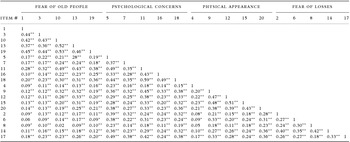
Table 1 displays the correlation matrix for the 20 AAS items. All relationships were in the expected direction, and the majority were above r = 0.30 (Allen and Bennet, Reference Allen and Bennet2008).
Correlation matrix for anxiety of aging scale items

*p < .05; **p < .01.
The CFA value of the a priori first-order four-factor AAS model indicated reasonable fit on most goodness of fit indices (χ 2 = 491 (df = 164), p < 0.001; CFI = 0. 911; RMSEA = 0.050 [95% CI: 0.045, 0.056]). CFA was again conducted to test the second-order factor model, whereby the four AAS sub-scales are accounted for by an overarching single factor of “aging anxiety.” The first second-order factor CFA showed reasonable fit (χ 2 = 509 (df = 166), p < 0.001; CFI = 0.906; RMSEA = 0.051 [95% CI: 0.046, 0.057]). This second-order model was compared with the first-order model given above. The scaled χ 2 difference indicated that the first-order model was a better fitting model for the data (ΔMLM χ 2 = 19.969 (2), p < 0.0001). It was therefore decided to proceed using the first-order factor model.
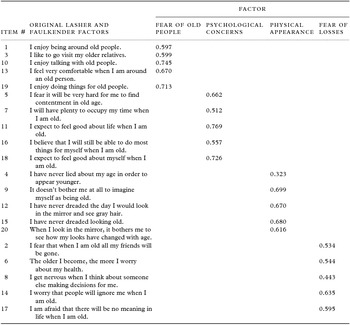
The final standardized factor loadings for the first-order model are presented in Table 2. Internal consistency for the four factors, as measured by Cronbach's α, was good for Fear of Old People (α = 0.80), Psychological Concerns (α = 0.80), and Physical Appearance (α = 0.73) dimensions, and moderate for Fear of Losses factor (α = 0.69).
Factor loadings for anxiety about aging scale from confirmatory factor analysis of first-order model

Multiple group analysis
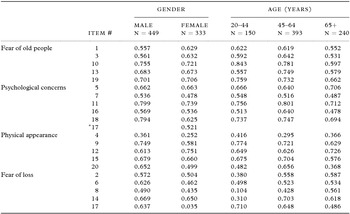
Multiple group analysis was used to explore our second aim of testing for gender and age measurement invariance in the four-factor AAS model. Age was grouped into young adults (20 to 44 years. n = 150), mid-aged adults (45 to 64 years, n = 393), and older adults (65 years and older, n = 240). Examination of item loadings between gender and age were reasonably consistent (see Table 3).
Standardized factor loadings by gender and age for the original Lasher and Faulkender (Reference Lasher and Faulkender1993) AAS factors

Note: *Item cross-loading.
Gender invariance testing
Separate baseline analyses for males (χ2 = 360 (164), p < 0.001; CFI = 0.918; RMSEA = 0.052 [95% CI: 0.044, 0.059]) showed reasonable model fit whereas model did not fit for female data (χ 2 = 326 (164), p < 0.001; CFI = 0.878; RMSEA = 0.054 [95% CI: 0.046, 0.063]). Item 17 (“I am afraid that there will be no meaning in life when I am old”) was cross-loaded onto Psychological Concerns based on MIs. This improved somewhat the model fit for females (χ 2 = 299 (163), p < 0.001; CFI = 0.898; RMSEA = 0.050 [95% CI: 0.041, 0.059]), with no further logical MIs indicated.
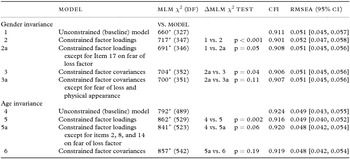
In the first step of multi-group invariance testing (model 1, Table 4) the baseline model was established. In the second step (model 2) this baseline model was compared with a nested model constraining factor loadings. There was no significant change in the CFI and RMSEA indices between the unconstrained gender model and the nested model constraining factor loadings, but the χ 2 change (ΔMLM χ 2) was significant (p < 0.001, Table 4). This result should be balanced by the non-significant CFI or RMSEA change between models. Nevertheless, further investigation was undertaken by systematically freeing factor loadings from the largest to the smallest discrepancy using MIs as a guide. This testing revealed freeing item 17 (“I am afraid that there will be no meaning in life when I am old”) from the Fear of Losses resulted in a non-significant χ 2 change from model 2 (p = 0.05).
Summary of goodness of fit for group invariance tests

Notes: MLM = Robust ML Estimator Estimates; ΔMLM χ 2 test computed with the unconstrained (baseline) model as a reference model; CFI = Comparative Fit Index; SRMR: Standardized Root Mean Square Residual = Adjusted Goodness of Fit Index; CI = Confidence Interval.
*p <.001.
In the third step (model 3), the χ 2 change from model 2a was significant at p = 0.04. Further investigation indicated that freeing covariance parameters between Fear of Losses and Physical Appearance resulted in a non-significant χ 2 change from model 2a (p = 0.11).
Together, these results indicate that the AAS factors and structure were generally invariant between males and females with the exception of item 17, which loaded onto Psychological Concerns for females, and had unequal factor loadings on Fear of Losses.
Age-Group Invariance Testing
Separate analyses showed that the mid-aged data revealed adequate fit (χ 2 = 288 (164), p < 0.001; CFI = 0.942; RMSEA = 0.044 [95% CI: 0.036, 0.052]). Poorer fit was found for younger (χ 2 = 319 (164), p < 0.001; CFI = 0.829; RMSEA = 0.079 [95% CI: 0.066, 0.092]) and older participants (χ 2 = 267 (164), p < 0.001; CFI = 0.887; RMSEA = 0.051[95% CI: 0.044, 0.062]). Using MIs as a guide, correlating residual variance of item 12 (“I have never dreaded the day I would look in the mirror and see gray hairs”) with item 15 (“I have never dreaded looking old”) and item 14 (“I worry that people will ignore me when I am old”) with item 8 (“I get nervous when I think about someone else making decisions for me”) improved fit somewhat for the younger group (χ 2 = 254 (162), p < 0.001; CFI = 0.899; RMSEA = 0.061 [95% CI: 0.046, 0.076]). For the older age group, model fit was improved by cross-loading item 20 (“When I look in the mirror, it bothers me to see how my looks have changed with age”) with Fear of Losses (χ 2 = 249 (163), p < 0.001; CFI = 0.906; RMSEA = 0.047 [95% CI: 0.035, 0.058]).
After establishing a baseline comparative model (step 1 – model 4, Table 4), the second step of age-group models indicated poorer fit when factor loadings were constrained equal (ΔMLM χ 2 p = 0.002 – model 5). Again, this difference should be moderated by the non-significant differences in CFI and RMSEA indices. Nevertheless, systematic examination of factor loadings revealed that the χ 2 change became non-significant between baseline and model 2a when factor loadings for items 2, 8, and 14 were freed between age groups (model 5a, p = 0.06). In the final model (model 6) the χ 2 change and fit indices did not show any significant differences. Together, these findings indicate that factor loadings for three of the items on Fear of Losses (items 2, 8, and 14) may not be invariant across age groups.
Discussion
The current study had three overarching goals: first to confirm the structural validity of the AAS, second, to test whether the second-order factor accounted better for the relationship between factors of the AAS than the first-order structure, and third to examine possible group measurement invariance in the latent dimensions of the AAS regarding gender and age. To our knowledge, this is the first time the factor structure of the AAS has been validated, and that gender and age-group measurement invariance has been tested since the introduction of scale into the literature by Lasher and Faulkender (Reference Lasher and Faulkender1993).
The results of CFA models are generally supportive of the original first-order four-factor construct of the AAS: Fear of Old People, Psychological Concerns, Physical Appearance, and Fear of Losses, proposed by Lasher and Faulkender (Reference Lasher and Faulkender1993). Our results support the notion that anxiety about aging is a multidimensional construct. Testing between the first- and second-order factor models indicated that the four dimensions of Fear of Old People, Psychological Concerns, Physical Appearance, and Fear of Losses dimensions were best represented in this sample as four distinct but correlated dimensions of aging anxiety. Furthermore, our findings indicate that the AAS shows good ability to discriminate between these dimensions across a wide range of age.
Age and gender measurement invariance
Results presented here indicate that the AAS factor loadings are equivalent across males and females, and adult age groups for all factors except for the Fear of Losses factor. These findings suggest that the AAS can provide meaningful and comparative statements to be made across these groups regarding anxiety about aging within the context of Fear of Old People, Psychological Concerns, and Physical Appearance factors, enhancing the usefulness of the AAS.
However, the non-equivalence findings across gender and age groups for item loadings on the Fear of Losses factor may make it problematic to compare across groups and make valid conclusions regarding group-related differences for this particular dimension of anxiety about aging. The age-group differences in factor loadings for items of fear, nervousness, and worry regarding personal relationships with age (items 2, 8, and 14) indicate that the Fear of Losses factor is not explaining similar variance in these items for the younger age group compared with the older age group. Similarly, males were found to have higher factor loadings for the item addressing “Fear of having no meaning in life with age” (item 17), compared with females.
Possible explanations for non-equivalence of factor loadings are that these items may not have the same meaning across groups, or alternatively, there is a response bias where a group or groups are more likely to endorse extreme responses (strongly agree/strongly disagree) or middling responses (agree/disagree) (Gregorich, Reference Gregorich2006). As differences for factor loadings were only found for a small number of items, it is unlikely that extreme response style (ERS) is the explanation here. Further analysis (not shown) examining the distribution of responses across groups for these items also did not support an ERS explanation. Therefore, our findings suggest that the items in the Fear of Losses factor may have differential meanings across age and gender.
This notion fits with theoretical work suggesting differences in the relevance and salience of dimensions of aging anxiety across the lifespan (e.g. Lynch, Reference Lynch2000) as well as a developmental perspective that argues that attitudes toward aging change according to exposure across the lifespan (Levy, Reference Levy2009). Findings within the literature that children as young as nine years already display moderate fears of aging (e.g. McGuinn and Mosher-Ashley, Reference Mcguinn and Mosher-Ashley2002; measured using the AAS) suggest that the elements of aging anxiety that are measured through the AAS are present early in the lifespan. Our cross-sectional data are limited in testing a lifespan theory, but it does provide preliminary evidence that a dimensional construct for fear of aging is present across adult age groups, although meaning within the dimensions, particularly Fear of Losses, may change with age. Future research would benefit from the longitudinal examination of the trajectories of associations between dimensions of aging anxiety across the adult lifespan.
The explanation of differential item meanings is further supported for males and females with the item in question (item 17 – “I am afraid that there will be no meaning in life when I am old”) cross-loaded for females onto Psychological Concerns as well as the original Fear of Losses factors. Lasher and Faulkender (Reference Lasher and Faulkender1993, p. 257) distinguished these two factors by noting that Psychological Concerns “tapped personal or internal issues” whereas Fear of Losses related to “something being taken away” and was a more externally focused concept. The concept of “meaning in life” is a psychological construct linked to well-being (Steger et al., Reference Steger, Frazier, Oishi and Kaler2009). Our findings indicate that for females this item may be seen as both an “internal issue” as well as tapping the notion of externally losing something.
Our findings also indicated gender differences in relationships between the Fear of Losses and Physical Appearance factors suggesting that the connection between these factors was weaker for females compared with males. This discrepancy is not surprising considering the literature that shows that aging anxieties are significantly different for females due to the Western construction of beauty and youth, and the “double jeopardy” of ageism and sexism that can make aging for females particularly threatening (Whitbourne and Sneed, Reference Whitbourne, Sneed and Nelson2004). Coupled with our results, this suggests that while the multidimensional construct of anxiety about aging holds for both males and females, females in general may be more sensitive to the distinction between these two particular dimensions.
Caution should be taken, however, not to over interpret these group differences. The measurement differences were not substantial; in fact, the CFI and RMSEA indices do not change by more than 0.01, and the χ 2 test is sensitive to sample size. What our findings do indicate is that there is a need for further research surrounding Fear of Losses items across age and gender that may contribute by enhancing theoretical and practical understanding of fear of loss with regard to age anxiety.
Strengths and limitations of the study
Strengths of the study include the reasonably large sample of adults with ages ranging across the lifespan, providing good statistical power to examine age and gender invariance. The limitations of this study should be taken into account when interpreting the results. The cross-sectional data cannot provide a developmental aging perspective, nor can we dissect causality or directional issues, such as that raised by the interesting dynamics we have found to exist between dimensions of aging anxiety. The positioning of the AAS within the larger questionnaire should also be considered. In an additional analysis, a one-sample t-test showed that the mean total AAS score was slightly higher than the Lasher and Faulkender's (Reference Lasher and Faulkender1993) sample (mean score difference = 0.69; t(782) = 2.062, p = 0.04). This suggests that in the current samples anxiety of aging may have been heightened by the preceding expectations of aging questions. The differences in mean anxiety between samples, however, would not be expected to affect the overall structural patterns shown here, as these are based on correlations between variables; nevertheless, the results do indicate that the positioning of AAS scales within larger questionnaires should be considered carefully.
Another consideration in the interpretation of these results is possible cohort, historical, cultural, and ethnicity effects in the formation and expression of fears of aging in an Australian sample. For example, exposure of unique milieu and historical events, like the baby boomer generation has experienced compared with both older and younger generations, is likely to significantly have an impact on their expectations and experiences of aging (Bengtson, Reference Bengtson, Bengtson and Anchenbaum1993). Age-attitudes tend to be more positive in the collectivist Eastern cultures (e.g. Malyasia, India, China) compared with more individualistic cultures (e.g. the United Kingdom, Australia; Lockenhoff et al., Reference Lockenhoff2009). Future research is needed to explore the cross-national application of the AAS, as well as tracking AAS scores in prospective studies to understand the replicability of the four-factor structure.
Conclusions
In conclusion, the findings in our study further our knowledge about an increasingly relevant area of research regarding fears associated with aging. Based on our findings, we would argue that the AAS is a valid measure of the multidimensional construct of anxiety about aging across age groups and gender. Our findings of general measurement invariance for age and gender suggest that anxiety about aging holds similar dimensions and constructs for males and females across age groups. Our results indicate that the AAS is a suitable measure to further the understanding of age-group and lifespan changes in anxiety about aging for males and females as indices of the AAS are comparable for these groups. However, our findings regarding the potential differential meaning of items across groups in the Fear of Losses factor, as well structural invariance across gender between Fear of Loss and Physical Appearance, indicate salience of the experience of aging as well as cultural expectations and stereotypes of aging, including those that are gender based may differentially inform responses. The findings suggest promising future research endeavors where anxiety about aging is tracked longitudinally in different age groups to further our understanding of the effects that transition through various life stages has on fear and anxiety of aging and the impact of these constructs on well-being throughout the lifespan.
Conflict of interest
None.
Description of authors’ roles
Kerry A. Sargent-Cox formulated the research questions, designed the study, assisted with analyzing the data, and wrote the paper. Richard A. Burns assisted with the formulation of research questions, statistical methods, and analyzing the data. Masori Rippon designed the study and collected the data.