The Gospel of St Matthew (26: 14–16) tells us that Jesus was betrayed by Judas for thirty pieces of silver:
Then one of the twelve, called Judas Iscariot, went unto the chief priests,
And said unto them, ‘What will ye give me and I will deliver him unto you?’ And they covenanted with him for thirty pieces of silver.
And from that time he sought opportunity to betray him.
The other Gospel accounts are similar, although Mark and Luke only mention money and do not specify thirty pieces of silver, while John simply mentions the betrayal by Judas. Matthew is the only one of the four to take the story further: he tells us (27: 3–8) that Judas later repented and took the thirty pieces of silver back to the chief priests and elders, throwing down the pieces of silver in the Temple before hanging himself. The chief priests took the silver pieces up, but said: ‘It is not lawful for to put them into the Treasury, because it is the price of blood’ (quia precium sanguinis est in the Vulgate version).
Throughout the Middle Ages various legends, accounts and commentaries expanded on this episode. Relics considered to be examples of the thirty pieces of silver have not been widely studied, or their significance realised. The only major study in English is by Sir George Hill who gave a paper on the subject to the Society of Antiquaries of London in 1904, which was subsequently printed in Archaeologia.Footnote 1 Hill’s research showed that the thirty pieces of silver were sometimes identified with rings of wrought metal and sometimes with coins, which in turn were sometimes linked with the gifts of the Three Magi. Sometimes the coins are of silver, sometimes of gold.
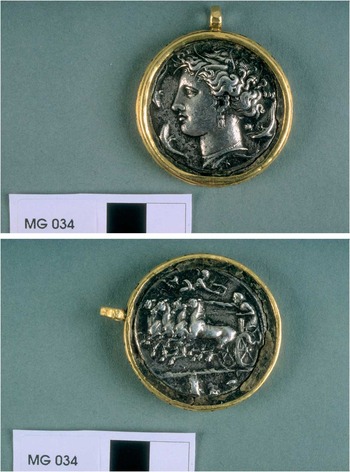
The coin we discuss here (fig 1), while not unusual in itself, is significant for its relevance to this theme. It is a Syracusan dekadrachm of the late fifth century bc, or possibly the earliest fourth, from a well-attested series originating from dies signed by Euainetos.Footnote 2 The series has been well studied: it suffices to say here that it is currently connected with minting by Dionysios of Syracuse during his attempts to counter Carthaginian aggression in eastern Sicily in the last decade of the fifth century bc.Footnote 3
The Hunt dekadrachm, c 400 bc: obverse and reverse. Photograph: courtesy of the Hunt Museum, Limerick

This particular example is not unknown to the world, and it is referenced in Hill’s works,Footnote 4 but it has so far lain hidden in the depths of a mid-nineteenth-century Parisian catalogue,Footnote 5 in the Hunt Museum’s website and museum guideFootnote 6 and in a general book on the archaeology of Greece.Footnote 7 The coin was purchased by John Hunt, a connoisseur of early medieval art, at an unknown date and in 1978 it was incorporated into his foundation, the Hunt Museum, in Limerick, where it now forms a small but outstanding exhibit.Footnote 8 It is associated with a numismatic card disc, with annotations in various hands. One of these, which says ‘Rev 366 – same sale’, might give one small clue as to its history. The reference is probably to Boehringer’s reverse die 366 of the Syracuse series. Unfortunately, for our purposes, this is an extremely common die – Boehringer lists thirty-three such coins – but the disc does suggest that the sale of the dekadrachm took place after the publication of Boehringer’s Reference Boehringer1929 catalogue.Footnote 9
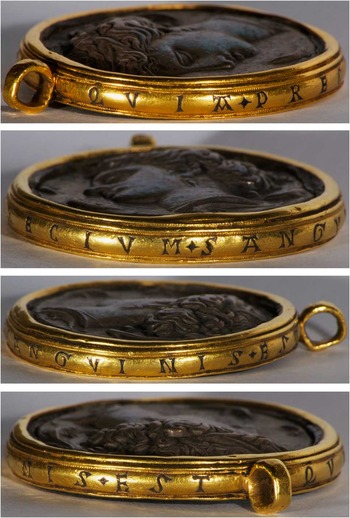
What distinguishes the piece is the mounting of the coin (fig 2), and no doubt this is what drew Hunt’s attention to it in the first place. The mount is of gold, with a ring for a pendant and plenty of lead to fix it to the coin, obscuring a little of its surface. Engraved on the mount are the words from Matthew 27 cited above – QUIA.PRECIUM.SANGUINIS.EST (‘since it is the price of blood’)Footnote 10 – and this inscription gives the piece its unique character.
The Hunt dekadrachm’s mount, early 14th century ad. Photograph: courtesy of the Hunt Museum, Limerick

Medieval attempts to identify the thirty coins of the Gospel are treated fully in Hill’s excellent review and, as he points out, ‘no single one of the professed relics was actually a coin of the kind that was in circulation in Judaea at the time of Christ’. Nearly all the coins in his list are of Rhodian origin and much earlier than the first century ad. One possible reason for this, as Hill points out, is that Crusaders used Rhodes as a base, and were probably familiar with the ancient coins of this island. Another possible reason, which Hill does not mention, is that, unlike this dekadrachm, several of these Rhodian coins bear the head of Helios crowned by the rays of the sun; to some viewers this might look like the Crown of Thorns associated with the Passion of Christ.
Among the other ‘pre-Judas’ coins that Hill lists, only two can be identified: ‘an ancient barbarous Celtic imitation of a silver tetradrachm of Philip II of Macedon’, reportedly ‘sent from Silesia’,Footnote 11 and the dekadrachm that is the subject of this paper. The dekadrachm stands out from the other coins both for its impressive size and for the fact that it is unlikely to have acquired its ‘holy’ status in the eastern Mediterranean world (something that is also true of the ‘Celtic’ piece). In antiquity, at any rate, these coins did not travel east, nor did most other pieces minted in the Italian peninsula. Exceptions are rare: perhaps the most striking example is a hoard of small Sicilian bronzes from central Greece of much the same date as the dekadrachm,Footnote 12 but these were probably the ‘savings’ of a mercenary who had been operating in Sicily; the pieces would have had little value in their place of discovery. The same is true of the five contemporary Sicilian bronze fractions from the Athenian Agora listed by Kroll.Footnote 13 A silver dekadrachm is a far different proposition, though the fragility of the argumentum e silentio is demonstrated by the find of a bronze coin of the Syracusan tyrant Agathokles, datable to c 295–290 bc, that was placed in the primary burial in a tomb at Kymissala, Rhodes, to be used as Charon’s obol.Footnote 14 The political geography of the Mediterranean was much different c 300 bc than a century earlier, however, and the likelihood that our coin remained in Sicily or southern Italy must remain high.
This is corroborated by the nature of the script on the ring. While Hill describes the letters as Gothic, they are really elaborate Lombardic letters. The letter A has a straight bar rather than a broken cross bar. Exploring the dates of letters on bishops’ seals in England, H S Kingsford dated the broken cross bar to the period from the early twelfth to the first years of the thirteenth centuries.Footnote 15 The straight bar appears to be later; it can be compared with that on the reliquary of the Holy Blood held at the cathedral of Boulogne-sur-Mer (Pas de Calais), which reads + de sanguine ihu xpi (‘the blood of Jesus Christ’). This also has elaborate Lombardic letters, including the letter A with a straight cross bar, and probably dates from around 1308.Footnote 16 It seems likely that the coin-mount inscription dates from the same period. This would make the coin an early example of a ‘thirty pieces’ relic, based on Hill’s observation that the use of Helios coins in this role on Rhodes seems to have supplanted that of an entirely different coin or medal, depicting St Helena, at some time in the fifteenth century.Footnote 17
The coin was catalogued in Paris in 1864 and it may have been in France for some time previously. F de Mély notes three places in France that had ‘thirty pieces’ relics:Footnote 18 the Visitandines at Aix-en-Provence (Bouches-du-Rhône), Notre-Dame de Puy (Le Puy-en-Velay, Auvergne) and the Abbey de St-Denis (Paris). One of these could be the Hunt dekadrachm and St-Denis is the most likely. There is no mention of such an object in the abbey’s 1634 inventory,Footnote 19 though a list of objects from St-Denis and from Ste-Chapelle compiled on 5 December 1793 included deux pièces de monaie en argent. Nothing further is heard of these two coins and they may, of course, be quite unrelated to the present object.Footnote 20 Even so, one might speculate that the object might have been held in a French, and possibly Parisian, treasury or church until the French Revolution, and that it passed into the hands of collectors subsequently. Only the chance survival of an accurate inventory description would allow it to be identified more securely.