Available treatment of coronary stenosis, leading to myocardial ischemia, is by medication, coronary artery bypass graft surgery (CABG), or percutaneous transluminal coronary angioplasty (PTCA). Bare-metal stents (BMS) and drug-eluting stents (DES) are used during PTCA to improve angioplasty by providing mechanical support. DES avoid endothelial aggression by metal, which is a cause of restenosis in some patients with BMS, and release an immunosuppressive, antiproliferative drug locally to prevent in-stent restenosis.
Four DES are currently reimbursed by the French national health insurance. The first to be reimbursed were a sirolimus-eluting stent (CYPHER) and a paclitaxel-eluting stent (TAXUS). Their indication at first listing in 2003 was use in patients at high risk of restenosis with BMS (lesions >15 mm, vessel diameter <3 mm or diabetic patients), but two indications were added the following year (BMS in-stent restenosis and total coronary chronic occlusion). In 2006 and 2007, two further DES, a zotarolimus-eluting stent (ENDEAVOR) and an everolimus-eluting stent (XIENCE V or PROMUS), were added to the reimbursement list for some of these indications. Compared with BMS, DES reduce the need for repeat target lesion revascularization (TLR) of a de novo lesion in a native coronary artery. The relative risk (RR) of repeat TLR at 1-year decreased by 75 percent in randomized controlled trials (RCTs) and 30 percent (from 30 to 60 percent) in prospective comparative observational studies (Reference Neyt, Van Brabandt and Devriese4;Reference Hill, Boland and Dickson9;Reference Jensen, Maeng and Kaltoft10;Reference Stettler, Wandel and Allemann19;Reference Yan, Duffy and Clark25).
Recent clinical data indicated that the incidence of stent thrombosis (ST) according to the Academic Research Consortium (ARC) definition (Reference Cutlip, Windecker and Mehran5) was slightly higher after 1 year with DES than BMS (increase from 0.3 percent to 1.4 percent [DES] versus 0 to 0.6 percent [BMS]) but no different over the whole follow-up (F/U) period which extended up to 4 years (Reference Neyt, Van Brabandt and Devriese4;Reference Daemen, Kukreja and van Twisk6;Reference Hill, Boland and Dickson9;Reference Jensen, Maeng and Kaltoft10;Reference Stettler, Wandel and Allemann19;Reference Yan, Duffy and Clark25). There was no significant difference in death and myocardial infarction (MI) rates but, according to several prospective observational comparative studies, the rates of death or MI were reported lower with DES (Reference Anstrom, Kong and Shaw1;Reference Applegate, Sacrinty and Kutcher2;Reference Neyt, Van Brabandt and Devriese4;Reference Daemen, Kukreja and van Twisk6;Reference Hill, Boland and Dickson9;Reference Jensen, Maeng and Kaltoft10;Reference Marroquin, Selzer and Mulukutla14;Reference Stettler, Wandel and Allemann19;Reference Tu, Bowen and Chiu21;Reference Yan, Duffy and Clark25). In prospective observational noncomparative studies, an increased incidence of need for TLR, deaths, and MI was recorded at 1 year in patients who received DES “off label” than those who received DES “on label” (Reference Jeremias, Ruisi and Kirtane11;Reference Win, Caldera and Maresh24).
Clearly, more information is needed on DES safety and efficacy in patient populations with different characteristics, especially those at high risk of restenosis with BMS, and also on the conditions of long-term associated dual antiplatelet therapy.
Aims
The objective of our systematic review was to assess DES efficacy and safety by patient category (patients’ clinical features and lesion type) and compared with medication alone, CABG surgery or BMS placement. The purpose of this work was to establish when DES placement may be recommended for reimbursement by the French national health insurance.
Methods
We searched six bibliographic databases (as Medline, Embase, Pascal Database, Cochrane Library, National Guidelines, HTAs Database) over the period January 2002 to August 2009 (languages: English and French) using the following main keywords: drug-eluting stents, coronary, stent.
Selection criteria for the type of studies were as follows: the most recent study from the same source; HTA reports published after 2005, meta-analyses published after the search period covered by the selected HTA report (or published after 2002 in the absence of a HTA report); RCTs published after the search period covered by the selected meta-analyses or HTA report (or RCTs published after 2002 in absence of a meta-analysis or HTA report); prospective cohort studies of more than 100 patients followed up for at least 6 months (design and population defined) published after the search period covered by the selected HTA report or published after 2002 in the absence of a HTA report. The primary clinical efficacy end point selected was the rate of repeat revascularization of a treated lesion (target lesion revascularization, TLR) particularly driven by the documented return of clinical symptoms (i.e., MI or unstable angina, recurrence of angina pectoris). Secondary efficacy end points were the rate of angiographic restenosis (late loss, LL) and the rate of global revascularization (targeted and nontargeted revascularization of the initial lesion). The main safety criteria selected were overall mortality and ST rates (Academic Research Consortium [ARC] definition) (Reference Cutlip, Windecker and Mehran5). Other safety criteria were occurrence of MI, of stroke. We also selected articles on specific patients’ clinical features and lesion type relating to four DES (CYPHER™, TAXUS™, ENDEAVOR™, and XIENCE V™ /PROMUS™) compared with alternative treatments (medication alone, CABG surgery, or BMS placement).
We used a standard template to extract efficacy and safety data from the selected articles. The methodological quality (MQ) of the articles was also assessed in the template by using a validated method developed by the HAS and in accordance with those used by others (Reference Moher, Jadad and Tugwell16;Reference Moher, Jadad and Nichol17). For meta-analysis articles, quality criteria focused on study selection, quality of the analysis and validity of the conclusion. For RCTs articles, they were adequacy of the randomization, baseline comparability, blinding, withdrawals, and intention-to-treat (ITT). For prospective cohort articles, they were selection and confounding bias, degree of exhaustiveness, and accuracy.
We performed a narrative synthesis of evidence based on a systematic review of literature relating to DES which included different sources: published data (from the bibliographic databases), unpublished data (lodged by manufacturers) and a meta-analysis we conducted from the individual trials (S4). This meta-analysis was used to update the already published meta-analysis or in case of insufficient literature data according to the patients’ clinical features, lesion type, or DES device. No specific data from the manufacturers was retained.
All data was reviewed by a multidisciplinary panel of health professionals (interventional cardiologists, cardiovascular radiologists, specialists in intensive care, cardiac surgeons and methodologists in health technology assessment [HTA]). All completed a conflict of interest statement, working in the public or private health sectors in different regions of France. Definitions of the most relevant end points were assessed in a meeting with the panel of health professionals before beginning the search in the bibliographic databases. The reference treatment of each patient category identified was also defined. It was BMS in patients with risk factors for restenosis (lesions >15 mm, vessel diameter <3 mm, or diabetic patients), ST-segment elevation MI (STEMI), total coronary chronic occlusion or vein graft stenosis. It was medication, CABG surgery, angioplasty with BMS or balloon alone in patients with in-stent restenosis after BMS. It was CABG surgery in operable patients with complex lesions such as multivessel lesions or unprotected left main stenosis.
All the references to the selected studies are listed in the supplementary materials section, which can be viewed online at www.journals.cambridge.org/thc2011007.
RESULTS
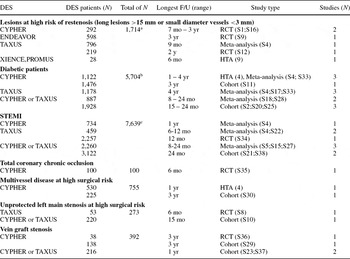
Using the above criteria, we selected two HTA reports and thirty-eight clinical studies. These included eleven meta-analyses (including ours [S4]), eleven RCTs, and sixteen prospective cohort studies (Supplementary Figure 1, which can be viewed online at www.journals.cambridge.org/thc2011007). For each clinical situation (grouped according to the reference treatment), Table 1 and Supplementary Table 1, which can be viewed online at www.journals.cambridge.org/thc2011007 give the DES devices studied, the number of patients treated by DES, the longest F/U of each study, and the number and type of studies. The MQ of the selected meta-analysis including all RCTs was determined to be high (search strategy well defined, appropriate description of eligibility criteria and good quality of analysis, accordance of conclusion with results). The MQ of the selected RCTs was determined to be good (sufficient detail on method of randomization, description of baseline comparability, details of masking procedures and withdrawals, ITT analysis) except in unprotected left main stenosis (S8) and vein graft stenosis (S36). The MQ of the selected cohort studies was determined to be sufficient because of the effort to reduce the risk of selection and confounding bias (with consecutive patients, prospective F/U, audit data system, adjustment on baseline characteristics, use of propensity score). These biases are inherent to the observational aspect of this type of study. The risk of these biases were high in multivessel disease (S19;S30), unprotected left main stenosis (S10), and vein graft stenosis (S23) because of the lack of measures taken to limit them. No study comparing DES with drugs was retrieved. DES efficacy and safety is given in Tables 2, 3, and Supplementary Tables 2 and 3, which can be viewed online at www.journals.cambridge.org/thc2011007.
Description of DES Studies Considered for the Narrative Systematic Review by Patient Category: Comparison with BMS as Reference Treatment

aTotal excluded 219 patients from the TAXUS VI RCT (S12) (2 years F/U) as already analyzed in the meta-analysis (S4) at 9 months.
bTotal excluded 887 patients from the meta-analysis (S18,S28) as already analyzed in the meta-analyses (S4;S17;S33).
cTotal excluded 1,193 patients from the meta-analysis (S4,S22) as already analyzed in the meta-analyses (S5;S15;S27).
DES, drug-eluting stent; BMS, bare-metal stent; STEMI, ST-segment elevation myocardial infarction; RCT, randomized controlled trial; Cohort, prospective cohort study; HTA, health technology assessment report; F/U, follow-up.
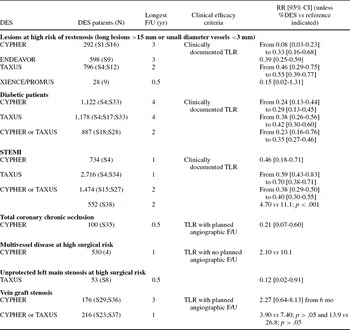
DES Efficacy: Comparison with BMS as Reference Treatment

DES, drug-eluting stent; BMS, bare-metal stent; CI, Confidence Interval; F/U, Follow-Up; TLR, target lesion revascularization; STEMI, ST-segment elevation myocardial infarction; RR, Relative Risk.
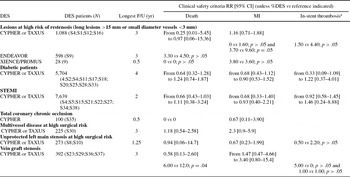
DES Safety: Comparison with BMS as Reference Treatment

aDefinite and probable according to Academic Research Consortium definition (Reference Cutlip, Windecker and Mehran5).
DES, drug-eluting stent; BMS, bare-metal stent; MI, myocardial infarction; STEMI, ST-segment elevation MI; CI, confidence interval; F/U, follow-up; RR, Relative Risk.
Comparison with BMS
Patients with Lesions at High Risk of Restenosis (Lesions >15 mm Long or Vessel Diameter <3 mm). CYPHER and TAXUS were significantly more effective than BMS in patients with lesions at high risk of restenosis (Table 2). The relative risk (RR) of clinically documented TLR for CYPHER was between 0.08 and 0.33 over a F/U period of up to 3 years (S1;S16). For ENDEAVOR, it was 0.39 at 3 years (S9). For TAXUS, it was between 0.46 and 0.55 over a F/U period of up to 2 years (S4;S12). For XIENCE/PROMUS, it was 0.15 at 6 months (Reference Hill, Boland and Dickson9). All devices appeared as safe as BMS in terms of ST, deaths, and MI (9;S1;S4;S9;S12;S16). After 1 year of F/U, four cases of ST (definite, probable, or possible according to ARC definitions) were reported with CYPHER; one case was reported with BMS (S16) (Table 3).
Diabetic Patients. CYPHER and TAXUS were significantly more effective than BMS in diabetic patients (RR of clinically documented TLR: 0.24 to 0.29 for CYPHER; 0.38 to 0.42 for TAXUS) over a F/U period of up to 4 years (S4;S17;S18;S28;S33) (Table 2). To avoid one TLR, seven patients had to be treated (number needed to treat [NNT]: 7 [5–9]) (S18;S33). Both devices appeared as safe as BMS in terms of ST, deaths, and MI if dual antiplatelet therapy was continued for 1 year (4;S2;S9;S11;S17;S18;S20;S25;S28;S33) (Table 3). However, when it lasted for just 2 to 3 months, an excess of death was reported with DES in 278 patients (RR: 2.30 [1.18–5.12] and 2.90 [1.38–6.10] for CYPHER) (4;S33).
Patients with STEMI. CYPHER and TAXUS were significantly more effective than BMS in STEMI patients (RR of clinically documented TLR: 0.46 for CYPHER; up to 0.70 for TAXUS) (S4;S15;S27;S34;S38). To avoid one TLR, 14 patients had to be treated (NNT: 14 [11–20]) (S15;S27). Both devices appeared as safe in terms of deaths and MI over a F/U period of up to 2 years (S4;S5;S15;S21;S22;S27;S34–S38) (Table 2). No difference was reported in the total number of definite or probable ST after 1 year of F/U (S4;S34) (Table 3).
Patients With Total Coronary Chronic Occlusion. CYPHER was more effective than BMS in patients with total coronary chronic occlusion (RR of TLR with planned angiographic F/U: 0.21; reduction of late loss: 1.04 mm at 6 months) and appeared as safe in terms of death, MI, and stroke in the only small study concerned (S35) (Tables 2 and 3).
Patients with Multivessel Disease and/or Unprotected Left Main Stenosis at High Surgical Risk. In patients with complex lesions and at high surgical risk, the studies reported that the option of PTCA needs to be discussed in a multidisciplinary medical–surgical team (MDT) meeting. DES have been compared with BMS in 1,028 DES patients (Table 1). TAXUS and CYPHER were significantly more effective than BMS (RR of TLR without planned angiographic F/U: 0.12 to 0.20 at 1 year) (4,S8) (Table 2). Both devices appeared as safe as BMS in terms of ST, death, MI, and stroke. However, the data on safety concerned only 498 patients with DES (S8;S10;S30) (Table 3).
Patients with Vein Graft Stenosis. In this indication, neither CYPHER nor TAXUS was superior to BMS (RR of TLR with planned angiographic F/U: 2.27; RR of MI: 1.47 to 3.40 over a F/U period of up to 3 years) (S23;S29;S36;S37). A small study even reported an excess of deaths 15 months after DES placement (29 percent versus 0) (S36). However, these studies included only 392 patients with DES (Tables 2 and 3).
Comparison with Alternatives Other Than BMS
Patients with BMS In-Stent Restenosis. In patients with BMS in-stent restenosis with clinical manifestations of myocardial ischemia, DES use (CYPHER or TAXUS) was significantly more effective than angioplasty without stenting (RR of TLR clinically documented or with planned angiographic F/U: 0.27 to 0.47 over a F/U period of up to 2 years) (S6;S7;S24) (Supplementary Table 2). DES appeared as safe as angioplasty without stenting in terms of deaths and MI. No cases of ST, as defined by ARC, were reported in the 730 patients analyzed (S6;S7;S24) (Supplementary Table 3).
Patients with Multivessel Disease and/or Unprotected Left Main Stenosis at a Low-to-Moderate Surgical Risk. Data in comparison to CABG surgery was available for 13,576 DES patients with complex lesions (multivessel disease and unprotected left main stenosis) and a low-to-moderate surgical risk (including 4,095 diabetic patients) (Supplementary Tables 1 and 3). CABG surgery was significantly more effective than either CYPHER or TAXUS. The risk of repeat revascularization was two to three times greater with DES than CABG surgery after a F/U of 1 to 3 years (RR of global revascularization without planned angiographic F/U for multivessel disease: 2.05 to 2.81; RR of TLR without planned angiographic F/U for unprotected left main stenosis: 2.98) (S3;S13;S14;S19;S26;S31;S32) (Supplementary Table 2). The results reported no difference between DES and CABG surgery in terms of deaths and MI (RR: 0.95 to.1.50) except in diabetic patients (RR: 1.20 [0.99–1.45] to 1.88 [0.89–3.97]) (S3;S13;S14;,S19;S26;S30–S32). However, according to post hoc analyses, severe events might be more frequent with TAXUS than after CABG surgery in patients with a high risk lesions for PTCA (high SYNTAX score) (S31). Data on ST was fragmentary, with a global incidence of 1.10 percent to 3.50 percent (S26;S30) (Supplementary Table 3). The incidence of stroke was significantly increased at 1 year after CABG surgery (from 2.20 to 4.00 percent versus from 0 to 0.60 percent) (S3;S14;S19;S31).
DISCUSSION
Our narrative synthesis of evidence from the systematic review did not reveal a survival benefit of stenting with DES rather than with other alternatives for any patient category or lesion type. DES use did not demonstrate an increase in the risks of ST compared with BMS, of deaths or MI compared with all alternative treatments over a F/U period of up to 4 years. However, for some patient categories, the studies are underpowered to detect possible mild differences. For example, late stent thrombosis occurred with an annual rate of less than 0.6 percent/year (Reference Wenaweser, Daemen and Zwahlen22), and more than 20,000 randomized patients are needed to be able to detect a difference. Compared with BMS, DES reduced the need for TLR in some candidates for angioplasty. On average, seven to fourteen patients, depending upon category, had to be treated to avoid one TLR with BMS.
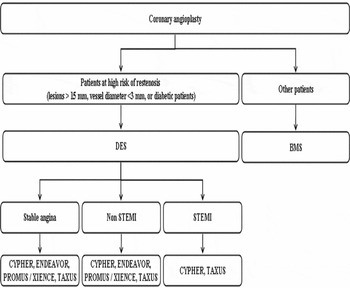
Based on our analysis after reviewing the panel of experts, we recommend restricting reimbursement by the French national health insurance for DES use in patients with a high rate of restenosis with BMS attributable to a de novo single vessel lesions (lesions >15 mm, vessel diameter <3 mm, or diabetic patients), provided that current guidelines for myocardial revascularization are complied with (Reference Wijns, Kolh and Danchin23). The recommended devices are CYPHER, TAXUS, ENDEAVOR, and PROMUS/XIENCE (Figure 1). In other situations (particular case single vessel and multivessel lesions), an MDT approach is indispensable before opting for DES as recommended by the guidelines (Reference Wijns, Kolh and Danchin23): (i) DES may be used to treat total coronary chronic occlusion (>72 hr) when there is evidence of ischemia and when lesion access seems reasonable (recommended devices: CYPHER and, despite lack of conclusive data, TAXUS) (ii) DES is the preferred option for treatment of a first BMS in-stent restenosis (i.e., return of clinical ischemic symptoms prompting repeat revascularization) (recommended devices: CYPHER and TAXUS) but, in all other cases, all possible treatment options should be considered. In particular, CABG surgery should be preferred for a second restenosis with extensive myocardial ischemia or if lesion access is poor; (iii) the MDT may opt for DES in patients who are at very high surgical risk with some accessible de novo multivessel lesions (lesions >15 mm, vessel diameter <3 mm, or diabetic patients) after surgical discussion about score risk factors (EUROSCORE and SYNTAX score). When angioplasty is inadvisable (high SYNTAX score), CABG surgery is the standard treatment with complete revascularization of the ischemic areas. When complete revascularization by angioplasty is possible (low or intermediate SYNTAX score), stent placement might be preferable when surgical risk is very high (high EUROSCORE) (recommended devices: CYPHER and TAXUS); (iv) the MDT may opt for DES in some cases to treat unprotected left main stenosis if angioplasty was considered even though the standard treatment is CABG surgery (recommended device: CYPHER) (Supplementary Figures 2 and 3, which can be viewed online at www.journals.cambridge.org/thc2011007).
Choice of type of revascularization and therapeutic position of drug-eluting stents (DES) for reimbursement. Single vessel lesions: General case. DES, drug-eluting stent; BMS, bare-metal stent; CABG, coronary artery bypass grafting; MI, myocardial infarction; STEMI, ST-segment elevation myocardial infarction.

Contraindications to DES use for reimbursement are those in the CE-marking, namely, left ventricular ejection fraction <30 percent, lesions with calcifications. For ENDEAVOR, XIENCE, and PROMUS, contraindications are MI less than 72 hr previously and unprotected left main stenosis. For TAXUS, the CE-marking contraindicates treatment of unprotected left main stenosis (Figure 1, Supplementary Figures 2 and 3). In the absence of conclusive data, a vein graft stenosis is not an indication for DES use.
Our conclusions are based on a thorough and rigorous systematic review, and the views of a panel of experts who had completed a conflict of interest statement. However, we did not analyze meta-analyses already reviewed in earlier HTA reports (e.g., those in the HTA report of the Belgian Health Care Knowledge Centre (KCE)) (Reference Neyt, Van Brabandt and Devriese4). End points were defined by the panel. Our primary end point (clinically documented repeat revascularization of a treated lesion) provides a good estimate of stent efficacy whereas revascularization with planned angiographic F/U, that is not clinically documented, may lead to overestimation of efficacy. Furthermore, by focusing on target lesion revascularization rather than on the target vessel, we assessed intrinsic stent efficacy. An effect on the vessel may be due to the patient and not to the stent as demonstrated in a meta-analysis in vein graft stenosis (significant reduction of TVR with DES compared to BMS) (Reference Meier, Brilakis and Corti15). We also considered global revascularization rate (targeted and nontargeted revascularization of the initial lesion) as this is an important criterion from the patient's perspective and in terms of cost-effectiveness (a cost-effectiveness analysis has been performed, but not reported here).
In our knowledge until now, results of the most recent review are in accordance with our results which stopped the search data in August 2009. A recent Cochrane review has assessed only comparison versus BMS in different subgroups (diabetes mellitus, long lesions, small vessels, complex lesions) on the basis of forty-seven RCTs analyzed (without inclusion of observational studies) (Reference Greenhalgh, Hockenhull and Rao7). The authors did not establish recommendations on DES use; they concluded that there were no statistical differences in death, MI or thrombosis; TLR reductions were evident with DES use and subgroups analyses largely mirrored these findings (Reference Greenhalgh, Hockenhull and Rao7). Three other reviews have established recommendations on DES use based on comparison between DES and BMS only in unselected patients: (i) The National Institute for Health and Clinical Excellence (NICE) has recommended that DES use be restricted to patients with independent risk factors for restenosis (lesions >15 mm or vessel diameter <3 mm) on the basis of expert opinion but their report did not conclude with regard to patient category and lesion type (Reference Hill, Boland and Dickson9;18); (ii) The KCE report could not conclude on DES reimbursement by health insurance (Reference Neyt, Van Brabandt and Devriese4); (iii) the review of Bavry and Bhatt recommended restricting DES use to patients at high risk of restenosis and low risk of ST (reported risk factors for restenosis and/or ST were diabetes, small vessels, long lesions, multivessel disease, bifurcations, in-stent restenosis, and total coronary occlusion) (Reference Bavry and Bhatt3). In complex lesions, a meta-analysis showed similar results on death, MI, and stent thrombosis which must be interpreted with caution because of the limited statistical power for safety data as we said in our review (Reference Meier, Brilakis and Corti15). In another study (RCT DEDICATION) at 3-years (Reference Kaltoft, Kelbaek and Thuesen12), the results showed an excess of cardiac death with DES compared with BMS already observed at 1 year (Reference Kaltoft, Kelbaek and Klovgaard13). However, the DEDICATION study is underpowered and the investigators had access only to the patient's vital status (not information on clinical characteristics which might have affected cardiac death). Moreover, the efficacy results were consistent with our systematic review. A longer follow-up is now available for some subgroups assessed in our review, particularly for multivessel lesions, and confirms or amplifies the initial findings from RCTs as 3-year F/U SYNTAX (unpublished data, 2010) or 1-year F/U SPIRIT IV (Reference Stone, Rizvi and Newman20).
There are several potential limitations to our systematic review: (i) we considered devices on the French reimbursement list only. These include, however, the DES with the highest level of evidence for efficacy and safety in 2009. Moreover, we have defined the minimum data set needed to lodge an application for reimbursement of a new DES (unpublished); (iii) we restricted our review to a comparison of DES with alternative treatments, and did not compare PTCA to CABG surgery or PTCA to medication alone. Indeed, PTCA technique is clearly defined in the management of coronary insufficiency by the current guidelines (Reference Wijns, Kolh and Danchin23); (iv) our review did not establish an optimal duration for dual antiplatelet therapy (data not reported here). While awaiting more conclusive data, we recommend, like others, a minimum of 12 months (Reference Grines, Bonow and Casey8). Moreover, we were unable to quantify the risk associated with treatment discontinuation or continuation after surgery. We recommend that patients be provided with appropriate information before the intervention (a card specifying DES type, placement date, and recommended duration of antiplatelet therapy).
CONCLUSIONS
Our systematic review has confirmed the benefit of DES but in certain indications only. Outside these indications, BMS should be the preferred option. In the case of patients with complex lesions, a medical–surgical consultation is essential to decide on best management. The indications for DES should become clearer once the long-term results from multicenter clinical trials comparing DES to CABG surgery become available.
SUPPLEMENTARY MATERIAL
Supplementary Table 1
Supplementary Table 2
Supplementary Table 3
Supplementary Figure 1
Supplementary Figure 2
Supplementary Figure 3
CONFLICT OF INTEREST
M Cucherat is a member of the Board at GSK and a consultant at Sorin Biomedical and Servier. The other authors do not report any potential conflicts of interest.
CONTACT INFORMATION
Emmanuelle Schapiro-Dufour, PharmD, MSc (e.schapiro@has-sante.fr), Project Manager, Service d'évaluation des dispositifs, Haute Autorite de Sante HAS, 2 avenue du Stade-de France, 93218 Saint-Denis-La-Plaine cedex, France
Michel Cucherat, MD, PhD (mcu@upcl.univ-lyon1.fr), Researcher, UMR 5558, Faculté de Médecine Laennec, 7 rue Guillaume Paradin, 69008 Lyon, France
Elodie Velzenberger, PhD (e.velzenberger@has-sante.fr), Project Manager, Hubert Galmiche, PharmD (h.galmiche@has-sante.fr), Deputy Head of Department, Catherine Denis, MD (c.denis@has-sante.fr), Head of Department, Service d'évaluation des dispositifs, Haute Autorite de Sante HAS, 2 avenue du Stade-de France, 93218 Saint-Denis-La-Plaine cedex, France
Jacques Machecourt, MD, FESC (JMachecourt@chu-grenoble.fr), Professor, Department of Cardiology, Chief, Service de cardiologie et d'urgences cardiologiques, CHU Grenoble, B.P. 217, 38043 Grenoble cedex 9, France