1. Introduction
Productivity is a defining property of language (Chomsky Reference Chomsky1968). Upon hearing panana and katata, young infants spontaneously extract the ABB structure in artificial languages, and they readily generalize it to novel forms (e.g. wofefe; Marcus et al. Reference Marcus, Vijayan, Rao and Vishton1999, Gervain, Berent & Werker Reference Gervain, Berent and Werker2012).
Similar generalizations are routinely evident in natural language as well. For example, it is well known that Semitic languages allow ABB stems, but strongly disfavor AAB forms (Greenberg Reference Greenberg1950, McCarthy Reference McCarthy1979). Many studies have shown that speakers of Semitic languages generalize the dislike of AAB stems to novel forms (e.g. Berkley Reference Berkley1994, Berent & Shimron Reference Berent and Shimron1997, Buckley Reference Buckley1997, Berent, Everett & Shoimron Reference Berent, Everett and Shimron2001, Frisch & Zawaydeh Reference Frisch and Zawaydeh2001). In fact, speakers demonstrably project such generalizations across the board, even to novel instances with novel phonological elements (segments, features) that are unattested in their language (Berent et al. Reference Berent, Marcus, Shimron and Gafos2002). For example, Hebrew speakers favor maθaθ to θaθam despite the fact that the segment θ and its place of articulation are unattested in their language. Similar projections to nonnative features have been also demonstrated by signers of American Sign Language (ASL; Berent, Dupuis & Brentari Reference Berent, Dupuis and Brentari2014).
Such broad projections are readily explained by the hypothesis that some phonological constraints are algebraic (Chomsky & Schützenberger Reference Chomsky, Schützenberger, Braffort and Hirschberg1963, see also Marcus Reference Marcus2001, Berent Reference Berent2013, Berent & Marcus Reference Berent and Marcus2019). Algebraic principles operate on variables that stand for entire classes. For example, in the ABB generalization above, B (and A) is a variable that stands for the class of ‘any syllable’ (much like X in y = 2X can apply to ‘any integer’). Because the ABB structure is expressed over an entire class (e.g. ‘any syllable’), rather than specific instances (e.g. pa, ma), this generalization is expected to automatically extend across the board, to any member of the B class, irrespective of whether its features are native to the language or novel.
In fact, the prediction of the algebraic hypothesis is even stronger. If the relevant generalization (e.g. ABB) truly extends to any member of a given class (e.g. ‘any syllable’), then speakers might generalize their grammatical knowledge not only to novel spoken syllables (e.g. wofefe) but even to syllables that are signed. Indeed, to generalize an algebraic principle, all that is required is that its structural conditions are met. If a given condition (e.g. ABB) truly applies to ‘any syllable’, and if speakers can spontaneously extract syllables from signs (Berent, Dupuis & Brentari Reference Berent, Dupuis and Brentari2013), then the relevant generalization should proceed automatically across language modalities – to both speech and signs. Thus, if a speaker of an ABB language who has had no previous experience with a sign language were to encounter an ABB structure in sign (in American Sign Language), they would not be expected to treat it as dance or pantomime, akin to nonlinguistic stimuli. Rather, the speaker should spontaneously encode it linguistically, and constrain it by relevant grammatical principles from her spoken language.
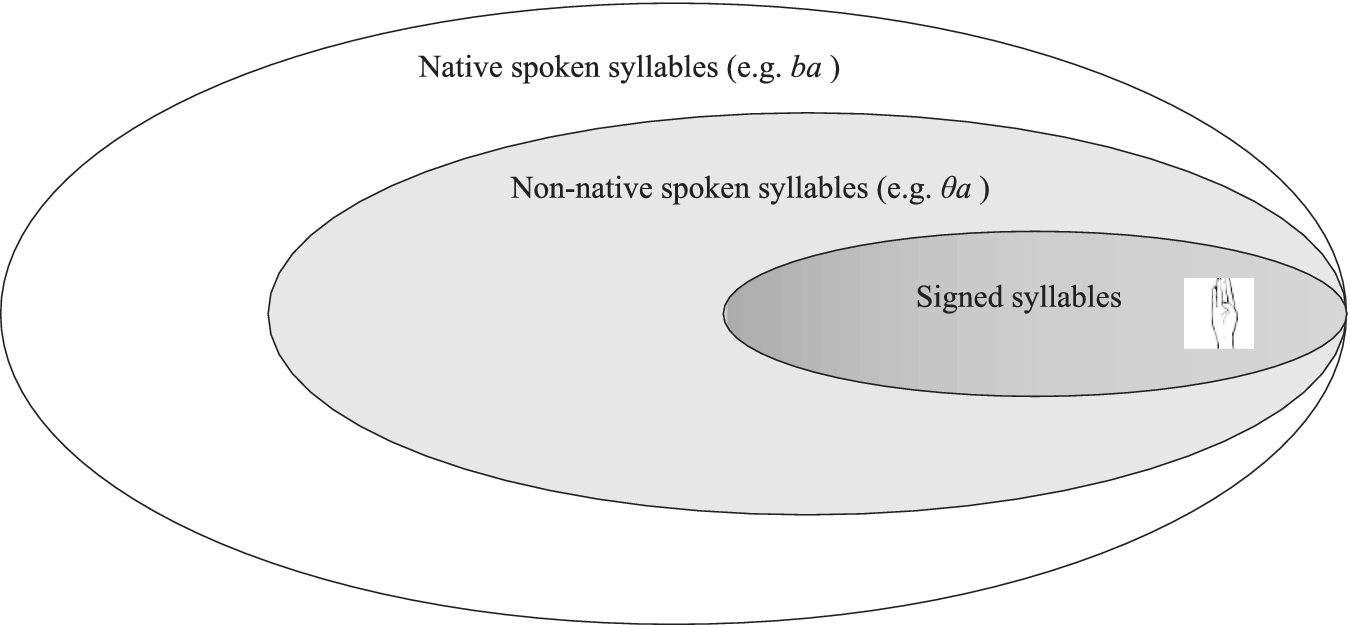
Phonological generalizations, then, may be far broader in scope than previously assumed, inasmuch as they might encompass not only the space of phonological features in spoken languages – both native and nonnative features – but also in signed ones. Thus, a Hebrew speaker, for instance, is expected to generalize the ABB rule to native Hebrew syllables (e.g. ba), to nonnative Hebrew syllables (e.g. θa), and even to signed syllables (see Figure 1). Phonology, in this view, could thus be partly amodal.
The scope of phonological generalization.

To be clear, the hypothesis of amodal phonology only implies that some phonological principles project across language modalities – it certainly does not claim that this is the case for all phonological principles. There is no question that a feature like ‘labial’ only plays a role in spoken language phonology, whereas ‘handshape’ is only relevant to sign language phonology. Other principles, however, might not appeal to modality-specific elements, and thus, would have the potential for cross-modal transfer. Our question here is whether such principles exist.
The hypothesis of amodal phonology makes three predictions. First, some grammatical constraints on spoken language phonology might be operative in sign language phonology. Accordingly, signers and speakers would partly converge on the same grammatical constraints. A second, stronger prediction concerns the possibility of cross-modal transference. If some constraints are amodal, then it is conceivable that speakers could spontaneously project this knowledge to linguistic signs. Finally, if those cross-modal projections depend on linguistic principles, then such projections should be systematically modulated by the structure of participants’ spoken language.
Here, we test these predictions. Our case study concerns the contrasting restrictions on doubling. Doubling, generally, refers to repeated phonological elements (e.g. banana, or generally, ABB, where A and B are distinct syllables). We chose this case study for two reasons. First, doubling is pervasive across languages, both spoken (Suzuki Reference Suzuki1998, Walter Reference Walter2007) and signed (Wilbur Reference Wilbur2009). For example, the World Atlas of Language Structures (WALS; Dryer & Haspelmath Reference Dryer and Haspelmath2013, Rubino Reference Rubino2013) lists 313 spoken languages with reduplication compared to only 55 languages without it. Doubling, then, potentially reflects a core universal property of the grammar. Second, since doubling is an algebraic formal structure, a phonological restriction on doubling needs not be confined to any particular linguistic channel. As such, doubling restrictions have the potential to transfer across language modalities.
Our experimental investigation evaluates this possibility. We start by showing that doubling is amenable to two distinct parses, one phonological and another morphological, which are each subject to distinct constraints. We then ask whether speakers enforce the constraints on doubling in spoken language (Section 2). Next, we move to examine whether speakers with no command of a sign language spontaneously project their knowledge of spoken language phonology to signs of American Sign Language (Section 3).
1.1 The double-identity of doubling
Linguistic research suggests that doubling (e.g. banana, panana) is subject to two competing structural parses at two distinct levels – the morphology and the phonology. At the morphological level, doubling is formed by reduplication – a productive process that generates complex morphological forms by copying a base, either fully or partially (Wilbur Reference Wilbur1973, Marantz Reference Marantz1982, McCarthy & Prince Reference McCarthy, Prince, Beckman, Urbanczyk and Walsh1995a, Inkelas Reference Inkelas, Lieber and Stekauer2014). For example, in Manam, the base pána ‘chase’ gives rise to panána ‘run’ (Lichtenberk Reference Lichtenberk1983), a complex reduplicative form that shares with the base both form and meaning.
Doubling, however, can also be parsed as phonological identity. For example, in the English banana, the repetition in the two final syllables is accidental—the final na has no relation to bana. In what follows, we will use the term doubling generally, to refer to the repetition of two elements; we will use identity and reduplication to refer to its structural parse at the phonological and morphological levels, respectively. Crucially, each such parse is subject to distinct sets of constraints (see (1) below). These constraints target both the presence of repeated elements and their proximity.
-
(1) The conflicting constraints on doubling
-
(a) Phonology
The Obligatory Contour Principle (OCP): Adjacent identical phonological elements are banned within a morpheme.
-
(b) Morphology
Anchoring (McCarthy & Prince Reference McCarthy and Prince1993)
Anchor right: In B+R [i.e. reduplication where the reduplicant (R) follows the base (B)], the final element of the reduplicant must be identical to the final element of the base.
Anchor left: In R+B [where the reduplicant precedes the base], the first element of the reduplicant must be identical to the first element of the base.
-
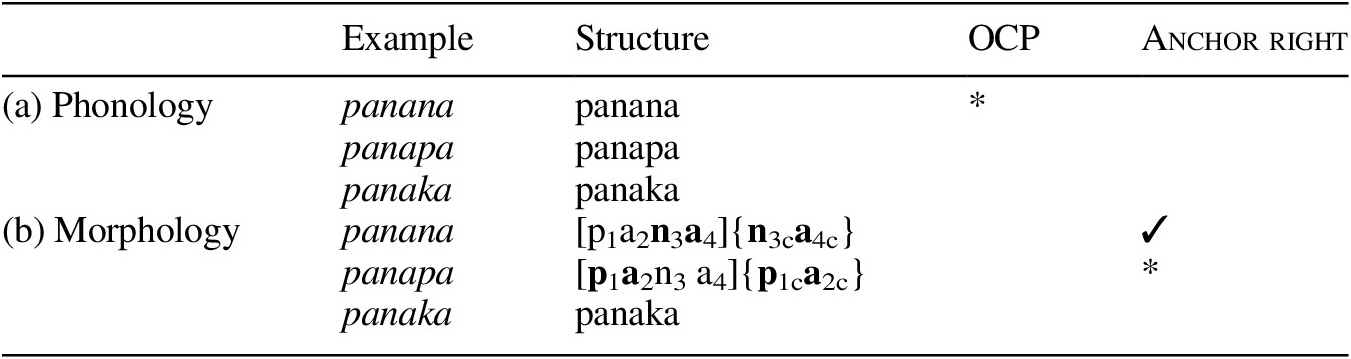
At the phonological level, identity is banned by the Obligatory Contour Principle (OCP), defined as a ban on adjacent identical phonological elements, often limited to within a morpheme (McCarthy Reference McCarthy1981, Reference McCarthy1986). In its original form, the OCP was proposed as a ban on identical tones (Leben Reference Leben1973), segments (McCarthy Reference McCarthy1981) and features (McCarthy Reference McCarthy and Keating1994). To enforce identity avoidance across intervening surface elements (e.g. the identical consonants in the Arabic samam ‘he poisoned’), adjacency was defined relative to phonological constituents, such as autosegmental tiers (McCarthy Reference McCarthy1981) or feature domains (Smolensky Reference Smolensky, Smolensky and Legendre2006). Such mechanisms render forms like panana, for example, dispreferred relative to panapa irrespective of intermediate vowels (cf. /pa.na.na/ vs. /pə.na.nə/). Subsequent proposals, however, suggest that the OCP could further target prosodic elements, such as syllables (e.g. Plag Reference Plag, Kehrein and Wiese1998, Yip Reference Yip, Lapointe, Brentari and Farrell1998), although this proposal has also met with criticism (de Lacy Reference de Lacy1999).Footnote 2
To underscore the strong parallelism in identity avoidance across language modalities – speech and signs – in what follows, we will provisionally assume that the OCP may target identical syllables. We further suggest that speakers encode a phonological form of panana in which the final syllables are identical (/pa.na.na/), regardless of the phonetic realization of the vowels. We will return to discuss these assumptions in the Discussion. Note, however that, regardless of grain-size (feature or syllable) and vowel quality, all accounts assume that, at the phonological level, panana is dispreferred to both panapa and panaka; since neither exhibits adjacent identical elements, panapa and panaka do not violate the OCP (as defined here, see Table 1(a)).Footnote 3
The acceptability of phonological vs. morphological doubling.

In contrast, at the morphological level, doubling (e.g. panana) is encoded as a single element and its copy (i.e. reduplicant, marked by ‘c’; e.g. [p1a2n 3a 4]{n 3ca 4c}).Footnote 4 Since the base /pana/ is repetition-free (only one copy of na is present), the OCP is vacuously satisfied. However, correspondence requires proximity between the base and its copy (Marantz Reference Marantz1982, McCarthy & Prince Reference McCarthy, Prince and Goldsmith1995b, Inkelas & Zoll Reference Inkelas and Zoll2005, Idsardi & Raimy Reference Idsardi, Raimy, Vaux and Nevins2008, Raimy Reference Raimy2012), and this demand is enforced by constraints such as Anchoring (McCarthy & Prince Reference McCarthy, Prince and Goldsmith1995b). For clarity of exposition, we limit our discussion to ABBc and ABAc and the constraint Anchor Right. In the case of panana, Anchor Right (Table 1(b)) requires the reduplicant to be adjacent to its corresponding element in the base. Accordingly, the adjacent doubled elements in pa.na.na are better formed than the non-adjacent ones in pa.na.pa (see Table 1(b)).
Summarizing, at the level of phonology, doubling is parsed as identity, and adjacent identical elements are ill-formed. At the morphological level, by contrast, doubling (parsed as reduplication) is preferred (e.g. ABBc > ABC), and proximity is required.
In what follows, we gauge the scope of doubling projections. We first ask whether speakers constrain doubling in novel spoken words (i.e. unimodally); we next evaluate whether they spontaneously transfer the same constraints to a novel linguistic modality – to novel ASL signs. But before we test for cross-modal projections, let us first consider the plausibility of this proposal.
1.2 Can doubling restrictions apply across language modalities?
According to the algebraic hypothesis, responses to linguistic stimuli should depend on their structural parse. Since phonological and morphological doubling are assigned radically different parses, the acceptability of the same form (e.g. panana) should thus shift, depending on the relevant level of analysis. And since the parses of doubling are defined formally (ABB vs. [AB]{Bc}), with no reference to specific phonetic substance, it is thus conceivable that these constraints could apply uniformly across linguistic modalities, for both speech and signs (see Table 2).
The acceptability of doubling across language modalities.

To project a constraint from spoken language to sign language, however, the constraint in question must reference a representational primitive that is available to adult speakers who are sign-naive. Phonological features, such as handshapes, are unlikely candidates for cross-modal transfer, as nonsigners lose their sensitivity to these signed features within the first year of life (Baker et al. Reference Baker, Idsardi, Golinkoff and Petitto2005, Palmer et al. Reference Palmer, Fais, Golinkoff and Werker2012). Syllables, by contrast, may well be available cross-modally. Not only are syllables represented in both signed and spoken language, but they are further defined by a shared constraint. In both modalities, syllables must exhibit a single sonority peak – such as a path movement, in sign language (Brentari Reference Brentari1993, Sandler Reference Sandler1993) or a vowel, in spoken language (Clements Reference Clements, Kingston and Beckman1990). Moreover, in both modalities, sonority peaks correlate with peaks of phonetic energy that are highly salient perceptually (Sandler & Lillo-Martin Reference Sandler and Lillo-Martin2006). Accordingly, the syllable presents a plausible target for cross-modal transfer.
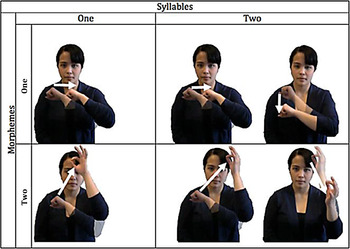
To examine whether English speakers can spontaneously extract syllables from signs, and whether syllables are distinct from morphemes, our past research has systematically manipulated the number of syllables and morphemes in novel ASL signs (Berent et al. Reference Berent, Dupuis and Brentari2013). Syllables, in these experiments, were defined by the number of sonority peaks (i.e. one movement per syllable). Morphemes, in turn, were defined by the number of distinct handshapes, as an ASL morpheme must exhibit a single group of selected fingers (Brentari Reference Brentari1998, Sandler & Lillo-Martin Reference Sandler and Lillo-Martin2006); thus a single handshape indicates a monomorphemic sign, whereas two handshapes indicate a bimorphemic one (see Figure 2).
(Colour online) The manipulation of syllable and morpheme structure (from Berent et al. Reference Berent, Dupuis and Brentari2013).

To determine whether English speakers spontaneously contrast syllables from morphemes, we thus presented participants with signs where the number of syllables (i.e. path movements) was incongruent with the number of morphemes (i.e. handshapes) – either bimorphemic monosyllables (akin to the English cans) or monomorphemic disyllables (akin to the English candy). Participants were asked to indicate either the number of syllables or the number of morphemes.
Remarkably, responses to the two tasks differed. When English speakers counted signed syllables, they spontaneously tracked the number of sonority peaks (path movements). In contrast, when asked to count morphemes, English speakers largely ignored the number of sonority peaks, and when provided minimal feedback, they identified morphemes by the number of handshapes. Thus, responses to a single sign (e.g. akin to cans) shifted, depending on whether participants counted the number of syllables (two) or morphemes (one). The finding that (a) English speakers use sonority to define syllables, but not morphemes, and that (b) they do so in a novel linguistic modality opens up the possibility that the syllable is an amodal phonological constituent.
If the OCP and Anchoring constrain syllables, it is thus possible that speakers could spontaneously apply the OCP and Anchoring to both speech and signs. Finally, if doubling projections rely on principles that are linguistic, then it is further conceivable that those projections would depend on the morphological structure of participants’ native language. Accordingly, the projection of doubling to signs should depend on the morphology of participants’ spoken language.
Recent studies from our lab have examined these predictions using the case of full reduplication (A → AA, where A is a phonological constituent) Berent et al. Reference Berent, Bat-El, Brentari, Dupuis and Vaknin-Nusbaum2016, Berent et al. Reference Berent, Bat-El, Brentari and Platt2020). We found that speakers with no command of a sign language spontaneously constrain doubling in signs. Moreover, signers shift their responses depending on the linguistic level of analysis. When presented with bare phonological forms, doubling is disliked (AA < AB), but when these same forms are presented as morphological reduplication, the doubling aversion shifts into a preference (AA > AB).
Critically, this shift obtains only if this morphological parse is in line with speakers’ native language. Thus, when reduplication indicates semantic plurality (A= ball, AA = many balls), the reduplication preference is seen in speakers of English (where the morphology productively marks semantic plurals) but not in Mandarin Chinese (with no productive plural morphology, Berent et al. Reference Berent, Bat-El, Brentari, Dupuis and Vaknin-Nusbaum2016, Berent et al. Reference Berent, Bat-El, Brentari and Platt2020). Hebrew speakers, on the other hand, projected reduplication to diminutives, as Hebrew productively marks diminution by reduplication (e.g. klavlav ‘puppy’ from kelev ‘dog’). Also in line with this prediction, English and Mandarin speakers did not project the reduplicative parse to diminutives (as these languages never use reduplication to indicate attenuation; Berent et al. Reference Berent, Bat-El, Brentari and Platt2020).
The case of full reduplication ( A → AA), however, is relatively limited inasmuch as it only requires that people encode the presence of doubling. Partial reduplication (AB → ABB) presents a more formidable challenge, as here, participants must not only encode the presence of doubling but further bind its location to the word’s edge. In line with this analysis, past research has shown that these two operations – doubling-encoding and edge-binding – rely on different brain mechanisms (Gervain et al. Reference Gervain, Berent and Werker2012). Formally, these two types of reduplication (AA and ABB) further invoke different constraints. While the preference for full reduplication (AA > AB) is due to DEP violation (by AB), the partial reduplication preference (ABB > ABA) reflects the violation of Anchoring (by ABA, see Table 1b). Our question then, is whether speakers spontaneously project the relevant constraints (OCP and Anchoring) across-language modalities.
Section 2 explores the reactions of English speakers to novel English forms (ABB vs. ABA), showing that, when ABB strings are viewed as phonological forms (as identity), ABB < ABA (due to the OCP), whereas, under the morphological parse (as reduplication), ABB > ABA (due to Anchoring). Section 3 below demonstrates that English speakers, with no knowledge of sign language, project the same two parses to novel signs. A similar shift is found with Hebrew speakers, but the semantic conditions for eliciting a morphological parse differ from English, in accord with the distinct morphologies of these two spoken languages. Together, these results demonstrate that phonological restrictions spontaneously transfer cross-modally.
2. Doubling projections within a language modality: Spoken language
The restrictions on phonological identity arguably exist in every language (Suzuki Reference Suzuki1998, Walter Reference Walter2007) and they are amply documented experimentally (Berkley Reference Berkley1994, Berent & Shimron Reference Berent and Shimron1997, Buckley Reference Buckley1997). However, not all languages exhibit morphological reduplication. This state of affairs allows us to ask whether people can project onto doubling two distinct parses – phonological identity vs. morphological reduplication – even when morphological reduplication is unattested in their language.
English presents an interesting test case. English exhibits various forms of reduplication, seen in (2) below, and speakers demonstrably extend them productively (Pinker & Birdsong Reference Pinker and Birdsong1979, Nevins & Vaux Reference Nevins and Vaux2003, Ghomeshi et al. Reference Ghomeshi, Jackendoff, Rosen and Russell2004).
-
(2) English reduplication (from Nevins & Vaux Reference Nevins and Vaux2003, Ghomeshi et al. Reference Ghomeshi, Jackendoff, Rosen and Russell2004)
-
(a) Dismissal reduplication: reduplication-shmeduplication
-
(b) Full reduplication: bye-bye, pee-pee
-
(c) Rhyming: teenie-weenie
-
(d) Ablaut: chit-chat, zigzag
-
(e) Contrastive focus reduplication: Did you bring chicken salad or SALAD-salad
-
These cases, however, originate from the syntax, rather than the morphology (Nevins & Vaux Reference Nevins and Vaux2003, Ghomeshi et al. Reference Ghomeshi, Jackendoff, Rosen and Russell2004), as evident by the fact that English reduplication does not form major lexical categories (Noun, Verb, Adjective; Inkelas Reference Inkelas, Lieber and Stekauer2014). This feature distinguishes syntactic reduplication from morphological reduplication in languages such as Hebrew, where reduplication freely forms new lexical categories (e.g. kav ‘line noun’ → kivkev ‘he drew a broken line verb’) and reduplicative outputs can be inflected in both verbs (e.g. kivkav-ti ‘I drew a broken line’) and adjectives (e.g. katan ‘small sg’ → ktantan ‘smallish sg’ → ktantan-im ‘smallish pl’). The resulting question, then, is whether English speakers will nonetheless project doubling to morphological forms, and whether the preference for morphological reduplication will contrast with identity aversion in the phonology.
A previous set of experiments explored these questions (Berent et al. Reference Berent, Bat-El, Brentari, Dupuis and Vaknin-Nusbaum2016). In these studies, English speakers were asked to make a forced choice between two novel printed words – one with doubling, and one with no doubling, a control (e.g. slaflaf vs. slafmat). In one condition, these options were presented either alone or as potential names for a single object, and participants simply chose between these two options, so doubling in form had no bearing on meaning (i.e. doubling is a phonological pattern only). In a second condition, doubling indicated a systematic link between form and meaning (e.g. plurality, a morphological operation); here, participants were first given the meaning of the base (e.g. slaf = one ball), and then asked to select a name for an object set (e.g. slaflaf or slafmat). Results showed a marked shift in doubling preferences across conditions – phonology vs. morphology. Viewed as meaningless patterns (i.e. as phonological forms), doubling was systematically disliked (e.g. slaflaf < slafmat), suggesting that, by default, English speakers parse doubling as phonological identity; this is only expected, as English lacks morphological reduplication. But once doubling signaled plurality, the doubling aversion shifted to a systematic preference (e.g. slaflaf > slafmat).
Since the stimulus is unchanged across conditions, the shift is inexplicable by the stimulus’ own properties (phonetic or statistical frequency). The shifting response thus shows that doubling exhibits structural ambiguity, whose resolution depends on the level of analysis – phonology vs. morphology. These results are in line with the algebraic hypothesis. But the evaluation of the algebraic hypothesis is incomplete, inasmuch as this research only gauges the presence of identity (e.g. in AA vs. AB) forms. As noted (in Table 1), the shift (from identity to reduplication) should also be affected by proximity (e.g. in AAB vs. ABA forms).
Even more worrisome is the possibility that the previous results may be due to no structural restrictions at all. Because these results obtained from printed forms, where doubling was explicitly marked by letter repetition, it is unclear whether people would spontaneously attend to doubling in natural speech. And because doubling in these stimuli (e.g. slaflaf) was further modeled after a Hebrew pattern (e.g. klavlav ‘puppy’) that is rather atypical of English phonology, its aversion could be partly due not to identity but to their unusual phonotactics. Thus, the question remains whether doubling preferences are governed by phonological principles that are algebraic. The following experiments address this question.
2.1 Novel English words: English speakers
Experiments 1 and 2 examined the capacity of English speakers to parse doubling in novel English words. In each experiment, participants made a forced choice between a matched pair of trisyllabic spoken stimuli – either ABB or ABA (e.g. panana vs. panapa ).
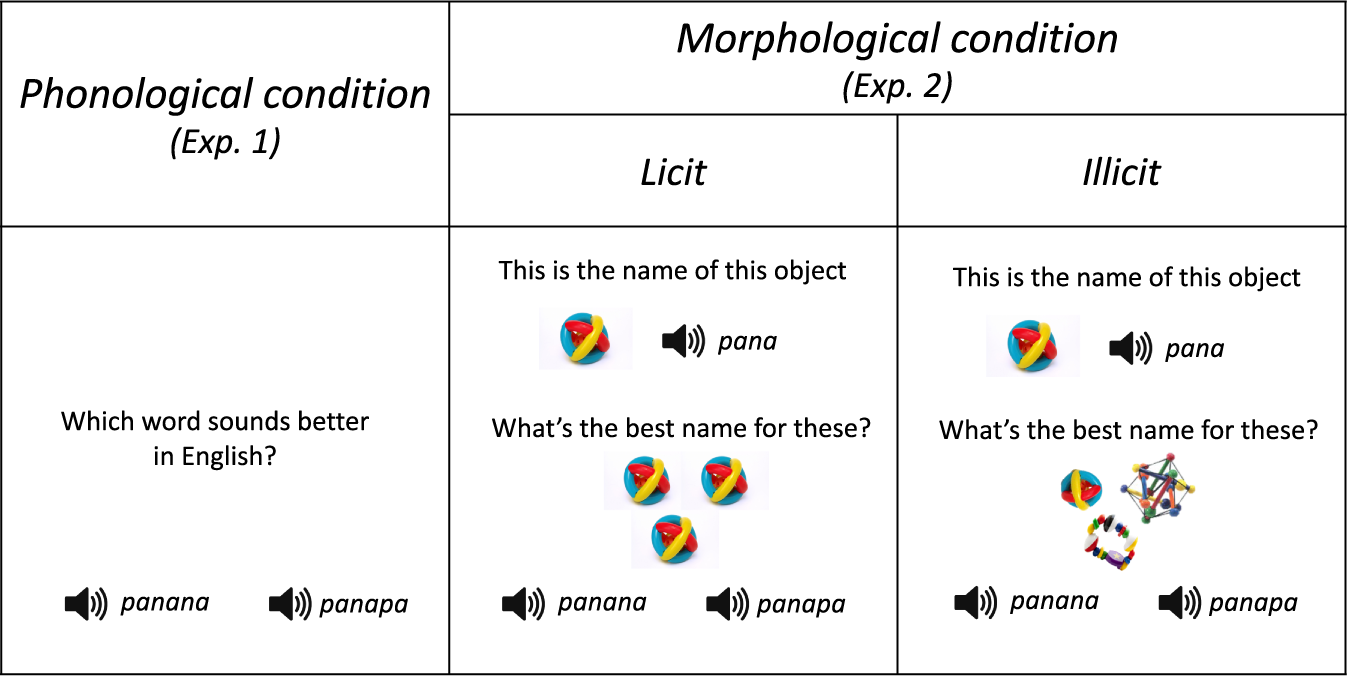
Experiment 1 (Figure 3, left) simply asked participants to indicate which word sounds better in English, so doubling was expected to reflect phonological identity, as it was devoid of any systematic link to a base. In Experiment 2, doubling indicated a systematic morphological operation – of plurality. To establish this morphological link, here, we used a two-step rating procedure. Participants were first presented with the base (AB), paired with a single novel object. In the second step, they saw a set of objects, paired with two spoken words (ABB or ABA). Their task was to indicate which word made a better name for the set (see Figure 3, right).
(Colour online) The procedure in the phonological and morphological conditions (in Experiments 1 and 2).
Ball photo credit: FreeDigitalPhotos.net, image creators: Suat Eman, images of the other objects are licensed under Creative Commons (modified).

To determine whether doubling preferences are indeed due to the formation of a licit morphological link between form and meaning, Experiment2 contrasted two semantic conditions. In the licit semantic condition, the objects associated with the base and reduplicative forms were of the same kind (e.g. a ball vs. a set of balls of the same kind as the base); in the illicit condition the objects were distinct (e.g. a ball vs. a ball, a rattle and a brush), thereby violating the requirement that semantic plurals correspond to tokens of a single conceptual type (see Figure 3).Footnote 5
2.1.1 Predictions
Because English speakers lack experience with morphological reduplication, we expect that, by default, they will parse bare phonological forms as phonological identity. In line with this hypothesis, phonological identity is indeed systematically avoided across languages (Suzuki Reference Suzuki1998). If by default, bare nouns are parsed as identity, then when presented with isolated novel words (in Experiment 1), adjacent identical elements will be dispreferred (ABB < ABA, per the OCP). In contrast, once appropriate semantic cues for reduplication are available (and only then), English speakers will form a correspondence between the base and the copy, and once they do so, the OCP will not be relevant, but Anchoring will be enforced. Consequently, in the licit condition, the Anchoring-obeying ABB forms should now be preferred relative to Anchoring-violating ABA forms (ABB > ABA). No such preference is expected in the illicit morphological condition.
2.1.2 Methods
2.1.2.1 Participants
Participants in Experiments 1 and 2 consisted of two groups of native English speakers (N = 24 per group). Participants were recruited using Amazon Mechanical Turk, and they were reportedly free of any language or reading disorders. In this and all subsequent experiments, each group was assigned to a single experiment. Thus, one group was assigned to the phonological condition; the second was assigned to the morphological conditions (both licit and illicit).
2.1.2.2 Materials and procedures
The materials consisted of 30 matched pairs of ABB vs. ABA forms (e.g. tanana, tanata). Pair members were novel CV.CV.CV English words, matched for their A and B syllables. The materials were recorded by a native English speaker who was instructed to maintain a constant vowel quality across the three syllables.
In each trial, participants made a forced choice between the two matched pair members (ABB and ABA, counterbalanced for left vs. right order). In Experiment 1, these options were presented alone, so doubling had no morphological function. Experiments 2 presented doubling as a morphological operation of plurality. To this end, each trial first paired the base (AB) with a single novel object (e.g. ball) and asked participants to type in the base that they heard; participants next saw a set of between three and five objects, and were asked to choose the best name for the object set (ABB or ABA). In the licit semantic condition, the object set was of the same kind as the base object, in the illicit condition (presented in a separate block of trials that followed the licit block), the set was heterogeneous. Trial order within each block was randomized.
2.1.3 Results and discussion
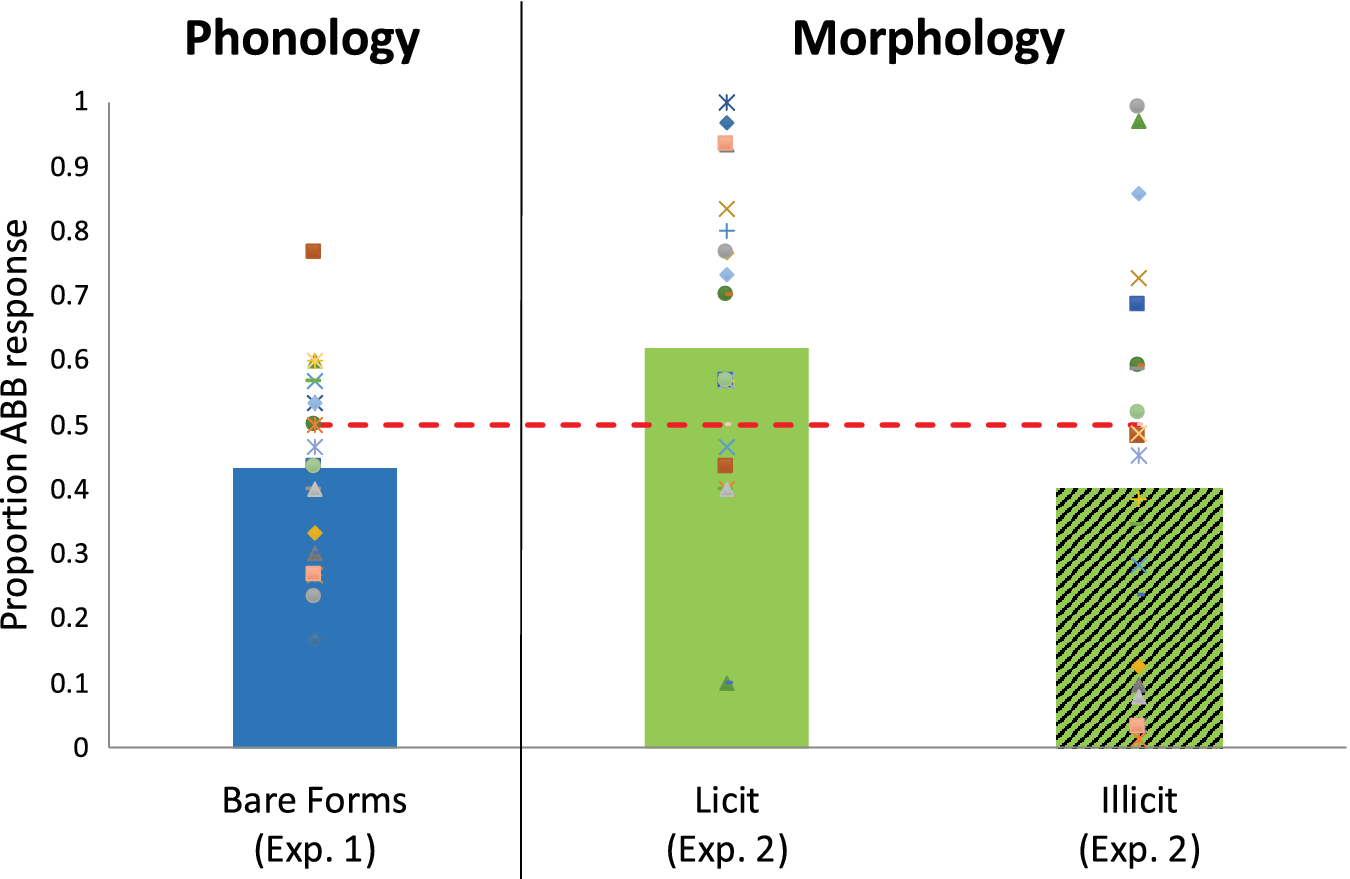
Figure 4 plots the results. In this and all subsequent figures, bars indicate the proportion of ABB responses; the scatter plot indicates the responses of individual participants; chance level (0.5) is indicated by the broken line. We tested the statistical reliability of the ABB preference by comparing the intercept against chance (0 in log odds) using an intercept-only mixed-effects logistic regression model with participants and item-pairs as random effects.
(Colour online) Doubling preferences for novel English words (in Experiments 1 and 2).

Results showed that, when English speakers were presented with bare phonological forms (in Experiment 1), their choice of ABB forms was significantly lower than chance. In other words, people disfavored ABB forms relative to ABA ones (for statistical tests see Table 3). The emergence of these results with spoken words, despite no explicit orthographic marking of repetition, and with materials that are phonotactically typical, suggests that the aversion of ABB forms is due to their phonological identity. These results are consistent with the hypothesis that at the level of phonology, adjacent identical elements are dispreferred, in line with the OCP.
Statistical tests of the doubling preferences in Experiments 1 and 2.

Remarkably, once doubling was presented as a licit morphological process of plurality formation (in Experiment 2), the dislike of ABB forms shifted into a significant preference. Here, participants significantly favored ABB forms over their ABA counterparts. We suggest that the pairing of the base (AB) and complex forms (ABB/ABA) with objects of the same kind (e.g. one ball vs. a set of balls) underscored the formal correspondence between their elements (e.g. as [A1B2]{Bc2} vs. [A1B2]{Ac1}, where subscript ‘c’ stands for ‘copy’). And once correspondence was established, people immediately required that the copy be adjacent to its source, in line with Anchoring.
And indeed, people only showed a doubling preference when reduplication was semantically licit (i.e. paired with a homogeneous set of objects, such as three balls). In contrast, when the object set was heterogeneous (e.g. a ball, a rattle and a pacifier), the no-doubling preference obtained. These results suggest that English speakers assigned doubling a reduplicative parse only when provided with an explicit licit semantic link between the base and the reduplicative form.Footnote 6
The emergence of these preferences in English is remarkable, given that the English language lacks morphological reduplication. Critically, doubling preferences shifted – from aversion to preference – depending on the semantic context. These results are in line with the hypothesis that the restrictions on doubling are algebraic.
3. Cross-modal projections
The possibility that restrictions on doubling are algebraic entails that knowledge of these constraints appeals not to the phonetic substance of linguistic stimuli but rather to their constituent structure, defined by variables, such as *AA (where A stands for a phonological element). In its strongest form, the algebraic hypothesis predicts that such constraints are amodal – they can extend irrespective of phonetic substance, to both speech and manual signs.
And indeed, the special status of doubling (as distinct from forms without doubling) is not unique to spoken language. Sign languages frequently employ reduplication in a variety of morphological functions (Supalla & Newport Reference Supalla, Newport and Siple1978, Wilbur Reference Wilbur2009, e.g. A ‘sit’ → AA ‘seat’). Moreover, recent results suggest that native ASL signers further enforce the Anchoring constraint on novel reduplicative signs in their native language (Andan et al. Reference Andan, Bat-El, Brentari and Berent2018). Like speakers, signers prefer signs that are Anchoring-obeying (AAB and ABB, where A and B stand for distinct ASL syllables) relative to Anchoring-violating ABA forms.
We next move to test a yet stronger prediction of the algebraic hypothesis, namely, the possibility that this constraint on sign structure might be available to nonsigners. Given that English speakers are known to spontaneously extract syllables from signs (Berent et al. Reference Berent, Dupuis and Brentari2013), it is conceivable that they could contrast the identity of signed syllables and their proximity.
Thus, Experiments 3 and 4 examine whether speakers with no command of a sign language will spontaneously project the Anchoring constraint to novel ASL signs.
3.1 Novel ASL signs: English speakers
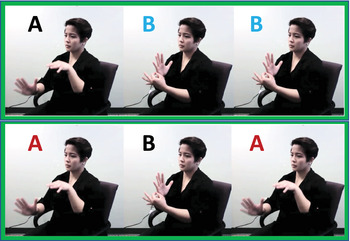
Experiments 3 and 4 compared the acceptability of matched pairs of novel ASL signs. In Experiments 3a and 4, ABB signs were contrasted with ABA signs (in direct parallel with the structure of our spoken materials in Experiments 1 and 2, see Figure 5). Experiment 3b further contrasted ABB signs with ABC forms (where C indicates a signed syllable, distinct from the other two). This latter contrast was introduced because past research has shown that the ABB/ABA contrast (which requires discriminating the location of doubling) is more demanding than the ABB/ABC contrast (which only requires detecting the presence of doubling, Gervain et al. Reference Gervain, Berent and Werker2012). These performance limitations could thus prevent English speakers from contrasting ABB/ABA forms even if they are in principle sensitive to doubling (e.g. in the contrast between ABB and ABC forms).
(Colour online) An example of the ABB and ABA signs (adapted with permission from Andan et al. Reference Andan, Bat-El, Brentari and Berent2018, Figure 1).

English speakers were presented with a pair of novel signs, and they were asked to indicate which form is likely to make a better sign in ASL. Experiments 3a–b presented the signs in isolation—as bare phonological forms. Experiment 4 presented the same signs in a morphological context, such that doubling indicated a morphological operation of plurality. Here, participants first saw the base sign AB, paired with a single object; next, they saw an object set, either objects of the same kind (in the licit condition) or a heterogenous set (in the illicit condition). Their task was to indicate which form makes a better name for the set.
3.1.1 Predictions
The algebraic hypothesis predicts that speakers will spontaneously project their phonological knowledge concerning doubling to signs. By default, English speakers should thus parse bare ABB signs as phonological identity, so ABB forms should be dispreferred, especially when compared to ABC forms (a contrast that is easier to encode than the ABB/ABA comparison, Gervain et al. Reference Gervain, Berent and Werker2012). But once a reduplicative parse becomes available (in the licit morphological condition), a reduplication preference should emerge (ABB>ABA).
3.1.2 Methods
3.1.2.1 Participants
Participants in Experiments 3a, 3b and 4 included three distinct groups of native English speakers (N = 20 each), recruited through Amazon Mechanical Turk. Participants reported no command of a sign language. They were likewise reportedly free of any language and reading disorders.
3.1.2.2 Materials and procedures
The materials in Experiments 3a and 4 consisted of 22 pairs of novel trisyllabic ASL signs – ABB and ABA; Experiment 3b paired the same ABB signs with novel ABC signs. Within each pair, signs shared the same ‘A’ and ‘B’ syllables. The two syllables (A and B) were chosen such that within a pair, the A and B syllables differed in both handshape and place of articulation. All signs were phonotactically legal in ASL, and they were articulated by a native signer. The set of ABB/ABA signs are the same as those used in Andan et al. (Reference Andan, Bat-El, Brentari and Berent2018), and their structure is detailed therein (for an example of the three types of signs, ABB, ABA and ABC, see https://www.youtube.com/playlist?list=PLBdp4mOe9SrepPw36tMWItR7i1IvkHgEW).
In Experiments 3a and 3b, the signs were presented as bare phonological forms, as described in Experiment 1 (without any objects). Experiment 4 paired ABB/ABA signs with object sets – either a set of homogeneous objects (in the licit plural condition) or a set of heterogenous objects (in the illicit plural condition), as described in Experiment 2. Participants in all conditions were told: ‘We know this is a hard task without knowing any American Sign Language. Please try your best and go with your gut feeling’.
3.1.3 Results and discussion
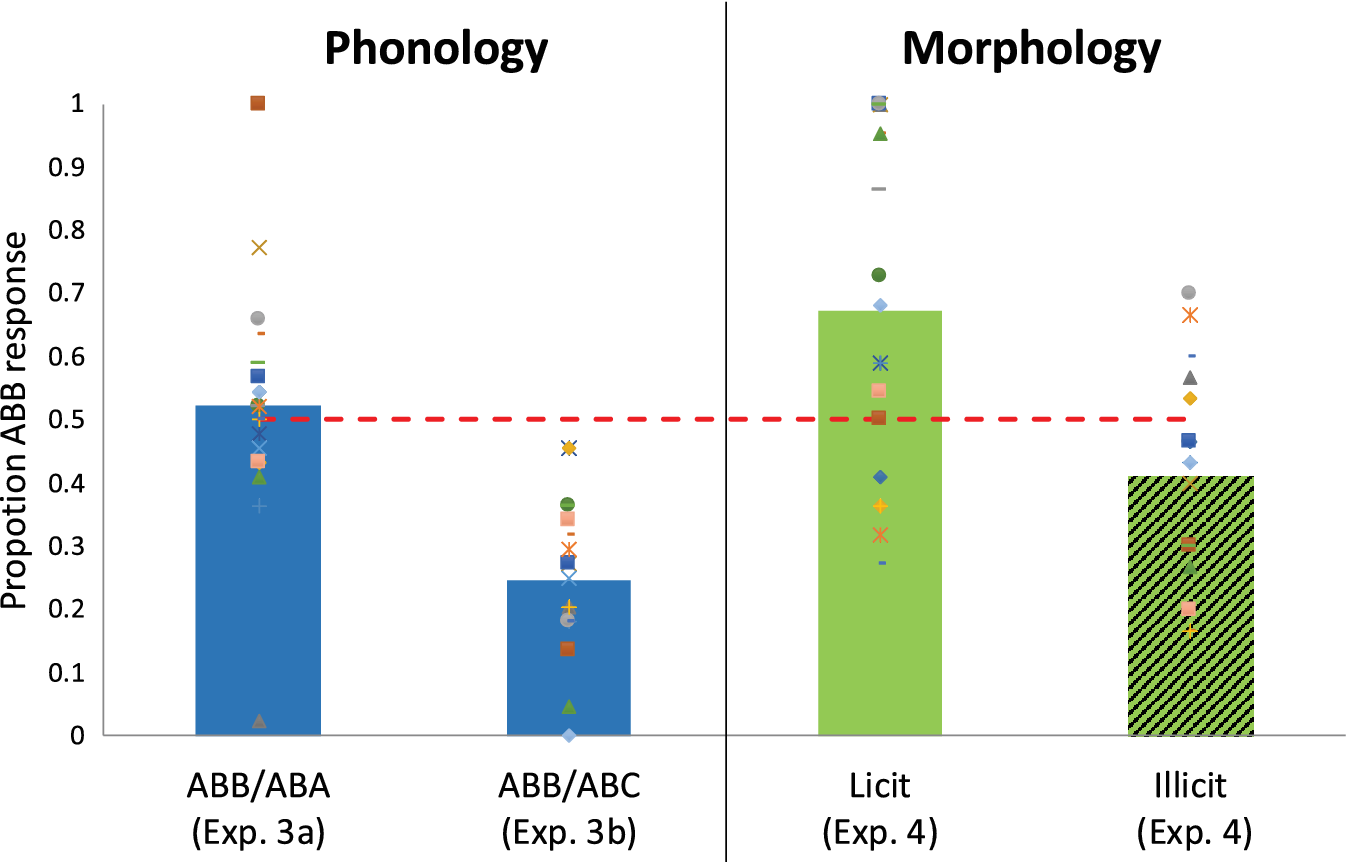
Figure 6 presents the doubling preference of English speakers for novel signs (for statistical tests, see Table 4). An inspection of the means suggests that, despite having no knowledge of ASL, English speakers showed systematic responses to doubling.
(Colour online) The doubling preference of English speakers to novel signs (in Experiments 3 and 4).
Note: The A and B labels are presented for illustration only; they were not presented to participants.

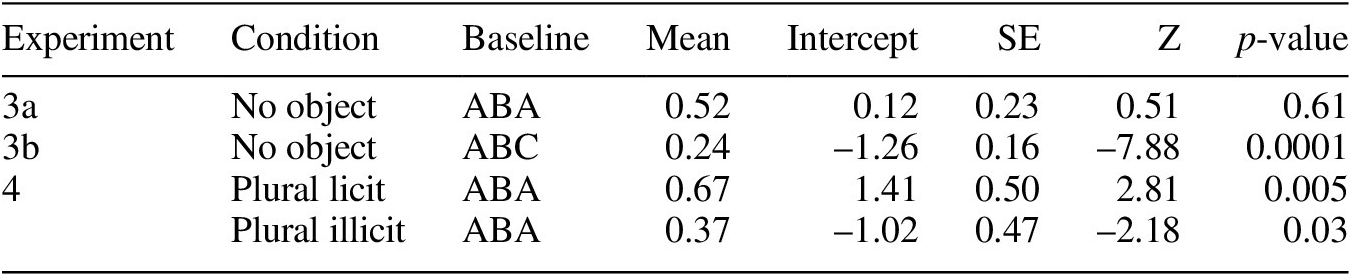
Statistical tests of the doubling preferences in Experiments 3 and 4.

Specifically, when doubling was presented by itself, as bare phonological forms, no doubling preference emerged for the ABB/ABA contrast (in Experiment 3a). In fact, when ABB forms were contrasted with ABC forms (in Experiment 3b), we found a significant doubling aversion, just as we had observed for novel English words (in Experiment 1), and in line with the OCP.
Remarkably, when doubling signaled licit semantic plurality (in Experiment 4), doubling in signs now elicited a significant preference (in line with Experiment 2). As expected, this preference did not obtain when semantic plurality was illicit (with a heterogeneous object set). These results suggest that the semantic link between the AB base and ABB form allowed English speakers to parse their formal correspondence (as [AB]{Bc}), in line with Anchoring. For the most part, the doubling preferences for signs (in Experiments 3a and 4) further mirrored the doubling preferences for novel English words (in Experiments 1 and 2).
The main difference between responses to signs and words occurred when ABB forms were contrasted with ABA forms in the phonological condition (in Experiment 3a). Here, responses to signs were at chance, whereas ABB words elicited significant doubling aversion (in Experiment 1). This result also contrasts with the Experiment 3b, where bare ABB signs elicited a significant doubling aversion as compared to bare ABC signs.
Taken at face value, this result would seem to suggest that, when it comes to signs, the grammar of English speakers only bans the presence of identical syllables (i.e. in ABB vs. ABC), but not their adjacency (in ABB vs. ABA). This proposal, however, fails to explain why the grammatical constraints on signs differ from the ones on spoken language (in Experiments 1 and 2). Additionally, in ongoing work in our lab, we have found that attention demands can modulate speakers’ sensitivity to the ABB/ABA contrast even for stimuli in spoken language. We thus attribute this outcome not to the grammar but to performance limitations.
We suggest that English speakers are not indifferent to the grammatical distinction between ABB and ABA signs; rather, they might occasionally fail to encode their structure. Indeed, the distinction between ABB and ABA forms requires that participants encode both the presence of doubling (common to ABB and ABA forms) and its position (which contrasts ABB and ABA forms). Past research, examining the encoding of ABB forms in newborn infants, found that these two functions engage different brain mechanisms (Gervain et al. Reference Gervain, Berent and Werker2012). These experiments gauged the responses of newborns to spoken trisyllabic forms – ABB, AAB or ABC – using Near Infrared Spectroscopy. Results showed that doubling detection (evident in discrimination of ABB/ABC forms) activated left temporal regions of the brain bilaterally, whereas anchoring doubling to edge position (evident in the discrimination of AAB/ABB forms) activated inferior frontal brain regions (possibly involving Broca’s area). These results confirm that the ABB/ABC and ABB/ABA contrasts rely on different computations.
The more complex binding of doubling to word edges might further impose greater attention demands, so when participants are presented with stimuli in an unfamiliar language modality, the binding computation might be fragile. This fragility is easier to overcome in the plural condition, as the presentation of the AB base draws attention to the reduplicative ABB structure. But when presented with bare signs, speakers could easily overlook the distinction.
This proposal explains why English speakers responded at chance when ABB bare signs were contrasted with ABA forms (in Experiment 3a) but they showed a significant doubling avoidance when the same ABB signs were contrasted with ABC forms (in Experiment 3b). Since these ABB/ABC forms contrast on the presence of doubling (rather than its position), English speakers readily differentiated these bare signs, and consequently, a significant doubling aversion emerged.
Together, these results suggest that English speakers with no command of a sign language systematically constrain the structure of novel ASL signs. When presented as licit plurals, people parse doubling as reduplication, and they require anchoring of the copy to the base. But when this parse is unavailable (for illicit plurals, or for bare phonological forms), doubling is represented as phonological identity, and since adjacent identical elements are banned by the OCP, doubling is dispreferred.
3.2 Novel ASL signs: English vs. Hebrew speakers
Finding that English speakers shift their doubling preferences for signs, depending on their linguistic analysis – as identity vs. reduplication – is in line with the hypothesis that they extract the algebraic structure of ABB signs. These results, however, do not establish whether speakers rely on grammatical principles (e.g. OCP, Anchoring). And indeed, it is conceivable that participants relied on an iconicity strategy that roughly aligns the number of repeated syllables with the number of objects (e.g. if AB = ‘one ball’ then ABB = ‘two balls’). If adjacent repeated syllables are more salient, then it is possible that iconicity would lead participants to favor the alignment of ‘two balls’ with ABB (over ABA) forms.
To adjudicate between these possibilities, we next examined whether speakers’ responses to signs are modulated by knowledge of their spoken language. We reasoned that, if the parsing of signs is based on iconicity, then all speakers should interpret doubling alike, regardless of their native language. But if the encoding of signs is constrained by linguistic principles, then the encoding of signs should depend on the morphology of participants’ native language.
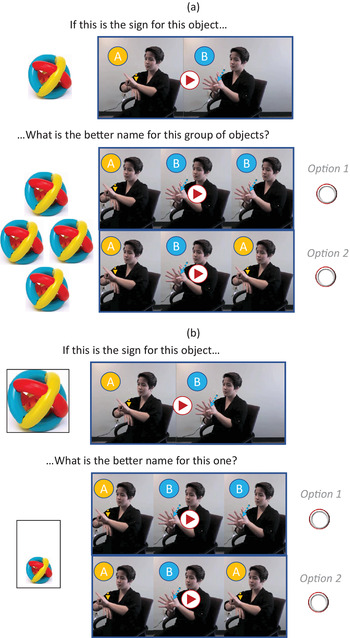
To examine the effect of participants’ spoken language on the parsing of signs, we compared the doubling preferences for the same novel signs presented in two semantic contexts. One context suggested that doubling signals semantic plurality (as discussed in above, see Figure 7a); in another, doubling signaled diminution. For example, participants first saw the AB base paired with a pot, and next, they were asked to choose a name for a diminutive pot (see Figure 7b). We presented these two experiments to speakers of two spoken languages that differ with respect to the morphological structure of their spoken language – English vs. Hebrew.
(Colour online) An illustration of the plural and diminutive conditions.
Ball photo credit: FreeDigitalPhotos.net, image creators: Suat Eman.

We reasoned (following Uspensky Reference Uspensky1972, Kajitani Reference Kajitani and Shields2005; see also Inkelas Reference Inkelas, Lieber and Stekauer2014) that augmentation (e.g. plurality) is the unmarked semantic property of reduplication, so the conditions necessary for assigning plurals a reduplicative parse should be relatively lax. To assign a reduplicative parse, speakers merely need their native language to provide evidence that plurality can be expressed by some morphological operation (either affixation or reduplication).Footnote 7 Thus, when the relevant lexical category is not marked morphologically for plurality, the reduplicative parse should be blocked. In line with this prediction, past research found that speakers of Mandarin (with no productive nominal plurals) do not project a reduplicative parse to signs when reduplication expresses plurality (Berent et al. Reference Berent, Bat-El, Brentari and Platt2020). In contrast, English and Hebrew speakers both possess the necessary experience, as both languages mark plurals by affixation (e.g. Hebrew shir ‘song ms.sg’ → shirim ‘songs’). We thus expected speakers of both languages to readily project a reduplicative parse to signs presented as nominal plurals.
Diminution, by contrast, is the marked semantics of reduplication, so the conditions on its projection are more stringent. We suggest that diminution is projected only if participants’ native language marks this property on the relevant semantic category (nouns) by reduplication, specifically. And it is here where the two languages contrast. While English has no morphological reduplication, Hebrew uses reduplication to express diminution (e.g. katan ‘small’ → ktantan ‘smallish’). Hebrew thus presents its speakers with specific evidence suggesting that diminution can be expressed by reduplication. If the parsing of signs is modulated by the grammar of spoken language, then, unlike English speakers, Hebrew speakers will readily assign the reduplicative parse to signs when reduplication indicates diminution. We thus compared the responses of English and Hebrew speakers to ABB and ABA signs, presented as plurals or as diminutives.
Thus, Experiments 6 and 7 administered the plural and diminutive conditions to Hebrew speakers. For the corresponding plural condition with English participants, we reproduce the results from Experiment 4; the diminutive condition was assigned to a new group of English-speaking participants (in Experiment 8).
To further demonstrate that the different responses of Hebrew and English speakers to signs specifically concern the projection of a reduplicative parse, in Experiments 5a–b, we first investigated the doubling of Hebrew speakers to signs presented as bare phonological forms. Experiment 5a contrasted ABB and ABA forms, while Experiment 5b contrasted ABB and ABC (as in Experiments 3a and 3b, respectively). Here, we expect Hebrew speakers to parse doubling as phonological identity, and consequently, doubling should be dispreferred. As noted, however, we expect the encoding of doubling in the ABB/ABA contrast to impose greater attention demands, as this contrast requires the binding of identity to the edge (whereas the less demanding ABB/ABC contrast only requires encoding the presence of doubling). Consequently, we expect stronger doubling preference with ABB/ABC (in Experiment 5b) relative to ABB/ABA forms (in Experiment 5a).
3.2.1 Methods
Experiments 5–7 contrasted responses of Hebrew speakers to ABB and control signs. Experiments 5a–b presented participants with a contrast between two bare signs – either ABB/ABA (in Experiment 5a, as in Experiment 3a, with novel words) or ABB/ABC (in Experiment 5b, as described in Experiment 3b, with novel words). Subsequently, Experiments 6 and 7 presented the same signs in a morphological context.
Experiment 6 presented the signs as licit plurals (as described in Experiment 2). Experiment 7 presented the signs as licit diminutives. Participants first saw the AB base paired with a single object. Next, they were presented with a diminutive version of the same object, and asked to choose its name (ABB or ABA). In each such experiment, the licit block was followed by a block of illicit plurals/diminutives. As expected, we found no-doubling preference in the illicit conditions (in Experiment 6: M = 0.29, Experiment 7: M = 0.34, Experiment 8: M = 0.2), but to simplify the discussion, here, we focus on the licit condition only.
Hebrew speakers (in Experiments 5a, 5b, 6 and 7) were assigned to four groups of native Hebrew speakers, students at Western Galilee College, Israel. These groups were sampled from various classes so samples sizes varied (Experiments 5a: N = 10, Experiment 5b: N = 9, Experiment 6: N = 19, and Experiment 7: N = 21).
To determine whether the responses of Hebrew speakers to signs depend on their linguistic experience, we further compared their responses to those of native English speakers. English participants in the plural condition are those reported in Experiment 4; the data is reproduced here for viewing convenience. The diminutive condition was assigned to new group of English speakers (N = 24), recruited from Amazon Mechanical Turk; we refer to this condition as Experiment 8. Each group received instructions in its native language (English or Hebrew).
3.2.2 Results and discussion
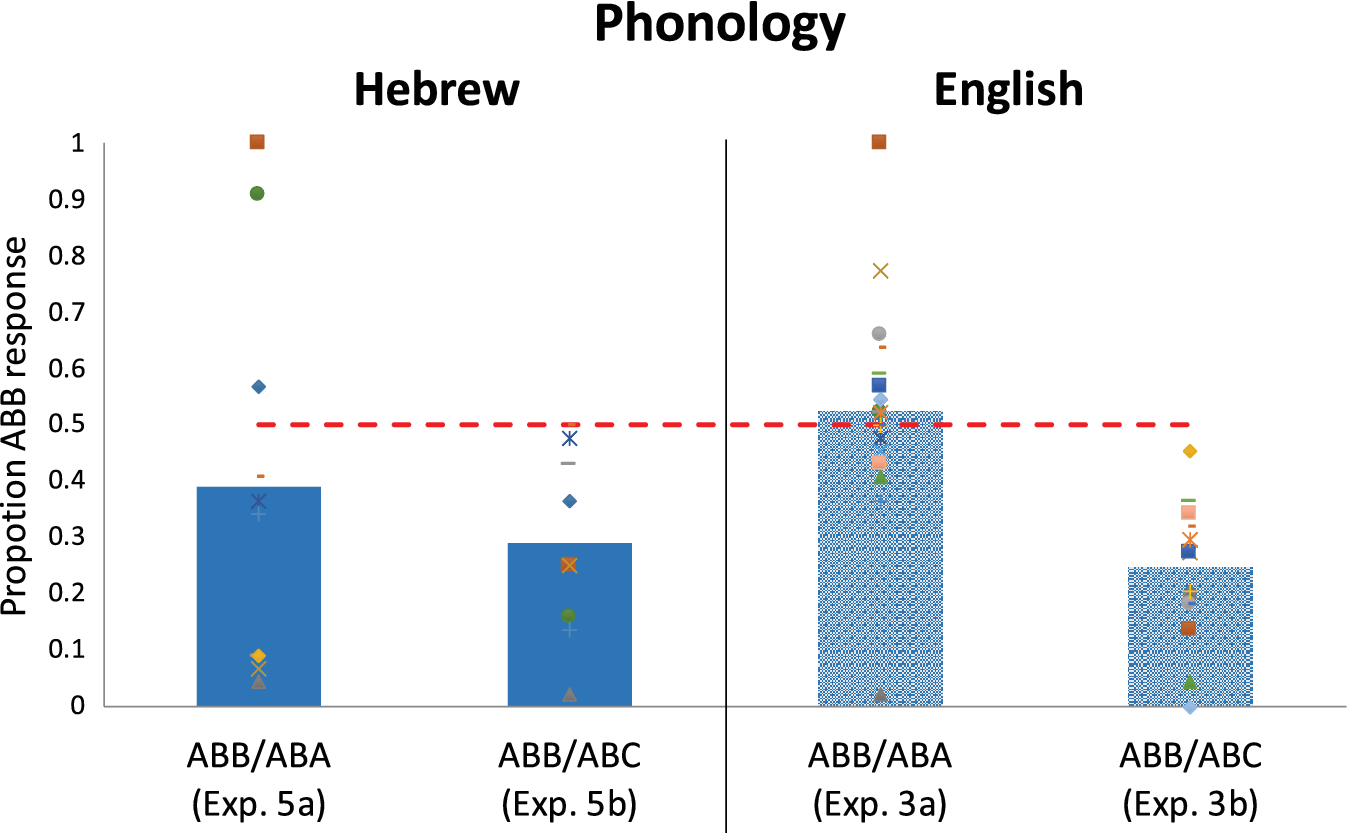
Before we consider the effect of linguistic experience on the assignment of a reduplicative parse to signs, we first wanted to ascertain that Hebrew speakers parse doubling in bare signs as identity. Figure 8 presents the results; for comparison, we present the results of Hebrew speakers along the findings from English speaking participants (reported in Experiment 3a–b).
(Colour online) The doubling preference of Hebrew and English speakers to bare nouns (in Experiments 5 and 3, respectively).

An inspection of the means suggests that, overall, Hebrew speakers dispreferred ABB forms, and these conclusions are also supported by the statistical tests (see Table 5). The doubling aversion, however, was significant only when ABB were compared to ABC forms, but not relative to ABA forms, and this was the case for speakers of both English and Hebrew. The selective aversion of ABB forms relative to ABC, but not ABA forms, is line with our proposal that the ABB/ABA is more taxing, as it requires the binding of doubling to the sign’s edge.
Statistical tests of the doubling preferences in Experiments 5–8.

Having established that Hebrew and English speakers both show doubling aversion to bare signs (in line with an identity parse), we next asked whether the distinct morphologies of these two languages would modulate the projection of a reduplicative parse for plurals and diminutives.
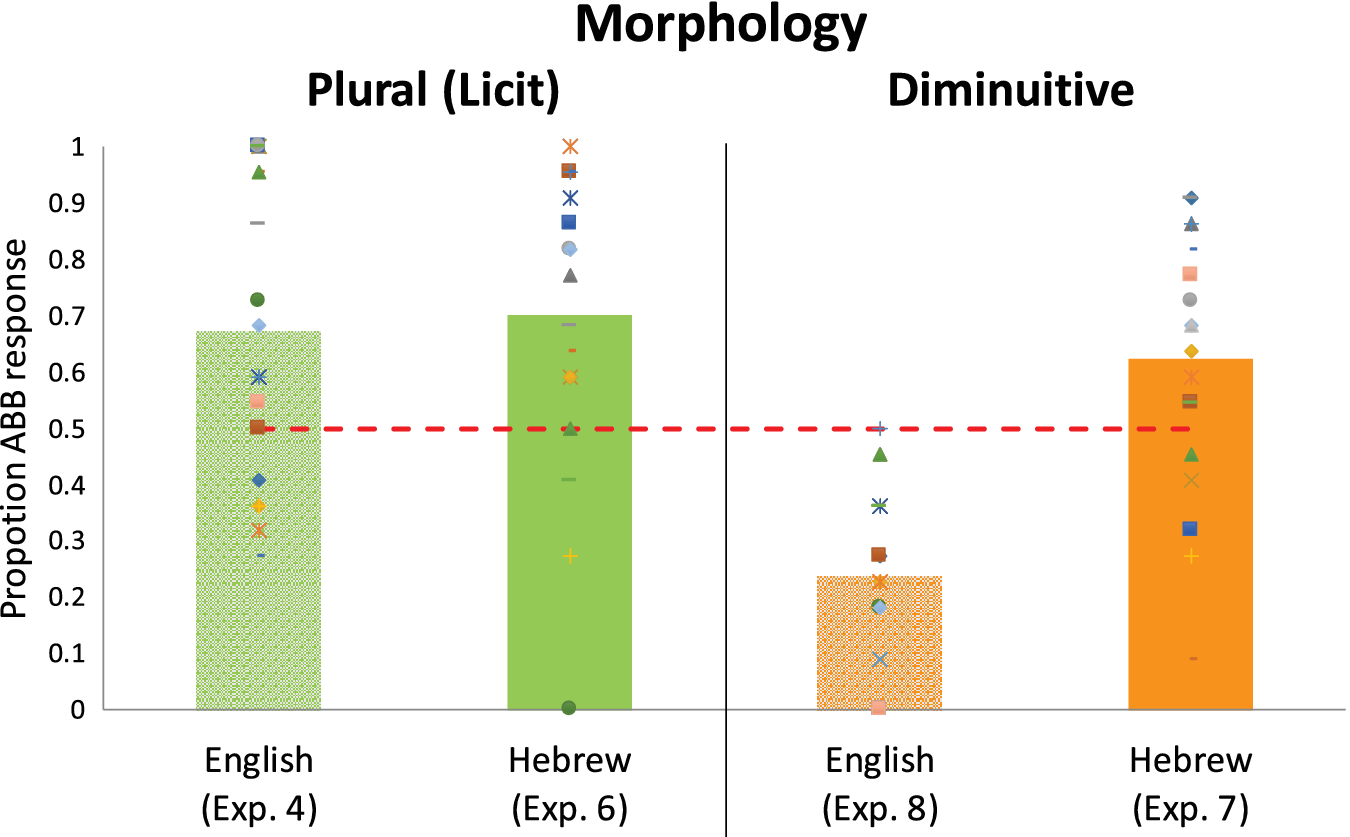
An inspection of the means (see Figure 9) suggests that English and Hebrew speakers both showed a doubling preference when doubling indicated plurality, and the reliability of this preference was confirmed by statistical tests (see Table 5). These results suggest that when doubling indicated plurality, the unmarked semantics of reduplication, speakers of both languages interpreted doubling as reduplicative. But when doubling indicated diminution, the preferences of the two groups diverged. English speakers showed a doubling aversion, whereas Hebrew speakers showed a significant doubling preference.
(Colour online) The doubling preference of English vs. Hebrew speakers to plurals and diminutives.

The doubling aversion of English speakers suggests that, despite the semantic context, English speakers were unable to project a reduplicative parse to diminutives. This is expected, given that diminution is the marked semantic value of doubling, and the English morphology presents its speakers with no evidence that doubling can carry this marked semantics. Hebrew, in contrast, offers abundance of evidence that doubling can express diminution, and consequently, Hebrew speakers were able to parse diminutive signs as reduplicative.
Taken as a whole, these results demonstrate that English and Hebrew speakers assign distinct parses to the same phonetic forms, and these differences depend on the morphology of their spoken language. This finding demonstrates that the parsing of signs is constrained by linguistic experience with spoken language. Accordingly, the grammatical principles of spoken language transfer across language modalities.
4. Discussion
This study asked whether knowledge of language transfers spontaneously across language modalities. That is, do speakers who have had no previous experience with a sign language spontaneously project grammatical principles from their native spoken language to ASL signs?
Our case study concerned the restrictions on doubling (ABB vs. ABA forms). We first demonstrated that English speakers shift their responses to novel English words depending on the linguistic level of analysis. When analyzed as phonological identity, adjacent identical syllables are systematically disliked (ABB < ABA), in line with the OCP. But once doubling is presented as a licit morphological operation of plurality, the doubling aversion shifts into a systematic preference (ABB > ABA), as predicted by Anchoring.
Our subsequent experiments showed that speakers with no command of a sign language spontaneously project these principles to novel ASL signs. Moreover, the projection of doubling constraints to signs depends on the morphology of participants’ spoken language. While Hebrew speakers extended the reduplicative parse to diminutives, no such preference obtained for English speakers. This outcome is expected given that diminution – the marked semantics of reduplication – is found in the morphology of Hebrew, but not of English.
Together, these results show that (i) a single, invariant phonetic form can elicit conflicting linguistic parses – aversion vs. preference; whereas (ii) a linguistic parse can remain invariant when the phonetic substance is radically altered – from speech to signs; and (iii) these parses are constrained by the morphology of participants’ spoken language.
These conclusions are readily explained by the hypothesis that these responses to doubling are guided by principles that form part of speaker’s knowledge of language, and that the relevant linguistic principles are algebraic. Indeed, if doubling presents an algebraic relation over variables (ABB, where A and B stand for distinct syllables), and if speakers can further spontaneously extract syllables from signs (as they demonstrably do, Berent et al. Reference Berent, Dupuis and Brentari2013), then one would expect the constraints on doubling to apply to any instance of the ‘syllable’ category, for both speech and sign. Insofar as algebraic principles are sensitive to structure, and blind to idiosyncratic properties of specific tokens (their phonetic substance, sensorimotor demands and frequency), algebraic principles are further abstract. As such, our conclusions further support the role of abstraction in phonology (e.g. Chomsky & Halle Reference Chomsky and Halle1968, Kisseberth Reference Kisseberth1969, Hyman Reference Hyman1970, de Lacy Reference de Lacy and Parker2008, Hale & Reiss Reference Hale and Reiss2008).
As noted, the hypothesis that doubling restrictions (both identity avoidance and reduplication) operate on the syllable has been debated (see Plag Reference Plag, Kehrein and Wiese1998, Yip Reference Yip, Lapointe, Brentari and Farrell1998 vs. de Lacy Reference de Lacy1999). And indeed, doubling responses to spoken words (e.g. of panana) are amenable to explanations that appeal to either melodic (segments or features) or prosodic constituents (e.g. syllables, morai). The results from signs, however, strongly favor the prosodic interpretation (McCarthy & Prince Reference McCarthy, Prince, Beckman, Urbanczyk and Walsh1995a).
To constrain the repetition of signed features, participants must be able to extract them reliably. But the existing evidence suggests that, in the absence of exposure to sign language, signed phonetic categories (e.g. handshape) are lost by 14 months of age (Baker et al. Reference Baker, Golinkoff and Petitto2006). It is thus difficult to see how non-signers could constrain doubling at the feature level. In contrast, past research has shown that English speakers with no command of a sign language spontaneously extract the syllabic structure of signs (Berent et al. Reference Berent, Dupuis and Brentari2013). The most likely explanation for the converging responses to speech and signs is that, in both cases, doubling is defined over syllables. As such, our results are in line with the hypothesis that the grammatical restrictions on doubling (e.g. OCP, Anchoring) can target the syllable. And since these constraints further apply across language modalities, the syllable must be further encoded by abstract variables, in line with the algebraic hypothesis.
Not only are the findings consistent with the hypothesis of algebraic grammatical principles, but they might be further inconsistent with the alternative, namely, the possibility that the responses to doubling reflect solely the idiosyncratic properties of specific syllable instances (e.g. of ba and ma). At first blush, this possibility would seem to be immediately ruled out by the finding that people exhibit similar responses to spoken and signed stimuli, despite their markedly different sensory characteristics. But proponents of this view might conjecture that repetition in the two modalities could nonetheless elicit similar demands. Crucially, such demands are due not to the grammatical parse assigned to doubling, but only the sensorimotor (domain-general) demands of the stimulus (Walter Reference Walter2007, Idsardi & Raimy Reference Idsardi, Raimy, Vaux and Nevins2008).
Repetition, to be sure, does exact costs on the perceptual and articulatory system, known as repetition blindness (Nelson, Perkell & Westbury Reference Nelson, Perkell and Westbury1984, Kanwisher Reference Kanwisher1987), and this cost has been previously cited as a cause of identity avoidance in phonology (Walter Reference Walter2007). But we see several reasons to question whether these sensorimotor costs are directly responsible for the behavior observed here.
First, the perceptual costs of repetition are temporally constrained – they obtain only at rapid presentations rates (typically, less than 250 ms for visual and auditory stimuli; Kanwisher Reference Kanwisher1987, Soto-Faraco & Spence Reference Soto-Faraco and Spence2002). Our stimuli, however, were presented at far slower rates (approximately 680 ms and 320 ms per syllable, for signed and spoken stimuli, respectively), so it is highly unlikely that doubling aversion in our experiments is due to (perceptual) repetition blindness. Second, it is difficult to see why a perceptually-based doubling aversion would shift to a preference in the morphological condition.
In response to this latter challenge, one might invoke a second domain-general pressure of iconicity – the bias to form a systematic (i.e. non-arbitrary) link between linguistic forms and their referents (Dingemanse Reference Dingemanse2015, Rozhanskiy Reference Rozhanskiy2015, Mattes Reference Mattes2017). Since homogeneous object sets and ABB signs both include multiple identical parts, it is conceivable that iconicity could elicit a preference for ABB signs for homogeneous sets. The iconicity account, however, should further predict no reduplication preference for diminutives. Moreover, since iconicity is a domain-general heuristic, its putative effect on plurals should be independent of linguistic experience.
Our results, however, counter both predictions. First, Experiment 7 shows that Hebrew speakers project the reduplicative parse to diminutives (contrary to iconicity, and in line with this grammar, see also Berent et al. Reference Berent, Bat-El, Brentari, Dupuis and Vaknin-Nusbaum2016). Footnote 8 Second, related research has shown that Mandarin speakers (whose native language lacks productive morphological plurals) systematically fail to project the reduplicative parse even when doubling is associated with semantic plurals (Berent et al. Reference Berent, Bat-El, Brentari and Platt2020).
The most likely explanation for our results, then, is that the projection of reduplicative parse to both speech and signs is constrained by a single set of grammatical principles that are algebraic, and thus, applicable across language modalities. As noted, we do not wish to suggest that all phonological principles are amodal. A ban on labial (*labial), for instance, is trivially modality-specific. But since the OCP and Anchoring concern doubling which, by definition, is an algebraic relation, such principles are prime candidates for being amodal.
Taken as a whole, the results of our research strongly suggest that some grammatical restrictions are amodal – they transfer spontaneously from one linguistic modality (speech) to another (signs). The phenomenon of cross-modal transfer poses various challenges to the view that the constraints on language structure are solely determined by domain-general principles, such as sensorimotor difficulties and iconicity. In contrast, cross-modal transfer is readily captured by the view of phonological restrictions as algebraic (Berent Reference Berent, Hannah and Bosch2018). Thus, at least some phonological principles are algebraic, amodal and abstract.