Implications
Early experience with specific foods can improve their acceptance and preference later in life. However, our past and present results with sheep suggest that mere exposure to foods in early life may not be sufficient to attain that outcome. Behaviour towards a food source and learning about its consequences depend not only on the food's intrinsic properties but also on the alimentary context in which it is presented. Current results can be interpreted as showing that the use of high levels of nutrient supplementation can cause a negative experience with LQF (i.e. a decrease in the preference and acceptance), whereas restricted levels of supplementation (a more typical scenario) may promote the opposite result (i.e. enhanced experience with LQF).
Introduction
Early food experience has the potential to increase food acceptance (voluntary intake of a given food) and preference (choices among food alternatives) in ruminants (Provenza and Balph, Reference Provenza and Balph1987; Distel and Provenza, Reference Distel and Provenza1991; Distel et al., Reference Distel, Villalba and Laborde1994). Moreover, preference for low-quality food (LQF) is expected to be enhanced when animals are induced to ingest this type of food jointly with high-quality food (HQF), due to improved post-ingestive consequences (Baraza et al., Reference Baraza, Villalba and Provenza2005; Villalba et al., Reference Villalba, Provenza and Shaw2006). Contrary to that expectation, in a previous paper we reported that sheep that were exposed early to LQF (mature oat hay), simultaneously with HQF supplements (sunflower meal and ground corn), later ate less of this LQF than sheep that did not experience oat hay early in life (Catanese et al., Reference Catanese, Distel, Rodríguez Iglesias and Villalba2010).
Though many traditional models of diet selection assume that animals select food as function only of the intrinsic nutritional characteristics of each foodstuff (e.g. Farnsworth and Illius, Reference Farnswoth and Illius1998), it has been shown that animals tend to behave towards food options in comparative rather than absolute terms (Flaherty, Reference Flaherty1996; Bateson, Reference Bateson2004; Rosati and Stevens, Reference Rosati and Stevens2009). Options that are commonly rated as ‘good’ can be perceived as ‘less good’ when experienced closely to access to higher-quality alternatives (Zellner, Reference Zellner2007). Moreover, the comparative process that affects behaviour towards a food option is not only restricted to the alimentary environment in which it was experienced but may also affect later behaviour in other contexts due to learning (e.g. see Zentall and Clement, Reference Zentall and Clement2001). This relative effect of multiple foodstuffs on behaviour is thought to play an adaptive role during foraging, biasing partial preferences towards the best food alternatives (e.g. Flaherty et al., Reference Flaherty, Blitzer and Collier1978; Pecoraro et al., Reference Pecoraro, Timberlake and Tinsley1999; Bergvall and Balogh, Reference Bergvall and Balogh2009). For example, Fallow deer Dama dama showed decreased intake of a food containing 1% tannin when presented after a preload meal with the same food but containing 0.25% tannin, compared to when it was presented after a preload with the 1% tannin food (Bergvall et al., Reference Bergvall, Rautio, Tuomas and Leimar2007). Thus, deer treated the meal containing 1% tannin not absolutely but in comparison (or contrast) to the preload food.
On the basis of Catanese et al.'s (Reference Catanese, Distel, Rodríguez Iglesias and Villalba2010) findings, we propose that the relative effect of foods on diet selection may also occur during early experience with foods, and may have sustained consequences in the selection of diet. We hypothesized that sheep that were exposed early to mature oat hay along with high levels of supplements could ‘devalue’ this LQF due to continuous comparisons against nutritional supplements. In this study, we tested the devaluation hypothesis using a successive negative contrast (SNC) procedure (see Flaherty, Reference Flaherty1996, pp. 19–53, for details). In a consummatory SNC procedure, ‘shift’ subjects are unexpectedly changed from HQF to LQF, and their postshift consumption is then compared against the consumption of ‘unshift’ subjects that receive only the LQF in all sessions of the SNC procedure. A consummatory SNC effect is empirically represented by lower postshift consumption of the LQF in shift than in unshift subjects. The magnitude of the difference between preshift and postshift consumption is regarded as a measure of the perceived hedonic disparity between the HQF and the LQF (Flaherty and Sepanak, Reference Flaherty and Sepanak1978; Papini and Pellegrini, Reference Papini and Pellegrini2006). In this study, we used the experienced sheep (ES; exposed to oat hay early in life) and inexperienced sheep (IS; not exposed to oat hay early in life) from our previous study (Catanese et al., Reference Catanese, Distel, Rodríguez Iglesias and Villalba2010). Therefore, if the LQF was devalued during early experience, as hypothesized, we predicted a stronger SNC effect in ES than IS, namely a larger difference in postshift LQF intake between the shift and unshift groups of ES relative to IS.
Material and methods
The study was conducted at the ‘Centro de Recursos Naturales Renovables de la Zona Semiárida’ (CERZOS) located in Bahía Blanca (38° 44′ S; 62° 16′ W), Argentina, in June 2008. All maintenance and experimental protocols fulfilled animal welfare regulations of the Universidad Nacional del Sur, Bahía Blanca, Argentina.
Subjects and early experience
Twenty-four 1-month-old Corriedale lambs (Ovis aries L.; 12 females and 12 castrated males) were randomly assigned to two experimental groups balanced by sex and placed in contiguous experimental yards (200 m2) separated by a black canvas. Exposure to treatments started when animals were 60 days old and lasted until they were 210 days old. In this period, ES were fed mature oat hay (metabolizable energy, ME: 1.8 Mcal/kg; CP: 6.1%; and NDF: 69.3%) and IS were fed alfalfa hay (ME: 2.2 Mcal/kg; CP: 15.1%; and NDF: 44.4%) as their early basal food. Both ES and IS also had simultaneous access to restricted amounts of sunflower meal (ME: 2.0 Mcal/kg; CP: 28.4%; and NDF: 45.2%) and ground corn (ME: 3.4 Mcal/kg; CP: 8.5%; and NDF: 25.1%) to ensure a similar daily CP and ME intake between experimental groups. For each group, the concentrated supplements (sunflower meal + ground corn) represented ∼50% of total daily intake. Each food type was provided daily in separate feed bunks at 0900 h. There was enough trough space for all the lambs to eat at one time either the basal food or the supplements.
The average intake of mature oat hay, sunflower meal and ground corn in ES during exposition was: 462 ± 133 g, 369 ± 110 g and 70 ± 16 g (mean ± s.d.), respectively, whereas the average intake of alfalfa hay, sunflower meal and ground corn in IS was 389 ± 107 g, 232 ± 71 g and 137 ± 35 g, respectively.
Following early experience treatments, they were exposed to a series of choice tests, where all animals were exposed to oat hay, alfalfa hay, sunflower meal, ground corn, etc. This experiment started when sheep were 300 days old. For further details, see Catanese et al. (Reference Catanese, Distel, Rodríguez Iglesias and Villalba2010).
Procedure: SNC
Before the beginning of the SNC experiment, subjects were weighted, and placed into individual pens (3 m2) under shelter. Each pen had an automatic water dispenser (0.25 l) and a plastic feed bunk (10 l). ES were randomly assigned to either the shift or the unshift condition (ES-S and ES-U, respectively), balanced by weight and sex. The same was done with IS (IS-S and IS-U, respectively). The result was a total of four experimental groups, resulting from the 2 × 2 combination of early experience treatments (ES and IS) and shift-unshift conditions (n = 6 in each group). The SNC experiment lasted for 15 days. Subjects experienced one session per day, and two successive phases (preshift and postshift) as described below.
Preshift phase
Preshift sessions were run from 0840 h to 1000 h, during which subjects in ES-S and IS-S were fed ad libitum alfalfa hay (HQF), and subjects in groups ES-U and IS-U were fed ad libitum mature oat hay (LQF). Later each day, from 1500 h to 1730 h, all subjects were fed a basal diet (65% sunflower meal, 30% ground corn and 5% mineral premix) ad libitum, which served to fulfil daily nutritional requirements (National Research Council, 1985) and to homogenize nutritional conditions between shift and unshift conditions. The preshift phase was finished once the following criteria were met: a minimum of 10 preshift sessions and three consecutive days of stable average intake in all four groups.
Postshift phase
The postshift phase started the day after the last preshift session. During postshift sessions, from 0840 h to 1000 h, all subjects were fed ad libitum LQF, whereas HQF was not offered in this phase. This implied that subjects in the shift condition (i.e. groups ES-S and IS-S) experienced a downward change in food quality from HQF to LQF, while the feeding situation for subjects in the unshift condition (i.e. groups ES-U and IS-U) remained unchanged across phases (i.e. unshift subjects received LQF in both phases of the experiment). The postshift phase ended when shift subjects reached similar daily intakes of LQF relative to their respective unshift controls. At the end of the SNC experiment, subjects were weighted and released into a communal enclosure.
Experimental measures and statistical analyses
We measured the amount of LQF or HQF consumed per subject and per session as the main dependent measure across both preshift and postshift phases. The individual daily intake of LQF or HQF was obtained by weighing and calculating the difference between the offered and refused amounts of each type of food. Finally, data were corrected by the live weight of animals, and expressed as grams of dry matter (DM) of LQF or HQF consumed daily per kilogram of body weight (g/kg BW).
To analyse intake data during the preshift and postshift phases, we used a 2 × 2 factorial ANOVA with repeated measures. The model included early experience treatment and shift/unshift conditions as between-subject factors, and session as a within-subject factor. Subjects were the experimental unit and the random term of the model. The within-animal covariance matrix was modelled with a compound symmetric structure, which proved to have the best fit for the data involved in all tests according to Schwarz's Bayesian criterion (Littell et al., Reference Littell, Henry and Ammerman1998). All ANOVA analyses were performed using the PROC MIXED procedure of SAS statistic software (SAS Institute Inc., Cary, NC, USA). This statistical model was also used to test a set of planned comparisons: intake of ES-S v. ES-U and of IS-S v. IS-U in the first postshift session. We also planned to compare the magnitude of the consummatory change from the last preshift session to the first postshift session of groups ES-S and IS-S by computing the difference in intake between these sessions for each individual. Unplanned comparisons were evaluated using the Tukey–Kramer HSD test (Ruxton and Beauchamp, Reference Ruxton and Beauchamp2008).
Results
Preshift phase
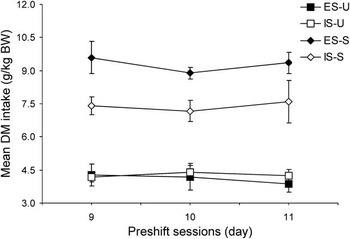
There was a significant early experience treatment × shift/unshift condition interaction (F 1, 18 = 4.48, P < 0.05) for DM intake in the last three preshift sessions (i.e. sessions 9, 10 and 11; Figure 1). This interaction was due to a higher daily DM intake of HQF by subjects in group ES-S than by subjects in group IS-S (mean ± s.e.: 9.28 ± 0.49 and 7.38 ± 0.62 g/kg BW, respectively; Tukey–Kramer HSD test, T 4, 18 = 4.51, P < 0.05), whereas daily DM intake of LQF was similar between groups ES-U and IS-U (mean ± s.e.: 4.10 ± 0.49 and 4.27 ± 0.28 g/kg BW, respectively; Tukey–Kramer HSD test, T 4, 18 = 0.93, P > 0.900). There was no significant effect of session (F 2, 36 = 0.18, P > 0.83) or session × early experience treatment × shift/unshift condition interaction (F 2, 36 = 0.12, P > 0.88), which indicated that intake was relatively stable by the end of the preshift phase in all experimental groups.
Mean daily dry matter (DM) intake of sheep exposed early (experienced sheep, ES) or not (inexperienced sheep, IS) to oat hay, in the shift (S) or unshift (U) condition, during the last three preshift sessions (i.e. when intake was stable) of the successive negative contrast procedure (n = 6 in each group). Subjects in ES-S and IS-S were fed alfalfa hay, whereas subjects in ES-U and IS-U were fed oat hay. Error bars denote ± 1 s.e.

Postshift phase
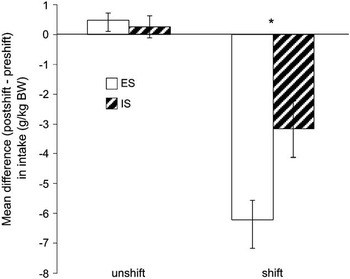
The analysis of DM intake including the last preshift and first postshift sessions as repeated measures showed a significant session × early experience treatment × shift/unshift condition interaction (F 1, 20 = 7.08, P < 0.02). This interaction reflected the differential decrement in DM intake observed during the downward shift in food quality between groups ES-S and IS-S, which is supported by a significantly higher decline in intake in the first group (F 1, 20 = 5.00, P < 0.04; Figure 2). Moreover, DM intake of LQF in the first postshift session was lower in ES-S than in ES-U (mean ± s.e.: 3.14 ± 0.47 and 4.34 ± 0.43 g/kg BW, respectively; F 1, 20 = 5.19, P < 0.05), whereas there was no difference in DM intake of LQF between IS-S and IS-U in that session (mean ± s.e.: 4.42 ± 0.35 and 4.51 ± 0.14 g/kg BW, respectively; F 1, 20. = 0.02, P > 0.86)20.
Mean difference in dry matter (DM) intake between the first postshift session and the last preshift session of sheep exposed early (experienced sheep, ES) or not (inexperienced sheep, IS) to oat hay, in the shift or unshift condition of the successive negative contrast procedure (n = 6 in each group). Shift subjects accessed alfalfa hay and oat hay in preshift and postshift sessions, respectively; while unshift controls only accessed oat hay in all sessions throughout the procedure. Error bars denote ± 1 s.e. *P < 0.05.

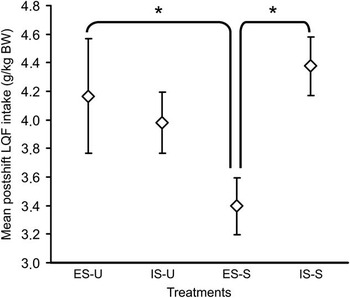
The 2 × 2 factorial ANOVA of DM intake in the four postshift sessions (i.e. sessions 12, 13, 14 and 15) showed a significant early experience treatment × shift/unshift condition interaction (F 1, 20 = 4.73, P < 0.04). This effect can be explained by a lower mean DM intake in ES-S than in ES-U (F 1, 20 = 4.40, P < 0.05) and a lower mean DM intake in ES-S than in IS-S (F 1, 20 = 6.71, P < 0.02), during postshift sessions (Figure 3). There was no session × early experience treatment × shift/unshift condition interaction (F 2, 38 = 0.62, P > 0.54). There was a significant effect of session (F 2, 60 = 3.30, P < 0.03), explained by a higher DM intake of LQF in session 15 than in session 13 (Tukey–Kramer HSD test, T 3, 38 = 4.73, P < 0.05).
Mean daily dry matter (DM) intake of oat hay (LQF) by sheep exposed early (experienced sheep, ES) or not (inexperienced sheep, IS) to oat hay, in the shift (S) or unshift (U) condition, during the postshift phase (sessions 12, 13, 14 and 15) of the successive negative contrast procedure (n = 6 in each group). Error bars denote ± 1 s.e. *P < 0.05.

Discussion
Present results support the hypothesis that sheep devaluated the LQF that was simultaneously fed with nutritional supplements during early experience. This hypothesis was proposed as a possible explanation for the lower intake of LQF by ES relative to IS during the preference trials reported in Catanese et al. (Reference Catanese, Distel, Rodríguez Iglesias and Villalba2010). As predicted, ES and IS behaved differently when confronted with the abrupt transition from HQF to LQF in the SNC procedure, since the unexpected downward change in food quality resulted in a reliable SNC effect in ES (i.e. a significantly lower intake of LQF in ES-S than in ES-U during the first postshift session) but not in IS. Moreover, ES-S showed a higher preshift to postshift DM intake decline relative to IS-S, and a lower mean DM intake of LQF during the postshift phase relative to ES-U and IS-S. These results suggest that subjects in ES perceived the hedonic difference between LQF and HQF to be much larger than subjects in IS did (Flaherty and Sepanak, Reference Flaherty and Sepanak1978; Flaherty and Kaplan, Reference Flaherty and Kaplan1979; Papini and Pellegrini, Reference Papini and Pellegrini2006), which is consistent with LQF having been devaluated in ES.
On the basis of the well-established notion of incentive relativity (Flaherty, Reference Flaherty1996), we believe that the devaluation of LQF may have resulted from its continuous comparisons with the highly preferred nutritional supplements fed during early experience. This type of comparison between foods of different quality is called ‘simultaneous contrast’, and has been argued to be particularly relevant for herbivores (Bergvall and Balogh, Reference Bergvall and Balogh2009). During the early experience of the subjects used in this study, all foods were offered simultaneously; however, subjects did not easily accept the LQF, which was eaten only after all nutritional supplements had been consumed. Similarly, Nolte et al. (Reference Nolte, Provenza and Balph1990) observed that lambs that were exposed early to wheat grain (HQF) and mountain mahogany (Cercocarpus montanus, a shrubby species of relatively low nutritional quality) ate wheat from the beginning but were reluctant to eat mountain mahogany; such behaviour might have resulted from a simultaneous negative contrast during early experience and may explain the reported failure to induce a preference for that food.
Incentive contrasts operate in a bidirectional mode, in the sense that an HQF can not only produce an exaggerated reduction (i.e. devaluation) on intake of a lower-quality alternative, but also the latter can induce an increased intake of the former (i.e. overvaluation; e.g. Flaherty and Largen,Reference Flaherty and Largen1975; Flaherty and Sepanak, Reference Flaherty and Sepanak1978; Bergvall and Balogh, Reference Bergvall and Balogh2009). This may help explain the increased intake of HQF in ES-S during the preshift phase of the SNC procedure when compared to IS-S, which was also observed in our previous study. An alternative and non-mutually exclusive explanation for the reduced intake of HQF observed in IS-S is that this group could have devalued this food (alfalfa hay), since it was experienced simultaneously with nutritional supplements (of higher nutritive value than HQF) during early experience. However, ES experience with LQF should have been much more affected by contrast effects than IS experience with HQF, since the disparity in nutritional quality was greater between the LQF and the concentrated supplements than between the HQF and the supplements. Unexpectedly, subjects in ES-U did not eat less LQF than those in IS-U, as was consistently observed in our previous work. In this study, subjects in ES-U could have been limited to reach lower intake levels of LQF than subjects in IS-U due to a floor effect imposed by morning hunger and the restriction in time of food availability (see Newman et al., Reference Newman, Penning, Parsons, Harvey and Orr1994).
In contrast with present results, a common observation is that ruminants’ preference for LQF can be improved by nutrient supplementation (Villalba et al., Reference Villalba, Provenza and Goudong2004, Reference Villalba, Provenza and Shaw2006). For example, Baraza et al. (Reference Baraza, Villalba and Provenza2005) showed that sheep developed higher preference for LQF when experienced in a high-nutritional context than when experienced in a low-nutritional context. The main difference between such studies and ours is that we used high levels of supplementation (ground corn plus sunflower meal represented ∼50% of total daily intake). The offer of large quantities of HQF induces substitution of LQF by cattle (i.e. reduction in forage intake due to supplementation; Moore et al., Reference Moore, Brant, Kunkle and Hopkins1999), thus bypassing any positive effect on intake due to digestive complementation between foods (e.g. Freer et al., Reference Freer, Dove, Axelsen, Donnelly and McKinney1985). Since substitution and complementation (i.e. increment in LQF consumption due to nutritional supplementation) occur along a continuum of supplement availability (see Dove, Reference Dove2002), different levels of supplementation may lead to contrasting results during experience. This view agrees with the observation that ruminants given unrestricted access to highly nutritious alternatives fail to develop preference for simultaneously available LQF (Provenza et al., Reference Provenza, Villalba, Dziba, Atwood and Banner2003), whereas restricted access to nutritious foods (e.g. through high stock density) was shown to improve acceptance of and preference for LQF (Shaw et al., Reference Shaw, Villalba and Provenza2006). The latter situation is the most common in commercial livestock operations due to the high costs of nutrient supplementation.
In synthesis, our results suggest that mere exposure to LQF in early postnatal experience may not be sufficient to increase its acceptance and preference later in life, since the alimentary context where early experience takes place appears to modulate its consequences. High levels of nutrient supplementation can result in devaluation of LQF, while restricted supplementation may enhance acceptance of and preference for LQF through improved post-ingestive consequences.
Acknowledgements
This research was supported by grants from the Agencia Nacional de Promoción Científica y Tecnológica de la República Argentina to RAD (PICT 170, Prestamo BID) and the Universidad Nacional del Sur (PGI 24/A167) to RAD, and fellowships from the Consejo Nacional de Investigaciones Científicas y Técnicas de la República Argentina (CONICET) to EF and FC and from the Comisión de Investigaciones Científicas de la Provincia de Buenos Aires (CIC) to MIC. Nilda Didoné did the chemical analysis of the foods.