Introduction
In situ observations of the scallop Adamussium colbecki at New Harbor, McMurdo Sound, indicate that individuals often display valve-clapping behaviour comprised of a single clap. This behaviour can resuspend seston that may supplement their nutrition (Chiantore et al. Reference Chiantore, Cattaneo-Vietti, Albertelli, Misic and Fabiano1998). Similarly, meiofaunal densities are lower within populations of scallops in Terra Nova Bay, suggesting clap-induced suspension of meiofauna (Danovaro et al. Reference Danovaro, Pusceddu, Mirto and Fabiano1999). Valve claps could also be related to respiration, gamete release, or the clearance of faeces and pseudofaeces. To date, the frequency of valve claps in Adamussium colbecki has not been determined. In this study, we use time-lapse videography to quantify the incidence of valve claps in a population of scallops occurring in fine sediments at New Harbor.
Materials and methods
The study site was at a 25 m depth below multiannual sea ice in Explorers Cove, McMurdo Sound (77°34.549′S, 163°31.166′E). Sediments were composed of silty sand (Gooday et al. Reference Gooday, Bowser and Bernhard1996). In addition to Adamussium colbecki (Stockton Reference Stockton1984, Berkman Reference Berkman1990), the sea urchin Sterechinus neumayeri and the brittle stars Ophiosparta gigas and, Ophionotus victoriae were present as were pycnogonids and foraminiferan protists. The benthic fish Trematomus bernachii was also common.
Divers deployed an underwater video system (Fieldcam TLV; Fuhrman Diversified, Seabrook, TX, USA) which included a SONY SSC-C350 CCD camera to film a population of A. colbecki. Time-lapse on the video recorder (SONY EVT-820) was set at 28 video frames/min. Filming took place from 27 October–30 November 1998. At weekly intervals, the camera was rotated to film a different direction. An underwater lamp (Birns and Sawyer, Hollywood, CA, USA), fitted with red cellophane was mounted above the video camera to permit continuous filming.
Three video segments that each provided 20–24 hr views of the scallop population were selected. Two of these were views of the same bed of scallops but taken over two periods (14 November and 16 November). For the third segment, a different view of a contiguous group of scallops had been filmed (18 November). The numbers of scallops framed in each segment were determined from counts on the computer monitor. Densities of scallops in the field of view filmed on 14, 16 and 18 November were estimated to be 27, 33 and 27 per m2, respectively.
A transparency was secured to the computer monitor, and the location of a given scallop marked. Each scallop was then followed individually over the video segment. Total valve-clap values, per scallop, were divided by the length of the video segment analysed to yield valve-claps per hour, per scallop, per video segment. To check that no valve claps were missed between video frames, we determined the rate of clapping in eight scallops from video segments taken on 7 and 14 November. Valves closed in one or two video frames, and opened over the subsequent 2–6 frames so no claps were omitted.
We also evaluated how many claps were precipitated by a physical disturbance. To evaluate whether there were temporal or spatial differences in claps caused by physical disturbance, we used an ANOVA to compare the mean number of claps per hour initiated by disturbance, per hour, across the three video segments. In a temporal comparison, we first compared the mean incidence of claps caused by disturbance in the two video segments taken of the same scallops but on different days (14 and 16 November). As we found no temporal difference in clap frequency initiated by disturbance, we conducted a spatial comparison for 16 November from this site and compared it with the incidence of scallop claps initiated by disturbance in the 18 November showing a different portion of the scallop population.
Results
Analysis of the three time-lapse video segments revealed little variation between them in clap frequency per hour with mean ± 1 SE values of 3.7 ± 0.26, 4.2 ± 0.21, and 3.8 ± 0.28 claps/scallop/hr on 14, 16 and 18 November respectively. Assuming that all 15 scallops present on 14 November were present at the same site on 16 November, then there was a mean incidence of claps per hour of 3.9 ± 0.2 (n = 32 individual scallops followed over the three video segments).
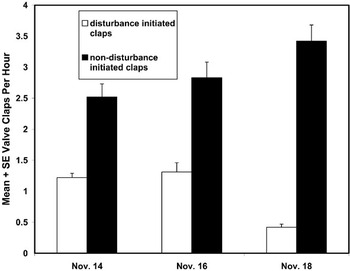
We found no significant inter-day difference (P = 0.389, F ratio = 0.75) in disturbance-induced claps between the 14 November and 16 November clap incidences (1.22 ± 0.07 claps/scallop/hr, n = 16 scallops, 14 November; and 1.31 ± 0.15, n = 15 scallops, 16 November) (Fig. 1). In contrast, there was a significant (P < 0001, F ratio = 286.29) three-fold difference, in frequency of valve clap, initiated by disturbance, between the two portions of the scallop population (0.42 ± 0.05 claps/scallops/hr, n = 17 scallops, 18 November; 1.31 ± 0.15, n = 15 scallops, 16 November). Collectively, claps induced by physical disturbance were triggered by fish (95%), brittle stars (2%) and scallops (3%).
Histogram showing the incidence of scallop claps (number per hr) from the video segments analysed from 14 and 16 November (two views of same portion of scallop population) and 18 November (view of different portion of scallop population). Shown by the open bars is the incidence (claps per hr) of scallop claps initiated by disturbance (fish, brittlestar, or scallop contact). Closed bars show the incidence (claps per hr) of scallop claps that occurred in the absence of disturbance. (n = 16 scallops followed for 20 hr on 14 November, n = 15 scallops followed for 21 hr on 16 November, n = 17 scallops followed for 22 hr on 18 November).

Discussion
Adamussium colbecki claps its valves from 3.7–4.2 times per hour. Clap frequency was consistent on both a temporal and a spatial scale. When scallop clap rates are coupled with the estimates of scallop density, the incidence of claps ranges from 100 to 139 claps per m2 benthos per hour. While the two different portions of the scallop population displayed over a three-fold difference in clap frequency induced by fish, ophiuroids, and other scallops, the incidence of claps initiated by physical disturbances was low overall (11–33% of total claps).
Has valve-clapping behaviour evolved to supplement nutrition? Certainly, there is no evidence that clap-induced seston is generated for the benefit of conspecifics. However, seston could be an important source of supplemental nutrition, particularly in high density populations or under light-restricting conditions. Clapping might also enhance respiration. However, this appears unlikely in highly oxygenated waters. Claps could be associated with reproduction. Expulsion of gametes in Argopecten purpuratus is accompanied by claps (Martinez et al. Reference Martinez, Saleh, Mettifogo, Campos and Inestrosa1996). However, no spawning occurred with claps in the present study. The most likely alternative is that valve claps could facilitate the extrusion of faeces and pseudofaeces to avoid gill clogging.
Valve clapping in A. colbecki may have indirect benefits for other organisms. For example, foraminiferans that capture (through suspension feeding) or collect (through substrate scouring) organic particles using pseudopodia could exploit scallop clap-generated seston that settles to the substratum (Travis & Bowser Reference Travis and Bowser1991). In summary, despite significant metabolic demands associated with valve clapping in A. colbecki (Denny & Miller Reference Denny and Miller2006), either nutritional benefits or the removal of faeces and pseudofaeces must outweigh costs associated with clapping.
Acknowledgements
We thank J.M. Bernhard, S.P. Alexander, N.W. Pollock, R. Sanders, M. Amsler, C. Amsler and J. Mastro. Supported by the NSF (JBM – OPP-8815959, OPP-9118864, ANT-0838773 SSB – OPP-9530735, ANT-0739583).