Introduction
Making decisions is an important part of managing one's life with dementia. The progressive course of dementia implies continuous changes in the lives of people with dementia and their informal caregivers. It causes various problems that require decisions (Groen-van de Ven et al., Reference Groen-van de Ven2016), both medical and social, both major and minor (Livingston et al., Reference Livingston2010; Hamann et al., Reference Hamann2011; Wolfs et al., Reference Wolfs2012; Samsi and Manthorpe, Reference Samsi and Manthorpe2013). The decisions include topics such as obtaining a diagnosis, using dementia-related health and social services, supervision and assistance in daily living, admission to a nursing home, and legal and financial matters (Livingston et al., Reference Livingston2010; Wolfs et al., Reference Wolfs2012; Samsi and Manthorpe, Reference Samsi and Manthorpe2013).
Studies show that people with dementia want to participate in decision making about their situation as long as possible, although they realize it will become difficult as the illness progresses (Hamann et al., Reference Hamann2011; Fetherstonhaugh et al., Reference Fetherstonhaugh, Tarzia and Nay2013). Involving formal and informal caregivers in decision making can promote autonomy for people with dementia by using their extant capacities (Boyle, Reference Boyle2014). Relatives and professionals can help people with dementia understand information and consider the preferences (Smebye et al., Reference Smebye, Kirkevold and Engedal2012). The aim of involving relatives is to reach decisions that people with dementia can identify with, regardless of who eventually makes the decisions (Peisah et al., Reference Peisah, Sorinmade, Mitchell and Hertogh2013). Decision making is thus defined as a complex process in the context of dementia care networks that involves people with dementia and their informal and professional caregivers (Wolfs et al., Reference Wolfs2012).
Shared decision making is widely promoted to get patients involved (Blanc et al., Reference Blanc2014). Shared-decision-making models have not been developed for the context of dementia, so it is unclear how these models can support the decision making of people with dementia and their caregivers (Peisah et al., Reference Peisah, Sorinmade, Mitchell and Hertogh2013). The essential elements of shared decision making are: the recognition that there is a decision to be made; the exchange of information; the deliberation about options; the expression of values and preferences; and making and implementing decisions (Stacey et al., Reference Stacey, Légaré, Pouliot, Kryworuchko and Dunn2010). Shared-decision-making models generally tend to focus on the patient–physician dyad (Stacey et al., Reference Stacey, Légaré, Pouliot, Kryworuchko and Dunn2010) and on verbally and rationally choosing options during consultations (Entwistle and Watt, Reference Entwistle and Watt2006). This focus may be too challenging for people with dementia, and may hinder their involvement. A relational approach to decision making may be more suitable for promoting the agency of people with dementia (Boyle, Reference Boyle2014).
A relational approach to shared decision making focuses on interdependence and the supportive or obstructive roles of others, such as professionals and informal caregivers in making decisions that patients can identify with (Entwistle and Watt, Reference Entwistle and Watt2006; Peisah et al., Reference Peisah, Sorinmade, Mitchell and Hertogh2013). As such, a relational approach may contribute to the social health of people with dementia by responding to the dynamic balance between a person's capacities and limitations and his or her social environment (Vernooij-Dassen and Jeon, Reference Vernooij-Dassen and Jeon2016). A recent literature review concludes that the descriptions of shared decision making in dementia vary widely (Miller et al., Reference Miller, Whitlatch and Lyons2014). The central theme is the involvement of the person with dementia in decision making about their lives. Miller et al.’s review does not make any connection to the essential elements of shared decision making in existing models. It is therefore unclear what challenges professionals experience when they want to facilitate shared decision making in dementia care networks. Our research aim was to describe the particular challenges of shared decision making for the people with dementia, their informal caregivers, and their professionals. This knowledge may contribute to the development of a model that does justice to the real-life experience of those who are involved in decision making in dementia care networks.
Methods
Design
Our study has a qualitative, multiperspective design involving semi-structured interviews, and it is part of a larger longitudinal study of decision making in dementia (Span et al., Reference Span2015; Groen-van de Ven et al., Reference Groen-van de Ven2016).
Setting
The participating people with dementia and their informal caregivers were interviewed at home. Professional caregivers were interviewed at their workplaces. We stressed the importance of interviewing participants, especially people with dementia, alone so that they could share their perspectives without feeling influenced (Nygård, Reference Nygård2006). However, sometimes the person with dementia was willing to participate only if the informal caregiver was present during the interview.
Participants
To find information-rich cases, we purposefully selected care networks (Coyne, Reference Coyne1997) each consisting of a person with dementia, two informal caregivers, and two professional caregivers. We aimed at maximum variation in the characteristics of people with dementia (gender, socio-economic status, and stage of dementia) and type of informal caregivers, for instance spouses, children, other relatives, and friends (Coyne, Reference Coyne1997). We recruited care networks spread over the Netherlands. We used three recruitment routes: (1) healthcare organizations, (2) local meetings for informal caregivers and people with dementia, and (3) the Dutch Alzheimer's Society website. The inclusion criteria were a diagnosis of any form of dementia and the availability of at least one informal caregiver. The exclusion criteria were not having a clear diagnosis of dementia and the person with dementia not being able to participate in an interview (as assessed by the informal caregiver). In line with Creswell (Reference Creswell1998) we expected to reach data saturation between 20 and 30 care networks.
Data collection
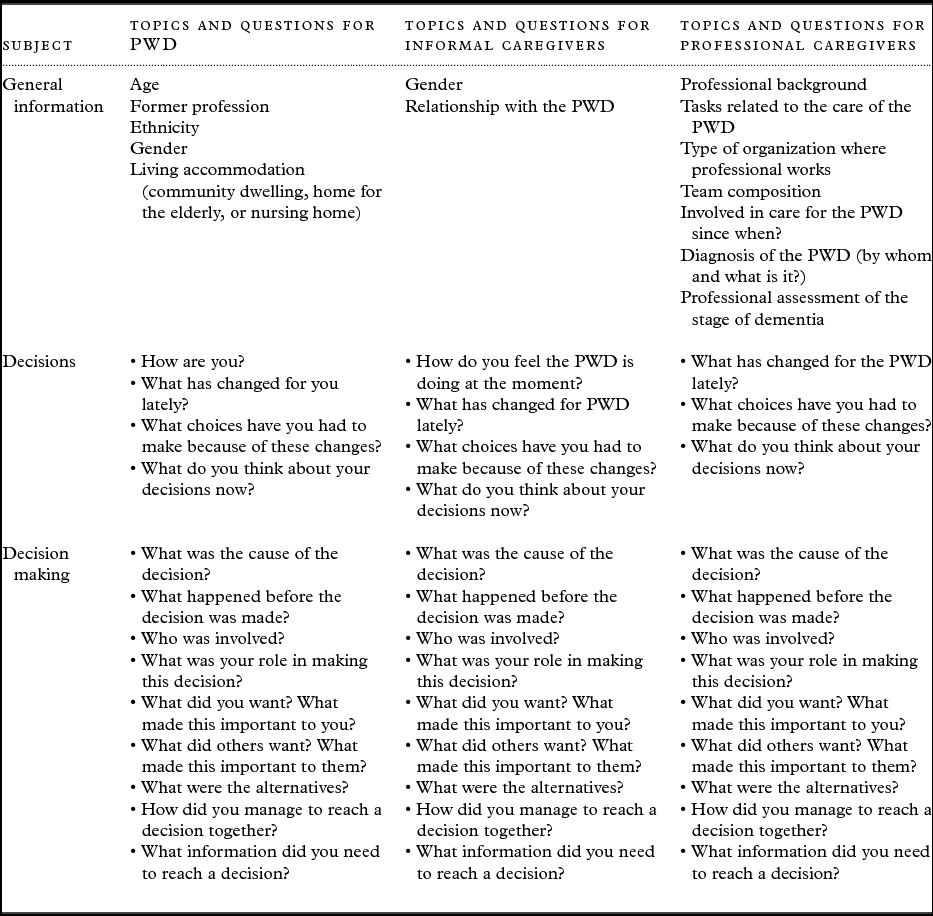
Eleven interviewers used an interview guide to conduct the semi-structured interviews. All interviews in a given care network were done by the same interviewer. The topics included the decisions made, participants in decision making, and ways of contributing to decision making (Table 1). The interviewers included eight students studying for bachelor degrees (in nursing, speech therapy, or applied gerontology) whom the researchers (LG, MS, and KC) trained in qualitative interviewing and in interviewing people with dementia. The interviews lasted averagely 1 h and were audio-taped and transcribed verbatim.
Interview topics for the different types of respondents

To maximize the person with dementia's responses we trained the interviewers to take time to build trust by engaging in informal talk before the interview started (Murphy et al., Reference Murphy, Jordan, Hunter, Cooney and Casey2015). We chose to interview the primary informal caregivers as the first respondents in our care networks. The resulting information helped us use prompts in interviews with people with dementia.
Data analysis
The aim of our study was to describe the particular challenges of shared decision making in the context of dementia care networks. Even though we were aware of the elements of shared decision making in other contexts, we wanted to be open to the particulars of decision making in dementia. Therefore, we used content analysis (Elo and Kyngas, Reference Elo and Kyngas2008) based on open coding and constant comparison (Corbin and Strauss, Reference Corbin and Strauss1990) to analyze our data. Open coding consists of reading the interview transcripts and labeling the relevant interview fragments. Constant comparison means comparing newly analyzed data with emerging codes and categories. To keep the focus on the care network story rather than the separate interviews, we read all the interviews of a care network before coding (Kendall et al., Reference Kendall2009). To ensure rigor, LG and MS independently coded the 15 interviews from the first three care networks and agreed on an initial coding scheme consisting of a description and an example quote for each code. The multidisciplinary research group then discussed and agreed on this coding scheme. This multidisciplinary group included researchers specializing in health science, psychology, gerontology, nursing science, medicine, sociology, and anthropology. LG used the scheme to code the remaining interviews. The research group discussed any new codes or refinements of the coding scheme. We reached data saturation after analyzing the data of 18 care networks, when no new codes emerged (Creswell, Reference Creswell1998). The next steps of our analysis included clustering codes into categories, followed by grouping categories into themes. For this part of the analysis, we used affinity diagramming (Johnson et al., Reference Johnson, Barach and Vernooij-Dassen2012), which involved three sessions with the research group led by a process leader. We used Atlas.ti software for the analysis.
Ethical considerations
The regional ethical board of the Isala Clinics, (Zwolle, the Netherlands) approved this study (number 10.11113). Taking part required the consent of both the person with dementia and the informal caregiver. The participants received oral and written information before consenting. The person with dementia's consent was regarded as a process (Murphy et al., Reference Murphy, Jordan, Hunter, Cooney and Casey2015). The interviewers remained alert to any verbal or nonverbal signs that the person with dementia did not want to continue the interview (Meulenbroek et al., Reference Meulenbroek2010), and they did not share interview information with care network members, i.e., the participants (Kendall et al., Reference Kendall2009).
Results
Participants
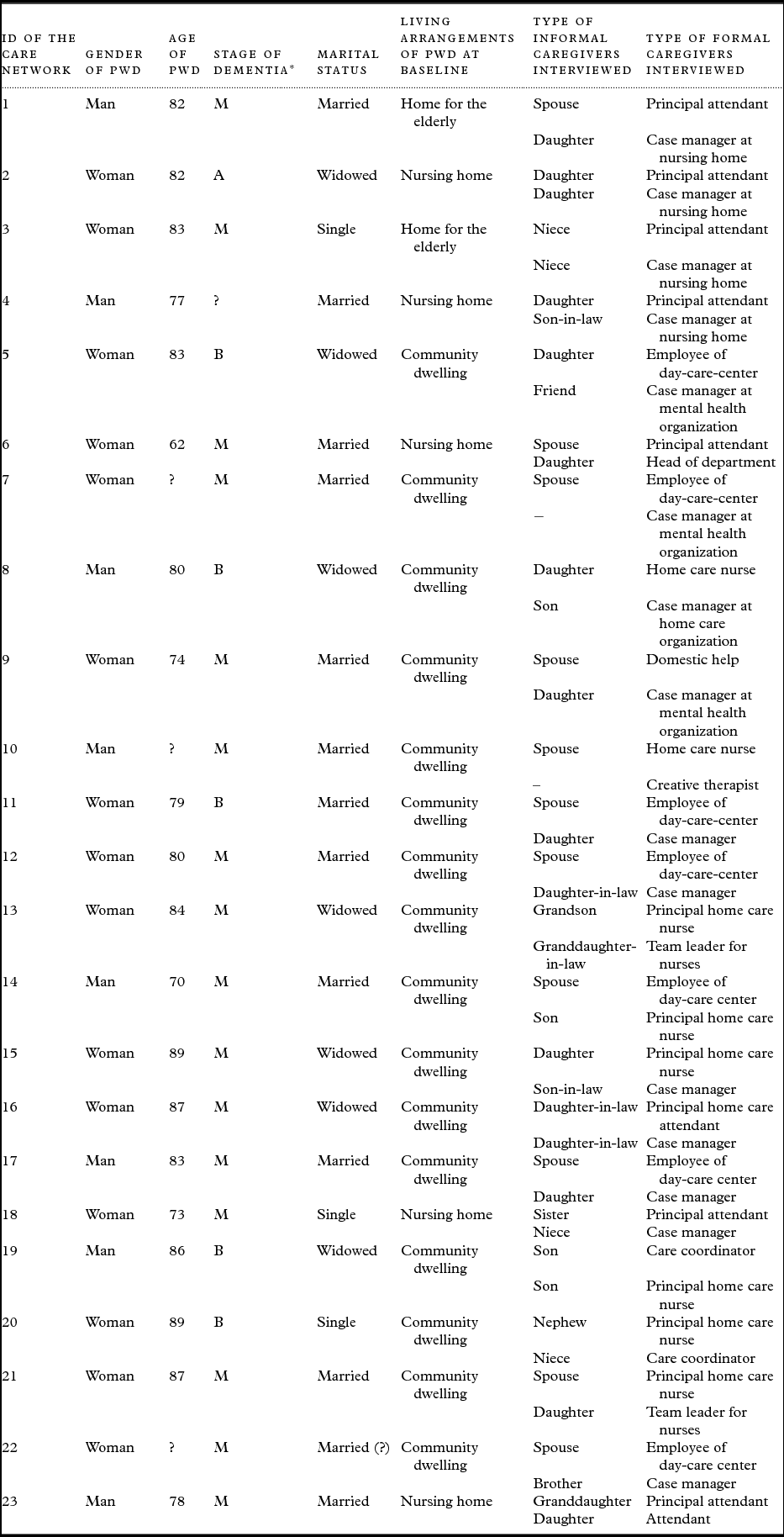
Of the 30 care networks that we invited, 25 consented to participate. Refusals were due to the expected burden of the interviews on caregivers or people with dementia. Two care networks were excluded because a person with dementia unexpectedly could not participate in the interview due to stress (one care network), and a person's diagnosis of dementia was reset to mild cognitive impairment during the study (one care network). The remaining 23 care networks included 23 people with dementia, 44 informal caregivers, and 46 professional caregivers, resulting in a total of 113 interviews. Table 2 lists the characteristics of the care networks.
Characteristics of the participants with dementia and the caregivers interviewed

* Judgment by professional interviewed.
A = advanced dementia, B = beginning dementia, M = moderate dementia, PWD = person with dementia.
The challenges of shared decision making in dementia care networks
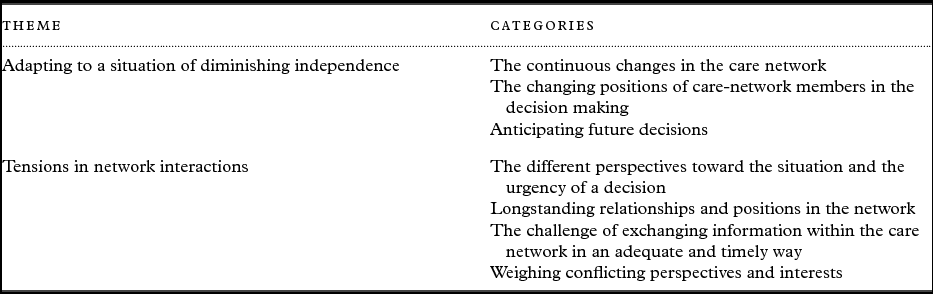
In our analyses, we found two themes representing the challenges of shared decision making in dementia care networks: (1) adapting to a situation of diminishing independence, which includes the continues changes in the care network; the changing positions and roles of care network members; and, anticipating future decisions; and (2) tensions in network interactions, which result from different perspectives and interests and which require reaching agreement about what constitutes a problem in the situation by exchanging information in the care network. Table 3 lists the themes and categories that emerged from the analyses.
Themes and categories of the challenges of shared decision making in dementia care networks

Theme 1: adapting to a situation of diminishing independence
This theme represents the continuous changes that challenge the independence of the person with dementia and that prompt decision making. The theme consists of three categories: (1) the continuous changes in the care network, (2) the changing positions of care network members in the decision making, and (3) anticipating future decisions.
The continuous changes in the care network
People with dementia and their care networks encounter continuous change over the course of time.
Normal, everything was normal, all fine, but it slowly became less, became less. And, it goes on too. – Woman with dementia, care network 6
The lives of people with dementia and their informal caregivers are intertwined, especially when the informal caregiver is the spouse of the person with dementia. Changes in the situation for one care-network member therefore often have implications for other care-network members as well.
My driver's licence will expire in two years. So, I try to keep doing the groceries for at least two years. But, with [my partner's] eyes getting worse. Yes, I call on myself to keep taking that over from her. – Man with dementia, care network 10
An important source of continuous change includes the progressive nature of the dementia which results in the declining functioning of the person with dementia. Participants are more or less aware of the progressive nature of dementia, which requires decisions that often force the person with dementia to give up independence little by little. Examples of this involve stopping activities such as car driving, managing the financial matters at home or accepting increasing assistance with daily activities such as grocery shopping, household chores, going out alone, and washing and clothing oneself. The declining functioning of the person with dementia living in the community is often automatically counterbalanced by the informal caregiver providing more care. In this way, the continuous changes in the functioning of the person with dementia impact the roles of the other care-network members.
For [my mother] a lot has changed too. You see, it used to be like this. When they were cycling together, my dad used to be in the front, because he knew his way everywhere, and my mother used to follow him. But now, my mother has to cycle in the front. . . . She has to be in charge now. And, that's actually exactly opposite to what she was used to. So the roles have changed completely. – Daughter of a man with dementia, care network 17
Another source of changes in the situation of the care network is the levels of functioning of the informal caregiver. Unforeseen circumstances, for instance health issues or caregiver overburdening, may result in the informal caregiver relinquishing care, which other informal caregivers or professionals have to take over, or which in some cases, results in institutionalization.
Then I fell, and I bruised my rib. So then I was out of the running a little while, so to speak. And then my husband ended up in [the care home]. . . . – Partner of a man with dementia, care network 1
After institutionalization, the progressive decline of the person with dementia requires decisions about, for instance, the activity program and relocation to another ward. The challenge for the care-network members within this category represents the central dilemma in many decisions for people with dementia: weighing the independence and well-being of the person with dementia against safety risks and, especially in the context of community living, overburdening the primary informal caregiver.
Well, my wife. She's in two minds about it. She likes to have me home. But she's afraid something will happen to me. – Man with dementia, care network 4
The changing positions of care network members in the decision making
As the dementia progresses, the decision-making capacities of the person with dementia diminish. This affects the positions of both the person with dementia and the informal caregivers in the decision making, with spouses or children taking over the responsibility for the person with dementia.
If there is something that I can't manage, I will call my son and he will come to check on me. – Woman with dementia, care network 13
As the role of the person with dementia diminishes, the informal caregivers take on more responsibility for the decision making. This change of positions in the decision making is gradual. In the initial stage their caregivers help people exchange information and share considerations. At this stage, they are actively encouraged to express their preferences in an open way.
If you have people who are still really in the initial phase of dementia, then it is really all about questions: what do you want to do today? What do you like? And then you can really try to meet the individual's wishes. – Activity coordinator of a woman with dementia, care network 22
When the dementia progresses an overview of their situation and the options can help people with dementia make decisions, particularly if the number of options is limited and the information is provided at shorter notice. Decision making can become stressful in the later stages of dementia, and some informal caregivers and professionals then take charge of it.
That's under discussion with him too: that you shouldn't tell him things too much in advance. A lot was being written in his calendar, for example. That really makes him restless. . . . So that's why we said: ‘We won't put anything in his calendar too much in advance anymore because it only causes restlessness. . . . He loses his grip and doesn't know when and how. So we didn't really discuss that extra care we arranged with him. We just said that we would come by a bit more often, but not like, not very clear. We just go there on Friday afternoons and tell him we've come to do something fun. That's fine with him. – Home care nurse of a man with dementia, care network 8
It is in this later stage that informal caregivers may be faced with difficult decisions such as deciding about admission to a nursing home. Professionals help informal caregivers by being present, listening to them, legitimizing the informal caregiver's considerations, and functioning as messengers for difficult decisions.
I didn't tell her [that she would be admitted to the nursing home], and I didn't want to tell her either. I thought she wouldn't accept it from me. So we agreed a long time ago that [our case manager] would tell her. – Sister of a woman with dementia, care network 18
The challenge for people with dementia and their informal caregivers is the gradual accommodation of the change in decision-making responsibility from the person with dementia to the informal caregivers. For professionals and informal caregivers, the challenge is to involve the people with dementia in decision making in accordance with their capabilities. For people with dementia this means trusting their caregivers in the decisions they make for them.
[Interviewer: What has changed for you since you came to live here in the nursing home?] [Silence] That is a very difficult question. I don't even know that anymore. Because, I lose everything so suddenly. Everything that's in my head, if I do like this, it is gone. Yes, it's going fast. [Silence]. That is why it's very difficult to answer your question. I don't even know myself. But, I trust my caregivers. I feel that they can help me. And that is a good feeling. – Woman with dementia, care network 18
Anticipating future decisions
Making decisions in a timely manner is important to people with dementia and their care networks because many care networks want to respect the independence of the person with dementia as long as possible.
[Interviewer: Is that important for you, your independence?] Oh yes! I would find it terrible if I would have to move to. . .if I walk past those homes over there. . . I would find it terrible to live there. [. . .] Look, if I or the others would notice, he can't manage anymore, then it would be different. But, I feel I can still manage quite well. – Man with dementia, care network 8
Timing decisions rightly implies anticipating future problems. Future problems relate to the progressive decline in functioning of the person with dementia, the vulnerability of and burden on the informal caregiver, and organizational barriers such as waiting lists. The participants are aware that thinking ahead about decisions allows the person with dementia a voice in these decisions.
Now she is still good enough to be actively involved in [thinking about what to decide if something should happen to dad] – Daughter of a woman with dementia, care network 9
However, discussing future issues is emotional because they relate to either the deterioration of the person with dementia (and giving up independence) or to the informal caregiver (relinquishing care). Some participants tend to avoid thinking about these situations.
It is just as it is now, and I am very happy with things as they are. So why would I change that. Of course, I could, if the moment comes when I think: yes, now it's going all wrong. – Woman with dementia, care network, care network 18
But, if he weren't here at all, no, then I couldn't stay here [independent living] anymore. But yes, what then? But, well, I just won't think about that. – Woman with dementia, care network 9
The challenge for care-network members is to discuss issues in a good time so that the person with dementia can have a say. This implies coping with the progressive nature of dementia in order to prepare for decisions ahead. The challenge for professionals facilitating shared decision making in dementia care networks is to adjust their decision-making pace to that of the care-network members by introducing issues and then checking whether the members are able to discuss these issues now or whether they should be postponed.
At a given moment I said to him [the spouse], how do you feel about nursing home admission, which can also be a prospect. Well, in the beginning he was really holding back: “O no” you know, like “No I won't do that to her. Everything is fine as it is. I want to take care of her until the end. We live very beautifully here” You know? Like that. Then you notice that he's not ready for it yet. Then you let it rest for a while. Then he comes up with something again and then you just touch the subject lightly again, let it settle in. Let him adjust to the idea for a couple of months. And then, when he has made the decision, then he speeds up, he will make calls and arrange things. – Case manager of a couple of whom the woman has dementia, care network 7
Theme 2: tensions in network interactions
This theme involves the ways in which the care-network members work together and influence each other during the decision making. It includes four categories: (1) the different perspectives toward the situation and the urgency of a decision, (2) longstanding relationships and positions in the care network, (3) the challenge of exchanging information within the care network, and (4) weighing conflicting perspectives and interests.
The different perspectives toward the situation and the urgency of a decision
Care-network members differ in their views of the situation, their values, and their ideas about what constitutes a problem. This influences their appraisal of decisions. People with dementia and their primary informal caregivers face the dementia on a day-to-day basis so that they experience the changes in the situation as gradual and small. Some people with dementia are aware of the problems related to their dementia, others not.
At the checkout of the supermarket when I want to pay, that's all really complicated. These days you have to put your bankcard in the back and it used to be in front. And meanwhile I have to watch that they won't take my wallet and then this cash girl asks ‘Do you have ten cents extra?’ And I go ‘Can you speak louder, I can't hear.’ And in the meantime I see the queue behind me waiting. They are thinking ‘That old buffer is not getting anywhere’. And that upsets me and then when I get home it appears I have forgotten things. Oh! I used to like shopping, but now I get drowned in. It is very hard. – Man with dementia, care network 10
I'm doing fine. I have no problems. I wouldn't know. Going to the day-care is fine. Well, I actually don't belong there. The day-care employee says it too: They can better put you on the pay role. – Woman with dementia, care network 11
The informal caregivers and professional report that people with dementia may overestimate their capabilities. However, even primary informal caregivers may have difficulties seeing the deterioration of the person with dementia or difficulties taking away independence. People with dementia and their primary informal caregivers often focus mainly on the present situation and tend to avoid thinking about the future.
But I am not going to sit there puttering about and thinking. What will be, will be. If it happens, then it happens by itself, and then I'll see. Doing that beforehand is not living. –Woman with dementia, care network 18
Secondary informal caregivers often have other views of the situation and urgency of decision making. They see changes in functioning as more abrupt, which sometimes means they see the situation as problematic earlier on. Further, the situation of both the person with dementia and the primary informal caregiver concerns them, and the risk of overburdening the primary informal caregiver is a problem to them as well. Secondary informal caregivers tend to focus more on preparing for the future by anticipating decisions that may become relevant in the future.
As brothers, we are more or less on the same wavelength, although I notice that my brother, well, he lives opposite my father, so well, he comes by my father's much more often than I do. He is there almost every day, depending on the situation. And well, I have said before, wouldn't it be better if he went to another place. I am in favor of a better situation for him. But my brother is more like: let him be. It's okay as it is. – Son of a man with dementia living alone, care network 19
All the care network members – the people with dementia and their informal and professional caregivers – value the autonomy and independence of the person with dementia.
[Interviewer: How did you like it in the sheltered home?] It was okay, but still, you're not your own boss, are you? You're like a child. They pamper you, and if you are not well, they will do everything to make it go away. They pat you on the back, but you're not your own boss anymore. [Interviewer: And you would like to be?] Yes, of course. I would give as much for it as the entire proceeds from the collection for this or that. – Woman with dementia, care network 2
The perspectives on how to preserve autonomy differ between care network members. The need of people with dementia for independence may result in a refusal of professional care, but informal caregivers and professionals see precisely that professional care as the means of preserving independent living in the long run.
He talks about it as a chain of surrendering. It's getting worse and worse. That's how he sees it. Well I understand that's how it feels to him, it apparently does. But, I think he would be better off if he would accept more care and look at the possibilities. Then again, his energy seems to be gone. Stick to what you have, and don't give in, because it only gets worse. I think that if he would accept care in good time, he could have more instead of less. –Son of a man with dementia living alone, care network 19
Professionals and secondary informal caregivers do not curb independence lightly. However, the perspective of safety risks, given the functional decline of the person with dementia and the possible overburdening of the primary informal caregiver, is a serious matter to them.
We are considering whether or not to put his medication in a safe, so that he cannot get it himself, so that only we [home care] have the key. Only that's quite a rigorous step. So, we will try again for a while, until it gets too risky. – Case manager of a man with dementia living alone, care network 8
The challenges for care network members are: to share and listen to each other's perspectives of the situation; to acknowledge the deterioration of the person with dementia; and, to find common grounds about what problems require decision making and how to shape decision making. The challenge for professionals is to establish trust in the care network so that care-network members feel free to share their views.
Longstanding relationships and positions in the care network
Care network members, more or less knowingly, influence each other via their mutual positions and relationships when they discuss and implement decisions. They often have longstanding relationships based on their particular roles (e.g., spouse, daughter, or case manager). Professionals especially mention the importance of trustful relationships for making decisions. However, longstanding or trustful relationships may also hamper an open dialogue about decisions, such as when care network members are afraid of hurting each other's feelings.
Now, it's not nice of me to say it. Because I have a very good father and I am his only child. To say, as hard as nails, “Dad, you have to stay here [in the care home], you cannot go home. – Daughter of a man with dementia, care network 4
Longstanding relationships and positions that influence decision making consist of the unspoken rules about who has a say and the strategies that care-network members use for pushing through decisions.
My daughter is wide awake, you know. So when she suggests something I'll usually think ‘Oh well, you're quite right. – Man with dementia, care network 8
For example, my brother didn't want her to bicycle any more. And I felt, now, just let her enjoy bicycling. She'll get there OK. . . . [Interviewer: How did you solve that?] Well, by avoiding it, just not talking about it. That's the easy way. I heard from my sister-in-law that my brother really didn't want mum to bicycle. I just said, “Well I don't mind. She can cycle if she wants to.” And, I would say that to my mother too. My mother said to me, “Your brother won't let me bicycle.” Then I said, “No, he says that, but if you think you can do it, I'll let you bicycle.” My brother knew what I had said to our mother. But, he just left it alone. . . You know each other very well, don't you? – Daughter of a woman with dementia, care network 2
The positions of professionals are relevant too. People with dementia and their informal caregivers sometimes tend to rely on the expertise of the professional, given their specific role and put their own ideas aside.
Living at home and living where she is now [in the nursing home], there should be something in between. Well, they [the case manager and the nursing home staff] all advised it, so I assume that that is well, uh. . . Well, I don't know how that works. I assume that they have looked into it. – Niece of a woman with dementia, care network 17
[Interviewer: What did you think of that? That the home care nurses suggested that personal alarm?] Good. They are quite right. I don't know what kind of things exist and all. But then they come up with this. Well, I think that's fine. – Man with dementia, care network 8
The challenge for the professional facilitating shared decision making is to elicit the perspectives of the different care networks despite the existing communication patterns and positions in the care network. It is a challenge for professionals and informal caregivers to stand up for the person with dementia if necessary.
The challenge of exchanging information within the care network
Exchanging information involves care-networks members sharing knowledge, information, thoughts, and ideas about the decision in question. This information-exchange is often difficult to follow for the person with dementia. They rely on their informal caregivers for comprehending what the decisions are about.
Spouse: For me it's more easy to oversee the consequences. That's much more difficult for her: to list all the ins and outs, to weigh the pros and cons against each other, and then to reach a decision. At least, that is how I feel it. That I keep trying to explain her again and again how things are and what choices we have. And, that is how we reach decisions.
Woman with dementia: “I can't anticipate so well, and what will be possible, and he can do it all so much better.
Interviewer: And how is that for you?
Woman with dementia: Well, pleasant. That's why I say, if he wouldn't be there, it would be a disaster. – Interview with a woman with dementia and her spouse, care network 9
Given that multiple participants are involved in the decision making, an adequate information exchange is extra complicated. The challenge is for all participants to contribute their perspectives. The fact that not every participant is present when decisions are discussed hinders the process. Sometimes participants who are not present want to provide background information that they feel is relevant. For example, the daughters of the woman with dementia in care network 21 felt the need to stand up for their mother by explaining their perspectives about the relationship of their parents.
My sister and I went to talk with [the case manager]. My mother absolutely did not trust this lady. . . . So, at least we informed this lady, and also told her the whole history of my parents. Because, although I feel [my father] is now really trying his best, he had previously been a really lousy husband. – Daughter of a woman with dementia, care network 21
In some situations, organizational barriers hinder adequate information exchange between the professional caregivers.
Because she only has an indication for support [and not for treatment], the [contact with relatives and other professional caregivers] is really minimal. Only if there are special circumstances, will I first contact the daughter, and if there is really a dramatic decline, or really a big problem, then of course I will alert the [case manager]. With someone with an indication for treatment, you will keep in touch more. – Day-care employee, care network 5
Providing adequate information for people with dementia and their caregivers is a challenge to professionals. Care-network members have differing information needs and preferences for the timing of the information provision. Some want to be well-informed about everything from the beginning to get a grip on the situation, whereas others are reluctant to learn about anything related to the dementia because the information is too confronting for them.
My brother has a book. I say I don't want to read it; I'll see what happens to me. – Partner of man with dementia, care network 17
These information needs can change over time, which makes it necessary for professionals to continue monitoring the information needs of care-network members. The final challenge in exchanging information about the decision is that care-networks members, professionals as well as people with dementia and their informal caregivers, often have little information about alternative options.
Weighing conflicting perspectives and interests
When deciding together about the situation of the person with dementia, care-network members need to weigh the perspectives and the interests of all the participants. Considerations of care-network members vary depending on the perspectives and interests of the care-network members. They include respecting the identity and personality of the person with dementia, striving for well-being, considering the levels of functioning of the person with dementia, safety issues, caregiver burden, and the quality of relationships between the person with dementia and the informal caregiver, as well as practical and financial issues. Depending on the perspectives of care-network members, certain interests may be dominant in considering the situation and possible solutions.
[Interviewer: So, you were kind of surprised, because the test results were quite good, but still you had to stay here in the nursing home.] Then it comes to my wife. They say to me: ‘Your wife can't take care of you’. But, my wife doesn't have to take care of me. I dress myself, I undress myself. If I get home I can help. Clean a bit. I did it all. She never complained. Only, she is afraid that I will fall and she doesn't get me on my feet again. Of course, that can happen. But, you can get help then. – Man with dementia, care network 4
It is important that someone keeps an eye on her, at least checking several times a week. And I do say this. But well, her interest is meeting new people. So there are different interests, depending on the perspective. It's important to the daughter that her mother can live in her home safely. She lives far away and is worried. – Case manager of a woman with dementia, care network 5
The different perspectives and interests of care-network members sometimes cause dilemmas that need to be resolved by deliberation.
It would be less of a problem for me if she were to live in a care home, that's true of course. But it must be good for her. As long as she is not up to it, I don't know, I feel that I cannot force it upon her. I feel I should allow her freedom. – Daughter of a woman with dementia, care network 5
The participants feel that the process of deliberating potentially conflicting perspectives and interests is shared when they have a sense of working together in making decisions. This requires that care-network members at least have an idea about what the others think about a given decision.
And we have also always said, now, whatever you decide. We're behind you. But we are so interwoven with each other that we really can't just make such a difficult decision alone, that we all just want to consult one another about how or what. – Daughter of a woman with dementia, care network 6
The challenge for care-network members is to share considerations about the decision, overcome dilemmas, and reach consensus about what to do and when.
Discussion
Our results suggest that the care networks of people with dementia encounter two challenges when making decisions together: (1) adapting to a situation of diminishing independence of the person with dementia, and (2) tensions in network interactions. These challenges relate to social health and to the essential elements of shared decision making.
Our results relate to the essential elements of shared decision making as described by Stacey et al. (Reference Stacey, Légaré, Pouliot, Kryworuchko and Dunn2010), but seem to be influenced by the dementia process. The first essential element is recognizing that there is a decision to be made. Our theme of tensions in network interactions highlights the complexity of this element in the context of dementia care networks, as people with dementia, their informal caregivers and professionals, may express different ideas about what constitutes a problem for which decision making is relevant her and now. Informal caregivers’ roles are overlooked in many shared-decision-making models (Stacey et al., Reference Stacey, Légaré, Pouliot, Kryworuchko and Dunn2010). Epstein and Gramling (Reference Epstein and Gramling2013) have pointed out that shared decision making for complex problems has specific characteristics. In complex situations such as the ones that dementia creates, it is necessary to consider the multiple perspectives, including those of the informal caregivers, to attune decisions to the patient's characteristics. A shared attentional focus can help promote effective decision making in complex situations with multiple participants, who often highlight different facets of the situation. This means that professionals who want to facilitate shared decision making in dementia care networks need to work together with all relevant participants towards a shared view of the situation and the problem that needs addressing now.
The second and third essential elements include exchanging information and deliberating about options (Stacey et al., Reference Stacey, Légaré, Pouliot, Kryworuchko and Dunn2010). Our theme of adapting to a situation of diminishing independence of the person with dementia illustrates that it is precisely the capacities necessary for exchanging information and deliberation about options that diminish over time in people with dementia. Taking the involvement of people with dementia seriously means that professionals and informal caregivers need to gradually accommodate to the changing capacities of the person with dementia, allowing them to contribute to decision making according to their capabilities. They do this by helping people with dementia getting an overview of the situation and the options, by limiting the amounts of information, and by providing information at shorter notice. This declining control over the decision making contrasts with the perspective of shared decision making in other chronic contexts, such as diabetes management, where shared decision making aims at patients’ growing control over the disease (Montori et al., Reference Montori, Gafni and Charles2006). Our results show that over time deliberating about decisions can become stressful to people with dementia. However, they can contribute to the decision making in ways that go beyond deliberating, for instance by expressing their desires, their emotions, and body language (Boyle, Reference Boyle2014). Acknowledging and taking into account these expressions can help professionals and informal caregivers in the later stages of the dementia to attune decisions to the preferences of the person with dementia.
Finally, also the elements of expressing values and preferences and making and implementing decisions are challenging in the context of dementia care networks. People with dementia are well able to express their values and preferences (Feinberg and Whitlatch, Reference Feinberg and Whitlatch2001). However, decisions have consequences for both people with dementia and their informal caregivers. People with dementia and their informal caregivers may have different preferences and interests. Professionals who want to facilitate shared decision making in the context of dementia care networks should thus try and find a balance between the preferences and interests of people with dementia and their informal caregivers.
The challenges concerning shared decision making in dementia care networks relate to all three dimensions of social health (Huber et al., Reference Huber2011): (1) the capacity to fulfil one's potential and obligations, (2) the ability to manage one's life with some degree of independence despite a disease, and (3) the ability to participate in social activities. Social health implies a dynamic balance between a person's capacities and limitations and his or her social environment. Looking at dementia from the perspective of social health puts the focus on the remaining capacities of people with dementia and the possibilities of compensating for disabilities (Vernooij-Dassen and Jeon, Reference Vernooij-Dassen and Jeon2016).
As to the theme of adapting to a situation of diminishing independence of the person with dementia, an important prerequisite for supporting the remaining capacity of people with dementia is that their networks must allow them a role in the decision making. Care network members can either include or marginalize people with dementia in making decisions (Entwistle and Watt, Reference Entwistle and Watt2006; Hamann et al., Reference Hamann2011; Smebye et al., Reference Smebye, Kirkevold and Engedal2012; Boyle, Reference Boyle2014). When informal caregivers are confronted with diminishing capacities, they tend to exclude people with dementia from decision making too early on (Miller et al., Reference Miller, Whitlatch and Lyons2014). Our results show that even in the mild stages of the dementia, people are only moderately involved in decisions. The decisions in dementia care networks often concern the decreasing independence of the person with dementia and their diminishing control over their lives. Shared decision making in dementia aims to preserve the autonomy of the person with dementia for as long as possible (Livingston et al., Reference Livingston2010; Samsi and Manthorpe, Reference Samsi and Manthorpe2013) and professionals need to advocate the decision-making role of the person with dementia. This means being aware of any marginalization of people with dementia and helping them participate in ways that strengthen their remaining capacities, such as expressing values and communicating experiences and feelings (Peisah et al., Reference Peisah, Sorinmade, Mitchell and Hertogh2013).
Professionals can also build on the remaining capacity of people with dementia by anticipating future decisions. The difficulty here is that participants’ preferences in anticipating future decisions differ. Pressuring people with dementia and their families into making decisions before they are ready to make them can cause family conflict and caregiver stress (St-Amant et al., Reference St-Amant2014). However, not anticipating future decisions limits the choice of options and the opportunity for the person with dementia to be included in the decision making (Wolfs et al., Reference Wolfs2012). This results in a negative impact on the social health of the person with dementia. Professionals must therefore balance the idea of anticipating future decisions with the preferences of the participants, who want to focus on living well in the present. Introducing change slowly is relevant here (Livingston et al., Reference Livingston2010). It allows people with dementia and their informal caregivers to adjust to having to make certain decisions, which provides them with an opportunity to manage their own lives while the dementia progresses.
As to the theme of tensions in network interactions, the progressive dementia demands changes in patients’ and informal caregivers’ roles (Samsi and Manthorpe, Reference Samsi and Manthorpe2013). Over time the informal caregiver's role in the decision making increases, which means that people with dementia may not be the ones actually making the decisions. This is not necessarily problematic if the interacting participants take into account the expressed desires, emotions and body language of the person with dementia, thereby reaching decisions that are meaningful to him or her and attuned to his or her values and experiences (Peisah et al., Reference Peisah, Sorinmade, Mitchell and Hertogh2013; Boyle, Reference Boyle2014). Such decisions may restore the social health of people with dementia with respect to managing their lives and remaining socially active (Vernooij-Dassen and Jeon, Reference Vernooij-Dassen and Jeon2016).
Finally the social health of people with dementia impacts the way the shared decision making evolves. If people with dementia have invested in good-quality relationships, and have built supportive networks over the course of their lives, their decision making may be more easily facilitated. In contrast, poor family relationships, loss of social contacts, and disturbed social behavior caused by the dementia hinder shared decision-making processes. Longstanding family relationships influence how making decisions is shared in dementia care networks (Samsi and Manthorpe, Reference Samsi and Manthorpe2013; St-Amant et al., Reference St-Amant2014; Su et al., Reference Su, McMahan, Williams, Sharma and Sudore2014). Positions in families and unspoken expectations in family circles affect who has a say (St-Amant et al., Reference St-Amant2014; Su et al., Reference Su, McMahan, Williams, Sharma and Sudore2014) and therefore whose perspective will gain the most weight.
Limitations and strengths
This study has some limitations: first, it is based on self-report, not on observing decision-making situations such as consultation with professionals, people with dementia, and their informal caregivers. Second, we included only people with dementia who had at least one informal caregiver: those without informal caregivers may present different or additional experiences. Third, this study involves only people with dementia who can participate in interviews. Although we reached a wide variety of dementia care networks, the person with dementia who can no longer participate in interviews likely experiences decision making differently. This study also has strengths: the first is its multi-perspective approach describing each case from five perspectives, which provides rich data from 113 care network members. The second strength is its thorough analytical process involving a multidisciplinary research team.
Conclusion
The challenges found in the actual process of shared decision making in dementia care networks relate to all dimensions of social health. In shared decision making, informal caregivers can compensate for limitations in cognitive abilities, while strengthening the remaining capacities of the person with dementia and allowing the person with dementia to fulfil his or her role in decision making. When decision making aligns with the needs and wishes of people with dementia, they can manage their lives as independently as possible and remain socially active. The challenges described have consequences for a model of shared decision making in dementia care networks. Such a model requires flexibility regarding changes in the capabilities and roles of the care network members, which preserves the autonomy of the person with dementia. It requires professionals advocating the involvement of people with dementia by helping them participate in ways that strengthen their remaining capacities, such as expressing values and communicating experiences and feelings. Finally, it requires professionals to work with care networks towards a shared view about what constitutes a problem in the situation.
Conflict of interest
None.
Description of author's roles
L. Groen-van de Ven is a PhD candidate and the principle investigator of the project. C. Smit and J. Jukema are project leaders. M. Vernooij-Dassen and J. Eefsting are promotors. L. Groen-van de Ven, M. Span and K. Coppoolse conducted the interviews. All authors contributed to the data analysis. L. Groen-van de Ven drafted the manuscript. All authors commented critically on several drafts of the manuscript.