Introduction
Most health systems aim to achieve productive efficiency or cost-effectiveness,Footnote 1 demonstrating to taxpayers, policy holders and shareholders their health system’s value for money.
The global economic crisis, beginning in late 2007, has intensified the imperative for improved efficiency in health care systems across Europe. As governments try to reduce deficits in public spending, health care expenditure is being subjected to detailed scrutiny. Meanwhile, demographic change, a rise in multi-morbidity and long-term conditions and the rising costs of health care, put health care budgets and provision under increasing pressure, with real concerns about medium- and long-term sustainability. For many countries, therefore, the question in health care is how to do more with less. Health systems must find ways of continuing to deliver as comprehensive as possible range of health services – and to acceptable levels of quality – with budgets that are growing more slowly than in past decades, static or reducing.
Identifying areas for reform in secondary care is likely to be at the forefront of such efforts. The acute hospital sector is one of the largest areas of expenditure within a health system (Orosz and Morgan, Reference Orosz and Morgan2004; Jones and Charlesworth, Reference Jones and Charlesworth2013), and hence is likely to be an important area of interest for policy makers seeking to make gains in productive efficiency. As such, this article seeks to:
-
1. examine the evidence on productive efficiency in respect of hospital care, identifying those areas which appear to hold the most promise for policy makers and practitioners seeking to improve health system efficiency;
-
2. set out the lessons to be learned from international experience of seeking to improve efficiency within health systems, with a focus on what policy makers and practitioners should do if they are to adopt an evidence-based approach;
-
3. identify any remaining gaps in the existing evidence base.
This work builds on research and analysis from the ‘Quest for Efficiency in the NHS’ programme commissioned by the Nuffield Trust in 2009–2010, notably that of Hurst and Williams (Reference Hurst and Williams2012).
Context
Until 2009, health care spending across Europe grew at a faster rate than the rest of the economy, with an annual average growth rate of 4.6% between 2000 and 2009. As a result the health sector absorbed a growing share of the gross domestic product (GDP). While necessarily speculative, analysis by the Organisation for Economic Co-operation and Development (OECD) finds that over the next 50 years public spending on health and social care are projected to increase faster than economic growth (De La Maisonneuve and Oliveira Martins, Reference De La Maisonneuve and Oliveira Martins2013). If health care spending pressures continue in line with recent trends across the OECD, public health spending as a share of GDP is projected to increase from 5.5% between 2006 and 2010 to 11.8% in 2060.
Rising expenditure on health partly reflects changes in the demand for health care. New technological innovations in diagnosis and treatment means we can do more than ever before, yet such progress also comes at a cost. Official estimates in the United States suggest that about half of the historical increase in real health spending has been driven by technological change (Center for Medicare and Medicaid Services, 2000). Changing demographics also influence health care expenditure. Populations in many countries continue to age and increasing numbers of people are facing long-term chronic disease such as dementia [World Health Organisation (WHO), 2005]. Although calendar age alone has been shown to have limited effect on demand for health care, and health care expenditure, once remaining lifetime is controlled for (Barer et al., Reference Barer, Evans, Hertzman and Lomas1987; Newhouse, Reference Newhouse1993; Zweifel et al., Reference Zweifel, Felder and Meiers1999). Smith et al. (Reference Smith, Newhouse and Freeland2009) argue that, when combined with the costs associated with developments in technology, changes in income and insurance packages, demographic changes may come to drive cost increases as health care systems increasingly look to do more for an ageing baby boomers. Alongside such changes, people are also struggling to maintain their wellbeing, fitness and diet, with rising levels of obesity in a number of countries (Sassi, Reference Sassi2010), and those with chronic conditions and multi-morbidities require long-term support and treatment.
As these pressures push health care costs higher, the continuing financial climate means that health systems (insurers and governments) may find it difficult to meet demand with greater expenditure. Economic growth in most European countries fell sharply in 2008 and recovery since has been sluggish. Although forecasts now show the economic outlook for the EU strengthening, following the double-dip recession growth only turned positive in a large majority of Member States in 2013 and significant legacy costs remain (European Commission, 2014).
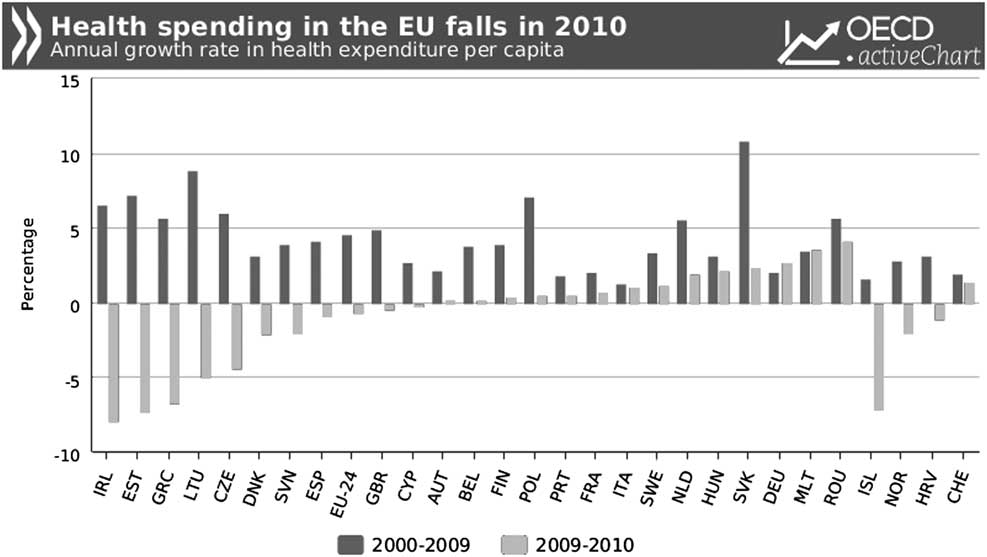
In response to such problems, many governments initially tried to maintain spending plans – further raising the share of health spending as a percentage of GDP as GDPs dropped (OECD, 2010). However, countries across Europe are now looking to reduce public expenditure (OECD, 2012), with many raising questions about the sustainability of historic trends in health spending. Across Europe health spending per person fell in real terms by 0.6% in 2010. This was the first time health spending has fallen in Europe since 1975 (OECD, 2012). Figure 1 shows the change in spending per head.
Health spending in the EU Source: Health at a Glance Europe 2012.

Countries, therefore, need to find ways to maintain or increase levels and quality of care while levels of demand rise, unit costs increase and budgets stagnate or shrink. Here it is worth noting in particular the need to maintain care for frail older people, those living with multiple co-morbidities and/or mental illness, people nearing the end of life, and others with chronic and continuing health needs, for such is the complex web of services for such people, their care is perhaps at greatest risk of deterioration, and it is precisely such users that often lack influence and voice within the health system.
Method
This article updates, expands upon and further scrutinises a recent review of the international literature on ways to achieve greater productive efficiency in secondary care settings (Hurst and Williams, Reference Hurst and Williams2012). The review was designed to cover medical, public health, nursing, health services research, health management and economics sources from 1988 to 2012. English-language literature on health system and hospital efficiency in Australia, Canada, Scandinavia, the Netherlands, the United Kingdom and the United States was accessed. Accessed databases included Cinahl, EconLit, Embase, HMIC, Medline and PubMed.
The review initially focused on the following keywords: cost-efficiency; cost and quality; efficiency; efficiency and effectiveness; efficiency and quality; health care; health services; health system; hospitals; labour productivity; Magnet hospitals;Footnote 2 manager–doctor cooperation; manager–doctor relationships; nurse burnout; nurse productivity; performance; primary care; productive efficiency; productivity; skill mix; staff productivity; technical efficiency; turnaround; value for money; and X-inefficiency. Searches were amended and the review repeated in an iterative process following an initial appraisal of the evidence.
For the purposes of this analysis, ‘secondary care settings’ is taken to include any care provided by medical specialists in a hospital or similar setting. We aimed to exclude articles solely relating to primary or community care. ‘Productive efficiency’ is defined as the combination of ‘technical efficiency’ (the minimal use of any one input to produce a given output or outcome, given the level of other inputs) with ‘cost-efficiency’ (the least-cost mix of inputs to produce any one output or outcome). In cases where outcomes are specified as the endpoint of production, productive efficiency is taken as equivalent to cost effectiveness (see Box 1 for further definitions).
Glossary of key terms (adapted from OECD Website, 2014)
‘Technical efficiency’ – Full technical efficiency is the minimal use of any one input to produce a given output or outcome, given the level of other inputs. ‘Cost-efficiency’ – Full cost-efficiency is the least-cost mix of inputs to produce any one output or outcome. ‘Productive efficiency’ – Maximum productive efficiency is the maximum output that can be achieved for given inputs. Where outcomes are specified as the endpoint of production and inputs are priced, maximum productive efficiency is understood as equivalent to maximum cost effectiveness. ‘Cost-effectiveness’ – See above. ‘Crude efficiency’ – Measures of efficiency which lack a quality adjustment ‘X-efficiency’/‘X-inefficiency’ – X-efficiency is when competitive pressures cause firms to combine the optimum combination of factors of production. X-inefficiency occurs when a firm has little incentive to control costs, causing the average cost of production to be higher than necessary. ‘Productivity’ – A ratio of a volume measure of output to a volume measure of input use. ‘Labour productivity’ – Output per unit of labour input. ‘Secondary care’ – Any care provided by medical specialists in a hospital or similar setting.
Ideally, in assessing productive efficiency, the measurement of outputs should include outcomes or the quality of care, as well as its volume. However, it is important to note here that published studies of the determinants of differences in efficiency in health care almost invariably fail to include complete measurements of the quality of health care, often leaving out quality entirely. Rather, in studies of determinants, outputs are often measured by patient throughput and episodes of care delivered. Official statistics on NHS productivity now incorporate some elements of health outcomes and patient experience (National Audit Office, 2011; Black, Reference Black2012), yet such quality measures are not often used within statistical analyses of the determinants of productivity. To capture the distinction between ideal measures of productive efficiency and these less complete measures, therefore, we use the term ‘crude efficiency’ to denote measures of efficiency where quality adjustment is missing entirely.
Findings are split into three areas, each speaking to different determinants of a hospital’s productive efficiency. These are:
-
(i) The external policy environment: for example, financial pressures, payment methods, competition, performance monitoring and management, and pay-for-performance.
-
(ii) Local management of hospitals: for example, leadership and management practice, manager–physician cooperation, and technology adoption at the hospital level.
-
(iii) Operational processes: for example, methods of production such as: reducing length of stay, raising the proportion of day cases to inpatients, changing staff and skill mix ratios and adopting the optimum scale for productive activities.
The inter-relationship of these sets of factors is depicted in Figure 2 below.
Determinants of productive efficiency in hospitals (Hurst and Williams, Reference Hurst and Williams2012)

Findings
The external policy environment
Financial pressures
The evidence suggests that periods of significant growth in income for publicly funded hospitals are associated with reduced crude productivity. Conversely, financial pressure on hospitals has consistently been found to be associated with greater crude productivity – as measured by activity rising faster than real spending on inputs (Appleby, Reference Appleby1999). However, it is not clear at what level a financial squeeze on hospitals might inevitably impact adversely on quality of patient care.
Recent analysis of the experience of the NHS in England over the period 2000–2010 suggests quality-adjusted productivity fell during a time of increased budgets (National Audit Office, 2011). Subsequent analysis, though, has emphasised the limitations of this study, particularly in respect to taking into account changes in quality, which have tended to be overlooked following its original publication (Black, Reference Black2012).
Elsewhere, evidence from cross-country comparisons appears to show that relative abundance is associated with relative inefficiency. Appleby (Reference Appleby2008) compared productivity in England and Scotland. Historically Scotland has spent more on health per capita than England (16% higher in 2005/6, falling to 9% higher in 2009/10 – HM Treasury, 2011). However, crude ratios of outputs to inputs suggest the Scottish NHS is less productive than England: operations per consultant are around 12% less than in England; admissions to hospital 18% less and inpatient and day case episodes per bed around 40% less. Connolly et al. (Reference Connolly, Bevan and Mays2010) extended this comparative analytical work within the United Kingdom in 2010 and confirmed these findings, which are also consistent with evidence from other sources.
Evidence from the United States suggests that efficiency improvements can be achieved by raising the volume of activity, rather than cutting costs. For example, Bazzoli et al. (2004–200Reference Bazzoli, Lindrooth, Hasnain-Wynia and Needleman5) looked at the consequences of the tariff squeeze for US hospital operations following the implementation of the Balanced Budget Act in 1997, which reduced payments to hospitals under Medicare mainly by restricting inflation updating of diagnostic-related group (DRG) payment rates over a number of years. Although the authors did not investigate hospital efficiency as such, they found that hospitals under the greatest financial pressure tended to increase both inpatient and outpatient Medicare volumes, and to maintain staffing and bed levels. In turn, this implies that within a case-based payment regime health care spending may rise following a tariff squeeze, if the volume of activity is allowed to rise irrespective of the underlying levels of population health need. Thus, if cost containment is the overriding concern, it may be necessary to discourage additional volume. Rosko (Reference Rosko2004) found similar efficiency gains in the United States following the Balanced Budget Act.
Payment methods
Payment methods and their reforms can improve hospital efficiency. For example, one method consistently associated with lower length of stays is national, fixed-price, case-based payment systems using DRGs or health care resource groups (HRGs) (Busse et al., Reference Busse, Geissier, Quentin and Wiley2011). Such payment systems have been introduced in a number countries in recent decades (Kimberly et al., Reference Kimberly, de Pouvourville and D’Aunno2008). Although their impact on activity is varied, Hurst and Williams (Reference Hurst and Williams2012) argue that fixed-price, case-based payments can encourage efficiency by rewarding hospitals for activity and cost-reduction, by informing purchasers about relative prices, and by encouraging competition on quality rather than price. Recent experience with ‘Payment by Results’ in England suggests that such systems can be managed centrally to encourage hospitals to lower unit costs, to encourage changes in case mix, or to incentivise quality improvements (Farrar et al., Reference Farrar, Scott, Ikenwilo and Chalkley2007). However, there may also be less desirable side-effects such as: increasing unneeded as well as needed activity; increasing transaction costs, increasing risk selection and by encouraging upward drift in DRG/HRG coding by hospitals (Farrar et al., Reference Farrar, Scott, Ikenwilo and Chalkley2007). In some circumstances, case-based payments have been accompanied by technical efficiency but lower cost efficiency (full cost-efficiency being the least-cost mix of inputs to produce any one output or outcome). For example, in Norway, Biørn et al. (Reference Biørn, Hagen, Iversen and Magnussen2002) found that the introduction of case-based funding for hospitals led to an increase in needed activity along with a rise in relative remuneration rates for staff, lowering cost-efficiency. This suggests that the effect of introducing case-based payments on efficiency will depend partly upon whether such changes are accompanied by expanding or contracting budgets and activity, and ideally would be assessed against overall levels of population health need.
Competition
US studies suggest that competition can be a driver of efficiency (Rosko, Reference Rosko2001; Jiang et al., Reference Jiang, Bernard and Begun2006a, Reference Jiang, Bernard and Begun2006b; Huerta et al., Reference Huerta, Ford, Peterson and Brigham2008; Valdmanis et al., Reference Valdmanis, Rosko and Mutter2008). A key point in this literature is the effect of competition between hospitals on quality. Here it has been widely shown that competition with fixed prices improves quality (Cooper et al., Reference Cooper, Gibbons, Jones and McGuire2011; Gaynor et al., Reference Gaynor, Moreno-Serra and Propper2011). However, evidence about the effects of competition on quality when prices are market determined are more mixed. A recent study by Propper et al. (Reference Propper, Burgess and Gossage2008a), suggest that although price competition in the NHS internal market of the 1990s had a favourable effect on waiting times among acute hospitals in England (between 1991 and 1999), it had an adverse effect on acute myocardial infarction (AMI) mortality. In other words, an improvement in observable quality (waiting times) was achieved at the expense of unobservable quality (mortality). More widely, debates continue about the reliability of the evidence on competition either way. Bevan and Skellern (Reference Bevan and Skellern2011), for example, question whether measures of AMI morality are the right metric to explore the effects of competition on elective care arguing that the effect of patient choice for elective surgery on the quality of elective surgery can only be tested by measures specific to elective surgery. Moreover, it might also be questioned whether econometric ‘difference in difference’ studies (such as Propper et al., Reference Propper, Burgess and Gossage2008a; Cooper et al., Reference Cooper, Gibbons, Jones and McGuire2011; Gaynor et al., Reference Gaynor, Moreno-Serra and Propper2011), even when carried out rigorously (as they are in these studies), can account for the effects of competition on quality, given inherent difficulties in accurately measuring competition and change in competition over time, in estimating the overall likely health gain achievable by the interventions, and in establishing cause as well as association.
Performance monitoring and management
External performance measurement and management are often considered to be major tools for improving efficiency, with health care systems paying significant policy and management attention to the use of targets, benchmarking, public reporting and rewarding performance of health care providers. However, the evidence is mixed on external reporting and its effect on the performance of health care organisations. Fung et al. (Reference Fung, Lim, Mattke, Damberg and Shekelle2008) undertook a major review of the evidence on whether publishing patient-care performance data in the United States improves the quality of health care (selection of providers, quality improvement activity and outcomes). The authors found inconsistent results with some studies showing stimulation of quality-improvement activities and others not. Later criticism by Hibbard (Reference Hibbard2008) suggests that at least some of this variation may depend how information on performance is published. In England, Bevan and Hood (Reference Bevan and Hood2006) reviewed the effect of the publication of performance ratings together with targeting some selected indicators of quality for NHS trusts in England between 2001 and 2005. They concluded that the then ‘star rating’ system had improved performance on key targets such as waiting times. Similarly studies by Propper et al. (Reference Propper, Sutton, Whitnall and Windmeijer2008b, Reference Propper, Sutton, Whitnall and Windmeijer2010; cf. Connolly et al., 2010), comparing evidence from performance in England and Scotland appear to show that the policy of setting targets for elective care waiting times in the English NHS shortened waiting times and increased admissions for elective care. However, such policies were enacted at a time of rising budgets. There is an open question, therefore, about whether public reporting can help maintain quality when budgets are under pressure.
Pay for performance
Pay for overall performance at the organisational level is another apparently attractive policy tool for those seeking to improve productive efficiency. Mehrotra et al. (Reference Mehrotra, Damberg, Sorbero and Teleki2009) identified evaluations of the Centre for Medicare and Medicaid Services’ Premier Hospital Quality Incentive Demonstration Project (HQID) comparing HQID hospitals with control hospitals. The HQID offers financial rewards for good quality care as assessed by 33 process and outcome indicators of quality for five clinical conditions. The evaluation suggested that the scheme generated a 2–4% improvement in process quality in the intervention hospitals (fuller discussion in Tanenbaum, Reference Tanenbaum2009). However, in a study by Ryan (Reference Ryan2009) of over 11 million individual Medicare patient records in 3570 acute hospitals from 2000 to 2006, no evidence was found that HQID had a significant effect on risk-adjusted mortality for AMI, heart failure, pneumonia or coronary artery bypass graft patients. A pay-for-performance scheme similar to the HQID was introduced into 24 acute hospital trusts in north-west England in 2008. Trust performance was assessed by a score based on mortality and re-admission rates (variously) in five clinical domains. A three-year evaluation of this scheme using individual patient data suggested that the introduction of pay for performance was associated with a reduction in mortality of 1.3 percentage points in the combined mortality for the three conditions studied. It was not clear, though, whether these favourable results were entirely due to the payment of bonuses, and evaluators argued that the details of the implementation of incentive programmes and the context in which they are introduced – in particular investment in organisational development and support – may have had an important bearing on their outcome (Sutton et al., Reference Sutton, Nikolova, Boaden, Lester, McDonald and Roland2012).
Local management of hospitals
Leadership and management practice
Leadership, management and organisational culture are widely believed to influence productivity. Bloom and Van Reenen (Reference Bloom and Van Reenen2006) collected information on 18 management practices from 732 medium-sized firms in the United States, France, Germany and the United Kingdom and found that they were strongly associated with firm productivity, profitability and firm-survival rates. Similar results have been published recently for the NHS. Bloom et al. (Reference Bloom, Propper, Seiler and Van Reenen2010) interviewed managers and clinicians in orthopaedics and cardiology in acute hospitals in England using an evaluation tool of 18 management practices falling into four groups: patient pathways; targets; performance measurement and management of staff; staff rewards and sanctions. They found that their measure of management quality was favourably correlated with indicators of hospital performance such as mortality rates, waiting times, financial performance, staff satisfaction and the overall rating from the Health care Commission, although authors warn that this may not imply causal relationships.
Vina et al. (Reference Vina, Rhew, Weingarten, Weingarten and Chang2009) investigated the association between various organisational factors and performance among 92 hospitals which had implemented ‘pay-for performance’. They compared management between hospitals in the top two and bottom two deciles of performance. More top-performing hospitals reported having: adequate human resources; support of nursing staff; and an organisational culture that supported coordination of care, pace of change, willingness to try new projects, and a focus on identifying system errors rather than blaming individuals. They also reported more use of clinical pathways; organisation into multi-disciplinary teams; and use of computerised physician-order entry into the hospital.
Manager–physician co-operation
There is a significant literature that associates hospital productivity with the degree of cooperation and engagement between general managers and physicians. In a recent review of the US literature on hospital/physician collaboration, Burns and Muller (Reference Burns and Muller2008) reported on a previous study that suggested that a key distinguishing feature between high and low performing hospitals was ‘the level of both hospital executives’ and physicians’ behavioural skills’. These skills included: physicians’ trust in hospital executives; mutual respect and support; frequent and candid communication; physicians’ involvement in all clinically related decision making; transparency of hospital finances to physicians; consistent physician and hospital executive leadership over time (i.e. low turnover); physician leadership development; and physician-led efforts to promote a sense of shared economic risk (Burns and Muller, Reference Burns and Muller2008).
Technology adoption
The availability and diffusion of new, cost effective technologies might be thought of as a critical determinant of gains in hospital efficiency. However, it is often difficult to reap net expenditure savings from them. Many advances – such as magnetic resonance imaging – represent an addition to, rather than substitution for, the range of diagnostic options in a hospital. New therapies offering care for hitherto untreatable, or partially treatable, patient constituencies, also put upward pressure on demand and expenditure, with such technologies under patent frequently introduced at premium prices. In a Dutch study of the impact of 63 broad innovations on expenditure in 66 general hospitals between 1995 and 2002, only one group of technologies was found to have significant impact in terms of reducing costs, this being the adoption of ICT for various hospital processes (Blank and Van Hulst, Reference Blank and Van Hulst2009). Similar issues might be raised with respect to bodies such as the National Institute for Health and Care Excellence (NICE). In England, NICE is tasked with appraising the cost-effectiveness of all technologies falling within its remit in order to ensure that purchasers within the NHS receive value-for-money. However, recent work by Claxton et al. (Reference Claxton, Martin, Soares, Rice, Spackman, Hinde, Devlin, Smith and Sculpher2013), has suggested that NICE’s purported threshold for cost-effectiveness [widely considered to be around £20,000 – £30,000 per Quality-Adjusted Life-Year (QALY) gained] may be higher than that prevalent in the wider NHS (£12,936 per QALY gained), meaning any NICE-evaluated technologies approved for purchase could displace existent technologies with better cost-effectiveness.
There is some evidence that the rate of diffusion of new, cost effective technologies varies significantly across hospitals with profound consequences for outcome. This was vividly demonstrated by Beech and Morgan (Reference Beech and Morgan1992) when tracing the first favourable trial of day surgery (for hernia repair) in the United Kingdom back to 1955. They pointed out that the (then) Ministry of Health began advocating day surgery in 1967, yet there was still a need to recommend use of day surgery to late adopters nearly 55 years after this first trial (NHS Institute for Innovation and Improvement, 2009).
An important question arising from the situation facing health systems currently is whether increased financial pressure will tend to slow the rate of adoption of new, cost-effective technologies inhibiting valuable technological advances or potential improvements in productivity. All other things being equal, the answer to this question is likely to be ‘yes’. Tightening the health budget will be likely to raise the cost-effectiveness threshold for accepting any new technology, potentially squeezing out some new technologies.
Operational processes
Benchmarking operational processes
Operational processes lie at the heart of the question of productive efficiency in hospitals. Improving hospital efficiency is a matter of changing productive processes to increase output (including quality) for any given level of inputs, or to reduce one or more input for any given output. In their empirical work, Hurst and Williams (Reference Hurst and Williams2012) found that tactics for improving productive efficiency within the processes of English hospitals included those set out in box 2 below. Evidence from research suggests that as well as efforts to improve average productivity across all hospitals, there is almost always variation across hospitals in the relevant parameters, and that benchmarking can help to point towards ‘the efficiency frontier’.Footnote 3 Opportunities to improve efficiency in any one hospital at the operational level will also depend heavily on the initial conditions in that hospital and in the short run some inputs will be fixed.
A selection of the options available to hospital managers for improving productive efficiency by addressing operational processes
- Increasing activity - Reducing bed numbers, increasing bed occupancy - Maximising the use of operating theatres - Increasing rates of day cases - Reducing length of stay - Increasing staff productivity – reducing staffing numbers, skill-mix review, reducing the use of temporary staff - Improving use of diagnostics - Rationalising stock levels on the wards - Using generic rather than branded drugs - Improving new to follow up ratios for outpatient appointments - Reducing cancelled operations - Reducing the number of people who do not attend outpatient appointments - Standardising the procurement of medical and other supplies
Reducing length of stay is a clear target for improving efficiency, and there is evidence from the American literature that shorter length of stay has played a part in improving apparent efficiency in US hospitals. A Norwegian study (Martinussen and Midttun, Reference Martinussen and Midttun2004), used frontier techniques to measure variations in hospital efficiency across 51 hospitals, suggesting that increasing day surgery was positively and significantly linked to hospital efficiency over the period 1999–2001. However, in order for efficiency gains to be realised, reduced lengths of stay must result in bed and staff reductions and concentration of services (Clarke, Reference Clarke2002).
Similarly, a substantial body of research into evidence of variations in hospital admission rates (e.g. Wennberg, Reference Wennberg2011), suggests there may be potential to reduce admissions, together with their attendant costs, without any lose in health of those not treated.
Following their empirical work, Hurst and Williams (Reference Hurst and Williams2012) noted that there can sometimes be a ‘lack of synergy’ between system level objectives to create efficiencies in health care, and objectives at the operational level on the part of hospitals to pursue increased efficiency. This suggests external policy drivers, internal management processes and priorities of hospitals need to be better aligned. Indeed, the persisting variation in performance across hospitals (within and across health systems) in relation to benchmarks of processes such as those set out in Box 2 points to the importance of policy levers which can move providers to improve the productive efficiency of their basic operational activity.
Use of staff and skill mix
Optimising the use of staff is critical for improving hospital efficiency, particularly given the high percentage of hospital expenditure devoted to personnel. Research evidence suggests that staff productivity can be raised by reducing the use of temporary staff, cutting overtime, improving occupational health services and taking measures to reduce sickness absence (Hassan et al., Reference Hassan, Austin, Celia, Disley, Hunt, Marjanovic, Shehabi, Villalba-Van-Dijk and Van Stolk2009). Benchmarking of workforce data is also highlighted as a way of reducing spare capacity among staff (Fogel, Reference Fogel2004). The importance of such benchmarking by hospitals is underlined by work from the NHS Institute (2006), which revealed that patient admissions and finished consultant episodes per consultant vary by over 100% between NHS trusts in England, the implication being that if ways could be found to bring all trusts up to the average for consultant productivity, consultant staffing could be reduced by 7% nationally.
In the case of nursing, there is literature which suggests positive associations between various indicators of patient quality and a number of factors, including aspects of the nurse working environment; richer nursing skill mix; and higher nurse staffing levels. Lower nurse staffing levels are associated with lower nurse job satisfaction, higher nurse burnout and higher nurse turnover. This literature has been reviewed by the US Association for Health Care Research and Quality (Kane et al., Reference Kane, Shamliyan, Mueller, Duval and Wilt2007) concluding that higher registered nurse staffing is associated with less hospital-related mortality, cardiac arrest, hospital-acquired pneumonia and other adverse events.
Limited evidence also suggests that a richer nurse skill mix is associated with lower mortality. It is possible, however, that these associations are indirect – both nurse staffing characteristics and patient outcomes might be attributable to variation in the management and quality cultures across hospitals. An English study on variation in nurse staffing levels (Rafferty et al., Reference Rafferty, Clarke, Coles, Ball, James, McKee and Aiken2007) contained very similar findings to those gathered in the United States. If the associations between nurse staffing and outcomes were causal, findings from the United States would suggest that there is a clear business case for many hospitals to improve nursing skill mix but not necessarily to increase overall nursing numbers (Needleman et al., Reference Needleman, Buerhaus, Stewart, Zelevinsky and Mattke2006).
Positive associations can also be found between levels of physician staffing and patient outcomes. For example, Pronovost et al. (Reference Pronovost, Angus, Dorman, Robinson, Dremsizov and Young2002) conducted a literature review of studies of physician staffing variations across intensive care units (ICUs). They concluded that high intensity medical staffing was associated with lower ICU and hospital mortality and with reduced ICU and hospital length of stay. Given that most, if not all, hospital care depends on teamwork, this leads to wider questions about hospital staff skill mix generally. There is literature which suggests that nurses can substitute successfully for physicians in some circumstances, but most of this literature appears to relate to primary care and there is little or no evidence available on the cost effectiveness of these arrangements (Buchan and Calman, Reference Buchan and Calman2005).
Management of back office functions
In the NHS in England, independent analysis of back office functions (e.g. finance, human resources, estates management, information management and technology, governance and risk) has suggested that at least £600 million (of a total of £2.8 billion) could be saved each year if NHS bodies were able to standardise good practice (Fairhurst and Reilly, 2010). This drew on prior work by the UK Treasury that identified the potential to save 20–30% of back office expenditure across the public sector (HM Treasury, 2009). Benefits of such standardisation have been cited as improved efficiency, spending on buildings and equipment, better information and data, improved customer service, and a basis for comparisons of performance and processes across organisations.
Evidence on productive efficiency: summary
Whether during funding contraction, expansion or stasis, improving efficiency will always be a matter of improving the output/input ratio in hospital services. The overriding message from this assessment of the evidence is that much is known about the subject, and about those areas requiring specific and sustained management attention. Tackling unexplained variation across a range of basic metrics – both clinical and administrative – could improve efficiency. We now take this evidence and examine the implications for practitioners and policy makers who are seeking to improve the productive efficiency of their health care system at a time of significant economic constraint.
Discussion
Lessons for policy makers and practitioners
This assessment of research evidence on productive efficiency within health care offers important pointers to policy makers and managers in many countries who are grappling with the challenge of how to ‘do more with less’. What is clear is that there is a wide body of evidence available to guide improvements in the productive efficiency of health providers. We set out here five lessons for policy makers and managers that emerge from our analysis.
Concentrate on raising efficiency across all hospitals
All providers, including the best, need to concentrate on their efficiency in the current ‘crisis’ by tightening their management, speeding-up the adoption of cost-saving new technologies, maximising the use of information technology for hospital systems; ensuring appropriate richness of skill mix and improving processes (OECD, 2010).
There is a wide body of evidence and support to guide hospitals in how they might address such issues. In England this comes from national organisations such as the NHS Institute for Innovation and Improvement and the Audit Commission. However, international research evidence such as that discussed in this article also gives clear pointers about ‘top tips’. What is clear is that high calibre general and clinical management will be critical to the ability of local organisations to deliver improved productive efficiency, for so much of this depends on collaborative working between different professional and managerial groups within hospitals, and an openness to review and change local practice.
Tackle variation in a relentless manner
One of the main questions raised by our analysis of productive efficiency is why, when so much is known about what drives and can improve hospital efficiency, does so much variation persist across, and sometimes within, individual hospitals? The reasons are probably multiple and will include in some areas: lack of data, conflicting incentives, suboptimal management and governance, lack of clinical engagement, and an inheritance of inefficient location and configuration of built hospital capacity. Existing research evidence provides tools for how these problems might be addressed; for example, how to benchmark operational processes and set targets to address variation. The potential for benchmarking to highlight what overall efficiency gains should ‘everyone do the best that can be done’ is striking in its simplicity. At present, achieving true change through such mechanisms remains elusive. However, financial austerity may concentrate minds over the coming few years, as might further advances in the availability and linking of data (particularly on costs at the patient level), and the increasing sophistication of payment incentives.
Think carefully about the role of payer organisations and national funding and planning bodies
This assessment emphasises the importance of clarifying the role of funding and planning bodies in relation to health care system efficiency. Given the strength of the body of evidence about ways in which hospitals could operate to increase productive efficiency, it would seem that any health system wanting to improve provider efficiency should consider how best to use payer organisations, as well as national and international organisations, to provide evidence and advice about best practice in efficiency. This might include up-to-date clinical guidelines, expertise in benchmarking of both clinical and administrative practice, and advice and support about service improvement and change management.
The analysis in the article also highlights the importance of using policy tools to both incentivise and support local efforts to improve health care provider efficiency. Payment mechanisms, arrangements for performance management, competition policy, and the overall level of funding for the health system itself can all be deployed to support improved productivity. Tariffs for health care procedures, for example, can be crafted to support best clinical practice, and to discourage (perhaps by being set at zero) treatments of no clinical value.
Clearly there is an appropriate balance between central direction and local autonomy and control. At a time of significant financial austerity, the question for policy makers is how far they can allow local providers to determine their own levels of efficient clinical and managerial practice, and how far they need to direct local organisations towards specific benchmarks and outcomes.
Measurement is vital
A primary concern for policy makers is to ensure that the health care providers from whom they purchase care have robust performance measures in place that enable an assessment to be made of actual and relative performance in respect of different standards of efficient practice. Whilst all health care systems have measures of performance, these may more frequently be concerned with raw assessments of activity, outputs, finance and quality. The use of composite measures that draw together activity, finance and quality in order to make assessments of efficiency appear to be much less common (Hardie et al., Reference Hardie, Cheers, Pinder and Qaiser2011)
In times of austerity, there can be a tendency for policy makers to adopt more centralist approaches to performance management. However, the evidence in this article suggests is that there is a need for a set of universal measures of efficiency which can be applied to local health care providers, and against which progress can be assessed and reported on. This does not have to form part of hierarchical performance management - it may take place through a system of external regulation of health care, or some process of self-regulation and audit. What is important is that measures are of a nature that enables comparisons to be made within and across organisations, including those that are within different models of ownership, of varying scale, and delivering a broad or narrower range of health care services.
Public reporting of the performance of health care organisations is typically focused on clinical standards achieved by hospitals and/or the experience of patients and their families (Walshe, Reference Walshe2011). The evidence on public reporting is that it tends to influence the behaviour of health care professionals and organisations more than it does the choices of patients and carers (Berwick and Wald, 1990; Hibbard et al., Reference Hibbard, Greene, Sofaer, Firminger and Hirsh2012). This would suggest policy makers could use the fear of being ‘named and shamed’ to exert greater improved productive efficiency from a health care system (although such a policy may be undesirable for other reasons). Progress towards achieving an agreed set of measures of efficient practice (be this clinical or administrative, or both) could be reported on in a public manner, enabling the media, public and others to ask questions of local providers about variation from expected good practice.
International comparisons can really help
It could always be argued that international evidence on achieving greater productive efficiency in health care, while interesting in the abstract, is of little use in solving the problems of one’s own country, given that the success or failure of such interventions is often strongly context-dependent. However, one of the lessons that emerges from the literature is the extent to which evidence can cross natural boundaries: for example, evidence about the efficiency benefits of manager/clinician co-operation are surely universal.
It is not just within health care systems that measurement and benchmarking of progress towards productive efficiency can be made, though. Just as the current global economic crisis has impacted on many health systems, so they share common challenges in relation to how they manage provider organisations, review and improve operational processes, and connect the external policy environment with local management practice. Indeed, local managers and clinical leaders may respond more positively to international comparisons of performance in relation to productive efficiency (where these exist) than national comparisons; for while the former promote a sense of healthy competition with overseas neighbours, the latter offer can offer unflattering comparisons with direct competitors, thereby potentially threatening income streams.
This raises the question as to which organisations might assume the role of benchmarking cross-national comparisons of markers of productive efficiency. Clearly those bodies that currently carry out cross-national studies, such as the OECD, the Commonwealth Fund, WHO and others may seek to expand their assessments to cover markers such as those suggested in this article. As we know from WHO’s attempt to assess health systems’ performance across five performance indicators in 2000, making cross country comparisons can prove to be murky and disputed waters (WHO, 2000). However, recent work by the OECD shows progress can be made in comparing data on health policies and health care system efficiency across international boundaries (Joumard et al., Reference Joumard, André and Nicq2010; OECD, 2010b). There is a long way to go, though, in agreeing on and collecting cross-boundary measures of productive efficiency in hospitals and health systems, especially when it comes to adjustment for quality. It would also require a major additional effort of data collection and exchange across countries – something countries are unlikely to agree to quickly.
Limitations of the study and limitations of the available literature
This study has sought to summarise what we know about how to improve productive efficiency of hospitals, organising existing research in respect to different determinants of a hospital’s productive efficiency (i.e. the external policy environment, local management of hospitals, and Operational processes). From this it has sought to draw five practical lessons for policy makers and managers. However, it is important to recognise both the limitations of our study and the limitations of the available literature.
First, our study does not pay proper respect to the context in which research claims efficiencies are gained or lost. To be of greatest use to policy makers, one would want to differentiate between policies enacted in different systems of care (e.g. Beveridge as opposed to Bismark systems, or systems in which funding is based on activity as opposed to those in which it is not). It is reasonable to assume that such contexts would have a significant effect on how and whether efficiencies are gained (e.g. in systems without activity-based payment systems, it is plausible to assume that activity will be stable without external drivers, meaning as funding increases cost per case will raise, and as it decreases costs per case will fall). In reviewing the literature on offer, one might also want to distinguish between that evidence which measures efficiency with respect to total cost and that which measure it by unit cost.
One advantage of analysis at this level of granularity is that it would allow policy makers in different localities to identify more accurately research and evidence of the greatest use, given their particular context. However, for reasons of space, this is not a project we have been able to undertake here.
Our review of the literature on improving hospital efficiency, then, is necessarily broad-brushed. However, even amongst such broad brushes, gaps in the evidence base are still clearly visible. Some of these deficits relate to research questions already raised above. However, others relate to questions which, in some cases, have not yet been asked. In particular, we note a lack of evidence around the following:
-
1. How we can adjust for ‘quality’ when measuring productivity.
-
2. The role new payment mechanisms can play in encouraging more efficient and consistent clinical and managerial practice.
-
3. The extent to which internal and external performance management can be used to best promote efficiency in organisations.
-
4. How we can best ensure the rapid diffusion of appropriate technology (while simultaneously warding against the uptake of unproven or unnecessary technologies).
-
5. The effect of competition on the efficiency and performance of hospitals.
-
6. The optimum financial pressure necessary to improve efficiency without undermining activity and the financial integrity of individual institutions.
-
7. The institutional conditions under which actors (sponsors, medical doctors, hospital managers, governments, regulatory agencies) involved in health care (at which ever level) will be best able and willing to enhance efficiency without violating quality and equity.
-
8. The relationship between skill mix, staffing levels and efficiency.
-
9. How we can best employ benchmarking and variations information.
These matters primarily relate to improving productive efficiency in secondary care settings. However, we also note a lack of evidence on the role of hospitals within context of improving the efficiency of the health system. Such matters include: the right balance of spending between primary and secondary care; between these two and community and social care; the extent to which greater integration between such sectors can improve efficiency (cf. Garber, Reference Garber2011); and what mechanisms can best ensure that purchasers commission the most cost-effective range of services possible (cf. Robinson et al., Reference Robinson, Dickinson, Williams, Freeman, Rumbold and Spence2011; Rumbold et al., Reference Rumbold, Alakesen and Smith2012).
Conclusion
In this article we have presented evidence on the determinants of hospital productivity and where action can be taken to improve it (making no claims as to whether such policies are desirable or undesirable for other reasons). Within these bounds, we have highlighted five areas for action including: concentrating on efficiency across all hospitals; tackling variation; thinking carefully about how payer organisations and national planning bodies can use incentives; ensuring good measurement of the right metrics, and using international comparisons thoughtfully. We have also highlighted a number of areas where the evidence base should be improved at both policy and operational levels.
Acknowledgements
The authors would like to thank Sarah Gregory, Jan-Kees Helderman, John Appleby, participants at the European Health Policy Group meeting in Copenhagen in 2012 and two anonymous referees for their many helpful comments on earlier versions of this article, as well as the Nuffield Trust for funding the research upon which the paper is based. Professor Aileen Clarke is funded by the National Institute for Health Research (NIHR) Collaboration for Leadership in Applied Health Research and Care West Midlands. The views expressed are those of the author(s) and not necessarily those of the NHS, the NIHR or the Department of Health.