Introduction
Coconut (Cocos nucifera Linn.) is the most important plantation crop grown in more than 90 countries across the world. India is the largest coconut-producing country in the world contributing 31.02% of the world production, and it is cultivated in 16 states and 4 union territories. The area and production of coconut in the country during 2014–2015 was 1.98 million hectares and 20439.61 million nuts, respectively (Gaude Priolkar et al., Reference Gaude Priolkar, Wadkar and Kshirsagar2017). Coconut palm is susceptible to a large number of pests, of which Opisina arenosella Walker (Lepidoptera: Oecophoridae) is a serious defoliating pest, causing severe economic damage (Mohan et al., Reference Mohan, Radhakrishnan Nair, Kesavan Nampoothiri and Rajan2010). The O. arenosella larvae feed on the leaves, confining themselves within galleries of webs constructed using silk, frass and chewed matter. The upper surface of the affected leaves shows a scorched appearance and from a distance, the infested orchard gives a dried appearance (Chandrashekharaiah et al., Reference Chandrashekharaiah, Chakravarthy, Bhanu and Prabhakar2014; Kumara et al., Reference Kumara, Chandrashekharaiah, Subaharan and Chakravarthy2015). Severe damage results in reduced nut, bunch and leaf production (Mohan et al., Reference Mohan, Radhakrishnan Nair, Kesavan Nampoothiri and Rajan2010).
Cutting and burning of infested fronds was the only control measure during the early 1920s. Cutting the infested fronds had no favourable impact on pest populations and also impaired palm vigour (Nirula, Reference Nirula1956; Joy and Joseph, Reference Joy and Joseph1972). Biological control methods were undertaken during the mid-1950s (Simmonds, Reference Simmonds1970; Nagarkatti, Reference Nagarkatti1973; Nasser and Abdurahiman, Reference Nasser, Abdurahiman, Upadhyay, Mukerji and Chamola2001). Perhaps one of the earliest organized biological control campaigns in India was against O. arenosella. Mass rearing and release of Trichospilus pupivora Ferr., Goniozus nephantidis Mues., Elasmus nephantidis Roh. and Bracon brevicornis Wesm were undertaken regularly to prevent the spread of this pest (Nagarkatti, Reference Nagarkatti1973). However, the failure of these parasitoids led to the importation of non-native enemies, such as Spoggosia bezziana (Baranov) and Eriborus trochanteratus Morley from Sri Lanka, and Bessa remota (Ald.) from Malaysia (Nagarkatti, Reference Nagarkatti1973; Nasser and Abdurahiman, Reference Nasser, Abdurahiman, Upadhyay, Mukerji and Chamola2001). However, the introduced parasitoids provided a low rate of parasitism and failed to persist under field conditions. The biological control approach has been unsuccessful and severe outbreaks of the pest have occurred (Nagarkatti, Reference Nagarkatti1973). The application of synthetic insecticides (root and stem administration) was effective against O. arenosella (Shivashankar et al., Reference Shivashankar, Annadurai and Srinivas2000), but insecticide application is not an environmentally friendly practice, often proving harmful to natural enemies and exacerbating the problems of toxic residues in dried copra and tender coconut (Simmonds, Reference Simmonds1970; Kanagaratnam and Pinto, Reference Kanagaratnam and Pinto1985). The presence of the female sex pheromone in O. arenosella was established in 1986 (Mumford et al., Reference Mumford, Hall, Perera and Kanagaratnam1986; Murthy et al., Reference Murthy, Gour, Reddy, Babu and Zaheruddcen1995; Fernando and Chandrasirl, Reference Fernando and Chandrasirl1997). Sex pheromones can be an environmentally friendly effective pest management tool, either alone or in combination with a bio-control programme (Carde, Reference Carde1976; Witzgall et al., Reference Witzgall, Kirsch and Cork2010). The aim of the present study was to identify female sex pheromone compounds of O. arenosella and evaluate their attractiveness to male moths under laboratory and field conditions.
Materials and methods
Test insect
Larvae of O. arenosella, collected from an infested coconut garden in Bangalore, South India (12°58′34″ N, 77°36′11″ E, 914 m AMSL), were reared on coconut leaves until pupation at the behaviour testing laboratory (L14:D10 photo-regime at 26 ± 2 °C and 65 ± 5% RH), Bio-Control Research Laboratories (BCRL), Bangalore. Pupae were sexed and kept in a plastic box (6 × 4 cm), with a perforated lid for ventilation, till moth emergence. Moths were fed with 10% sugar solution on a cotton wad and used for the subsequent experiments.
Pheromone gland extraction
One-day-old virgin females (n = 20) were selected for pheromone gland extraction during the scotophase. The abdomen of each moth was pressed gently with fingers to extrude the pheromone gland. The extruded part, i.e. pheromone gland, was excised with scissors and kept in n-hexane for 20 min at room temperature and the supernatant liquid was then collected. Finally, the crude extract obtained was transferred into another screw-cap glass vial, concentrated with a gentle nitrogen stream and stored at −20 °C until it was used for chemical analysis and bioassay.
Gland content analysis
Female pheromone gland extract was analysed with gas chromatography coupled electroantennographic detection (GC–EAD). An Agilent 7890 A GC system was fitted with a HP-5 capillary column (30 m × 0.32 mm i.d. × 0.25 μm film; Agilent J&W Scientific, Folsom, CA, USA). The carrier and makeup gas was nitrogen (99.999%) with a flow rate of 1.2 mL/min. The GC oven was programmed from 150 °C for 2 min, then at a rate of 10 °C/min to 220 °C, and hold time was 20 min. Antennal responses of male moths were recorded with a Syntech IDAC-2 (Syntech, The Netherlands). Effluents from the column were split at a ratio of 1:1 between a flame ionization detector (FID) and the electroantennogram detector (EAD). Humidified air at 26 °C delivered the GC effluent to the antennal preparation bridged between Tungston electrodes with electric conductible gel.
Gas chromatography–mass spectrometry (GC–MS) analysis was conducted using a Shimadzu Gas Chromatograph and a mass spectrometer QP2010S electron ionization (EI) mass selective detector (MSD) using a Restek International RTX-5 capillary column 30 m (l) × 0.25 mm (i.d.) × 1 μm (df). The column oven was programmed after an initial delay of 2 min from 150 °C to 300 °C at 20 °C /min. Helium was used as carrier gas with a flow rate of 1 mL/min. One μl of the sample was introduced in the split ratio of 10:1 at an injection temperature of 150 °C. The chemical structure of each compound was elucidated by comparison with data in the mass spectral library (NIST 05) of the software present in GC–MS and the expected peak was elucidated by the comparison of the mass spectra of the authentic sample spectra.
GC analyses were performed on an Agilent 7890A GC system with a HP-5 column. Retention indices (RI) of EAD-active components in the extract and authentic chemicals were determined by comparisons with retention times of standard hydrocarbons (C21–C40 Fluka make from Sigma-Aldrich) by using Pherobase Kovats Retention Index calculator.
Synthetic chemicals
The (Z,Z,Z)-3,6,9-tricosatriene was synthesized at BCRL Bangalore from linolenic acid (Sumathi, Reference Sumathi2000; Cabrera et al., Reference Cabrera, Eiras, Gries, Gries, Urdaneta, Miras, Badji and Jaffe2001). The synthesized compound had 99% purity and >99% isomeric purity, as determined by analysis on the Shimadzu Gas Chromatograph GC-14B and FID detector at BCRL, using a Lab Alliance RH-WAX capillary column 30 m (l) × 0.25 mm (i.d.) × 0.50 µm (df). The column oven was programmed after an initial delay of 2 min from 60 °C to 220 °C at 6 °C per minute. Nitrogen gas was used as a carrier with a flow rate of 1.3 mL/min. One microliter of the sample was introduced in the split ratio of 10:1 at an injection temperature of 60 °C.
Behavioural assays
Experiments were conducted during scotophase at BCRL. A wind tunnel of 80 × 30 × 30 cm was calibrated to 25 cm/s, 5 lux (light intensity), 26 ± 2 °C and 65 ± 5% RH. Freshly emerged males were placed individually in a 5 cm × 5 cm × 10 cm acrylic rectangular cage. They were transferred to the flight tunnel 30 min before the beginning of the study. Moths were allowed to acclimatize in the light intensity and airflow. The female pheromone gland extract was prepared by using 100 female glands extracted in 500 µL hexane and synthetic sex pheromone solution was prepared by dissolving 25 µL of (Z,Z,Z)-3,6,9-tricosatriene in 500 µL hexane. Exactly 20 µL of the solution was impregnated on a piece of the filter paper (5 cm × 5 cm filter paper Whatman No. 1) for each bioassay. The filter paper was placed in the wind tunnel using 10 cm acrylic stand towards the upwind area. Similarly, filter paper without pheromone was used in behavioural assays as a control. The number of moths that took flight and the number of moths reaching the upwind zone where the pheromone source was kept were recorded. Each experiment was terminated at 60 min. Ten male moths were used in each experiment and the experiment was repeated three times in a day with different sets of moths.
Cage experiment
The field cage was constructed using nylon mesh (2.13 m × 1.7 m × 1.7 m). The synthetic (Z,Z,Z)-3,6,9-tricosatriene (> 99% pure after GC test) was impregnated on plastic vial dispensers (100 µg) and was used for the cage studies. Two wingvane traps, one with pheromone lure and the other without pheromone lure, were suspended at 1.5 m above the ground in the cage with 1 m space between them. The newly emerged male moths (14-hour old; n = 121 moths) from the laboratory culture were released into the cage for 35 days continuously. The trap catches were recorded daily on the number of moths caught in the trap with and without pheromone bait, and also moths that failed to respond to the pheromone trap during the following day. The position of the traps was interchanged regularly to avoid the position effect.
Evaluation of the trap with and without lure
This part of the study was conducted at Thyamagondlu (13°12’05.24”'N 77°17’50.08”'E, 896.112 m AMSL) and Bidadi (13°12’05.24” N77°17’50.08”E, 896.112 m AMSL). In Thyamagondlu, cross vane traps were used. Ten traps with pheromone bait were placed in the middle of the canopy, along a row of coconut palms, at one trap for every three palms. These ten traps were followed by one trap without pheromone and the experiment was repeated for 15 times, so that 15 traps without pheromone lures and 150 traps with pheromone lures were tested. The wing trap was used in Bidadi, and each trap without the pheromone was surrounded by 4 traps with the pheromone, and 15 such sets were tested. The observations on moth catches were recorded every week during the peak moth emergence period.
Efficiency of pheromone in attracting male and female moths
To study the efficiency of the pheromone in attracting male and female moths of O. arenosella, a one hectare infested coconut field was selected at Bidadi. In total, 60 wing vane pheromone traps were placed in the middle of the canopy, at one trap for every two palms. Observations on male and female moths trapped in the pheromone traps were recorded at weekly intervals.
Statistical analysis
Weekly trap counts were pooled for each treatment and data was Log (x + 1) transformed. The effects of treatments in cage studies, evaluation of trap with and without lure, and efficiency of pheromone in attracting males and females were analysed using a pair-wise test (t-test). ANOVA was used for multiple comparisons, behavioural assays and EAD studies (SPSS 13.0).
Results
Gas chromatography coupled electroantennographic detection (GC–EAD)
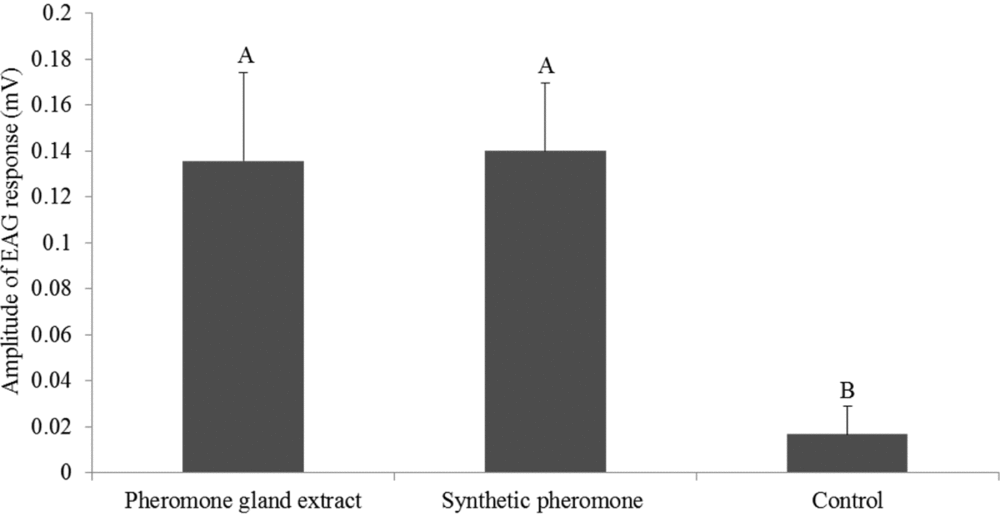
GC–EAD analysis of pheromone gland extract using male antennae showed antennal response to a single component present in a minute quantity at around 14 min, and also the antenna responded to the synthetic compound (Fig. 1). The results indicate that the male moth response to the female gland extract and synthetic pheromone is significantly higher than the control (F = 61.052; df = 2.17; P <0.001) (Fig. 2). No significant variation was recorded in the response between female gland extract and synthetic pheromone, but the response to the synthetic pheromone was higher compared to the response to the gland extract.
Gas chromatography coupled electroantennographic detection (GC–EAD) chromatogram of synthetic pheromone (a) and pheromone gland extracted (b) tested using virgin female of Opisina arenosella.

Gas chromatography coupled electroantennographic detection (GC–EAD) response of male Opisina arenosella to the female pheromone gland extract, synthetic pheromone and air (control). The same letters on the bar graph indicate the mean differences are not significant at the 5% level by LSD. Vertical lines are the ±SDs.

Gas chromatography–mass spectrometry (GC–MS)
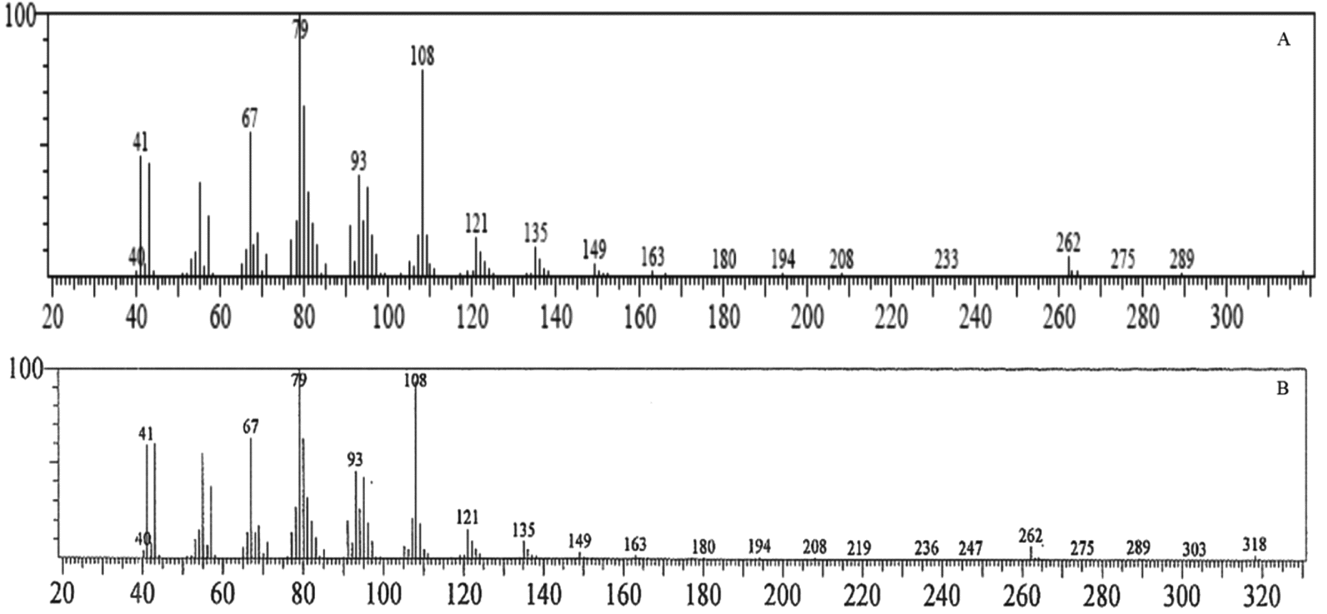
The volatile extract collected from the female pheromone glands of O. arenosella contained only one EAD-active peak at around 14 min retention time (Fig. 1). The MS and RI confirmed the structure as (Z,Z,Z)-3,6,9-tricosatriene when compared with the synthetic (Z,Z,Z)-3,6,9-tricosatriene (Fig. 3a and b). M+ ion was invisible in the natural volatile MS (Fig. 3a), due to low quantity, whereas fragments at m/z 79 and 108 support the presence of three double bonds at 3,6,9 positions with a straight chain; m/z 262 indicates [M-C4H8]+ and all other fragments were matching with that of synthetic MS, as well as (Z,Z,Z)-3,6,9-tricosatriene from the MS library of Shimadzu GC–MS QP2010S mass selective detector. The RIs of both natural and synthetic (Z,Z,Z)-3,6,9-tricosatriene were similar: 2281 in the HP-5 column.
Mass spectrometry (MS) profile for natural pheromone (A) and synthetic pheromone (Z,Z,Z)-3,6,9-tricosatriene (B).

Behavioural assays
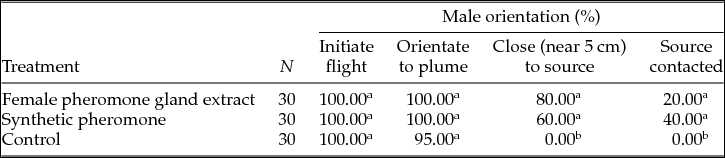
The response of O. arenosella to female pheromone odour was significantly more in synthetic and gland extract compared to the control (F = 81.00; df = 2.28; P <0.001). The male moths initiated upwind flight immediately after the exposure to pheromone (range of 2.5–10.0 min) compared to control (range of 8.5–20.0 min). The percentage of male moths that oriented towards plume was 100% to the synthetic and gland extract (Table 1), but up to 95% to the control treatment. Male moths reached approximately 5 cm near to the point source where the female pheromone gland extract and synthetic pheromone were dispensed and none of the moths reached near the source in the case of control treatment. Similarly, the highest percentage of male moths reached the point source when exposed to synthetic pheromone and gland extract compared to control (F = 18.04; df = 2.28; P < 0.001). No significant differences were observed in male moths landing onto the source between pheromone gland extract and synthetic sex pheromone.
Opisina arenosella male moth response to female gland extract, synthetic pheromone and control (air) sources in wind tunnel assays

Mean values with the same superscript (a or b) within a column are not significantly different at a 5% level of significance.
Cage studies
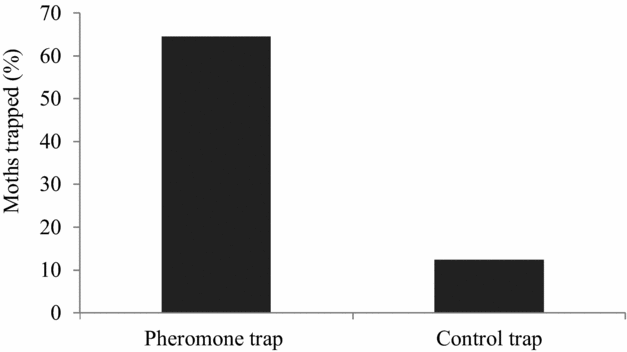
Significantly more male moths were trapped in the pheromone trap compared to control trap (t = 5.46, df = 27, P <0.01) (Fig. 4). Male moths (23.14%) released into the cage were not attracted to either the pheromone-baited trap or to the control trap, but their percentage was significantly less compared to moths trapped in the pheromone-baited trap. The results of cage studies confirmed that the pheromone traps proved to be more attractive than traps without pheromone lure.
Percentage moths trapped in pheromone baited and unbaited (control) traps in the cage experiment.

Evaluation of trap with and without lure
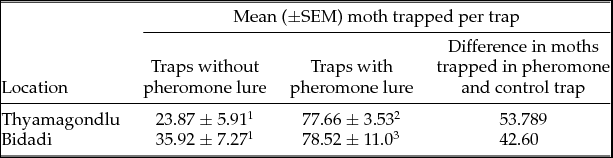
Moth catches in the pheromone traps were significantly more compared to traps without lure at both experimental sites (Bidadi, t value = 6.48; df = 13; P <0.001; Thyamagondlu, t value = 4.86; df = 12; P <0.001). The mean (±SD) number of moths per trap baited with sex pheromone lure was 77.66 ± 3.53 and 78.52 ± 11.0 in Thyamagondlu and Bidadi, respectively (Table 2).
Opisina arenosella moths trapped in the pheromone trap with and without lure

1N = 15 traps; 2N = 150 traps; 3N = 60 traps.
Efficiency of pheromone in attracting males and females
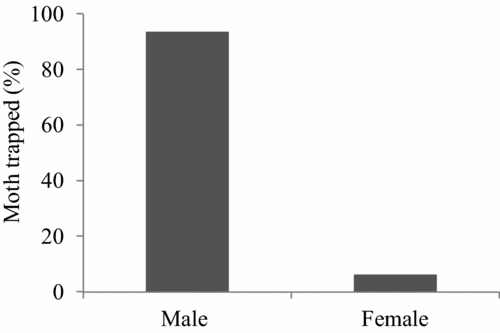
A total of 3694 moths were trapped in 60 traps with an average of 61.57 moths per trap. Out of 3694 moths caught in the pheromone-baited traps, 93.20% were male (3459) and 6.79% were female (235) (t = 11.03, df = 58, P <0.001) (Fig. 5). The results indicate that pheromone traps are more effective in trapping the male moths than the female moths.
Percentage male and female moths trapped in the synthetic female sex pheromone baited traps.

Discussion
The GC–MS analysis of pheromone glands extract showed the presence of long chain trienyl hydrocarbon compound (Z,Z,Z)-3,6,9-tricosatriene as a female sex pheromone of O. arenosella. Technically, this compound belongs to Type II pheromone compound group (C17–C23 (6Z,9Z)-6,9-dienes and (3Z,6Z,9Z)-3,6,9-trienes). These types of long chain hydrocarbons have been identified in lepidopteran families, such as Tischeriidae, Noctuidae, Arctiidae, Crambidae, Geometridae and Lymantriidae (Ando et al., Reference Ando, Inomata and Yamamoto2004; Yamakawa et al., Reference Yamakawa, Takubo, Ohbayashi, Naka and Ando2012; El-sayed, Reference El-Sayed2014). The pheromone communication system in O. arenosella was established by the studies conducted in Sri Lanka (Mumford et al., Reference Mumford, Hall, Perera and Kanagaratnam1986) and India (Murthy et al., Reference Murthy, Gour, Reddy, Babu and Zaheruddcen1995), but attempts at identifying the sex pheromone of O. arenosella were unsuccessful, due to a lack of considerable difference in the male moths caught in virgin female-baited and unbaited traps, as well as synthetic pheromone-baited and unbaited traps (Cork and Hall, Reference Cork and Hall1998). The current study confirms the presence of the single pheromone component in the female pheromone gland extracts as a major sex pheromone component in O. arenosella. Single volatile compounds are rarely unique (Ambrogi et al., Reference Ambrogi, Fonseca, Coracini and Zarbin2009) and only blends of volatiles encode specificity (Linn et al., Reference Linn, Campbell and Roelofs1986; Witzgall et al., Reference Witzgall, Chambon, Bengtsson, Unelius, Appelgren, Makranczy, Muraleedharan, Reed, Hellrigl, Buser, Hallberg, Bergström, Tóth, Lofsted and Lofqvist1996; Arn et al., Reference Arn, Toth and Priesner2000). The presence of a single active compound, i.e. tetradecanyl acetate (14Ac) and (Z)-7-tetradecen-1-yl acetate (Z7-14Ac), was also identified in Cheimophila salicella (Oecophoridae) (Gillespie et al., Reference Gillespie, King, Salasreyes and Slessor1984) and Izatha peroneanella (Walker) (Oecophoridae sensu lato) (Twidle et al., Reference Twidle, Clare, Stanbury and El-Sayed2014), respectively. The single compound detected in O. arenosella is probably the main pheromone component. In the female gland extract, additional peaks were also recorded along with the Z3Z6Z9-23Hy peak. This may be due to the presence of minor pheromone compounds or other chemical compounds found not only in the tissue of the pheromone glands, but also from other parts of the body (e.g. body waxes) (Xiao and Honda, Reference Xiao and Honda2010). Further studies are required for structural identification to verify the existence of possible minor pheromone components.
The superfamily Gelechioidea comprising 16 families (Heikkila et al., Reference Heikkila, Mutanen, Kekkonen and Kaila2014), including Oecophoridae, have Type I pheromone (Ando et al., Reference Ando, Inomata and Yamamoto2004). The putative compound in O. arenosella was synthesized from linolenic acid (Sumathi, Reference Sumathi2000; Cabrera et al., Reference Cabrera, Eiras, Gries, Gries, Urdaneta, Miras, Badji and Jaffe2001). Similarly, in Phthorimaea operculella (Zeller) and Tuta absoluta (Meyrick), belonging to the family Gelechiidae, the pheromone is biosynthesized from linoleate and linolenoate (Roelofs and Bjostad, Reference Roelofs and Bjostad1984). The putative compound in O. arenosella was identified as Type I. However, biosynthesis from linoleate and linolenoate would be a characteristic of Type II, and these structures are uncommon, and whether they should be characterized as Type I or Type II or a mixture can be made by detailed studies of their biosynthesis pathways (Allison and Cardé, Reference Allison and Cardé2016). Similarly, in the family Gelechiidae and Batrachedridae, the sister family group of Oecophoridae, the pheromone compounds were identified as Type I group. However, the pheromone biosynthesis pattern relates with the characteristics of Type II (Lofstedt et al., Reference Lofstedt, Wahlberg, Millar, Allison and Cardé2016). The differences in structural features of the pheromone compounds were also reported among the superfamilies Yponomeutoidea, Gracillaroidea and Tineoidea, the sister group of the superfamily Gelechioidea (Ando et al., Reference Ando, Inomata and Yamamoto2004).
Experimental results of the wind tunnel, cage and field experiments revealed that the sex pheromone (synthetic and gland extract) was more effective in attracting male moths, indicating that the female pheromone cues are involved in the sexual communication of O. arenosella. Usually, male moths are trapped in the pheromone traps. However, at times, female moths are also trapped in pheromone traps in negligible numbers. This may be due to accidental catches, an effect of trap colour or the presence of male moths in and within the vicinity of the pheromone traps (Rothschild and Minks, Reference Rothschild and Minks1977; Wallis and Shaw, Reference Wallis and Shaw2008; Hoddle et al., Reference Hoddle, Millar, Hoddle, Zou, McElfresh and Lesch2011). The current study confirms that the pheromone-baited traps attract more male moths than control traps. From the foregoing observations, we inferred that the major female sex pheromone of O. arenosella is (Z,Z,Z)-3,6,9-tricosatriene.
In India, O. arenosella is managed by cutting infested fronds, root-and-stem injection of synthetic insecticides and natural enemies. Light trapping is ineffective in attracting male O. arenosella moths (Muralimohan et al., Reference Muralimohan, Sreekanth and Srinivasa2007). Currently, none of the management practices has been found effective against O. arenosella. In the current study, pheromone traps were found to be effective in attracting male moths and may serve as an alternative tool for monitoring and managing O. arenosella. Srinivasa and Muralimohan (Reference Srinivasa and Muralimohan2009) discussed the behaviour and life cycle of O. arenosella concerning the utility in integrating sex pheromone traps for monitoring and management of this pest. Further information on the standardizing of trapping techniques, i.e. trap density, trap design and lure dosages, is required for implementing pheromone traps for the management of O. arenosella.
Acknowledgements
The authors are grateful to the Coconut Development Board, India for partial funding for this project.