Introduction
The research literature indicates that earlier-life exposure to extreme and prolonged trauma can impact the ways in which individuals respond to, and cope with, the numerous and often cumulative challenges that arise during the final decades of life. Little is known, however, about older trauma survivors’ experiences of using community care services. Genocide is undoubtedly the most extreme form of mass trauma. The Jewish Holocaust survivor population is the oldest and largest group of genocide survivors currently living in Australia. A study of their aged care experiences may have implications for the care of other groups of older survivors of war-related trauma.
The Holocaust refers to the persecution and mass killing of six million Jews by the Nazi regime during the Second World War. Nazi policy was to erase the Jewish people systematically and thoroughly. Regardless of their specific wartime experiences, all Holocaust survivors were exposed to one or more of the following ordeals: recurrent episodes of terror; prolonged mental and physical abuse, degradation and hunger; exposure to unbearable weather, lethal labour and repeated losses; and the constant threat of murder (Rosenbloom, Reference Rosenbloom1985; Safford, Reference Safford1995). Children were orphaned, entire families were lost and whole Jewish communities vanished. Survivors’ lives and personalities were altered forever and trust in others was irreparably damaged.
The majority of Jews who managed to stay alive in Nazi-occupied countries during the Holocaust were young adults between the ages of 18 and 35 years at the end of the Second World War. Approximately 35,000 Jewish Holocaust survivors resettled in Australia in the post-war years and they have grown old in Australia. Australia has the highest number of Holocaust survivors per capita outside Israel (Rutland, Reference Rutland2005). However, most Holocaust survivors who were living in former Soviet Union countries at the end of the Second World War, and are living in Australia today, migrated after the 1990s.
Literature on ageing Holocaust survivors
The literature indicates that extreme and prolonged traumatisation can have a profound and sustained impact on the ways in which individuals respond to, and cope with, the numerous and often cumulative challenges that arise during their final decades of life (Shmotkin et al., Reference Shmotkin, Blumstein and Modan2003; Hinton et al., Reference Hinton, Pich, Chhean and Pollack2005). Extensive quantitative research with non-clinical, community samples has found worse physical, functional and psychological wellbeing among ageing Holocaust survivors than among their peers (Barel et al., Reference Barel, Van Ilzendoorn, Sagi-Schwartz and Bakermans-Kranenbur2010). Ageing Holocaust survivors in Israel report higher rates of chronic health conditions, sleep disorders and feelings of loneliness, and require a higher intensity of home care than other older Israelis (Brodsky et al., Reference Brodsky, Sharon, King, Be'er and Shnoor2010). Research in Australia has found that, while older community-dwelling Holocaust survivors do not differ significantly in their social and daily functioning from two control groups of older Jewish people who were not in Europe during the war, the survivors function worse on a range of psychological measures than the comparison groups (Joffe et al., Reference Joffe, Brodaty, Luscombe and Ehrlich2003). Glicksman (Reference Glicksman2017) reported similar results in a comparative study of Holocaust survivors and older American-born Jewish people in community and residential care settings.
Another branch of the Holocaust literature suggests that the way Holocaust survivors have put their lives back together, established families, developed careers and achieved emotional stability indicates their ‘outstanding resilience in domains of daily functioning’ (Shmotkin et al., Reference Shmotkin, Shrira, Goldberg and Palgi2011: 8). Recent qualitative studies reflect the view that too much emphasis has been placed on the negative psychological effects of Holocaust trauma and not enough on health-promoting factors, such as growth, adaptability and resourcefulness. Studies of the life trajectories of ageing Holocaust survivors have identified indicators of resilience characterised by growth, adaptability, resourcefulness and pragmatism (Pirner, Reference Pirner2006; Hirst et al., Reference Hirst, LeNavenec and Aldiabat2011).
Holocaust survivors and aged care
The extant literature on Holocaust survivors’ experiences of aged care typically focuses on the potential for survivors to experience hospital and residential aged care settings as profoundly disturbing, due to the possibility that these settings may induce feelings of helplessness and reactivate traumatic memories (David and Pelly, Reference David and Pelly2003). This literature is based predominantly on case studies, anecdotal evidence and clinical observations made by medical, social work and nursing professionals. It reports that certain aspects of medical and institutional care environments (e.g. staff uniforms), normal day-to-day activities (e.g. showering) or personal traits of particular staff (e.g. foreign accents) may trigger conscious or unconscious memories of trauma experienced during the Holocaust. In turn, these memories may stimulate adverse emotional and behavioural reactions that present challenges for aged care staff (David and Pelly, Reference David and Pelly2003; Carlson et al., Reference Carlson, Lauderdale, Hawkins and Sheikh2008; Anderson et al., Reference Anderson, Fields and Dobb2011). This phenomenon may be exacerbated for survivors with dementia, as they may experience the intrusion of terrifying and painful memories of earlier trauma upon their current reality (David and Pelly, Reference David and Pelly2003). Adverse emotional reactions and behaviours among ageing Holocaust survivors in institutional settings noted in the literature by care professionals include anxiety, depression, fear, distrust, anger, non-cooperation, aggression, screaming and hoarding (Hirschfeld, Reference Hirschfeld1977; Zilberfein and Eskin, Reference Zilberfein and Eskin1992; Adams et al., Reference Adams, Mann, Prigal, Fein and Souders1994; Joffe et al., Reference Joffe, Joffe and Brodaty1996; Levine, Reference Levine2001; Ehrlich, Reference Ehrlich2004; Sindler et al., Reference Sindler, Wellman and Stier2004).
A few empirical studies from several countries have shown evidence of these effects. In a Canadian study, Shour (Reference Shour1990) found that nursing home staff describe Holocaust survivor residents as more aggressive than other residents. Nurses in Israel find caring for survivors in community and institutional care settings especially difficult because it takes an enormous amount of patience, time, understanding and attentiveness (Leonhard, Reference Leonhard2003). The literature suggests that adverse reactions to care among older survivors often arise from aged care workers’ lack of knowledge, training, skills or confidence to deal with the effects of remote extreme trauma (Hirschfeld, Reference Hirschfeld1977; Carlson et al., Reference Carlson, Lauderdale, Hawkins and Sheikh2008; Teshuva et al., Reference Teshuva, Borowski and Wells2016). However, Carstairs (Reference Carstairs2004) warned against automatically assuming that the behaviours of Holocaust survivors result directly from their past traumatic experiences. She argued that because the stereotype of older Holocaust survivors is one that emphasises their vulnerability, there is a danger that symptoms of dementia or other conditions will be hidden by marking them with the label of post-traumatic stress.
Although gerontologists are increasingly turning to narrative approaches in attempts to understand ageing from the inside (Kenyon et al., Reference Kenyon, Clark and De Vries2001), insights into Holocaust survivors’ perspectives about the experiences of receiving formal care in community and residential aged care settings have been absent from the literature. This omission calls for a qualitative research approach. In response, a phenomenological study that aimed to describe Holocaust survivors’ lived experience of using formal aged care services was conducted in Melbourne, Australia. This paper presents data from that study which addresses the research question: How do Holocaust survivors describe the experience of receiving care in aged care settings? The intent of this research was to give a voice to older community-dwelling Holocaust survivors as recipients of aged care services.
In a separate sub-study, qualitative data were collected from 70 direct care staff about their experiences of providing care for Holocaust survivors. These staff emphasised the complexity of, and stresses associated with, working with this client group, and recognised the need for high levels of empathy for their clients (Teshuva et al., Reference Teshuva, Borowski and Wells2016). They described using trauma-sensitive strategies as required, adopting self-care strategies and requiring support when stressful situations arose.
Study conceptual framework
This study was guided by the social constructivist perspective of qualitative research advocated by Charmaz (Reference Charmaz2006), which emphasises diversity of local worlds, multiple realities, and the complexities of particular worlds, views and actions. The researchers are academics in the fields of gerontology, psychology and social work. The first author's German-Jewish parents escaped Nazi Germany with their parents (the first author's grandparents) and arrived in Australia as child refugees shortly before the outbreak of the Second World War. Adopting the axiological assumption of social constructivism, the first author was conscious that she interpreted the data through the lens of her family and cultural history. She used the technique of ‘reflexivity’ (Krefting, Reference Krefting1991: 218) to reflect upon her assumptions and presumptions about the phenomenon during the interpretation and writing phases of the research.
Because the authors were interested in interpreting what the findings implied about aged care practice and theory, they adopted van Manen's (Reference van Manen1990) interpretive phenomenological approach, which involves gathering data and writing a description of the lived experience of the phenomenon under inquiry.
Our review of the theoretical literature revealed that no conceptual framework existed for understanding Holocaust survivors’ experiences of receiving aged care services or their care relationships with aged care workers. This study adopted the theoretical position that the lived experience of aged care for Holocaust survivors is conceptually located at the intersection of three theoretical perspectives: the ageing and lifecourse (ALC), person-centred care (PCC), and trauma and ageing perspectives. These three perspectives have not previously been explicitly used together as the theoretical basis for research on ageing Holocaust survivors.
The ALC perspective seeks to account for outcomes later in the lifecourse based on earlier life experience (Dannefer, Reference Dannefer, Binstock and George2011). It provides the conceptual grounding for dealing with the notion that life trajectories and transitions of individual Holocaust survivors are inextricably intertwined with their previous traumatic experiences (Suedfeld et al., Reference Suedfeld, Soriano, McMurtry, Paterson, Weizbeck and Krell2005).
PCC is the dominant model for provision of health and aged care. Edvardsson et al. (Reference Edvardsson, Winblad and Sandman2008) summarised PCC as comprising the following characteristics: predictability, continuity of support, genuine interest in the welfare of the person, maximising the person's control, setting attainable goals, validating emotions, working with due regard for the person's cultural reality and tailoring specific interventions to the nature of the problem.
Various theoretical perspectives on trauma and ageing are present in the literature. The vulnerability perspective suggests that health issues and social losses typically associated with ageing may reawaken memories of trauma (Kahana et al., Reference Kahana, Kahana, Harel, Kelly, Monaghan, Holland and Gottlieb1997). The resilience perspective suggests that coping skills that facilitated early survival become resources in meeting late-life stressors (Kahana et al., Reference Kahana, Kahana, Harel, Kelly, Monaghan, Holland and Gottlieb1997). We interpreted study findings through the lens of Shmotkin's (Reference Shmotkin, Jacoby and Keinan2003) model of general resilience (which has enabled ageing Holocaust survivors to lead basically normal lives) alongside specific vulnerabilities (which typically lie in distinct psycho-social domains).
A broader framework that locates ageing within a lifecourse perspective that places due weight on the social and historical context is also likely to be useful in considering the impacts of early trauma on later-life experiences. Elder et al. (Reference Elder, Kirkpatrick Johnson, Crosnoe, Mortimer and Shanahan2003) identified five general principles to guide research within the lifecourse paradigm. The first, the Principle of Lifespan Development, is the overarching assertion that human development and ageing are lifelong processes. The second, the Principle of Agency, claims that individuals are not passively acted upon, but construct their own lifecourse through changes and actions they take within the opportunities and constraints that apply. The Principle of Time and Place asserts that individuals’ life trajectories are embedded and shaped by the historical times and places they experience over their lifetime. The Principle of Timing recognises that the same events or experiences may affect individuals in different ways, depending on when they occur in the lifecourse. The final principle, the Principle of Linked lives, is that people's lives are interdependent and that larger social and historical events influence individuals through their networks of shared relationships.
Study design
Purposive sampling was used to recruit 13 Holocaust survivors for in-depth interviews. The inclusion criteria were: being a Jewish Holocaust survivor; being sufficiently cognitively intact to participate in the interview; currently using aged care community services; and being willing to meet with the researcher. Gaining access to the field and recruiting older Holocaust survivors was a lengthy process. Reluctance to be interviewed is perhaps to be expected from this client group. The main strategy for gaining access to Holocaust survivors was the ‘gatekeeper’ approach. Service managers from Melbourne's largest Jewish aged care services agency, acting as gatekeepers, assisted in identifying potential participants from among their clients and judging whether they met the inclusion criteria. Those judged to be eligible were asked whether they would consent to being contacted by the main researcher. This sampling approach resulted in the recruitment of 11 participants who were community service users. Two additional people were included using a strategy known as ‘snowball sampling’, which involves recruiting people who are referred by others in their own network (Liamputtong, Reference Liamputtong2013).
Data ‘saturation’, a concept associated with grounded theory, was used to inform the number of in-depth interviews undertaken (Glaser and Strauss, Reference Glaser and Strauss1967). In-depth interviews were chosen as the most suitable data-gathering method for Holocaust survivors. The interviews, which were run in a conversational style using traditional in-depth interviewing techniques, were conducted in the participants’ homes. Interviews with five participants who migrated from former Soviet Union countries were conducted through a certified Russian interpreter. Based on findings from a series of community consultations held with counsellors, social workers and service managers conducted in the first stage of the project, a set of open-ended questions was developed. The questions elicited participants’ stories about: their positive and negative experiences of using aged care services; their views on what aged care workers should know about working with older survivors of trauma; and whether their early life experiences (of trauma) have influenced their experiences of receiving aged care services. Specific prompts included: ‘Thinking about the different care workers that have come to your house to help you, was there anything that you particularly liked about the way they provided care? Was there anything that bothered you about the way they provided care?’ Where possible, some information was gathered about study participants’ lives before, during and after the Second World War. This information allowed the researchers to examine participants’ aged care experiences in the context of their life stories.
In accord with practice in many phenomenological studies, data were examined using thematic analysis according to guidelines set out by Braun and Clarke (Reference Braun and Clarke2006). All audio recordings were transcribed verbatim and listened to in their entirety. Gaps in the transcripts were filled, and errors were corrected. Meaningful statements that reflected the phenomenon being explored were extracted from each transcript. Similar statements were clustered into themes and sub-themes. All themes were linked to specific participant quotations to provide context. The final stage involved the process of interpreting the data, examining how emerging themes might make parts of an overall story and, consistent with van Manen's (Reference van Manen1990) interpretive phenomenological approach, writing our interpretation of how effective community care may be described from the perspective of clients who are Holocaust survivors.
Two strategies were used to ensure credibility of the findings (Creswell, Reference Creswell2007). First was methodological triangulation: the process of using multiple sources of data to expand on and verify identified themes (Padgett, Reference Padgett2012). Other sources of data used for triangulation were in-depth individual interviews with six care professionals with expertise in working with Holocaust survivors, and with the adult children or grandchildren of six Holocaust survivors who were receiving aged care services at the time of the study. The second strategy, peer debriefing, involved an additional two colleagues examining the data and questioning the links between the data and the emerging themes that had been derived. This process assisted the authors to clarify their interpretation of the data. The study had approval from La Trobe University Human Ethics Committee.
The participants
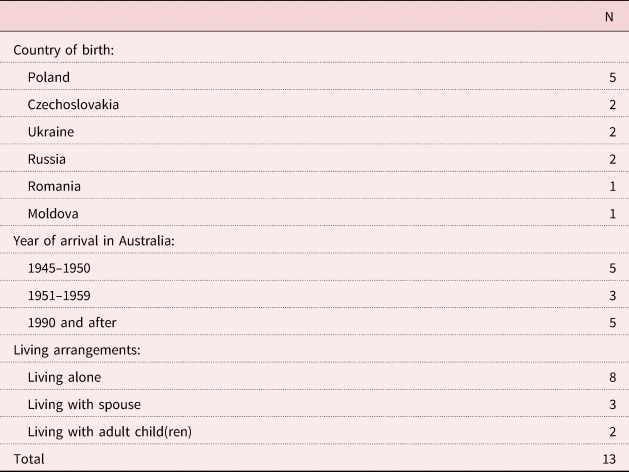
The 13 study participants (11 women and two men) were aged 80 years and over at the time of the interviews. They were born in various Eastern Europe and former Soviet Union countries (see Table 1). They came from diverse socio-economic and religious backgrounds. Some grew up in large urban cities and others came from small towns. Six participants were concentration camp survivors. Most were interned in several camps for various periods of time between 1941 and 1945. Two were children when they were separated from their parents in a ghetto and transported to the camps. Five had married other concentration camp survivors after the war.
Characteristics of Holocaust survivor participants

Seven participants who did not go through the camps experienced a range of wartime ordeals. Five participants were young children or teenagers who survived by hiding during the war, experiencing great hardship, deprivation and cruelty. Two participants served in the Russian army during the war. Study participants’ ages at the end of the war ranged from late teens to early twenties. Eight participants arrived in Australia in the post-war years between 1945 and 1959, and five migrated from former Soviet Union countries (Russia, Ukraine and Uzbekistan) after 1990. Participants who spent the post-war years in the former Soviet Union continued to experience discrimination in all aspects of life due to state-sponsored anti-Semitism until their eventual migration to Australia.
At the time of the interviews, most participants were receiving practical and emotional support from their children and grandchildren. In addition, all had experienced a gradual and reluctant increase in the use of home-based support services including domestic assistance, transport, personal care and home-delivered meal services. Six participants were also using social support services (social activities in a community-based group setting).
The emerging themes
Four major themes emerged from the data analysis. Theme 1 highlighted the pragmatic view that aged care workers, hereafter referred to as carers, should do their job well. Theme 2 identified the notion of carers supporting the client to maintain their autonomy. Theme 3 dealt with the centrality of good relationships with carers, and Theme 4 uncovered the desire to be treated as an individual.
Theme 1: I want carers to do their job well
Theme 1 represented the pragmatic view that carers should provide a good service and do their job well. This meant different things to different people. It involved carers coming on time, and being thorough, flexible and knowledgeable about care-related matters. Continuity of care (having the same person for every service) was important to many participants. Lack of continuity meant having to establish new relationships and re-explain care tasks to each new carer. Mrs W wanted carers to have a ‘customer is always right’ attitude and considered too much talking a waste of valuable work time. Some expressed dissatisfaction with the quality of cleaning. For example, Mrs C said: ‘The best cleaner does not do [clean] like you do yourself. They try, so I say [it's] better than nothing.’
Another aspect of doing the job well was the carers’ willingness to be flexible. Many participants valued carers who were willing to do extra tasks around the house. Mrs J, for example, wanted her carers to dust her collection of ornaments and said, ‘If you are lucky, you get someone who you can tell her, “wash this or do this”’. Another participant expressed frustration with a particular carer who, ‘whatever I wanted her to do, she said, “I can't do it”’.
Regarding carer knowledge, many participants wanted their carers to have knowledge about the cost of aged care services and to help them navigate the service system. Mrs J said she wanted to understand ‘How I will be provided for’ and ‘who is going to pay if I have no money?’ She also wanted her carer to ‘be like a nursing sister … with some medical experience’. Carers’ medical and aged care knowledge was also important to other participants. Mrs R, who had two carers providing care for both her and her husband (who had advanced dementia), wanted her carers to know more about Parkinson's disease and how it affected her physical functioning: ‘They don't know and it's so hard to explain what it is. There are many things that I cannot do, and they don't understand.’
Mrs R also lamented that some carers do not understand how to work with a person with dementia. She described the different ways her two carers spoke to her husband: ‘Especially now my husband is repeating himself. One of the carers, she understands and she can laugh with him but the other one, she is cross. She says, “I told you already, I told you so many times”’.
Theme 2: I want to be supported to maintain my autonomy
Most study participants described the loss of independence and taking up aged care and support services as an extremely difficult life transition. Mrs S explained: ‘We are very independent-minded people. We lived a very hard life and we are used to relying on ourselves. So, this moment when I had to rely on someone else, an agency, it was a bit difficult.’
Participants were grateful to have home care services that helped them manage the jobs that they could not undertake due to their physical limitations. However, in general, they were averse to carers taking away their autonomy. For example, Mrs W, who had arthritis in her shoulders, said she was happy someone came to vacuum the carpet, cart the washing to the line and hang it up. In the same breath, however, she spoke with fervour about being self-reliant and doing as much as possible on her own. She claimed: ‘This is my Tatts lotto [a lottery game] that I can manage. It's better than money.’ She had adapted the way she did her daily tasks in order to maintain as much control over her life as possible and often gave small gifts to her carers to encourage them to do a good job.
Participants said that some carers did things for them that in their view were not necessary. They wanted carers to ‘let them’ do the things they could do. For example, Mrs L described her carer as ‘over-protective’ and ‘like a mum’. She explained that when they went out: ‘She [the carer] wants to put my legs into the car and I keep saying to her “please [name of the carer], I can do it myself. What I can do myself, let me”.’ Mrs B (a Polish concentration camp survivor) said: ‘Somebody can come, I don't mind it, but what I can do myself, I have to do myself.’
Mrs R, who was extremely incapacitated by Parkinson's disease, was apprehensive about carers taking away her independence. Her daughter, who was present at her interview, commented: ‘You talked about carers who don't treat you as an independent person. You still want to do things on your own. Not to take it away from you or to treat you like a baby.’ Mrs R replied to her daughter: ‘Yes, that is the tendency, including you.’ She explained that her carers tended to take over when she struggled with particular tasks and to make decisions on her behalf. Some decisions, such as drinking from a straw instead of a glass, she was able to accept, but she insisted that she did not want help in the toilet even though she had use of only one hand: ‘It is very hard, but I think I'd rather cope with my one hand.’
Mrs C, who had been a child in the concentration camp and asserted that she had survived thanks to the protection of an older girl in her barracks, was an exception. Her attitude about the way home care was provided differed from that of most study participants. She expressed the acceptance that: ‘Whatever happens, happens.’
Theme 3: It's important to have a good connection with the carer
While Theme 1 described participants’ experiences of being cared for, Theme 3 focused on their experiences of being cared about by their carers. Participants described their connections with carers on a continuum ranging from high levels of emotional closeness at one end of the continuum to extreme ambivalence and insensitivity at the opposite end. In general, participants highly valued having close and caring relationships with their carers. Close emotional relationships were described in terms of having a special bond with the carer, mutual caring, friendship and the carer being like a family member. For example, Mrs K explained that she went to medical school with her carer's aunt and that he was ‘like a second son’. He was willing to do anything she asked him to do, including learning to sterilise his hands and apply bandages to her wound. Similarly, Mr S said: ‘The person who comes to our home … he's like our son. He's a very good person. He's like one of our own. He's a Russian Jew … We like him very much.’ Mrs T said, ‘I'm protective of her [the carer] as much as she's protective of me and we have that kind of beautiful warm relationship.’ Mrs A described a sense of wellbeing and calm that she experienced when there was a special relationship with a carer:
I'm much more appreciative of a carer who comes and sits down and has a cup of tea with me and says, ‘How are you?’ and gives me a hug and gives me a kiss much more than when she will clean my house.
Those who participated in planned group activities for Holocaust survivors asserted that close and intellectually stimulating friendships with activities staff contributed to their quality of life. Mrs A described the Holocaust survivors’ activity group as ‘like our second family’. She said:
It is as if we come to our second home … The staff there are just great. We are all very happy with them … We have the meals, but the main thing is we have exercises there … We play games and we say to each other, ‘Now we're going to kindergarten’. That's our joke (laugh) … Then we have those intellectual, challenging things that we do to keep our minds going … Generally, we enjoy spending time there.
Mrs S quoted from a Russian poem called ‘The Autumn of Life’ to demonstrate how she felt about old age: ‘Thousands of pains and memories that come flooding back … Some hair going grey and the rain falling and all those questions that remain unanswered.’ She considered the staff at the Russian Holocaust survivors group to be friends and explained how they helped to cheer her up: ‘They say to us, well don't close down, don't shut out, just go out, go to the world, look at things, try to be interested in things.’
Participants said they could ‘feel’ the difference between carers who really cared about them and those who just carried out their tasks. Mr and Mrs S said the most important aspect of receiving home support services was the relationship with the person and that they would not be happy with a carer who ‘would just work and wouldn't pay any attention to us’. In contrast, Mrs C described a carer who came to her house to provide a cleaning service and spent the entire time talking on the phone to her boyfriend: ‘If she would see me falling down, she wouldn't come to pick me up … But I'm not saying anything about this because it's her problem, not mine.’
Examples of distressing encounters with carers also emerged from the data. The most distressing types of encounters for Holocaust survivors were those that resonated with past traumatic experiences. Mrs W angrily related the experience of a friend (also a Holocaust survivor) who was living in a residential aged care facility. Her friend, who had approached the duty nurse late in the afternoon and asked for something to eat, was told she must wait until dinnertime. The participant firmly believed that the nurse should have understood that a person who experienced starvation during the war should not be forced to wait for food.
Mrs L, an Auschwitz survivor, had experienced a series of very disturbing encounters with hospital staff during a short-term hospital admission. Her experiences highlight the importance of trauma-awareness and of carers paying attention to details that matter to a trauma survivor. She explained that during her hospital stay most of the nurses lacked understanding about her fear of needles, which emanated, she said, from her ‘memories of the tattoos’. She explained: ‘There was only one nurse who knew how to approach me and tell me, “Don't worry, it won't hurt.” Just a simple sentence like that, like you talk to a child.’ She also gave an account of a nurse who told her to get out of the shower and then did not come back with a towel for 15 minutes. Having lived through the camps strongly exacerbated the impact of experiencing this indignity:
I was sitting for about 15 minutes naked and shivering, waiting to get dry. No help and no understanding. So, this was the worst experience I had in the hospital which reminded me of the camp, and I told her [the nurse] that something like that I experienced only in Auschwitz.
Mrs L also said that the male nurses in the hospital developed a dislike for her because every time she went to the bathroom she asked for a female nurse to attend to her. Male staff found this hard to accept, and one of them told her, ‘A nurse is a nurse. It shouldn't make any difference.’ She elaborated:
And they keep telling me, ‘You hate men, do you?’ And I tried to explain to them that I didn't hate men but that I need some privacy and, again, I didn't explain this to them, that in the camp we were treated like dogs. There were containers in the open for the toilet. They were in the open and on the other side of the barbed wire were men. And this was terrible. It wasn't a matter of hate. I didn't mind men for anything else but not in the toilet.
Theme 4: I want to be understood as an individual
Questions were posed to ascertain whether participants considered it important for carers to know about the Holocaust and specifically about their personal history. Some participants thought it could be helpful for their carers to know about the Holocaust. Mrs R, for example, said it was important for her live-in carers to understand her background and to be ‘patient’ because she often woke up at night scared after having nightmares. As indicated in Theme 3, a few participants wanted carers to pay attention to specific and individualised trauma-related details that impacted the delivery of their care.
In general, however, participants wanted to be understood as individuals and did not want to be perceived as members of a vulnerable group of older people. Mr M, for example, considered it important for clients and carers to get to know each other as individuals and for carers to know that ‘everybody is different’. Most participants claimed they saw little point in telling the carer about their Holocaust history and that they saw little connection between carers’ knowledge about the Holocaust and the quality of care they received. In fact, most participants usually did not tell their carers they were Holocaust survivors. Mrs C said that when she got to know her carers ‘a little bit’ they usually found out that she was a Holocaust survivor but, for their sake, she did not want to tell them much about it: ‘I'm not telling them more than just sparingly, only in a few words. I don't want to tell them because it can be very traumatic, I think, for people to listen to it.’
Despite not wanting to be treated as members of a homogeneous group, the researchers found that most conversations with the study participants about aged care were interlaced with recollections about the war years. For example, Mrs J, a concentration camp survivor who spoke of wanting a carer with some medical experience (as noted in Theme 1), described working in a makeshift hospital after the war assisting with operations, even though she had no medical training. She talked about that experience with great pride: ‘I was strong … I could hold a leg during an amputation … I became like a [nursing] sister.’ Similarly, another respondent, Mrs N, despite telling the interviewer that she never talks to carers about the Holocaust and that ‘It [carers knowing about the Holocaust] doesn't matter’, recalled an eyewitness account of her younger brother and other inmates being taken away by the Russians when they arrived in Auschwitz on 27 January 1945. She said, ‘They went somewhere, I don't know where, and on the way, he [my brother] got typhus and two or three days before the war ended he died.’
In explaining why being able to laugh with a carer was important, Mrs C recounted how the girls in her concentration camp barrack would sing and laugh to try to forget their suffering: ‘We used to laugh in the camp. We had to laugh. You couldn't have survived any other way.’ Mrs T, who was housebound and lived alone, felt that a gentle and understanding carer who demonstrated real caring could help soothe a survivor's emotional pain. In her view:
A survivor is only the one who stayed alive, the rest [the trauma] is with them. They were all damaged and, if the carer is gentle enough and understanding, that is a great help. I can see the difference, not just coming and cleaning that's not enough. It's cleaning my pain and my soul is more important.
Discussion
Few studies have provided insights into what it may be like for Holocaust survivors to experience using aged care services. Previous research has focused on nurses’ and social workers’ perceptions of how ageing Holocaust survivors experience care. This paper contributes to the research literature the first detailed phenomenological account of the lived experience of using community aged care services for older Holocaust survivors. Thematic analysis revealed that Holocaust survivors describe this experience in terms of: carers doing their job well; being supported to maintain autonomy; having good relationships with carers (demonstrated through kindness, patience, warmth and respect); and being understood as an individual. These universal themes have been identified in previous research with other groups of care recipients (Piercy, Reference Piercy2000; Walsh and Shutes, Reference Walsh and Shutes2013). These themes also align with the characteristics of person-centred care and a re-ablement approach to service provision (Glendinning and Newbronner, Reference Glendinning and Newbronner2008; Lewin et al., Reference Lewin, De San Miguel, Knuiman, Allan, Boldy, Hendrie and Vandermeulen2013) – indicated by participants’ strong desire to maintain autonomy (Theme 3).
The conceptual framework developed for this study assisted the researchers in interpreting the findings. Previous research on this topic has tended to associate Holocaust survivors in aged care with trauma-related triggers. Examining the data through the filter of person-centred care revealed that a person-centred care approach is equally important to Holocaust survivors as it is for all aged care clients. However, the data also highlighted that the negative impacts of not being treated in ways consistent with person-centred principles are exacerbated for trauma survivors.
Participants reported instances of when non-person-centred care encounters had caused them extreme distress due to resonance between these experiences and earlier life traumatic events. This is consistent with previous research conducted with aged care and nursing staff caring for Holocaust survivors (Hirschfeld, Reference Hirschfeld1977; Adams et al., Reference Adams, Mann, Prigal, Fein and Souders1994; David and Pelly, Reference David and Pelly2003; Ehrlich, Reference Ehrlich2004; Carlson et al., Reference Carlson, Lauderdale, Hawkins and Sheikh2008; Teshuva et al., Reference Teshuva, Borowski and Wells2016).
The ALC and trauma and ageing perspectives helped us further to develop a more nuanced understanding of how Holocaust survivors’ experiences of aged care might differ from those of aged care clients who are not trauma survivors.
Two of the Principles of are relevant to our findings. Firstly, we considered their ALC Principle of Agency, which states that ‘individuals construct their own life course through the choices and actions they take within the opportunities and constraints of history and social circumstance’ (Elder et al., Reference Elder, Kirkpatrick Johnson, Crosnoe, Mortimer and Shanahan2003: 51). Against a history of total powerlessness and deprivation that Holocaust survivors endured during the Second World War, the Principle of Agency explains to some extent the intense need of study participants for carers both to provide high-quality care (Theme 1) and assist them to maintain their autonomy (Theme 3).
A further ALC theme that relates to the findings is that of the Principle of Time and Place. This principle asserts the importance of cohort effects. Our participants recognised that their lives had been irreparably damaged by historical events – time and place had altered their entire lifecourse. In old age, while they wished to have their Holocaust experiences acknowledged and taken into consideration in the delivery of their care, they did not want to be defined by these experiences (Theme 4).
The principle of timing may also be relevant to the study participants. It is possible that the way Holocaust survivors experience using aged care services varies in particular ways depending on their age at the end of the Second World War. A further study, comparing child and adult survivors, would be needed to explore this.
Lastly, Shmotkin's (Reference Shmotkin, Jacoby and Keinan2003) trauma principle helped us understand that older survivors’ narratives about their aged care experiences reflect enormous resilience, demonstrated by clearly articulated views about: how care should be provided (Theme 1), maintaining one's autonomy (Theme 2) and being treated as an individual (Theme 4); alongside specific vulnerability illustrated by expressions of ongoing emotional pain and stories of unnecessary distress and hurt caused by insensitive care-giving behaviours that resonated with past traumatic experiences (Theme 3). This concurs with findings from a Canadian study that identified the resilience of Holocaust survivors living in residential aged care homes (Pirner, Reference Pirner2006).
These findings have implications for care practice and staff training. Shedding light on the survivors’ perspective of aged care may help free aged care workers from over-generalised views about this client group or thinking narrowly about Holocaust survivors in terms of general vulnerability. Further, the study findings may steer carers away from an over-emphasis on ‘addressing behaviours triggered by past traumatic experiences’ (Anderson et al., Reference Anderson, Fields and Dobb2011: 764). The danger of focusing on triggers is that it may distract from acknowledging survivors’ resilience and, more broadly, from examining problematic care-giving practice (Teshuva et al., Reference Teshuva, Borowski and Wells2016).
Lastly, the study findings inform practice by confirming the importance of general person-centred care practice for this client group, while at the same time highlighting an important additional dimension that may need to be applied to the practice of person-centred care when working with clients who are trauma survivors: namely trauma-awareness. This dimension encompasses skills such as accepting and accommodating personal reactions to care situations that resonate with past traumatic experiences. While trauma-related knowledge and skills are familiar to care professionals who provide services for survivors of trauma in other settings, aged care workers rarely have this type of training.
The study was limited methodologically by gatekeeper bias. It is probable that aged care managers denied access to the study to some people under their care who might have been willing to take part. The effect of gatekeeper attitudes on recruitment has been previously reported (Groger et al., Reference Groger, Mayberry and Straker1999). A further limitation of the study was the issue of self-selecting samples. This may have resulted in a sampling bias that meant that the most vulnerable or distrusting survivors were not interviewed, and it most likely explains why distressing care encounters for Holocaust survivors in community settings were raised more commonly by paid and family carers in interviews conducted for the purpose of triangulation of the data than by survivors themselves.
In this qualitative study we were not able to explore whether different personal trauma history (e.g. whether interned in a concentration camp) and personal characteristics (e.g. whether adult or child survivors) influenced the experience of using community care services in old age. As more child survivors move into the aged care service system, care providers may be dealing with a new set of challenges. Research on their experiences of aged care services has yet to be done. The study findings suggest that there is room for future quantitative studies that explore within-cohort differences and that fill the gap in the literature on older trauma survivors’ perspectives on the experience of living in a residential care home.
Given the worldwide trend of population ageing and the persistence of torture and trauma in conflict zones around the world, aged care and support workers are likely to be caring for increasing numbers of older people who have experienced severe and prolonged trauma earlier in their lives. Australia has been a place of resettlement for successive waves of refugees since the end of the Second World War. This study of the oldest living group of genocide survivors may have broader implications for understanding the care experiences and needs of ageing survivors of war-related trauma from other cultural backgrounds and potentially for older survivors of other kinds of extreme trauma.
Acknowledgements
The authors wish to thank Jewish Care Victoria for their assistance in recruiting Holocaust survivors for this study. They would also like to express sincere gratitude to the study participants who so warmly and generously shared their time and experiences.
Financial support
This work was supported by the ANZ Wicking Trust, the Victoria Department of Health and Human Services, and Jewish Care Victoria.