Introduction
Pain is highly prevalent among trauma casualties, and if left untreated, may lead to clinical, social, and economic burden such as the development of chronic pain and posttraumatic stress disorder (PTSD). Reference Buckenmaier, Rupprecht and McKnight1–Reference Berben, Schoonhoven, Meijs, van Vugt and van Grunsven5 Proper pain relief is associated with better functional ability, recovery, and quality of sleep and is essential to reduce adverse cardiac effects such as dysrhythmia and ischemia, improve wound healing, and immune function. Reference Thomas and Shewakramani6–Reference Herrera-Escobar, Apoj and Weed8
Pain management is considered an indicator of the quality of care. Reference Morone and Weiner9–11 Many factors have been shown to influence pain treatment in trauma, including providers’ experience and training, perceptions regarding analgesia, the belief that pain is inevitable or necessary for diagnosis, concern of adverse effects, as well as patient characteristics (gender, race/ethnicity). Reference Thomas and Shewakramani6,Reference Sinatra7,Reference Heins, Heins, Grammas, Costello, Huang and Mishra12–Reference Chen, Shofer and Dean21
So far, the impact of gender in medicine has focused mainly on the patient, while little information is available regarding the influence of health care providers’ gender on clinical decision-making processes, especially in the prehospital setting. Reference Samulowitz, Gremyr, Eriksson and Hensing19–Reference Champagne-Langabeer and Hedges22 As more women practice medicine, this becomes an issue that requires further evaluation. 23,24
Current literature regarding the influence of provider gender on pain management is inconsistent, emphasizing the need for further investigation of this issue. This study aimed to investigate the effect of health care providers’ gender on pain management approaches among prehospital trauma casualties treated by the Israel Defense Forces (IDF) medical teams.
Methods
Study Design
This was a retrospective cohort study of the Israel Defense Force Trauma Registry (IDF-TR) database from 2015 through 2020. The Israel Defense Forces Medical Corps (IDF-MC) institutional review board approved the study (2014-1484). The manuscript was written and edited according to the STROBE statement. Reference von Elm, Altman and Egger25
Study Population
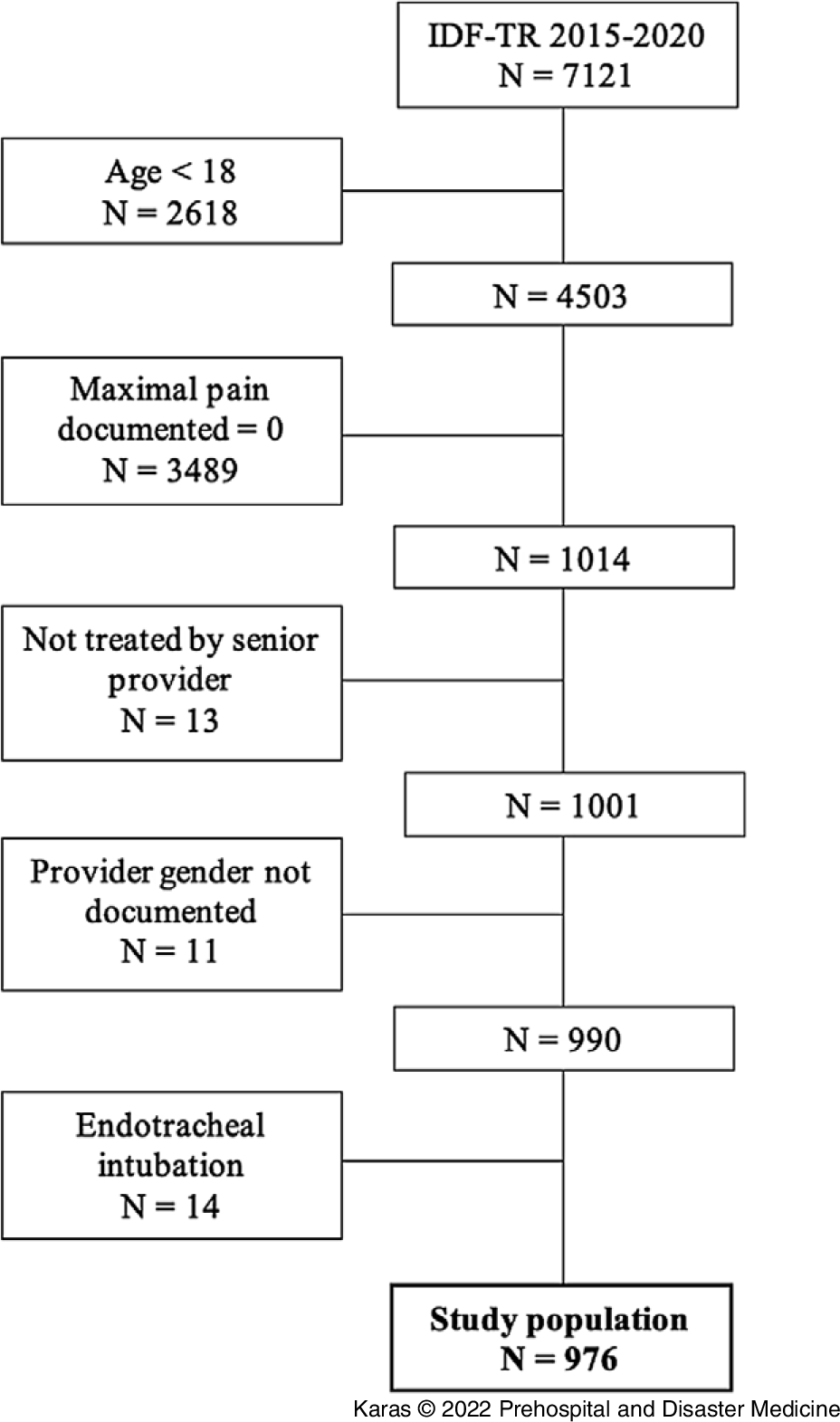
This study included all trauma casualties recorded in the IDF-TR from 2015 through 2020, treated by military medical teams including a senior provider (ie, physician or paramedic). All casualties with documentation of pain level were included in this study to minimize selection bias. Exclusion criteria were: age under 18, pain score of 0/10, and casualties who underwent endotracheal intubation. A subgroup analysis was performed for casualties who had pain assessed at least two times and had at least one measurement of pain severity of five or higher.
The IDF Trauma Registry
Data in this study were collected from the IDF-TR, a military prehospital trauma registry. It includes data regarding trauma casualties, both military and nonmilitary, treated by IDF medical teams collected on casualty cards. The physician or paramedic adds the data into a digital web-based registry within 72 hours. All new entries are reviewed daily by a dedicated team from the Trauma and Combat Medicine Branch (TCMB) for validation of accuracy and completion of missing data. The data collected include the incident details, casualty demographics, injuries identified, personal protective gear, vital signs measurements, medications administered, interventions performed, evacuations, and outcomes.
IDF Analgesia Clinical Practice Guidelines
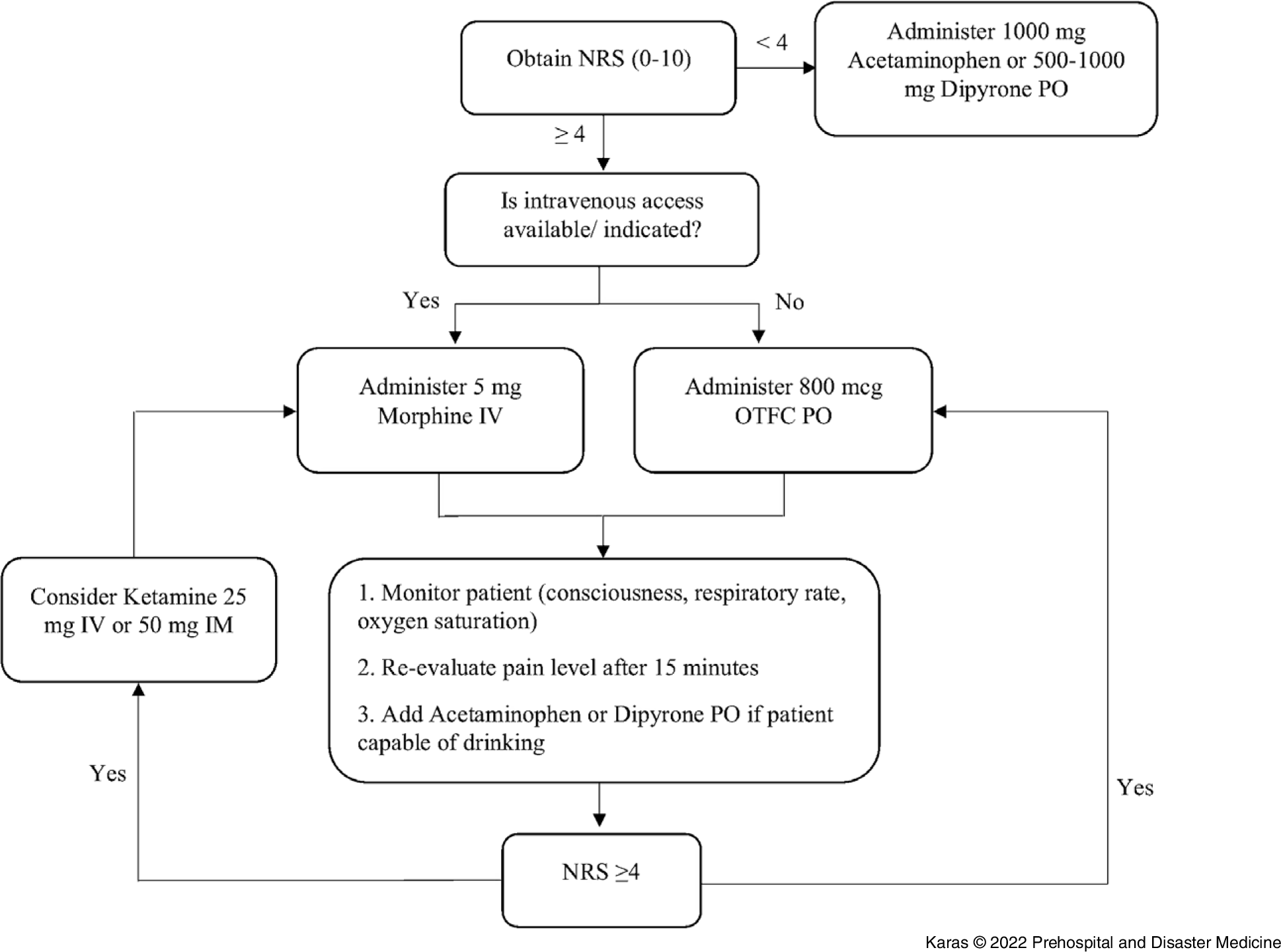
The IDF Clinical Practice Guidelines (CPG) for analgesia (Figure 1), as introduced in June 2013, indicate that any pain a casualty suffers from should be addressed. Pain score is obtained using the Verbal Numerical Rating Scale or Visual Analog Scale. Administration of oral analgesics (Paracetamol or Dipyrone) is indicated for all casualties experiencing pain of any severity. When pain score is five or higher, Morphine (5mg intravenous [IV], decreased to 2mg in case of profound shock, or 10mg intramuscular [IM]) or Oral Transmucosal Fentanyl Citrate (OTFC) (800mcg) are indicated. Casualty is re-evaluated after fifteen minutes, and if the pain score is still five or higher, Ketamine (25mg IV) should be considered, and either Morphine or OTFC could be re-administered. The CPG was revised in December 2020.
The IDF CPG Protocol for Pain Management in Trauma Casualties.
Abbreviations: IDF, Israel Defense Forces; CPG, Clinical Practice Guidelines; NRS, Numerical Rating Scale; OTFC, Oral Transmucosal Fentanyl Citrate.

Variables
Data extracted from the IDF-TR included: casualty age and gender; population (military or other); casualty urgency (as defined by the provider according to risk for life or limb, based on mechanism, injured body regions, vital signs, or required treatments); mechanism (penetrating and non-penetrating); body parts involved; vital signs (saturation, systolic blood pressure, heart rate); objective signs of profound shock (systolic blood pressure <90mmHg or heart rate >130 bpm); Glasgow Coma Scale (GCS); life-saving interventions (LSI) performed, including the use of tourniquet, chest decompression with needle thoracostomy or chest drain, packing, treatment with tranexamic acid or administration of blood products such as freeze-dried plasma, packed red blood cells, or whole blood administration; type of senior provider (doctor/paramedic); level of pain; and administration of oral analgesia, OTFC, Morphine (IV or IM), or Ketamine. “Delta- pain” was defined as the difference in pain severity between the maximal pain severity in the earliest documented phase and the minimal pain severity in the last documented phase.
Study groups were divided according to senior provider (ie, paramedic or physician) gender, emphasizing whether the senior providers treating were only female or treating along with a male provider to eliminate decisions that the other team member could have affected. Notably, teams include medics as well, yet these were not taken into account when dividing into groups as the senior provider mainly determines analgesic treatment.
Statistical Analysis
Study groups were divided into three groups according to senior provider gender: female, male, or both female and male. Continuous variables were compared between the groups utilizing the student’s t-test or the Mann-Whitney nonparametric test. Categorical variables were compared using the Chi-square or Fischer’s exact tests. A multivariable logistic regression analysis was performed to assess the odds ratio of receiving an analgesic agent, depending on the presence of a senior female provider in the team, adjusting for confounders, including casualty gender; LSI performed; level of consciousness; casualty urgency; injuries of the head, neck, extremities, or torso; blood pressure; and pain score (five or higher). Variables for multivariable adjustment were chosen a-priori based on clinical relevance or previous studies suggesting their significance. Reference Thomas and Shewakramani6,Reference Samulowitz, Gremyr, Eriksson and Hensing19,Reference Hoffmann and Tarzian20,Reference Betelman Mahalo, Avital and Radomislensky26 Addressing pain scores was significant since treating mild pain may be guided by different considerations, as well as the patient’s refusal to receive treatment. The multivariable regression model did not include casualties for whom there was no documented GCS. Missing information about systolic blood pressure and casualty urgency was grouped into an “unknown” category and considered a separate group in the model. Delta-pain was compared for casualties with a maximal pain score of five or higher and more than one documented pain severity assessment. A P value of <.05 defined statistical significance. All analyses were conducted with R version 4.0.3 (R Core Team; Vienna, Austria). A power analysis was not performed due to an unknown estimated effect size since literature is inconsistent.
Results
During the study period, a total of 7,121 casualties were treated by IDF-MC medical teams, of whom 976 (13.7%) were eligible for this study. The casualty selection process is presented in Figure 2.
Flow Diagram of Study Population.
Abbreviation: IDF-TR, Israel Defense Forces Trauma Registry.

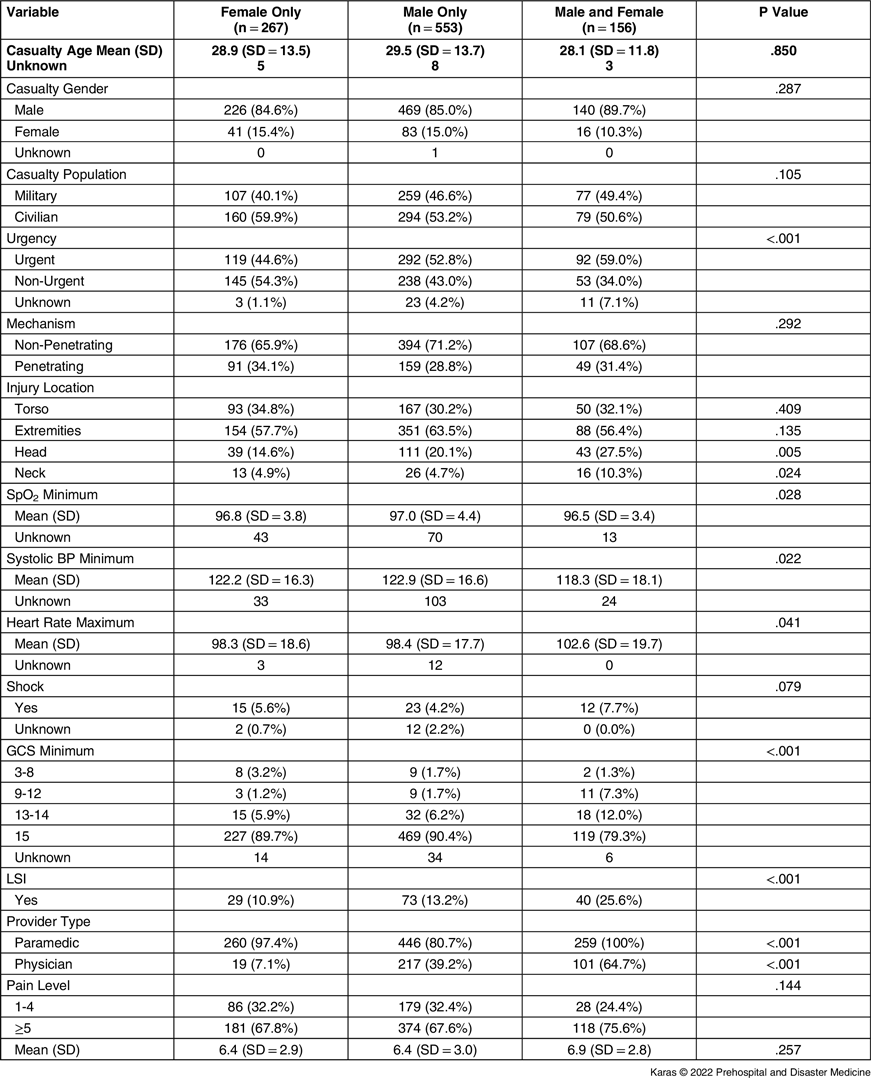
There were no differences in demographic characteristics of casualties between study groups, including age (P = .850), gender (P = .287), and population type (P = .105). The male-only and both male and female provider groups included more urgent casualties (P <.001) with higher rates of head and neck injuries (P = .005 and P = .024, respectively) and LSIs performed in these groups (P <.001). The GCS was lower in male and female provider groups (P <.001). There was no statistically significant difference in average pain levels (P = .257). Table 1 presents casualty demographics, injury characteristics, and casualty assessment.
Casualty Demographics and Injury Characteristics According to Senior Providers Present in the Event

Abbreviations: SpO2, arterial oxygen saturation measured by a pulse oximeter; BP, blood pressure; GCS, Glasgow Coma Scale; LSI, life-saving interventions.
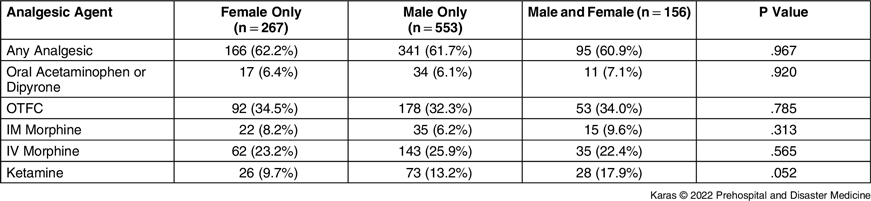
On total, 602 casualties (61.7%) were treated with analgesics. The univariate analyses (Table 2) demonstrated no statistically significant difference in analgesic treatment between groups, overall (P = .967) and per specific agent.
Probability of Analgesic Treatment by Group

Abbreviations: OTFC, Oral Transmucosal Fentanyl Citrate; IM, intramuscular; IV, intravenous.
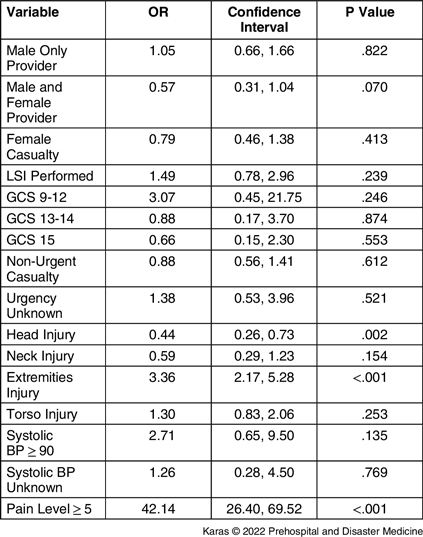
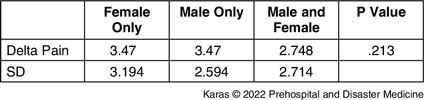
In the adjusted multivariable model (Table 3), no significant associations were found between potential confounding variables and the administration of analgesia. Univariate analysis of delta-pain between groups (Table 4) showed no significant differences (P = .213).
Multivariate Model for Association between Various Variables and Pain Management

Abbreviations: LSI, life-saving interventions; GCS, Glasgow Coma Scale; BP, blood pressure.
Average Decrease in Pain Level (Delta Pain) by Group for Casualties with at least Two Documented Pain Severity Assessments with at least One of Them ≥5 (N = 415)

Discussion
This cohort did not demonstrate an association between provider’s gender and pain management in the prehospital setting, neither in analgesic administration nor in the degree of pain relief (delta-pain). Although study groups did differ in some injury and casualty assessment characteristics (urgency, injured body regions, LSI performed, and GCS), no significant differences in pain levels or management between groups were found. There was also no difference in the selection of specific analgesic agents between groups, except a borderline significant association between Ketamine administration and provider gender, with lower rates among female providers. Adjusting for possible confounders, including high pain levels (five or higher), still showed no difference in pain management between study groups. This implies that not only do female providers assess and treat pain like male providers, but the quality and appropriateness of analgesic agent and dose administrated are also comparable. Trends in recent decades reveal a constantly increasing prevalence of female health care providers. 23,24 This study, which showed no differences in pain management between providers according to gender, further supports the concept of gender equality in medicine and the military.
Pain management is mainly researched within hospitals, same for differences in treatment and outcomes according to health care provider’s gender. When comparing this study to current literature, there is only partial agreement. Studies on simulated virtual pain had inconsistent results. While some showed different reactions to patient characteristics influenced by observers’ gender, others concluded that patient characteristics or observer attitudes were responsible for disparities. Reference Robinson and Wise27–Reference Hirsh, Hollingshead and Matthias32 There is also disagreement in studies of acute pain management in emergency departments. Reference Raftery, Smith-Coggins and Chen33,Reference Safdar, Heins and Homel34 In the prehospital setting, data are even scarcer and also reveal inconsistent findings regarding pain management approaches and proper pain relief according to provider gender. Reference Albrecht, Taffe, Yersin, Schoettker, Decosterd and Hugli13,Reference Oberholzer, Kaserer and Albrecht35–Reference Siriwardena, Asghar and Lord37
There are several explanations for the discrepancy of findings in literature and discordance with this study. First, most studies in this field were performed in an experimental or hospital/clinic environment. This study reflects prehospital pain management where considerations may be different. This study was based on face-to-face encounters between provider and casualty in a non-experimental environment; therefore, it could represent a more reliable assessment of providers’ decisions and possible bias. Second, female providers in this research were all military senior providers. Females serving in roles such as military physicians or paramedics may have different characteristics than others, influencing their approach to pain management. Third, teams with multiple providers treated casualties in this study, whereas previous studies focused on one decision maker.
Similarities in pain management between senior providers in this study could have resulted from the IDF-MC strict protocol and indications for pain management, which limits decision making. Clinical guidelines improve consistency of care and reduce variability in treatment. Reference Zohar, Eitan and Halperin17,Reference Woolf, Grol, Hutchinson, Eccles and Grimshaw38 In the IDF, analgesic treatment has become more common in trauma since the introduction of a new CPG in 2013 and implementation of OTFC among medical teams, and has also become more acceptable on the battlefield. Reference Benov, Salas and Nakar39,Reference Vysokovsky, Avital and Betelman-Mahalo40 These trends most likely had an impact on results in this study. Providers in this study were all trained in the IDF, working under the same protocols and with the same analgesic agents available, which minimizes variations.
Current literature identifies several barriers to analgesic treatment such as providers’ experience, training, perceptions, adverse effects, patient characteristics, and LSI performed. Reference Thomas and Shewakramani6,Reference Sinatra7,Reference Heins, Heins, Grammas, Costello, Huang and Mishra12–Reference Chen, Shofer and Dean21,Reference Betelman Mahalo, Avital and Radomislensky26 In this study, less than two-thirds of casualties were treated with analgesia, despite the IDF CPG recommendation to treat all patients suffering pain at any level (62.2% in the female group, 61.7% in the male group, and 60.9% in both male and female group; P = .967). Head injuries were more prevalent in some groups, which may have caused providers to avoid analgesics so to keep the casualties’ level of consciousness to monitor neurologic deterioration.
Limitations
This study has several limitations. The IDF-TR is based on medical providers’ reports and casualty cards filled during and after the medical evacuation. Documentation is a significant challenge when treating trauma casualties in the military environment, especially the accurate pain documentation at the point-of-injury. In addition, in events where more than one provider was involved, there was difficulty determining which caregiver was responsible for the decision to administer analgesia. Study groups were divided into teams including only female or male senior providers and both male and female teams to minimize this limitation. Some of the casualties in this study were part of events with multiple casualties, which could have influenced pain management priorities and abilities, yet this was not taken into consideration. External validity is limited since only providers from a specific military setting in Israel were included; hence, the study findings cannot be generalized beyond the study population. The sample size in this study also limits ability to determine differences according to provider gender. Confounding of results in this study by other considerations in pain management, as presented previously, cannot be ruled out.
Conclusion
This study did not show an association between IDF-MC providers’ gender and pain management in the prehospital setting. This study reveals again that many casualties were not treated with analgesics. Future studies should further examine pain management in trauma, and hopefully, provide possible interventions to improve treatment.
Conflicts of interest/funding
The authors declare no conflicts of interest. No funding was provided for this study. This study was accepted for presentation at the Military Health System Research Symposium Conference, August 23-26, 2021.
Author Contributions
AK contributed to the literature search, study design, data interpretation, and writing. LF contributed to the literature search and writing. IR contributed to the data analysis. GA contributed to the study design, data interpretation, and writing a critical revision. SG contributed to the data interpretation and critical revision. JC contributed to the critical revision. SG contributed to the literature search, study design, data interpretation, writing, and critical revision. AB contributed to the literature search, study design, data interpretation, writing, and critical revision. SG and AB contributed to the manuscript equally and are co-last authors.