Adherence to medical treatment remains difficult for many segments of the general population. For children with congenital and acquired cardiac disease, the challenges associated with adherence can often be overwhelming. For some children with cardiac disease, failure to adhere to the prescribed regime may even be life-threatening.
Advances in medical and surgical management of cardiac disease have prolonged and improved the lives of children with potentially life-threatening conditions. Haemodynamic and electrophysiologic residues, nonetheless, may require long-term treatment with complex medical regimes that may include diuretics, drugs to reduce afterload, beta blockers, antiarrhythmics, and anticoagulation. These medications, although potentially life-saving, may have serious side effects if administered inappropriately. In addition, physical, neurodevelopmental, and psychosocial morbidities are not uncommon in children with serious forms of cardiac disease, and can result in complex needs for long-term management, potentially affecting adherence to treatment. For those with life-threatening disease not amenable to medical or surgical therapies, cardiac transplantation exists as a well recognized option. Once transplanted, strict adherence to a rigorous follow-up protocol and complex immunosuppressive drug regime is required.
Not surprisingly, clinicians have observed that the process of adherence to treatment is complex. If interventions are to be successful, clinicians recommend that future studies will need to be multidimensional in nature, and include a combination of biological, cognitive, and psychological factors.Reference Bunchman1–Reference Hsu3 Those researching adherence to treatment in children are generally cognizant of important developmental and age-related differences with respect to responsibility. For example, the providers of care are generally responsible for adherence to treatment for infants and very young children. As children mature, responsibilities quite naturally shift to the developing adolescent and young adult.Reference Roberts4 A number of qualitative studies are beginning to accrue identifying communication, positive self-concept, social support systems, and knowledge of and ability to identify with the disease process, as potentially important factors in the process of adherence to treatment.Reference Bunchman1, Reference Sherry, Simmons, Wung and Zerwic2, Reference Kools, Kennedy, Engler and Engler5–Reference McAllister, Buckner and White-Williams7
Despite the importance of adherence to treatment for children with cardiac disease, and more specifically for children with cardiac failure, there remains little in the way of generalizable information for the practicing clinician. Of those studies that have been published, the majority have focused on adults,Reference DiMatteo8 paediatric subspecialties other than cardiology,Reference Kahana, Drotar and Frazier9 or narrowly defined segments of the paediatric cardiac population.Reference Chartrand, Servando and Chartrand10–Reference Wray, Waters, Radley-Smith and Sensky14 The purpose our review was to scan the literature with respect to adherence to treatment for children with congenital and acquired cardiac disease, paying particular attention to rates of adherence, risk factors for nonadherence, and the relationship between adherence to treatment and clinical outcomes. We then provide recommendations designed to maximize both the impact and scientific rigours of future studies in the field of paediatric cardiology.
Method
Literature Search
We used 3 groupings of keywords to search the current literature, specifically:
• Heart disease, heart defects, congenital, card*, or heart*”;
• Children, adolescent, or pediatrics;
• And adherence, self-management, self care, compliance, patient compliance, or self administration.
Databases used for this review included MEDLINE, Pub Med’s Single Citation Manager, Cochrane Library, Cochrane Central Register of Controlled Trials, Scopus, and Google Scholar. We identified those peer-reviewed articles published worldwide through December of 2008. In an effort to expand the scope of the search beyond the available electronic databases, and to ensure as much as possible that we would not miss articles not indexed by the aforementioned databases, we also reviewed and obtained papers cited within relevant articles.
Criterions for Inclusion and Exclusion
We included peer-reviewed articles written in English that defined, measured, and investigated adherence to regimes of medical treatment in a systematic way, and that included children or adolescents with cardiac disease or cardiac failure as definable samples. Articles that primarily dealt with adults, or for which cardiac disease was not a primary focus, were excluded.
Results
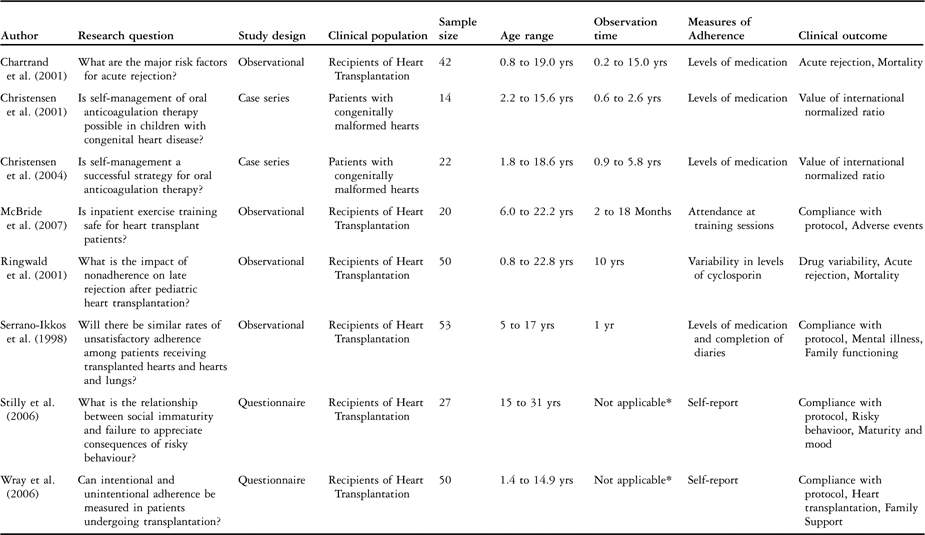
We identified a total of 8 articles in which adherence to treatment had been investigated within the context of a cohort of children with cardiac disease. Of these studies, 2 involved children with congenitally malformed hearts, while 6 included children with cardiomyopathy, cardiac failure, or children who had undergone transplantation of the heart (Table 1).
Description of Studies Used in the Review of Literature.
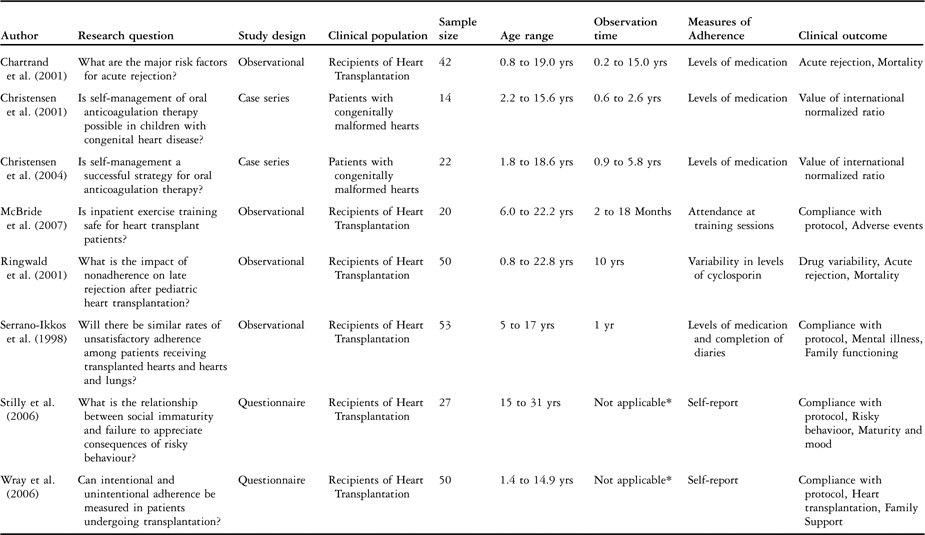
Note: * Cross-sectional data received at one time point.
Rates of Adherence
Not all the studies reported general rates of adherence. Of those that did, the percentage of children and adolescents who were reported to be adherent to medical treatments varied greatly. Among a sample of children with end-stage heart failure awaiting transplantation, a rate of adherence of 96% was reported for a sustained, low intensity, in-patient exercise programme.Reference McBride, Binder and Paridon15 In a sample of 50 children receiving either heart, or heart-lung transplants, it was reported that almost half, specifically 18 of 40 of their sample, disclosed that they were either intentionally, in 18%, or unintentionally in 28%, nonadherent to their prescribed treatment.Reference Wray, Waters, Radley-Smith and Sensky14 Substantially higher rates of 63% for missed medications, and 67% for missed appointments, were reported in another study for patients 10 years after transplantation.Reference Stilley, Lawrence, Bender, Olshansky, Webber and Dew13 Conversely, another group reported a rate of adherence of 70% to both medication and completion of diaries in a sample of 53 children followed for up to 12 months after heart and lung transplantation.Reference Serrano-Ikkos, Lask, Whitehead and Eisler16
Risk Factors for Nonadherence
Several risk factors for nonadherence were identified in the 8 studies evaluated. The most prominent finding with respect to risk factors for nonadherence appeared to be related to age. Older children and adolescents evidenced lower rates of adherence to treatment than younger children.Reference Wray, Waters, Radley-Smith and Sensky14, Reference Serrano-Ikkos, Lask, Whitehead and Eisler16, Reference Ringewald, Gidding, Crawford, Backer, Mavroudis and Pahl17 For recipients of heart and/or heart-lung transplantation, all 7 episodes of intentional nonadherence were observed in those aged from 14 to 18 years, with 4 of the 7 episodes occurring in the most recent year.Reference Wray, Waters, Radley-Smith and Sensky14 The second most prominent risk factor pertained to family structure. For example, more acute rejections were reported among patients living in single-parent households than among those living in two-parent households.Reference Ringewald, Gidding, Crawford, Backer, Mavroudis and Pahl17 Similarly, children living with both biological parents reported higher rates of adherence than did children living with single-parent or blended families.Reference Serrano-Ikkos, Lask, Whitehead and Eisler16 Children of parent dyads, where one of the parents was critical of the emotional availability of the partner during the period of transplantation, appeared to be less adherent than children of parent dyads who considered each other to be emotionally available.Reference Serrano-Ikkos, Lask, Whitehead and Eisler16
Other notable risk factors and correlates with nonadherence for an adolescent and young adult sample included smoking in one-tenth, tattoos in one-third, a sedentary lifestyle in nine-tenths, multiple body piercings in one-third, and illicit use of street drugs in one-tenth, as well as difficulty maintaining the dietary requirements of an adult diet.Reference Stilley, Lawrence, Bender, Olshansky, Webber and Dew13 During the portion of the study involving a clinical interview, Stilley et al.Reference Stilley, Lawrence, Bender, Olshansky, Webber and Dew13 found that poor adherers scored lower than good adherers across six inductively derived themes of maturity, specifically trusting others, family support, involved with others, optimistic outlook, long-term goals, evolving development, and a clinical measure of self concept that integrated the transplant experience with self concept.Reference Stilley, Lawrence, Bender, Olshansky, Webber and Dew13 Conversely, Wray and colleaguesReference Wray, Waters, Radley-Smith and Sensky14 found no statistically significant associations between adherence and beliefs about medication, perceptions of illness, or transplant related variables, such as the time since transplantation, the type of transplant, the age at transplantation, or the diagnosis prior to transplantation.
Relationships with Clinical Outcomes
Several studies confirmed a strong relationship of poor outcomes in terms of morbidity, mortality, or rejection with nonadherence. A total of 49 episodes of acute rejection were observed in 15 of 50 children receiving heart transplants, 7 of whom died.Reference Ringewald, Gidding, Crawford, Backer, Mavroudis and Pahl17 Of the episodes, three-quarters could be attributed to nonadherence. Self reports of nonadherence corroborated the finding based on levels of anti-rejection drugs in nine-tenths of cases.Reference Ringewald, Gidding, Crawford, Backer, Mavroudis and Pahl17 Others reported a poor rate of adherence based on levels of cyclosporin.Reference Serrano-Ikkos, Lask, Whitehead and Eisler16 In another study, its was found that 3 of 4 adolescent and young adults who adhered poorly had died, while all 5 patients showing good adherence group were alive and well 10 years after transplantation.Reference Stilley, Lawrence, Bender, Olshansky, Webber and Dew13 A statistically significant relationship was found between compliance with immunosuppressive medications and acute rejection, with no deaths among 25 children who were compliant compared with almost half of children who were noncompliant dying following transplantation.Reference Chartrand, Servando and Chartrand10 Episodes of rejection were very uncommon among children aged less than 5 years, but significantly more common among those aged 15 years and older.Reference Chartrand, Servando and Chartrand10
In the lone study involving intervention, 14 children with congenitally malformed hearts were taught strategies of self-management to use Coumadin, an oral anticoagulation medication that reduces the risk of thromboembolic events.Reference Christensen, Attermann, Hjortdal, Maegaard and Hasenkam12 The authors found that, after 27 weeks in the study, all patients, or the parents in the case of very young children, were capable of operating the equipment and adjusting the levels of Coumadin levels.Reference Christensen, Attermann, Hjortdal, Maegaard and Hasenkam12 Values for the international normalized ratio were in an appropriate range from one-sixth to nine-tenths of the time, with the median being two-thirds.Reference Christensen, Attermann, Hjortdal, Maegaard and Hasenkam12 In a follow-up study 3 years later, the group reported that children were within the therapeutic range almost three-quarters of the time.Reference Christensen, Andersen, Maegaard, Hansen, Hjortdal and Hasenkam11 Additionally, in the first study, all 14 patients and parents reported complete satisfaction with the programme of treatment, and all but one patient wanted to continue with treatment following the study.Reference Christensen, Attermann, Hjortdal, Maegaard and Hasenkam12
Summary and Recommendations
We identified, from our review of the literature, a number of different outcomes related to adherence for children with congenital and acquired cardiac disease. From attendance rates at an in-patient exercise programme to a study providing self-management in anti-coagulation, the spectrum of adherence-related outcomes for children with cardiac disease remains quite broad. In some studies, the outcomes are absolute, such as mortality, cardiac failure, or rejection of transplanted organs, while for others, informative surrogates are used, such as levels of anti-rejection drugs and levels of prothrombin. The risk models themselves have tended to follow suit, with an equally broad range of related factors, such as diet, variables related to the patients, the level of family support, risk-taking behaviours, and indicators of mental illness. The absence of a prior predictive model is a significant weakness, as it capitalizes on sample-specific variation that may not be generalizable.
We detected 3 notable themes from our review of the literature. First, levels of adherence vary widely, from relatively low to very high. Equally important is the realization that, although values of adherence are reported, they reflect a wide range of conditions and options for treatment across different age groups, from toddlers to adolescents and young adults. Second, relationships between measures of adherence and established clinical outcomes often seem to be study-specific and, in many cases, dependent upon uniquely defined variables of interest. Third, many of the studies we reviewed use imprecisely delineated methodologies, such that it would be hard to replicate methods, let alone generalize findings to other segments of the population of children with cardiac disease.
Our review also indicated that adherence to treatment in children with cardiac disease is understudied relative to many other chronic health conditions suffered by children.Reference Drotar18, Reference Rapoff19 Despite this rather sobering realization for clinicians who treat children with cardiac disease, some promising trends are also noted. Most importantly, all 8 studies reviewed have acknowledged that adherence to treatment plays a critical role in achieving a successful medical outcome. In addition, even among the less well executed studies, the established and fairly well recognized outcomes of prothrombin times and levels of cyclosporine can be acknowledged as objective indicators of adherence. Another contribution to the literature is the number of different measures of adherence used in these studies, ranging from self-reported information to specific biochemical markers, thereby creating a fairly diverse pool of measures that future researchers can draw upon when developing their own studies.
Despite these early and important contributions to the literature, children with cardiac disease remain a vastly understudied segment, one that could surely benefit from promotion. Future researchers should strive to describe the incidence and prevalence of nonadherence to treatment for children with cardiac disease using valid and reliable measures. Recently published works involving children with cystic fibrosis,Reference Modi, Lim, Yu, Geller, Wagner and Quittner20 and children with diabetes,Reference Harris, Wysocki and Sadler21 serve as examples in this regard.
Another area of need in future research concerns the study of the relationship between adherence and clinical outcomes. Although causal connections between adherence to treatment, control of illness, and health-related clinical outcomes are relatively well-established with Type I diabetes, and infectious diseases such as infection with the human immunodeficiency virus, the relationship between adherence in children with cardiac disease has not been well documented. For this reason, there is an important opportunity in the field of paediatric cardiology to describe the impact of adherence to treatment in a range of relevant outcomes, through such methodologies as clearly defined clinical cutoffs that delineate positive versus negative outcomes, and validated clinical thresholds below which medication may be less effective, or ineffective altogether.Reference Pai and Drotar22 Finally, very little is known about the efficacy of strategies for intervention to reduce nonadherence and negative outcomes in vulnerable populations, or the efficacy of preventative strategies to promote adherence to prescribed medications.
In order to maximize the scientific rigour and clinical impact of future research in adherence to medical treatment for children with cardiac diseases, researchers should consider the following recommendations, not simply to enhance the quality of science, but to begin the process of laying the foundation for future strategies for intervention:
• Obtain both quantitative and qualitative measures of adherence. While it is crucial to gather information on the rates of adherence using the most up-to-date objective systems and technology,Reference Rapoff19 it is also important to ask respondents or their parents for verbal confirmation or validation of adherence, as well as their perceptions of barriers to, or facilitators of adherence to treatment.Reference Fine, Becker and De Geest23 Objective methods are useful to document the rates of adherence in an unbiased manner. Subjective measures, such as interviews or questionnaires are very well suited to describe the situational context and factors that reflect the decision making of both the patient and his or her family
• Clearly identify primary and secondary endpoints of nonadherence. In many of the studies we reviewed, it was difficult to distinguish primary from secondary endpoints. For example, are levels of cyclosporine the endpoint of interest, or is it acute rejection? It may well depend on whether one is interested in mortality of the person or rejection of the transplanted organ, or simply an indicator of morbidity, which increases the likelihood of future complications. Hence, the selection of endpoints can have a profound impact on the strength of the relationships and generalizations made from them. Moreover, authors are encouraged to focus on a single, primary, operationally well-defined endpoint for which the outcome of interest has a basis in the professional literature. Where appropriate, two or three additional, secondary endpoints, also operationally well-defined, may be used to extend our understanding of the process of adherence to treatment.
• Emphasis on the factor of interest. Extending the notion of primary versus secondary endpoints, it was often difficult for us to understand the basis for the comparisons made in the studies we reviewed. For example, it matters greatly whether rates of adherence are being compared with respect to episodes of rejection, or, conversely, whether the episodes of rejection are being compared with respect to the level of adherence.Reference Wray, Waters, Radley-Smith and Sensky14 The results, and subsequent interpretations, are not the same. In some studies we reviewed, it appears that the comparisons were made both ways, producing difficulty in identifying explicitly the comparisons of interest. Much of this can be handled with well-written sections detailing methods and analysis of data. Investigators are encouraged to follow closely the reporting guidelines of their respective journals and/or professional associations. Alternative and well-respected documents that investigators may consult for guidance include the Consolidated Standards of Reporting TrialsReference Moher, Schulz and Altman24, Reference Stinson, McGrath and Yamada25 and the Transparent Reporting of Evaluations with Nonrandomized Designs.Reference Des Jarlais, Lyles and Crepaz26
• Plan studies with sufficient power to impact on adherence to treatment. Being able to detect a statistically significant difference between the groups studied when it is present is a function of the size of the sample. Among the 8 studies we reviewed, none indicated that they were sufficiently powered to detect differences, and none identified the effect sizes of interest. Given the multidimensional nature of adherence and the psychological, social, and environmental influences at any one time, it will be necessary to identify from the outset the anticipated effect sizes of specific influences, alone and in combination with other potential confounding variables in a given study.Reference Fine, Becker and De Geest23 Multi-centered studies, although much more difficult to conduct, may be needed to obtain sufficient numbers of children with very specific types of cardiac disease such as children with functionally univentricular physiology, electrophysiologic abnormalities, cardiomyopathies, and cardiac failure requiring transplantation of the heart.
• Develop an epidemiologic foundation for the study of adherence. Prior to estimating the strength of existing relationships between measures of adherence and other clinical correlates and predictors, we must first know the extent of the problem, and patterns of behaviors related to adherence in the children we treat. Hence, we recommend that investigators first report and clearly describe the rates of adherence for their sample as a whole and for relevant subgroups, for example by age, gender, cardiac diagnosis, before moving on to other, more complicated situations.Reference Fine, Becker and De Geest23
Acknowledgement
The authors wish to extend a special note of thanks to Ms Alison Kissling, Medical Librarian, for her assistance with this process.