Introduction
Research in bipolar disorder (BD) implicates fronto-limbic-striatal dysfunction, with meta-analyses generally suggesting prefrontal cortex (PFC) hypoactivation and limbic hyperactivation during face emotion processing paradigms (Chen et al. Reference Chen, Suckling, Lennox, Ooi and Bullmore2011; Delvecchio et al. Reference Delvecchio, Fossati, Boyer, Brambilla, Falkai, Gruber, Hietala, Lawrie, Martinot, McIntosh, Meisenzahl and Frangou2012; Houenou et al. Reference Houenou, Frommberger, Carde, Glasbrenner, Diener, Leboyer and Wessa2011; Kupferschmidt & Zakzanis, Reference Kupferschmidt and Zakzanis2011; Blond et al. Reference Blond, Fredericks and Blumberg2012; Strakowski et al. Reference Strakowski, Adler, Almeida, Altshuler, Blumberg, Chang, Delbello, Frangou, McIntosh, Phillips, Sussman and Townsend2012). However, the precise nature of the dysfunction varies; differing task demands and face emotions are used across studies and may contribute to discrepancies in the literature. Moreover, there is limited research on how abnormalities differ developmentally, i.e. in pediatric versus adult patients (Kim et al. Reference Kim, Thomas, Rosen, Moscicki, Brotman, Zarate, Blair, Pine and Leibenluft2012). We report data from a relatively large sample [62 BD, 119 healthy comparisons (HC)] in which we compared neural activity across different attention conditions and face emotions, using a paradigm that was brief enough to be tolerated by affected children and adults.
In the current emotional face viewing task, as in other tasks, there are three types of attentional conditions: (1) implicit, (2) passive viewing and (3) explicit. During implicit paradigms, subjects focus on a stimulus feature other than the face emotion. Amygdala hyperactivity has been reported consistently in both pediatric and adult BD patients during such tasks, including gender labeling (Lawrence et al. Reference Lawrence, Williams, Surguladze, Giampietro, Brammer, Andrew, Frangou, Ecker and Phillips2004; Kalmar et al. Reference Kalmar, Wang, Chepenik, Womer, Jones, Pittman, Shah, Martin, Constable and Blumberg2009; Surguladze et al. Reference Surguladze, Marshall, Schulze, Hall, Walshe, Bramon, Phillips, Murray and McDonald2010; Ladouceur et al. Reference Ladouceur, Farchione, Diwadkar, Pruitt, Radwan, Axelson, Birmaher and Phillips2011; Garrett et al. Reference Garrett, Reiss, Howe, Kelley, Singh, Adleman, Karchemskiy and Chang2012; Kim et al. Reference Kim, Thomas, Rosen, Moscicki, Brotman, Zarate, Blair, Pine and Leibenluft2012; Thomas et al. Reference Thomas, Kim, Bones, Hinton, Milch, Reynolds, Adleman, Marsh, Blair, Pine and Leibenluft2013), face age labeling (Pavuluri et al. Reference Pavuluri, Passarotti, Harral and Sweeney2009) and face image color labeling (Chen et al. Reference Chen, Lennox, Jacob, Calder, Lupson, Bisbrown-Chippendale, Suckling and Bullmore2006; Keener et al. Reference Keener, Fournier, Mullin, Kronhaus, Perlman, LaBarbara, Almeida and Phillips2012; Perlman et al. Reference Perlman, Almeida, Kronhaus, Versace, Labarbara, Klein and Phillips2012). However, the precise direction of dysfunction in the PFC and striatum during implicit face emotion processing has been variable, with some reports indicating hyperactivation in BD (Lawrence et al. Reference Lawrence, Williams, Surguladze, Giampietro, Brammer, Andrew, Frangou, Ecker and Phillips2004; Wessa et al. Reference Wessa, Houenou, Paillère-Martinot, Berthoz, Artiges, Leboyer and Martinot2007; Hassel et al. Reference Hassel, Almeida, Kerr, Nau, Ladouceur, Fissell, Kupfer and Phillips2008, Reference Hassel, Almeida, Frank, Versace, Nau, Klein, Kupfer and Phillips2009; Surguladze et al. Reference Surguladze, Marshall, Schulze, Hall, Walshe, Bramon, Phillips, Murray and McDonald2010; Ladouceur et al. Reference Ladouceur, Farchione, Diwadkar, Pruitt, Radwan, Axelson, Birmaher and Phillips2011; Keener et al. Reference Keener, Fournier, Mullin, Kronhaus, Perlman, LaBarbara, Almeida and Phillips2012) and others reporting hypoactivation (Lawrence et al. Reference Lawrence, Williams, Surguladze, Giampietro, Brammer, Andrew, Frangou, Ecker and Phillips2004; Hassel et al. Reference Hassel, Almeida, Frank, Versace, Nau, Klein, Kupfer and Phillips2009; Pavuluri et al. Reference Pavuluri, Passarotti, Harral and Sweeney2009; Garrett et al. Reference Garrett, Reiss, Howe, Kelley, Singh, Adleman, Karchemskiy and Chang2012).
While some researchers have included passive viewing as a form of implicit face processing, subjects’ attention during passive viewing is completely unconstrained and the cognitive demands are unclear. As in implicit paradigms, amygdala hyperactivation has been reported in BD during passive viewing (Blumberg et al. Reference Blumberg, Donegan, Sanislow, Collins, Lacadie, Skudlarski, Gueorguieva, Fulbright, McGlashan, Gore and Krystal2005; Pavuluri et al. Reference Pavuluri, O'Connor, Harral and Sweeney2007; Killgore et al. Reference Killgore, Gruber and Yurgelun-Todd2008), although amygdala hypoactivation has also been observed (Blumberg et al. Reference Blumberg, Donegan, Sanislow, Collins, Lacadie, Skudlarski, Gueorguieva, Fulbright, McGlashan, Gore and Krystal2005). Similarly, both PFC and striatal hyperactivation (Pavuluri et al. Reference Pavuluri, O'Connor, Harral and Sweeney2007) and hypoactivation (Blumberg et al. Reference Blumberg, Donegan, Sanislow, Collins, Lacadie, Skudlarski, Gueorguieva, Fulbright, McGlashan, Gore and Krystal2005; Pavuluri et al. Reference Pavuluri, O'Connor, Harral and Sweeney2007; Killgore et al. Reference Killgore, Gruber and Yurgelun-Todd2008) have been reported in passive viewing paradigms.
Explicit face emotion processing paradigms, in which the task directs attention toward the face emotion, have also elicited amygdala hyperactivity in BD (Yurgelun-Todd et al. Reference Yurgelun-Todd, Gruber, Kanayama, Killgore, Baird and Young2000; Rich et al. Reference Rich, Vinton, Roberson-Nay, Hommer, Berghorst, McClure, Fromm, Pine and Leibenluft2006; Foland et al. Reference Foland, Altshuler, Bookheimer, Eisenberger, Townsend and Thompson2008; Almeida et al. Reference Almeida, Versace, Hassel, Kupfer and Phillips2010; Chen et al. Reference Chen, Suckling, Ooi, Jacob, Lupson, Bullmore and Lennox2010; Versace et al. Reference Versace, Thompson, Zhou, Almeida, Hassel, Klein, Kupfer and Phillips2010; Hulvershorn et al. Reference Hulvershorn, Karne, Gunn, Hartwick, Wang, Hummer and Anand2012), although some find hypoactivation (Lennox et al. Reference Lennox, Jacob, Calder, Lupson and Bullmore2004; Chen et al. Reference Chen, Lennox, Jacob, Calder, Lupson, Bisbrown-Chippendale, Suckling and Bullmore2006; Vizueta et al. Reference Vizueta, Rudie, Townsend, Torrisi, Moody, Bookheimer and Altshuler2012). These mixed findings in BD are consistent with meta-analyses in healthy adults (Sergerie et al. Reference Sergerie, Chochol and Armony2008), suggesting that explicit face emotion processing may probe the amygdala less effectively than do passive viewing paradigms, and may even be associated with decreased amygdala activation (Costafreda et al. Reference Costafreda, Brammer, David and Fu2008). In BD, as with implicit and passive viewing tasks, findings in the PFC and striatum include both hyperactivity (Rich et al. Reference Rich, Vinton, Roberson-Nay, Hommer, Berghorst, McClure, Fromm, Pine and Leibenluft2006; Foland et al. Reference Foland, Altshuler, Bookheimer, Eisenberger, Townsend and Thompson2008; Robinson et al. Reference Robinson, Monkul, Tordesillas-Gutiérrez, Franklin, Bearden, Fox and Glahn2008; Chen et al. Reference Chen, Suckling, Ooi, Jacob, Lupson, Bullmore and Lennox2010; Hulvershorn et al. Reference Hulvershorn, Karne, Gunn, Hartwick, Wang, Hummer and Anand2012) and hypoactivity (Yurgelun-Todd et al. Reference Yurgelun-Todd, Gruber, Kanayama, Killgore, Baird and Young2000; Lennox et al. Reference Lennox, Jacob, Calder, Lupson and Bullmore2004; Altshuler et al. Reference Altshuler, Bookheimer, Townsend, Proenza, Sabb, Mintz and Cohen2008; Foland et al. Reference Foland, Altshuler, Bookheimer, Eisenberger, Townsend and Thompson2008; Foland-Ross et al. Reference Foland-Ross, Bookheimer, Lieberman, Sugar, Townsend, Fischer, Torrisi, Penfold, Madsen, Thompson and Altshuler2012; Hulvershorn et al. Reference Hulvershorn, Karne, Gunn, Hartwick, Wang, Hummer and Anand2012). Thus, it is difficult to determine the impact of attentional demands on BD neural dysfunction because conclusions in the literature are based on findings across studies that use different paradigms. Studies have yet to include multiple attention conditions, including constrained (implicit and explicit) and unconstrained (passive viewing) conditions within one task.
In both constrained and unconstrained attentional paradigms, a wide range of face emotions have elicited neural dysfunction in BD. These emotions include happy (Lawrence et al. Reference Lawrence, Williams, Surguladze, Giampietro, Brammer, Andrew, Frangou, Ecker and Phillips2004; Lennox et al. Reference Lennox, Jacob, Calder, Lupson and Bullmore2004; Blumberg et al. Reference Blumberg, Donegan, Sanislow, Collins, Lacadie, Skudlarski, Gueorguieva, Fulbright, McGlashan, Gore and Krystal2005; Chen et al. Reference Chen, Lennox, Jacob, Calder, Lupson, Bisbrown-Chippendale, Suckling and Bullmore2006; Pavuluri et al. Reference Pavuluri, O'Connor, Harral and Sweeney2007; Hassel et al. Reference Hassel, Almeida, Kerr, Nau, Ladouceur, Fissell, Kupfer and Phillips2008, Reference Hassel, Almeida, Frank, Versace, Nau, Klein, Kupfer and Phillips2009; Almeida et al. Reference Almeida, Mechelli, Hassel, Versace, Kupfer and Phillips2009; Shah et al. Reference Shah, Wang, Kalmar, Chepenik, Tie, Pittman, Jones, Constable, Gelernter and Blumberg2009; Surguladze et al. Reference Surguladze, Marshall, Schulze, Hall, Walshe, Bramon, Phillips, Murray and McDonald2010; Versace et al. Reference Versace, Thompson, Zhou, Almeida, Hassel, Klein, Kupfer and Phillips2010; Passarotti et al. Reference Passarotti, Sweeney and Pavuluri2011; Garrett et al. Reference Garrett, Reiss, Howe, Kelley, Singh, Adleman, Karchemskiy and Chang2012; Keener et al. Reference Keener, Fournier, Mullin, Kronhaus, Perlman, LaBarbara, Almeida and Phillips2012; Mourao-Miranda et al. Reference Mourão-Miranda, Oliveira, Ladouceur, Marquand, Brammer, Birmaher, Axelson and Phillips2012; Perlman et al. Reference Perlman, Almeida, Kronhaus, Versace, Labarbara, Klein and Phillips2012; Thomas et al. Reference Thomas, Brotman, Muhrer, Rosen, Bones, Reynolds, Deveney, Pine and Leibenluft2012), angry (Pavuluri et al. Reference Pavuluri, O'Connor, Harral and Sweeney2007; Altshuler et al. Reference Altshuler, Bookheimer, Townsend, Proenza, Sabb, Mintz and Cohen2008; Passarotti et al. Reference Passarotti, Sweeney and Pavuluri2011; Keener et al. Reference Keener, Fournier, Mullin, Kronhaus, Perlman, LaBarbara, Almeida and Phillips2012; Perlman et al. Reference Perlman, Almeida, Kronhaus, Versace, Labarbara, Klein and Phillips2012; Thomas et al. Reference Thomas, Brotman, Muhrer, Rosen, Bones, Reynolds, Deveney, Pine and Leibenluft2012, Reference Thomas, Kim, Bones, Hinton, Milch, Reynolds, Adleman, Marsh, Blair, Pine and Leibenluft2013), sad (Lawrence et al. Reference Lawrence, Williams, Surguladze, Giampietro, Brammer, Andrew, Frangou, Ecker and Phillips2004; Lennox et al. Reference Lennox, Jacob, Calder, Lupson and Bullmore2004; Chen et al. Reference Chen, Lennox, Jacob, Calder, Lupson, Bisbrown-Chippendale, Suckling and Bullmore2006; Jogia et al. Reference Jogia, Haldane, Cobb, Kumari and Frangou2008; Almeida et al. Reference Almeida, Versace, Hassel, Kupfer and Phillips2010; Versace et al. Reference Versace, Thompson, Zhou, Almeida, Hassel, Klein, Kupfer and Phillips2010; Garrett et al. Reference Garrett, Reiss, Howe, Kelley, Singh, Adleman, Karchemskiy and Chang2012; Keener et al. Reference Keener, Fournier, Mullin, Kronhaus, Perlman, LaBarbara, Almeida and Phillips2012; Perlman et al. Reference Perlman, Almeida, Kronhaus, Versace, Labarbara, Klein and Phillips2012), neutral (Rich et al. Reference Rich, Vinton, Roberson-Nay, Hommer, Berghorst, McClure, Fromm, Pine and Leibenluft2006; Altshuler et al. Reference Altshuler, Bookheimer, Townsend, Proenza, Sabb, Mintz and Cohen2008; Hassel et al. Reference Hassel, Almeida, Frank, Versace, Nau, Klein, Kupfer and Phillips2009; Garrett et al. Reference Garrett, Reiss, Howe, Kelley, Singh, Adleman, Karchemskiy and Chang2012; Thomas et al. Reference Thomas, Brotman, Muhrer, Rosen, Bones, Reynolds, Deveney, Pine and Leibenluft2012, Reference Thomas, Kim, Bones, Hinton, Milch, Reynolds, Adleman, Marsh, Blair, Pine and Leibenluft2013) and fearful (Yurgelun-Todd et al. Reference Yurgelun-Todd, Gruber, Kanayama, Killgore, Baird and Young2000; Lawrence et al. Reference Lawrence, Williams, Surguladze, Giampietro, Brammer, Andrew, Frangou, Ecker and Phillips2004; Chen et al. Reference Chen, Lennox, Jacob, Calder, Lupson, Bisbrown-Chippendale, Suckling and Bullmore2006; Altshuler et al. Reference Altshuler, Bookheimer, Townsend, Proenza, Sabb, Mintz and Cohen2008; Hassel et al. Reference Hassel, Almeida, Kerr, Nau, Ladouceur, Fissell, Kupfer and Phillips2008; Killgore et al. Reference Killgore, Gruber and Yurgelun-Todd2008; Shah et al. Reference Shah, Wang, Kalmar, Chepenik, Tie, Pittman, Jones, Constable, Gelernter and Blumberg2009; Surguladze et al. Reference Surguladze, Marshall, Schulze, Hall, Walshe, Bramon, Phillips, Murray and McDonald2010; Keener et al. Reference Keener, Fournier, Mullin, Kronhaus, Perlman, LaBarbara, Almeida and Phillips2012; Perlman et al. Reference Perlman, Almeida, Kronhaus, Versace, Labarbara, Klein and Phillips2012; Thomas et al. Reference Thomas, Brotman, Muhrer, Rosen, Bones, Reynolds, Deveney, Pine and Leibenluft2012). However, similar to conclusions drawn about BD dysfunction across different attention conditions, it is difficult to determine the impact of specific face emotions on neural function in BD because most studies use only one face emotion or collapse analyses across face emotions. To date, no study has included multiple face emotions and attention states (including both implicit and explicit conditions, and passive viewing) in one statistical model.
We examined neural dysfunction during face emotion processing across several emotions and attention states in pediatric and adult BD patients. We used a face emotion processing paradigm because behavioral deficits in face emotion labeling have been found in BD patients irrespective of age of onset (Kohler et al. Reference Kohler, Hoffman, Eastman, Healey and Moberg2011). Face processing deficits are also present during euthymia (Schenkel et al. Reference Schenkel, Pavuluri, Herbener, Harral and Sweeney2007; Rich et al. Reference Rich, Fromm, Berghorst, Dickstein, Brotman, Pine and Leibenluft2008), representing a potential endophenotype of the illness (Brotman et al. Reference Brotman, Guyer, Lawson, Horsey, Rich, Dickstein, Pine and Leibenluft2008; Olsavsky et al. Reference Olsavsky, Brotman, Rutenberg, Muhrer, Deveney, Fromm, Towbin, Pine and Leibenluft2012). However, it remains unclear whether the neural correlates of such behavioral deficits differ in pediatric and adult BD. Meta-analyses report that decreased amygdala volume is found more consistently in youth than in adults with BD (Pfeifer et al. Reference Pfeifer, Welge, Strakowski, Adler and DelBello2008; Chen et al. Reference Chen, Suckling, Lennox, Ooi and Bullmore2011), suggesting that functional amygdala abnormalities may be more prominent in BD youth than in adults (Kim et al. Reference Kim, Thomas, Rosen, Moscicki, Brotman, Zarate, Blair, Pine and Leibenluft2012).
We used a paradigm that included both implicit (nose width) and explicit (hostility, subjective fear) ratings, in addition to an unconstrained attention condition (passive viewing). The task included multiple face emotions (angry, happy, fearful, neutral). Four regions of interest (ROIs) were selected, including the amygdala, anterior cingulate cortex (ACC), inferior frontal gyrus (IFG) and putamen; these regions have been consistently implicated in BD (Chen et al. Reference Chen, Suckling, Lennox, Ooi and Bullmore2011; Delvecchio et al. Reference Delvecchio, Fossati, Boyer, Brambilla, Falkai, Gruber, Hietala, Lawrie, Martinot, McIntosh, Meisenzahl and Frangou2012; Houenou et al. Reference Houenou, Frommberger, Carde, Glasbrenner, Diener, Leboyer and Wessa2011). Our primary ROI analyses included, in one statistical model, all attention conditions, face emotion, subject age and diagnosis. We expected between-group diagnostic differences to emerge in all ROIs. We also examined main effects of diagnosis and diagnosis by age group interactions.
Specifically, given the relatively consistent literature on amygdala hyperactivation in BD across face emotions (Chen et al. Reference Chen, Suckling, Lennox, Ooi and Bullmore2011; Delvecchio et al. Reference Delvecchio, Fossati, Boyer, Brambilla, Falkai, Gruber, Hietala, Lawrie, Martinot, McIntosh, Meisenzahl and Frangou2012; Houenou et al. Reference Houenou, Frommberger, Carde, Glasbrenner, Diener, Leboyer and Wessa2011; Kupferschmidt & Zakzanis, Reference Kupferschmidt and Zakzanis2011; Blond et al. Reference Blond, Fredericks and Blumberg2012), we hypothesized that, relative to HC, both adult and pediatric BD patients would demonstrate increased amygdala activity to constrained (implicit, explicit ratings) and unconstrained (passive viewing) attention tasks across all face emotions (angry, fearful, happy, neutral). Consistent with a recent study using a gender identification paradigm (Kim et al. Reference Kim, Thomas, Rosen, Moscicki, Brotman, Zarate, Blair, Pine and Leibenluft2012), we expected amygdala dysfunction to be more pronounced in BD youth than BD adults, particularly during the implicit task. Based on meta-analyses (Chen et al. Reference Chen, Suckling, Lennox, Ooi and Bullmore2011; Delvecchio et al. Reference Delvecchio, Fossati, Boyer, Brambilla, Falkai, Gruber, Hietala, Lawrie, Martinot, McIntosh, Meisenzahl and Frangou2012; Houenou et al. Reference Houenou, Frommberger, Carde, Glasbrenner, Diener, Leboyer and Wessa2011), we also anticipated BD IFG hypoactivation. Finally, we expected that dysfunction in the cognitive control circuit composed of the ACC and striatum would be sensitive to attentional demands.
Method
Subjects
Usable functional magnetic resonance imaging (fMRI) data were obtained from 181 participants, including 36 pediatric BD (9–18 years old), 26 adult BD (24–58 years old), 57 HC children (9–18 years old) and 62 HC adults (20–53 years old). From these 181 subjects, data from 101 have been published previously, including 32 pediatric BD patients (Rich et al. Reference Rich, Vinton, Roberson-Nay, Hommer, Berghorst, McClure, Fromm, Pine and Leibenluft2006; Brotman et al. Reference Brotman, Rich, Guyer, Lunsford, Horsey, Reising, Thomas, Fromm, Towbin, Pine and Leibenluft2010; Olsavsky et al. Reference Olsavsky, Brotman, Rutenberg, Muhrer, Deveney, Fromm, Towbin, Pine and Leibenluft2012), 56 HC children (Rich et al. Reference Rich, Vinton, Roberson-Nay, Hommer, Berghorst, McClure, Fromm, Pine and Leibenluft2006; Guyer et al. Reference Guyer, Monk, McClure-Tone, Nelson, Roberson-Nay, Adler, Fromm, Leibenluft, Pine and Ernst2008; Beesdo et al. Reference Beesdo, Lau, Guyer, McClure-Tone, Monk, Nelson, Fromm, Goldwin, Wittchen, Leibenluft, Ernst and Pine2009; Brotman et al. Reference Brotman, Rich, Guyer, Lunsford, Horsey, Reising, Thomas, Fromm, Towbin, Pine and Leibenluft2010; Olsavsky et al. Reference Olsavsky, Brotman, Rutenberg, Muhrer, Deveney, Fromm, Towbin, Pine and Leibenluft2012) and 13 HC adults (Guyer et al. Reference Guyer, Monk, McClure-Tone, Nelson, Roberson-Nay, Adler, Fromm, Leibenluft, Pine and Ernst2008). The adult BD data (n = 26) and data from 54 other subjects (four pediatric BD, one HC child, 49 HC adults) have not been published previously.
Pediatric BD patients were assessed using the Schedule for Affective Disorders and Schizophrenia for School-Age Children – Present and Lifetime version (K-SADS-PL; Kaufman et al. Reference Kaufman, Birmaher, Brent, Rao, Flynn, Moreci, Williamson and Ryan1997). To evaluate mood, clinicians administered the Children's Depression Rating Scale (CDRS; Poznanski et al. Reference Poznanski, Grossman, Buchsbaum, Banegas, Freeman and Gibbons1984) and the Young Mania Rating Scale (YMRS; Young et al. Reference Young, Biggs, Ziegler and Meyer1978) to parent and child within 48 h of scanning.
Adult BD (BD-I or BD-II) was assessed using the Structured Clinical Interview for DSM-IV-TR Axis I Disorders – Patient Edition (SCID-I/P; First et al. Reference First, Spitzer, Gibbon and Williams2002) or the Diagnostic Interview for Genetic Studies (DIGS; Nurnberger et al. Reference Nurnberger, Blehar, Kaufmann, York-Cooler, Simpson, Harkavy-Friedman, Severe, Malaspina and Reich1994). The Structured Interview Guide for the Hamilton Depression Rating Scale, Seasonal Affective Disorders Version (SIGH-SAD; Williams, Reference Williams1988) and the YMRS (Young et al. Reference Young, Biggs, Ziegler and Meyer1978) were used to evaluate mood state in BD adults.
Exclusion criteria included: IQ < 70, history of head trauma, neurological disorder, pervasive developmental disorder, unstable medical illness, or substance abuse/dependence in the past 3 months. Medicated patients were included. For details, see online Supplementary Material.
Behavioral paradigm
For task details, see Supplementary Material and Rich et al. Reference Rich, Vinton, Roberson-Nay, Hommer, Berghorst, McClure, Fromm, Pine and Leibenluft2006; Guyer et al. Reference Guyer, Monk, McClure-Tone, Nelson, Roberson-Nay, Adler, Fromm, Leibenluft, Pine and Ernst2008; Beesdo et al. Reference Beesdo, Lau, Guyer, McClure-Tone, Monk, Nelson, Fromm, Goldwin, Wittchen, Leibenluft, Ernst and Pine2009; Brotman et al. Reference Brotman, Rich, Guyer, Lunsford, Horsey, Reising, Thomas, Fromm, Towbin, Pine and Leibenluft2010; Olsavsky et al. Reference Olsavsky, Brotman, Rutenberg, Muhrer, Deveney, Fromm, Towbin, Pine and Leibenluft2012. In brief, subjects viewed adult faces displaying happy, fearful, angry or neutral expressions. Attention conditions included one implicit (‘How wide is the nose?’), two explicit (‘How hostile is the face?’; ‘How afraid are you?’) and one passive viewing condition.
Behavioral data analysis
We used a 2 (diagnosis: BD, HC) × 2 (age group: child, adult) × 4 (face emotion: angry, happy, fearful, neutral) × 3 (attention state: fear, hostility, nose width) Greenhouse–Geisser-corrected repeated-measures ANOVA, with face emotion and attention state as within-subject variables. To understand the significant interactions, separate post-hoc 2 (diagnosis) × 3 (attention state) and 2 (diagnosis) × 4 (face emotion) ANOVAs were used. We used t tests to further decompose these post-hoc analyses, and Pearson correlations to assess relationships between mood ratings and behavioral performance.
fMRI data
For scanning acquisition and preprocessing, see Supplementary Material.
We conducted separate left and right ROI analyses with a small volume correction (SVC), using family-wise error (FWE) correction at a statistical threshold of p < 0.05. The primary analysis consisted of a four-way ANOVA [2 (diagnosis) × 2 (age group) × 4 (face emotion) × 4 (attention state)]. There were no suprathreshold voxels in any of the ROIs in the four-way ANOVA (see Supplementary Material for a trend).
Given our primary interest in differences between BD and HC, analyses then focused on the significant three-way interactions that included diagnosis. A 2 (diagnosis) × 4 (face emotion) × 4 (attention state) ANOVA three-way interaction yielded the highest number of significant clusters. No other significant three-way interactions (i.e. diagnosis × age group × attention state and diagnosis × age group × face emotion) in any of the ROIs survived FWE correction. We also examined two-way interactions of diagnosis × age group and main effects of diagnosis in each ROI.
In post-hoc analyses, age, behavioral ratings and reaction time were included as covariates. We performed a 2 (diagnosis) × 4 (face emotion) × 4 (attention state) repeated-measures ANCOVA, with age as a continuous covariate; a 2 (diagnosis) × 4 (face emotion) × 4 (attention state) repeated-measures ANCOVA, with ratings (hostility ratings of neutral faces) as a covariate; and a 2 (diagnosis) × 4 (face emotion) × 4 (attention state) repeated-measures ANCOVA, with reaction time as a covariate.
To test the effects of potentially confounding variables on our results (see Supplementary Material), post-hoc t tests compared: (1) euthymic (n = 36) versus non-euthymic (n = 24) patients, (2) patients with (n = 34) versus without a co-morbid diagnosis (n = 28), and (3) unmedicated (n = 12) versus medicated (n = 47) patients. Finally, we used Pearson correlations to examine associations between neural activation and mood, along with neural activation and psychotropic medications.
In addition to ROI analyses, we conducted an exploratory whole-brain analysis, using a statistical threshold of p < 0.001, uncorrected, voxel-wise extent threshold of k ⩾20 (Lieberman & Cunningham, Reference Lieberman and Cunningham2009). We obtained results consistent with the ROI analyses (see Supplementary Material and Table S4).
Results
Demographic and clinical characteristics
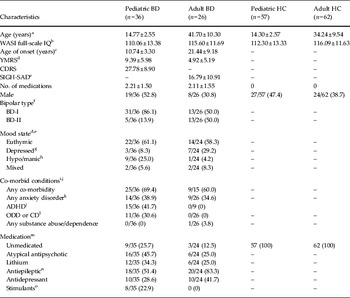
For demographic and clinical data, see Supplementary Material and Table 1.
Subject characteristics

BD, Bipolar disorder; HC, healthy comparisons; WASI, Wechsler Adult Intelligence Scale; YMRS, Young Mania Rating Scale; CDRS, Children's Depression Rating Scale; SIGH-SAD, Structured Clinical Interview Guide for the Hamilton Rating Scale, Seasonal Affective Disorders version; ADHD, attention deficit hyperactivity disorder; ODD, oppositional defiant disorder; CD, conduct disorder.
Values given as mean ± standard deviation or number (percentage).
a Adult groups were older than children groups (p's < 0.001). Adult BD patients were older than adult HC (p < 0.005).
b Missing data from one adult BD, one child HC and seven adult HC.
c Missing data from one pediatric BD. Pediatric BD patients had an earlier age of onset than adult BD patients (p < 0.001).
d Missing data from two adult BD patients. Higher YMRS scores in pediatric than in adult BD patients (p < 0.005).
e Missing data from two adult BD patients.
f Pediatric BD were more likely to be type I compared to adult BD (p < 0.005).
g Adult BD were more likely to be depressed compared to pediatric BD (p < 0.05).
h Pediatric BD were more likely to be hypomanic compared to adult BD (p < 0.05).
i Missing co-morbid diagnosis data from one pediatric BD.
j Missing co-morbid ADHD diagnostic data from 17 adult BD.
k Includes generalized anxiety disorder, separation anxiety disorder, social phobia, panic disorder, post-traumatic stress disorder and obsessive–compulsive disorder.
l Higher rates of ODD/CD in pediatric than in adult BD (p < 0.005).
m Missing medication data from one pediatric and two adult BD patients.
n Adult BD patients were more likely to be taking antiepileptic medications compared to pediatric patients (p < 0.01).
o Pediatric BD patients were more likely to be taking stimulant medications compared to adult patients (p < 0.01).
Behavioral analyses
Ratings
A diagnosis × age group × face emotion × attention state interaction (F 6,1026 = 2.30, p < 0.05) revealed that pediatric patients rated neutral faces as more hostile than did other groups (p's < 0.01) (see Supplementary Material and Table S1).
Reaction time
A diagnosis × face emotion interaction (F 3,513 = 4.41, p < 0.01) revealed that patients responded slowest to fearful faces and HC responded slowest to angry faces (p's < 0.05) (see Supplementary Material and Table S2).
fMRI analyses
Diagnosis × face emotion × attention state
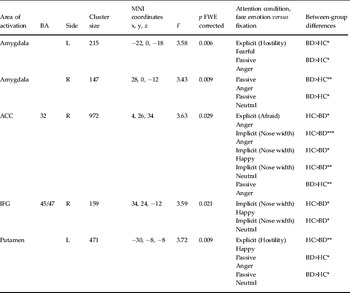
This three-way interaction yielded numerous significant FWE-corrected SVCs in the ROIs (Table 2).
Region of interest (ROI) results of the diagnosis × face emotion × attention state analysis

ACC, Anterior cingulate cortex; IFG, inferior frontal gyrus; BA, Brodmann area; BD, bipolar disorder; HC, healthy comparisons; R, right; L, left.
* p < 0.05, ** p < 0.01, *** p < 0.001.
Amygdala
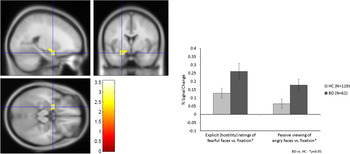
Compared to HC, patients showed left amygdala hyperactivation during explicit (hostility) ratings of fearful faces (t = 2.27, p = 0.03) and passive viewing of angry faces (t = 2.06, p = 0.04) (Fig. 1). Patients also showed right amygdala hyperactivation versus HC during passive viewing of angry and neutral faces (t = 2.82, p = 0.005 and t = 2.34, p = 0.02 respectively).
Left amygdala hyperactivity during explicit (hostility) ratings of fearful faces and passive viewing of angry faces in patients with bipolar disorder (BD) and healthy comparisons (HC).

ACC
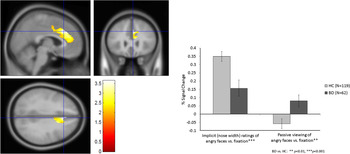
In response to angry faces during passive viewing, patients demonstrated hyperactivation in the right ACC (t = 2.76, p = 0.006). However, during explicit (subjective fear) ratings of angry faces (t = 2.46, p = 0.02) and during implicit (nose width) ratings of angry, happy and neutral faces, patients demonstrated right ACC hypoactivation (t's = 2.17−3.38, p's = 0.03−0.001) (Fig. 2).
Right anterior cingulate cortex (ACC) activation during angry faces: hypoactivity during implicit (nose width) ratings but hyperactivity during passive viewing in patients with bipolar disorder (BD) and healthy comparisons (HC).

IFG
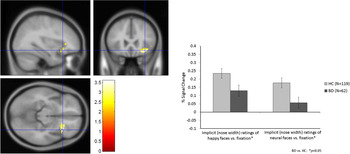
Patients demonstrated hypoactivation in the right IFG during implicit (nose width) ratings of happy and neutral faces (t = 1.96, p = 0.05 and t = 2.31, p = 0.02 respectively) (Fig. 3).
Right inferior frontal gyrus (IFG) hypoactivation during implicit (nose width) ratings of happy and neutral faces in patients with bipolar disorder (BD) and healthy comparisons (HC).

Putamen
Patients showed left putamen hyperactivation during passive viewing of angry and neutral faces (t = 2.38, p = 0.02 and t = 2.19, p = 0.03 respectively) and left putamen hypoactivation during explicit (hostility) ratings of happy faces (t = 2.71, p = 0.007).
Post-hoc analyses
Covarying age, ratings and reaction time
The three-way interactions remained significant when covarying age, hostility ratings of neutral faces and reaction time (p's < 0.05).
Mood state, co-morbid illnesses and medication
Post-hoc t tests comparing euthymic versus non-euthymic patients, patients with and without a co-morbid diagnosis, and unmedicated versus medicated patients indicated that mood state, co-morbidity and medication were unlikely to be driving the findings in most ROIs (p's > 0.07; see Supplementary Material). There was no association between activation in any ROI and number of medications, YMRS, CDRS or SIGH-SAD scores.
Diagnosis × age group
This two-way interaction was significant (p < 0.001, uncorrected, k = 152; p < 0.001, FWE corrected) in the left amygdala (−16, −4, −18) (F 1,177 = 5.40, p = 0.02), with child BD demonstrating greater activation than adult BD (p = 0.03).
Main effects of diagnosis
We found main effects of diagnosis in all ROIs (p's ⩽ 0.001, FWE corrected) except the left amygdala (p = 0.26, FWE corrected) (see Supplementary Material and Table S3). Compared to HC, BD showed hyperactivation in the right amygdala (t = –2.20, p = 0.03), left putamen (t = –1.94, p = 0.06) and right putamen (t = –1.78, p = 0.08). Also compared to HC, BD showed hypoactivation in the left (t = 2.39, p = 0.02) and right (t = 2.27, p = 0.03) ACC and left (t = 2.30, p = 0.02) and right (t = 2.79, p = 0.006) IFG.
Discussion
To our knowledge, this is the first study to compare neural activation in response to multiple face emotions and attentional conditions in adults and children with and without BD. We found that, relative to HC, both pediatric and adult patients demonstrated amygdala hyperactivity during both explicit ratings (hostility of fearful faces) and unconstrained processing (passive viewing of angry and neutral faces). BD hypoactivation in the IFG was present during implicit processing (nose width ratings) of neutral and happy faces. ACC and putamen abnormalities were present in response to angry, happy and neutral faces; however, the direction of dysfunction depended on attentional demands. BD patients showed ACC and putamen hyperactivation to angry and neutral faces when attention was unconstrained but ACC and putamen hypoactivation when attention was constrained, either with an implicit (nose width rating) or explicit (subjective fear or hostility rating) task. Neural dysfunction did not differ between euthymic versus non-euthymic, medicated versus unmedicated BD patients, and those with versus those without co-morbidities. Behaviorally, consistent with work in a partially overlapping sample (Rich et al. Reference Rich, Vinton, Roberson-Nay, Hommer, Berghorst, McClure, Fromm, Pine and Leibenluft2006; Brotman et al. Reference Brotman, Rich, Guyer, Lunsford, Horsey, Reising, Thomas, Fromm, Towbin, Pine and Leibenluft2010), pediatric BD patients rated neutral faces as more hostile than did other groups.
In the context of multiple face emotions and attention conditions, patients had pervasive overactivity in the amygdala in response to negatively valenced and neutral faces during both unconstrained attention and explicit face emotion processing. Main effects of diagnosis also showed BD hyperactivity in the right amygdala across the entire task (i.e. all attention conditions and face emotions). The amygdala is crucial to effective emotional appraisal and regulation (Davis & Whalen, Reference Davis and Whalen2001), and our results are consistent with BD patients’ dysfunction in these domains (Pavuluri & Passarotti, Reference Pavuluri and Passarotti2008; Kohler et al. Reference Kohler, Hoffman, Eastman, Healey and Moberg2011). Our findings add to the existing literature by demonstrating amygdala hyperactivation in both pediatric and adult BD across several attentional conditions and in response to several face emotion types.
Consistent with the literature (Chen et al. Reference Chen, Suckling, Lennox, Ooi and Bullmore2011; Delvecchio et al. Reference Delvecchio, Fossati, Boyer, Brambilla, Falkai, Gruber, Hietala, Lawrie, Martinot, McIntosh, Meisenzahl and Frangou2012; Kupferschmidt & Zakzanis, Reference Kupferschmidt and Zakzanis2011; Foland-Ross et al. Reference Foland-Ross, Bookheimer, Lieberman, Sugar, Townsend, Fischer, Torrisi, Penfold, Madsen, Thompson and Altshuler2012), we also observed IFG hypoactivation in BD during implicit ratings of happy and neutral faces; main effects of diagnosis revealed general BD hypoactivation during the task. The IFG is also crucial in the integration of emotional information (Cabeza & Nyberg, Reference Cabeza and Nyberg2000) and emotion regulation (Quirk & Beer, Reference Quirk and Beer2006), and plays a role in effective modulation of the amygdala. Indeed, some studies suggest that IFG dysfunction is unique to BD relative to other mood disorders (Delvecchio et al. Reference Delvecchio, Fossati, Boyer, Brambilla, Falkai, Gruber, Hietala, Lawrie, Martinot, McIntosh, Meisenzahl and Frangou2012).
In contrast to amygdala hyperactivity and IFG hypoactivation, dysfunction in the cognitive control circuit comprising the ACC and putamen was sensitive to task demands. The relevant literature in BD is mixed, demonstrating both frontostriatal hyperactivity (Lawrence et al. Reference Lawrence, Williams, Surguladze, Giampietro, Brammer, Andrew, Frangou, Ecker and Phillips2004; Rich et al. Reference Rich, Vinton, Roberson-Nay, Hommer, Berghorst, McClure, Fromm, Pine and Leibenluft2006; Pavuluri et al. Reference Pavuluri, O'Connor, Harral and Sweeney2007; Wessa et al. Reference Wessa, Houenou, Paillère-Martinot, Berthoz, Artiges, Leboyer and Martinot2007; Foland et al. Reference Foland, Altshuler, Bookheimer, Eisenberger, Townsend and Thompson2008; Hassel et al. Reference Hassel, Almeida, Kerr, Nau, Ladouceur, Fissell, Kupfer and Phillips2008, Reference Hassel, Almeida, Frank, Versace, Nau, Klein, Kupfer and Phillips2009; Robinson et al. Reference Robinson, Monkul, Tordesillas-Gutiérrez, Franklin, Bearden, Fox and Glahn2008; Chen et al. Reference Chen, Suckling, Ooi, Jacob, Lupson, Bullmore and Lennox2010; Surguladze et al. Reference Surguladze, Marshall, Schulze, Hall, Walshe, Bramon, Phillips, Murray and McDonald2010; Ladouceur et al. Reference Ladouceur, Farchione, Diwadkar, Pruitt, Radwan, Axelson, Birmaher and Phillips2011; Hulvershorn et al. Reference Hulvershorn, Karne, Gunn, Hartwick, Wang, Hummer and Anand2012; Keener et al. Reference Keener, Fournier, Mullin, Kronhaus, Perlman, LaBarbara, Almeida and Phillips2012) and hypoactivity (Yurgelun-Todd et al. Reference Yurgelun-Todd, Gruber, Kanayama, Killgore, Baird and Young2000; Lawrence et al. Reference Lawrence, Williams, Surguladze, Giampietro, Brammer, Andrew, Frangou, Ecker and Phillips2004; Lennox et al. Reference Lennox, Jacob, Calder, Lupson and Bullmore2004; Blumberg et al. Reference Blumberg, Donegan, Sanislow, Collins, Lacadie, Skudlarski, Gueorguieva, Fulbright, McGlashan, Gore and Krystal2005; Pavuluri et al. Reference Pavuluri, O'Connor, Harral and Sweeney2007, Reference Pavuluri, Passarotti, Harral and Sweeney2009; Altshuler et al. Reference Altshuler, Bookheimer, Townsend, Proenza, Sabb, Mintz and Cohen2008; Foland et al. Reference Foland, Altshuler, Bookheimer, Eisenberger, Townsend and Thompson2008; Killgore et al. Reference Killgore, Gruber and Yurgelun-Todd2008; Pochon et al. Reference Pochon, Riis, Sanfey, Nystrom and Cohen2008; Hassel et al. Reference Hassel, Almeida, Frank, Versace, Nau, Klein, Kupfer and Phillips2009; Garrett et al. Reference Garrett, Reiss, Howe, Kelley, Singh, Adleman, Karchemskiy and Chang2012; Hulvershorn et al. Reference Hulvershorn, Karne, Gunn, Hartwick, Wang, Hummer and Anand2012) in BD. Our work may clarify the previous findings by indicating that, compared to HC, unconstrained viewing was associated with hyperactivity in BD whereas directed attention (either explicit or implicit ratings) elicited hypoactivation in these regions.
The ACC and putamen are important components of the emotional processing and cognitive control circuits, with involvement in attention allocation, conflict detection and cognitive interference mediation (Devinsky et al. Reference Devinsky, Morrell and Vogt1995; Bush et al. Reference Bush, Luu and Posner2000). When attention was unconstrained during passive viewing of angry or neutral faces, BD patients demonstrated ACC, amygdala and putamen hyperactivation. It is difficult to interpret activation patterns during passive viewing because we do not know the cognitive processes engaged. However, in the absence of attentional instructions, viewing emotional faces while continuing to comply with the demands of being in the scanning environment may require greater engagement of cognitive control regions in patients than in healthy subjects.
In contrast to hyperactivity during passive viewing of angry and neutral faces, BD patients showed hypoactivation in the ACC and putamen when asked to attend to either nose width or their subjective fear while viewing a face. Of note, the pattern of activation in these areas during constrained attention tasks was similar to that in the IFG. This suggests that, compared to healthy subjects, patients did not engage the cognitive control circuit effectively in the context of these task demands. The nose width rating task is, in essence, a cognitive interference task because subjects are asked to rate nose width while not attending to the face emotion. Healthy subjects recruited the cognitive control circuit during this task whereas BD patients showed relative hypoactivity in the circuit, consistent with prior work demonstrating executive (Fleck et al. Reference Fleck, Shear, Madore and Strakowski2008) and cognitive control (Strakowski et al. Reference Strakowski, Adler, Holland, Mills, DelBello and Eliassen2005; Drevets et al. Reference Drevets, Savitz and Trimble2008) dysfunction in BD. Similarly, when rating their subjective fear of an angry or happy face, BD patients did not engage this circuit. Despite these differences in neural activity, there were no group differences in performance, possibly because imaging measures may be more sensitive to group differences than behavioral measures. Other studies also find decreased PFC activation in BD patients without group differences in performance (Foland et al. Reference Foland, Altshuler, Bookheimer, Eisenberger, Townsend and Thompson2008; Hassel et al. Reference Hassel, Almeida, Kerr, Nau, Ladouceur, Fissell, Kupfer and Phillips2008; Foland-Ross et al. Reference Foland-Ross, Bookheimer, Lieberman, Sugar, Townsend, Fischer, Torrisi, Penfold, Madsen, Thompson and Altshuler2012).
We expected, but did not observe, three additional findings in the amygdala: (1) that the implicit task (nose width), like the explicit and passive viewing tasks, would elicit amygdala hyperactivity; (2) that during implicit processing amygdala dysfunction would be more marked in pediatric versus adult BD; and (3) that BD would show amygdala hyperactivity to happy faces.
While multiple reasons, including Type II error, may have contributed to not observing amygdala hyperactivity during implicit processing, one potential explanation is that our implicit task involves nose width rating rather than the more commonly used gender labeling (Lawrence et al. Reference Lawrence, Williams, Surguladze, Giampietro, Brammer, Andrew, Frangou, Ecker and Phillips2004; Kalmar et al. Reference Kalmar, Wang, Chepenik, Womer, Jones, Pittman, Shah, Martin, Constable and Blumberg2009; Surguladze et al. Reference Surguladze, Marshall, Schulze, Hall, Walshe, Bramon, Phillips, Murray and McDonald2010; Ladouceur et al. Reference Ladouceur, Farchione, Diwadkar, Pruitt, Radwan, Axelson, Birmaher and Phillips2011; Kim et al. Reference Kim, Thomas, Rosen, Moscicki, Brotman, Zarate, Blair, Pine and Leibenluft2012). We used nose width, as opposed to gender labeling (a binary option), to parallel the 1–5 ratings in the explicit rating conditions. If subjects had been allowed to process the face globally within the context of an implicit task such as gender labeling, rather than being asked to direct their attention to a specific region of the face (nose), we may have detected amygdala hyperactivity in BD. In fact, recent eye tracking work indicates dysfunctional gaze patterns in BD, whereby patients focus less on the eyes and more on the nose relative to HC subjects (Kim et al., Reference Kim, Arizpe, Rosen, Razdan, Haring, Jenkins, Deveney, Brotman, Blair, Pine, Baker and Leibenluftin press). In the nose width condition, subjects were instructed to focus their eye gaze to the nose. This task instruction may have obfuscated between-group differences in amygdala processing during this implicit processing condition. In addition, it has been suggested that tasks that impose fewer attentional demands (e.g. gender labeling, passive viewing) are more likely to elicit amygdala activation (Costafreda et al. Reference Costafreda, Brammer, David and Fu2008); judging nose width requires a relatively high level of effortful attention and thus may be less likely to elicit amygdala activation. Consistent with this, in the current study we found amygdala hyperactivation during passive viewing of angry and neutral faces but not during the implicit task (nose width).
Second, we did not detect differences in amygdala function between pediatric and adult BD specifically during the implicit rating condition. However, across all attention conditions and face emotions, diagnosis by age group interactions showed that left amygdala hyperactivation was more pervasive in pediatric than in adult BD patients. The one prior study comparing pediatric versus adult BD used a gender labeling paradigm; across emotions, there was amygdala hyperactivity in pediatric BD versus adult BD and healthy subjects (Kim et al. Reference Kim, Thomas, Rosen, Moscicki, Brotman, Zarate, Blair, Pine and Leibenluft2012). Consistent with those results, our findings suggests that, relative to adult BD, pediatric patients’ amygdala dysfunction may be particularly pervasive and less sensitive to attentional demands and face emotions.
Third, although angry, fearful and neutral faces elicited amygdala hyperactivity, we did not observe amygdala hyperactivation to happy faces. Others have noted amygdala hyperactivation to happy faces in both BD children and adults (Lawrence et al. Reference Lawrence, Williams, Surguladze, Giampietro, Brammer, Andrew, Frangou, Ecker and Phillips2004; Blumberg et al. Reference Blumberg, Donegan, Sanislow, Collins, Lacadie, Skudlarski, Gueorguieva, Fulbright, McGlashan, Gore and Krystal2005; Chen et al. Reference Chen, Lennox, Jacob, Calder, Lupson, Bisbrown-Chippendale, Suckling and Bullmore2006; Pavuluri et al. Reference Pavuluri, O'Connor, Harral and Sweeney2007, Reference Pavuluri, Passarotti, Harral and Sweeney2009; Surguladze et al. Reference Surguladze, Marshall, Schulze, Hall, Walshe, Bramon, Phillips, Murray and McDonald2010). Those paradigms included varying intensities of happiness in the faces, with some studies demonstrating amygdala hyperactivity to mild, and others to intense, happiness (Lawrence et al. Reference Lawrence, Williams, Surguladze, Giampietro, Brammer, Andrew, Frangou, Ecker and Phillips2004; Surguladze et al. Reference Surguladze, Marshall, Schulze, Hall, Walshe, Bramon, Phillips, Murray and McDonald2010). Here, we used only one face emotion intensity. Future studies are needed to examine the neural correlates of subtle changes in emotional expressions and corresponding patterns of neural modulation.
These findings should be considered in light of additional limitations. First, our BD patients were in a variety of mood states at the time of testing, which may influence neural activity (Foland-Ross et al. Reference Foland-Ross, Bookheimer, Lieberman, Sugar, Townsend, Fischer, Torrisi, Penfold, Madsen, Thompson and Altshuler2012; Liu et al. Reference Liu, Blond, van Dyck, Spencer, Wang and Blumberg2012; Townsend & Altshuler, Reference Townsend and Altshuler2012). However, findings did not differ between euthymic (n = 36) and non-euthymic (n = 24) BD patients, and there was no relationship between mood rating scores and activation in any ROIs, suggesting that mood state did not account for our results. Second, most BD patients had co-morbid diagnoses (n = 34), but they did not differ from BD patients without a co-morbid diagnosis (n = 28) in blood oxygen level-dependent (BOLD) activity in most ROIs. Of note, BD patients with co-morbidities showed higher amygdala activity during passive viewing of neutral faces compared to BD without co-morbidities, suggesting that co-morbid diagnoses may be associated with more severe amygdala dysfunction. Third, most patients were medicated; although activation did not differ between medicated (n = 47) and unmedicated (n = 12) patients, these post-hoc analyses were underpowered and thus susceptible to Type II error. Studies indicate that neural dysfunction may normalize with treatment, suggesting that medication may be unlikely to be driving the between-group differences that we observed (Chang et al. Reference Chang, Wagner, Garrett, Howe and Reiss2008; Phillips et al. Reference Phillips, Travis, Fagiolini and Kupfer2008; Passarotti et al. Reference Passarotti, Sweeney and Pavuluri2010, Reference Passarotti, Sweeney and Pavuluri2011; Hafeman et al. Reference Hafeman, Chang, Garrett, Sanders and Phillips2012; Pavuluri et al. Reference Pavuluri, Passarotti, Fitzgerald, Wegbreit and Sweeney2012). Although our sample sizes compare favorably to those in the literature, future studies with even larger samples are needed to clarify the role of psychotropic medication, co-morbidity and mood state on the neural correlates of face emotion processing. Finally, although this face viewing paradigm enabled us to examine multiple face emotions and attention states, each is sampled relatively sparsely (eight replicates for each attentional condition). Although this design maintained short task duration and increased tolerance for youth and adults with severe psychopathology, it precluded connectivity analyses. The task is also prone to Type II error, particularly in the context of complicated models with multiple within- and between-subject variables. Thus, the findings we observed are likely to be particularly robust.
In sum, our results demonstrate fronto-limbic-striatal dysfunction in both pediatric and adult BD. In the context of multiple face emotions and attention conditions, we observed amygdala hyperactivation during both explicit (i.e. hostility ratings of fearful faces) and unconstrained processing (i.e. passive viewing of angry and neutral faces), and IFG hypoactivation during implicit ratings of happy and neutral faces. By contrast, ACC and striatal dysfunction were most sensitive to task demands. We observed hypoactivation in BD in these regions when attention was directed during either an implicit or an explicit rating, but hyperactivation when attention was unconstrained. Future imaging studies should continue to examine stimulus valence and attentional demands in the pathophysiology of pediatric and adult BD. Moreover, work is needed to explore the functional connectivity of the frontal-limbic-striatal circuit in the development and maintenance of the illness.
Supplementary material
For supplementary material accompanying this paper, visit http://dx.doi.org/10.1017/S003329171300202X.
Acknowledgments
Funding for this study was provided by the Intramural Research Program of the National Institute of Mental Health (NIMH), National Institutes of Health (NIH). We thank the staff of the Emotion and Development and Experimental Therapeutics and Pathophysiology Branches at NIMH and the patients and their parents for their participation.
Declaration of Interest
Dr Olsavsky's research was made possible through the Clinical Research Training Program, a public–private partnership supported jointly by the NIH and Pfizer Inc. (through a grant to the Foundation for NIH from Pfizer Inc.). Dr Zarate is listed as a co-inventor on a patent application for the use of ketamine in major depression. Dr Zarate has assigned his rights in the patent to the US government but will share a percentage of any royalties that may be received by the government. All other authors have no conflicts to disclose.