In the past several decades, many scholars of public opinion in the United States have argued that American women are less likely than American men to endorse military action as a means to deal with international problems. Evidence for this “gender gap” has been found in studies of public opinion during major international conflicts (Bendyna et al. Reference Bendyna, Finucane, Kirby, O'Donnell and Wilcox1996; Wilcox, Ferrara, and Allsop Reference Wilcox, Ferrara and Allsop1993), as well as studies of longitudinal trends that examined pooled data sets from multiple conflict periods (Berinsky Reference Berinsky2009; Burris Reference Burris2008; Fite, Genest, and Wilcox Reference Fite, Genest and Wilcox1990; Shapiro and Mahajan Reference Shapiro and Mahajan1986). Researchers sometimes view men's generally greater rates of support for military actions as part of a more general “gender gap” phenomenon in U.S. politics, but the cumulative evidence has suggested that foreign policy issues and questions of peace/war generate the widest and most consistent gender gaps (see Holsti Reference Holsti2004, 209–10 for a review).
THEORETICAL EXPLANATIONS AND DERIVED HYPOTHESES
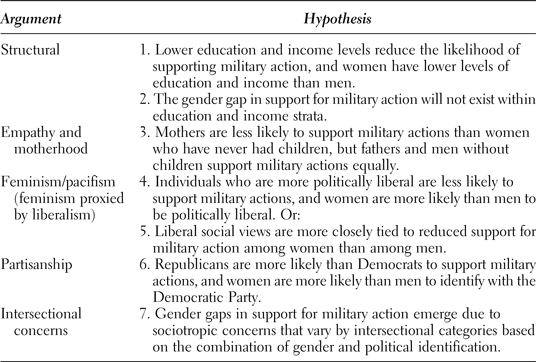
Theoretical explanations that assume the gender gap is consistent over time fall into three general types. First, structural explanations attribute women's lower levels of support for military action to their inferior position within the socioeconomic and/or political stratification system. Proponents of these explanations argue that women's social position leads them to endorse policies that prefer “bread over bombs” (i.e., women want the government to spend money on reducing educational and income inequality in the United States, rather than on fighting wars abroad)Footnote 1 and to be less informed and less interested in foreign affairs than men, specifically as a result of their lower level of education (for critical reviews of these arguments, see Bendyna et al. Reference Bendyna, Finucane, Kirby, O'Donnell and Wilcox1996; Nincic and Nincic Reference Nincic and Nincic2002; Wilcox, Ferrara, and Allsop Reference Wilcox, Ferrara and Allsop1993).Footnote 2 Two hypotheses emerge from the structural approach:
H1:
Lower education and income levels reduce the likelihood of support for military action, and women have lower levels of education and income than men.
H2:
Because an individual's attitudes are attributed to her level of education and economic success, the gender gap in support for military action will not exist within education and income strata. Footnote 3
Second, scholars who embrace an “empathy and motherhood” approach attribute women's lower propensity to endorse military actions to their stronger tendency to feel empathy and compassion for victims of war. These scholars assert that women's higher levels of empathy are associated with the experience of motherhood (Brooks and Valentino Reference Brooks and Valentino2011; Ruddick Reference Ruddick1980, Reference Ruddick1995). Mothers, according to this argument, feel empathy because they have children and thus abhor war and feel sorry for the victims (other people's children) that war creates abroad. Another (less prevalent) argument that centers on motherhood suggests that childrearing makes women (relative to men) less attentive to news reports and less informed about foreign affairs, and as a result women are less likely to be mobilized to support military actions (for a review, see Bendyna et al. Reference Bendyna, Finucane, Kirby, O'Donnell and Wilcox1996, 2). Arguments that highlight the experience of women as mothers are different from the previous (structural) argument insofar as they suggest that regardless of the class or educational background of a woman, it is her identity as a mother that shapes her attitudes toward U.S. military intervention. This type of argument leads to my next hypothesis:
H3:
Women who are mothers will be less likely to support military actions than women who have never had children, but fathers and men without children will support military actions equally.
A third type of argument ties pacifist attitudes to feminist consciousness. This perspective is part of a larger approach that highlights the relationship between the adoption of a feminist identity and the espousal of liberal, egalitarian, and pacifist values, which are viewed as the alternative to values more likely to be embraced by men: conservatism, competitiveness (i.e., an orientation toward dominance), and militancy (Conover Reference Conover1988). Rooted in the feminist writing of the 1980s, this argument generally assumes that whereas most women are socialized to accept masculine values, women who adopt a feminist identity are resocialized—they discover and embrace “women's values” (e.g., compassion and responsibility for others), which in turn reshapes their policy preferences (see Conover Reference Conover1988 for a review). Some authors have attributed the espousal of these values to women's roles and experiences as mothers (e.g., Ruddick Reference Ruddick1980, Reference Ruddick1995). However, the “feminism/pacifism” approach differs from the “empathy and motherhood” argument because the former stresses that only a woman who experiences a feminist turn in her socialization will adopt a “woman's perspective” that will then shape her policy preferences. Therefore, with respect to the gender gap in support for military actions, this perspective maintains that the gender gap is not a general phenomenon, but rather a result of lower levels of support for wars among a subset of women who are both feminists and pacifists (and that there is no—or a much smaller—parallel subgroup of men). Proponents of this perspective contend that the attitudes of women in this feminist-pacifist subset reduce the average level of support for military actions among women (Brooks and Valentino Reference Brooks and Valentino2011; Conover Reference Conover1988; Conover and Sapiro Reference Conover and Sapiro1993).Footnote 4
Feminism is not measured directly in the current study. Instead, respondents’ self-reported level of liberalism is used as a proxy for feminism. (The use of this proxy is discussed in detail on pages 16–17) Thus, for the gender gap to emerge through the “feminism/pacifism” mechanism, one of the two following hypotheses must hold:
H4:
Individuals who are more politically liberal are less likely to support military actions, and women are more likely than men to be politically liberal.
H5:
Because for many women liberalism and pacifism are closely related ideological frameworks, we can expect liberal social views to be tied more closely to reduced support for military action among women than among men.
This final hypothesis stands in contrast to Cook and Wilcox's (Reference Cook and Wilcox1991) argument that feminism leads to feminist—not feminine—values and thus should have similar effects on women and men.
RECENT CHALLENGES TO THE “GENDER GAP” ARGUMENT
Despite the notable progress in this field, the gender gap in U.S. public opinion about military actions is still not well understood for three reasons. First, several researchers have conducted cross-national comparisons of public reactions to war, showing that while the gender gap in the United States is generally significant (both statistically and substantively), gender gaps in other countries are considerably smaller or even completely absent (Eichenberg Reference Eichenberg2012; Tessler, Nachtwey, and Grant Reference Tessler, Nachtwey and Grant1999; Wilcox, Hewitt, and Allsop Reference Wilcox, Hewitt and Allsop1996). This cross-national variation challenges the theoretical arguments outlined above because in principle, each argument should be valid not just for the United States, but for other countries engaged in wars. (For example, if structural differences generate the gender gap, the gap should emerge not only in the United States, but also in any country that engages in war and has gendered economic and educational stratification).
Second, the majority of previous studies have examined relatively stable (or slowly changing) characteristics of men and women (e.g., education and income). While this line of investigation has produced important insights, the role of contextual factors in the formation of the gender gap merits further study. Eichenberg (Reference Eichenberg2003, Reference Eichenberg2016) showed that the characteristics of military actions affect the size of the gender gap in the United States. Specifically, the gender gap was widest when military actions involved sending troops abroad and when the policy objective of the action was to restrain a foreign aggressor or force political change in a foreign country. In contrast, the gender gap was smaller for operations that did not involve sending ground troops and when the official goal was humanitarian or peacekeeping. Further, as shown later in this article, the size of the gender gap also varies across phases of a given military engagement. The gender gap, in other words, has an important episodic aspect that so far has not been thoroughly investigated.
Third, as current feminist literature highlights, gender categories are not homogenous, but rather contain individuals with various life experiences, beliefs, attitudes, and loyalties influenced by the intersection of gender and other systems of social classification. This fundamental insight about “intersectionality” (e.g., Crenshaw Reference Crenshaw1989; Hill Collins Reference Hill Collins1998) has not been incorporated in studies of the gender gap phenomenon (as suggested by the use of the term “gender gap”). Specifically, research on the topic has neglected the possibility that gender interacts with variables such as partisanship and ethnicity/race to create a range of subnational constituencies whose members differ in their propensity to respond positively or negatively to military actions.Footnote 5
THE INTERSECTION OF GENDER AND PARTY AFFILIATION
The current study highlights the intersection of gender and partisanship for both empirical and theoretical reasons. Prior studies have established that partisanship plays a pivotal and growing role in public opinion formation in the United States (Allison Reference Allison2011; Berinsky Reference Berinsky2009), and for several decades there has been a growing gender gap in partisanship such that women are more likely than men to identify with the Democratic Party (Erikson, MacKuen, and Stimson, Reference Erikson, MacKuen and Stimson2002, 172–73; Kaufmann Reference Kaufmann2002), and conversely, men are more likely than women to embrace conservative positions and identify with the Republican Party (Kaufmann and Petrocik Reference Kaufmann and Petrocik1999; Norrander Reference Norrander and Whitaker2008, 25–26; Wirls Reference Wirls1986). In the United States, identification with the political right increases the likelihood of supporting militant policies (Gries Reference Gries2014); thus, partisanship might moderate, and perhaps even mediate, the effect of gender on attitudes about military actions. (The mechanism, according to Bendyna's Reference Bendyna, Finucane, Kirby, O'Donnell and Wilcox1996 critical review, is that men are more easily mobilized by Republican politicians who call for military actions, while women are more likely to be influenced by Democratic politicians who counsel restraint.) This scenario leads to a dual hypothesis:
H6:
Republicans are more likely than Democrats to support military actions, and women are more likely than men to identify with the Democratic Party. Footnote 6
However, by attributing men's and women's different propensities to identify with the political left or right to their gender per se, this approach to the gender gap preserves a disturbing degree of gender essentialism. A more nuanced (and less essentialist) approach focuses on differences within gender categories. For example, recent studies of gender differences in ideological identification and partisanship in the United States (Huddy, Cassese, and Lizotte Reference Huddy, Cassese, Lizotte and Whitaker2008; Norrander and Wilcox Reference Norrander and Wilcox2008) show that these differences reflect, to a significant degree, a split between women due to different social backgrounds: whereas highly educated, secular, single, and black women are more likely to identify as liberal and Democrat, less educated (but more affluent), white, and more religious women tend to identify as conservative and Republican. This insight about political attitudes in the United States suggests that the investigation of the gender gap in support for military action should move beyond the basic gender gap in partisan identification (i.e., women are more likely than men to identify with the Democratic Party and men are more likely than women to identify with the Republican Party). Instead, the investigation should observe how, in light of an anticipated or ongoing military engagement, men's and women's attitudes form and vary within each political camp. In particular, the investigation should seek to uncover the distinct concerns that lead specific subsets of men and women to differ from other subsets in their attitudes toward specific military engagements.
Studies of public opinion in the United States have stressed the importance of sociotropic concerns (as opposed to personal interests) for policy preferences (Huddy et al. Reference Huddy, Feldman, Taber and Lahav2005; Joslyn and Haider-Markel Reference Joslyn and Haider-Markel2007; Kinder and Kiewiet Reference Kinder and Kiewiet1979; Sears Reference Sears and Kuklinski2001). Therefore, the investigation of the gender gap in support for military action should also focus on this type of concern, which represents ideological preferences, and not on self-interests that might derive from the social position of individuals in society (which structural arguments highlight) (Nincic and Nincic Reference Nincic and Nincic2002). Furthermore,
H7:
Sociotropic concerns vary not simply by gender or partisanship, but across categories based on the interaction of gender and political identification.
This hypothesis can be labeled “intersectional concerns.” Thus, for example, in light of a specific expected or ongoing military engagement, the concerns of Democrat women might be different from the concerns of both Republican women and Democrat men (and, of course, from the concerns of Republican men, which may be a more trivial finding). Table 1 summarizes the full set of hypotheses.
Summary of hypotheses

METHODOLOGY
Although the gender gap is an aggregate phenomenon, understanding it requires analysis of individual-level data. The following section includes three distinct but complementary analyses of the gender gap in support for military action. In the first section, hypotheses that are derived from the main theoretical arguments are tested via an analysis of data from repeated cross-sectional public opinion polls conducted from 1986 to 2007 during or in anticipation of military operations. The results of this analysis point to political identification as an important mechanism driving gender gaps, and thus the second section uses the same data to examine how gender interacted with partisanship over the course of three military operations: the Gulf War, the NATO campaign in Kosovo, and the Iraq War. The third section narrows the scope of analysis but increases the empirical richness: this section includes analyses of variable-rich survey data collected during the 2003 invasion of Iraq to further test the theoretical arguments examined in the first section, and to investigate arguments that could not be tested using the larger data set. In both the first and third parts of the analysis, standard regression analysis is followed by mean decomposition that allows an assessment of the relative importance of gap-generating mechanisms.
Outcome Variable
The outcome variable in all steps of the data analysis takes a binary format, which records whether respondents supported or opposed military actions. The variable combines information from two standard Gallup questions asked during or in anticipation for military engagements: (1) “Do you favor or oppose the war with [country name]?” and “Do you approve or disapprove of the U.S. decision to go to war with [country name]?”
Explanatory Variables
The structural argument is represented by two variables: (1) the respondent's education level (8-level scale) and (2) the respondent's annual income (6-level scale). The “empathy and motherhood” argument is tested via two proxy variables: (1) a variable that records the respondent's marital status and (2) a variable that records whether the respondent had children living with her at home (see pages 15–16 for the discussion of these proxies). The feminism/pacifism argument is tested via a variable that records political ideology (5-level scale; see pages 16–17 for a discussion of the use of this variable as a proxy for feminism). Partisanship is measured by a set of dummy variables for identification as Republican, Democrat, or independent.Footnote 7 The data set analyzed in the final section (about the Iraq War) includes several other variables that assess specific concerns of respondents (for example, concern about the economic consequences of the war). (These additional variables are reviewed on pages 31–32.)
Statistical models also include several control variables: (1) the number of days from the survey to the onset of military action, (2) the number of days from the onset of military action to the survey, (3) age, and (4) race/ethnicity.
DATA ANALYSIS AND DISCUSSION
Part 1: Estimating Gender Gaps from 1986 to 2011
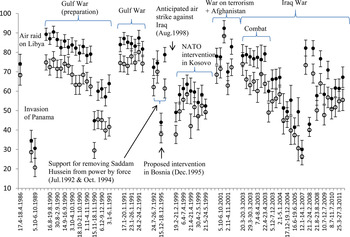
Figure 1 presents estimates of support for military actions from 74 Gallup surveys that asked respondents about their attitudes toward wars or smaller military operations undertaken by the U.S. military, starting with the air raid on Libya in 1986 and ending with the Iraq War. Most questions focused on support for or opposition to military actions, but a small number inquired about support for sending troops to fight in anticipated wars or (primarily on the right side of the graph) asked participants whether or not going to war was a mistake. The figure includes 95% confidence intervals for each estimated mean; when the confidence interval lines for men and women overlap, the gender gap is not statistically significant.
Mean and 95% confidence intervals of support rates for military actions (various measures) by gender, U.S. adult citizens, 1986–2011.

The results in Figure 1 offer three fundamental insights about the gender gap in support for military actions. First, in the United States, the rate of support for military actions is consistently higher for men than for women (women's support rate did not exceed that of men in any survey). Second, while the average size of the gender gaps in Figure 1 is about 10.6 percentage points, the gaps vary from 3 to 22 percentage points. This variation is a strong reason to avoid sweeping, ahistorical statements about the gender gap. The data clearly show that at some historical moments there were considerable gaps between the attitudes of American men and women, but on other occasions there was a virtual consensus between men and women, either in favor of or against military actions. Therefore, the gender gap is, to a significant degree, an episodic phenomenon.
Third, many of the estimated gender gaps (about 40%) were not statistically significant. While it is not surprising that the very small gaps failed to reach statistical significance, strikingly, several fairly sizable gaps of seven to nine points also failed to reach significance despite having sizable samples. The likely reason for these results is the considerable variation in the attitudes expressed within each of the gender categories.
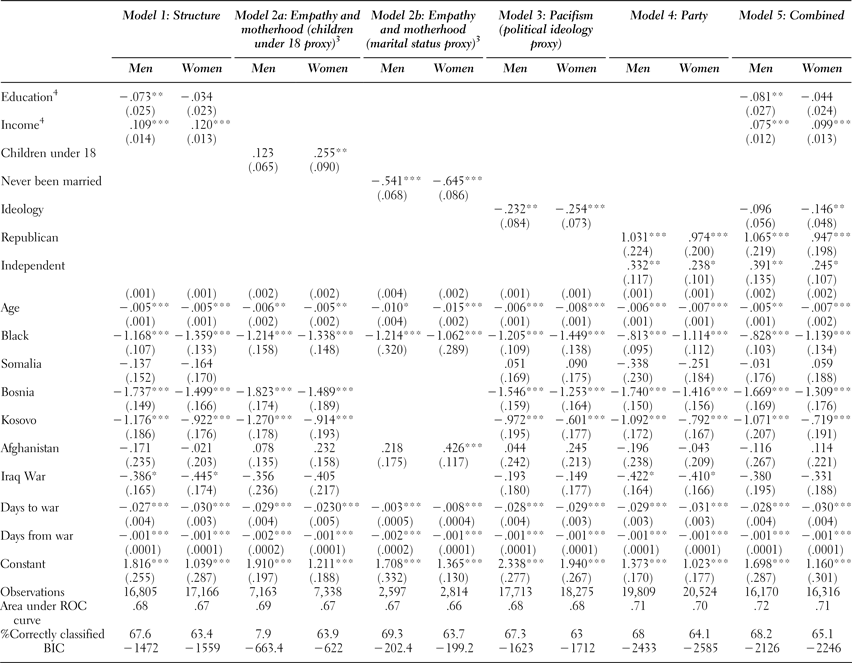
Next, I calculate a decomposition of the gender gap and test how other predictors mediate or moderate the relationship between gender and support for and opposition to military actions. Table 2a presents the findings of a regression analysis using data from 49 polls. The outcome variable combined information from two standard questions about support for military action: (1) “Do you favor or oppose the U.S. war with [country name]?” (2) “Do you approve or disapprove of the U.S. decision to go to war with [country name]?” (Of the polls included in Figure 1, 25 were not included in the regression analysis because they used different terminology to ask about support for military actions or because they lacked data on important explanatory variables.)
Coefficients from logistic regressions modeling support for military actions, United States 1986–2007 polls1,2

Source: Gallup.
Notes: ***p < .001, **p < .01, *p < .05 (robust standard errors in parentheses).
1. To keep the measurement of the outcome variable consistent, this part of the analysis does not include data collected after January 2007 because up until then surveys included a question about support or opposition to ongoing or expected military actions. Since then the surveys only asked whether going to war was a mistake or not.
2. Because the estimated coefficients from decomposition are not invariant to the choice of omitted dummy, we use in all decompositions an ANOVA-type normalization procedure that allow us to estimate coefficients for the entire set of dummies without changing the aggregate effect or the sum of characteristics effect. Therefore, Tables 1b and 2b report coefficients for dummy variables that in Tables 1a and 2a served as reference (“omitted”) variables. (See Powers, Yoshioka, and Yun Reference Powers, Yoshioka and Yun2001, 562–63)
3. Models 2a and 2b omit some of the war dummy variables because their inclusion created a collinearity problem due to the reduced sample size. Interaction models that included the full list of war dummy variables and used an equivalent method for decomposing the gender gap produced similar findings.
4. An additional analysis with this variable in its ordinal format leads to the same conclusion.
The coefficients in Table 2a are the log-odds of supporting military actions rather than objecting to these actions. Although this data set has a limited capacity to test the theoretical arguments directly, variables such as education, income, ideology, and partisan identification can be used to test some of the arguments; specific models and the use of proxy variables are discussed below. Each of the regression models in Table 2a includes a variable or a set of variables that tests the hypotheses derived from one of the theoretical arguments about the gender gap. (A set of control variables is included in all models.) The results are presented separately for women and men to facilitate comparison.
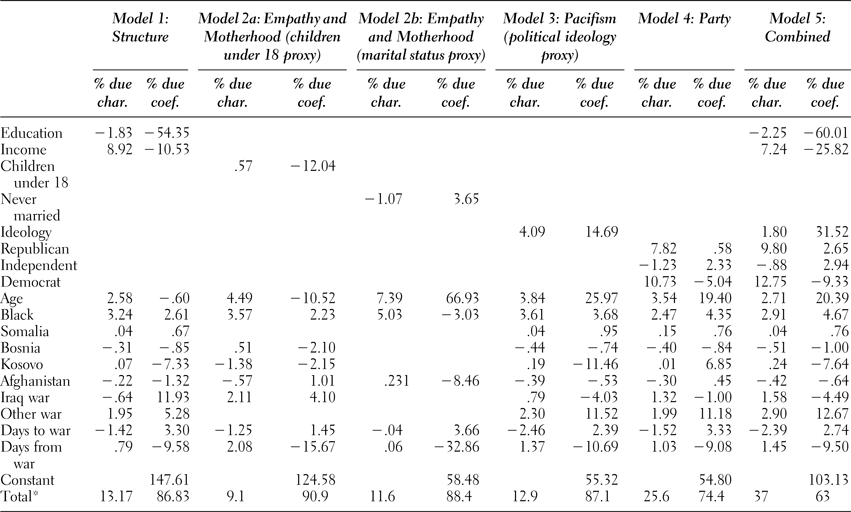
Next, the models in Table 2b decompose the gender gap using the multivariate decomposition method proposed by Powers, Yoshioka, and Yun (Reference Powers, Yoshioka and Yun2011). This procedure estimates by how many percentage points the gender gap would increase or decrease if gender differences in the sizes of the coefficients for each of the independent variables (the size of the effects, or the “returns” in economic jargon) were eliminated, and by how many percentage points the gap would increase or decrease if the scores of men and women on those variables (the distributions, or individuals’ “assets”) were equalized.
Gender gap decomposition

Notes: “char” = individuals’ characteristics as measured by independent variables; “coefs” = coefficients of independent variables. *Using the alternative Oaxaca-Blinder decomposition method produced similar results.
Model 1 in Table 2a tests the structural argument by estimating the effects of education and income on the likelihood of support for military action ( H 1 ). The findings do not support the hypothesized role of education: the variable that measures education has a negative coefficient that is larger and statistically significant only for men. Further, the results reveal that in the period covered by the data set, the distribution of education was quite similar for men and women, with the majority of respondents having an education level at the upper end of the scale. The direction of and gender difference in the effect of education on support for military action—a negative effect that is larger among men—means that education reduces rather than accounts for the gender gap. The results of the decomposition shown in Table 2b support this conclusion: differences in education level have a minor (negative) effect on the gender gap, while differences in the effect of (i.e., returns on) education reduce the size of the gender gap considerably (Model 1 in Table 2b estimates that if the effects of education were equalized, there would an increase of about 54% in the gender gap).
Model 1 in Table 2a provides some support for the expected role of income as a gap-generating variable—income has a positive effect on the likelihood of support, while the income level is, on average, lower for women. However, the decomposition in Table 2b shows that differences in income account for only a small portion of the gender gap in support for military action. (Equalizing income would be expected to reduce the gender gap by about 9%.)
As an additional test of the structural argument, I compared the magnitude of gender gaps within different education and income strata. (Due to space limitation, these results are not shown.) The structural argument predicts that the gender gap will disappear or become very small when the sample is restricted to a specific education or income stratum ( H 2 ). However, the data in most surveys reveal gender gaps in attitudes within educational categories, as well as within income categories. These findings further support the conclusion that the gender gap is not caused by differences in the economic and social positions of women and men.
Models 2a and 2b test the “empathy and motherhood” argument, which proposes that women who have children are more likely to oppose military actions because they tend to empathize with war victims, and if a similar parenthood effect exists for men, it is weaker ( H 3 ). Because the surveys did not ask respondents if they had children, two proxies for motherhood status—whether a child under age 18 lives in the home and marital status—were used to test the argument. (These variables are not included in the integrated model described below [Model 5] because their inclusion would entail dropping most of the surveys [which did not include the necessary data] from the analysis.)
Model 2a includes a variable that indicates whether the respondent has children under 18 living in the home. I assume that many of the respondents who answered “no” to this question do not have any children, and almost all of those who answered “yes” have children. The model results do not support the motherhood argument: first, having children in the home is associated with greater (rather than weaker) support for military actions, and, second, the effect is stronger and statistically significant only for women. Still, it is possible that older respondents who reported having no children living at home had children living elsewhere. Therefore, I reestimated Model 2a with three age-restricted subsamples: respondents under the age of 50, respondents under the age of 40, and respondents under the age of 30. It is safe to assume that the younger the respondents, the lower the likelihood that they have children living outside the home;Footnote 8 thus, the use of the “children under 18 living at home” variable as a proxy for having children at all is more justifiable for younger groups. In all three subsample analyses, the coefficient for having/not having children under 18 living at home was not statistically significant (results not shown), indicating that the data do not support the “empathy and motherhood” argument.
Model 2b contains a dummy variable that indicates whether a respondent has ever been married. This variable is not an ideal way of assessing whether a woman has children or not either, because some mothers have never been married (for example, single mothers or lesbian mothers who are not married but live with partners). However, because the majority of women who have never been married have no children (Ellwood and Jencks Reference Ellwood and Jencks2004), having been married is used as a rough proxy of having a child. The motherhood hypothesis is not supported by the results: never-married individuals are less likely to support military actions than those who have been married, and the size of the effect is fairly similar for men and women. Taken together, the results of Models 2a and 2b do not support the “empathy and motherhood” argument, although because motherhood and empathy are not tested directly, this argument cannot be completely dismissed (but see Fite, Genest and Wilcox 1990: the authors included a direct measurement of parenthood in their analysis of the gender gap in foreign policy preferences but did not find a statistically significant effect of this variable).
Model 3 tests the “feminism/pacifism” argument, using political ideology as a proxy for feminism. This proxy might seem problematic for two reasons. At the level of political theory, certain variants of feminism (e.g., radical feminism and Marxist feminism) advocate the decoupling of feminism and liberalism (see, for example, Higgins Reference Higgins2004; Nicholson Reference Nicholson1986; Weedon Reference Weedon1999). At the empirical level, not all liberals are also feminists, and many liberal women explicitly refrain from adopting the “feminist” label, even if they express feminist opinions (see McCabe Reference McCabe2005 for review).
Despite these potentially problematic issues, my decision to use the liberalism scale as a proxy for feminism is justifiable for several reasons. First, as Weedon (Reference Weedon1999, 13) noted, since the 1960s western feminism has largely embraced liberal ideals such as freedom, emancipation, equality, and the use of rational means to oppose traditional forms of authority. Therefore, as even radical feminists who highlight the patriarchal roots of liberalism acknowledge, most feminists proudly claim the “liberal” label (e.g., Eisenstein Reference Eisenstein1993, 4). Second, in the United States specifically, the labels “liberal” and “conservative” denote the most salient ideological cleavage, and therefore even if feminists criticize the liberal-feminist theory, they are still more likely to claim the “liberal” label than the “conservative” label (as a marker of policy preferences) when asked to choose between the two. Third, as Conover (Reference Conover1988, 1000) explained, the feminism/pacifism argument does not focus on identification with the “feminist” label, but rather highlights the espousal of liberal values during feminist (re)socialization.Footnote 9 This clarification is important because studies have shown (for a review, see Peltola, Milkie, and Presser Reference Peltola, Milkie and Presser2004) that while some American women (especially younger women) who embrace feminist values refrain from adopting the “feminist” label because of its perceived stigma (e.g., the stereotype that feminists are not feminine, are militant, and are antifamily), these women are nonetheless likely to support feminist goals and identify as politically liberal. Fourth, at the empirical level (for all three reasons mentioned above), in the United States, self-identification as politically liberal is positively associated with self-identification as feminist and even more strongly related to the espousal of feminist values (Conover and Sapiro Reference Conover and Sapiro1993, 1086; Cook and Wilcox Reference Cook and Wilcox1991, 1117; McCabe Reference McCabe2005).
The findings (Model 3 in Table 2a) do not support H 4 : individuals who are liberal are less likely to endorse military action (as expected), but in the focal period the distribution of the political ideology scale was similar for men and women. Further, the decomposition in Table 2b estimates that equalizing the distribution of political ideology would reduce the gender gap in support for military action by only 4%.
H 5 receives some support from the results of Model 3 in Table 2b, which indicate that when education, income, and partisanship are controlled, if the effects of political ideology were the same for men and women, the gender gap would be 15% smaller than the observed gap. This gap-creating mechanism is quite modest in Model 3, but as we shall see shortly, it is stronger in Model 5, which contains more variables.
Thus far, the results have provided minor or no support for the structural and “empathy and motherhood” arguments and moderate support for the feminism/pacifism argument. The gender gap may, however, be partly the result of differences in political orientation. As shown in Tables 2a and 2b, women are more likely than men to identify with the Democratic Party; the results of Model 4 show that Republicans are the most likely to support military actions and that Democrats are the least likely to support these actions (supporting H 6 ). The gender difference in party affiliation accounts for a significant portion of the gender gap in support for military action (equalizing the distribution of the partisan identification variable would be expected to reduce the gender gap by about 17%).
Model 5 includes the indicators associated with all of the arguments except the “empathy and motherhood” argument (because its indicators were included in only a few of the surveys). The results (in Table 2b) support two of the hypotheses: H 5 is supported because much of the gap is attributed to political ideology having a stronger effect on support for military action among women than among men, and H 6 is supported because a large portion of the gap is the result of women being more likely to identify with the Democratic Party and men being more likely to identify with the Republican party. (Note that this finding is net of differences in political ideology.)
Two additional notable findings emerged regarding the effects of control variables. First, the models included variables measuring the number of days until the initiation of a military action by the United States (coded “0” if a survey was administered after a military operation had begun) and the number of days that had passed since a military action had begun (coded “0” if a survey was administered before a military operation had begun). These variables were included to account for the possibility that support for and opposition to military action builds up gradually prior to the beginning of the action and then declines gradually as the rally-round-the-flag effect of the war weakens. I expect the highest levels of support to be recorded close to the onset of wars and the lowest levels of support to be recorded in the earlier and later periods. Interestingly, the variable that records the number of days that had passed since the beginning of a military action had a larger negative coefficient for men than for women, and equalizing this coefficient would modestly increase the gender gap. This pattern emerged because in most prolonged military engagements, if a gender gap developed in an early phase of the war, the gap diminished considerably or completely disappeared in latter phases. Figure 1 shows that this occurred in the Gulf War, the NATO campaign in Kosovo, and the Iraq War (all three cases are discussed later in the text). In these cases, the gender gap declined during the course of the military engagement because men's level of support (which started from a higher point) declined more sharply than women's level of support. The difference between men's and women's coefficient for the number of days passed since the beginning of a military action reflects this pattern.
Second, the dummy variables that represent distinct wars make a relatively minor contribution to the size of the gender gap. This finding seems to challenge Eichenberg's (Reference Eichenberg2016) argument that the size of the gender gap is determined primarily by the specific goals and intensity of a given military engagement or war. The current findings and Eichenberg's findings differ for two (completely different) reasons: (1) Eichenberg's (Reference Eichenberg2016) data set, which was compiled from multiple sources, includes many military operations that received relatively little media coverage and public attention in the United States (e.g., peacekeeping missions in Israel/Palestine) or did not actually involve taking up arms (e.g., the confrontation between the United States and North Korea regarding the latter country's nuclear program), and thus were not addressed in Gallup Polls (the sources I used). In contrast, the data analyzed in this paper include only ongoing or impending military engagements that were covered in the headlines and became part of the public conversation. (2) Whereas Eichenberg used a pooled data set (recording average levels of support for military actions among men and women), the current study analyzed individual-level data (as Eichenbreg [2016] recommended in the conclusion of his most recent article on the topic); thus, in this study, tests of statistical significance factor in the degree of variation in attitudes within gender categories.Footnote 10
To summarize, the findings so far indicate that gender interacts with partisan and ideological identification to produce the gender gap. In addition, Figure 1 shows that the gender gap has been quite volatile—especially during the course of military engagements—certainly much more volatile than partisan identification. These results demonstrate that the gender gap in support for military engagement is not a simple reflection of a “partisan gap” (i.e., the gender gap does not occur only because women are more likely than men to support the Democratic Party and Democrats are less likely to support military actions). To elaborate on these results, I next inspect the interaction between gender and political partisanship more thoroughly.
Part 2: Breaking Down the Gender Gap by Party Association
This part of the data analysis follows a simple course: I first detect instances of major gender gaps and gender consensus in the data and then explore how these instances relate to partisan identification. To keep the presentation of findings as simple and straightforward as possible, I focus on three major wars: the Gulf War (1991); the NATO aerial campaign in Kosovo (1999); and the Iraq War (from March 20, 2003).
The Gulf War
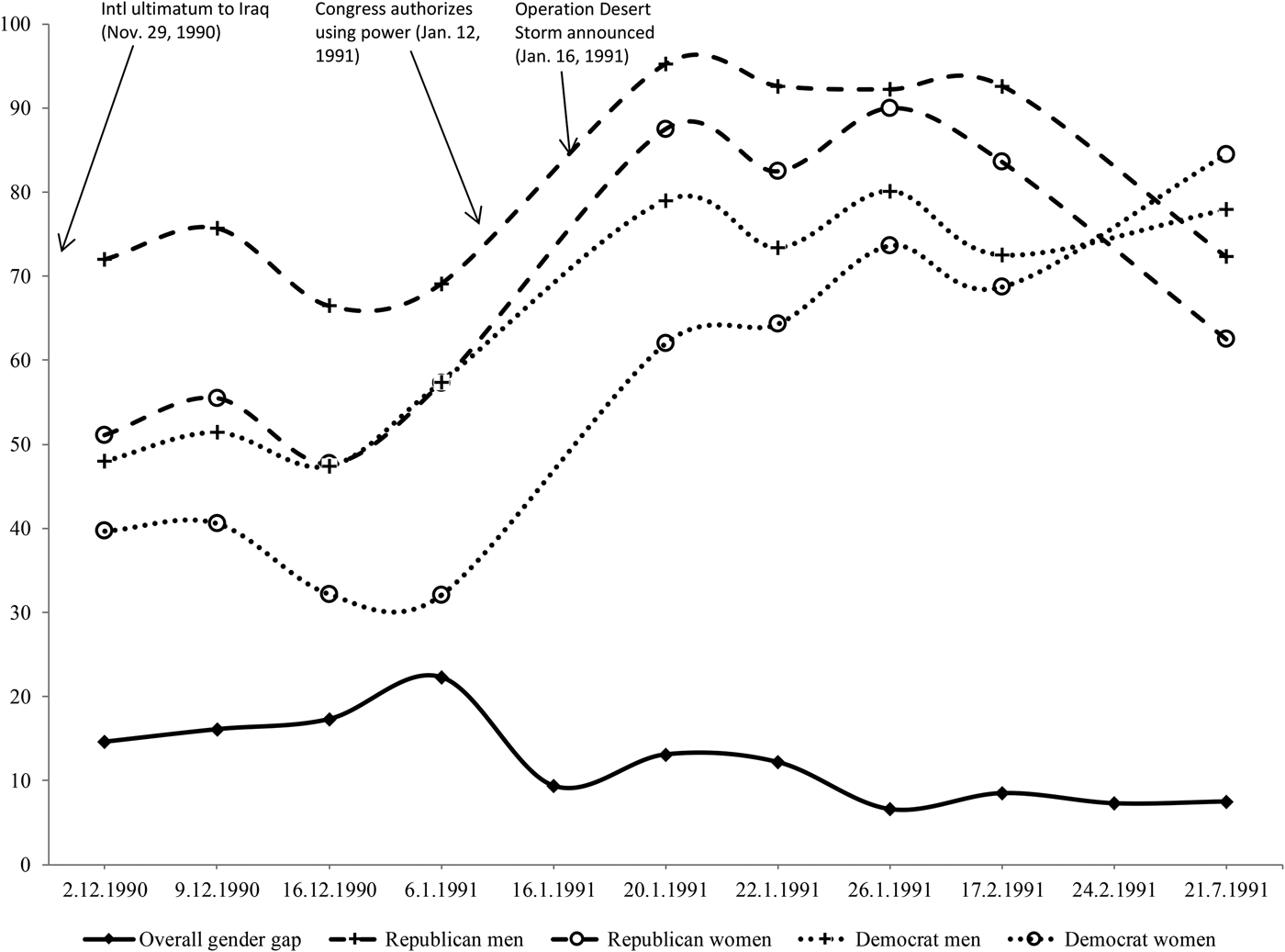
Figure 2 presents estimates of the gender gap in support for the Gulf War (solid line) and then breaks down the results by gender and political party.
Support rates for the Gulf War by gender and party.

As shown in the graph, prior to the Gulf War a considerable gender gap reached a peak of 22 in early January 1991. When Operation Desert Storm was announced (on January 16), the gender gap declined sharply, falling to less than 10 percentage points, as support among women jumped by about 30 points while support among men increased, but less drastically. Was this overall pattern repeated across the basic categories of partisan identification? The graph suggests that from the final stage of preparation through the initiation of the war, gender differences depended to a significant degree on partisan identification (in the figure, some data points are missing because one poll did not include questions about partisan identification). For Republicans, the gender gap declined from around 20 percentage points to about 12 points after Congress authorized the use of military force, and the gap remained quite small in the latter period as the support of both Republican men and women peaked. The findings for Democrats are fundamentally different. After Congress authorized the use of military force, the gender gap widened to nearly 30 points. A few days into the war, the gender gap among Democrats had decreased, but remained quite wide at 17 points. The findings for independents (not shown) are similar to those for Democrats.
To summarize, in general, U.S. men were more supportive of the military intervention in the Persian Gulf than U.S. women, but the size of the gender gap varied across three chronological phases: (1) At the onset of the conflict and in the early stages of the buildup to war, the gender gap was largest within the Republican camp—Republican men's level of support was more than 70%, while Republican women's level of support was about 50% (similar to Democrat men); (2) As the preparation for war advanced, the gap within the Republican camp declined while the gap within the Democratic camp grew because in that stage the Bush administration's public opinion campaign was quite effective in mobilizing the support of men in both political camps, and was very successful in mobilizing the support of Republican women, but was not as successful in mobilizing the support of independent and Democrat women; (3) Once the military operation began, the gender gap declined to its lowest levels as Democrat women began to support the war in greater numbers, eventually reaching support levels similar to those of Democrat men. Are these findings generalizable to other instances of military engagement? As stated above, the gender gap is partly context-dependent, and thus gender gaps may vary in their mechanisms of emergence. To establish this argument, I examine the patterns in the gender gap during two other military engagements.
NATO's aerial campaign in Yugoslavia
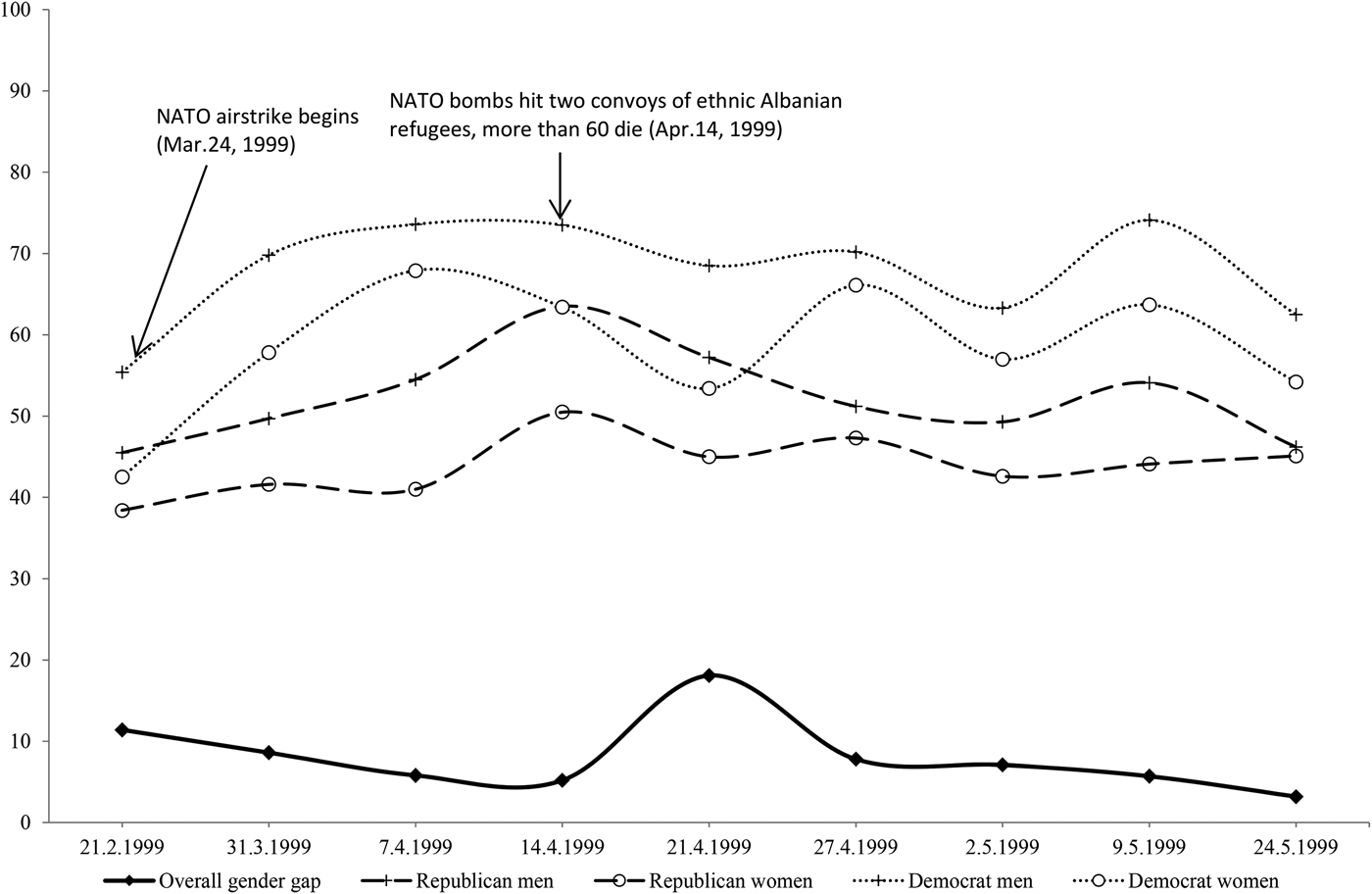
In general, during NATO's three-month aerial campaign in Kosovo the gender gap in support for the military action was minimal. However, a short-term gender gap of about 18 points emerged after April 14, 1999, when NATO aircraft attacked two convoys of refugees and killed dozens. In the Yugoslavian campaign, Democrats (both men and women) had been more supportive of the military action than Republicans, probably because Democrats both identified with the goal of the intervention and because the president was a Democrat. However, in response to the April 14 attack, many Democrat women shifted from expressing support for the campaign to expressing opposition or ambivalence. A similar decrease in support occurred among independent women. Therefore, in contrast to the Gulf War, in which gender gaps emerged when Democrat and independent men increased their support for the war, in the case of the NATO operation in Kosovo a gender gap emerged when tragic events temporarily shook Democrat and independent women's confidence in the justifiability of the military intervention. In comparison, the event had very little effect on the attitudes of Republicans, and this (lack of) effect was similar for men and women who identified as Republican.
The Iraq War
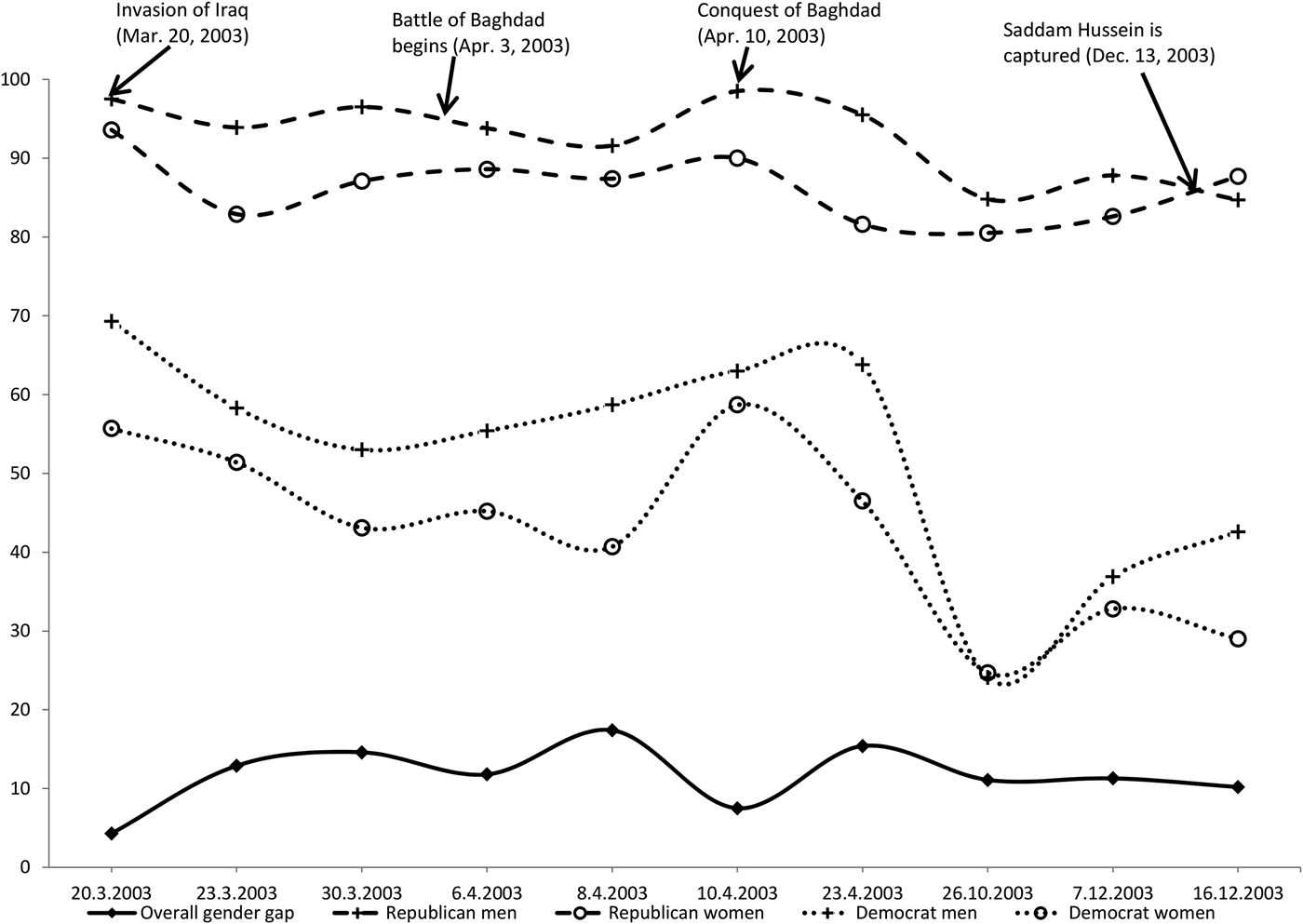
The final example concerns gender gaps in support for the Iraq War. Figure 4 shows that at the onset of the war the gender gap was minor, but it increased within days and remained quite stable even when the general support level declined. Further, in some polls, the overall gender gap was larger than the gaps within each of the two political camps, which means that the overall gender gap was partly due to the partisan divide in attitudes about the war (Jacobson Reference Jacobson2007) and women's higher likelihood of identifying as Democrats.Footnote 11 However, Figure 4 also reveals that during the Iraq War, both the largest and the smallest overall gender gap emerged when Democrat men and Democrat women reacted to changing circumstances in different ways. The gap peaked at about 17% during the battle of Bagdad because support among Democrat men was steadily increasing, but Democrat women maintained medium to low levels of support. The overall gap then declined to about 7% because the conquest of Baghdad elevated (for a very short period) support for the war among Democrat women, perhaps because these women expected the violence to end and hoped it would be replaced with Democracy building and humanitarian activity in Iraq, which would emancipate Iraqi women and improve their life conditions (as the Bush administration had repeatedly promised in an effort to convince American women to support its foreign policy; see Ferguson Reference Ferguson2005 and Ferguson and Marso Reference Ferguson and Marso2007).
Support rates for the NATO campaign in Kosovo by gender and party.

Support and rates for Iraq War by gender and party.

In sum, closer analysis of these three military engagements (the Gulf War, NATO's campaign in Kosovo, and the Iraq War) revealed that to a significant degree, the gender gap in support for military action emerges through the interaction of gender and partisan identification, and thus plays out in different ways for different military actions.Footnote 12 In the theoretical discussion, I suggested that temporary “gender gaps” emerged because, to the extent that women and men in different political camps diverged in their ideological commitments, different concerns drove their responses to specific military engagements or war events (for example, the reaction of Democrat women to an atrocity that took place during the aerial camping in Kosovo was different than the reactions of individuals in other gender-party categories). To examine this proposition (i.e., the idea that differing concerns drove the variation in responses), in the next section I shift from the analysis of a large but relatively variable-poor data set to the analysis of a smaller but variable-rich data set.
Part 3: A Closer Inspection of the Gender Gap at the Onset of the Iraq War
The investigation in this section focuses specifically on the public's reaction to the invasion of Iraq in March 2003, for which relatively rich survey data are available. As shown in Figure 4, the gender difference in support of the war was initially larger among Democrats, and, in addition, Democrats were less likely than Republicans to support the military operation in Iraq. What was the state of mind of Democrats (especially Democrat women) who opposed the invasion of Iraq? Were they concerned about the potential economic consequences of the war (as the “structural” argument proposes)? Were they motivated by “parental” concerns about the victims of war? Or were they motivated by a more general pacifist ideology (as the feminism/pacifism argument suggests)? Or perhaps they were concerned about some other issue, such as the effect of the war on the international standing of the United States (an issue discussed later in this section)?
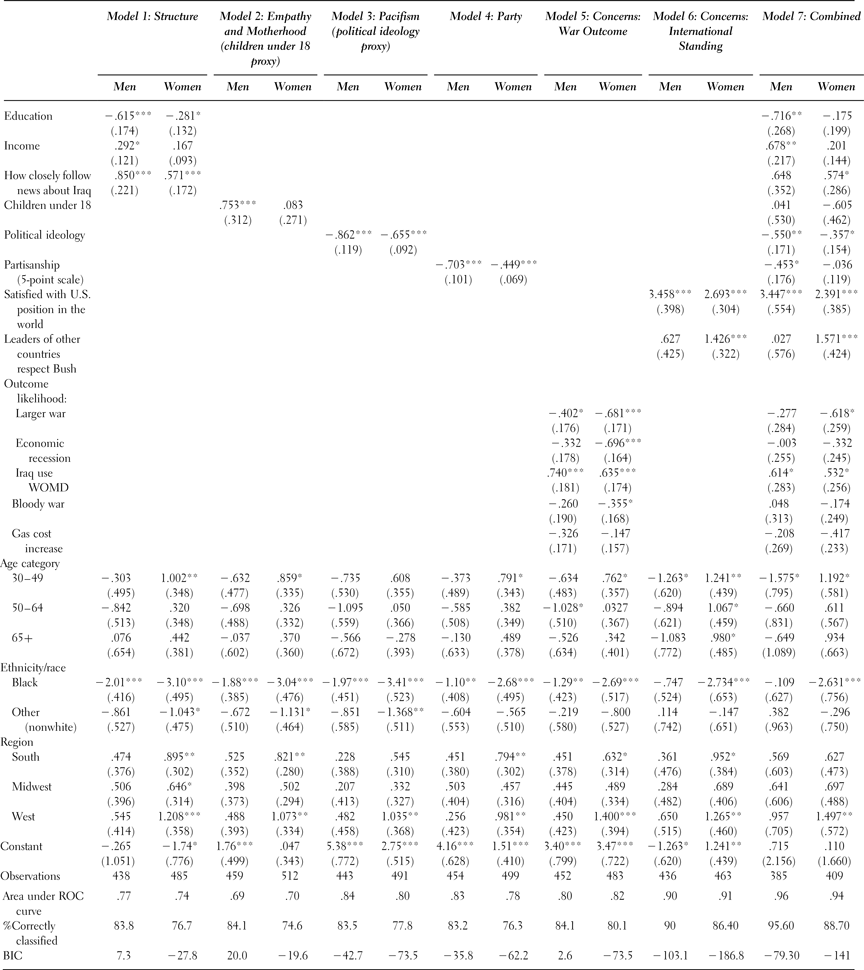
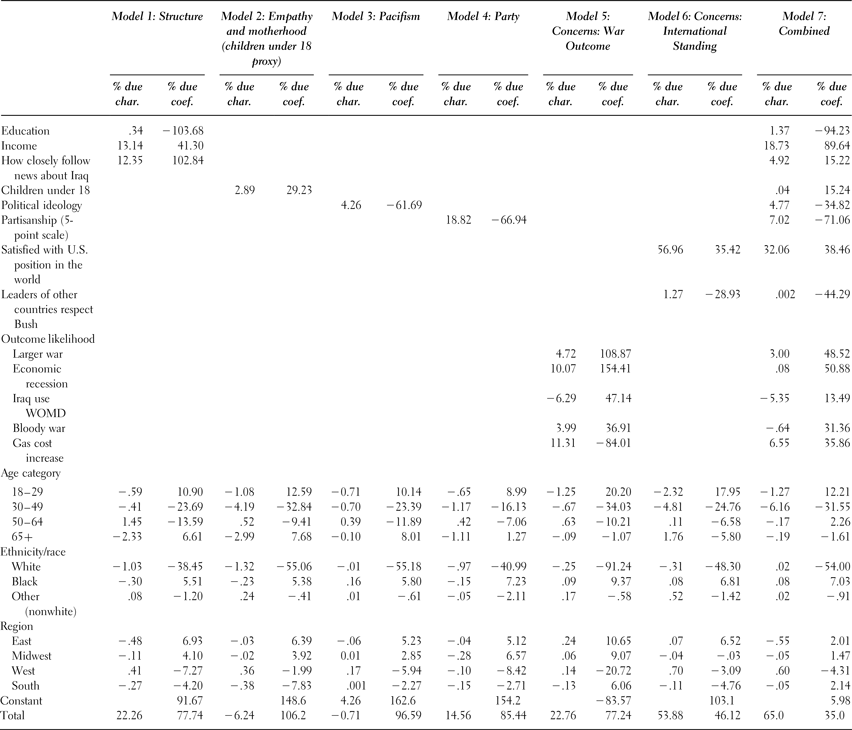
A Gallup poll conducted during the invasion of Iraq included an extensive list of questions that can be used to test these competing arguments. Table 3a presents the results of logistic regression models in which support or lack of support for the invasion of Iraq is the outcome variable. Results are presented separately for women and men to facilitate comparison. Table 3b presents results for the decomposition of the gender gap. Due to the lack of data on marital status, in this analysis the “empathy and motherhood” argument is tested only through the “children under 18” indicator.
Coefficients from logistic regressions modeling support for the invasion of Iraq United States, March 20–23, 2003

Source: Gallup poll.
Note: ***p < .001, **p < .01, *p < .05; standard errors in parentheses.
Gender gap decomposition

Source: Gallup poll.
Some of the results in Tables 3a and 3b are similar to those found in analyses using the larger data set (Tables 2a and 2b): the data do not support the structural argument (a very small portion of the gender gap may be due to income or income differences), and they also do not support the “empathy and motherhood” argument (the coefficient for having children at home is not statistically significant for either women or men).Footnote 13 In addition, in these models only a small portion of the gender gap is due to women's higher likelihood of identifying with the Democratic Party and men's higher likelihood of identifying with the Republican Party. Further, as in Part 1, the results do not support the first hypothesis associated with the “feminism/pacifism” argument ( H 4 ): the gender gap is not the result of women having a higher level of liberalism. In contrast to the findings in Part 1, however, the results in this set of analyses also fail to offer support for the second hypothesis associated with the “feminism/pacifism” argument ( H 5 ): the negative effect of being liberal on the likelihood of supporting military action is not stronger for women than for men.
The analyses in this section and those in Part 1 differ in important ways. The models in this section include several variables that were not available in the extended data set used in Part 1; I outline the results for these variables next. As mentioned in the theoretical discussion, previous studies of public opinion in the United States regarding major policy issues have shown that opinions are driven by sociotropic concerns rather than personal interests (Huddy et al. Reference Huddy, Feldman, Taber and Lahav2005; Joslyn and Haider-Markel Reference Joslyn and Haider-Markel2007; Kinder and Kiewiet Reference Kinder and Kiewiet1979; Sears Reference Sears and Kuklinski2001). Two models estimate the effects of such concerns. In Model 5 (Table 3a), a set of variables represents the expectations of respondents regarding the development of the war in Iraq. Two of these variables—concerns about the U.S. economy and concerns about gas prices in the United States—are direct indicators of the “bread over bombs” argument associated with the structural approach. In addition, three variables facilitated the differentiation of the effects of economic concerns from the effects of other war-related concerns. The findings indicate that concerns about gas prices did not play a statistically significant role in shaping attitudes toward the war. In contrast, both concerns about the possibility that the war would lead to an economic recession in the United States and concerns that the invasion of Iraq would turn into a larger and bloody war were associated with increased opposition to the war. These results suggest that general pessimism rather than specific concerns about the economy affected attitudes toward the war (although most of these coefficients lose statistical significance in Model 7). Another finding seems to provide some support for the “bread over bombs” argument: women expressed higher levels of concern than men when asked about economic consequences, while the levels of concern for other consequences were quite similar for men and women. However, when additional explanatory variables are added (in Model 7), the difference in concern about the economic consequences of the war contributes very little to the gender gap.
Whereas Model 5 tested the effect of concerns about the domestic consequences of war (and found weak evidence for this effect), Model 6 tested the possibility that the gender gap was driven by concerns about the international standing of the United States. The inclusion of this model in the analysis was based on two precedents. First, Wittkopf (Reference Wittkopf1990,41–42) has argued that in the United States, women are more likely than men to prefer isolationist foreign policy, and men are more likely than women to support militant internationalist policy. More recently, Brooks and Valentino (Reference Brooks and Valentino2011) found experimental evidence that gender gaps may emerge partly because actions taken by the U.S. military are considered in the context of their implications for the general international role and status of the United States.
The survey used in this part of the analysis allowed me to test this possibility, as respondents were asked about their level of concern about the United States’ position in the world. The findings show that support for the war was positively associated with respondents’ level of satisfaction with the United States’ position in the world.Footnote 14 Further, postestimation diagnostics revealed that the most influential observations were those of respondents who were less satisfied than average with the international position of the United States and more likely to object to the war. This result indicates that the coefficient primarily reflects the negative effect of concerns about the international position of the United States. This pattern was even stronger among women. Further, the overall level of satisfaction with the United States’ position in the world was lower for women than men; Model 6 in Table 3b estimates that if the extent of concern about the international standing of the United States were the same for men and women, the gender gap would be about 57% smaller. Taken together, these findings suggest that women's lower level of support for the invasion of Iraq was partly due to their greater propensity to feel alienated by the militant leadership role played by the United States in the “war on terror” era.
The main findings from Models 1–6 remain significant in Model 7 (the full model). However, the effect of partisanship is much smaller in Model 7 (relative to Model 4) and is no longer statistically significant for women. In addition, Model 7 estimates that equalizing partisan identification would reduce the gender gap by only about 7%, compared to about 19% in Model 4. This pattern indicates that opposition to the invasion of Iraq was due not so much to partisanship per se, but rather to differential ideological dispositions that, when primed by the war, resulted in the concerns that led many Democrats in general, and Democrat women in particular, to oppose the Iraq War. Specifically, during the “war on terror,” one of these ideological dispositions—the idea that the United States should pursue a foreign policy that has international legitimacy, especially when using military power—resulted in concerns about the international standing of the United States, as highlighted in Model 6 above. Indeed, dissatisfaction with the international standing of the United States was both more likely for women (36%) than for men (22%) and more likely for Democrats (51%) than for Republicans (12%); therefore, Democrat women were the most likely (58%) and Republican men were the least likely (7%) to express this concern. Concerns about the international standing of the United States, however, might not be the only relevant disposition. Other ideational dispositions associated with partisanship and political ideology (e.g., national chauvinism [Gries Reference Gries2014]) may not have been detected in public opinion polls simply because polls did not include questions about these dispositions.
CONCLUSION
This study sought to advance the scholarly understanding of why, on average, U.S. women generally support military actions at lower rates than U.S. men. In general, the findings confirm Eichenberg's (Reference Eichenberg2003, Reference Eichenberg2016) argument that the gender gap in support for military engagements has not been a singular (i.e., constant) phenomenon, but rather, significant gender gaps have emerged in American public opinion in some historical moments but not others. This variation means that the findings do not support traditional arguments that, by attributing the gender gap to women's lower social or economic position, women's experience of motherhood, or the ideological commitments of feminist-pacifist women, effectively assume the existence of a unitary gender gap. However, whereas Eichenberg has focused on the intensity and goals of military engagements as two factors that affect the size of gender gaps, the current study revealed how gender gaps in support for warfare have emerged and dissipated during the course of military engagements.
Further, the findings suggest that gender gaps emerged because certain ideological dispositions became salient and led specific constituencies—Republican men, Republican women, Democrat men, and Democrat women—to respond differentially to major war events.Footnote 15 At certain historical junctures, these dispositions were activated, temporarily widening a gender gap that at other times was fairly narrow. For example, during the invasion of Iraq, a gender gap emerged because many Democrats in general, and especially Democrat women, were more concerned than the rest of the public about the international position of the United States in the era of the “war on terror” and believed that the United States was bullying other countries.
To establish the contextual aspect of gender gaps, consider a second example that I could discuss only briefly in this paper: in the case of the 1999 NATO intervention in Kosovo, the average gender gap was about 30% smaller than the average gap during the Iraq War (8%compared to nearly 12%). The Kosovo campaign, which was a coalition airstrike that had a humanitarian mission approved by the international community, was supported by Democrats at a higher rate than Republicans. Therefore, in the United States, the main gap in response to this military operation was not between women and men, but between citizens who believed that the United States should collaborate with other countries in order to help suffering peoples and prevent mass atrocities (preferably through diplomacy but, if necessary, by using force), and citizens who preferred isolationist, self-utilitarian foreign policy (the latter view is more common among conservatives [Gries Reference Gries2014, 102], who almost unanimously supported the invasion of Iraq four years later based on the same ideological view). Moreover, in the case of Kosovo, a short-term wider gap of about 18 percentage points emerged after NATO aircraft attacked two convoys of refugees, leading many Democrat and independent women to temporarily shift from expressing support for the campaign to expressing opposition to or ambivalence about the intervention in Yugoslavia.
This study shares a major limitation with previous studies: attitudinal data that were collected via surveys and polls carry a limited amount of information. Therefore, future investigation of gender gaps should involve searching for additional ideational (and perhaps also emotional) dispositions that drive support for or opposition to military actions. However, this search should not focus on dispositions that distinguish all men from all women. Instead, the investigation should allow researchers to attribute dispositions to specific subsets of the population that are created when gender interacts with other variables. This study emphasized the intersection of gender and partisanship, but other traits that were not examined, such as ethnicity/race and age (or generation), may also contribute to the scholarly understanding of the rise and decline of gender gaps in support for military actions.
In conclusion, combining the main insights of this study—that the gender gap is not constant but episodic and that it emerges due to activated ideological dispositions within specific subsets of the public—provides an outline for future research on the gender gap, which may require the collection of original and more nuanced data. This future research should focus on three questions: (1) When does the gender difference in the mean level of support for military engagement increase or decrease during the course of specific wars? In other words, which events (e.g., the outbreak of war, major escalations, mass atrocities, cease-fire agreements) cause the gap to increase or decrease? (2) How do specific gaps emerge? In each case, which sections of the public were subject to temporary attitudinal changes that led to the development of a gender gap? (3) Why do temporary gender gaps emerge? Which ideological commitments mediate shifts in attitudes during specific periods to create a gender gap?
SUPPLEMENARY MATERIAL
To view supplementary material for this article, please visit https://doi.org/10.1017/S1743923X17000228