Epimeletic or care-giving behaviour, observed in several species of cetaceans, refers to the help that a healthy individual provides to a sick, injured or dead individual (Caldwell & Caldwell, Reference Caldwell, Caldwell and Norris1966). This assistance is generally conducted by a healthy dolphin swimming with the incapacitated member, helping it to stay floating at the surface, or maintaining it away from an apparent source of danger (Norris & Prescott, Reference Norris and Prescott1961). This behaviour can be intraspecific or interspecific and has been described in several dolphins, both in the wild and in captivity, including the rough-toothed dolphin (Steno bredanensis) (Lodi, Reference Lodi1992; Felix, Reference Felix1994; Ritter, Reference Ritter2007). The rough-toothed dolphin is found in tropical and warm temperate seas around the world and seems to prefer waters with temperatures up to 25°C (Jefferson et al., Reference Jefferson, Leatherwood and Webber1993; Miyazaki & Perrin, Reference Miyazaki, Perrin, Ridgway and Harrison1994; Culik & Wiirtz, Reference Culik and Wurtz2004; Siciliano et al., Reference Siciliano, Moreno, Silva and Alves2006). Steno bredanensis occurs along the Brazilian coastal waters (Siciliano et al., Reference Siciliano, Moreno, Silva and Alves2006), and the World Conservation Union (Reeves et al., Reference Reeves, Smith, Crespo and Sciara2003) has listed the status of rough-toothed dolphins worldwide as ‘data deficient’, very little information being available, including social behaviour (Kuczaj & Yeater, Reference Kuczaj and Yeater2007).
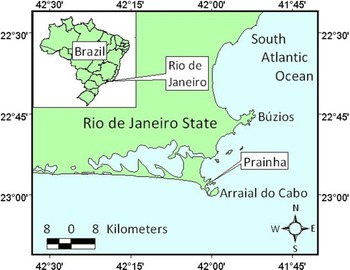
The aim of this note is to contribute new evidence of epimeletic behaviour in S. bredanensis in Brazilian waters. On 2 April 2007 we received information from lifeguards about a dead stranded rough-toothed dolphin at Prainha, Arraial do Cabo, east coast of Rio de Janeiro State, Brazil (Figure 1). Moments before the carcass came ashore, local fishermen related having observed two other dolphins of the same appearance as the stranded dolphin, swimming around the carcass.
Map showing the location of the occurrence of the rough-toothed dolphin stranded (Prainha), on the east coast of the Rio de Janeiro State.

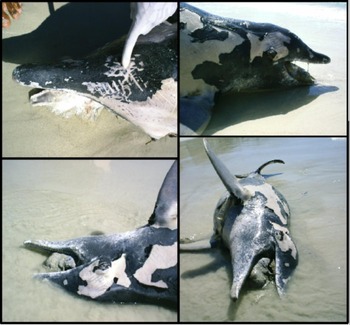
According to the local fishermen and lifeguards, the two dolphins were continuously pushing the carcass toward the surface with their beaks and other parts of their bodies. When we arrived at the beach we examined the carcass which showed recent teeth marks on different parts of its body, such as the melon, around the dorsal fin, fluke and on its belly (Figure 2). The dolphin was a male, 187 cm in total body length from the tip of the upper jaw to the caudal notch and it was in a moderate state of decomposition. According to Siciliano et al. (Reference Siciliano, Ramos, Di Beneditto, Santos, Fragoso, Lailson-Brito, Azevedo, Vicente, Zampirolli, Alvarenga, Barbosa and Lima2007) juveniles have a body length from 171.5 to 212 cm, therefore, the dolphin discussed in this note was a juvenile. In several parts of the body of the dolphin the skin had disappeared, the blubber was visible and the carcass smelled of decomposition. At the moment that we made the record no scavenger was observed eating the carcass, and we arrived at the place of stranding a few minutes after the carcass came ashore. The body of the stranded dolphin was inflated, and this fact could have helped the carcass to keep floating at the surface without great effort. However, observing the internal and external characteristics of the stranded dolphin we presumed that it died two or three days before, and the dolphins which participated in the epimeletic behaviour carrying and maintaining this dolphin floating at the surface could have spent a considerable amount of energy doing it. This type of behaviour has often been described in mother–calf pairs of bottlenose dolphins (Tursiops truncatus) (Felix, Reference Felix1994; Rollo & Monteiro-Filho, Reference Rollo and Monteiro-Filho1994; Dudzinski, Reference Dudzinski, Sakai, Masaki, Kogi, Hishii and Kurimoto2003). However, since this species is the most extensively studied, both in the wild and in captivity, the epimeletic behaviour should not be considered more common for this than for other species (Felix, Reference Felix1994). Few other species have shown this behaviour, for example, common dolphin (Delphinus delphis), franciscana (Pontoporia blainvillei), marine-tucuxi dolphin (Sotalia guianensis), Pacific white-sided dolphin (Lagenorhynchus obliquidens), Amazon river dolphin (Inia geoffrensis), and rough-toothed dolphin (Steno bredanensis) (Caldwell & Caldwell, Reference Caldwell, Caldwell and Norris1966; Lodi, Reference Lodi1992; Felix, Reference Felix1994; Santos et al., Reference Santos, Rosso, Siciliano, Zerbini, Zampirolli, Vicente and Alvarenga2000; Cremer, Reference Cremer, Hardt and Junior2006). Interspecific epimeletic behaviour has also been reported in a bottlenose dolphin attempting to lift a dead Pacific white-sided dolphin; a male bottlenose dolphin lifted a dead common dolphin, and a male pilot whale (Globicephala melas) carried a dead female Pacific white-sided dolphin for several hours (Caldwell & Caldwell, Reference Caldwell, Caldwell and Norris1966). Along the Brazilian coast there are other reported cases of epimeletic behaviour in cetaceans. Cremer et al. (Reference Cremer, Hardt and Junior2006) reported a case of epimeletic behaviour on the southern Brazilian coast including a stranded neonate or a premature calf of P. blainvillei presenting recent teeth marks in its body. Furthermore, it also presented net marks. These scratches might indicate the intention of the adult to rescue the calf, during the entanglement after or before its liberation. Rollo & Monteiro-Filho (Reference Rollo and Monteiro-Filho1994) reported two adults of T. truncatus interacting with a relatively decomposed calf in Santa Catarina, southern Brazil. One adult could be identified as a female that probably gave birth for the first time and she insistently maintained the calf far from the research boat and pushed it. Flores (Reference Flores and Siciliano2006) and Santos et al. (Reference Santos, Rosso, Siciliano, Zerbini, Zampirolli, Vicente and Alvarenga2000) described cases of epimeletic behaviour in S. guianensis in Brazilian waters and Di Beneditto et al. (Reference Di Beneditto, Ramos and Lima2001) also described a possible case in P. blainvillei. There are two other reported cases of epimeletic behaviour in S. bredanensis. Lodi (Reference Lodi1992) reported an adult female supporting another dead adult female at the surface for several hours in Ilha Grande Bay, Rio de Janeiro, Brazil. Ritter (Reference Ritter2007) recorded a mother of a rough-toothed dolphin pushing its dead calf for several days until the carcass became relatively decomposed. In this case, the mother was assisted by two other adult members of the group. Caldwell & Caldwell (Reference Caldwell, Caldwell and Norris1966) noted that such behaviour may be directed both at adults and young dolphins by other adults, and their story included many examples of animals in distress physically aided by other animals. This behaviour, principally that involving adult cetaceans, could be part of a mutual assistance between the members of the group, which promotes an important behaviour for the social structure of the group (see Connor & Norris, Reference Connor and Norris1982), but its real nature is still unclear.
Photographs showing the state of decomposition of the rough-toothed dolphin and teeth marks in its head and other regions of its body.

The social structure of rough-toothed dolphins is poorly understood. However, previous studies have indicated that rough-toothed dolphins display a highly complex social structure (Ritter, Reference Ritter2002; Kuczaj & Yeater, Reference Kuczaj and Yeater2007).
According to Ritter (Reference Ritter2007) there is a hypothesis that the group of dolphins can adapt its behaviour to the exceptional circumstances caused by the death of a newborn. However, it is apparent from the existing literature that this behaviour is displayed in several other circumstances. The case described in this note clearly shows that the epimeletic behaviour could have lasted a few days, therefore, the death of a member of a group could have an effect on its social structure.
It is very difficult to observe the epimeletic behaviour in the field during sightings or strandings research, therefore, it is rarely recorded. However, this behaviour has been observed in several species of cetaceans, indicating that it could be a normal pattern of social behaviour, which may occur in different patterns according to the social evolution of each species.
ACKNOWLEDGEMENTS
The authors are very grateful to the local lifeguards and fishermen who provided relevant information described in this note. We also acknowledge the team involved with GEMM-Lagos (Grupo de Estudos de Mamíferos Marinhos da Região dos Lagos) for their help during field work. A special thank you to Anne Marie L.S.F. de Moura for her encouragement for writing this note.