Introduction
CTNND1 (Catenin delta 1, OMIM: 601045) encodes p120-catenin, a member of the armadillo-repeat-containing Armadillo protein family. As a core regulator of the cadherin signalling pathway, p120 mediates intercellular adhesion and signal transduction, modulates the epithelial-mesenchymal transition process, and plays a pivotal role in embryonic organ development. Reference Ishiyama, Lee and Liu1–Reference Yanagisawa and Anastasiadis3
Mutations in the CTNND1 gene can cause blepharocheilodontic syndrome. The main clinical manifestations of blepharocheilodontic syndrome include craniofacial and oral malformations, while it can also be accompanied by CHD, limb deformities, and neurodevelopmental disorders. Reference Alharatani, Ververi and Beleza-Meireles4
To date, CTNND1 mutations have been reported in only 22 patients worldwide, among whom approximately 32% (7/22) were diagnosed with CHD. Reference Conti, Di Napoli and Hafdaoui5 The predominant lesion types include atrial septal defect, ventricular septal defect, and conotruncal heart defects. Reference Zhao, Li and Sun6 Currently, there are no reported cases of complex congenital heart malformations accompanied by venous system developmental anomalies caused by CTNND1 mutations.
We report a case of CTNND1 mutation in a prenatal fetus that presented only with CHD, with fetal cardiac ultrasound findings of total anomalous pulmonary venous connection. Through the instances in this paper, we propose that total anomalous pulmonary venous connection is a clinical prenatal hallmark of CTNND1 abnormalities. Our case expands the phenotypic spectrum of CTNND1 gene mutations.
Case presentation
A 37-year-old healthy pregnant woman, G2P1, had no consanguinity with her husband and did not take any medications during pregnancy. The pregnant woman has one previous pregnancy that resulted in the birth of a healthy girl, and no other family members have a history of heart disease.
The prenatal ultrasound examination of fetal heart performed at 26 + 6 gestational weeks (g.w.) showed an increased distance between the descending aorta and the left atrium on the four-chamber view. A right pulmonary vein was visualised bypassing the top of the left atrium to the left side of the left atrium, where it converged with the left pulmonary vein to form a common venous chamber, which then drained into the coronary sinus (Figure 1 a , b ) (Supplementary Video 1,2). Based on these findings, intracardiac total anomalous pulmonary venous connection was diagnosed; meanwhile, single umbilical artery malformation was identified. After a multidisciplinary consultation to assess the fetal prognosis, the couple opted for termination of pregnancy and underwent genomic sequencing but declined an autopsy.
Prenatal imaging and genetic findings of the fetus with TAPVC and the CTNND1 variant. ( a ), ( b ), Fetal echocardiography demonstrating total anomalous pulmonary venous connection. ( a ), Two-dimensional image. ( b ), Colour Doppler image. ( c ), Family pedigree of the proband. ( d ), Sanger sequencing chromatogram confirming the heterozygous CTNND1 variant (c.2098C>T) in the proband. LV = Lleft Ventricle; RV = Right Ventricle; RA = Right Atrium; LPV = Left Pulmonary Vein; RPV = Right Pulmonary Vein; CPV = Common Pulmonary Vein; CS = Coronary Sinus; DAO = Descending Aorta.

Figure 1. Long description
The image consists of four panels. Panel (a) shows a two-dimensional fetal echocardiography image demonstrating total anomalous pulmonary venous connection. Key structures labeled include the left ventricle (LV), right ventricle (RV), right atrium (RA), left pulmonary vein (LPV), right pulmonary vein (RPV), common pulmonary vein (CPV), coronary sinus (CS), and descending aorta (DAO). Panel (b) displays a color Doppler image of the same structures, highlighting blood flow. Panel (c) presents a family pedigree diagram of the proband, indicating the presence of a genetic variant. Panel (d) shows a Sanger sequencing chromatogram confirming a heterozygous CTNND1 variant (c.2098C>T) in the proband.
Through follow-up, we learned that there were no significant abnormalities in the development of the eyelids, lips, and limbs of the fetus after induction of labour.
All genetic tests were performed following genetic counselling and written informed consent. Using the techniques previously reported, we conducted a whole-exome sequencing and copy number variation sequencing for the fetus and the parents. Reference Sun, Yi and Hao7 In accordance with the guidelines of the American College of Medical Genetics and Genomics, pathogenic variants were considered confirmed genetic findings, and Sanger sequencing was used for validation.
In the identified CHD genes, we did not find any chromosomal abnormalities or harmful variants; however, we did find a frameshift variant c.2098C>T (p.R700*) in the CTNND1 gene (NM_001085458.2) that forms a premature stop codon (Figure 1 d ). With the knowledge that the variant would lead to the relevant codon changing to a stop codon and altering how proteins function, the variant had been classified as a pathogenic variant.
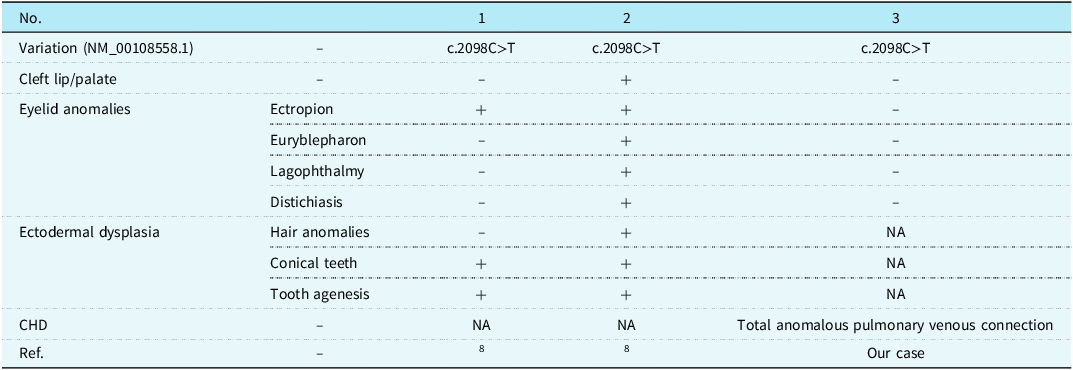
We found that this variant is identical to the ones reported in two cases (a mother and her child) by Ghoumid et al., but there are significant differences in clinical phenotypes. Reference Ghoumid, Stichelbout and Jourdain8 Our case presents with total anomalous pulmonary venous connection, whereas the cases they reported manifested as cleft lip and palate, eyelid anomalies, and ectodermal dysplasia (Table 1).
Clinical phenotypes of patients harbouring the CTNND1 mutation (c.2098C>T)

Table 1. Long description
A table with three columns and six rows, comparing clinical phenotypes of patients with the CTNND1 mutation c.2098C>T. The columns are labeled No., 1, 2, and 3. The rows detail variations in phenotypes such as cleft lip/palate, eyelid anomalies, ectodermal dysplasia, and CHD. Column 1 has no variation, ectropion under eyelid anomalies, and no CHD. Column 2 shows c.2098C>T variation, no cleft lip/palate, multiple eyelid anomalies, hair and tooth anomalies, and no CHD. Column 3 shows c.2098C>T variation, no cleft lip/palate, no eyelid anomalies, no ectodermal dysplasia, and total anomalous pulmonary venous connection under CHD.
+ = Positive; − = Negative; NA = Not Available.
Discussion
We report a prenatal fetal case of total anomalous pulmonary venous connection, a complex CHD, caused by a CTNND1 pathogenic variant, without typical eyelid, cleft lip/palate, or limb phenotypic abnormalities. This finding significantly expands the clinical phenotypic spectrum of CTNND1 mutations, suggesting CTNND1 should be included in candidate genes for differential diagnosis of specific prenatal cardiac malformations.
The identified nonsense mutation c.2098C>T (p.R700*) is identical to that reported by Ghoumid et al. in two pedigree patients (mother and son), but clinical manifestations differ remarkably: their patients showed typical blepharocheilodontic syndrome features, Reference Ghoumid, Stichelbout and Jourdain8 while our fetus presented solely with complex CHD.
This genotype-phenotype discordance may stem from multiple factors. Marked interindividual and intrafamilial phenotypic variability exists, as individuals with the same mutation exhibit varying severity, from full syndrome to mild features. Reference Ghoumid, Stichelbout and Jourdain8 Additionally, phenotypic evaluation limitations affect results: our pregnancy was terminated due to poor prognosis of severe CHD, and autopsy refusal precluded assessment of subtle, late-onset non-cardiac phenotypes (e.g., dental anomalies). Meanwhile, Ghoumid et al. lacked focus on cardiac phenotypes, possibly overlooking mild or subclinical cardiovascular abnormalities.
This discordance is prominent given limited reported cases, highlighting the need for comprehensive systematic phenotypic assessments, including detailed prenatal/postnatal cardiovascular imaging. This case underscores the critical role of high-resolution prenatal fetal echocardiography in detecting structural cardiac malformations and the value of integrated genetic testing for aetiological diagnosis.
In conclusion, our isolated prenatal total anomalous pulmonary venous connection case linked to CTNND1 pathogenic variant incorporates total anomalous pulmonary venous connection into CTNND1-associated disorder phenotypes, implying its potential role in fetal cardiovascular development. Our results indicate that for complex prenatal cardiac malformations—particularly total anomalous pulmonary venous connection—extended genetic testing including CTNND1 should be considered. This strategy can improve diagnostic rates and provide families with more accurate prognostic evaluations and reproductive guidance.
Supplementary material
The supplementary material for this article can be found at https://doi.org/10.1017/S1047951126113171.
Acknowledgements
The authors extend their gratitude to the parents of the fetus for their valuable contribution to this study.
Author contributions
All authors made substantial contributions to the study. Minjie Sun was responsible for conceptualisation, methodology, investigation, formal analysis, visualisation, and writing the original draft. Hairui Sun contributed to data curation, formal analysis, methodology, and visualisation. Yihua He (corresponding author) supervised the study, performed validation, critically revised the manuscript for important intellectual content, and approved the final version to be submitted.
Financial support
This work was supported by the National Natural Science Foundation of China (U21A20523) to Y.H.
Competing interests
The authors declare that there is no conflict of interest.
Ethical standard
The authors assert that all procedures contributing to this work comply with the ethical standards of the Measures for the Ethical Review of Biomedical Research Involving Human Subjects (China) and with the Helsinki Declaration of 1975, as revised in 2008, and have been approved by the Beijing Anzhen Hospital’s Ethics Committee, affiliated with Capital Medical University. The parents have provided informed written consent for publication. All details that might disclose the identity of the subjects have been omitted.