Introduction
Individuals who have sustained a traumatic brain injury (TBI) are vulnerable to negative social consequences, including a reduction in social integration. One facet of social integration, community integration, is critical to rehabilitative efforts and optimal recovery. Community integration subsumes participation across a variety of social settings, including home, occupational, and social environments. For those with TBI, better community integration is associated with positive social outcomes, including greater self-esteem (Juengst, Arenth, Raina, McCue, & Skidmore, Reference Juengst, Arenth, Raina, McCue and Skidmore2014), higher cognitive functioning (Cicerone, Mott, Azulay, & Friel, Reference Cicerone, Mott, Azulay and Friel2004), and better emotional and physical health (Doninger et al., Reference Doninger, Heinemann, Bode, Sokol, Corrigan and Moore2003). TBI populations, however, are at a heightened risk of experiencing diminished community integration (Willer, Rosenthal, Kreutzer, Gordon, & Rempel, Reference Willer, Rosenthal, Kreutzer, Gordon and Rempel1993), rendering individuals more susceptible to decreased life satisfaction and poorer quality of life (Cicerone et al., Reference Cicerone, Mott, Azulay and Friel2004).
Despite the fact that community integration is a hallmark goal of rehabilitation, there is a notable gap in our understanding of factors that contribute to diminished community integration within TBI populations. One potential barrier of community integration in TBI is impaired ability to identify facial emotions (facial affect recognition; FAR). It has been estimated that up to 39% of individuals with moderate to severe TBI suffer from FAR deficits (Babbage et al., Reference Babbage, Yim, Zupan, Neumann, Tomita and Willer2011), which likely contributes to misinterpreting affective/social cues and responding inappropriately.
Research probing the explicit relationship between FAR and community integration has been inconsistent in TBI. In one TBI study, better FAR performance was related to higher scores on social and occupational aspects of integration (Knox & Douglas, Reference Knox and Douglas2009). By contrast, Milders et al. failed to find a significant relationship between FAR ability and home and social integration in TBI (Milders, Fuchs, and Crawford, Reference Milders, Fuchs and Crawford2003). However, their sample comprised higher functioning, ready-to-work individuals with TBI, so the findings may underestimate the emotional and social changes in a severe TBI population. Recently, May et al. (Reference May, Milders, Downey, Whyte, Higgins, Wojcik and O’Rourke2017) found that better emotion recognition was related to higher scores on the productivity subscale of the Community Integration Questionnaire (CIQ; Willer et al., Reference Willer, Rosenthal, Kreutzer, Gordon and Rempel1993), but not on the social or home integration subscale. However, the authors relied on a measure of FAR not validated in TBI. Additional research is needed to better characterize the link between TBI-acquired FAR deficits and community integration.
While there is some evidence linking FAR and constructs related to community integration, few studies have examined this relationship by testing FAR using both static (photographs) and dynamic (videos) displays of emotion. It has been argued that dynamic displays have better ecological validity and may be uniquely sensitive to deficits in TBI (McDonald & Saunders, Reference McDonald and Saunders2005). Thus, in the current study, we included a dynamic measure, which was developed for use in TBI (The Awareness of Social Inference Test or TASIT; McDonald, Flanagan, Rollins, & Kinch, Reference McDonald, Flanagan, Rollins and Kinch2003). Furthermore, we investigated FAR proficiency for each of the basic emotions across both static and dynamic FAR tasks. We hypothesized that deficits in overall FAR—whether captured with static or dynamic displays, or both—would predict difficulties in community integration in individuals with TBI.
Method
Participants
The current study included 27 individuals with moderate to severe TBI and 30 healthy controls (HCs). Individuals with TBI met the Mayo Classification System criteria for moderate/severe TBI (Malec et al., Reference Malec, Brown, Leibson, Flaada, Mandrekar, Diehl and Perkins2007) and were at minimum 1 year postinjury [mean time since injury = 112.47 months, standard deviation (SD) = 97.95]. Injury severity was confirmed through medical records; however, if records were not available, family members were required to confirm a loss of consciousness greater than 30 min. All participants were free from neurological disease/injury (apart from brain injury among TBI participants), psychotic disorders, such as schizophrenia, and substance abuse/dependence. Participants were recruited from our institution-wide database of eligible volunteers, who were originally recruited from the general community or referred by a partnering institution from the Northern New Jersey Traumatic Brain Injury System. The two groups did not significantly differ in age (years) (TBI: M = 40.89, SD = 14.53, range = 20–65; HC: M = 38.27, SD = 13.85, range = 21–63; t(55) = .70, p = .49), years of education (TBI: M = 14.70, SD = 2.03, range = 12–20; HC: M = 15.43, SD = 1.85, range = 11–18; t(55) = 1.42, p = .16), or gender composition (TBI = 4F/23M; HC = 9F/21M; χ 2(1) = 1.86, p = .17).
Procedure
This work was approved by the Kessler Foundation Institutional Review Board and was conducted in accordance with the Declaration of Helsinki. Participants completed these measures as part of a larger neuroimaging study on social cognition in TBI whose findings will be presented elsewhere. All participants provided written informed consent prior to study participation and were compensated.
Static affect recognition
For static FAR, we used The Task of Facial Emotion Recognition—Kessler Foundation (Copyright© 2015 Kessler Foundation Inc. All rights reserved.) (TOFER-KF©; Genova et al., in press). In this task, participants were presented with 36 photos of different actors presented in random order and displaying each of six emotions: happiness, sadness, anger, surprise, fear, and disgust. During each trial, participants indicated via button press that which of the six basic emotions was being expressed. The proportion of correct responses out of 36 was computed for the total score, and the proportion of correct responses out of six was computed separately for each emotion.
Dynamic affect recognition
The Emotion Evaluation Test of the TASIT (McDonald et al., Reference McDonald, Flanagan, Rollins and Kinch2003) is designed to assess FAR through a series of videotaped vignettes. Each vignette features actors exhibiting one of seven emotions (happy, sad, surprised, angry, anxious, revolted, and neutral) in everyday situations. Each emotion was presented four times. The proportion of correct responses out of 28 was computed for the total score, and the proportion of correct responses out of four was computed separately for each emotion.
Community integration
The CIQ (Willer et al., Reference Willer, Rosenthal, Kreutzer, Gordon and Rempel1993) yields three subscales: (1) home integration, related to functioning within a home setting, (2) social integration, referring to leisure activities and social interaction performed outside the home, and (3) productivity, assessing participation in employment, educational, and volunteer activities. Higher scores reflect higher levels of community integration.
Neuropsychological performance
To examine the possibility that group differences in FAR reflected more general effects of TBI on cognition, performance on the California Verbal Learning Test—Second Edition (CVLT-II; Delis, Dean, Kramer, Kaplan, Ober, Reference Delis, Dean, Kramer, Kaplan and Ober2000) was also considered. Memory impairment is a well-documented consequence of TBI (Vanderploeg, Crowell, & Curtiss, Reference Vanderploeg, Crowell and Curtiss2001) and served as a proxy for more general effects of TBI on cognition. Performance on this measure was summarized by the raw score for total correct recall on the first five trials.
Data Analysis
Independent samples t tests were used to analyze group differences between TBI and HC groups, and multiple regression was used to examine a subset of group differences after controlling for neuropsychological performance. A mixed design analysis of variance (ANOVA) was run to compare relative performance on static and dynamic tests between groups. Pearson correlation coefficients were computed to test the association between performance on FAR tasks and CIQ. Statistical tests (with the exception of demographic differences) were one-tailed, with the hypothesis that TBI participants should perform worse than HCs on FAR and CIQ. Additionally, we expected that FAR should correlate positively with CIQ for all participants. To guard against inflation of type I error, the Benjamini–Hochberg procedure (Benjamini & Hochberg, Reference Benjamini and Hochberg1995), for controlling false discovery rate (FDR), was applied. Results surviving correction for multiplicity are labeled in Tables 1 and 2 .
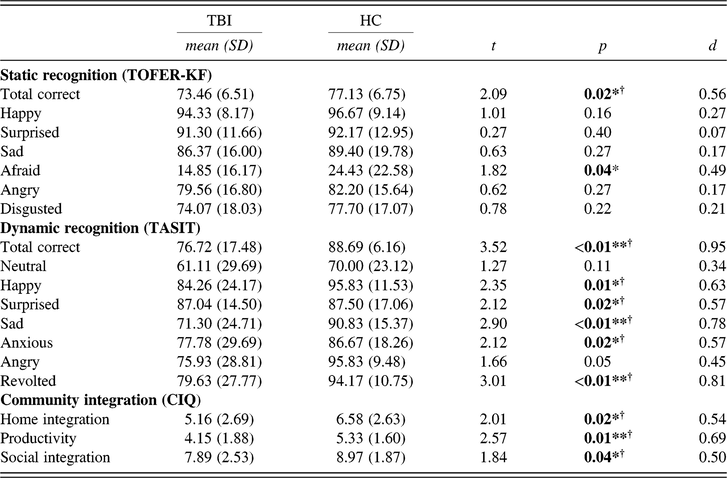
Group differences in percentage correct responses for static and dynamic FAR, and in community integration

* t test is significant at the 0.05 level (one-tailed).
** t test is significant at the 0.01 level (one-tailed).
† t test is significant after FDR correction.
d = Cohen’s d effect size.
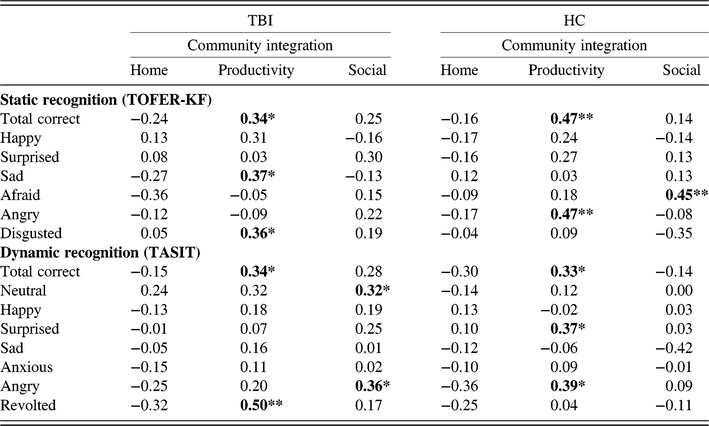
Associations between FAR performance and community integration

* Correlation is significant at the 0.05 level (one-tailed).
** Correlation is significant at the 0.01 level (one-tailed).
† Correlation is significant after FDR correction.
Results
Group Differences
Means, SDs, and t tests for each measure are presented in Table 1 . Results from t tests revealed group differences on both FAR measures. For static FAR, the TBI group performed significantly worse than controls on total identification. For the dynamic FAR task (TASIT), the TBI group was also significantly less accurate than controls on all variables except for recognition of neutral and angry expressions. Finally, for each CIQ subscale, the TBI group reported significantly lower community integration than the control group. As presented in Table 1 , nearly all of the significant differences survived FDR correction for multiple comparisons.
The TBI group performed significantly worse on the CVLT-II than HCs, t(55) = 1.90, p = .03. In order to test whether the group differences in FAR persisted after controlling for neuropsychological performance, we conducted two linear regression analyses, each with the static or dynamic FAR total correct score as the dependent variable. The independent variables were case status (HC vs. TBI) and performance on the CVLT-II. Results indicated that case status was the only significant predictor of FAR performance on the static recognition task, β = .27, t(54) = 1.97, p = .03, and also on the dynamic recognition task, β = .43, t(54) = 3.22, p < .01, suggesting that the FAR deficits we observed in TBI are not explained by one’s level of cognitive impairment. Furthermore, demographic variables, such as age, education, and gender, were not significantly associated with performance on the static or dynamic FAR tasks, and did not change the pattern of results described above when included as covariates in the regression models.
Differential Deficits
Performance on the two tests of FAR was highly correlated, r(55) = .47, p < .001; yet, we wished to examine whether the TBI-related deficits were more apparent on one of the tasks. To this end, we conducted a 2 × 2 mixed ANOVA with case status (TBI vs. HC) as a between-subjects factor and the total correct score for each measure of FAR (static vs. dynamic) as a within-subjects factor. A significant interaction indicated that the performance difference between groups was larger for the dynamic task than the static task, F(1,55) = 7.03, p = .01. Follow-up simple effects testing further revealed that this effect was driven by the HC group, which obtained significantly higher scores on the dynamic task (89%) than the static task (77%), p < .01. In contrast, the TBI group’s performance did not significantly differ between the dynamic task (77%) and the static task (73%), p = .156.
Associations between FAR and Community Integration
Static FAR. As illustrated in Table 2 , performance on the static FAR task was positively associated with community integration, with significant correlations restricted to CIQ productivity subscale. Total identification and recognition of sadness and disgust were positively associated with CIQ productivity. Dynamic FAR . Better recognition of neutral affect and anger were correlated with higher CIQ social integration. Total identification and recognition of revulsion were positively associated with CIQ productivity. While many of the correlation coefficients were moderate or large in magnitude, it is worth noting that due to the high number of tests, none of the correlations survived FDR correction and thus, this pattern of results should be interpreted with caution.
Discussion
The purpose of the current study was to investigate the relationship between community integration in TBI and impairments in FAR. In line with prior research, the TBI group demonstrated deficits in FAR and poorer community integration, relative to HCs. As hypothesized, we observed moderate-to-large correlations between both the static and dynamic measures of FAR and community integration, suggesting that deficits in FAR may contribute to social isolation documented in individuals with TBI (Hoofien, Gilboa, Vakil, & Donovick, Reference Hoofien, Gilboa, Vakil and Donovick2001; Morton & Wehman, Reference Morton and Wehman1995).
One aim of this study was to explore TBI-related deficits in FAR across multiple forms of measurement. While the overall pattern of results was similar across the two FAR tasks, deficits in the TBI group were more pronounced on the dynamic task. These results provide further support for the argument that the TASIT is especially sensitive to TBI-related FAR deficits (Knox & Douglas, Reference Knox and Douglas2009; McDonald et al., Reference McDonald, Flanagan, Rollins and Kinch2003; McDonald & Saunders, Reference McDonald and Saunders2005). For HCs, performance on the dynamic task was relatively better than performance on the static task. By comparison, scores on the two tasks did not differ significantly for the TBI group. As facial processing capacity is already reduced in individuals with TBI (McDonald et al., Reference McDonald, Flanagan, Rollins and Kinch2003), they may not benefit from the additional detail and rich sensory information that accompanies dynamic displays. Given that dynamic displays are more ecologically valid, they may be more illustrative of the difficulties that individuals with TBI face in everyday life.
Across the two FAR tasks, participants’ overall proficiency in FAR was associated with community integration, as measured by CIQ. One unanticipated finding was that FAR was most consistently associated with the CIQ productivity subscale, a pattern we observed in both samples (TBI and HC). This mirrors the results of May et al. (Reference May, Milders, Downey, Whyte, Higgins, Wojcik and O’Rourke2017), who showed that FAR performance was associated solely with CIQ productivity. One possible explanation for the subscale-specific effects concerns the divergent social groups represented in each construct. The home integration subscale is primarily composed of questions regarding the division of labor in the household (e.g., “who usually cares for the children in your home?”), and thus likely depends heavily on the dynamics of a limited number of intimate relationships. The social integration subscale taps into participation in leisure activities and time spent with close others, and the productivity subscale measures participation in schooling, volunteer work, and employment. The relationship between FAR and productivity suggests that difficulties in FAR could be most impactful for social interactions with others with whom one does not have a close personal relationship (e.g., coworkers).
The current work is limited in that as it is underpowered relative to the scope of the analyses, some of which did not meet the threshold for significance after correction for multiple comparisons (despite effect sizes in the moderate-to-large range). While our findings are consistent with a body of research linking FAR and social integration in TBI (e.g., Knox & Douglas, Reference Knox and Douglas2009), future research would most certainly benefit from utilizing larger samples. Additionally, the lack of a control task for our FAR measures limits their construct validity. It could be argued that the FAR deficits measured are attributable to a more global deficit in face recognition or some other TBI-related perceptual disturbance. Additional research employing a perceptual control task would likely improve the validity of these results. Other potential areas for future research include using informant-based reports from family members to verify aspects of social integration, employing longitudinal designs, and better phenotyping research participants. These strategies would improve the accuracy of assessing social integration, better delineate how the relationship between social cognitive deficits and social integration in TBI may evolve over time, and identify additional factors that may moderate or mediate the difficulties observed in both of these domains.
Conclusion
Although numerous studies have detailed the prevalence of impaired FAR in TBI, few studies have examined the extent to which these impairments predict one’s ability to integrate into the community. While the current research is correlational in nature, the association between FAR and community integration suggests that social cognitive deficits in TBI may contribute to social isolation of this population. While the literature on the relationship between difficulties with FAR and social integration has been inconsistent (e.g., Knox & Douglas, Reference Knox and Douglas2009; Milders et al., Reference Milders, Fuchs and Crawford2003), the current study’s use of a task validated in TBI (TASIT) lends support to research showing that such a relationship exists. Existing social cognitive interventions (e.g., Neumann, Babbage, Zupan, & Willer, Reference Neumann, Babbage, Zupan and Willer2015) could help to prevent difficulty with community integration post-TBI and reduce the well-documented burden of isolation and decreased quality of life. Given that rehabilitation success is so closely tied with strong social networks and social support (Izaute et al., Reference Izaute, Durozard, Aldigier, Teissedre, Perreve and Gerbaud2008), a clearer understanding of the issues leading to reduced community integration for individuals with TBI should be a priority in future research.
ACKNOWLEDGMENTS
This work was supported by research grant CBIR13IRG026 [JL and HMG], funded by the New Jersey Commission on Brain Injury Research. All the authors report no conflicts of interest.