Introduction
Sugarcane is the most extensively cultivated row crop in Florida, grown on approximately 167,000 ha (USDA NASS 2018) along or near the southern edge of Lake Okeechobee in south Florida. According to the 2017 Florida sugarcane census, 74% of the crop is cultivated on organic or muck soils (Histosols) in the Everglades Agricultural Area and the remainder on mineral or sandy soils adjacent to the Everglades Agricultural Area (VanWeelden et al. Reference VanWeelden, Swanson, Davidson and Rice2018). Sugarcane is a perennial crop propagated vegetatively using stalk pieces or setts beginning in late August until early January and harvested over a 3- to 4-y cycle from mid-October until early May in Florida, resulting in three to four crops harvested annually from a field before it is plowed under and replanted (Baucum and Rice Reference Baucum and Rice2009). The first year’s crop, or plant cane, accounts for 31% of the crop in Florida, and the subsequent crops, or ratoon cane, account for 69% (VanWeelden et al. Reference VanWeelden, Swanson, Davidson and Rice2018). Sugarcane development is usually slow in Florida during the first 3 months after planting or regrowth of ratoon crops. There is usually variation in sugarcane canopy closure depending on variety and when planting or harvesting occur for plant or ratoon cane, respectively (Sandhu et al. Reference Sandhu, Singh, Gilbert and Odero2016). Because it grows slowly, sugarcane is very sensitive and vulnerable to weed competition early in the season before canopy closure, making the critical timing of weed control before canopy closure important. In Florida, this period coincides with the dry season, when sugarcane growth is quite slow (Odero et al. Reference Odero, Duchrow and Havranek2016).
Also because of slow sugarcane growth, stress from limited moisture, and because of weed competition early in the season, growers must use appropriate measures to provide control of problematic weeds to mitigate adverse effects that can affect tillering and crop yield (Azania et al. Reference Azania, Rolim, Casagrande, Lavorenti and Azania2006). In sugarcane production systems such as those in Florida, where fields are burned before harvest, leaving no sugarcane residue on the soil surface, small-seeded annual grass and broadleaf weeds are the most problematic (Martins et al. Reference Martins, Velini, Martins and de Souza1999; Silva et al. Reference Silva, Martins and Martins2016). Fall panicum, a small-seeded annual grass, is the most problematic annual grass associated with sugarcane in Florida (Odero et al. Reference Odero, Sellers, Baucum and Curtis2014). It is a tall, semi-erect bunchgrass that can grow up to 200-cm tall and produce 12- to 50-cm long leaves (Bhandari et al. Reference Bhandari, Ebina, Saha, Bouton, Rudrabhatla, Goldman and Kole2011). Fall panicum is also a prolific seed producer, producing up to 100,000 seeds plant−1 (Govinthasamy and Cavers Reference Govinthasamy and Cavers1995), which can continuously replenish the soil seedbank and re-infest sugarcane in subsequent seasons. Season-long interference of fall panicum in Florida sugarcane can result in yield losses of up to 60% in cane and sucrose, depending on variety (Odero et al. Reference Odero, Duchrow and Havranek2016). In addition, the critical timing of fall panicum removal is from 6 to 8 wk after sugarcane emergence and coincides with the period of slow sugarcane growth before canopy closure (Odero et al. Reference Odero, Duchrow and Havranek2016).
Many sugarcane growers in Florida have reported difficulty in controlling fall panicum with current management practices (J. Shine, personal communication). Fall panicum management programs in Florida mainly comprise combinations of POST herbicides and inter-row mechanical cultivation. PRE pendimethalin, commonly used for grass control, is not usually effective, especially when applied under dry conditions with no incorporation associated with sugarcane planting and harvesting in Florida (Odero and Shaner Reference Odero and Shaner2014). As a result, combinations of ametryn with atrazine or metribuzin with a small window of application (fall panicum <4-cm tall) are used for early-season fall panicum control. However, combinations of these triazines seldom provide effective control of fall panicum, because of the narrow period of susceptibility. Consequently, asulam applied alone or in combination with trifloxysulfuron is often used as a rescue treatment for fall panicum taller than 30 cm to control escapes early in the season (Odero and Dusky Reference Odero and Dusky2014; Odero et al. Reference Odero, Duchrow and Havranek2016). However, reduced susceptibility of fall panicum populations to asulam in Florida sugarcane has recently been reported (Fernandez et al. Reference Fernandez, Odero, MacDonald, Ferrell, Sellers and Wilson2018).
Because chemical control is one of the most efficient methods for weed management in sugarcane, evaluation of efficacious selective herbicides with crop safety is key to successful weed management in the crop (Velini et al. Reference Velini, Martins, Manoel, Matsuoka, Travain and Carvalho2000). Topramezone was recently registered for broadleaf weed and grass control in sugarcane in the United States. It is a pyrazole herbicide that inhibits 4-hydroxyphenylpyruvate dioxygenase (4-HPPD), a key enzyme in the biosynthesis of prenylquinones (e.g., plastoquinone) and tocopherols; it blocks conversion of 4-HPPD to homogentisate in the carotenoid biosynthetic pathway (Anonymous 2011; Grossmann and Ehrhardt Reference Grossmann and Ehrhardt2007). This results in bleaching or whitening of susceptible plant species, due to oxidative degradation of chlorophyll and photosynthetic membranes, followed by necrosis and eventual plant death within 14 d (Anonymous 2011; Grossmann and Ehrhardt Reference Grossmann and Ehrhardt2007). Topramezone is applied POST at 12 to 25 g ai ha−1 for annual grass and broadleaf weed control in corn (Zea mays L.) (Shaner Reference Shaner2014). Selectivity of topramezone in corn is attributed to selective metabolism and lower sensitivity of the 4-HPPD target enzyme (Grossmann and Ehrhardt Reference Grossmann and Ehrhardt2007). The mechanism of selectivity of sugarcane to topramezone is likely similar to that of corn (Martins et al. Reference Martins, Costa, Cardoso, Rodrigues and Silva2010). Information on the efficacy of topramezone on fall panicum management and safety on sugarcane is needed to make the herbicide a viable option for management of the most prevalent and problematic annual grass weed in Florida sugarcane.
Photosystem II (PSII)-inhibitor triazine herbicides (i.e., atrazine, metribuzin, and ametryn) are widely used for weed control in sugarcane in Florida. Abendroth et al. (Reference Abendroth, Martin and Roeth2006) reported greater weed control efficacy of up to 26% more when mesotrione, a 4-HPPD inhibitor, was mixed with PSII-inhibitor herbicides (namely, atrazine, bromoxynil, and metribuzin). Because synergistic interactions of a 4-HPPD–inhibitor herbicide with PSII-inhibitor herbicides have been reported, it is important to evaluate the efficacy of topramezone mixes with PSII herbicides used in Florida sugarcane on fall panicum control. Such mixing can have a synergistic or additive effect on weed control, reduce application costs, and widen the weed control spectrum; however, antagonism can also occur with such herbicide mixtures (Hydrick and Shaw Reference Hydrick and Shaw1994). Therefore, we conducted studies to (1) evaluate sugarcane tolerance to topramezone applied alone or in combination with the PSII-inhibitor herbicides atrazine, ametryn, and metribuzin and determine whether these mixes mitigate or aggravate phytotoxicity on sugarcane; and (2) evaluate the efficacy of topramezone applied alone or in combination with the PSII-inhibitor herbicides on fall panicum control in sugarcane.
Materials and Methods
Sugarcane Tolerance Study
Two field experiments were conducted to evaluate sugarcane tolerance to topramezone and mixes with atrazine, ametryn, and metribuzin in the 2016 to 2017 sugarcane season in Belle Glade, FL. The experiments were conducted on Dania muck soil (Euic, hyperthermic, shallow Lithic Haplosaprists) at the Everglades Research and Education Center (EREC) (26.67°N, 80.64°W), with a pH of 6.9 and organic matter content of 77%; and at the Glades Sugar Farm (26.70°N, 80.53°W), with a pH of 7.1 and organic matter content of 76%. Experimental fields were conventionally prepared, that is, they were plowed and disked and then hand planted with mature sugarcane stalks in 15-cm deep furrows spaced 1.5-m apart. Fertilizer was applied in the furrow prior to planting, based on University of Florida Institute of Food and Agricultural Sciences soil test recommendations (McCray et al. Reference McCray, Rice and Wright2015). Sugarcane varieties ‘CPCL 05-1201’, ‘CP 96-1252’, ‘CPCL 02-0926’, and ‘CPCL 00-4111’, commonly grown on organic soils (VanWeelden et al. Reference VanWeelden, Swanson, Davidson and Rice2018), were planted on November 18, 2016, at the EREC and on November 19, 2016, at the Glades Sugar Farm.
The experiment was designed as a randomized complete block design with a split-plot arrangement and four replications. Main plots consisted of the four sugarcane varieties, and subplots consisted of 11 herbicide treatments and a nontreated control. Subplots were 6-m wide by 15-m long. Topramezone was applied at 25 and 50 g ai ha−1 alone or in combination with atrazine (2,240 g ai ha−1), ametryn (440 g ai ha−1), or metribuzin (2,240 g ai ha−1) at the four-leaf stage of sugarcane on March 13, 2017, at the EREC and on March 23, 2017, at the Glades Sugar Farm. Atrazine, ametryn, and metribuzin were applied alone for comparison at the aforementioned rates because they are commonly used in Florida sugarcane (Odero and Dusky Reference Odero and Dusky2014). All herbicide treatments included crop oil concentrate (99% ai Agri-Dex®; Helena Chemical Co., Collierville, TN) at 1% vol/vol. Herbicides were broadcast applied using a CO2-pressurized sprayer with TeeJet XR11002VS nozzle tips (Spraying Systems Co., Wheaton, IL) mounted on an all-terrain vehicle calibrated to deliver 187 L ha−1 at 276 kPa at 4.8 km h−1. The plots were kept weed free with 2,4-D amine (1.12 kg ai ha−1) and asulam (3.7 kg ai ha−1) in combination with two cultivations in each field.
Sugarcane tolerance to topramezone and triazine combinations was evaluated by determining chlorophyll fluorescence, total chlorophyll, and carotenoid content at 7, 14, 21, and 28 d after treatment (DAT). Dark-adapted chlorophyll fluorescence was measured using a handheld pulse-modulated fluorometer (OS30p + Chlorophyll Fluorometer; Opti-Sciences Inc., Hudson, NH) on the two top visible dewlap leaves of sugarcane at each evaluation timing to determine the ratio between variable fluorescence (Fv) and maximum fluorescence (Fm). This ratio is a measure of maximum quantum efficiency of PSII in the dark-adapted state. Leaves were dark adapted for 30 min using dark-adaptation leaf clips (Opti-Sciences Inc., Hudson, NH) for accurate Fv/Fm measurements. Chlorophyll fluorescence has been used to detect plant responses induced by 4-HPPD–inhibiting herbicides that affect PSII (Elmore et al. Reference Elmore, Brosnan, Kopsell, Breeden and Mueller2011b; Goddard et al. Reference Goddard, Willis and Askew2010; McCurdy et al. Reference McCurdy, McElroy, Kopsell and Sams2009; McElroy and Walker Reference McElroy and Walker2009). Approximately 0.1 g of leaf tissue was harvested from the two top visible dewlap leaves, using a single-hole, handheld punch to collect homogeneous samples for determination of chlorophyll and carotenoid content. Immediately after harvest, the leaf tissue was wrapped in aluminum foil and stored in an ice-filled cooler before transport to the laboratory. The collected leaf tissue was placed in 5 mL of dimethyl sulfoxide (Thermo Fisher Scientific, Pittsburgh, PA) in glass tubes and incubated in a 65 C water bath for 2 h for chlorophyll and carotenoid extraction. A 3-mL aliquot of the extract from each sample was analyzed spectrophotometrically (Genesys™ 20 Visible Spectrophotometer; Thermo Fisher Scientific) at 649, 665, and 480 nm for chlorophyll a, chlorophyll b, and carotenoids, respectively, as described by Wellburn (Reference Wellburn1994). The dimethyl sulfoxide was used as a blank. Total chlorophyll (i.e., chlorophyll a and b) was calculated using the following equation: [(12.19 × absorbance at 665 nm) − (3.45 absorbance at 649 nm)] + [(21.99 × absorbance at 649 nm) − (5.32 × absorbance at 665 nm)]. Total carotenoid content was calculated using the following equation: [(1,000 × absorbance at 480 nm) − (2.14 × chlorophyll a) − (70.16 × chlorophyll b)]/220.
Millable or harvestable stalks of sugarcane were counted between July 3 and 5, 2017, at the EREC and on July 6 and 7, 2017, from each plot at both locations to determine the effect of the herbicide treatments on sugarcane stand. Whole stalks of sugarcane were hand harvested for each variety (4.6 m of a single row was harvested) and weighed at sugarcane maturity on February 16, 2018, at Glades Sugar Farm and on March 8, 2018, at the EREC to determine cane yield as tons of cane ha−1 (TCH). Sucrose content in kilograms of sucrose ton−1 (KST) of cane was determined from a 10-stalk sample for each variety. The stalk samples were milled and analyzed using a CPS-Disintegrator IRBI DM540-CPS (Bruker Optics, Bremen, Germany) to determine Brix and polarization for sucrose analysis. The KST was determined according to the theoretical recoverable sugar method described by Legendre (Reference Legendre1992). Sucrose yield (tons of sugar ha−1) was calculated as the product of TCH and KST.
All data were checked for normality and homogeneity of variance using the Shapiro-Wilks and Levene tests, respectively, in R (R Core Tem 2017) and transformed when necessary. Data were then subjected to ANOVA using a mixed linear model in R. Sugarcane variety, herbicides, and their interactions were considered fixed effects. All other effects or their interactions were considered random. Means were separated using the Tukey test at the 0.05 level of significance.
Fall Panicum Control Study
Two field experiments were conducted to evaluate the efficacy of topramezone and triazine herbicides on fall panicum control at the EREC (26.66°N, 80.64°W) in Belle Glade, FL, in the 2016 to 2017 sugarcane growing season. The experimental fields were approximately 150-m apart. The experiments were conducted on second ratoon CP96-1252 sugarcane fields planted on November 15, 2015, and harvested on March 5, 2017, as a first ratoon crop before establishing the experiments in areas naturally infested with high densities of fall panicum (average, 25 fall panicum plants m−2). Experiments were set up and treatments applied in the first and second locations on April 10, 2017, and April 11, 2017, respectively. Sugarcane agronomic practices, including fertilization, were conducted conventionally according to standard practices (McCray et al. Reference McCray, Rice and Wright2015). The soil type was a Dania muck soil with a pH of 7.0 and organic matter content of 71%.
The experiment was a randomized complete block design with four replications. Herbicide treatments consisted of topramezone at 25 and 50 g ai ha−1 applied alone or in combination with atrazine (2,240 g ai ha−1), ametryn (440 g ai ha−1), or metribuzin (2,240 g ai ha−1). Asulam (3,740 g ai ha−1), normally used for grass control in sugarcane, was included for comparison. A nontreated control was also included. All topramezone treatments and combinations were applied with methylated seed oil (99% ai; Dyne-Amic®; Helena Chemical Co.) at 1% vol/vol, whereas asulam was applied with nonionic surfactant (99% ai; Preference®; Winfield Solutions, LLC, St. Paul, MN) at 0.25% vol/vol. Plots were 3-m wide by 15-m long at both locations. The herbicides were broadcast applied onto 12-cm tall fall panicum and 14-cm tall sugarcane at the three- to four-leaf stage using a CO2-pressurized backpack sprayer with TeeJet XR11002VS nozzle tips (Spraying Systems Co.) calibrated to deliver 187 L ha−1 at 276 kPa at 4.8 km h−1.
Visual evaluation of fall panicum control was assessed at 14, 28, 42, 56, and 70 DAT on a scale of 0 (no control) to 100 (complete control or complete plant death). The level of visual control at each evaluation was based on comparison with the nontreated control. Sugarcane stand counts were recorded between July and August 2017, and plots were harvested on March 8 and 9, 2018, as described in the tolerance experiment.
Normality and homogeneity of variance were tested in a manner similar to that used in the tolerance study. Data were subjected to ANOVA using a mixed linear model in R to test effects of herbicides on fall panicum control, sugarcane millable stalks, and yield, with herbicide treatment considered a fixed effect. All other effects or their interactions were considered random. Treatment means were separated using Tukey test at the 0.05 level of significance.
Results and Discussion
Sugarcane Tolerance Study
There was significant location effect for all parameters measured, with the exception of sugarcane millable stalks and yield data (TCH and TSH). Therefore, data were analyzed by location for chlorophyll fluorescence, carotenoid, and total chlorophyll content, and combined over location for sugarcane millable stalks and yield parameters (TCH and TSH). Visual injury on leaf tissue of plants susceptible to topramezone, expressed as bleaching, was hardly observed on any of the sugarcane varieties; however, significant main effects were observed for chlorophyll fluorescence (Fv/Fm), carotenoid, and total chlorophyll content.
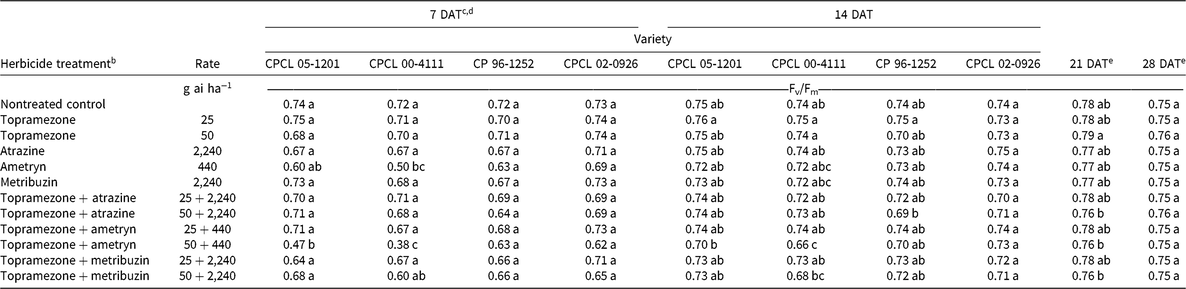
There were significant herbicide-by-variety interactions at 7 and 14 DAT evaluations for chlorophyll fluorescence and no interactions at 21 and 28 DAT at the EREC (Table 1). Therefore, chlorophyll fluorescence data are presented by variety at 7 and 14 DAT and averaged across varieties at 21 and 28 DAT for the EREC location. Topramezone at 25 and 50 g ai ha−1 did not affect chlorophyll fluorescence at any of the evaluation timings. However, chlorophyll fluorescence of CPCL 05-1201 and CPCL 00-4111 was reduced by 37% and 46%, respectively, compared with the nontreated control 7 DAT when topramezone (50 g ai ha−1) was applied in combination with ametryn. The effect of ametryn applied alone on chlorophyll fluorescence of CPCL 05-1201 and CPCL 00-4111 was not significantly different from that of topramezone (50 g ai ha−1) plus ametryn at 7 DAT. Ametryn applied alone also reduced chlorophyll fluorescence by 31%, compared with nontreated CPCL 00-4111 at 7 DAT. Chlorophyll fluorescence reductions of 7% to 11% were observed for CPCL 00-4111 and CP 96-1252 with application of topramezone (50 g ai ha−1) plus ametryn and topramezone (50 g ai ha−1) plus atrazine at 14 DAT; however, these reductions were not significantly different from that measured in the nontreated control. At 21 and 28 DAT, there was no effect of topramezone applied alone or in combination with PSII-inhibitor herbicides on chlorophyll fluorescence of sugarcane at the EREC (Table 1).
Chlorophyll fluorescence of sugarcane after application of topramezone and photosystem II–inhibitor herbicides (atrazine, ametryn, metribuzin) alone or in combination at the Everglades Research and Education Center in Belle Glade, FL.a

a Chlorophyll fluorescence measurements were taken from top visible dewlap leaves.
b All treatments included 1% (vol/vol) crop oil concentrate.
c Abbreviations: DAT, days after treatment; Fv/Fm, chlorophyll fluorescence.
d Means within a column followed by the same letter are not significantly different according to Tukey test at the 5% level of significance.
e Data represent combined effect across all varieties.
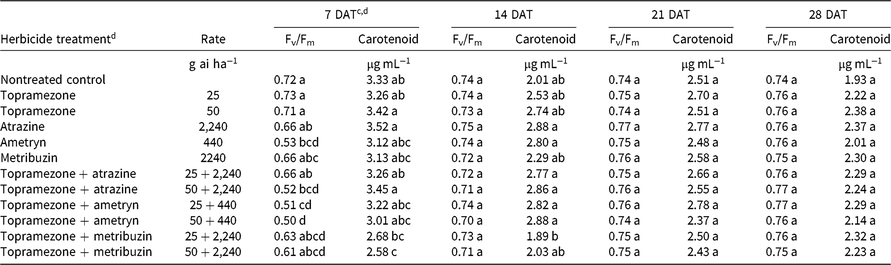
Because of lack of herbicide-by-variety interaction at the Glades Sugar Farm, chlorophyll fluorescence data were combined across varieties at each evaluation, and results are presented with respect to the significant main effect of herbicide treatment. Similar to what we found at the EREC, topramezone alone at both rates did not result in chlorophyll fluorescence reductions at any of the evaluation timings. However, the combination of topramezone (50 g ai ha−1) plus ametryn and ametryn applied alone resulted in significant reduction of 30% and 18%, respectively, of chlorophyll fluorescence, compared with the nontreated control at 7 DAT (Table 2). There was no herbicide effect on chlorophyll fluorescence between 14 and 28 DAT at the Glades Sugar Farm (Table 2). These results show that chlorophyll fluorescence, a measure of photochemical efficiency and plant health, was not affected when topramezone was applied alone at 25 or 50 g ai ha−1, indicating no effect of the herbicide on chlorophyll and surrounding membranes. The only effect was observed at 7 and 14 DAT with the higher rate of topramezone plus ametryn or atrazine, showing that mixes with these PSII-inhibitor herbicides will reduce sugarcane photochemical efficiency in the first 7 to 14 DAT, but this may depend on the variety. Sugarcane chlorophyll fluorescence ratings were similar for topramezone applied alone or in combination with the PSII-inhibitor herbicides from 21 DAT, indicating recovery of sugarcane from adverse effects of the aforementioned treatment combinations. Based on these results, sequential application of topramezone in combination with PSII inhibitor herbicides for weed control in sugarcane can be made 14 or 21 d from the preceding application, depending on the variety, whereas application of topramezone alone can be made sequentially 7 d after the preceding application.
Chlorophyll fluorescence and carotenoid content of sugarcane after application of topramezone and photosystem II–inhibitor herbicides (atrazine, ametryn, metribuzin), alone or in combination at Glades Sugar Farm in Belle Glade, FL.a, b

a Chlorophyll fluorescence measurements were taken from top visible dewlap leaves.
b Data combined across sugarcane varieties.
c All treatments included 1% (vol/vol) crop oil concentrate.
d Abbreviations: DAT, days after treatment; Fv/Fm, chlorophyll fluorescence.
e Means within a column followed by the same letter are not significantly different according to Tukey test at the 5% level of significance.
The ability of sugarcane to remain healthy after topramezone application and recover from adverse physiological effects, based on photochemical efficacy results, when treated with topramezone mixed with PSII-inhibitor herbicides showed sugarcane’s tolerance to the herbicide. In contrast, chlorophyll fluorescence of annual bluegrass (Poa annua L.), hybrid bermudagrass [Cynodon dactylon (L.) Pers. × C. transvaalensis Burtt-Davy ‘Tifway’], and common bermudagrass [C. dactylon (L.) Pers.] was significantly reduced after application of topramezone, indicating lack of tolerance to the herbicide (Elmore et al. Reference Elmore, Brosnan, Kopsell and Breeden2011a, Reference Elmore, Brosnan, Kopsell, Breeden and Mueller2011b, Reference Elmore, Brosnan, Breeden and Patton2013). Similar to the present findings on reduced photochemical efficiency of sugarcane with topramezone and PSII-inhibitor herbicide (i.e., ametryn, atrazine) combinations, photochemical efficiency of centipedegrass [Eremochloa ophiuroides (Munro) Hack ‘Tifblair’ ERLOP] tolerant to both atrazine and mesotrione when they were applied separately was reduced when these herbicides were applied in combination (McElroy and Walker Reference McElroy and Walker2009).
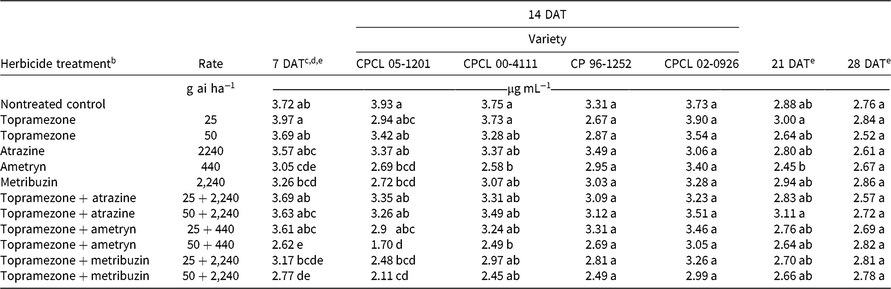
A significant herbicide-by-variety interaction was detected at 14 DAT, but not at 7, 21, and 28 DAT, for sugarcane carotenoid content at the EREC location. Consequently, carotenoid content data are presented by variety at 14 DAT and combined over variety at 7, 21, and 28 DAT for the EREC location (Table 3). Topramezone applied alone at 25 and 50 g ai ha−1 had no effect on carotenoid content. The combination of topramezone (50 g ai ha−1) plus ametryn or metribuzin resulted in the most significant reduction of carotenoid content (26% to 30%) at 7 DAT, compared with the nontreated control at the EREC. Furthermore, at 14 DAT, carotenoid content was reduced 34% and 57% with topramezone (50 g ai ha−1) plus ametryn for CPCL 00-4111 and CPCL 05-1201, respectively, compared with the nontreated control, whereas topramezone (25 and 50 g ai ha−1) plus metribuzin resulted in 37% to 46% reduction for CPCL 05-1201. Ametryn applied alone also caused significant reduction of carotenoid content at 7 DAT across all varieties and at 14 DAT for CPCL 00-4111 and CPCL 05-1201, compared with the nontreated control. Similarly, metribuzin applied alone caused significant carotenoid content reduction for CPCL 05-1201 compared with the nontreated control at 14 DAT. Carotenoid content of CP 96-1252 and CPCL 02-0926 was not affected by herbicide treatments 14 DAT at the EREC. At 21 and 28 DAT, carotenoid content of topramezone applied alone or in combination with PSII-inhibitor herbicides was not significantly different from that of the nontreated control at the EREC.
Carotenoid content of sugarcane after application of topramezone and photosystem II–inhibitor herbicides (atrazine, ametryn, metribuzin) alone or in combination at Everglades Research and Education Center in Belle Glade, FL.a

a Carotenoid content measurements were taken from top visible dewlap leaves.
b All treatments included 1% (vol/vol) crop oil concentrate.
c Abbreviation: DAT, days after treatment.
d Means within a column followed by the same letter are not significantly different according to Tukey test at the 5% level of significance.
e Data represent combined effect across all varieties.
Significant herbicide-by-variety interactions were not detected for carotenoid content for all evaluations at the Glades Sugar Farm location; therefore, data were combined over varieties and presented with respect to significant main effect of herbicide treatment (Table 2). With the exception of the combination of topramezone (50 g ai ha−1) plus metribuzin, which reduced carotenoid content (23%) compared with the nontreated control at 7 DAT, there were no significant herbicide effects on carotenoid content between 14 and 28 DAT at the Glades Sugar Farm. Changes in carotenoid content resulting from herbicide treatment are most likely associated with levels of lutein, β-carotene, and xanthophyll cycle pigments found in plants treated with 4-HPPD–inhibitor herbicides (Brosnan et al. Reference Brosnan, Kopsell, Elmore, Breeden and Armel2011). Recovery from 4-HPPD–inhibiting herbicide injury may be associated with increased photoprotective xanthophyll cycle pigments (Brosnan et al. Reference Brosnan, Kopsell, Elmore, Breeden and Armel2011). Because there was no stress imposed on sugarcane by topramezone applied alone, sequential application for weed control can be applied at 7-d intervals. However, sequential application of topramezone applied in combination with PSII-inhibitor herbicides that resulted in carotenoid content reduction between 7 and 14 DAT should be applied at 14- to 21-d intervals.
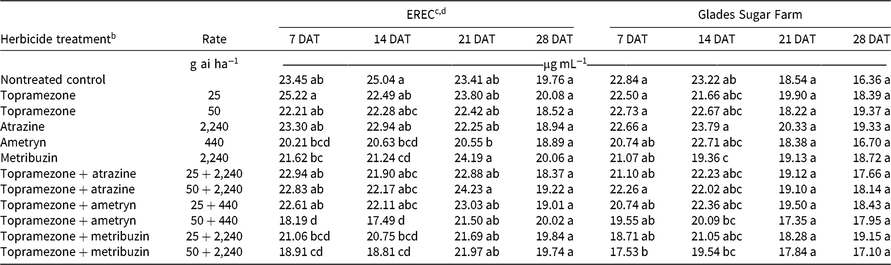
There were no significant herbicide-by-variety interactions for sugarcane total chlorophyll content at any evaluation at the EREC and Glades Sugar Farm locations. Total chlorophyll content data were combined over varieties and results presented with respect to significant main effect of herbicide treatment for both locations (Table 4). No significant reductions of total chlorophyll content were observed when topramezone was applied alone compared with the nontreated control, similar to results obtained for chlorophyll fluorescence and carotenoid content. There were significant herbicide effects on total chlorophyll content compared with the nontreated control for both locations 7 and 14 DAT. At the EREC, the combination of topramezone (50 g ai ha−1) plus ametryn resulted in the greatest total chlorophyll content reduction of 22% and 30% at 7 and 14 DAT, respectively, compared with the nontreated control, followed by topramezone (50 g ai ha−1) plus metribuzin, which resulted in 19% and 25% reductions 7 and 14 DAT, respectively. In addition, topramezone (25 g ai ha−1) plus metribuzin, ametryn, and metribuzin also reduced total chlorophyll content by 15% to 18% compared with the nontreated control 14 DAT at the EREC. Chlorophyll content of sugarcane to which any herbicide treatment was applied was similar to that of the nontreated control 21 and 28 DAT at the EREC. Topramezone (50 g ai ha−1) plus metribuzin was the only treatment that resulted in significant total chlorophyll content reduction (23%) compared with the nontreated control 7 DAT at the Glades Sugar Farm. At 14 DAT, only metribuzin applied alone caused significant reduction (16%) of total chlorophyll content at Glades Sugar Farm. Similar to the EREC, there was no effect of herbicide treatments on sugarcane total chlorophyll content 21 and 28 DAT. Significant reductions occurred 7 to 14 DAT with combinations of the higher rate of topramezone with ametryn or metribuzin, suggesting that sequential applications for topramezone alone can occur at 7-d intervals, whereas mixes with the two PSII-inhibitor herbicides should occur at 21-d intervals.
Chlorophyll content of sugarcane after application of topramezone and photosystem II–inhibitor herbicides (atrazine, ametryn, metribuzin), alone or in combination, combined over varieties, at the EREC and Glades Sugar Farm in Belle Glade, FL.a

a Chlorophyll content measurements were taken from top visible dewlap leaves.
b All treatments included 1% (vol/vol) crop oil concentrate.
Abbreviations: DAT, days after treatment; EREC, Everglades Research and Education Center.
c Means within a column followed by the same letter are not significantly different according to Tukey test at the 5% level of significance.
In this study, similar treatments (i.e., topramezone at 50 g ai ha−1 plus ametryn or metribuzin, ametryn, and metribuzin) resulted in reduction of sugarcane chlorophyll fluorescence, carotenoid, and total chlorophyll content between 7 and 14 DAT, followed by recovery at 21 DAT. However, Elmore et al. (Reference Elmore, Brosnan, Kopsell, Breeden and Mueller2011b) reported that chlorophyll fluorescence was not a good predictor of carotenoid and chlorophyll concentrations on turfgrass, contrary to the present findings on sugarcane. Overall, these results show that a single application of topramezone alone (25 and 50 g ai ha−1) had no effect on sugarcane, suggesting tolerance, and the only effects were observed with mixes with ametryn or metribuzin within the first 14 DAT. In situations where secondary applications of topramezone alone or in combination with these PSII-inhibitor herbicides may be required for efficacious weed control, topramezone applications alone can be made sequentially after 7 d, whereas the combinations can be made after 14 or 21 d, depending on sugarcane sensitivity.
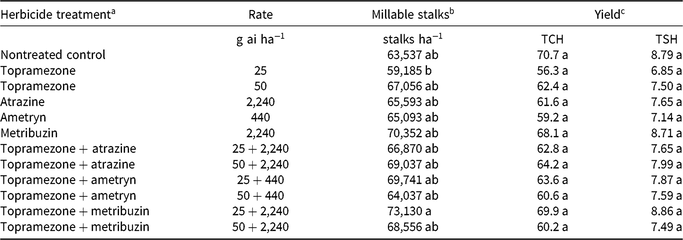
Sugarcane millable stalk and yield data (TCH and TSH) were combined across locations because there was no location effect. Additional analysis indicated that main effects of herbicide, variety, and their interactions were not significant for TCH and TSH; therefore, results of sugarcane yield are presented with respect to the main effect of herbicide treatment (Table 5). There was significant main effect of herbicide treatment for millable stalks; however, all herbicide treatment results were not significantly different from those observed on the nontreated control. For topramezone applied alone, sugarcane yield results reflected no effect on chlorophyll fluorescence, carotenoid, and total chlorophyll content, and recovery after 7 or 14 DAT for combinations with PSII-inhibitor herbicides, which initially reduced these parameters. Similarly, Martins et al. (Reference Martins, Costa, Cardoso, Rodrigues and Silva2010) reported no effect of topramezone alone (70 to 100 g ai ha−1) or in combination with tebuthiuron, a PSII-inhibitor herbicide on sugarcane yield despite initial injury of up to 43% at 7 DAT; however, no injury on sugarcane was observed from 35 DAT.
Sugarcane millable stalks and yield after application of topramezone and photosystem II–inhibitor herbicides (atrazine, ametryn, metribuzin) alone or in combination, combined over varieties, at the Everglades Research and Education Center and Glades Sugar Farm locations in Belle Glade, FL.

a All treatments included 1% (vol/vol) crop oil concentrate.
b Means within a column followed by the same letter are not significantly different according to Tukey test at the 5% level of significance.
c Abbreviations: TCH, tons of cane ha−1; TSH, tons of sugar ha−1.
Fall Panicum Control Study
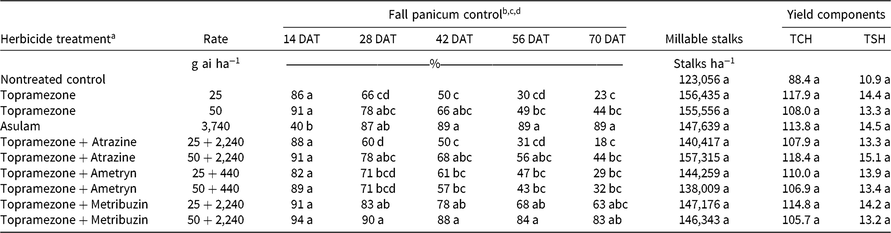
All data on fall panicum control were combined over locations because there was no location effect. Nontreated control data were not included in the fall panicum control analysis, because there was no variance. Visual sugarcane injury was not observed after any herbicide treatment application for all evaluations. The main effect of herbicide treatment was significant at all evaluations for fall panicum control (Table 6). Visual symptoms of fall panicum injury included bleaching of shoots, which progressively became necrotic, followed by plant death with no visual signs of regrowth of meristematic tissue. The rapid symptomology associated with topramezone phytotoxicity was observed on fall panicum 14 DAT. Topramezone applied alone or mixed with the PSII-inhibitor herbicides controlled fall panicum 86% to 94% at 14 DAT, compared with 40% with asulam. Asulam, a carbamate herbicide, exhibits slow symptomology on fall panicum, manifested as chlorosis on shoots followed by necrosis and occurrence of plant death from 28 DAT (D.C. Odero, personal observation). In contrast, Soltani et al. (Reference Soltani, Kaastra, Swanton and Sikkema2012) found that topramezone at 12 g ai ha−1 applied on two- to three- and five- to six-leaf fall panicum provided 72% and 62% control, respectively, at 14 DAT. At 28 DAT, the combination of topramezone (50 g ai ha−1) plus metribuzin provided the greatest fall panicum control (90%), whereas topramezone (25 g ha−1) plus atrazine had the least control (60%). The latter combination was not significantly different from topramezone alone (25 g ai ha−1) and from topramezone mixes with ametryn. Parochetti (Reference Parochetti1974) reported poor efficacy of POST atrazine on fall panicum control. Topramezone (50 g ai ha−1) plus metribuzin provided 88% fall panicum control 42 DAT, compared with 89% provided by asulam. Between 56 and 70 DAT, when sugarcane full canopy closure occurred, topramezone (50 g ai ha−1) plus metribuzin provided the greatest fall panicum control among treatments that contained topramezone. This level of control was not different from that provided by asulam, the commercial standard, which maintained 89% fall panicum control between 56 and 70 DAT. Other topramezone-containing treatments provided 18% to 68% fall panicum control between 56 and 70 DAT. Fall panicum subjected to the latter treatments exhibited regrowth of meristematic tissue and showed no topramezone injury.
Fall panicum control, sugarcane millable stalks, and yield after application of topramezone and photosystem II–inhibitor herbicides (atrazine, ametryn, metribuzin) applied alone or in combination, combined over two sites at the Everglades Research and Education Center in Belle Glade, FL.

a Topramezone treatments included 1% (vol/vol) methylated seed oil; asulam treatment included 0.25% (vol/vol) nonionic surfactant.
b Abbreviations: DAT, days after treatment; TCH, tons of cane ha−1; TSH, tons of sugar ha−1.
c Means within a column followed by the same letter are not significantly different according to Tukey test at the 5% level of significance.
d Nontreated control data were not included in the analysis because there was no variance.
Results from these experiments indicate that topramezone (50 g ai ha−1) plus metribuzin is a good option for POST fall panicum control in sugarcane, providing control similar to asulam, with limited to no regrowth or greening of meristematic tissue up to 70 DAT. Cauwer et al. (Reference Cauwer, Geeroms, Claerhout, Bulcke and Reheul2014) recommended application of topramezone on three-leaf fall panicum to ensure efficacious control. The main effect of herbicide was not significant for sugarcane millable stalks and yield (TCH and TSH) (Table 6). The absence of significant differences in sugarcane millable stalks and yield despite treatment effect on fall panicum control was probably related to stand variability of the second ratoon sugarcane stand used in the study.
The existing issue of reduced fall panicum control with asulam, the main POST herbicide for grass control in Florida sugarcane, requires the evaluation of alternative herbicide options. The results from this study indicated that topramezone (50 g ai ha−1) plus metribuzin provided acceptable control of fall panicum, with limited to no regrowth of meristematic tissue until canopy closure, equivalent to 56 to 70 DAT. Sugarcane chlorophyll fluorescence, total chlorophyll, and carotenoid content were not affected by topramezone at 25 and 50 g ai ha−1, indicating sugarcane tolerance to the herbicide. Transient reduction of these parameters by combinations of topramezone at the higher rate with ametryn or metribuzin occurred within the first 14 DAT despite lack of visual injury symptoms and was not detected thereafter, indicating recovery from combinations of the PSII-inhibitor herbicides. Based on these results, when sequential applications of topramezone alone or in combination with these triazine herbicides are required for efficacious weed control, topramezone applications alone can be made after 7 d, whereas the applications of the combinations can be made after 14 or 21 d, depending on sugarcane sensitivity. Topramezone applied alone or in combination with the triazine herbicides for fall panicum management in sugarcane must be used with other weed management options to proactively mitigate evolution of herbicide resistance.
Acknowledgments
The authors thank Jose Fernandez, Saulo Simoès, Franklin Casco, Leonard Fox (University of Florida - Everglades Research and Education Center), and Mathew Duchrow (Sugar Cane Growers Cooperative of Florida) for their help with the project. We acknowledge BASF Corporation for partially funding the project. No conflicts of interest have been declared.