Introduction
Phoebe cooperiana (Family Lauraceae) is a large evergreen, indigenous tree of Arunachal Pradesh, India that yields an economically important fruit. The tree is distributed in the low and mid hill areas of the state between altitudes of 90 and 1600 m mean sea level and a common associate in the tropical forest. Fruits are sold at prices ranging from $8 to $9 for 100 fruits or privately owned trees are leased at $250–$300 for a single season to local traders and middlemen. The fruit is eaten raw or cooked with chilli, ginger and served with rice or local beverages. The tree also yields good timber for plywood and furniture making and is categorized under the A4 class category of timber. Hence, it is extensively harvested for timber and removal of fruits from forest floor has disturbed the natural regeneration process in the wild (Payum et al., Reference Payum, Das, Ramashankar, Tamuly and Hazarika2013). Consequently, it was listed as one of the top priority species for domestication and conservation in Arunachal Pradesh (Lyngdoh, Reference Lyngdoh2015). Following this, studies on distribution mapping of the species within Arunachal Pradesh, presowing seed treatment, variation of morphological and biochemical fruit parameters across populations and standardization of vegetative propagation methods were undertaken (Dolley, Reference Dolley2019; Dolley et al., Reference Dolley, Lyngdoh, Devi and Hazarika2019, Reference Dolley, Lyngdoh, Singh, Singh, Devi and Hazarika2020; Pabin et al., Reference Pabin, Lyngdoh, Mehra, Devi and Payum2021).
As a step forward in the domestication process, identification and selection of superior germplasm are essential. This selection contributes to a multidimensional process that culminates in the production, management, diffusion and subsequent adoption of the desired germplasm (Simons and Leakey, Reference Simons and Leakey2004). In recent years, a participatory approach has been widely followed for the domestication of indigenous fruit trees (IFTs) where farmers are involved in trait identification, germplasm selection, production and dissemination. Superior trees of Uapaca kirkiana and Sclerocarya birrea were identified directly with communities to determine superior fruit traits based on tree-to-tree variation measured in wild populations (Akinnifesi et al., Reference Akinnifesi, Kwesiga, Mhango, Chilanga, Mkonda, Kadu, Kadzere, Mithofer, Saka, Sileshi, Ramadhani and Dhilwayo2006). Using the ideotype concept developed from farmers' consensus, superior trees of Irvingia gabonensis and Dacryodes edulis were selected for vegetative propagation (Leakey et al., Reference Leakey, Tchoundjeu, Schreckenberg, Shackleton and Shackleton2005; Leakey and Page, Reference Leakey and Page2006).
In a participatory selection, farmers are generally not aware of the variability patterns of economically important traits and the correlation amongst them, and therefore scientific evaluation complements the approach. Tree domestication and improvement must rely on the existence of intra and inter population variability level of economic traits, without which selection becomes a futile exercise. Dhliwayo-Chiunzi et al. (Reference Dhliwayo-Chiunzi, Matimati and Kachigunda2014) characterized the fruit morphological characters and total soluble solutes of nine trees of U. kirkiana that were screened as candidate trees for clonal propagation from an initial selection of 48 trees. Characterizing individual tree variation for fruit characters was also found useful in selection of cultivars of D. edulis (Leakey et al., Reference Leakey, Atangana, Kengni, Waruhiu, Usoro, Anegbeh and Tchoundjeu2002), and recently in Trichoscypha acuminata (Alain et al., Reference Alain, Akem, Avana, Muchugi, Degrande, Tchoundjeu, Jamnadass and Na'a2020). Further, this exercise can reveal the relationship between characters that will facilitate multi-trait selection to suit consumers' need and preferences and speed up future tree selection process based on limited characters.
The aim of the present study is to carry out phenotypic selection of P. cooperiana trees for fruit production, pulp weight and fruit shape from a base population comprising of trees identified by farmers as the best in the respective study sites. We resort to phenotypic selection because it is the method of tree selection which is more effective in capturing variation. In an earlier study by Dolley et al. (Reference Dolley, Lyngdoh, Singh, Singh, Devi and Hazarika2020) on P. cooperiana, although significant variation was reported for economically important traits such as fruit weight, pulp weight and pulp thickness among 14 populations of Arunachal Pradesh, India, the level of population variation detected for the morphological traits was found to be low. Following the selection process, we then characterized tree-to-tree variation for all fruit traits among selected genotypes with the aim of ascertaining the level of genetic variation among selected individuals and identifying promising individuals for mass multiplication and diverse genotypes that can serve as potential parents in future breeding programmes.
Materials and methods
Based on an ecological niche-modelling map developed by Dolley (Reference Dolley2019), we selected nine sites that fell under different suitability habitats for P. cooperiana in Arunachal Pradesh during 2018 (online Supplementary Table S1). The sites were located in three districts of the state between the altitudinal range of 94 and 174 m (Fig. 1). At each site, during the month of September 2019, farmers were asked to identify five best trees in the area which according to them yielded best fruits and would serve as mother plants for planting material. From each tree, 30 fruits were collected and which were divided into three replications of ten fruits each. Various fruit and seed dimensions such as length and diameter were measured and the same were also weighed with pulp and without pulp.
Study sites and location of selected trees of Phoebe cooperiana in Arunachal Pradesh, India.

In order to develop a selection index for screening of superior trees, we randomly and informally enquired from fruit sellers about traits that best dictate the quality of fruit. Based on a general consensus, high pulp content and round fruits were most preferred. Therefore, pulp fruit weight ratio (PFR) was used as a measure for pulp content and fruit diameter length ratio (FDLR) for fruit shape. PFR was calculated by dividing pulp weight by fruit weight while FDLR is calculated by dividing fruit diameter by fruit length. We further added the quantity of fruit produced, which is the number of fruits produced by the tree in the previous year, as one of the criteria for selection. Using these three traits, a selection index was developed as per Cotterill and Dean (Reference Cotterill and Dean1990) and shown in online Supplementary Table S2. The three traits (criteria for selection) were assigned a weighted contribution: PFR 50%, FDLR 40% and fruit production 10%. Trees obtaining scores above average (50) were selected.
The fruit and seed data of the selected trees were then extracted from the screening dataset of 45 trees (base population) and analysed for estimating the per cent improvement over base population and variability of traits. A complete randomized design was used for all parameters and variability was estimated as per procedure for analysis of variance suggested by Panse and Sukhatme (Reference Panse and Sukhatme1985). Simple correlation coefficient was used to determine the degree of association among all the characters for all the populations using the formula given by Weber and Moorthy (Reference Weber and Moorthy1952). Principal component analysis (PCA) that was performed to the standardized data set to observe the interrelationships of samples was analysed using Microsoft Excel 2010 with upgraded XLSTAT (version 2018.1; Addinsoft). The mean of the morphological characters was used to generate an unweighted pair group method with arithmetic averages (UPGMA) dendrogram using NTSYS (PC Software, version 2.1) as described by Rohlf (Reference Rohlf2000).
Results
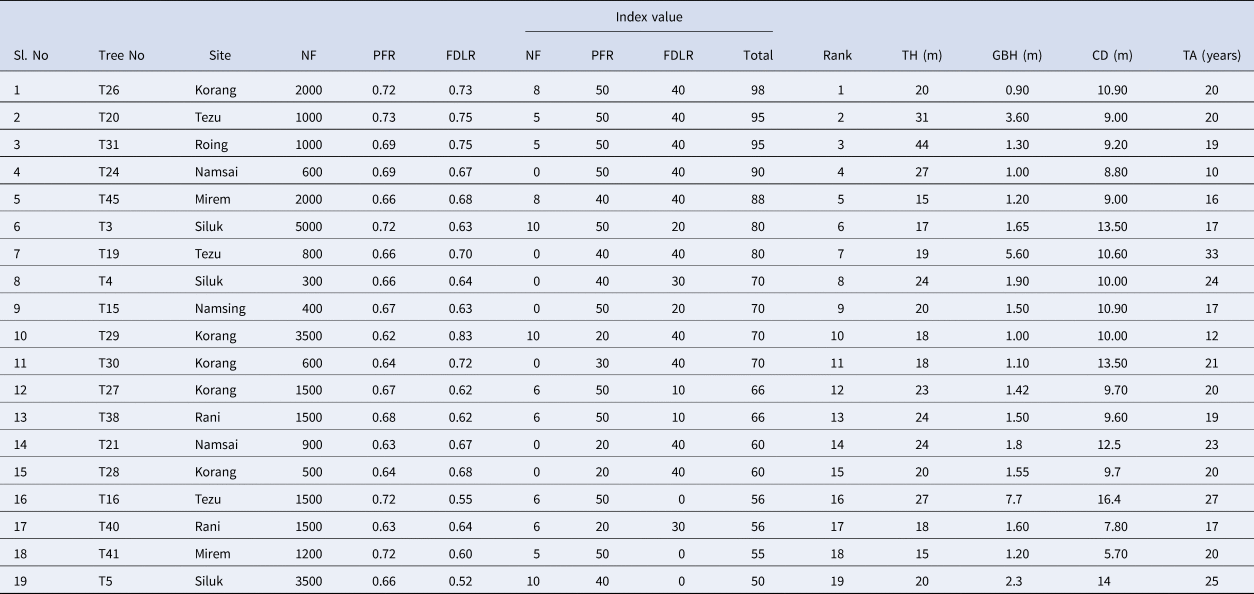
Trees were selected based on a total score obtained from fruit production, fruit pulp ratio and FDLR. Out of 45 trees that were initially identified by farmers, 24 had scores above the average value and were selected. However, five trees whose ages were above 30 were rejected to ensure that selected trees were in their mid-ages for greater vigour and productivity. The 19 trees were located in three districts of the state: the highest (11) from East Siang district and three each from districts of Lohit and Lower Dibang and two from Namsai (Fig. 1). The highest score was obtained by Tree. No. 26 from Korang (online Supplementary Fig. S1) followed by Tree No. 20 from Tezu and the lowest score was obtained by Tree No. 5 from Siluk (Table 3). After the screening process, three individuals each from Siluk, Tezu, Korang and Roing, two from Mirem, Rani and Namsai and one from Namsing were selected. None of the trees identified by farmers at Pasighat qualified for selection. Details of scores obtained by 19 trees along with their ranks are given in Table 3. There was large variation in the fruit-bearing capacity of selected trees ranging from 300 fruits in Tree No. 4 to 5000 fruits in Tree No. 3 (online Supplementary Fig. S2), both from Siluk (Table 1). The average age of selected trees was 19.05 years, ranging between 10 and 27 years, and crown diameter ranged from 5.70 to 14 m (Table 1).
Index values and morphological details of 19 trees of Phoebe cooperiana selected based on fruit production, pulp fruit ratio and fruit diameter length ratio in Arunachal Pradesh

NF, number of fruit per tree; PFR, pulp fruit ratio; FDLR, fruit diameter to length ratio; TH, tree height; GBH, girth at breast height; CD, crown diameter; TA, tree age.
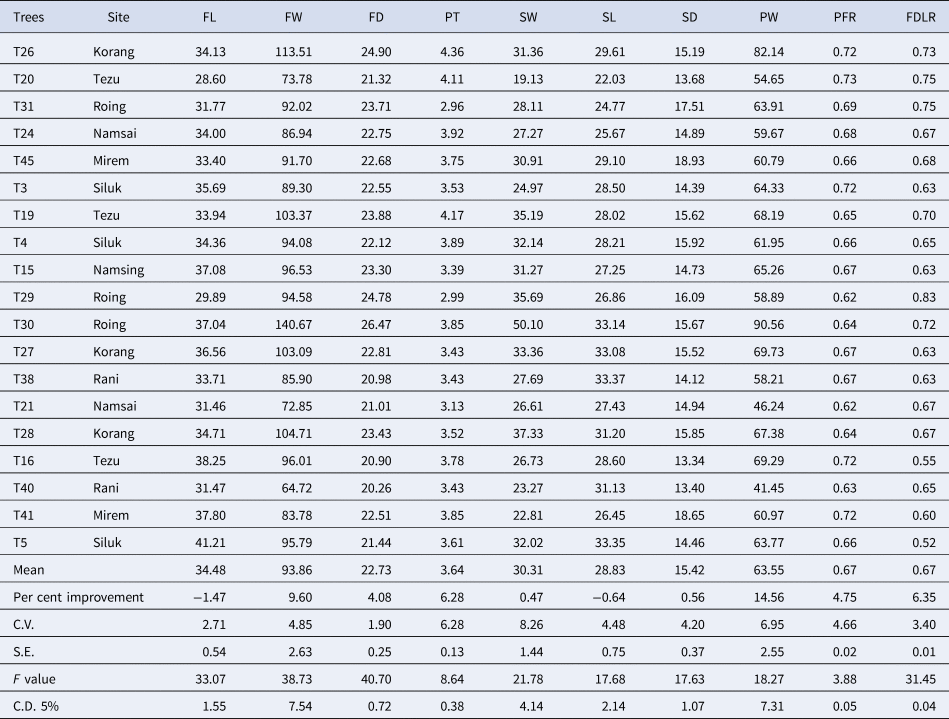
Following the screening test, the per cent improvement of fruit and seed traits over the base population ranged from 0.16% for seed diameter to 14.56% for pulp weight. Among economically important traits, the per cent improvement over mean of base population was 9.60% for fruit weight, 6.35% for FDLR and 6.20% for pulp thickness (Table 2). Significant variation was observed for all fruit and seed parameters among the 19 selected individuals (Table 2). Fruit characters that were desirable included pulp fruit ratio, FDLR, fruit weight, fruit diameter, pulp thickness and pulp weight. Tree No. 26 from Korang, which ranked first had the highest pulp thickness (4.46 mm; online Supplementary Fig. S3), while the second ranked Tree No. 20 from Tezu had the highest pulp fruit ratio and the least fruit length (0.73 and 28.60 mm, respectively; online Supplementary Fig. S4). Among selected trees, Tree No. 30 from Roing had exceedingly high fruit weight, seed weight and pulp weight (140.67, 50.10 and 90.56 g, respectively). However, its pulp fruit ratio was significantly lower than Tree No. 20, which had the highest value. The FDLR was the highest in Tree No. 29 (0.83) but had the lowest fruit pulp ratio (0.62). Coefficient of variation (CV) values of traits ranged from 1.92% for fruit diameter to 8.26% for seed weight.
Mean values for fruit and seed parameters of 19 trees of Phoebe cooperiana selected in Arunachal Pradesh

FL, fruit length; FW, fruit weight; FD, fruit diameter; PT, pulp thickness; SW, seed weight; SL, seed length; SD, seed diameter; PW, pulp weight; PFR, pulp fruit ratio; FDLR, fruit length diameter ratio.
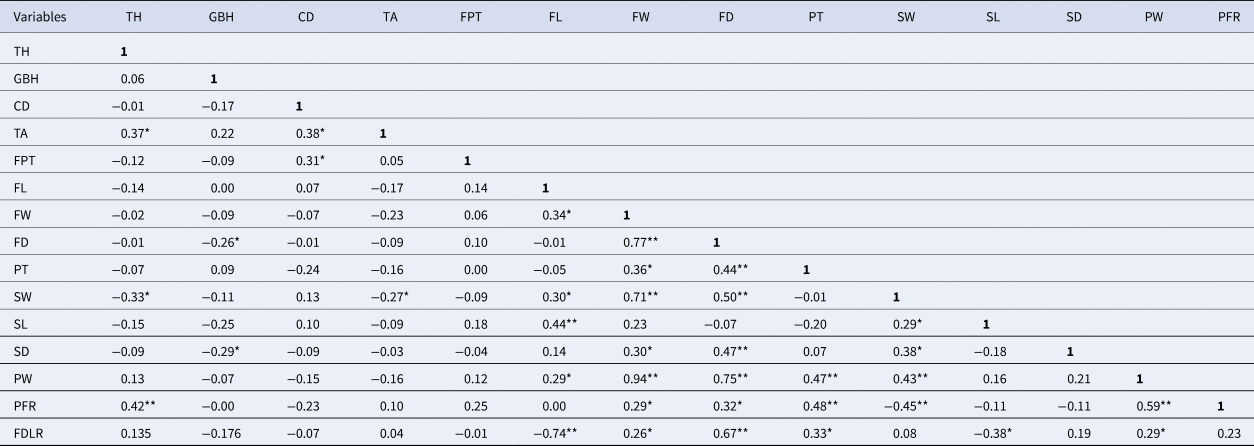
Correlation analysis revealed significant positive association between economic traits such as fruit weight and pulp weight (r = 0.94, P > 0.01), FDLR with fruit weight, pulp thickness and pulp weight (r = 0.23, P < 0.05; r = 0.33, P < 0.05; r = 0.29, P < 0.05; Table 3).PCA was used for identifying the traits contributing the most to the variability in the data set. Out of ten components, three components extracted Eigen values of >1 which contributed 81.94% of the total variation. The variables that largely contributed to the variability were fruit diameter, fruit weight, pulp weight, seed weight and fruit length. In PC1, the variation was mostly contributed by fruit weight (0.496), pulp weight (0.461) and seed weight (0.458), while it was FDLR (0.614) in PC2. The relationship among the different traits and individual trees and their association with respective principal component is illustrated in Fig. 2. The bi-plot dimension vectors showed positive relation among fruit weight, seed weight and pulp weight as well as among seed length with fruit length; pulp fruit ratio showed negative correlations with seed weight. The 19 selected trees were distributed in all quarters of the scatter plot where Tree No. 19, 20 and 26 clustered together for their similarity in fruit and seed dimensions while Tree No. 30 isolated itself, characterized by extremely high seed, fruit and pulp weight. Cluster analysis revealed grouping of genotypes into seven groups. Tree No. 26 and 30 were placed individually in two separate clusters, while rest of the genotypes were mixed in the other five clusters showing no indication of geographic affinities (Fig. 3).
Correlation coefficient among tree characteristics, fruit and seed parameter for 19 individuals of Phoebe cooperiana selected in Arunachal Pradesh

TH, tree height; GBH, girth at breast height; CD, crown diameter; TA, tree age; FPT, fruits per tree; FL, fruit length; FW, fruit weight; FD, fruit diameter; PT, pulp thickness; SW, seed weight; SL, seed length; SD, seed diameter; PW, pulp weight; PFR, pulp fruit ratio; FDLR, fruit length diameter ratio.
**Significant at 5%, *significant at 1%.
Phenotype by trait biplot illustrating the relationship between PC1 and PC2 for 19 phenotypes and 10 traits of Phoebe cooperiana.

Clustering pattern for 19 individuals of Phoebe cooperiana selected in Arunachal Pradesh.

Discussion
Insights from IFT domestication in Africa have shown that participatory selection greatly enhances farmers' acceptance of selected individuals and traits of economic interest (Kalinganire et al., Reference Kalinganire, Weber, Uwamariya, Kone, Akinnifesi, Leakey, Ajayi, Sileshi, Tchoundjeu, Matacala and Kwesiga2008; Dhliwayo-Chiunzi et al., Reference Dhliwayo-Chiunzi, Matimati and Kachigunda2014; Simon et al., Reference Simon, Akinnifesi, Mkonda, Mhango, Chilanga, Sileshi and Ajayi2015). However, this approach is not widely practiced in the Asian region and has been recently adopted for the first time in India for refining the tree selection criteria of Parkia timoriana based on farmers' knowledge and consumer preference (Phurailatpam et al., Reference Phurailatpam, Lyngdoh, Vasudeva, Mehra, Devi Mongjamand and Momin2021). Out of 45 trees that were initially identified by farmers using selection criteria recommended by them, the percentage of trees meeting the required score was only 42%. Either farmers were not rigorous enough with the selection process or the identification process could have also been driven by other parameters such as taste or colour. Nevertheless, this method of tree selection offers wide scope for refining the selection process by incorporating scientific knowledge with farmers' choices.
Individual tree selection is a useful method for making a quick and inexpensive genetic gain in a tree improvement programme (Zobel and Talbert, Reference Zobel and Talber1984) and is largely applicable in participatory selection and development of breeding populations of IFTs (Leakey and Page, Reference Leakey and Page2006). It also ensures that trees can be selected from diverse geographical origin and ecological niches to capture maximum variation. In our study, the selected trees were spread between the latitudes of 27°10′33.12″N and 28°10′33.12″N and longitude between 95°29′38.45″E and 95°84′54.92″E and based on the habitat suitability map developed by Dolley (Reference Dolley2019), nine trees were from highly suitable habitats, five from medium and four from low suitability habitat. The implication of selecting phenotypes of diverse origin is not only important for breeding but also when germplasm collections are contemplated (Raebild et al., Reference Ræbild, Larsen, Jensen, Moussa, De Groote, Patrick, Jules, Boukary, Haby, Antoine and Erik2011; Naseem et al., Reference Naseem, Muhammad, Summar and Faisal2019).
All fruit and seed traits among the 19 selected genotypes revealed significant tree-to-tree variation, which is consistent with the studies of Anegbeh et al. (Reference Anegbeh, Usoro, Ukafor, Tchoundjeu, Leakey and Schreckenberg2003), Abasse et al. (Reference Abasse, Weber, Katkore, Boureima, Larwanou and Kalinganiré2011) and Alain et al. (Reference Alain, Akem, Avana, Muchugi, Degrande, Tchoundjeu, Jamnadass and Na'a2020) for other IFT species. Zobel and Talbert (Reference Zobel and Talber1984) attributed among tree differences of traits to the outcrossing nature of individuals in a population commonly reported in fruit and seed characters of many IFTs (Leakey et al., Reference Leakey, Atangana, Kengni, Waruhiu, Usoro, Anegbeh and Tchoundjeu2002; Atangana, Reference Atangana2010; Shinde et al., Reference Shinde, Rane, Bhave, Gunaga and Narkhede2012; Alain et al., Reference Alain, Akem, Avana, Muchugi, Degrande, Tchoundjeu, Jamnadass and Na'a2020). The amount of variation expressed in terms of CV, according to Thompson (Reference Thompson1984), was observed to be high for economically important traits such as fruit weight, pulp weight, pulp thickness and pulp fruit ratio, which then offers ample scope for trait improvement. All these characters showed significant positive correlation with each other and also to FDLR (Table 3) making multi-trait improvement an easy task. When the range values of fruit and seed traits obtained in the present study were compared with those of 14 populations estimated by Dolley et al. (Reference Dolley, Lyngdoh, Singh, Singh, Devi and Hazarika2020), higher upper limit values were obtained in our study, which indicates that individual tree selection is an effective strategy for identifying rare and extreme phenotypes. For instance, Tree No. 30 from Roing (online Supplementary Fig. S5) had exceedingly high values for fruit weight, seed weight and pulp weight while Tree No. 3 from Siluk (online Supplementary Fig. S6) had high reproductive capacity, which can be valuable genotypes in future breeding programmes.
The strong positive correlation exhibited among economic traits further eases the task of multi-trait improvement in the species (Table 3). This is further emphasized in the bi-plot scatter diagram (Fig. 2) where economic traits that were highly correlated contributed significantly to total variability offering greater opportunities during selection. We observed no affinities of trees from the same geographical location grouping together in the cluster analysis. It is observed that because of the increasing demand for the species, there is a high chance that propagating materials are transferred across villages and districts in the recent years, especially when the age of trees screened were between 10 and 27 years only.
Conclusion
The practice of tree ranking and understanding tree-to-tree variation for economic characters are essential activities in participatory tree selection programme. The results of the study show that less than half the number of trees that were initially identified by the farmers could fulfil the criteria opted by them stressing the importance of scientific reasoning with farmers' knowledge and preferences. Using three simple selection criteria, considerable level of improvement in fruit and seed parameter was achieved over a narrow base population of 45 trees paving way for more extensive surveys and screening. At this juncture, it is also recommended that qualitative traits and organoleptic tests may be included as criteria in the screening process. The exercise of individual selection has revealed large tree-to-tree variation among the selected individuals and our understanding about the variability patterns of economically important fruit parameters and their inter-relationship serves to make future selection a lot easier. However, a clear understanding of heritability patterns of the traits should be established through field genetic trials should the opportunities of breeding occur in future. In light of the present situation, we should concentrate on multiplication of individuals that have performed exceedingly well through a standardized vegetative method of propagation to ensure that their clonal material is disseminated among famers and also preserved for future improvement.
Supplementary material
The supplementary material for this article can be found at https://doi.org/10.1017/S1479262123000989