Introduction
The exploration of a particular musical genre in its local and historical context helps us to understand different experiences and systems of meaning, as well as the process of cultural change in a specific society. This is a topic of particular interest in the case of rebetiko, a Greek popular musical genre commonly associated with stringed instruments, mainly bouzouki,Footnote 1 and urban low life. Since the 1970s the study of rebetiko has greatly benefitted from scholarly investigations into issues such as social context, style, poetry and contemporary Greek intellectual discourse on urban music.Footnote 2 However, this scholarship has paid somewhat less attention to the anonymous rebetiko songs of the non-commercial tradition (Gauntlett Reference Gauntlett1985) that arose in the ‘primary phase’ of the genre's history (Damianakos Reference Damianakos1987, Reference Damianakos2001 [1976]).
In general, the anonymous, non-commercial rebetiko tradition seems to have developed in the large port cities of the eastern Mediterranean from the late 19th century to the interwar era, in the framework of a subculture that emerged among marginalised urban social groups and was associated with a divergent system of beliefs and values outside mainstream society. Among the areas where this tradition appeared were urban centres on the island of Crete. Crete was an active centre of culture and commerce during Classical, Roman and Byzantine times (Herzfeld Reference Herzfeld2003, p. 282), and was under Venetian rule from 1204 to 1669, when it was conquered by the Ottomans. In 1899 the island was declared an Autonomous State under Ottoman suzerainty, with Prince George of Greece as High Commissioner, backed by an international military force comprised of British, French, Italian and Russian troops.Footnote 3 Crete remained autonomous until 1913, when it was united with Greece. To the present day it is regarded as a divergent social and cultural entity within the Greek nation, characterised by a strong sense of local pride, a tradition of bellicose heroism (Herzfeld Reference Herzfeld1985, Reference Herzfeld2003) and a lively folk music scene centred on the Cretan lyra (Dawe Reference Dawe2003, Reference Dawe, Cooper and Dawe2005, Reference Dawe2007a,Reference Daweb).
In the case of Heraklion, the island's largest city, a hybrid type of rebetiko music emerged at the time of the Cretan Autonomous State and was maintained until the late 1950s, mainly being performed around the brothels in Lakkos, a neighbourhood on the southwest perimeter of the Venetian walled city. This neighbourhood became a dynamic social space structured around complex socio-cultural networks based on impromptu economic transactions at times bordering on the illegal, such as gambling, prostitution, hashish-smoking and smuggling. Lakkos was a divergent microcosm lying outside the dominant norms of the time, mirroring the town's ‘low other’. Indeed, the name Lakkos itself (literally, ‘pothole’)Footnote 4 expressed this sense of discrimination, symbolically marking out the fluid boundaryFootnote 5 between the local world and respectable society.
The men who lived in Lakkos or frequented the area were mostly from the lower strata, including individuals who occupied a prominent position in local social networks and who had accumulated symbolic capital in the form of prestige and reputation (Bourdieu Reference Bourdieu1977). Known as kaldirimitzides, dayides, kapadayides, rebetes, maghes and dervisia,Footnote 6 they dressed in a distinctive way, used a local idiom borrowing from harbour slang and cultivated a way of life oriented around low life, namely pleasure seeking, aggressive manliness, hashish smoking, spells in prison, heroic boasting and flirting. In this milieu, communal-based songs variously known as vlamika, kutsavakika, murmurika, hashiklidika, mortica, kaldirimitzidika, Lakoudiana (literally, ‘Lakkos songs’) and ‘whore songs’ were cultivated.
This article briefly explores some methodological issues in the study of non-commercial rebetiko before moving to a description of fieldwork methodology. Drawing from a range of sources, the study employs a variety of historical, sociological and anthropological perspectives to shed light on the factors contributing to the evolution of the social world in Lakkos, and the process via which it gradually fell into decline. Such an investigation reveals connections between social networks in the local economy and the building and maintenance of the rebetiko scene, and highlights the importance of the wider multicultural context for music-making practices. Emphasis is also placed on morphological elements of the songs and the ways in which participants used music to build worlds of meanings and negotiate their musical heritage.
The non-mainstream hybrid music scene in Lakkos is treated as an exemplary case for the discussion of ‘other societies’ within Greek reality (Hess 2003, p. 37), particularly with regard to the historical and socio-cultural context of local variants of rebetiko. This research can contribute to a comparative study of the evolution of many ethnic musical styles (for example tango, flamenco, fado) which were originally associated with socially marginalised classes in urban areas (Manuel Reference Manuel1990; Washabaugh Reference Washabaugh1998; Steingress Reference Steingress and Washabaugh1998, Reference Steingress2002). Moreover, I would argue that this study provides an opportunity to link the peculiarities of grassroots non-commercial rebetiko to the exploration of everyday local music-making practices in various countries worldwide (Finnegan Reference Finnegan1989; Cohen Reference Cohen1991; Slobin Reference Slobin1993; Kavouras Reference Kavouras, Hastrup and Hervik1994; Mitchell Reference Mitchell1996; Berkaak Reference Berkaak1999; DeNora Reference DeNora2000; Grazian Reference Grazian2003, Reference Grazian2004; Bennett Reference Bennett2004; Bennett and Peterson Reference Bennett and Peterson2004).
The localness of rebetiko: conceptual framework and fieldwork methodology
Despite the scholarly attention paid to the origins and the localness of rebetiko, there is a remarkable lack of disciplinary research on this subject. A number of empirical surveys based on folklore and biography have made sporadic inquiries into the loci of rebetiko. Such sources abound in references to dayides, tavernas, groups of maghes, old hashish dens and their songs, and the haunts of bouzouki-players in cities such as Smyrna, Athens, Piraeus, Thessalonica, Volos, Patra, Alexandria and Ayvalik (see, inter alias, Stringaris Reference Stringaris1937; Prokopiou Reference Prokopiou1949; Archigenis 1977 ; Hatzidoulis Reference Hatzidoulis1979, pp. 85–107; Vellou-Kail Reference Vellou-Kail1978, pp. 21–45; Gauntlett Reference Gauntlett1985, p. 183; Yenitsaris Reference Yenitsaris and Gautelett1992; Hristianopoulos Reference Cristianopoulos1999; see also the Stam-Stam (1929) articles published in Makedonia).
There have also been a handful of scholarly investigations into non-commercial rebetiko. The first attempt was the Damianakos sociological study of the genre based on content analysis of a corpus of songs derived from the Petropoulos anthology (Reference Petropoulos1989). Although influential, this relied heavily on theoretical constructs but lacked historical documentation (Smith Reference Smith1989, pp. 189–90; Gauntlett Reference Gauntlett1985, pp. 19–22). In particular, it contained widely accepted generalisations about the primary phase of the rebetiko world and its links to the closed social worlds of criminals and outlaws (Damianakos Reference Damianakos1987, pp. 128, 156–8; 2001 [1976]). On the other hand, Holst Reference Holst1991 [1975], in her early work on rebetiko, employed a more ‘impressionistic’ approach without paying undue attention to methodological and theoretical schemes, in an attempt to present an experiential view of grassroots music-making and rebetiko.Footnote 7
A more systematic investigation of traditional rebetiko was provided by Gauntlett (Reference Gauntlett1985). He used a wide range of sourcesFootnote 8 to investigate the evolution from anonymous oral tradition to strictly personal composition, detecting a process of increased stylisation, diversification of themes and complication of form. He highlighted the low-life preoccupations of non-commercial rebetiko songs, the high degree of uniformity in metrical specification, and the use of couplets and improvisation in song performance (Gauntlett Reference Gauntlett1985, pp. 51–73). He also suggested that there was an interaction between traditional and commercial rebetiko, due to the inclusion of traditional verses in commercial compositions and vice versa (Gauntlett Reference Gauntlett1985, p. 57).
In his well documented survey, Hatzipantazis (Reference Hatzipantazis1986) investigated the ‘pre-history’ of rebetiko in the spread of Anatolian music via the ‘café aman’ in Athens. Analyzing a body of texts published in Athenian newspapers, he described the advent and development of the café aman, a new form of entertainment emerging in the last two decades of the 19th century. Hatzipantazis’ perspective, which is based exclusively on textual analysis, highlights the ideological context of the furious debate over the ‘Greekness’ of popular music but offers limited information on grassroots music-making and the viewpoint of musicians and clients of the café aman scene.Footnote 9
Quite apart from the lack of studies based on ethnographic work, which are the key to fully understanding the conventions of non-literary musical worlds in their own terms (Cohen Reference Cohen1993, p. 128; Finnegan Reference Finnegan1989, p. 32), social scientists investigating rebetiko have certain methodological issues to address. Knowledge of an unfamiliar past social world requires an approach focused upon grassroots music-making and the viewpoints of subjects who experienced that world. As Bithell (Reference Bithell2006, p. 3) notes, ‘fieldwork opens doors into the past through memory and narrative, and also through a revisiting of the spaces in which the past and its music lived’. In the case of non-commercial rebetiko, the biographical method can help scholars better understand the use and meaning of grassroots musical practices. Nevertheless, the use of exclusively biographical material to interpret a remote musical past is beset by problems of arbitrary chronology, myth-making and idealisation of the phenomenon. These difficulties are compounded by the fact that the first attempts at a biographical approach to the rebetiko were very late in coming, in the mid-1970s, 20 years after the genre had fallen into decline. The opportunities still open to researchers to make use of oral accounts are fast disappearing, since the very last people who experienced the world of the rebetiko and could provide eyewitness accounts are now dying.
The use of secondary biographical sources is likewise fraught with difficulties. With very few exceptions (Vellou-Kail Reference Vellou-Kail1978; Gauntlett Reference Gauntlett1985; Torp Reference Torp and Buckley1991; Magrini Reference Magrini1997; Zaimakis Reference Zaimakis2009), the biographical approach to the rebetiko failed to attract the attention of scholars, and thus the arduous task of compiling life histories of those bearing the culture was left to amateur fans of the genre. Their interview techniques and analysis were plagued by a lack of methodology and critical evaluation, with a marked tendency to draw conclusions from shaky evidence (Gauntlett Reference Gauntlett2001, p. 154).
Thus a composite approach to the rebetiko, particularly in its pre-commercial phase, should combine a biographical and ethnographic approach (Kavouras Reference Kavouras1999) with historically orientated research that examines evidence from social history via contemporary written accounts in the press and official archives. This is of course no mean task, since references in official documents and articles in the bourgeois press dealing with popular culture are sporadic. Additionally, the comments that the bearers of written culture make on the products of popular tradition are ideologically loaded by nationalist beliefs and often tainted by a negative stance. Even within these limitations, systematic work on such materials can contribute to an understanding of the wider ideological circumstances and historical framework of an era, and can assist in monitoring chronological errors made in biographies.
In the case of Crete there has been a remarkable amount of scholarly investigation into local music (see, inter alias, Beaton Reference Beaton1980; Kapsomenos Reference Kapsomenos1987; Ball Reference Ball2000, Reference Ball2002; Dawe Reference Dawe2003, Reference Dawe, Cooper and Dawe2005, Reference Dawe2007a,Reference Daweb), although little attention has been devoted to the small-scale loci of rebetiko. I therefore conducted fieldwork in Lakkos which ran counter to this trend by providing new insights into the locality and pre-history of the genre, and by demonstrating that the non-commercial tradition even appeared in areas allegedly associated with a closed local culture.
This research took place from mid-1991 until late 1993. In the early phase of the project considerable time was spent in favourite haunts of the elderly, such as day care centres (Greek K.A.Π.H.) and coffee shops around Lakkos and other city neighbourhoods. Contact was thus established with elderly people who had first-hand experience of the Lakkos community and who provided eye-witness evidence about the performance of song in the past. Some of them occasionally sang or played bouzouki at meetings in neighbourhood coffee shops.
During the fieldwork a range of ethnographic and historical material was gathered. First were the voices of prominent individuals in the social life of the research area, some of whom were musicians. This material consisted of 25 tape-recorded autobiographies recounted by elderly people born between 1904 and 1925. Twelve interviewees had lived or worked in Lakkos and were directly involved in local economical networks, as owners of tekedes (hashish dens) or coffee shops, pimps, hawkers, itinerant musicians or gramophonatzides (busking gramophone players). The remaining life narratives came from 13 peopleFootnote 10 who lived and worked in the wider town and, through more occasional experiences of the Lakkos world, expressed the viewpoint of ‘outsiders’. Two of the interviewees were women (a waitress and a housewife).
Musicological evidence consisted of the lyrics of hashish songs published in newspapers during official crusades against such music, and recordings of songs by three musicians and a singer. Recorded during fieldwork, these performances offer a glimpse into a musical world long gone, revealing features of its style, performance practices and ornamentation techniques. Thirdly, supplementary information was derived from historical and literary works, with particular emphasis being accorded to information drawn from local magazines and newspapers in the first half of the 20th century. Fourthly, archival material and documents from the courts, the police and public services were consulted in the record office of the Vikelaia Town Library in Heraklion. Lastly, a corpus of photographs portraying daily life in Lakkos was assembled.
The methodology adopted was founded on ethnographically rich and historically informed accounts of the local scene, and involved cross-checking and critically assessing written and oral sources. Ethnographic work which focuses on grassroots music-making within a particular local setting (Cohen Reference Cohen1991; Shank Reference Shank1994; Mitchell Reference Mitchell1996; Grazian Reference Grazian2003) can help researchers to acquire practical knowledge about social networks, important events, distinguished persons, the experiential function of music in everyday life and the ways in which participants build places of meanings.
Reconstructing the subjects’ biographies, including the way they experienced major milestones in life and evaluated or rationalised the past, made for a highly interesting corpus of accounts. As Shelemay (Reference Shelemay2006, p. 20) argues, memory and history intersect in ethnographic interviews focused on the meaning of music. Inevitably, biographical reconstruction must take account of the highly emotive and nostalgic framework in which memories are grounded. Despite the methodological problems involved in using tape-recorded evidence to investigate a past musical scene,Footnote 11 musicological material can be combined with biographic evidence to reveal a ‘voice from the past’ that speaks about grassroots music-making.
At the same time, critical juxtapositions drawing from a variety of sources provide opportunities for sociological investigation of the historical and social context associated with a given local musical world. By drawing on historical material from contemporary written sources, it was possible to corroborate oral testimonies of particular interest and enrich the project with valuable information on an earlier era to which biography had limited access – the final years of Ottoman dominion and the period of the Cretan Autonomous State.
In this article, the music scene of Lakkos is explored as a distinctive social world encompassing a diverse range of sensibilities and musical practices, rooted in a socio-economic environment that revolved around entertainment and prostitution. Sociological analysis rooted in the ethnographic method is enriched by textual and archival sources, while the conceptual framework employs a wide range of perspectives, such as the art world, the local music scene and, to some extent, subculture theory.
In the field of art, the concept of the social world has been used in order to explore the social organisation of particular societies or communities, patterns of co-operation, social processes, and the context in which creators produce artworks via joint knowledge about the conventional means of doing things (Becker Reference Becker1982, pp. x, xi). Scholars also use the term ‘art world’ to illustrate the different musical styles occurring in the context of everyday life, to depict the cultural networks of individuals involved in each world, and to investigate the complex practices, world views and cultural influences embodied in each style (Finnegan Reference Finnegan1989; Martin Reference Martin2006).
The perspective of the local scene, as akin to the art world concept, is also used to map the socio-cultural significance of local musical practices in everyday life. This approach uses an ethnographically informed account to illustrate the continuities between the networks of micro-social worlds and the building and maintenance of local scenes (Bennett Reference Bennett2004, pp. 223, 226; Shank 1994). Finally, concepts from subculture theory are borrowed in order to explore the symbolic ties between the beliefs and lifestyles of a given subcultural space, and the forms its music takes (Willis Reference Willis1978; Hebdige Reference Hebdige1979; Sarbanes Reference Sarbanes2006), as well as the inter-cultural forces and cross-society links affecting the complex diversity of musical culture (Slobin Reference Slobin1993).
Emergence and evolution of the Lakkos social world
Analysis of historiographical and ethnographic material derived from a variety of sources (contemporary written accounts, oral histories and official archives) reveals three distinct periods in the social history of the Lakkos. The first was the cosmopolitan period, when the city was multicultural in nature owing to the co-existence of Christians and Muslims, augmented in the time of the Cretan Autonomous State by the presence of numerous foreigners and British soldiers serving the guarantor powers (Great Britain, Russia and Italy) on Crete.Footnote 12
Unlike the more closed traditions of peasant society which featured either the lyra or, in more mountainous districts, wind instruments such as the floyera (shepherd's pipe) and askomadoura (bagpipes), the multicultural social setting of urban society was reflected in a cosmopolitan music scene. A range of musical cultures were cultivated in Heraklion: the religious music of Dervish monasteries; café aman song; traditional rebetiko in the brothel and port areas; and Western European music in the dancehalls and music schools patronised by local elites.
Two main factors affecting the development of this cosmopolitan spirit were the founding of the Cretan Autonomous State, which initially involved the presence of a sizeable British garrison in the town, and the establishment in the 1890s of a steamship network linking Heraklion to other Eastern Mediterranean port towns such as Smyrna and Alexandria. There is ample evidence that from 1900 to around 1920 Smyrna was a highly cosmopolitan city with a lively music scene involving café amans, café chantans, dancehalls and taverns (Kalyviotis Reference Kalyviotis2002). Along with Istanbul, its influence extended beyond neighbouring towns like Mytilene (Dionysopoulos Reference Dionysopoulos1997; Htouris Reference Htouris2000) to even more remote parts of the Aegean Sea, including the harbour towns of Crete.
In the late 19th century, Lakkos was a poor neighbourhood with a few coffee shops frequented by Muslim dayides (see ‘Ar-is Planitis’ in Eleuthera Skepsis newspaper, 7 November 1928). The year 1900 marked a watershed in the social history of the neighbourhood; the ‘Decree on Brothels’Footnote 13 issued by the Cretan Autonomous State restricted whorehouses to certain areas within the city limits, far from the eyes of respectable people. This was just one way in which the State attempted to control the continuous influx of prostitutes and other women deemed immoral, who had flocked to the island's harbours to entertain the soldiers of the Great Powers. At the time, Lakkos served as a host area for the British soldiers encamped around the Martinengo Bastion on the adjacent Venetian walls, as well as for locals and visitors from the hinterland or elsewhere in the Eastern Mediterranean. Local networks of musicians grew up around the neighbourhood economy, which was based on prostitution and entertainment.
Vivid descriptions of the neighbourhood's lively cosmopolitan atmosphere are given in press references. The example given below is excerpted from an article in Elefthera Skepsi by the Heraklion intellectual Aris Hatzidakis, who wrote under the pen name Ar-is and had first-hand experience of the atmosphere in the neighbourhood:
The various tavernas became bars, and the old signs with Greek and Turkish names gave way to foreign-sounding ones. In the evenings the street took on a festive atmosphere, with people toing and froing and the bands playing at the back of the establishments. The English pound sustained Italian mandolin orchestras and lusty guitars; not a single instrument from the sitar to the grand piano was absent from the hostelries in Lakkos […] free of cares, quarrels and scandals, they would sip their beer or champagne, play games of billiards and enjoy free love with the ‘common women’, drawn from the humblest to the most aristocratic of homes. (Elefthera Skepsis, 7 November 1928)
Alongside the western-style haunts that appear to have ceased functioning once British troops withdrew from Heraklion in 1908, the neighbourhood square had small coffee shops, where locals could listen to ‘laternas playing zeibekika’ to ‘the sensual swaying of vagabond dancers’ (Nea Efimeris 3 April 1920), the amanedes and the strains of the bouzouki played by the amateur musicians of Lakkos. According to oral accounts, the coffee shops were frequented by the old kalderimitzides, as is evident in an extract from the biography of boatman Yiorgis Papadakis (Kalatzis 1906–1998):
As young kids we would sneak a look and see them on our way past. They were well dressed in trilbies and patent leather shoes, [holding] worry beads, and we would gawp at them. They played bouzouki there. Every coffee shop had a bouzouki hanging on the wall, a boulgari type-thing [smaller stringed instrument with metallic tied frets] the old timers played there, and whoever wanted could take it down and play it. Later on I became a regular too, got mixed up with the company there and learnt those mourmourika [bluesy] songs.
On behalf of respectable society, local journalists represented low-life characters as a risk to the moral order of society, provoking ‘inchoate social anxieties, insecurities and fears’ (Cohen Reference Cohen2002, p. xxv). They proposed that society be protected from the influence and symbolic risk presented by these groups and called for their social isolation or exile. One typical description of such social groups is found in a 1900 newspaper article that vividly describes their flamboyant dress and music:
Once again, in our city we have gradually begun to see the wild faces, glowering eyes and fearsome waxed moustaches of kapandayides and hard men who frequent the cobble-stoned alleys and coffee shops, with one sleeve of their overcoat hanging provocatively from the shoulder, their hats cocked over one brow, talking tough or singing a mantinadha [rhyming couplet of two 15-syllable lines] about God and fate. (Eleftheria 12 February 1900)
One type of music that exerted a powerful influence on the local scene was that of the café aman, cultivated in the city at the time of the Cretan Autonomous State. Café aman was the popular name for a type of café-cum-dancehall, which official documents and the press referred to as the kaffodeio. There appear to have been two distinct types of music cafes: cafés chantants offered, mainly, popular European-style music and dance, whereas the wide-ranging repertoire at cafés aman was more inspired by late Ottoman popular music. Although numerous texts focus on the moral risk posed to society by their operation, there is little detailed information about the music performed in these establishments.
Biographical material is also limited, since cafés aman went out of fashion after the Balkan Wars (1912–1914) and the First World War. With very few exceptions,Footnote 14 it was thus extremely difficult to locate informants who had first-hand experience of the tradition. For the most part, descriptions are confined to general references to ‘Eastern music’ and the use of stringed instruments such as mandola and boulgari. Clarinet, santouri (hammered dulcimer), laterna, trumpet, defi (tambourine) and clapadora (a type of clavecin) are also mentioned, revealing the multicultural nature of the kafodeio scene. Comments were also made about female artists, suggesting a music scene that went beyond the male-centred norms of the Cretan folk tradition. Nostalgic recollections of entertainment and the sensual enjoyments to be had in cafés aman, with references to their ‘passionate amanedes and sarkia’ appear in a book about yesteryear Heraklion by Dermitzakis (Reference Dermitzakis1962), a barber who often visited music cafes.
In general, café aman music was performed by local semi-professional small bands, the so-called kala pechnidia (literally ‘good toys/games’),Footnote 15 consisting of stringed instrument players from both the Muslim and Christian communities. They would have interacted and intermingled with groups of itinerant bands from Asia Minor who toured the ports of the Eastern Mediterranean, contributing to a multifaceted music scene. I would argue that the rebetiko of what Kounadis (Reference Kounadis1996) calls the Cretan school acquired a distinctive style around this time, with an emphasis on non-dance, slow-moving modes such as tabahaniotika, sarkia and kanakaris.
Of particular interest is the fact that our sources confirm arguments for the existence of two parallel styles of non-commercial rebetiko: the kutsavakiko tradition, emerging from hashish dens and brothel districts on the one hand, and the café aman tradition on the other (Gauntlett Reference Gauntlett1985; Holst Reference Holst1991). Oral testimonies and written sources provide substantial evidence that these traditions were linked via various networks of exchanges and cultural interaction, due to contact between café aman circles and the world of prostitution. The following quotation from a 1908 issue of the Heraklion newspaper Idi is typical:
And just how few in number are the protectors and procurers of women who cram into the renowned cafés aman come evening? In the daytime, these useful gentlemen roam the market, followed by a large hound and a manservant carrying an enormous basket, in which the dupes’ money is converted into meat and fish; in the evening, mandolin in hand, accompanied by women naked to the knee, they head for the pleasure dens, where they entice their devotees in hoarse, libidinous strains. (Idi 4 April 1908)
The most significant impact of the café aman on local society, including the city intelligentsia, is reflected in the works of the prestigious Cretan author Nikos Kazantzakis, who was born in Heraklion in 1883. In his famous book Zorba the Greek, two of the characters drawn from real life are associated with the social world of the café aman. Zorbas himself plays the santouri and visits the cafés aman in the city, while Madam Hortense is a former prostitute and artiste who worked in Cretan cafodeia during her youth. The writer gives a vivid account of the atmosphere in a café aman located near Prince's Square (now Eleftherias Square) in the city centre, describing the types of songs (amanedes and sarkia), dances, instruments (tambourine, dulcimer), and painted women. An interesting and highly scathing description of the very same music hall appeared in Nea Efimeris on 3 November 1913, denouncing it as a ‘flourishing’ café aman with ‘obscene dances, immoral songs, noisy instruments’, and calling on the authorities to ban such establishments.
Some of the cafés aman on Crete were transformed gradually into establishments where camouflaged types of prostitution were practised alongside musical performances (Zaimakis Reference Zaimakis1997–1999; Simandiraki Reference Simandiraki2001). The allegedly harmful effects on urban society of exposure to these new cultural practices aroused the indignation of conservatives. Repeated publication in the daily press of negative comments and calls for intervention led firstly to increased police control and the imposition of strict measures, and eventually to a ban on cafés aman in the mid-1910s. It seems that in the interwar era, similar activities eventually moved to the so-called séparées or tekedes (hashish dens) which emerged in Lakkos and at various locations on the outskirts of the city. These were small establishments consisting of a central room and another two or three smaller ones used for private entertainment, including bouzouki music, dancing, hashish smoking and whoring.
The second period in the history of local rebetiko began in 1923 and lasted until the onset of the German invasion (1940). It was marked by the influx of approximately 14,000 refugees from Asia Minor, and the exodus of Cretan Muslims under the terms of the population exchange provided for in the Treaty of Lausanne.Footnote 16 At that time, groups of musicians from Asia Minor such as the Politakia (See Idi 8 January 1925 and 17 February 1925) and the Rita Abatzi orchestra (Idi 4 February 1936) toured the town performing their music in central music halls. At the same time, newly arrived refugees began to earn their crust as itinerant musicians.
The influence refugees had on Lakkos music culture is evident in the biography of Prokopis Peponakis (1907–1998). In his wide-ranging tape-recorded song repertoire,Footnote 17 pride of place is given to a considerable number of traditional songs from Asia Minor, which he claimed to have learnt from old refugees. This musical cross-fertilisation was no accident. The people of Heraklion had grown familiar with such songs while listening to groups coming to cafés aman at the time of the Cretan Autonomous State, and a number of local non-dance tunes had similar melodies to those of Asia Minor songs, both being based on the makam compositional system.
The context of interaction between Asia Minor musical style and local bouzouki-players is recalled in a colourful narrative by Stavros Delis (1925–2008), a boulgari and santouri player originally from Bodrum in Asia Minor:
We were poor, uprooted people, struggling to find a lifeline, a little joy, to play our music, get to know a woman and forget our blues. A few of us made a living by playing in the hash dens and coffee houses in Lakkos. I can remember Fatsis, Ratsas and the Circassian. [Apart from Asia Minor songs] they had learnt Lakkos songs and could play them well. They had to know absolutely everything. They would set out from the refugee neighbourhoods, like Atsalenio, and go from coffee house to coffee house and from taverna to taverna until they ended up in Lakkos. There you could hear anything you wanted – mourmourika, songs from Istanbul, Symrna, the Kalamatianos, European tunes.
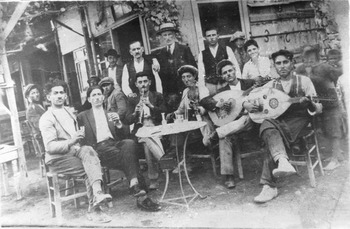
This narration points to the existence of a multicultural musical setting in which musicians organised open, fragile networks and made their music by exchanging cultural elements with other traditions. During this period, refugee bands playing instruments such as the clarinet, dulcimer, outi (ud), violin and the mandola (see Figure 1) spread the music of Asia Minor from the refugee settlements to Lakkos. In the late 1930s this interactive cultural system became highly pervasive, although cultural communication and exchange between refugees and a small sector of urban society, including the Lakkos milieu, was regarded with scorn by local elites. This was due to a number of factors. The 1930s was marked by an intense ideological and aesthetic quest in Greek society over issues of cultural identity and the Greekness of songs. In Heraklion, some of the journalists challenged the cultural quality and the national origin of amanedes and rebetiko songs, underlining the risk that they might spread into respectable society. They disapproved of the ‘shame and the vulgarity’ of amanedes, which songs they claimed had been cast out of their native Turkey only to find a second home in Greece. This led for calls that they be banned in the name of the ‘Greek soul and aesthetics’ (Idi 24 November 1935).
Armenian musicians originating from Asia Minor outside a local coffee-shop (1926). Far right is Artin Petrosian, one of the fieldwork interviewees (1905–1994, ud and bouzouki player).

In a similar manner, writers called for urban society to be cleansed of the rebetiko subculture, which journalists defined as the ‘long-standing tradition of kutsavakismou [proud, aggressive masculinity]’ reproduced by local maghes (Idi 5 December 1937). It seems that the negative arguments put forward by the intellectuals about the need for musical taste to be modernised paved the way for the all-out offensive launched by the dictatorship of Metaxas (1936–1941) against rebetiko. During this period, some of the manges in Lakkos were exiled as ‘dangerous and immoral persons’, the area was placed under tight police control, and all hashish dens in the city were banned. Lakkos songs were seen as stigmatising the cultural identity of the town, and local elites with fascist leanings declared their devotion to the ‘pure’ and ‘authentic’ Cretan tradition, in which musical styles featuring immoral or alien influences had no place.
The third period in local rebetiko history began during the German occupation and came to an end in the mid-1960s. In the post-war years Lakkos remained a dynamic entertainment area, frequented by troops from the American base at Gournes. As far as music was concerned, communal entertainment practices and grassroots improvised music increasingly gave way to recorded rebetiko. At the same time, the first large professionally run music halls known as ‘the bouzoukia’ appeared in the town, using electrically amplified ensembles and professional musicians, mainly from Athens. They began to attract clientele from Lakkos, gradually ousting communally organised forms of impromptu music-making.
From the mid-1950s onwards there was a marked increase in public rhetoric denouncing prostitution and the corruption of the nation's youth. On a local level, organised groups of incensed citizens aided by the Church demanded that Lakkos be cleansed of its negative role models and the symbolic pollution (Douglas Reference Douglas1993) that prostitution inflicted on the youth. Perceptions of heightened risk concerning sexual immorality evoked images of panic in urban society as a whole, leading to increased police control in Lakkos. Social dislocation reached a peak in the second half of the 1950s, when the state legislated to ban the concentration of brothels in particular areas within cities (Laws 3310/1955 & 4095/1960), ordering that they be dispersed over urban space.
By the early 1960s the town's brothels had disappeared from the area, which had been denuded of its basic functions. If Lakkos did play host to illegal activities such as prostitution and hashish smoking, as well as urban get-togethers involving older residents, these were only short-lived. Any remaining traces of former cultural activity in the area were cleansed in the time of the military junta (1967–1974), when yet another campaign for moral rectitude took place.
Music and everyday social life
As part of everyday social life in the local microcosm, music allowed for the expression of experiences, meanings and feelings. Cross-checking of oral accounts reveals that the neighbourhood had several skilled bouzouki players and amateur singers who performed ‘for their own sake’, i.e. to entertain themselves, while some had acquired prestige within local cultural space and stood out from the majority.
Music-making was a community function linked as much to forms of collective expression and creativity as to stimulation and enjoyment, while cultural networks in Lakkos were inextricably bound up with the local economy based on the production and dissemination of free-time activities and leisure. Indeed, several owners of coffee shops and hashish dens in the neighbourhood were skilled bouzouki players who would play to entertain their clientele during hashish smoking rituals, for indirect financial gain. Likewise, shop owners rented out laternas to itinerant players in the neighbourhood, who busked to entertain customers both within the area and at venues elsewhere in town. Furthermore, a number of fine singers and serenaders who had gained repute at competitions in Lakkos were pimps, protecting the best-known prostitutes.
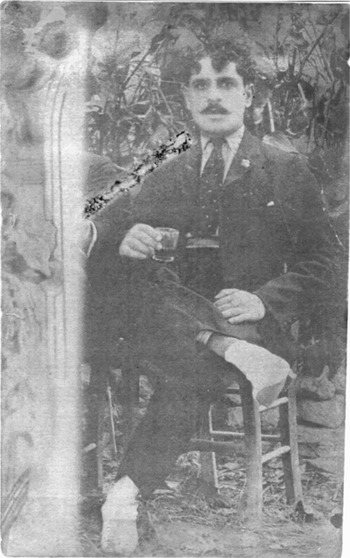
The negotiation of individual identities within public space was linked to excellence in various forms of popular art, such as bouzouki playing, singing, dancing and overall ability at skilfully representing the self in daily life. Along with a readiness to defend one's masculine pride, careful ‘tough guy’ dressing involving symbolic objects such as strings of worry beads, starched collars and occasionally ties, ‘republika’ hats, trilbies and patent leather shoes were just some of the means employed to lay claim to an acknowledgeable identity within the local environment (see Figure 2).
Manolis Birsimitzakis ‘Katsaros’ (1886–1967), a prestigious rebetis in Lakkos (about 1916).

Biographical material helps us understand the meaning participants attached to the actions and speech employed by rival members of the community in order to acquire a prestigious identity. Those who had made a name for themselves in competitive social practices such as dayilikia and yiankilikia Footnote 18 and collective artistic activities accumulated subcultural capital (Bourdieu Reference Bourdieu1984; Thornton Reference Thornton1996) ‘in the form of the prestige and renown attached to a name’ (Bourdieu Reference Bourdieu1977, p. 179). This distinction was then used by participants in order to improve their position in local power networks and, to some extent, to maximise material gain.
Using Foucault's terminology (Reference Foucault1978), the system operating in the Lakkos microcosm was hierarchical and characterised by a multitude of compound power relations, both internal and external, which came ‘from the bottom upwards’. The internal organisation of local space was based on open, more or less co-ordinated clusters of relations revolving around antagonistic practices and rituals of power. As regards external networks, the production and re-production of the local economy was to a great extent dependent for its survival on state and local authority policies.
The fact that Lakkos was mainly a place of entertainment for the lower strata did not stop left-wing commentators from viewing the neighbourhood as a morally and politically infectious place. They denounced certain prestigious rebetes for alleged secret dealings with the state machinery, implying that they passed on information to the Security Police in exchange for the unhindered pursuit of their activities, many of which were illegal. Beyond the devaluation of rebetiko by official left-wing discourse (Vlisidis Reference Vlisidis2004, pp. 67–164; Zaimakis Reference Zaimakis2009) as songs that mirrored the ‘putridity’ and the fatalism of the underworld, such findings reveal that the long-standing hostility of the dogmatic left towards the rebetiko world may also be accounted for in terms of wider social conflicts.
The local space associated with the primary phase of rebetiko was not as enclosed and marginal as has been claimed (Damianakos Reference Damianakos2001 [1976], pp. 199–215). The early rebetiko or pre-rebetiko scene was not restricted to an enclosed system, but extended into overlapping ones, with shifting borders that went beyond local boundaries. Despite outcries by respectable society, Lakkos was attractive to all those in the town who sought the forms of entertainment it offered, regardless of their social standing. The area thus maintained an open cultural system in which economic transactions took place and dynamic communication and entertainment networks developed. Within this microcosm: locals mingled with all sorts of people from different cultural backgrounds (soldiers, sailors, villagers, workers, dancers, hashish users, bohemian circles, etc.); new meanings and symbols emerged; cultural identities were performed; and courting and flirtation had their own place in daily interaction.
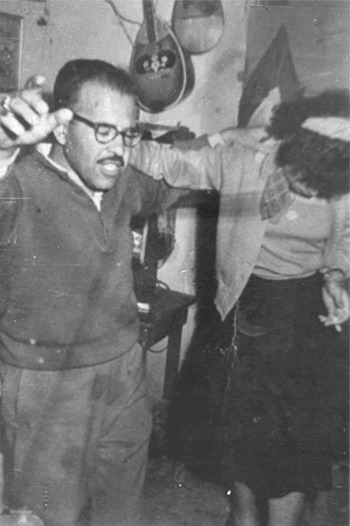
Gender issues deserve a special mention when studying the rebetiko (see for example Spyridaki Reference Spyridaki and Kotaridis1996; Holst-Warhaft Reference Holst-Warhaft and Washabaugh1998, Reference Holst-Warhaft and Magrini2003; Shand Reference Shand and Washabaugh1998). The biographical accounts we recorded (including female voices) present images of women who lived in grinding poverty. Exploited by pimps and fellow prostitutes, some were abandoned to die of venereal disease and others fell victim to male abuse. At the same time, other narratives refer to women enjoying life dancing and smoking hashish along with the men, thus transgressing the patriarchal norms of Cretan society at the time (see Figure 3). Mention was also made of women who profited greatly through involvement in the Lakkos economy and went on to acquire prestige and fameFootnote 19; some even appear to have donated a portion of their money to charity. Analysis of the biographical texts revealed that women played a number of roles in local society. They were free to roam in their own social world, triggering a moral outcry from the ‘respectable’ conservative urban elite, whether as mistress, prostitute, procuress, rebetissa, mother, wife, singer, dancer or housemaid. They could move upwards in the local social hierarchy from the lower strata, where they were subject to exploitation, to the point where they accumulated a prestigious identity in the rebetiko subcultural space.
Dancing in the teke of the interviewee Giorgos Karampinis (1919–2003, left) with a woman of Lakkos (around 1949).

On the musical culture of Lakkos: social memory, poetics and authenticity
Local music-making grew up within the particular context of brothels, hashish dens and portside haunts. Songs were performed by amateur musicians who had acquired a reputation in their environment and had their own patronage. In this musical world, everyone could practise the art of bouzouki-playing, laterna-playing, dancing or singing, which were part of daily social interaction and comprised the local collaborative activities through which Lakkos society reproduced the terms of its existence.
The songs were symbols of identity for local microcosms and, in terms of subcultural theory, there was a symbolic link, a homology, ‘between the community value system and its lifestyle, including subjective experience and the means or musical forms it used in order to express or reinforce its focal concerns’ (Hebdige Reference Hebdige1979, p. 112; Sarbanes Reference Sarbanes2006, p. 18). The songs were usually accompanied either by a laterna Footnote 20 and tambourine ensemble or by stringed instruments of the lute family (boulgari or bouzouki).Footnote 21 On special occasions songs were performed by small, semi-professional touring bands. Unaccompanied vocal performances were also common.
The arrival of refugees from Asia Minor enriched the local scene with further instruments (e.g. violin, clarinet, outi, santouri) played by small bands, although the bouzouki retained its emblematic status among locals. The lyra was heard when country musicians visited the town, even if the cultural boundaries between the two traditions were clear and urban performers belittled what they viewed as ‘hillbilly’ music.
Melodies were founded on makam-based (or dhromos) compositional systems, including microtonal variation with non-equal tempered intervals that provided performers with opportunities for improvisation. The metrical specification of verses was remarkably uniform, being based on the dominant iambic or trochaic 15-syllable line, with the couplet as its basic unit. The songs usually included traditional mandinadhes which are widely known and used in the Greek-speaking part of the Eastern Mediterranean (Kavouras Reference Kavouras2005). Song content and meaning is bound up with subcultural practices, values and modes of feeling, while themes focus on local interests: everyday adventures, flirting, infidelity and unrequited love, gambling, prison, bravery and hashish-smoking.
Taking into account orally composed songs recorded during fieldwork, I conclude that many songs are composed of a series of such couplets, often on divergent subjects, interposed with fixed refrains. Singers repeat phrases and interposed words or exclamations to cover any discrepancy between the melodic phrase and verse. As regards vocabulary, Turkish words or phrases are commonly interposed in the Greek couplets, and verses are coloured by local slang. Whether musical or linguistic, cross-fertilisation between Greek and Turkish elements can be taken as evidence of cultural syncretism on Crete during the Ottoman period.
Most of the tunes were non-dance, slow-moving kathistika (‘sedentary songs’) and melodies (e.g. tabachaniotika, amanedes, sarkia). Like the flamenco vocal style called cante (DaCosta Holton Reference DaCosta Holton1998, p. 313), one important feature of local poetry was the use of melismatic phrasings based on ornamentation techniquesFootnote 22 and also the use of an instrumental or vocal introduction to the songs. The singer could insert one- or two-syllable words (for example αμάν, ωχ, αχ) which, despite their nonsense content, were used by performers to express emotion and passion through musical performance.
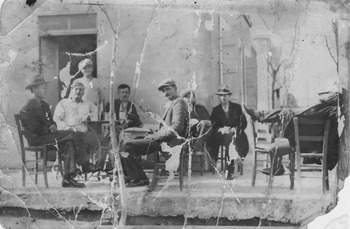
Two specific examples of songs recorded during fieldwork, performed by fine-voiced amateur local singer Prokopis Peponakis, display poetics, metrical and musical aspects of local songs (see Figure 4). Taken as whole performance, the first song consists of a range of couplets (which are unconnected together in terms of meaning) and refrains.

The local singer and interviewee Prokopis Peponakis (second from the right with the republica, 1907–2001), among a rebetes' company at the tavern in Bras, Heraklion (1928).

The song is composed of two rhyming distiches (a and c), each followed by a fixed eight-syllable refrain (b and d). The singer uses poetic elements from supralocal traditions in performance. A variation of the first couplet is quoted in Petropoulos’ anthology of rebetiko (Reference Petropoulos1989, p. 151) where it is attributed to Nikos Mathesis, a well known rebetiko lyric writer who frequently visited Lakkos in the post-war period. Regardless of its origin, variations of this couplet were commonly heard in Lakkos and were regarded as being part of local musical heritage.
Refrain b is quoted in Aravantinos’ anthology of folk songs (1880, p. 367, in Gauntlett Reference Gauntlett1985, p. 313) from the Epirus region in northwestern Greece. It is also included in the verses of Omologies (‘Confessions’), a song composed by V. Vermisoglou for café aman orchestras (Gauntlett Reference Gauntlett1985, p. 313). It stands as evidence of the common ground existing between dimotiko (folk) song and traditional oral rebetiko (Beaton Reference Beaton1980, pp. 193–8; Gauntlett Reference Gauntlett1985, pp. 310–31). Couplet c is a traditional mantinadha on the subject of local pride. A similar distich is cited in Pendlebury's ‘Archaeology of Crete’ (Reference Pendlebury1963, p. 329 [1939]) and, according to Professor Stylianos Alexiou, is an urban variant of a rural mantinadha.Footnote 24
Each line is introduced by a lengthy exclamation (1st couplet: ωχ in first line and αχ in second, 2nd couplet: ωχ in both lines), while the second line is repeated, an element which is frequently used in Cretan folk music. The two refrains seem to be based on the same melody, which the performer has split into two parts in an effort to reconcile the poetic verse with interchanged melodic phrases.
As regards the subject matter of the verses, the first couplet deals with the pains of imprisonment. Its vocabulary is coloured by both Cretan idioms (ekia, bistemenoi) and Turkish words (belli) and it turns on the importance of faithful friends and relatives and the torments of daily life in prison. Couplet c concerns the value of bellicose heroism in Crete, praising the use of arms and meraklides (men who take pride in doing everything, including enjoying the pleasures in life, to the best of their abilities). Similar couplets, full of references to collective violence, are commonly encountered in Cretan folk music (Herzfeld Reference Herzfeld2003, p. 301) and can be seen as expressions of a poetics of manhood (Herzfeld Reference Herzfeld1985, pp. 10–11) which reinforces long-held ideals and notions of masculinity in Cretan society. Lines b and d refer to the issue of unrequited love, lamenting the maghas’ passions and sorrows over his intractable partner.
The second recorded song is a slow-moving piece. According to the exponent it is based on a Turkish–Cretan non-dance mode which was played either on the lyra or, more often, the bouzouki.

The main part of this song (a) is composed of two couplets based on iambic 15-syllable verse, with a faster refrain consisting of an eight-syllable line (b). Each verse starts with a commonly used exclamation (ωχ, αχ) expressing a sudden release of energy, while the Turkish word yala is interposed among the half lines, allowing the adaptation of verses to the melody. The line at the end of the song rounds off its poetic structure and consists of a series of exclamations in Turkish (yiaskouri, yiala, dayianta) interposed by a Greek phrase. The main body of the song is a variation of an urban mantinadha (see Lioudaki Reference Lioudaki1936, p. 16) referring to unrequited love, a familiar issue in Lakkos. This mantinadha seems to be an element of so-called ‘whore songs’ in Lakkos.
According to newspaper journalist Aris Hatzidakis, who commented on similar songs in Drasis (30 December 1934), hundreds of verses were composed for the women in Lakkos, comprising meaningful mantinadhes which expressed a sad, lament-like mode. According to old people's testimonies they were most often sung in the Venereal Diseases Annexe, a small building in the centre of the neighbourhood where sick prostitutes were isolated. This particular example focuses on the cravings of a man for an unfaithful woman, who drives her admirer insane by wearing lipstick. The vocabulary comes from the context of wider cultural interaction in the town.
What these examples suggest is that such songs reflect a type of hybrid musical creation based on improvisation and oral composition, in which many structures and, to some extent, themes are taken from folk song traditions (see Beaton Reference Beaton1980, p. 194) and adjusted to local conventions. In Holst-Warhaft's (Reference Holst-Warhaft1997, pp. 232–3) terms, the non-conformist content of the verses and unrefined, grassroots language ‘crossed linguistic and ethnic boundaries’ and transgressed nationalist notions of local folklore.
During its early phases, the local music scene was based on anonymous creation and grassroots oral poetry, without the mediation of the recording process. The latter could refine and filter raw poetics and phraseology, resulting in stylisation and diversification of themes and the standardisation of tunes, as was later the case with commercial rebetiko. With regard to Heraklion, the songs were performed in the communal haunts of the lower social strata, mainly in Lakkos, and then diffused orally. Local musicians learned artistic conventions through schooling by veteran musicians and everyday interaction. They made songs by using traditional formulas taken from various cultural milieu and by borrowing words derived from different linguistic groups. Singers or musicians added new elements to their performances for the purpose of melodic or poetic ornamentation. Once recorded rebetiko songs were diffused in the 1930s, both anonymous oral poetry and newly composed songs attributed to named individuals entered the local music scene, and new articulations of known verses were created.
The performances recorded during fieldwork feature vocal improvisation, rhyming couplets and ornamentation, thus revealing the performers’ effort to present elements of a nostalgic traditional musical style and to project into it what Crazian calls images of ‘distinctiveness and authenticity’ (Grazian Reference Grazian2003). At the same time, performers reinforced their sense of self respect, eghoismo, which acts as a guiding principle in the works and activities of Cretan musicians and singers as they try to act as ‘true Cretan men’ (Dawe Reference Dawe, Cooper and Dawe2005, p. 127).
The locals employed binary schemes (for example, old–new, authentic–spurious, ours–alien) to stress the alleged superiority of a separate musical identity in the past, which they associated with deep emotions and divergent aesthetics and values. The performers implicitly challenged the discourse of modernity and the advent of commercialised music which led to the marginalisation of their musical identities. In this sense, music functioned as a means for nostalgic reflection on a world long gone. The interactive relationship between memory and music (Shelemay Reference Shelemay2006) provided the traditional performers with the opportunity ‘to retain some degree of continuity with the past at the level of style and interpretation, even if their repertories have not survived in the living tradition’ (Bithell Reference Bithell2006, p. 12).
Peponakis, the singer of the above songs, was of particular interest in this respect. He first frequented Lakkos in the mid-1920s, when recorded, attributable rebetiko were unknown in local society, and thus learned local songs orally from his elders in hashish dens and coffee shops. Only later did he learn recorded songs, incorporating selected pre-war material chiefly from the café aman in his improvised performances. Here we should note that Pennanen (Reference Pennanen1997) associates post-war rebetiko style songs with chordal harmony and the westernisation of melodies, and rejects them as spurious. Even more interesting in Peponakis’ case was the extensive use of variations on folk and oral rebetiko couplets in his impressive performances. His unrefined solo singing and improvised performances reveal a creator who cultivated his art in a non-commercial and, to some extent, oral musical world and remained committed to its aesthetics and principles.
Although urban song was undoubtedly influenced by Cretan folk music, particularly with regard to metrical structure, there appear to have been numerous differences between the two traditions. The old rebetiko were created in the fluid urban social space of the brothel districts, which were very different from the more stable cultural environments of peasant society where Cretan folk song developed. Unlike local rebetiko, folk song produced more refined ‘sculptured’ verses over time, due to the age-old collaborative production of compositions, as well as more conventional and artistic phraseology. Such songs were viewed and employed by the social elites as the local expression of Greek cultural heritage, from which local rebetiko were excluded as a ‘polluted creation’ subject to alien influences. Indeed, the low-life associations and sometimes seemingly Eastern sensibilities of urban music would have conflicted with the goals of Greek elites, who were working both to construct a collective identity for Greece as modern and western (Ball Reference Ball2002, p. 148) and to place Cretan cultural identity in the context of nationalistic folklore (Herzfeld Reference Herzfeld2003).
Lakkos songs were creations drawing on a communal body of themes based on formulas. As Beaton notes with regard to oral composition, these are not fixed, memorised units, but may be derived by the singer during performance from a system, or a series of systems, of stylised language and syntax. Thus, they are variable manifestations of underlying patterns in the minds of singers, which shape all songs sung in the same tradition (Beaton Reference Beaton1980, pp. 41, 43).
It seems that the orally improvised local songs were composed by selecting linguistic, musical and poetic elements from the wider multicultural environment. One example is the meaning attached to the use of the words dervish and tekes. They arrived from the terminology of the Sufi tradition, which had taken root in Muslim institutions in the towns of Ottoman-ruled Crete, and were re-contextualised in the framework of the local cultural system.Footnote 26 In musical terms, the use of various elements taken from different traditions is betrayed by the multicultural identity of the songs, which rendered them anything but ‘pure’ Hellenic creations in line with the aesthetic desires of Greek elites, which were oriented towards European standards that neglected ‘the existence of any Middle East, and in particular Turkish, influences in Greek culture’ (Torp Reference Torp and Buckley1991, p. 371).
From a historical perspective, it seems that the marginalisation of local non-commercial rebetiko was linked to a long-standing crusade for the moral betterment and westernisation of local culture. It is worth pointing out that early on, eminent local music teacher Yiorgos Hatzidakis (Reference Hatzidakis1909, p. 282) stressed the impact of ‘Eastern’ music on the local repertoire, while calling for a clear differentiation between authentic local musical traditions and the alien tunes of songs derived from the Turkish makam-compositional system (Hatzidakis Reference Hatzidakis1958, p. 107). Moreover, under the Metaxas regime, a version of Cretan music based on ‘pure’ local tunes mainly played on the lyra–lauto ensemble was promoted as the island's one and only ‘national’ musical tradition, ranged against other traditions which transgressed the romanticising, moralistic beliefs of nationalist discourse on Greek popular song.
The non-commercial rebetiko tradition disappeared in the social context of Greek post-war society. There were many reasons for this, including the diffusion of commercial rebetiko and the development of new forms of professional entertainment. Added to these were increased State surveillance in the areas where the old music flourished, and the marginalisation of the value system which supported it. Although widespread in Cretan cities in the past, hashish smoking was gradually stigmatised and marginalised under the impact of scientific discourse and stricter law enforcement, which contributed to changes in social attitudes toward users. This process was instigated by the Metaxas dictatorship, which imposed censorship on songs about hashish and immoral conduct in 1937 (Gauntlett Reference Gauntlett2001, p. 157; Pennanen Reference Pennanen2003, pp. 114–16; Vlisidis Reference Vlisidis2004, pp. 38–58, 54–5), while disapproval resurged during the civil war era (1946–1949).
Faced by changing tastes and the cultural nationalisation of Greek society, traditional, non-commercial rebetiko lost their significance in daily musical life. Only a handful of songs were professionally recorded, whenever emigrant musicians found suitable opportunities. Two examples stand out, the first being that of Stelios Foustalieris from Rethymnon, whose songs were usually accompanied a boulgari and sung by the Yiannis Bernidakis (also known as Baktsevanis), recorded in Athens between 1933 and 1955. As Liavas notes, Foustalieris’ songs blend Cretan urban tradition and local rebetiko with the Piraeus style and Asia Minor melodies (see notes in CD Box SA531, Stelios Foustalierakis i Foustalieris, Aerakis Kritiko Ergastirio, Heraklion 1994). The second case is that of Charilaos Piperakis, a lyra player from Chania who emigrated from Crete to USA, where he made his name under the pseudonym Kritikos (the Cretan). From 1926 to 1940 he recorded a large number of songs (Kounadis Reference Kounadis1996), some of which have been seen as rebetiko on the grounds that their morphological features display a creative mingling of Asia Minor-influenced Cretan folk song and the rebetiko of Greek communities in the USA.
Combined with what we know of Piperakis, fieldwork evidence of occasional links between locals and lyra players offers the potential for discussion of connections between the two different traditions on the island, as Dawe (Reference Dawe2007a) argues. With respect to contemporary Cretan music, a similar mingling has arisen through musical experimentation by some young musicians (e.g. Paximadakis, Avysinos) who encompass techniques inspired by a multicultural past in their repertoires. This revival may well have been inspired by the academic interest in Cretan rebetiko which emerged in the late 1990s (Damianakos Reference Damianakos and Kotaridis1996; Kounadis Reference Kounadis1996; Zaimakis Reference Zaimakis and Kotaridis1996, Reference Zaimakis2008; Petropoulos Reference Petropoulos2001, 123–30) followed by numerous newspaper articles (see e.g. Elefterotypia 4 December 1997, 7 September 2000; Apopsi tou Notou 25 January 2000; Patris 12 & 14 April 2007, 1 April 2007) and local television programmes devoted to the subject.
Conclusion
Although academic research into local settings of rebetiko is limited, sporadic references point to a non-commercial tradition which developed in various urban centres in the Eastern Mediterranean and the Greek hinterland. It seems that some oral non-commercial rebetiko emerged in social worlds organised around local networks connected with illegal activities such as smuggling and hashish-selling, and entertainment including prostitution, gambling, dice, laterna or bouzouki-playing, dancing, singing and shadow puppet theatre (Κaragiozis).
Investigation of the social world in Lakkos suggests that the forerunners of the rebetiko can be explored as a distinct musical style associated not so much with an isolated and enclosed cultural setting as, in Steingress’ terms (1998, p. 152), with the manifestation of intercultural and even transcultural communication among different social and ethnic groups. In the case of Heraklion, songs were influenced by the poetics of Cretan folk music and the multicultural musical tradition of the café aman scene. A particularly important role appears to have been played by bands from other port towns in the Eastern Mediterranean – mainly Smyrna and Constantinople – which visited the town during the period of Cretan autonomy. Inter-cultural communication continued in the interwar era, when Lakkos became a place that merged the music of local bouzouki players with that of Asia Minor musicians forcibly removed from Turkey to Greece under the terms of the population exchange. Music-making performed experiential functions and was a part of everyday collaborative activity (DeNora Reference DeNora2000) which afforded participants the opportunity to express their interests and lifestyles.
There can be no doubt that the musical and poetic aspects of the local music scene, with its low-life themes, unpolished language and coarse melodic phrases, constituted a threat to the value system of the middle and upper social strata. Moreover, the Left confronted the rebetiko as a potential enemy of the communist movement, criticising them as hedonistic and fatalistic songs that exerted a powerful influence on the lower social strata.
It is clear that the active tradition of oral, non-commercial rebetiko on Crete began to falter with the breakdown of the social environment in which communal cultural activities and collaborative music-making arose. In the context of modernisation and moral crusades in urban society, the rebetiko tradition constituted a two-fold risk for the dominant culture. On the one hand, it was based on cultural elements of alien influence derived from an undesirable Ottoman past, and was consequently a subversive element in the face of state efforts to cultivate a national identity. On the other hand, it was associated with an immoral social world which was seen as polluting the values of respectable society and corrupting youth.
In closing, I should stress the significance of studying the social and historical evolution of pre-rebetiko worlds, and of conducting ethnographic and sociological research at grassroots level. It is obvious that every local configuration of rebetiko had its own history, and that its style was shaped by specific historical and socio-cultural factors. Comparative research in a range of small-scale local scenes of rebetiko would not only offer us a more detailed insight into each historical and social context, but also contribute to the investigation of ‘other societies’, thus revealing the cultural diversity of Modern Greek society on the road to national integration.
Acknowledgements
The author would like to express his appreciation to the anonymous reviewers of Popular Music for their constructive advice and to the musician Ross Daily for his helpful suggestions concerning musicological material.