From 1800 forward, Western Europe experienced sustained long-run economic growth relative to the rest of the world, a process known as the “Great Divergence.” Economists and historians often focus on China when they explain why developing countries grew more slowly, leaving the Ottoman Empire largely out of this debate.Footnote 1 However, the Ottoman Empire, which was a large, multi-ethnic economy, and had important institutional differences with Europe, deserves attention in understanding long-run development trajectories of the West and other economies. In the seventeenth century, the Ottoman state was a major economic power; by the nineteenth century it had fallen behind even the more peripheral European countries. Despite severe economic and financial crises, the Ottoman Empire managed to survive into the modern age with most of its institutions intact.
Research on the Ottoman Empire has focused on its institutions to explain the Empire's economic performance. For instance, Şevket Pamuk (Reference Pamuk2004) shows that while the Ottoman political elite implemented selective institutional changes, the fear of losing their privileged position discouraged them from adopting institutions that could have put the Empire on a more sustained development path.
A critical component of Ottomans' stagnation was stunted business expansion in the Empire. The debate about the Ottoman Empire's poor economic performance has centered around two points: first, that business expansion within Europe surpassed Ottoman capital accumulation, and second, that non-Muslim Ottomans drove out both Muslim, and eventually Europeans, from trade within the Ottoman Empire. Timur Kuran (Reference Kuran2011) addresses both these points through a long-run analysis, which focuses on the interaction of Islamic inheritance law, partnership law, and pious foundations called waqfs. Inflexible and egalitarian inheritance rules made partnerships particularly vulnerable to untimely dissolution, which firms could have avoided by incorporating. Since Islamic law disallowed corporate forms, agents instead invested in waqfs, which trapped capital in unproductive enterprises due to waqfs' inflexible structure. Furthermore, Kuran (2011) argues that non-Muslim Ottomans were able to avoid these legal inefficiencies by acquiring European legal protection. This legal protection allowed them to operate under European law, thus opening up “access to new economic sectors supported by advanced legal codes” and use “large and durable organizations, financial techniques, and litigation practices that enable increasingly impersonal forms of exchange” (Kuran Reference Kuran2011, p. 200). In the eighteenth century, European legal protection gave non-Muslim Ottomans access to enterprise forms that later could become corporations. Indeed, non-Muslim Ottomans and Europeans founded most of the Ottoman corporations after the Ottoman government made the corporate form available in 1850 (Kuran Reference Kuran2011, p. 99). Thus, European law had advantages which unfolded over time and Ottoman legal institutions had unintended consequences that were realized over the long run.
While Kuran's (Reference Kuran2011) comprehensive analysis explains the Ottoman Empire's long-run commercial trajectory, this article takes up the challenge of examining the details of one specific episode: why non-Muslim minorities within the Ottoman Empire switched to European jurisdictions in the eighteenth century, and how this institution emerged.
This article is part of a broader project that focuses on a specific institution of the Ottoman legal complex: legal pluralism. The Ottoman Empire offered its subjects a menu of legal systems besides Islamic law for contracting and litigation. Legal pluralism appears in a broad range of settings such as medieval Europe, and contemporary conflicts of law between firms under different jurisdictions. In this article, I describe one channel, berat sales by European embassies that allowed non-Muslim Ottomans to exercise choice of law over a range of European and Ottoman legal systems. Berats were exemption licenses that provided tax privileges as well as access to European law. Beratlıs, non-Muslim Ottomans who carried berats, rose to prominence in Ottoman commerce relative to Muslims and Europeans.Footnote 2 The mechanism through which beratlıs succeeded in dominating the Levantine trade is an open question.Footnote 3 Thus, this article directly describes an important feature associated with non-Muslim Ottomans who surpassed Europeans and Muslims within the Ottoman Empire. I establish several key facts, and in so doing address why non-Muslim Ottomans acquired access to European law in the eighteenth century and whether this switch reflected a desire to operate under a more efficient legal system.
On the one hand, berat sales constituted an important episode in the Ottoman Empire's modernization, culminating in the adoption of the French commercial code in 1850. Berats fulfilled the growing demand for commerce-friendly legal rules and procedure, offered institutional variety, and fostered a strong middle class. On the other hand, rationing access to possibly more efficient legal rules led to an uncertainty about which law would apply if contracts were contested.
Although this article is motivated by the increasing economic disparity between the Ottoman Empire and Western Europe, it does not address the issue of divergence itself. Instead, I focus on a specific legal institution, the berat system, that afforded non-Muslim Ottomans the ability to engage in forum shopping in the eighteenth century. It was specifically these berat holders who surpassed both Muslims and Europeans in the Levantine trade within the Ottoman Empire by the early 1800s. The main contribution of this article is to provide a deeper understanding of how this legal protection system worked. I use diplomatic correspondence, chancery registers, merchant letter books, and commercial disputes from the British, French, and Ottoman archives to construct a novel price panel for British and French licenses and show that there was a prominent market for legal privileges.
The evidence supports five conclusions. First, non-Muslims were willing to pay large sums for this protection; berats cost on average 55 times the annual Ottoman gross domestic product (GDP) per capita in 1800. Second, the present discounted value of tax exemptions cannot fully explain berat prices. Third, the article shows systematic cross-sectional variation in the pricing of legal privileges across European countries. This variation suggests the market valued different countries' protection heterogeneously, reflecting either ambassadors' influence at the Ottoman court or differences in substantive law. Fourth, I address why non-Muslims purchased such legal exemption licenses at high prices and show that forum shopping was an important—though not exclusive—component in agents' decisions to acquire berats. Forum shopping appeared in about 48 percent of disputes involving berat holders. Furthermore, agents tried to obtain multiple berats in order to expand their legal options. Finally, this article demonstrates another channel through which legal systems might have hindered business expansion. Non-Muslim Ottomans purchased berats to strategically switch court systems as disputes arose, raising enforcement uncertainty. As Avner Greif (Reference Greif1993) and Kuran (Reference Kuran2011) show, the lack of reliable third-party enforcement mechanisms can cause trade to break down.
Economic historians have offered various theories regarding berats' role in Ottoman commerce and why non-Muslims obtained them. Ali İhsan Bağış (Reference Bağış1983) emphasizes tax exemptions. Kuran argues that minorities purchased berats to switch to more efficient, European, legal systems, whose advantages unfolded over time. One example of this greater efficiency, Kuran claims, is the dynamism and the larger menu of enterprise forms available under European law. On the other hand, Murat Çizakça and Macit Kenanoğlu (Reference Çizakça, Kenanoğlu, Faroqhi and Veinstein2008) argue that Islamic partnerships were actually quite flexible and the number of people who switched to European law was modest. Maurits H. van den Boogert (Reference van den Boogert2009) also challenges the jurisdictional shift theory, showing that consular courts did not necessarily apply their nations' laws. He cites examples where consuls followed Islamic legal jurisprudence instead. Furthermore, he notes that consular courts did not have more sophisticated procedures (such as reliance on written evidence) compared to the Ottoman courts, and were not better equipped in dealing with more complex organizational forms like joint-stock companies. In this article, I show that while there is suggestive evidence for jurisdictional shift, beratlıs' success is better understood through their advantage to forum shop over different European legal systems.
INSTITUTIONAL BACKGROUND
Berat Sales
Choice of law had always characterized the Ottoman Empire's legal setting, which treated the Empire's subjects based on religion. In civil and commercial matters, non-Muslim minorities could contract under any religious law (e.g., Catholic, Orthodox, Judaic) or Islamic law. Muslim subjects, however, had to use Islamic jurisprudence until the advent of secular courts in 1850.
The Ottoman government recognized each European country's residents as a distinct community as well, with the ambassador as the leader and supreme judge. Ambassadors and consuls were agents of the national organization that regulated the Levant trade. For Great Britain, this was the Levant Company, and for France, the Chambre de commerce de Marseille. Both organizations also had a monopoly over their country's trade with the Levant. In contrast, the Dutch Republic followed the principle of free trade despite having a similar government body (Boogert Reference van den Boogert2003, pp. 618–19).
European merchants in the Ottoman Empire had long enjoyed certain privileges. They could use consular jurisdiction in any dispute not involving Muslims. They were exempt from various taxes levied on non-Muslims and paid lower tariffs.Footnote 4 Furthermore, European ambassadors had the right to employ any non-Muslim Ottoman as a dragoman, or interpreter (Boogert Reference van den Boogert2005, p. 8). The Ottoman government fixed the stock of berats for each embassy, depending on the ambassador's influence and the power of the country he represented. Great Britain and France had the largest number at about 40 to 50. Other countries' berats ranged between 20 and 40.Footnote 5
In time, embassies began to cultivate their own interpreters and had no need for Ottoman subjects. European ambassadors started selling these surplus berats to the highest bidders among Ottoman religious minorities. We do not know exactly when this commercialization started. British ambassador John Murray remarked that selling vacant berats was a “perquisite that had belonged to [the] Embassy from its first institution,” in 1583.Footnote 6 Berat sales must have been well underway by the 1720s.Footnote 7
By the early nineteenth century, the Ottoman government made several attempts to suppress berat sales and prevent beratlıs from engaging in trade, manufacturing, tax farming, and guilds.Footnote 8 In 1806, the government ordered each beratlı to give up his license or return to the place of residence specified in his berat. About 30 Russian, French, and Austrian beratlıs complied, paying all taxes that had accumulated from the date they had acquired their berats.Footnote 9 Others petitioned for naturalization by the government that protected them (Francis Rey Reference Rey1899, pp. 276–77). At the same time, the Sultan formed a similar, competing protection system called “Europe merchants” (Avrupa tüccarı). The government issued the first licenses in 1806.Footnote 10 Britain agreed to stop berat sales permanently with the Treaty of the Dardanelles in 1809. Other countries soon followed (Rey Reference Rey1899, pp. 279–80).
Benefits of Buying Berats
Berats provided important privileges. They conferred exemptions from the poll tax (haraç), extra-ordinary taxes (avarız), the butchery tax (kassabiye), and non-canonical taxes (tekalif-i örfiyye). They also reduced the tariff burden from 5 percent to 3 percent. Berats gave beratlıs the option to bypass local courts and access consular services for arbitration and dispute resolution. Beratlıs could also use the legal-economic institutions, such as enterprise forms, of the country that bestowed the berat. Thus, a beratlı was practically a European subject armed with extraterritorial rights. Berats secured these privileges for life and protected beratlıs' sons as well as two “servants,” who received patents called nefer fermans; their bearers were referred as neferlis or fermanlıs. Berats were deeds of appointment, not property. Beratlıs could not sell, transfer or bequeath their patents; there was no secondary berat market. Strictly speaking, berats could not be sequestered and counted as collateral either, but embassies regularly seized and auctioned berats off to settle beratlıs' debts.Footnote 11 Similarly, nefer fermans also returned to the embassy when their holders relinquished them or passed away. It was impossible for beratlıs to re-sell these servant fermans, thus ruling out a speculation motive to acquire berats.Footnote 12
Beratlıs' privileges did not end with their demise, but rather after their estates' partition. Whenever a beratlı passed away, the consul would seal up the deceased's estate. The berat would return to the embassy only after the heirs agreed on a division, which followed the deceased's will if one existed or an arbitration among the inheritors otherwise. For instance, French law could oversee a French beratlı's inheritance. This practice could also shield the beratlı's estate from arbitrary taxes by the local authorities.Footnote 13
Revenues from Berat Sales
Ambassadors distributed berats as they wished, and the returns were their personal emolument.Footnote 14 In addition, new ambassadors charged each of their beratlıs 300 kuruş upon their appointment. Berat sales constituted the largest share of ambassadors' income. A British ambassador's annual salary was 8,000 kuruş whereas he made 12,000 kuruş each year on average from selling berats before 1795.Footnote 15 Thus, ambassadors were eager to sell berats despite finding the practice of selling them “scandalous.”Footnote 16 Similarly, consuls charged each existing beratlı in their province 100 kuruş upon arrival and 150 to 600 kuruş on each berat sale.Footnote 17 The Ottoman chancery also received 500 to 1,000 kuruş from each berat registration, and 300 to 500 kuruş upon a new Sultan's accession.Footnote 18
European merchants were far less enthusiastic about sharing their privileges with Ottoman subjects. The Levant Company made several attempts to curb berat sales but in the end yielded to the ambassadors (Boogert Reference van den Boogert2005, pp. 97–101). European merchants opposed berats on two grounds. First, the expanding number of beratlıs drew the attention of Ottoman officials, who then infringed on both groups' privileges.Footnote 19 Second, beratlıs posed significant competition to European merchants. French diplomat Félix de Beaujour advised berats' suppression precisely for this reason.Footnote 20 By the early nineteenth century, beratlıs had taken over most of the export trade (Masters Reference Masters1992, pp. 580–81).
Number of Beratlıs
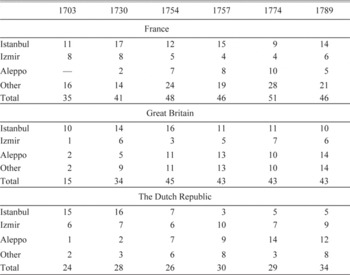
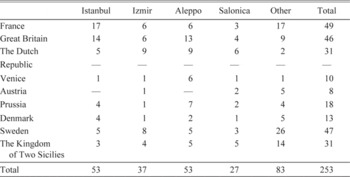
Beratlıs constituted a small class of non-Muslims in the Ottoman economy. For instance, there were a total of 202 people under European protection in Aleppo during the late 1760s: 48 beratlıs (mostly British and French) with 58 children, and 96 fermanlıs.Footnote 21 Table 1 reports estimates of British, French, and Dutch berats across the Empire over time. Table 2 displays a berat survey the Ottoman government conducted in 1793 and 1797. Both tables show that France, followed by Britain, had the highest number of berats. Britain, in particular, tripled its stock of berats between 1703 and 1754, likely reflecting the country's increasing influence at the Ottoman court. Overall, beratlıs were largely concentrated in important commercial centers: Istanbul, Aleppo (in Syria), Izmir (in western Turkey), and Salonica (or Thessaloniki, in Greece).
The Stock of French, British, and Dutch Berats

Sources:
Boogert (Reference van den Boogert2005, p. 88). Cited primary sources are BOA, ED 27/2 (France), 35/1 (Great Britain), 22/1 (Dutch Republic).
THE NUMBER OF BERATS IN CIRCULATION, C. 1797

Sources:
BOA HAT 196/9779 B, C, D, E, G, H, İ, J, 196/2898; Historical Archives of Macedonia K. 172 22/24 (cited in Vasdravellis Reference Vasdravellis1952, pp. 352–3).
Table 2 shows that there were 253 berats in circulation. This survey underestimates Austrian beratlıs and does not list Russian berats at all as the Ottoman government had annulled their berats due to an ongoing war. Furthermore, it does not report Spain's berats. Correcting for these ommissions, I estimate 340 berats in circulation, implying approximately 1,700 people under protection in the entire Empire. Evidently, this number is rather modest compared to the previous claims of hundreds of thousands beratlıs.Footnote 22
SOURCES AND DATA
Sources
The few berat prices that secondary sources give are anecdotal and communicate little sense of variation across time and countries. My data constitute the first large-scale sample of berat prices drawn from primary sources. There is no registry of berat sales in the archives. In order to acquire information about prices and buyers' characteristics, I exploited the fact that a European ambassador had to rely on his consuls to make sales outside of Istanbul. Consuls submitted prospective buyers' names, occupations, and bids in their correspondence to ambassadors. I sampled three important commercial centers, where most beratlıs were located: Aleppo, Izmir, and Salonica. I only included prices that I could verify with a receipt, confirmation of funds, or a bill of exchange. Hence, my sample represents actual transactions.
Prices
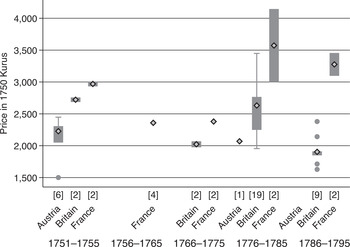
Figure 1 reports final berat prices, asks, and bids I constructed using primary evidence. Berat prices in real terms were generally stable over time; French berats cost 3,000 kuruş and British berats 2,000–2,750 kuruş in 1750 prices. Dutch berats were sold at 2,000 kuruş in real terms.Footnote 23 There seems to be a degree of stickiness as prices were slow to respond to devaluations. Another striking feature is the cross-sectional variation: French berats were the most expensive followed by British, then Dutch and Austrian. Across the whole sample of observations, with or without bid and ask prices, the two-sample Wilcoxon rank-sum (Mann-Whitney) test rejects the null hypothesis that British and French berat prices have equal medians at the 0.05 significance level, with p-values 0.0240 and 0.0412, respectively.
FINAL BERAT PRICES, ASKS, AND BIDS

Berats were remarkably expensive. Boogert (Reference van den Boogert2005) shows that in the early eighteenth century, a single berat sale in Aleppo could sustain the Dutch consulate's annual spending, or cover six months worth of expenditures in the late eighteenth century. In 1794, a British berat cost 55 times the estimated annual Ottoman GDP per capita at the time.Footnote 24 Furthermore, consider annual wages of unskilled and skilled labor in Istanbul in the eighteenth century. Between 1780 and 1789, assuming 300 work days per year, an unskilled worker's yearly income was about 142 kuruş; a skilled worker's 284 kuruş (Özmucur and Pamuk 2002, p. 301). Concurrently, a French berat cost 5,000 kuruş and a British berat 4,000.
EXPLANATIONS
I address several hypotheses that explain why non-Muslim Ottomans sought to procure berats: tax exemptions, obtaining access to specific trade networks, acquiring access to European law itself, and engaging in strategic forum shopping in disputes. These explanations are not mutually exclusive. Berats provided a bundle of important advantages that can be consistent with several hypotheses simultaneously. The tax benefits, which were important, cannot fully account for the price. There is little evidence that non-Muslim Ottomans acquired specific berats to gain access to particular trade networks. Forum shopping was an important aspect of beratlıs' activities; in fact, they purchased different berats to improve their position in disputes. The price variation across European countries suggests heterogeneity in the benefits that different European legal systems provided.
Tax Exemptions
All European berats provided the same value of tax reductions. While these benefits were no doubt attractive, multiple berat purchases and the cross-sectional price variation are both strong pieces of evidence inconsistent with an exclusive tax motive. One can directly show that an upper bound of tax benefits is still substantially lower than the berat price.
Berats granted exemptions from haraç, avariz, tekalif-i örfiyye, and kassabiye. The haraç tax was imposed on all adult males and its rate depended on the subject's income. I use the highest tax rate for this period, 11 kuruş per annum per male. Other taxes were imposed on hane, which was an Ottoman tax unit larger than a household. Their annual rates stabilized around 8 kuruş per hane. I assume that these are imposed on the household. Also accounting for the two agents berats protected, I estimate the annual value of tax exemptions as 63 kuruş. The nominal tax rates were stable throughout the eighteenth century.
To calculate the present discounted value of tax exemptions, I use the probability of death to derive the discount factor, a natural base since a berat's tenure terminated with its bearer's decease. I assume zero interest and inflation rate, and that the prospective buyer is 25 years old with two sons who would benefit from tax exemptions as if they were themselves adults.Footnote 25 These assumptions make future taxes worth more, thus yield an upper bound estimate of the present discounted value of tax exemptions. I calculate this upper bound as 660 kuruş, which is substantially lower than a berat's market price at 3,000 to 6,000 kuruş.Footnote 26 The Ottoman chancery charged 500 to 1,000 kuruş on each berat, effectively extracting the expected tax revenues it lost.Footnote 27
Bağış (Reference Bağış1983) argues that tariff cuts could have encouraged berat acquisitions. Non-Muslim subjects paid 5 percent ad valorem tariffs, Muslims paid 4 percent, and Europeans paid 3 percent. The primary evidence is ambiguous on the subject. The berat document itself does not list lower customs as a privilege (as opposed to all other taxes listed above). Possibly, beratlıs did not get lower customs by default; only Swedish and Dutch berats that were granted after 1777 seem to have conferred lower tariffs reliably.Footnote 28 The British and French ambassadors did manage to get 3 percent customs by making separate applications to the Ottoman government on an individual basis. These privileges had to be renewed almost annually following a new customs officer's appointment. There could also be other restrictions. For instance, the reduced customs that the British obtained for their beratlıs only applied to beratlıs' trade with Britain.Footnote 29 Beratlıs also had to make substantial payments and bribes each time they obtained these commands, costing as much as 1,056 kuruş.Footnote 30 Thus, beratlıs paid more than 3 percent customs even if they did get the Ottoman government's confirmation. Clearly, the French and the British could not secure lower customs effectively. The fact that theirs cost more than the Dutch berats suggests people valued berats beyond tariff cuts.
We can replicate the exercise above in order to infer an upper bound on the present discounted value of lower ad valorem tariff. Assuming the agent's trade incentives do not change when he pays lower tariffs—that is, he has the same trade volume under both tax regimes—in 1750, a trader had to expect importing or exporting at least 11,156 kuruş worth of goods each year on average in order to justify paying 3,000 kuruş for a berat; or 20,694 kuruş in 1780 for a berat costing 5,000 kuruş.
I am not aware of any data on how much trade beratlıs conducted. The closest approximation I was able to obtain comes from Izmir's customs registers collected by Abdullah Mesud Küçükkalay and Numan Elibol (Reference Küçükkalay and Elibol2006), and Küçükkalay (Reference Küçükkalay2008). Between 1771 and 1772, merchants using European ships paid 89 kuruş customs on average, implying a trade volume of about 3,000 kuruş per year. Between 1794 to 1804, the average import volume to Izmir per year was 1,750 kuruş per merchant overall, and 2,171 to 3,000 kuruş per merchant using Ottoman ships. Trade volume per beratlı is unlikely to be significantly different. In 1759, a French beratlı in Izmir paid 100 to 120 kuruş customs at the 5 percent rate, suggesting his trade volume was about 2,000 to 2,400 kuruş.Footnote 31 Similarly, Yanaki Cana, another French beratlı in Izmir, paid 500 kuruş in 1767, also at 5 percent, implying a trade volume of 10,000 kuruş, which was worth 7,931 kuruş in 1750.
One might argue that the protection berats provided against irregular taxes and expropriation made them valuable. Linda Darling (Reference Darling1996) shows that these taxes had become quite stable and “regular” by the end of the seventeenth century. Tax disputes between beratlıs and local authorities involved haraç imposition or tariffs rather than other irregular taxes.Footnote 32 Berats did confer protection from expropriation, essentially shielding a deceased beratlı's estate from local magistrates' arbitrary confiscations. In response, French beratlıs noted that consuls had sole jurisdiction over their beratlıs' inheritance.Footnote 33 The British consul in Aleppo remarked that he protected his beratlı Abdallah's estate and family “from the molestation of the Turkish justice for the usual time” before returning his berat to Istanbul. Similarly, following the British beratlı Antun Balit's decease, the same consul sealed up Antun's estate “the usual way, […] to secure the Heirs from the Interference of the Turkish Justice.”Footnote 34 Regardless, protection from extraordinary taxes cannot account for multiple berat purchases or the cross-sectional price variation.
Access to Trade Networks
One can argue that berats granted access to trade networks and markets that would otherwise be unavailable. The only reason foreign merchants would not include Ottoman subjects in their trade is aversion to potentially subjecting their firms to the Ottoman law. This was a real concern for British merchants.Footnote 35 We might expect agents to have a preference to transact only with parties who have fewer jurisdictional options.
There are only glimpses of evidence on this subject. Without having access to merchants' private letter books, it is impossible to completely map out beratlıs' and non-beratlıs' business networks and transactions. Several pieces of evidence are inconsistent with this hypothesis. First, a berat offered no ex ante commitment to the legal system to which it granted access. The license bestowed the option to use a European legal system. British merchants and beratlıs both had recourse to Islamic law. Hence, having a berat or trading with the Europeans of the same nationality did not bind an enterprise to that European legal system, or shield it from Islamic law. Second, commercial correspondence and consular registers suggest that British traders did not employ beratlıs as agents.Footnote 36 British merchants made a concerted effort to keep beratlıs out of British trade. Preventive measures included charging 20 percent consulage fees on all beratlıs using British ships. Clearly, buying British berats did not grant access to British trade. French merchants also imposed similar restrictions until the late eighteenth century.Footnote 37
On the other hand, the Dutch imposed no such restriction. They adopted a free trade policy and beratlı partners regularly opened establishments in Amsterdam, participating in that trade with or without Dutch merchants' involvement. Many of these beratlıs also had French or British berats. Thus, the Dutch trade was not exclusive to Dutch beratlıs. By the late eighteenth century, beratlıs had replaced Dutch traders in Izmir almost completely.
Arguably, berats allowed non-Muslims to participate in European trade by becoming intermediaries within the Ottoman Empire for the country whose berat they carried. There are two pieces of evidence against this argument. First, beratlıs themselves were not simply intermediaries. Although the first buyers in the early eighteenth century did intermediate European trade, by 1760 a typical beratlı was a merchant who had established firms in the Levant and Europe, had partnerships with other beratlıs, and were serious contenders to European merchants. Genuine dragomans (as opposed to beratlıs) and brokers did the actual intermediation in Ottoman ports by the late 1700s. Second, while these brokers would sometimes buy berats or nefer fermans, there is little correlation between the country whose berats they purchased and the country whose trade they intermediated. For example, French merchants had British, Swedish, or Neapolitan beratlıs as brokers in Aleppo and Salonica between 1750 and 1800.Footnote 38
Primary sources suggest that beratlıs mostly formed partnerships with other beratlıs or non-Muslim Ottomans who later purchased berats. Many beratlıs in Izmir participated in the European and Levant trade by sending partners to Amsterdam and Livorno.Footnote 39 Most merchants who participated in the trade between Izmir and Amsterdam had berats.Footnote 40
Berats might have opened up markets to Ottoman non-Muslims. However, berats did not necessarily open up trade networks or markets specifically associated with the country that dispensed them. A British berat offered little value to a merchant who hoped to participate in British trade. While some countries explicitly tried to keep all beratlıs out of their respective trade, others remained indiscriminate. Beratlıs' own trade patterns reflect that they emerged as competitors to Europeans and did not necessarily depend on Westerners for their commercial affairs. The current evidence does not reveal whether a trade network sensitive to specific berats existed among beratlıs. This is outside the scope of this article.
Jurisdictional Shift Hypothesis
The jurisdictional shift hypothesis argues that agents switched from an inefficient legal system to a more efficient one, much like Tiebout sorting (Tiebout Reference Tiebout1956; Kuran Reference Kuran2004a, Reference Kuran2011). Inefficiencies in a legal system arise from transaction and contracting costs, legal costs such as litigation and verification, and distortion of incentives. Assume there are two legal systems differentiated along costs they impose on trade. A given legal system, say British common law, might be more efficient than Ottoman law due to secure property rights, flexible inheritance rules, or better verification technology (due to reliance on written evidence). Agents would be willing to pay at most the difference between their expected gains and current payoff to place themselves under better legal rules. In a market with a fixed supply of access to additional legal jurisdictions, agents would bid the price up, and people with relatively smaller expected gains would stay in their original jurisdiction.
Now, suppose there are finitely many legal systems available. Tiebout sorting would imply that agents with the highest expected benefits would place themselves in the most efficient legal jurisdiction. Since the supply is fixed and positions are auctioned off, agents with relatively smaller expected benefits would place themselves in the second-best, and so on. This theory implies an ordering of legal systems in their efficiency reflected by the berat prices. Furthermore, by revealed preference, those who could afford access but did not purchase it do not benefit from “better” law.
Even though all berats granted the same tax exemptions, the cross-sectional price variation implies that berats were not homogenous objects. In order to assess the impact of “better law” on prices, we need to be careful about alternative explanations for the systematic variation in berat prices across jurisdictions. Berat price is a function of the discount factor which depends on mortality and prevailing interest rates, the value of tax exemptions, the probability that the Sultan annuls the berat, the quality of arbitration and protection services which depend on the competence or willingness of the particular ambassador and consul, and finally the value of the legal system itself. Given this formulation, there are three possible sources of variation: the probability of berat annulment, ambassador and consul effects, and the legal system.
Recall that a country's berats became void if war broke out with the Ottoman Empire. Such revocation might involve more than the loss of future benefits. When Napoleon invaded Egypt, the Ottoman government repealed all French berats and confiscated French beratlıs' estates in Aleppo. These beratlıs lost as much as 10,000 to 200,000 kuruş to these confiscations; they either had to leave the city or buy other berats to shield themselves.Footnote 41 Thus, we would expect Austrian and Russian berats to be relatively cheaper, since they were much more likely to go to war with the Ottoman Empire. During the eighteenth century, the Ottoman Empire had six military conflicts in Europe. Three of them involved Austria, four involved Russia, one Venice and the last the French First Republic. While we do not have data on Russian berats, the probability of annulment might explain the lower price of Austrian berats.
Berats' value also depended on the ambassador and the consul who did the actual representation. Whenever local magistrates intervened in beratlıs' business or an Ottoman subject sued a beratlı in an Islamic court, consuls represented beratlıs at the local court, and ambassadors at the higher court. An ambassador's influence at the Ottoman court was critical in acquiring favorable verdicts for beratlıs, which might explain the systematic price variation even across British and French berats. France had consistently a higher stock of berats than the British, whose berats exceeded the Dutch Republic's. Higher supply is associated with a higher price in this market due to the correlation between the berat stock and the ambassador's influence. Thus, the variation in prices might reflect a preference for better protection in disputes rather than a preference for legal systems.
Beratlıs' occupations also highlight the value of European law. The scattered data on applicants show that they were predominantly merchants, followed by sarrafs (bankers and moneychangers), artisans, shopkeepers, and brokers.Footnote 42 French ambassador Choiseul-Gouffier described beratlıs as “almost all rich sarrafs, or bankers” (Eldem Reference Eldem1999, p. 282). Thus, European law had value precisely for those involved in trade and finance.
Kuran (Reference Kuran2011) explains European rules' advantage in business expansion by Islamic law's less flexible organizational forms, less flexible inheritance law that gave insufficient discretion to testators, and the inefficiency of pious foundations called waqfs. The interaction of these three factors prevented capital accumulation in the Ottoman economy. Out of these factors, this article will discuss the partnership law, and briefly, inheritance rules.Footnote 43
The evidence shows that European enterprise forms mattered little for non-Muslim Ottomans' demand for berats in the eighteenth century. In this period, there were no general incorporation laws in Europe. Timothy Guinnane et al. (Reference Guinnane, Harris and Lamoreaux2007, p. 692) show that incorporation required special permission from the government in many European countries until the second half of the nineteenth century. Being unavailable to beratlıs, such organizational forms could not have provided incentives to buy berats. Joint-stock companies were also unavailable. In eighteenth-century Ottoman trade, the only possibility was the Levant Company, which was not really a joint-stock company; it had no stock. It was a regulated monopoly instead and did not admit beratlıs as members.Footnote 44 Furthermore, most beratlı firms were ordinary partnerships, which, as Çizakça (Reference Çizakça1996, p. 50) shows, had equivalent forms in Ottoman law. Beratlı firms remained family enterprises and rarely transformed into corporations well into the nineteenth century (McCabe, Harlaftis, and Minoglou Reference McCabe, Harlaftis and Minoglou2005, p. 179).
Indeed, Kuran (Reference Kuran2011) argues that the advantages of European legal rules were not immediate; they unfolded over time. While non-Muslims Ottomans' jurisdictional shift in the eighteenth century did not grant them access to superior enterprise forms, Kuran's thesis suggests that jurisdictional shift still enabled them to interact with more complex organizational forms and the concept of legal personhood, allowing non-Muslim minorities to form corporations more easily than non-Muslims when the corporate form did become optimal (and available) in the mid-nineteenth-century Ottoman Empire.
Beratlıs did have access to a particular type of firm organization that might have been unavailable otherwise: the merchant house. Comprising one or more partnerships, merchant houses were tied to a single venture. They had no legal personhood; such partnership contracts had to be renewed and could be subject to unilateral dissolution by a single party. Kuran describes merchant houses as precursors of joint-stock companies to which they could transform by issuing tradable shares. Although Ottoman law did not specifically disallow such enterprises, Turkish tribunals had trouble adjudicating disputes arising from their function (Kuran Reference Kuran2011, pp. 202–4). If Turkish courts did impose such transaction costs, then using European law would have been more efficient to operate merchant houses. Indeed, many beratlıs organized their firms as merchant houses.Footnote 45
Having access to more flexible inheritance laws is another possibility. Boogert (Reference van den Boogert2005, Reference van den Boogert2009) gives several examples where the partition instead followed Islamic law. Nevertheless, there are other cases that suggest flexible estate division, although the final inheritance outcome is not explicitly provided. The current evidence, then, appears too thin to verify this hypothesis effectively.
The Ottoman government's own competing berat sales reveal further evidence. In 1802, the Sultan formed his own corps of beratlı merchants called Avrupa Tüccarı, literally “European merchants,” and started issuing associated patents in 1806. Its inception coincided with the Ottoman government's rigorous attempts to suspend berats and other consular protections. Later, the government offered similar protection to its Muslim subjects as well, under the moniker Hayriye Tüccarı, literally “merchants of goodness.” Both groups had the same exemptions as the other beratlıs, including lower customs. While Avrupa Tüccarıs were not exempt from the haraç duty, the amount was modest and meant to emphasize that they were Ottoman subjects (Masters Reference Masters1992).
Ottoman berats also placed their bearers out of local courts' reach. These merchants' litigation followed European courts' arbitration procedures closely (Bağış 1983, pp. 65–70; Masters Reference Masters1992). Their privileges also extended to two agents, like the two nefers attached to European berats. The Ottoman government priced its berats competitively. Bağış (Reference Bağış1983) reports 1,500 to 2,000 kuruş, which are evidently lower than the prevailing prices of European berats in the late eighteenth century. By 1806, five or six of these patents had already been sold. In 1810, imperial beratlıs numbered around 80. In 1815, 151 such patentees existed. By 1835, the number had increased to 521, with another 453 procuring them between 1839 and 1861.Footnote 46 These are the cumulative number of registrations rather than the number of imperial berats in circulation; the number of imperial beratlıs was more modest.
Although the imperial berats enjoyed some initial success, especially in Aleppo, the reform failed to inspire confidence in non-Muslims, who might have found the Ottoman's promise to respect these privileges non-credible (Rey Reference Rey1899, p. 282). Since the Ottoman government simultaneously started suppressing European berats, we cannot determine the extent to which the Sultan's berats depressed the demand for European berats, if at all. Still, the imperial berats' apparent failure suggests that berats had value beyond tax exemptions, arbitration services, or representation by other merchants.
Overall, the systematic price variation across countries shows that the market valued each country's berat differently. I discussed three possible aspects of law that agents might have found profitable to induce switching jurisdictions: better enterprise forms, flexible inheritance law, and secure property rights. Enterprise form availability is an unlikely explanation. While access to European law provided access to and interactions with types of firm organization that allowed beratlıs to transition into modern organizational forms more successfully than Muslim Ottomans in the nineteenth century, those advantages might not account for berat purchases in the 1700s. There is suggestive evidence about flexible inheritance law's importance. Finally, confiscation risk and insecure property rights could have led to jurisdictional shift. However, it is not evident how that could affect the price variation.
Forum Shopping
One final motive for buying a berat could be forum shopping, where a litigant chooses the most favorable judge to hear or defend his case over a set of possible courts. That is, beratlıs chose different jurisdictions, not for efficiency gains, but to extract rents from their partners. Boogert (Reference van den Boogert2003) shows that in the Ottoman Empire, a plaintiff had to sue a defendant at the defendant's natural jurisdiction. This rule effectively allowed defendants, especially non-Muslim Ottomans, to engage in strategic court switching by placing themselves under the jurisdiction of Ottoman or European courts. Thus, beratlıs could defect to other jurisdictions either to get a favorable verdict or delay judgment. Verdict disparity across forums could be due to the underlying law itself or simply court bias.
This hypothesis states that there is an option value of having access to multiple legal systems and courts, independent of their efficiency. The law itself does not have to be different, since even adjudication delay implies gains for a defendant. Forum shopping has a natural testable implication: incentives to purchase multiple berats.
Indeed, compared to Europeans, Muslims, or other non-Muslims, beratlıs had more legal options for contracting and dispute resolution, which they fully exploited. The French ambassador Vergennes noted that “if the law of France harms and ruins [French beratlıs], they [would] resort to Turkish law” (Eldem Reference Eldem1999, pp. 282–83). Later, Sir Robert Liston, the British ambassador in Constantinople, revealed the extent of forum shopping in his report:
Men of profligate character procured Berats, to skreen [sic] them from the punishment of the Law, to enable them to avoid the payment of their just debts, or perhaps to oppress an innocent neighbour. […] And there are instances, not infrequent, that when one minister […] has determined to withdraw his patronage, and to deliver him over to the Tribunals of the Country, there has been found another minister ready to frustrate the good intention, by an adoption of the criminal.Footnote 47
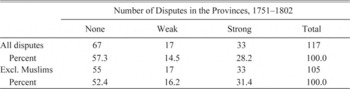
Case records give many concrete examples of forum shopping. In 1769, Essaid de Massé, a Dutch beratlı who did extensive trade with the Dutch Republic, declared himself an Ottoman subject during his bankruptcy despite the litigation having started in the Dutch consular court. In fact, he switched courts several times.Footnote 48 In 1789, The British ambassador Ainslie advised one of his nefer fermanlı to suspend the ferman temporarily to use the Ottoman jurisdiction.Footnote 49 Using consular correspondence and chancery registers, I constructed a sample of commercial disputes involving British and French beratlıs between 1751 and 1802. One should interpret this sample cautiously since it is a non-random sample of conflicts. Consuls and ambassadors' choice of dispute resolution was arbitration, and those successfully resolved in this way were unlikely to appear in consular correspondence. Even those registered in the consular chancery, but not reported to the ambassador, might be subject to selection. Thus, these cases likely overestimate the frequency of forum shopping, but they give some illustration of its extent and character. Table 3 displays the results.
THE FREQUENCY OF FORUM SHOPPING IN COMMERCIAL DISPUTES

Notes:
“None” refers to cases in which adjudication terminated in the court of application, and there was no application to a different jurisdiction. “Weak” indicates cases that involved some formal application to a different jurisdiction but still terminated in the court of application. “Strong” refers to disputes that terminated in a jurisdiction than in which it started. The row “Excl. Muslims” omits proceedings that involved Muslim litigants. The sample is constructed using British and French consular correspondence and chancery registers, primarily in Aleppo and Izmir.
Sources:
CADN 166PO/D1/1–4, 5, 7–10, 12, 15, 18–21, 23, 24, 26, 27, 29; 166PO/D71/1–3, 11; 166PO/D84/7–9, 11, 12, 14–20; 18PO/B/40; BL Add MS 45933; TNA FO 261/3–7; SP 105/191; SP 110/26, 53, 58.
“None” refers to successful adjudication or arbitration in the forum in which the case is filed. “Weak” refers to disputes where the defendant threatens to switch courts or registers the dispute in another forum but does not carry out the threat. “Strong” involves disputes where the defendant switches to another jurisdiction, which carries out the final adjudication. Percentages are reported in parentheses. In the records, 42.7 percent of disputes involved some degree of forum shopping, with 28.2 percent actually ending up in another court. When we exclude disputes involving Muslims, which required adjudication in Islamic courts, the percentages increase to 47.6 percent and 31.4 percent, respectively. Furthermore, ambassadors did not seem to have adjudicated disputes in their beratlıs' favor indiscriminately since defendant beratlıs found it profitable to switch courts. Ambassadors could refuse representation, would not accept cases, or even revoke berats if they thought a beratlı was too much trouble or was clearly at fault.Footnote 50
Forum shopping hypothesis predicts multiple berat or ferman purchases, which is consistent with the primary evidence. In Aleppo, c. 1755, a bankrupt Dutch fermanlı solicited a Venetian berat, fearing the sequestration of his Dutch berat. Others purchased berats despite having protection through their fathers. For instance, Shiudiac and Aida were both Dutch dragomans in Aleppo, with their sons respectively having Austrian and British berats.Footnote 51 The Karalı family in Aleppo was under several powers' protection. The father Petros Karalı had a Swedish berat. His son Yussuf, as noted earlier, had one from Spain, and Petros's other son Yeperi a Venetian berat. Petros had a brother İlyas who had a Dutch berat. Nasrallah Kassab's three sons each had berats of Denmark. Two of them resided in Aleppo, the other in Salonica. Two other Kassabs in Aleppo were British and Prussian beratlıs, but we cannot say for certain they were from the same family. The British beratlı Samaan Kassab's father, Elias Kassab, had an Austrian berat. Anton Diab and his son Petros had British and Swedish berats, respectively. Two members of the Frangopoulos family in Salonica, possibly brothers or father-and-son, had berats from France and Austria, c. 1761. Brothers Iakov and Abraham Frances, established in Salonica, had berats of Austria and Ragusa, respectively, c. 1761.Footnote 52
Since most firms were family-based, multiple licenses allowed a diverse portfolio of berats within the firm. This diversification is evident in other firms as well. Business partners Sader brothers and Anton Diab had berats from Britain and the Dutch Republic in 1763. Yusuf Dwek Cohen and Minas Uskan, Dutch and British beratlıs in a partnership in 1780s.Footnote 53
Furthermore, a beratlı or a beratlı's son could renounce his patent and purchase another country's berat. Yussuf Karalı, a merchant and French trader Pons's agent in Aleppo, abandoned the Swedish protection he had through his father's berat and applied to the Turkish tribunal, only to buy a berat from Spain later, all during the adjudication of his debt payment.Footnote 54 Another example involves Antonio Zingrilara. He was an Ottoman Greek who settled in Amsterdam and obtained Dutch citizenship in 1759, but had a dispute with the Dutch later. He applied to the Turkish court and in the end the Dutch revoked his citizenship in 1768. During this process he purchased a French berat in 1767, and later solicited a British berat in 1768.Footnote 55
This is strong evidence of forum shopping. Agents desired additional legal options to enhance their position whenever parties disputed the contract. This presented prospective berat buyers a trade-off. Having a berat could yield short-term gains in the form of forum shopping, but in the long-run could have the unintended consequence of harming their reputation. The looming threat of rent extraction could have discouraged agents without berats from entering into contracts or transactions with berat holders, which can decrease the number of potential partners beratlıs could enjoy. Werry, a British Consul in Izmir, simultaneously drew attention to the differences between Turkish and European law, and justified British reluctance to trade with local non-Muslims (including beratlıs) by non-Muslims' lack of commitment to European law ex ante.
It is well known, that there exists a wide difference between the Code of Turkish Laws, and the Laws & usages of Europe. It is also a fact, that all Subjects of Turky [sic], Greeks, Armenians, Jews, &c, are always amenable to the Turkish Tribunals […] No writen [sic] engagement under their head—no act past in a foreign Cancellaria or before a European Magistrate, is binding for them […] To obviate this, it would be highly useful […] that all Subjects of Turky [sic] entering, of their own accord, into an Engagement, transaction, or Contract whatever in matters of Trade, with any of the European Factories & under the Sanction & influence of the Laws of the Nation to which that Factory belongs, shall be obliged to abide by that engagement, transaction, or Consent, […] without being at liberty to appeal, or have recourse to the help of the Turkish Law, in order to elude the consequences of such Engagement for when likely to prove inconsonant with their own advantage, & profit.Footnote 56
It is not clear how much of an adverse impact holding berats had on beratlı merchants. Buying licenses that made reneging contracts possible could have created an unfavorable reputation among these merchants. In the end, such disadvantageous reputation might completely erode the license's value. European ambassadors and consuls disapprovingly made note of beratlıs' forum shopping in their reports.Footnote 57 Yet, non-Muslims paid large sums to acquire a portfolio of different berats.
There are two mechanisms that might have prevented the formation of such adverse reputational effects. First, information about being a beratlı was a license holder's private information. The market did not necessarily know if a particular merchant enjoyed European legal protection. In some cases, even an ambassador was not aware of those who were under his protection.Footnote 58 The fact that agents could (and did) purchase berats in the midst of ongoing legal disputes, and “discard” their berats after the termination of proceedings reinforced the information asymmetry between a potential berat holder and his partners. Second, the market might have coordinated on an inefficient equilibrium in which all participants acquired legal protection. Disputes between two beratlıs were resolved through arbitration in which arbitrators and consuls attempted to reach a consensus. Thus, if a merchant believed that other merchants would acquire berats, he had an incentive to obtain one as well to shield himself against potential partners' forum shopping. As non-Muslims bid up the price of the limited stock of berats, agents who either could not afford them (other non-Muslim Ottomans) or partake in this system (Europeans and Muslims) were discouraged from participating in the European-Ottoman trade, leading to beratlıs' entrenchment in this business.
CONCLUSION
The eighteenth-century Ottoman Empire offers an unusual case of legal pluralism in which access to additional European jurisdictions was auctioned off to non-Muslim Ottomans. This corps of merchants who had acquired legal privileges succeeded in getting ahead of both Muslims and Europeans in the Mediterranean trade by the early 1800s.
This article provided a systematic discussion of these privileges and their sales. I constructed a novel panel of price data for British and French licenses using primary sources. These price data revealed three important facts. First, berats were expensive investments. They cost as much as 55 times the annual Ottoman GDP per capita, or about 20 times the annual wage of skilled labor in Istanbul at the time. Second, berat prices showed statistically significant variation across countries, with the French having the most expensive licenses. Third, despite the hefty price, non-Muslim Ottomans found it profitable to purchase multiple berats simultaneously from different European nations.
Using these novel price data, as well as information on commercial disputes and reports, I calculated the extent to which various privileges mattered for explaining the demand for berats. Tax exemptions could not have exclusively driven berat demand; the discounted value of tax benefits make up a small portion of the full berat price. This factor is also inconsistent with the fact that agents purchased multiple berats, where one would have sufficed for evading taxes.
Furthermore, the systematic price variation suggests idiosyncratic benefits associated with the country which dispensed the berat. This observation is consistent with three arguments: access to trade networks, jurisdictional shift, and ambassador's influence. The evidence is too thin to effectively disentangle these three factors, which need not be mutually exclusive. The available primary sources do allow us to eliminate the trade networks explanation as both the French and the British were protective of their commerce and barred beratlıs from participating in it. Trade networks might have mattered to the extent that beratlıs themselves preferred trading with other non-Muslim Ottomans who had the same berat. Without the full account of every berat within partnerships and these firms' activities, there is little way to verify or repudiate this particular claim. On the other hand, there is suggestive evidence for both ambassador's influence and jurisdictional shift (i.e., acquiring benefits idiosyncratic to a legal system) in explaining the price variation.
In investigating the jurisdictional shift hypothesis, this article also addressed several points in Kuran's argument, which states that Ottoman business expansion stagnated due to the combination of inflexible inheritance law, partnership law that did not recognize legal personhood, and the existence of waqfs. I showed that better enterprise forms did not constitute a tangible benefit for beratlıs since they did not organize their firms as joint-stock companies or corporations; beratlı firms continued to be (mostly) family-based ordinary or limited partnerships. However, this article does not dispute that beratlıs' interactions with more flexible European organizational structures had long-run advantages that were realized in the nineteenth century as Ottoman minorities transitioned into using the corporate form more successfully than Muslims did. While the article presents some mixed evidence on more discretionary estate division, the sample is not large enough to verify this claim conclusively.
Neither quality of protection nor jurisdictional shift can explain multiple berat purchases. This article proposed a new hypothesis, strategic forum shopping, as an alternative. Multiple berat acquisition reflected the option value associated with having access to an additional legal system. Agents switched legal systems ex post in order to avoid or delay contractual obligations. This is consistent with the evidence on commercial disputes. Furthermore, forum shopping and ambassadors' influence together can explain the variation in berat prices, which might depend on how willing an ambassador or consul is to give favorable verdicts to their beratlıs.
This kind of strategic court switching created a great deal of uncertainty in contract enforcement. In this sense, this article enhanced the view that finds legal institutions culpable in the Ottomans' stunted business expansion by identifying another channel.