Introduction
CuCr2O4 and ZnMn2O4 spinels have gained considerable attention because of their interesting properties and applications in several fields. For example, CuCr2O4 is one of the most effective catalysts for CO oxidation important for automobile emission control and is also used to increase the rates of combustion of solid rocket propellants [Reference Severino, Brito, Carias and Laine1, Reference Meyer2, Reference West3, Reference Shen, Chen and Wu4]. It also has wide commercial applications as a catalyst for hydrogenation, dehydrogenation, oxidation, alkylation, propellant combustion, decomposition of alcohols, decomposition of organic compounds, and photocatalytic hydrogen production [Reference Yan, Zhang L, Yang, Tang, Lu, Guo, Dai, Han and Yao5, Reference Dandekar, Baker and Vannice6, Reference Laine and Severino7]. ZnxMn3−xO4 spinels are prospective materials for high negative temperature coefficient (NTC) thermistor applications because of their electron conduction properties, which makes them suitable for high-temperature devices such as infrared detectors [Reference Guillemet-Fritsch, Chanel, Sarrias, Bayonne, Rousset, Alcobe and Martinez Sarrion8, Reference Buchanan9]. ZnMn2O4 is also a cathode material for secondary batteries [Reference Yang, Yang, Lu, Li and Li10].
Additionally, chromium-containing spinels (particularly with Mg and Fe) are commonly found in igneous and metamorphic rocks of the crust and the upper mantle. They are widely considered as petrogenetic indicators [Reference Irvine11, Reference Evans and Frost12, Reference Dick and Bullen13, Reference Sack and Ghiorso14]. The chromium content of homogeneous spinels provides important information regarding the petrogenesis of MORB (mid-ocean ridge basalt) lava, magma mixing, and precipitation of coexisting phases [Reference Allan, Sack and Batiza15] and references therein].
The general formula of a spinel can be written as AB2O4 or (A1−xBx)[AxB2−x]O4, where round brackets represent tetrahedral sites, square brackets show octahedral sites, and x is the inversion parameter which ranges from zero (completely normal spinel) to 1 (completely inverse). The ideal spinel structure has a face-centered cubic close-packed lattice of oxygen anions with 1/8 of tetrahedral and 1/2 of octahedral sites occupied by cations. In the real spinel structure, the anions are displaced slightly from ideal close-packed position, away from the nearest tetrahedral cation, which results in larger tetrahedral and smaller octahedral sites.
All four end-members ZnMn2O4, Mn3O4, MgCr2O4, and CuCr2O4 and their solid solutions possess normal cation distributions, where the divalent cations Zn2+, Mn2+, Mg2+, and Cu2+ occupy tetrahedral sites and the trivalent ions (Mn3+ and Cr3+) have a strong preference for octahedral sites [Reference Miller16]. At ambient temperature, MgCr2O4 has a cubic structure, whereas CuCr2O4 and ZnxMn3−xO4 spinels are tetragonally distorted. The tetragonality decreases with increasing Zn content [Reference Shoemaker, Rodriguez and Seshadri17]. Mg1−zCuzCr2O4 undergoes a transition from cubic to tetragonal with a region of coexistence around 0.43 ≤ z ≤ 0.47 [Reference Shoemaker and Seshadri18] and the tetragonality increases with the Cu content.
The thermodynamic properties of these spinels and their solid solutions are applicable to a number of technological and geological scenarios as indicated above. Although the enthalpies of formation from oxides of the end-members (Mn3O4, ZnMn2O4, MgCr2O4, and CuCr2O4) have been measured by Navrotsky and Kleppa [Reference Navrotsky and Kleppa19] and Muller and Kleppa [Reference Muller and Kleppa20], using oxide melt solution calorimetry, no calorimetric data for the solid solution thermodynamics have been reported. Additionally, a discrepancy in the enthalpy of formation of the CuCr2O4 end-member was observed among values obtained by different authors using different methods (direct calorimetry versus the temperature dependence of free energy) [Reference Muller and Kleppa20, Reference Schmahl and Minzl21, Reference Gadalla and White22, Reference Tretjakow and Schmalzried23, Reference Jacob, Kale and Iyengar24].
To resolve these discrepancies and understand the mixing properties of the solid solutions and their dependence on crystal chemical factors, the present work determines, using high-temperature oxide melt solution calorimetry, the mixing energetics and thermodynamic stability of the ZnxMn3−xO4 and Mg1−zCuzCr2O4 spinel systems and links the thermodynamics to the structural characteristics and material properties.
Results and discussion
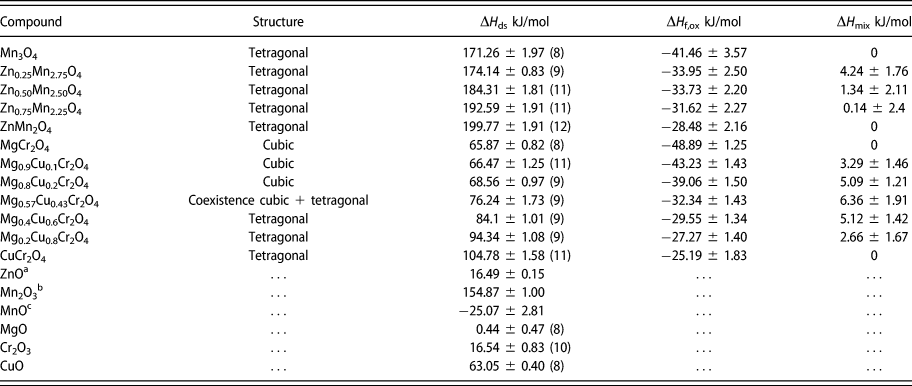
The enthalpies of formation from the oxides and from elements of the end-members ZnMn2O4, Mn3O4, MgCr2O4, and CuCr2O4 and their solid solutions were calculated from the drop solution enthalpies using the thermodynamic cycles below. The results are shown in Table I.
Average drop solution enthalpies (ΔH ds) at 973 K for ZnxMn3−xO4 and at 1073 K for Mg1−zCuzCr2O4 and their constituent oxides; enthalpies of formation from oxides (ΔH f,ox) and enthalpies of mixing of ZnxMn3−xO4 and Mg1−zCuzCr2O4. Uncertainties are two standard deviations of the mean and values in parentheses are the numbers of performed experiments.

a Zhang et al. [Reference Zhang, Lee, Xu and Navrotsky25].
b Birkner and Navrotsky [Reference Birkner and Navrotsky26].
c Calculated from Birkner and Navrotsky [Reference Birkner and Navrotsky26] and Robbie and Hemingway [Reference Robie and Hemingway29].
Enthalpies of formation from oxides of the ZnxMn3−xO4 system
ZnxMn3−xO4 (s, 298 K) + (1 − x)/4O2 (g, 973 K) → xZnO (dis, 973 K) + (3 − x)/2Mn2O3 (dis, 973 K)ΔH 1
ZnO (s, 298 K) → ZnO (dis, 973 K)ΔH 2
Mn2O3 (s, 298 K) → Mn2O3 (dis, 973 K)ΔH 3
MnO (s, 298 K) + 1/4O2 (g, 973 K) → 1/2Mn2O3 (dis, 973 K)ΔH 4
xZnO (s, 298 K) + (1 − x)MnO (s, 298 K) + Mn2O3 (s, 298 K) → ZnxMn3−xO4 (s, 298 K)ΔH f,ox
ΔH f,ox = −ΔH 1 + xΔH 2 + ΔH 3 + (1 − x)ΔH 4
Enthalpies of formation from elements of the ZnxMn3−xO4 system
ZnxMn3−xO4 (s, 298 K) + (1 − x)/2O2 → xZnO (dis, 973 K) + (3 − x)/2Mn2O3 (dis, 973 K)ΔH 1
Zn (s, 298 K) + O2 (g, 298 K) → ZnO (dis, 973 K)ΔH 5
2Mn (s, 298 K) + 3/2O2 (g, 298 K) → Mn2O3 (dis, 973 K)ΔH 6
Mn (s, 298 K) + 1/2O2 (g, 298 K) → MnO (dis, 973 K)ΔH 7
xZn (s, 298 K) + (3 − x)Mn (s, 298 K) + 2O2 (g, 298 K) → ZnxMn3−xO4 (s, 298 K)ΔH f,el
ΔH f,el = −ΔH 1 + xΔH 2 + ΔH 3 + (1 − x)ΔH 4 + xΔH 5 + ΔH 6 + (1 − x)ΔH 7
Enthalpies of formation from oxides of the MgxCu1−xCr2O4 system
MgzCu1−zCr2O4 (s, 298 K) + 1.5O2 (g, 1073 K) → zMgO (dis, 1073 K) + (1 − z)CuO (dis, 1073 K) + 2CrO3 (dis, 1073 K)ΔH 8
MgO (s, 298 K) → MgO (dis, 1073 K)ΔH 9
CuO (s, 298 K) → CuO (dis, 1073 K)ΔH 10
Cr2O3 (s, 298 K) + 1.5O2 (g, 1073 K) → 2CrO3 (dis, 1073 K)ΔH 11
MgO (dis, 298 K) + (1 − z)CuO (dis, 298 K) + Cr2O3 (dis, 298 K) → MgzCu1−zCr2O4 (s, 298 K)ΔH f,ox
ΔH f,ox = −ΔH 8 + zΔH 9 + (1 − z)ΔH 10 + ΔH 11
Enthalpies of formation from elements of the MgxCu1−xCr2O4 system
MgzCu1−zCr2O4 (s, 298 K) + 1.5O2 (g, 1073 K) → zMgO (dis, 1073 K) + (1 − z)CuO (dis, 1073 K) + 2CrO3 (dis, 1073 K)ΔH 6
Mg (s, 298 K) + O2 (g, 298 K) → MgO (dis, 298 K)ΔH 12
Cu (s, 298 K) + O2 (g, 298 K) → CuO (dis, 298 K)ΔH 13
2Cr (s, 298 K) + O2 (g, 298 K) → Cr2O3 (dis, 298 K)ΔH 14
zMg (s, 298 K) + (1 − z)Cu (s, 298 K) + 2Cr (s, 298 K) + 2O2 (g, 298 K) → MgzCu1−zCr2O4 (s, 298 K)ΔH f,el
ΔH f,el = −ΔH 7 + zΔH 9 + (1 − z)ΔH 10 + ΔH 11+ xΔH 12 + (1 − x)ΔH 13 + ΔH 14
The enthalpy of the reaction Mn2O3 + MnO → Mn3O4 at 298 K is −41.46 ± 3.57 kJ/mol, which agrees well with the value from Fritsch and Navrotsky [Reference Fritsch and Navrotsky28]: −40.7 ± 7.5 kJ/mol. Decreasing manganese content in the Mn3O4–ZnMn2O4 solid solutions results in less exothermic enthalpy of formation from oxides (Table I). The enthalpy of formation of ZnMn2O4 from oxides at 298 K is −28.48 ± 2.16 kJ/mol, consistent with Navrotsky and Kleppa [Reference Navrotsky and Kleppa19] value of −27.49 ± 0.96 kJ/mol at 970 K. The enthalpy of formation from elements −1337.98 ± 2.40 kJ/mol is the same within experimental error as the Robie and Hemingway [Reference Robie and Hemingway29] tabulated value of −1337.0 ± 4.0 kJ/mol.
The enthalpy of formation from oxides of MgCr2O4 at 298 K is −48.89 ± 1.25 kJ/mol (Table I), which is close to the Muller and Kleppa (1973) [Reference Muller and Kleppa20] value of −46.32 ± 0.75 kJ/mol, measured at 1173 K. Klemme and O’Neill [Reference Klemme and O’Neill27] reported a less exothermic formation enthalpy (−32.9 kJ/mol) calculated from the near-univariant reaction MgCr2O4 + SiO2 = MgSiO3 + Cr2O3 and literature thermodynamic data, but no explanation of the details was provided. The current thermodynamic cycles as written assuming that the final oxidation state of the dissolved chromium is Cr(VI). This assumption is supported by the yellow coloration of the sodium molybdate melt at the end of the high-temperature oxide melt solution experiment. An additional furnace experiment was performed to verify the final oxidation state of chromium. Sodium molybdate solvent was melted at 1073 K and Cr2O3 was added to the melt. The color of the solvent changed to blue, which indicated reduction of the molybdenum cation (Mo6+ → Mo5+) as an intermediate step and the final coloration of the melt was dark yellow/orange, which indicates the presence of Cr6+. In any case, as long as the final oxidation state of Cr is the same whether dissolving the binary oxide or the spinel, of differing chromium content, it is not actually necessary to know what it is.
Substituting copper for magnesium results in less exothermic enthalpies of formation in the MgCr2O4–CuCr2O4 system. A smooth change in the drop solution, respectively, in the formation enthalpy is observed. The enthalpy of formation from oxides of CuCr2O4 end member at 298 K is −25.19 ± 1.83 kJ/mol, which is different from the result obtained by Muller and Kleppa [Reference Muller and Kleppa20] at 1173 K: 10.42 ± 1.05 kJ/mol. Several studies on the thermodynamic stability of CuCr2O4 [Reference Muller and Kleppa20, Reference Schmahl and Minzl21, Reference Gadalla and White22, Reference Tretjakow and Schmalzried23, Reference Jacob, Kale and Iyengar24] have been performed, but significant disagreement in the enthalpy of formation from oxides, obtained by using different techniques, was observed. The results vary from −51.0 ± 1.5 kJ/mol (Tretjakow and Schmalzried [Reference Tretjakow and Schmalzried23], emf measurements) to +76 kJ/mol (Gadalla and White [Reference Gadalla and White22], dissociation pressure).
To check the exothermic formation enthalpy of CuCr2O4 from oxides, additional measurements were performed. The drop solution enthalpy of pure copper metal was measured at 1073 K in oxygen atmosphere as −106.72 ± 2.38 kJ/mol and was used together with the drop solution enthalpy of CuO to calculate the formation enthalpy of CuO. The result −157.07 ± 2.41 kJ/mol is consistent with −156.06 ± 2.00 kJ/mol [Reference Chase, Davies, Downey, Frurip, Mc-Donald and Syverud30]. To verify the drop solution enthalpies of the other two constituent oxides, MgO and Cr2O3, the enthalpy of formation from elements of MgCr2O4 was calculated (−1785.53 ± 1.16 kJ/mol) and compared with the Muller and Kleppa [Reference Muller and Kleppa20] value (−1787.40 ± 2.93 kJ/mol). Additionally, all chromium-containing spinels were measured on two different calorimeters, giving consistent results. Thus, we believe our values are consistent and correct.
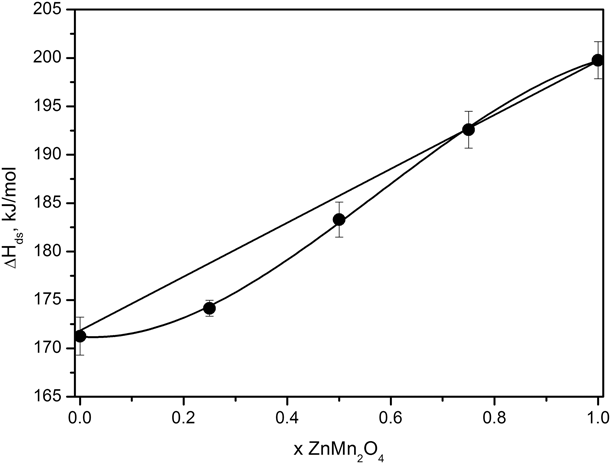
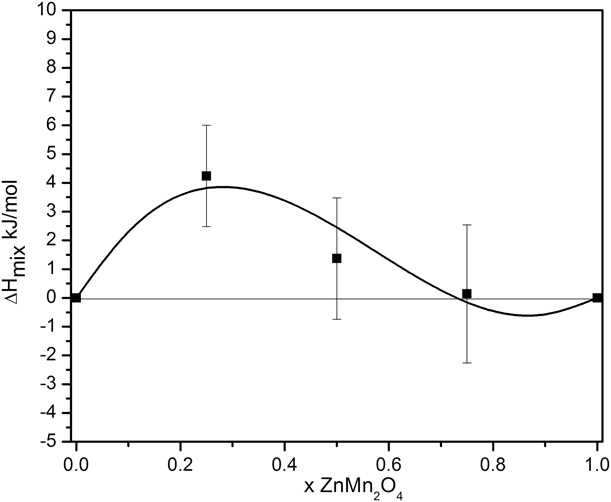
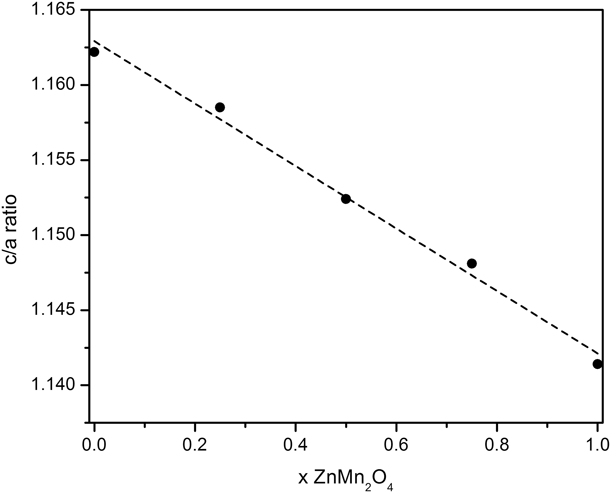
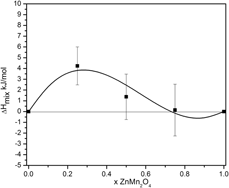
The enthalpies of mixing in both solid solution systems are calculated as the difference between the drop solution enthalpies of the solid solution and the weighted average of the end-members. They are endothermic, indicating some degree of energetic destabilization of the solid solutions. The drop solution enthalpies of the end-members and the ZnxMn3−xO4 solid solution can be fitted as a third-degree polynomial function (Fig. 1), representing a subregular solution with ΔH mix = x(1 − x)(W 1(1 − x) + W 2x) kJ/mol, where W 1 = 32.32 ± 14.56 and W 2 = −12.43 ± 12.17 kJ/mol. The experimental enthalpies of mixing, superimposed on the curve calculated from the polynomial fit, are shown in Fig. 2. Zn content increase results in less positive enthalpies of mixing, which become zero within the experimental errors when x > 0.75. Since both end-members are normal spinels where Zn2+ prefers tetrahedral sites and Mn3+ is in a Jahn–Teller distorted octahedral coordination, and the ionic radii of the divalent zinc and manganese have only a 10% difference (0.60 and 0.66 Å, [Reference Shannon31]), it is reasonable to assume that these ions are randomly distributed on tetrahedral sites. Thus, changes in the cation distribution and size mismatch factors should have minor to negligible effects on the mixing thermodynamics. The small positive heat of mixing could be explained by a slight change in the tetragonality of the structure, which increases as Zn content decreases. According to Shoemaker et al. [Reference Shoemaker, Rodriguez and Seshadri17], the c/a ratio decreases smoothly with manganese content increase, which they explain by the preference of zinc for covalent bonding and more regular tetrahedral coordination (Fig. 3).
Drop solution enthalpies of ZnxMn3−xO4 solid solution in molten sodium molybdate at 973 K. The straight line connects the two end-members; the curve represents a third-degree polynomial fit of the experimental data.

Enthalpies of mixing of ZnxMn3−xO4 solid solution. The straight line corresponds to zero heat of mixing, the curve is calculated from calculated from the polynomial fit of the drop solution enthalpies.

ZnxMn3−xO4 solid solution c/a ratio as a function of the composition.

The configurational entropy of a spinel A1−xBx(AxB2−x)O4 with a random distribution of the two cations on each sublattice is
 $${S_{\rm{c}}} = - R\left\{ {x\ln \;x + \left( {1 - x} \right)\ln \left( {1 - x} \right) + 2\left[ {{x \over 2}\ln {x \over 2} + \left( {1 - {x \over 2}} \right)\ln \left( {1 - {x \over 2}} \right)} \right]} \right\}\quad .$$
In this case, mixing occurs only on the tetrahedral sites, so only the first term is applicable and the equation is identical to that for a classical ideal solution with one mole of cations. By definition, the entropy of mixing is the difference between the configurational entropy of the solid solution and the weighted average of the mechanical mixture of the end-members. In the current case, the two end-members are normal spinels; hence, their configuration entropy is zero. Therefore, the Gibbs energy of mixing can be calculated from the enthalpies of mixing and the configurational entropy of the solid solution S c.
 $$\Delta {G_{{\rm{mix}}}} = \Delta {H_{{\rm{mix}}}} - T{S_{\rm{c}}}\quad .$$
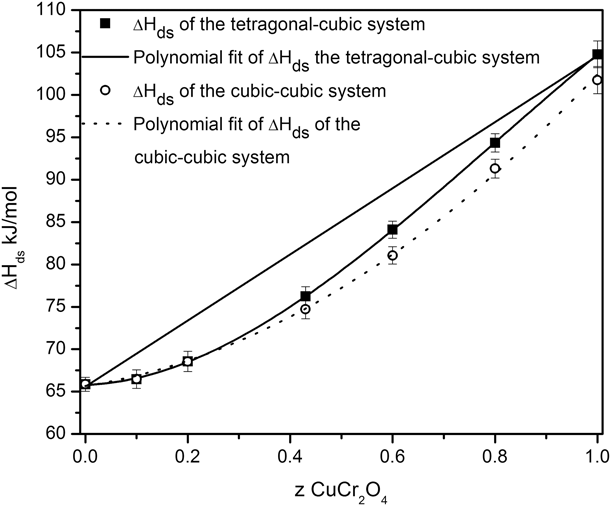
The drop solution enthalpies of the Mg1−zCuzCr2O4 system can be fitted in two different ways. Using the subregular solution model ΔH mix = z(1 − z)(W 1(1 − z) + W 2z) results in W 1 = 36.98 ± 2.84 kJ/mol and W 2 = 10.93 ± 3.89 kJ/mol (Fig. 4). This neglects the change in symmetry from cubic to tetragonal with increasing copper content.
Drop solution enthalpies of Mg1−zCuzCr2O4 solid solution in sodium molybdate at 1073 K. The straight line connects the two original end-members, the squares are the drop solution enthalpies of the original tetragonal–cubic solid solution; the solid curve represents a third-degree polynomial fit of the experimental data. The circles indicate the drop solution enthalpies of the cubic–cubic solid solution and are fitted as a second-degree polynomial with a dotted line.

Similar to the ZnxMn3−xO4 system, the cation distribution and size mismatch effects (the divalent tetrahedrally coordinated magnesium and copper have the same ionic radius of 0.57 Å, [Reference Shannon31]) should not influence the mixing properties of the chromium spinel solid solution significantly. Although MgCr2O4 end-member possesses a cubic structure at ambient temperature, replacing Mg2+ by Cu2+ results in coexistence of cubic and tetragonal solid solutions when z is between 0.43 and 0.47 and in a completely tetragonal structure at z > 0.47. It is appropriate to consider the effect of this symmetry change on the enthalpies of mixing. We do this by considering the enthalpy of mixing in a hypothetical continuous cubic solid solution between cubic end-members. According to Yé et al. [Reference Yé, Crottaz, Vaudano, Kubel, Tissot and Schmid32] and Kennedy et al. [Reference Kennedy and Zhou33], cubic CuCr2O4 exists at temperature above 853–870 K and cannot be quenched and preserved at room temperature. However, its enthalpy can be measured directly by DSC and was found to be 3.03 ± 0.26 kJ/mol at 849 ± 2 K in the present work. No weight change was observed during heating and cooling. Using the transition enthalpy (and ignoring any temperature dependence) and the drop solution enthalpy of the tetragonal phase, the drop solution enthalpy of the cubic CuCr2O4 phase can be calculated as 104.78 ± 1.58 (the drop solution enthalpy of the tetragonal phase) −3.03 ± 0.26 (transition enthalpy) = 101.75 ± 1.60 kJ/mol. The drop solution enthalpies of the tetragonal solid solutions were recalculated for cubic structure in the same way: ΔH ds(cubic) = ΔH ds(tet) − 3.03z, where z is the CuCr2O4 mole fraction. The resulting drop solution enthalpies were fitted as a second-degree polynomial with ΔH mix = 9.58 × z(1 − z) kJ/mol (Fig. 4).
The cubic to tetragonal transition in MgCr2O4 occurs at very low temperatures (around 10–12.5 K), resulting in a tetragonal distorted structure, isotypic with hausmannite (Mn3O4) (Ehrenberg et al. [Reference Ehrenberg, Knapp, Baehtz and Klemme34]), and the enthalpy of this transition is unknown. We did not consider mixing properties within the hypothetical solid solution having tetragonal structure at all compositions.
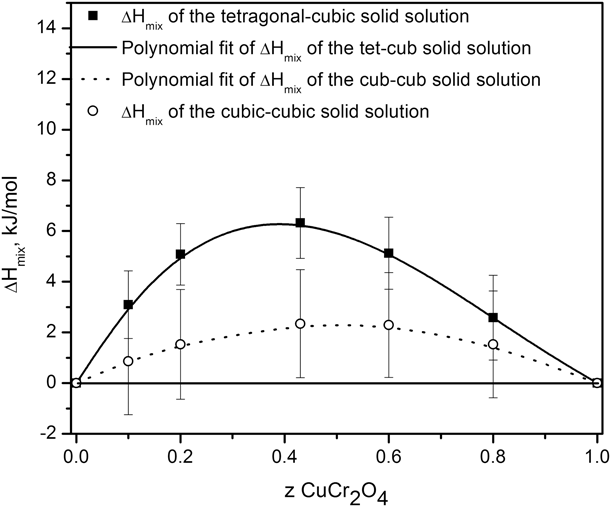
The experimental heats of mixing are shown on Fig. 5 together with those calculated from the polynomial fit curve for the original tetragonal-cubic system and the recalculated cubic–cubic one.
Enthalpies of mixing of Mg1−zCuzCr2O4 solid solution. The straight line corresponds to zero heat of mixing; the solid curve is calculated from the polynomial fit of the drop solution enthalpies of the original tetragonal–cubic solid solution. The open circles are the heats of mixing of the cubic–cubic solid solution and the dotted curve represents the polynomial fit.

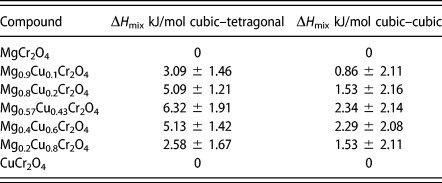
The mixing enthalpies of the cubic–cubic solid solution and the original cubic–tetragonal solid solution are also shown in Table II. It can be concluded that if both end-members possess the same cubic structure, the heats of mixing are smaller and close to zero or even zero within error, i.e., the largest contribution to the positive heat of mixing in the actual MgCr2O4–CuCr2O4 system is the structural transition. Because the actual errors of the enthalpies of mixing in a cubic–cubic solid solution are most likely larger than the error propagation shown in Table II, it can be assumed that the enthalpies are close to zero. Additionally, both end-members are normal spinels; therefore, there will be mixing of Mg and Cu cations on the tetrahedral site only. As a result, the Mg1−zCuzCr2O4 solid solution above 850 K is ideal in the sense of Raoult’s law and the activities are equal to the mole fractions.
Enthalpies of mixing of Mg1−zCuzCr2O4 solid solution: the experimental data for a tetragonal–cubic system, and the calculated data for the cubic–cubic solid solutions.

The calculated Gibbs energy of mixing using Eqs. (1) and (2) confirms the absence of solvus at any temperature similar to the ZnxMn3−xO4 system. Both spinel systems are thermodynamically stable over a wide temperature range, which makes them suitable candidates for both low- and high-temperature applications.
It should be noted that the mixing properties of the Mg1−zCuzCr2O4 system change with the tetragonal to cubic transition (when z ≥ 0.47), which should be taken into account if the materials are used above 850 K. The magnetic transitions at the low-temperature region are well known (Kemei et al. [Reference Kemei, Moffitt, Shoemaker and Seshadri35]), but the enthalpy of the MgCr2O4 cubic to tetragonal structural transformation at 12 K should be measured to access its effect on the mixing properties of the solid solutions when z ≤ 0.47.
Conclusions
The newly obtained data trends provide valuable information about the structure–property relationship when the change in the structure is the main factor affecting the mixing thermodynamics. In the two ZnxMn3−xO4 and Mg1−zCuzCr2O4 systems, only MgCr2O4 is cubic, whereas the other three end-members are tetragonal, which results in small positive heats of mixing. In both spinel solid solutions, the positive enthalpies of mixing are due to structural changes—increase in tetragonality and a transition from cubic to tetragonal lattice, for the manganese- and chromium-containing systems, respectively. If both end-members in the Mg1−zCuzCr2O4 system are taken as cubic, the heat of mixing would be close to zero and the solid solution will be thermodynamically ideal.
Experimental methods
All end-members, ZnxMn3−xO4 and Mg1−zCuzCr2O4 solid solutions, were synthesized and characterized by Shoemaker et al. [Reference Shoemaker, Rodriguez and Seshadri17] and Shoemaker and Seshadri [Reference Shoemaker and Seshadri18], and details are given therein. An additional CuCr2O4 sample was synthesized by similar methods for the TG-DSC measurements. The phase purity and the lattice parameters of all compounds were determined by X-ray powder diffraction, using a Bruker D8 Advance diffractometer, Bruker, Madison, Wisconsin (Cu Kα1 wavelength = 1.5406 A, Cu: 40 kV, 40 mA), with a step size of 0.01° and collection time 40 min. The homogeneity and stoichiometry of the samples are verified by wavelength dispersive analysis using a Cameca SX-100 electron microprobe, Cameca, Gennevilliers, France.
Thermal analysis (TG-DSC) was performed on a Setaram Labsys Evo instrument (Setaram Inc., Lyon, France) from room temperature to 1123 K with a 10 K/min heating rate in air. High-temperature oxide melt solution calorimetry was performed using a Tian Calvet twin calorimeter, as described previously [Reference Navrotsky36, Reference Navrotsky37, Reference Navrotsky38]. Samples in the form of pellets (between 4 and 6 mg) were dropped from room temperature (298 K) into molten 3Na2O·4MoO3 solvent in a platinum crucible in the calorimeter at 973 K (for ZnxMn3−xO4) and at 1073 K (for Mg1−zCuzCr2O4). The higher temperature was used for the chromium spinels to enhance their dissolution rate. Oxygen was flushed over the solvent at 90 mL/min and bubbled through it at 5 mL/min. The samples dissolved readily and no difficulties were encountered. The calorimeter was calibrated using the heat content of 5 mg α-Al2O3 samples.
Acknowledgments
Financial support from DOE Grant DE-FG02-97ER1 is gratefully acknowledged. The authors thank Dr. Ram Seshadri (University of California, Santa Barbara) for his valuable contribution and support.