Introduction
The variegated grasshopper Zonocerus variegatus (L.) (Orthoptera: Pyrgomorphidae) is a short-horned grasshopper with an aposematic colouration (Bamidele and Muse, Reference Bamidele and Muse2012). It is a phytophagous insect that feeds on a wide range of cultivated and uncultivated plants (Okonkwo et al., Reference Okonkwo, Ezeakacha and Nwankwo2011). It is the most dominant species among grasshoppers in many farmlands in Nigeria (Oku et al., Reference Oku, Arong and Bassey2011). Locally, the populations of Z. variegatus can be very large and cause considerable defoliation and subsequent crop yield loss; thus, they cause damage to economic and food crops by reducing the photosynthetic area, which results in yield reductions, and they weaken the plant, inhibit nutrient transport and expose the plant to viral and bacterial diseases by attacking the stems (Ogueji, Reference Ogueji2012). The incidence and scale of Z. variegatus outbreaks have increased in the last 20 years owing to the increased production of cassava and the spread of Chromolaena odorata (L.) (Bamidele and Muse, Reference Bamidele and Muse2012). While the first, second and third instars survive on weeds such as C. odorata and Aspilia africana (all Asteraceae), the fifth and sixth instars prefer Manihot esculenta (Euphorbiaceae) (Chapman et al., Reference Chapman, Page and McCaffery1986).
In an effort to mitigate the damage and economic loss caused by this insect, several control strategies have been employed to prevent and control its outbreak. The commonly employed measures include biological and chemical control methods (Barrientos-Lozano and Almaguer-Sierra, Reference Barrientos-Lozano and Almaguer-Sierra2009). Several synthetic chemical pesticides (such as organophosphates (OPs), organochlorines (OCs), cyclodienes and pyrethroids (PYRs)) have been used to control the insect (Chapman et al., Reference Chapman, Page and McCaffery1986). However, there are reports that the use of synthetic chemical pesticides has provoked resistance in this insect (Modder, Reference Modder1994). Plant-derived insecticidal products, as an alternative to chemical pesticides, are considered practical and safe to the environment, because of their easy availability, biodegradability and target-specific nature (Leatemia and Isman, Reference Leatemia and Isman2004). The most promising botanical families are Meliaceae, Rutaceae, Asteraceae, Annonaceae, Labiatae, Aristolochiaceae, Malvaceae and Lamiaceae (Isman, Reference Isman2000).
Ocimum gratissimum is a perennial herb belonging to the family Lamiaceae. The plant, believed to have originated from Asia and Africa, is also widely distributed in other regions of the world (Leal et al., Reference Leal, Chaves, Ming, Petenate and Meireles2006). The leaves of the plant contain essential oils and the plant is cultivated for various purposes (Lasisi and Ajuwon, 2002). In Nigeria and most parts of West Africa, it is used as a spice and condiment in dishes, because of the strong pungent flavour of its clove, and the whole plant and the essential oils of the plant have many applications in folk medicine (Ojo et al., Reference Ojo, Oloyede, Ajiboye and Olarewaju2014). The extracts and essential oils of this plant have been demonstrated to have insecticidal activity (Adeniyi et al., Reference Adeniyi, Orjiekwe, Ehiagbonare and Arimah2010).
Insects have developed resistance to almost all classes of chemical pesticides by detoxification mechanisms, which involve a number of detoxifying enzymes including glutathione S-transferases (GSTs) (Ranson et al., Reference Ranson, Rossiter, Ortelli, Jensen, Wang, Roth, Collins and Hemingway2001). GSTs are mainly cytosolic enzymes that catalyse the conjugation of electrophile molecules, with potentially toxic substances becoming more water soluble and generally less toxic (Zibaee, Reference Zibaee and Stoytcheva2011). GSTs play an important role in insecticide resistance and are involved in the metabolism of organophosphorus and OC compounds (Zibaee et al., Reference Zibaee, Sendi, Alinia, Ghadamyari and Etebari2009). Other xenobiotics such as plant defence allelochemicals have been reported to induce GST activity in phytophagous insects (Zibaee, Reference Zibaee and Stoytcheva2011).
Several studies have evaluated the contributory role of GSTs in insecticide resistance in Musca domestica (Wei et al., Reference Wei, Clark and Syvanen2001, Nascimento and Bicudo, Reference Nascimento and Bicudo2002), Drosophila melanogaster (Tang and Tu, Reference Tang and Tu1995), Nilaparvata lugens (Vontas et al., Reference Vontas, Small, Nikou, Ranson and Hemingway2002), Myzus persicae (Field and Devonshire, Reference Field and Devonshire1998) and the blowfly Lucilia cuprina (Campbell et al., 1998). Adewale and Afolayan (Reference Adewale and Afolayan2006) isolated and studied the activities of GST isolated from the hindgut of Z. variegatus. They reported that the purified enzyme had a native molecular weight of 40 kDa and a subunit molecular weight of 19 kDa and concluded that the kinetic pathway of detoxification by GST may assist Z. variegatus in coping with various xenobiotics encountered in its preferred food plants. However, there is a paucity of data on the induction of GST activity and the role of GST in insecticide resistance in Z. variegatus. Therefore, we carried out an initial study on the induction of GST activity in Z. variegatus exposed to PYR insecticide and O. gratissimum leaf extract. We also evaluated the kinetics of the GST extracted from insects exposed to these insecticides.
Materials and methods
Collection and identification of experimental insect species
Fifth-instar nymphs of the wet-season form of Z. variegatus were collected from cassava farms on the campus of the University of Ibadan, Ibadan, Nigeria, between July and August 2012. The insects were transported to the insectary of the Department of Zoology, University of Ibadan, where they were reared in insect cages (30 × 30 × 40 cm3) at 27 ± 5 °C and 55 ± 2% humidity and fed cassava (M. esculenta) leaves ad libitum until moulting into adult stage.
Chemicals
A commercial PYR pesticide formulation containing 0.05% imiprothrin ((2,5-dioxo-3-prop-2-ynylimidazolidin-1-yl)methyl 2,2-dimethyl-3-(2-methylprop-1-enyl)cyclopropane-1-carboxylate), 0.05% prallethrin (2-methyl-4-oxo-3-prop-2-yn-1-ylcyclopent-2-en-1-yl 2,2-dimethyl-3-(2-methylprop-1-en-1-yl)cyclopropanecarboxylate) and 0.015% cyfluthrin ((R)-cyano-(4-fluoro-3-(phenoxy)phenyl)methyl)(1R,3R)-3-(2,2-dichloroethenyl)-2,2-dimethylcyclopropane-1-carboxylate, CDNB (1-chloro-2,4-dinitrobenzene), n-hexane, acetonitrile and potassium phosphate were purchased from Sigma-Aldrich, Germany.
Preparation of Ocimum gratissimum leaf extract
Fresh leaves of O. gratissimum were obtained from plants growing on the campus of the University of Ibadan, Ibadan. The plant was identified by a trained taxonomist at the Department of Botany, University of Ibadan, Ibadan, Nigeria. Air-dried leaf samples were grounded with a Warring type stainless-steel commercial blender (Okapi, India). The blended leaf samples (100 g) were soaked in 500 ml of n-hexane for 48 h. The plant material was filtered and the filtrates were further filtered using Whatman No. 1 filter paper (Fisher Scientific, Chicago, IL, USA). The filtrate was evaporated to dryness on a water bath at 60 °C and a plant extract weighing 63 g w/w was obtained.
Experimental set-up
The insects were divided into three treatment groups and one control group. Each group consisted of 30 adult Z. variegatus in two replicates. The experimental set-up was as follows:
Control: Insects in this group were sprayed with 20 ml of distilled water.
Group 1: This group was given the code SS. Each replicate was sprayed with 20 ml of PYR insecticide. Insects that died within 24 h were collected and labelled as DSI, while insects that were alive 24 h after exposure were collected and labelled as LSI.
Group 2: This group was given the code SB1. Each replicate was sprayed with 25 g/dl of O. gratissimum leaf extract. All insects that were alive 24 h after exposure were collected and labelled as LBI25g/dl.
Group 3: This group was given the code SB2. Each replicate was sprayed with 250 g/dl of O. gratissimum leaf extract. All insects that died within 24 h of exposure were collected and labelled as DBI250g/dl, while insects that were alive 24 h after exposure were collected and labelled as LBI250g/dl.
All insect batches were weighed and stored at 4 °C.
Insecticide application
Exposure of the various treatment groups to both synthetic and botanical insecticides was done in test cage of dimensions 100 × 149 × 100 cm3 with the aid of a sprayer. Each batch was allowed to acclimatize in the test cage for 30 min before exposure to the insecticide. Mortality in insects exposed to the insecticides was monitored for 24 h.
Homogenization and protein quantification
Treated insect batches were homogenized in a potassium phosphate buffer (pH 6.5), using a Potter-Elvehjem homogenizer (Sigma-Aldrich, Germany). The homogenates were then filtered using Whatman No. 1 filter paper. The filtrates were centrifuged at 4000 rpm for 20 min. The clear supernatants obtained were transferred into specimen bottles, stored at 4 °C and used as a source for GST activity assay. Protein concentrations in the homogenates were determined using the method of Lowry et al. (Reference Lowry, Rosebrough, Lewis Farr and Randall1951).
Enzyme activity and kinetics
The activity of GST was assayed using the spectrophotometric method described by Habig et al. (Reference Habig, Pabst and Jakoby1974), using CDNB as the substrate, in ultraviolet (UV) semi-microcuvettes (Fisher Scientific). Sequential addition of 0.1 m phosphate buffer of pH 6.5 (1.78 ml), enzyme preparation (0.1 ml), 50 mm reduced glutathione (GSH) solution in buffer (0.1 ml), and 50 mm CDNB solution in acetonitrile (0.02 ml) to the insect homogenates (4 ml) in the microcuvettes was done to obtain a 2 ml final volume of the routine incubation mixture. Enzyme activity was determined by continuously monitoring the change in absorbance at 340 nm for 3 min at 25 °C using a Shimadzu UV-160 spectrophotometer (Shimadzu, Osaka, Japan). Values of the apparent Michaelis–Menten constant (K m) and maximal velocity (V max) of the GST extracted from Z. variegatus were determined using GSH. The activity was recorded within a range of GSH concentrations (0.8–9.6 mm), while the concentration of the other substrate was kept constant at 2.4 or 0.24 mm.
Statistical analysis
Data obtained are expressed as means ± SE. Significant differences between the test and control groups were tested using ANOVA at P< 0.05, with the SPSS computer software, version 17.0. The kinetics of the enzyme (V max and K m) was also estimated for CDNB-conjugating activity using the double-reciprocal Lineweaver–Burk plots.
Results
Mortality and body weight of Zonocerus variegatus
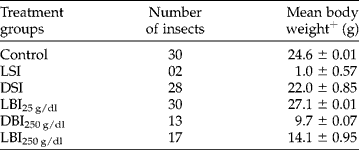
All insects in the control group exposed to distilled water and those exposed to 25 g/dl of O. gratissimum leaf extract were still alive after 24 h (Table 1). A total of 28 (93.30%) insects died in the group exposed to 20 ml of PYR insecticide within 24 h, while 13 insects (43.30%) died in the group exposed to 250 g/dl of O. gratissimum leaf extract within 24 h.
Mortality and body weight of Zonocerus variegatus
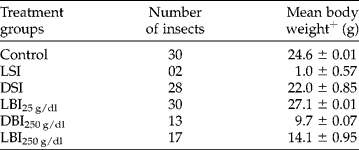
LSI, Z. variegatus that were alive after exposure to 20 ml of pyrethroid insecticide; DSI, Z. variegatus that died after exposure to 20 ml of pyrethroid insecticide; LBI25g/dl, Z. variegatus that were alive after exposure to 25 g/dl of botanical insecticide; DBI250g/dl, Z. variegatus that died after exposure to 250 g/dl of botanical insecticide; and LBI250g/dl, Z. variegatus that were alive after exposure to 250 g/dl of botanical insecticide.
+ Values represent means ± SE.
Total protein and total GST concentrations
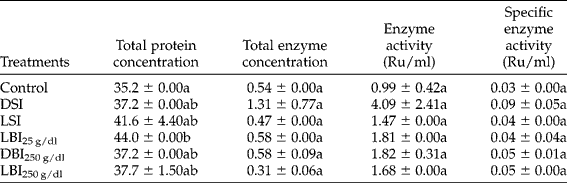
The concentration of total protein was significantly higher (P< 0.05) in insects exposed to the insecticides than in the control insects (Table 2). There was no significant difference (P< 0.05) in protein concentration between the dead and live insects after exposure to the insecticides. The concentration of total enzyme was higher in most of the insects exposed to the insecticides than in the control insects; however, the difference was not significant (P< 0.05). The concentration of total enzyme was higher in dead insects than in insects that were alive after exposure to the botanical and synthetic insecticides. Enzyme activity and specific enzyme activity were higher in insects exposed to the insecticides than in the control insects, while a higher enzyme activity was recorded in dead insects than in insects that were alive after exposure to the insecticides.
Total protein and total enzyme concentrations, enzyme activity and specific enzyme activity of GST extracted from Zonocerus variegatus exposed to synthetic and botanical insecticides1
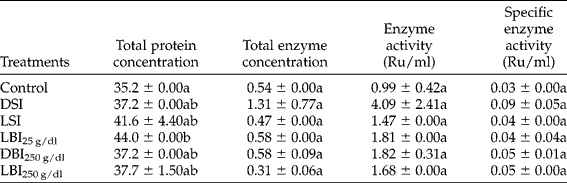
LSI, Z. variegatus that were alive after exposure to 20 ml of synthetic insecticide; DSI, Z. variegatus that died after exposure to 20 ml of synthetic insecticide; LBI25g/dl, Z. variegatus that were alive after exposure to 25 g/dl of botanical insecticide; DBI250g/dl, Z. variegatus that died after exposure to 250 g/dl of botanical insecticide; and LBI250g/dl, Z. variegatus that were alive after exposure to 250 g/dl of botanical insecticide.
Values in the same column with different letters are significantly different at P< 0.05.
1 Values represent means ± SE.
Kinetics of the activity of GST (Ru/ml) extracted from Zonocerus variegatus exposed to synthetic and botanical insecticides on GSH
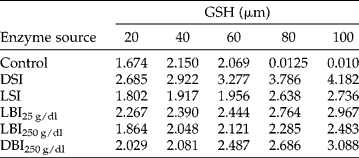
The specific activity of GST extracted from the control insects and insects exposed to both synthetic and botanical insecticides increased with increasing concentrations of the substrate (Table 3). However, the activity of GST extracted from the control insects decreased markedly at 80 and 100 μm concentrations of GSH. The specific activity of GST extracted from all insects exposed to both synthetic and botanical insecticides was higher at all concentrations of GSH than that of GST extracted from the control insects. Also, the specific activity of GST extracted from all dead insect groups was higher than that of GST extracted from the live insect groups.
Kinetics of the activity of glutathione S-transferase (unit/ml) extracted from Zonocerus variegatus exposed to synthetic and botanical insecticides on glutathione (GSH)

LSI, Z. variegatus that were alive after exposure to 20 ml of synthetic insecticide; DSI, Z. variegatus that died after exposure to 20 ml of synthetic insecticide; LBI25g/dl, Z. variegatus that were alive after exposure to 25 g/dl of botanical insecticide; DBI250g/dl, Z. variegatus that died after exposure to 250 g/dl of botanical insecticide; and LBI250g/dl, Z. variegatus that were alive after exposure to 250 g/dl of botanical insecticide.
Km and Vmax values of GST
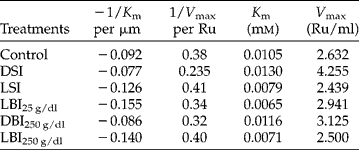
The GST extracted from insects that were alive after exposure to the insecticides had a high affinity for the GSH substrate (low K m value) than that extracted from insects that died after exposure. However, the GST extracted from insects that died after exposure to the insecticides exhibited high catalytic activities (high V max) than that extracted from insects that were alive after exposure. The V max and K m values of GST extracted from insects exposed to the synthetic insecticides were higher than those of GST extracted from insects exposed to the botanical insecticide (Table 4).
Michaelis–Menten constant (K m) and maximal velocity (V max) values of GST from double-reciprocal Lineweaver–Burk plots
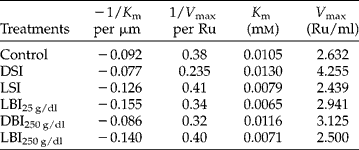
LSI, Z. variegatus that were alive after exposure to 20 ml of synthetic insecticide; DSI, Z. variegatus that died after exposure to 20 ml of synthetic insecticide; LBI25g/dl, Z. variegatus that were alive after exposure to 25 g/dl of botanical insecticide; DBI250g/dl, Z. variegatus that died after exposure to 250 g/dl of botanical insecticide; and LBI250g/dl, Z. variegatus that were alive after exposure to 250 g/dl of botanical insecticide.
Discussion
In the present study, the induction of GST activity in Z. variegatus was investigated. A high mortality rate was recorded in insects exposed to the synthetic insecticides than in those exposed to O. gratissimum leaf extract. This is in agreement with the results reported by Alao et al. (Reference Alao, Adebayo, Olaniran and Akanbi2011), who recorded a high mortality rate in insect pests of okra (Podagrica sp., Z. variegatus and Bemisia tabaci) exposed to lambdacyalothrin than in insects treated with organic composts. This high mortality rate in insects exposed to a synthetic chemical could be associated with the degree of toxicity of the synthetic insecticide at the tested doses, and the toxicity of the synthetic insecticide could be due to the non-degradability of the active ingredient in the commercial insecticide compared with the botanical insecticide (Hill and Waller, Reference Hill and Waller1982).
GSTs are a group of multifunctional proteins playing several roles in the detoxification of xenobiotics. GSTs are known to exhibit a widespread distribution in nature and have been implicated in selective toxicity and resistance mechanisms in many insect species against various insecticides. In the present study, an increase in GST concentrations was recorded in insects exposed to both synthetic and botanical insecticides, and this confirmed the increased activity of GST in insects exposed to the insecticides. This is in agreement with the results of previous studies that demonstrated an increased activity of GST in the house fly, M. domestica, with resistance to OPs (Wei et al., Reference Wei, Clark and Syvanen2001), in the fruit fly, D. melanogaster, with resistance to the OC 1,1,1-trichloro-2,2-bis-(p-chlorophenyl)ethane (Tang and Tu, Reference Tang and Tu1995), and in some strains of the planthopper N. lugens with resistance to PYR (Vontas et al., Reference Vontas, Small, Nikou, Ranson and Hemingway2002). Metabolic detoxification of xenobiotic compounds by GSTs in insects has been attributed to occur via GSH conjugation, dehydrochlorination, GSH peroxidase activity or passive/sacrificial binding (Yang et al., Reference Yang, Cheng, Singhal, Saini, Pandya, Awasthi and Awasthi2001). Several scientists have reported the association of GSTs with insecticide resistance in some orthopterans, e.g. Achaea janata (Yadwad and Kallapur, Reference Yadwad and Kallapur1988), Spodoptera litura (Wu and Lu, Reference Wu and Lu2008), Spodoptera exigua (Muhammad et al., Reference Muhammad, Hu, Afzal, Bashir, Liang and Jianjun2010) and Locusta migratoria (Qin et al., Reference Qin, Jia, Liu, Xuan, Yan Zhu, Guo, Ma and Zhang2011).
Furthermore, the lower concentrations and activities of GSTs in live insects when compared with dead insects plausibly suggest that GSTs might not be the only enzymes coding for insecticide tolerance/resistance in the surviving insects. Etang et al. (Reference Etang, Manga, Toto, Guillet, Fondjo and Chandre2007) have reported that metabolic resistance is mediated by previous exposure to various classes of insecticides, and the insects used in the present study had no previous history of insecticide exposure. The tolerance/resistance observed in the live insects compared with that observed in the dead insects suggests that there might be multiple mechanisms of resistance.
In conclusion, the results of the present study show that insecticide exposure induced GST activity in Z. variegatus. The role of GST in insecticide resistance in Z. variegatus and probable existence of multiple resistant mechanisms in insects exposed to insecticides are issues awaiting further elucidation.