


Introduction
Dialectical behaviour therapy (DBT) was developed to treat clients with complex, multi-diagnostic problems including chronic suicidal and self-harming behaviour. DBT integrates cognitive-behavioral change-oriented strategies with acceptance through a dialectical framework (Linehan, Reference Linehan1993). It is a multi-modal treatment that usually involves individual and group sessions where each mode serves a distinct function. There is substantial evidence for DBT’s effectiveness in improving targeted behaviours (e.g. suicidal behaviours) for problems associated with emotion dysregulation including borderline personality disorder (BPD; Delaquis et al., Reference Delaquis, Joyce, Zalewski, Katz, Sulymka, Agostinho and Roos2022; Stoffers-Winterling et al., Reference Stoffers-Winterling, Storebø, Kongerslev, Faltinsen, Todorovac, Jørgensen and Simonsen2022; Rizvi et al., Reference Rizvi, Bitran, Oshin, Yin and Rourk2024). Most research investigating clinical outcomes in DBT has been conducted with in-person treatment delivery (van Leeuwen et al., Reference van Leeuwen, Sinnaevae, Witteveen, Van Daele, Ossewaarde, Egger and van den Bosch2021).
There are many strategies for therapists to acquire and apply in DBT, which makes it challenging to learn and deliver competently. In psychotherapy research, adherence is the extent to which the treatment delivered includes prescribed components (Schoenwald and Garland, Reference Schoenwald and Garland2012). In a study of 63 therapists in routine practice who had read the DBT manual and attended DBT workshops, only 54% of 158 individual therapy sessions were coded as having adequately followed the treatment manual (Harned et al., Reference Harned, Schmidt, Korslund and Gaglia2024). As such, in just over half of those sessions, we can be confident that adherent DBT was being delivered. This is important because in an earlier study, Harned et al. (Reference Harned, Gallop, Schmidt and Korslund2022) showed fewer subsequent suicide attempts and lower risk of treatment drop-out when therapists were assessed as having followed the DBT treatment manual.
Treatment fidelity is the extent to which a program overall delivers a treatment as intended according to the protocol (Moncher and Prinz, Reference Moncher and Prinz1991). Unless treatment fidelity is explicitly measured, it is unknown whether DBT was delivered with fidelity. Certification allows for demonstration of competence in a therapy (Yager, Reference Yager2025) and may include assessment of a program’s fidelity. In line with DBT having been developed to be a team-based therapy (Linehan, Reference Linehan1993), the DBT-Linehan Board of Certification (DBT-LBC) is a non-profit organisation that oversees the certification of DBT programs to ensure they have the necessary components and organisational structure to implement DBT with fidelity to the research-supported model.
Premature therapy termination hinders the effective delivery of psychotherapy. Challenges with attendance, including not attending sessions and ultimately premature therapy termination are common among people accessing DBT (Chapman and Rosenthal, Reference Chapman, Rosenthal, Chapman and Rosenthal2016). Therapy is challenging if people have sporadic attendance and impossible if they prematurely leave. In DBT, missing four consecutive sessions (of either group or individual) for any reason, is defined as dropping out of therapy, meaning the client is unable to continue treatment (note that some programs amend the ‘4-miss rule’ to a ‘3-miss rule’). Orientation to the attendance rule occurs during pre-treatment (Linehan, Reference Linehan1993). In the published literature regarding treatment drop-out in DBT, there is large variability across studies, with an average drop-out rate of 28% across DBT randomised controlled trials (RCTs) and average drop-out rate of 33% for DBT RCTs that focus on BPD (Dixon and Linardon, Reference Dixon and Linardon2020). There is a broad range of average reported drop-out rates across studies from 17% to 58%, with higher rates reported in community settings (Landes et al., Reference Landes, Chalker and Comtois2016).
Understanding the reasons why clients leave treatment provides the opportunity to develop more effective retention strategies. There are multiple potential factors that may influence treatment withdrawal including ease of accessing care, assumptions about mental health treatment, and client characteristics (Barrett et al., Reference Barrett, Chua, Crits-Christoph, Gibbons and Thompson2008). In a systematic review and meta-analysis of drop-out rates from DBT RCTs, Dixon and Linardon (Reference Dixon and Linardon2020) found that 40% of reported reasons for drop-out related to external factors (e.g. problems with travel) compared with 15% associated with problems with the treatment itself (e.g. uncomfortable with group). In studies of DBT, the factors associated with drop-out have been clinical factors such as high levels of anger, hostility, greater ‘Axis I’ co-morbidity, and higher lifetime suicide attempts (Wnuk et al., Reference Wnuk, McMain, Links, Habinski, Murray and Guimond2013), impulsiveness, and avoidance (Barnicot et al., Reference Barnicot, Katsakou, Marougka and Priebe2011). In terms of client characteristics, similar to the broader psychotherapy literature, younger age has been associated with higher drop-out rates (Landes et al., Reference Landes, Chalker and Comtois2016). Finally, variations in therapeutic alliance (Wnuk et al., Reference Wnuk, McMain, Links, Habinski, Murray and Guimond2013) and treatment that occurs with how programs are run may impact drop-out rates (Landes et al., Reference Landes, Chalker and Comtois2016).
Session attendance in DBT varies substantially. In an RCT of DBT with a large sample size, average attendance was 77% for clients that completed DBT but only 59% for those who commenced in the study (McMain et al., Reference McMain, Chapman, Kuo, Guimond, Streiner, Dixon-Gordon, Isaranuwatchai and Hoch2022). There are now multiple studies about the overall length of DBT (Leichsenring et al., Reference Leichsenring, Fonagy, Heim, Kernberg, Leweke, Luyten, Salzer, Spitzer and Steinert2024), but less published research about the relationship between level of attendance and outcome. One might reasonably assume that more attendance would lead to better outcomes, as people are getting more ‘dose’ of the therapy. In a study of DBT for adolescents, higher treatment contacts led to lower suicidal ideation scores (Mehlum et al., Reference Mehlum, Tørmoen, Ramberg, Haga, Diep, Laberg, Larsson, Stanley, Miller, Sund and Grøholt2014). There is much less research exploring factors impacting attendance than about drop-out. Gulamani et al. (Reference Gulamani, Uliaszek, Chugani and Rashid2020) found that in a 12-week DBT group of college students, men attended more sessions than women and were less likely to drop out; however, the sample size was very small and hence, the findings may be spurious.
As several authors have noted (Bornheimer et al., Reference Bornheimer, Li Verdugo, Holzworth, Smith and Himle2022; Rizvi et al., Reference Rizvi, Bitran, Oshin, Yin and Rourk2024), there are disparities in the accessibility of DBT as an in-person treatment that includes lack of access to reliable transportation, the demands of twice weekly sessions, and people residing in areas where there is no DBT program. These disparities can be addressed in part through utilising technological advances. The need for innovative solutions was highlighted during the COVID-19 pandemic that led to stay-at-home orders, social distancing, and caution about in-person services. Although telehealth is not new, the COVID-19 pandemic prompted DBT programs to quickly transition to virtual delivery and hence provided a potential solution to addressing some of the barriers that exist with access (Comer, Reference Comer2021). However, DBT clinicians have raised concerns about the efficacy, safety, and feasibility of DBT delivered via telehealth for clients with high levels of dysregulation (Cooney et al., Reference Cooney, Walton and Gonzalez2022).
The use of telehealth for healthcare provision became essential during the COVID-19 pandemic and was utilised across settings, including mental health care (Sheridan-Rains et al., Reference Sheridan-Rains, Johnson, Barnett, Steare, Needle, Carr, Taylor, Bentivegna, Edbrooke-Childs, Scott, Rees, Shah, Lomani, Chipp, Barber, Debat, Oram, Morant and Simpson2021). Across systematic reviews, evidence suggests that mental health treatment delivered via telehealth can be as effective as in-person treatment, as well as being as acceptable (Barnett et al., Reference Barnett, Goulding, Casetta, Jordan, Sheridan-Rains, Steare, Williams, Wood, Gaughran and Johnson2021). In a systematic review and meta-analysis comparing attendance between in-person and telehealth models of care across 45 studies, Greenup and Best (Reference Greenup and Best2025) reported higher attendance with telehealth compared with in-person. However, the authors noted wide variation between studies. While telehealth has the potential to reduce disparities in access to treatment, research has identified disparities in telehealth use in general. Narcisse et al. (Reference Narcisse, Andersen, Felix, Hayes, Eswaran and McElfish2024) found that females had greater odds of using telehealth. Egan et al. (Reference Egan, Hurley, Goetz, Smith, Palmer and St Hill2022) investigated attendance before and after transitioning to telehealth and found that younger clients had fewer mental health visits after the telehealth transition while female clients accessed more mental health visits.
The transition of many DBT programs to virtual delivery during the COVID-19 pandemic spurred a number of qualitative studies among adolescent and adult populations, exploring challenges, solutions, and overall, lessons learned in delivering DBT via telehealth (Cooney et al., Reference Cooney, Walton and Gonzalez2022; Hyland et al., Reference Hyland, McDonald, Verzijl, Faraci, Calixte-Civil and Gorey2022; Hood et al., Reference Hood, Turner, Beggs, Owens and Chapman2023; Landes et al., Reference Landes, Pitcock, Harned, Connolly, Meyers and Oliver2022; Ramzan et al., Reference Ramzan, Dixey and Morris2022; Zalewski et al., Reference Zalewski, Walton, Rizri, White, Gamache Martin, O’Brien and Dimeff2021). The themes that emerged included that it was possible to deliver DBT via telehealth but required some reflection and adjustment to overcome the challenges and particularly for adolescents, a sense of loss and feeling uncontained (Ramzan et al., Reference Ramzan, Dixey and Morris2022). Lopez et al. (Reference Lopez, Rothberg, Reaser, Schwenk and Griffin2020) conducted a non-randomised trial and found that attendance rates were significantly higher for a DBT group delivered via telehealth (91%) compared with in-person (75%). Vonderlin et al. (Reference Vonderlin, Boritz, Claus, Senyüz, Mahalingam, Tennenhouse, Lis, Schmahl, Margraf, Teismann, Kleindienst, McMain and Bohus2025) published the first study comparing outcomes from DBT delivered via telehealth to in-person DBT. They did not report on attendance but had a dropout rate of 38% in the telehealth group.
Dunn et al. (Reference Dunn, Walton, Matsunaga, Williams and Dimeff2023) asked clients in their DBT clinic about preference for mode of delivery. For individual therapy, 34% chose in-person, 24% chose telehealth, and 30% chose a combination of both. For the skills group, 30% chose in-person, 33% chose telehealth, and 26% chose a combination of both (remaining percentages were where clients were unsure or did not respond). They found that clients’ perception of telehealth’s impact on progress in treatment was significantly related to their satisfaction with telehealth; however, it is unclear to what extent those preferences may impact attendance or drop-out.
Despite the anecdotal experience of clinicians that it was possible to switch to telehealth from in-person delivered therapy, a lot is still unknown. There is only one published study explicitly comparing differences in attendance when DBT was delivered in-person compared with telehealth, and that research found no differences (Walton et al., Reference Walton, Gonzalez, Cooney, Leigh and Szwec2023). However, there were some limitations to that study. The study was insufficiently powered to assess non-completion rates, and it is unclear to what extent the programs had fidelity to DBT. Hence, despite the number of programs globally that have moved to delivering DBT via telehealth, the question remains about the impact of the different delivery formats on outcomes, including attendance and non-completion rates.
The current study compares attendance and non-completion rates of telehealth and in-person delivered DBT in LBC-certified programs in the U.S. prior to and during the COVID-19 pandemic. The over-arching aim is to examine whether there were differences in LBC-certified DBT programs between telehealth and in-person service delivery.
Primary aims
-
(1) For people who transition from participating in DBT in-person to then participating via telehealth, is there a difference in attendance or non-completion between these different ways of participating in the treatment?
-
(2) For people who participate in DBT solely in-person compared with those who participate in DBT solely via telehealth, is there a difference in attendance or non-completion rates?
Secondary aim
-
(1) Are there effects of age, when examining differences in attendance and treatment non-completion between clients who participated in DBT in-person compared with telehealth?
Method
There are different terms and definitions in the literature used to describe when a client is no longer active in therapy, e.g. discontinuation, treatment withdrawal, attrition, drop-out, termination, non-completion. To minimise judgement, the current study will use the term treatment non-completion, defined as when a client stopped attending for the designated number of missed sessions, as defined by the program. This would lead to the client’s discharge from the DBT program.
Participants
In September 2020, study staff contacted all 21 DBT-LBC certified DBT programs in the U.S. to recruit clinics to provide anonymous data on session attendance in the one year before the transition to telehealth and the one year following. Clinics were asked to provide de-identified data on individual and group session attendance, client demographics (age, gender, and race/ethnicity) as well as whether the client left treatment before the planned ending. Of the 21 clinics contacted, five responded and shared data, which was merged into a pooled de-identified dataset.
Across the five participating clinics, data on 577 clients were provided. Of these 577 clients, there were three distinct cohorts: 189 started DBT in-person and then continued in telehealth, 174 started in-person and left before telehealth began, and 214 started DBT while in telehealth.
To examine cases with the opportunity to complete treatment in the study window, it was decided to include only those who had time to complete a full rotation of DBT skills within the study windows (e.g. the 12 months before or after the transition to telehealth). This resulted in a total sample of 505, with 153 starting DBT in-person and continuing to receive services via telehealth, 155 starting in-person and leaving before telehealth began, and 197 starting DBT while in telehealth.
DBT-LBC program certification
All programs in the present study were certified by the DBT-Linehan Board of Certification (DBT-LBC). The DBT-LBC is a non-profit organisation that oversees the certification of DBT therapists and programs, a process that requires programs to demonstrate they are delivering DBT with fidelity. The DBT-LBC uses a Program Fidelity Scale (PFS) as part of their program certification process (https://dbt-lbc.org/). The PFS clearly articulates the standards used for reviews of programs seeking DBT-LBC Certification, including the expectation of monitoring for clinician adherence across multiple program components. First, the PFS states that the Team Leader is responsible for helping clinicians increase DBT adherence and to ensure there is a plan in place to support adherence across all treatment modes. Additionally, the Consultation Team is tasked with providing feedback to one another such that adherence is prioritised. Thus, the program certification process attends to clinician adherence monitoring as an essential component of program fidelity.
Program certification involves multiple steps (see dbt-lbc.org) including an initial application, interviews with clients/client family members and program personnel, observation of a skills group and Consultation Team, and Program Certification Committee review. Program certification is granted for 5 years with yearly maintenance. During the yearly maintenance requirement, programs report changes in staff (e.g. team lead, therapists), information about clients (e.g. number enrolled, number started in past year), and number of new programs launched since previous certification (e.g. intensive out-patient).
Treatment
Comprehensive DBT includes five major modes: individual therapy, skills group, Consultation Team for therapists, out-of-session skills coaching, and ancillary interventions such as case management (Linehan, Reference Linehan1993). Individual therapy in DBT begins with a pre-treatment phase, usually lasting 3–4 sessions. During this time, the client and therapist are working in collaboration to determine whether DBT is a good fit for the client’s problem areas and goals. Following pre-treatment, clients attend weekly individual therapy sessions with agenda items guided by the target hierarchy: (1) life-interfering behaviours (e.g. suicidal ideation/attempts, self-harm), (2) therapy-interfering behaviours (e.g. alliance rupture, missing appointments), and (3) quality-of-life interfering behaviours (e.g. binge eating, anger outbursts). DBT skills are discussed during each session. DBT-LBC certified programs are required to complete regular monitoring of individual therapy sessions using an empirically supported measure, such as Harned et al.’s (Reference Harned, Schmidt, Korslund and Gallop2023) DBT Adherence Checklist for Individual Therapy.
Stage 1 DBT skills group includes weekly sessions lasting approximately 1.5–2.5 hours (depending on the program) for approximately one year (adults) or 6 months (adolescents). Skills are taught via rotating modules: Core Mindfulness, Emotion Regulation, Distress Tolerance, Interpersonal Effectiveness, and Walking the Middle Path (adolescents). The group format includes mindfulness practice, client homework review, a short break, teaching of the new skill, and group closing. DBT groups are skills-based rather than process-focused. For adolescent DBT, Stage 1 skills group is multi-family, which includes the adolescent client and their caregiver(s).
The Consultation Team is essential to comprehensive DBT and functions as ‘therapy for the therapist’. The focus is to ensure that DBT therapists are adhering to DBT assumptions and principles, to address therapist burnout and motivation to work with high-risk clients, and to provide consultation to increase therapists’ clinical skills.
Finally, out-of-session skills coaching is integral to comprehensive DBT. Skills coaching provides clients with out-of-session communication with a DBT therapist primarily via telephone call or text. The primary goal of skills coaching is to help clients generalise the skills learned in DBT. Skills coaching tends to be brief (10 minutes or less) and focused on skill use; it is not an additional therapy session. DBT therapists observe their own limits with coaching and communicate these limits with clients and the team.
Data analysis
Data were translated from digital files provided by the five programs and merged using SPSS 29. Of note, most data came from billing systems used by programs which were not designed for research, resulting in a large amount of missing data for demographic fields not commonly used in mental health billing (e.g. race and ethnicity) as well as dichotomous coding of gender demographics rather than more nuanced coding. Data were analysed separately for each cohort to meet the assumptions of the analyses involved and answer research questions using bivariate and multivariate analyses.
Results
Demographics
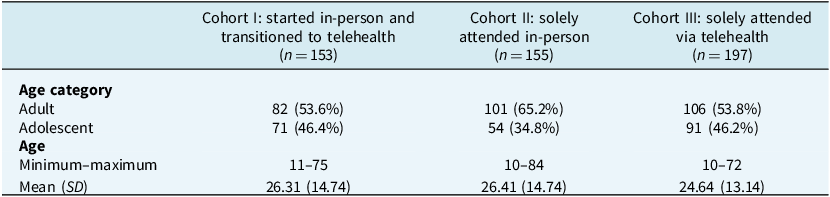
Demographic information for the three cohorts are shown in Table 1. As noted, many clinics did not provide information on race or ethnicity due to limitations of their billing and records systems. There was also limited information on client gender, often coded as a binary (female/male). As such, there was insufficient data to meaningfully report on these demographic variables.
Sample descriptives

Table 1 Long description
The table presents demographic information for three cohorts, detailing age categories and age ranges. It has four rows and three columns. The columns are labeled as Cohort I: started in-person and transitioned to telehealth (n=153), Cohort II: solely attended in-person (n=155), and Cohort III: solely attended via telehealth (n=197). The rows are labeled as Age category and Age. Under Age category, the table lists Adult and Adolescent with corresponding percentages for each cohort. For Adult, the percentages are 53.6 percent, 65.2 percent, and 53.8 percent for Cohort I, Cohort II, and Cohort III, respectively. For Adolescent, the percentages are 46.4 percent, 34.8 percent, and 46.2 percent for Cohort I, Cohort II, and Cohort III, respectively. Under Age, the table lists Minimum-maximum and Mean (SD). For Minimum-maximum, the ranges are 11-75, 10-84, and 10-72 for Cohort I, Cohort II, and Cohort III, respectively. For Mean (SD), the values are 26.31 (14.74), 26.41 (14.74), and 24.64 (13.14) for Cohort I, Cohort II, and Cohort III, respectively.
Many clinics did not capture gender-related information beyond a female/male binary.
Cohort I: Clients starting in-person and continuing into telehealth
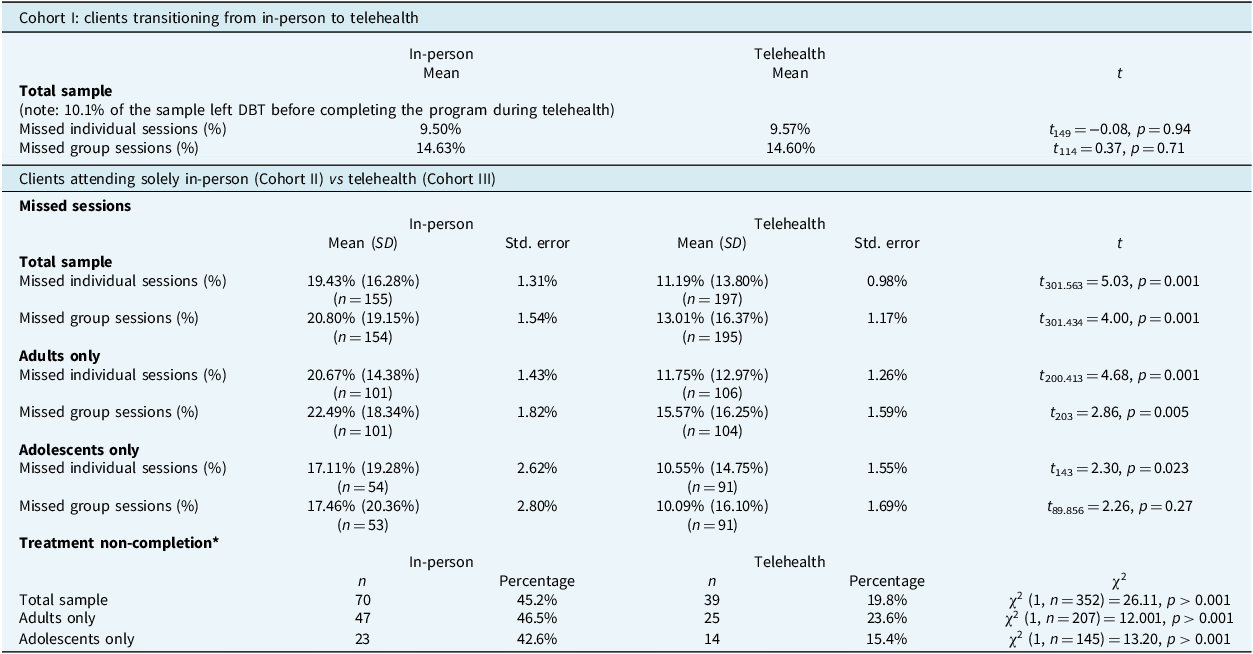
As shown in Table 2, paired t-tests showed no significant differences in the percentage of individual therapy (IT) sessions missed in before or after telehealth (mean missed IT sessions before telehealth (9.50%) and after (9.57%), t 149=−0.08, p=0.94). Additionally, there were no significant differences in mean missed skills group therapy (GT) sessions before telehealth (M=14.63%) and after (M=14.60%, t 114=0.37, p=0.71). The lack of significant differences in mean number of missed IT and GT sessions persisted when looking for effects of adolescent/adult status.
Missed sessions and treatment non-completion rates across cohorts

Table 2 Long description
The table compares missed sessions and treatment non-completion rates across different cohorts transitioning from in-person to telehealth. It has 12 rows and 10 columns. The columns are labeled as In-person Mean, In-person Std. error, Telehealth Mean, Telehealth Std. error, and t. The rows are labeled as Total sample, Adults only, and Adolescents only. The table includes data on missed individual sessions and missed group sessions for both in-person and telehealth settings. For the total sample, the missed individual sessions percentage is 19.43% in-person and 11.19% in telehealth. The missed group sessions percentage is 20.80% in-person and 13.01% in telehealth. For adults only, the missed individual sessions percentage is 20.67% in-person and 11.75% in telehealth. The missed group sessions percentage is 22.49% in-person and 15.57% in telehealth. For adolescents only, the missed individual sessions percentage is 17.11% in-person and 10.55% in telehealth. The missed group sessions percentage is 17.46% in-person and 10.09% in telehealth. The table also includes treatment non-completion rates for the total sample, adults only, and adolescents only, showing the number and percentage of non-completion in both in-person and telehealth settings.
*Determined by client reaching the threshold of consecutive misses as defined by the program.
Overall, 10.1% of the sample left DBT before completing the program during telehealth. There was no significant difference in rates of treatment non-completion across adolescent/adult client status.
Cohorts II and III: Clients seen solely in-person vs via telehealth
When comparing the two discrete, non-overlapping cohort groups (clients who only received in-person services vs those who only received telehealth services), several differences emerged. As seen in Table 2, there were fewer mean missed IT and GT sessions for individuals in the telehealth window than the in-person window, a finding that persists when separating the sample by age category (adolescent/adult). Additionally, the rates of treatment non-completion were lower in the telehealth window than the in-person window.
Discussion
While the provision of mental health services via telehealth has become widespread since the COVID-19 pandemic, most studies assessing treatment delivery have been conducted with in-person services (e.g. van Leeuwen et al., Reference van Leeuwen, Sinnaevae, Witteveen, Van Daele, Ossewaarde, Egger and van den Bosch2021). The current examination of the delivery of DBT before, during, and after transition to telehealth helps untangle some of the unique effects of the pandemic on mental health service delivery. This study is novel in that it collates data from DBT programs certified by the DBT-LBC. Program Certification offers some assurance that each program demonstrated delivery of DBT with fidelity to the evidence-based model. Therefore, there is reason to be confident that these programs operated relatively similarly across clinics, as they have all been evaluated as including the components and organisational structure required to deliver DBT to fidelity. Also distinct about this study is that, to the authors’ knowledge, this telehealth investigation utilises the largest sample to date, drawn from multiple clinics across the U.S.
Overall, results not only answer questions about a specific historical moment; the data also provide some information about how in-person and telehealth delivery of DBT compare. This is valuable given how common telehealth services have become since the pandemic. Primary aim 1 was to describe treatment attendance and treatment non-completion rates for DBT clients transitioning from in-person to telehealth at the time of the COVID-19 pandemic. There were no significant differences found. Primary aim 2 assessed differences in attendance and treatment non-completion for DBT clients participating solely in-person vs in telehealth. Those attending DBT exclusively via telehealth demonstrated lower missed IT and GT sessions and treatment non-completion. Finally, the secondary aim related to age group found no differences when comparing adolescent and adult participants.
Navigating a unique historical event: clients starting in-person and continuing into telehealth
The DBT-LBC certified programs in this study appeared to navigate the transition from in-person to telehealth in a way that did not negatively impact clients’ attendance or their likelihood of not completing treatment. Primary aim 1 assesses whether there was a difference in rates of attendance or treatment non-completion from treatment for clients making this transition. For these clients, there were no significant differences for either variable examined. In terms of missed sessions, there was no significant difference in missed IT or GT sessions before compared with after the transition. This held true even when looking at age (adult/adolescent status). Just over 10% of the sample did not complete treatment during telehealth, with no significant difference across adult/adolescent age groups.
This aligns with previous work suggesting that clients were as likely or more likely to attend telehealth DBT sessions as in-person sessions prior to the COVID-19 pandemic (Lopez et al., Reference Lopez, Rothberg, Reaser, Schwenk and Griffin2020). It also aligns with the qualitative research that has been reported from the COVID-19 pandemic regarding DBT delivered via telehealth that it is possible to do (Cooney et al., Reference Cooney, Walton and Gonzalez2022; Hyland et al., Reference Hyland, McDonald, Verzijl, Faraci, Calixte-Civil and Gorey2022; Hood et al., Reference Hood, Turner, Beggs, Owens and Chapman2023; Landes et al., Reference Landes, Pitcock, Harned, Connolly, Meyers and Oliver2022; Ramzan et al., Reference Ramzan, Dixey and Morris2022; Zalewski et al., Reference Zalewski, Walton, Rizri, White, Gamache Martin, O’Brien and Dimeff2021). Walton et al. (Reference Walton, Gonzalez, Cooney, Leigh and Szwec2023) also found that there was no difference between attendance comparing telehealth DBT sessions and in-person DBT sessions during the COVID-19 pandemic (Walton et al., Reference Walton, Gonzalez, Cooney, Leigh and Szwec2023), although that study had a smaller sample size and shorter time duration than the current study. The current research builds on this study, strengthening the argument for the use of telehealth in DBT, as using data from programs certified by the DBT-LBC bolsters confidence in the findings. This is because it is likely that DBT-LBC certified programs possess a consistent organisational structure that could facilitate successful transition to telehealth. When programs complete the DBT-LBC certification process, they demonstrate not only fidelity to the DBT model but commitment on the part of the organisation or clinic to deliver all the components of the treatment. It is plausible that the organisational structures already present at the certified clinics helped ensure that the treatment was similar enough before and after transition to keep clients engaged.
In addition to a well-articulated program structure, DBT as a treatment emphasises problem-solving and building commitment on the part of clients and therapists alike. During the pandemic, many clients, therapists, and clinics encountered difficulties transitioning to telehealth (AlRasheed et al., Reference AlRasheed, Woodard, Nguyen, Daniels, Park, Berliner and Dorsey2022). Within that historical context, challenges including access to technology, economic stressors due to job loss, and logistical concerns arising from stay-at-home orders were met by DBT therapists with orientation towards problem-solving and troubleshooting solutions to keep clients engaged in treatment (Hood et al., Reference Hood, Turner, Beggs, Owens and Chapman2023; Zalewski et al., Reference Zalewski, Walton, Rizri, White, Gamache Martin, O’Brien and Dimeff2021). The current data suggest that the certified programs in this study were able to manoeuvre through the transition to telehealth in ways that maintained treatment without significant disruption.
Format comparison: clients seen solely in-person vs via telehealth
This study also provides insight into how in-person vs telehealth delivery of DBT compare, as articulated in primary aim 2 assessing differences across these formats. Comparing clients who only attended in-person treatment prior to the commencement of the pandemic with those who solely attended via telehealth, differences began to emerge with telehealth seeing fewer missed sessions and non-completion of treatment. Across all clients, there were significantly more missed in-person IT and GT sessions compared with telehealth. This pattern held true when examining adult and adolescent participants separately and aligns with prior findings of significantly higher attendance for DBT groups delivered via telehealth compared with in-person (Lopez et al., Reference Lopez, Rothberg, Reaser, Schwenk and Griffin2020).
These results may reflect the reality that barriers exist limiting access to in-person services for some clients. These include transportation challenges, lack of availability of DBT within their community, and demands of the treatment (e.g. twice-weekly sessions) (Bornheimer et al., Reference Bornheimer, Li Verdugo, Holzworth, Smith and Himle2022; Rizvi et al., Reference Rizvi, Bitran, Oshin, Yin and Rourk2024). Telehealth has the potential to equalise some of these barriers, arguing for the continued assessment of its effectiveness as a DBT delivery format. This aligns with evidence from other evidence-based treatments supporting favourable outcomes delivering prolonged exposure (Yuen et al., Reference Yuen, Gros, Price, Zeigler, Tuerk, Foa and Acierno2015) and cognitive processing (Peterson et al., Reference Peterson, Mintz and Moring2022) therapies via telehealth.
Across all groups, significantly higher treatment non-completion occurred before telehealth, suggesting that clients were more likely to leave treatment when attending in-person. The percentages of non-completion rates in the current study before telehealth was 45.20% for the whole sample and during telehealth was 19.80%. A recent study comparing DBT delivery in-person vs telehealth (Vonderlin et al., Reference Vonderlin, Boritz, Claus, Senyüz, Mahalingam, Tennenhouse, Lis, Schmahl, Margraf, Teismann, Kleindienst, McMain and Bohus2025) noted a non-completion rate of 38% in the telehealth group. This compares with an average non-completion rate of 28% when assessing DBT RCTs (Dixon and Linardon, Reference Dixon and Linardon2020).
Strengths
The uniqueness of this study springs from the programs included in the analysis. Namely, all data were drawn from DBT programs certified by the DBT-LBC. While certification does not ensure session adherence, it does provide some assurance that the programs were structured with fidelity to the DBT model. This includes clients’ attendance in weekly individual therapy and skills group sessions, which were measured in this study. DBT protocol also specifies the way that clients exit the program if their departure occurs before they officially complete, through a pre-defined number of consecutive misses. Choosing to embark on the certification process suggests the programs were highly motivated to deliver DBT with fidelity and therefore invested in maintaining the structure even through challenging times. Because this study involves multiple sites, the fact that all programs successfully completed the DBT-LBC certification process increases confidence that the core components of the treatment were delivered similarly across them. Additionally, drawing data from multiple sites helped create a large sample size from geographically diverse areas across the U.S.
The current study also builds upon and extends findings from prior research. In particular, Walton et al. (Reference Walton, Gonzalez, Cooney, Leigh and Szwec2023) demonstrated clients were as likely to attend DBT via telehealth compared with in-person. This study, however, looked at only one module on telehealth, so the length of time was significantly compressed given that standard adult DBT lasts for at least 1 year and adolescent DBT for at least 6 months. Seeing similar results from a multi-site study covering a significantly longer period of time bolsters the argument for the effective use of telehealth in DBT.
Limitations and future directions
Historical effects associated with the COVID-19 pandemic are important considerations when interpreting the data, particularly related to primary aim 1 focusing on the transition process itself. Because the data were collected during the pandemic, it is uncertain as to the extent that it can be generalised to non-pandemic times. Marked by rapid changes, stay-at-home orders, economic challenges, and over a million deaths in the U.S., the fact that the programs in this study were able to bridge clients from in-person to telehealth services in such a short period of time is remarkable. Primary aim 2, comparing in-person and telehealth formats, offers insights that may be more generalisable to non-pandemic times. Here, telehealth delivery was associated with fewer missed sessions and treatment discontinuations. This suggests the acceptability of DBT via telehealth for clients as well as the potential for this delivery format to minimise absences and keep people in treatment. However, given that this study was conducted during the COVID-19 pandemic, there are several contextual factors that may influence the findings. As Walton et al. (Reference Walton, Gonzalez, Cooney, Leigh and Szwec2023) discuss, for many there were less competing occupational or social demands during the pandemic and in fact, attending therapy may have given them something to do as well as help them maintain connection to others. These factors may have contributed to the reduced non-completion rate. As such, further research is required to be conducted when these contextual factors are not in play, to understand differences in attendance and non-completion rates between treatment delivered in-person or via telehealth.
In assessing limitations, it is helpful to ask what was missing from the current analysis. For instance, it did not include the clinical characteristics of the sample, so it is unclear as to the extent to which client profiles were similar to those included in published RCTs. Additionally, we know how treatment attendance and non-completion changed with telehealth, yet do not know the extent to which symptoms changed. Attending treatment does not automatically equate with benefiting from treatment. To answer such questions, it is necessary to assess symptoms, which was outside of the scope of the current study. This study focused on engagement and while if people attend their appointments, they have greater opportunity to benefit from the therapy, future research is required to measure whether there are differences in clinical outcomes between people who receive DBT in-person vs via telehealth. This is an important future direction to create a fuller picture of the pros and cons of delivering DBT in-person vs via telehealth. Another factor related to access to telehealth, particularly during the pandemic transition period, is rural vs urban location of the client. This could potentially impact their ability to connect to WiFi; however, we were not able to ascertain exact locations due to the limitations of the dataset. Based on this, an important future consideration is to collect information related to technology, which may include the specific location of the client and the extent to which economic marginalisation shapes their level of access.
Finally, because this study was conducted through extracting data from medical records, we were subject to the limitations of this methodology. For example, when clients reach the designated number of consecutive misses, they are considered to have not completed treatment. At the same time, it is not possible to know the reasons why the misses occurred. It would be helpful in future work to assess the reasons for missing sessions to ascertain whether different reasons emerge in-person vs telehealth formats. Additionally, it was difficult to fully assess aspects related to client diversity. Gender was most often reported as a binary (female/male), with non-binary and transgender being reported extremely infrequently. Similarly, data on race were most often missing. This is relevant because the COVID-19 pandemic was a public health crisis that revealed race-based disparities (Magesh et al., Reference Magesh, John, Li, Mattingly, Jain, Chang and Ongkeko2021).
As a result, outside of age (adolescent/adult), we were unable to determine whether other demographic variables were related to treatment attendance and treatment non-completion. This amplifies the call from others (Sloan et al., Reference Sloan, Zelkowitz, Brooks and Cohen2023; Harned et al., Reference Harned, Gallop, Schmidt and Korslund2022; Haft et al., Reference Haft, O’Grady, Shaller and Liu2022) to assess and report ethnoracial, gender, and sexual identities so we may better understand how these intersecting factors influence clients’ access to and participation in treatment. Addressing treatment gaps and improving access for marginalised groups is critical to equalise health inequities and aligns with DBT’s emphasis on integrating social, political, and environmental influences (Linehan, Reference Linehan1993) when seeking to understand clients’ experiences. To fully understand the pros and cons of DBT via telehealth as well as its effectiveness across populations, it is necessary to be as inclusive as possible of all client identities and environmental contexts.
Data availability statement
The data that support the findings of this study are available from the corresponding author (C.J.W.) upon reasonable request.
Acknowledgements
We are grateful to the LBC-Certified DBT programs that agreed to participate in this study. Gathering historical data and compiling it took a lot of work. We deeply appreciate their willingness to participate and their dedication to enhancing the delivery of DBT.
Author contributions
Carla Walton: Conceptualization (Lead), Investigation (Equal), Methodology (Equal), Project administration (Equal), Writing - original draft (Lead), Writing - review & editing (Lead); Kim Skerven: Conceptualization (Equal), Project administration (Equal), Writing - original draft (Lead), Writing - review & editing (Lead); Andrew White: Conceptualization (Equal), Data curation (Lead); Taylor Davine: Conceptualization (Equal), Methodology (Lead), Writing - original draft (Equal).
Financial support
None.
Competing interests
Carla Walton is a Director and Trainer for DBT Training Australia and provides training and consultation in DBT for Behavioral Tech Institute. Kim Skerven is co-owner of Center for Behavioral Medicine which offers LBC-certified DBT programs. She also volunteers for the DBT-Linehan Board of Certification. Andrew White is co-owner of Portland DBT Institute which offers LBC-certified DBT programs. He also volunteers for the DBT-Linehan Board of Certification. Taylor Davine is a staff psychologist at the Center for Behavioral Medicine.
Ethical standards
Conduct of the study, including data collection processes and deidentification processes, received IRB approval by the Behavioral Health Research Collective IRB (BRTC Study 045).

 Open access


Comments
No Comments have been published for this article.