The musical sun, which set at Liszt's death, shines again through Busoni. He warmed the night through his art, with which he caused the individuality of each person to flourish. It is the desire of all his students that it may be granted him henceforth through the magic of his art, and through his fascinating spirit-filled dealings, to influence the art world.
Adolf Mirus, 1901Footnote 1When Franz Liszt died in 1886, the world lost an innovative composer, mentor and pianist. Yet his influence did not die with him. Even so, few of his successors can claim to have walked in his footsteps – to have lived and taught in the same rooms – and to have shared many of his ideals. Ferruccio Busoni did just that when the Grand Duke Carl Alexander (1818–1901) invited him to hold piano master classes in Weimar in 1900 and 1901, just as he had invited Liszt to do nearly two decades earlier (1881–1885).Footnote 2 Liszt's years in Weimar as court composer, from 1848–1861, also led to the development of some of his most innovative experiments in form, colour and the melding of the poetic and the musical – experiments that Busoni admired.
This article shows the ways in which Liszt's Weimar years became models for Busoni, as he sought to position himself as a prominent ‘musical polymath’ at the turn of the century. By living, teaching and performing in the same Weimar buildings as his predecessor, such as the Tempelherrenhaus and the Hofgärtnerei, Busoni presumed to ‘assume Liszt's mantle’. Hans Huber has aptly described him as an heir of Liszt's Weimar tradition:
Of all the interpreters of Liszt's piano works, Busoni stands first and foremost in our own time, and probably also for the future, both in his understanding of the Weimar tradition and in his aesthetic and cultural talents, and, last but not least, in his fabulous, unrivalled piano technique.Footnote 3
Yet Busoni not only emulated Liszt, he also promoted him in an age when he was considered of only tangential importance. By producing authoritative editions of Liszt's music and, perhaps more significantly, by emulating Liszt's activities as a transcriber and composer, Busoni enhanced piano sonority while extending Liszt's ideas about the future of music. For instance, he explored new ways of using the pedals to create interesting sonorities and colours at the piano. In this way, he shared attitudes associated with the Zukunftsmusik movement, and his outlook was rooted in Liszt's compositions, as opposed to those of Richard Wagner.Footnote 4 At the same time, he helped foster a lineage of young musicians who patterned their careers and music after Liszt.
The surprising absence of many primary source materials relating to Busoni's promotion of Liszt leads us to rely on his behaviour – on a history defined primarily by recorded actions rather than archival documents. Based on surviving memoirs, letters, scores, essays and concert programmes, this article thus explores Liszt's impact on Busoni and his pupils. It reveals a musician not only emulating Liszt, but also expanding upon his ideas and promoting them to others. In the process, it enriches understanding of the role that Liszt played in Busoni's creative activities and adds to recent scholarship about the scope of Liszt's legacy in the early twentieth century.Footnote 5
The Liszt–Busoni Connection
Like many of his generation, Busoni was initially sceptical of the artistic merit of Liszt's compositions and interpretations. According to Larry Sitsky, ‘there used to be a popular myth – and the misconception still exists – that Busoni was a pupil of Liszt, indeed, the greatest pupil of Liszt. In reality, Busoni's personal connections with Liszt were tenuous.’Footnote 6 In a letter to his wife dated 2 August 1907, Busoni reveals just how far this myth was from the truth – his adoration of Liszt developed only in his maturity after extensive exposure to his compositions:Footnote 7 ‘Liszt I misunderstood at first, then I adored him, and then quietly admired him’.Footnote 8 Busoni initially felt ambivalence toward the music of Liszt, and he never studied with him. In 1877, Busoni heard the aging Liszt perform his Concerto in E-Flat, S. 124, and found it less than satisfactory.Footnote 9 He also performed for Liszt as a boy; but when his father asked for a letter of recommendation, Liszt reportedly refused on the grounds that he never gave such letters.Footnote 10
Even despite initial ambivalence, study of Liszt's compositions eventually convinced Busoni of their merits. Edward Dent claims that Busoni's earliest performance of a composition by Liszt took place in 1878, when he was 12. From 1879 to 1889, Busoni also programmed 17 additional compositions by Liszt in his recitals. Dent argues, however, that it was only as a professor of piano at the Helsinki Music Institute in 1889 that Busoni really began to appreciate Liszt's music.Footnote 11 Martin Wegelius, the director of the Helsinki Music Institute, idolized the music of the New German School – especially that of Wagner and of Liszt. Although his promotion of Wagner had no effect on Busoni, his encouragement to give Liszt more serious consideration as a composer and pianist was transformative. Busoni's initially ambivalent attitude about Liszt's music is amply evident in a letter to Henri and Kathi Petri, written shortly after his arrival in Helsinki, in which Busoni noted that Wegelius was encouraging him to include Liszt in the instructional repertoire:
I spoke with my ‘superior’, Director Wegelius, about methods of tuition. I asked if I should adhere to a programme, a specific method or any particular educational materials. ‘Actually we have no such things, but, well – (after reflecting at some length) – one could perhaps take the Inventions of Bach as a starting point. Plenty of Bach, plenty of Bach, also Mozart, Beethoven, Liszt … … ??!!!!!’Footnote 12
At the very least, it seems that Wegelius's repertoire suggestion inspired Busoni to examine Liszt's compositions in greater depth. From 1890 to 1900, Busoni added about twice as many Liszt compositions to his concert repertoire as he had in the previous decade (see Table 1). As Hans Heinz Stuckenschmidt points out, this shift was not merely a numerical one. Before 1890, the compositions performed by Busoni consisted mainly of virtuoso transcriptions. After that year, he added more important original compositions, including Années de Pèlerinage, the Sonata in B Minor, and the Transcendental Etudes. In addition, he reformulated his technique based on a thorough study of Liszt's music.Footnote 13 After 1900, he added fewer pieces to his repertoire in general (see Table 2).
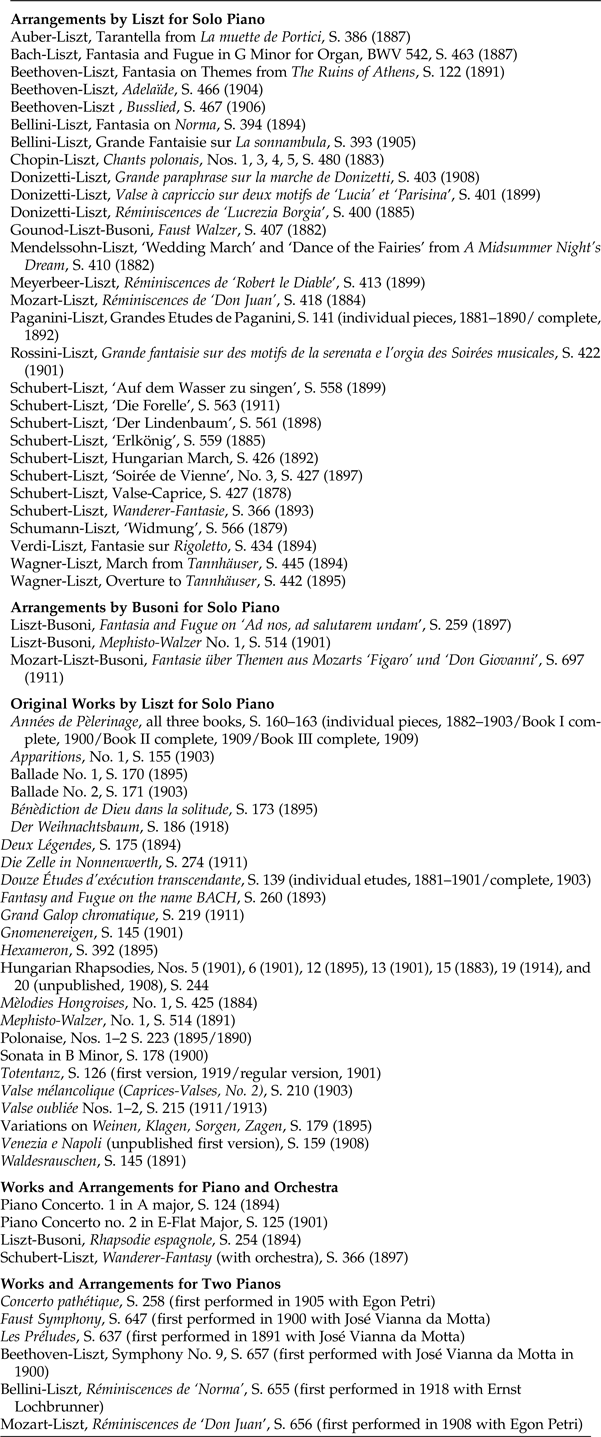
Busoni's Liszt RepertoireFootnote 14

List of Liszt's Works Performed by BusoniFootnote 15

Liszt, Busoni and Zukunftsmusik
Around the turn of the century, when Busoni was actively thinking and writing about his vision for the future of music, he also came to view Liszt as an artist with lofty ideals.Footnote 16 Liszt, along with J.S. Bach and Wolfgang Amadeus Mozart, became the most important compositional and professional models for Busoni. In 1903, Busoni specifically praised Liszt for searching beyond public acclaim for something greater, an unattainable ideal of artistic perfection. This is evident from a motivational anecdote he told Egon Petri about Liszt's reported inability to overcome cold and clammy hands, regardless of who listened, thereby signifying concern for art above concern for applause.Footnote 17
Busoni also viewed Liszt as a visionary composer. He thought him to be on par with Bach, stating:Footnote 18 ‘Truly Bach is the Alpha of pianoforte composition and Liszt the Omega’.Footnote 19 He distinguished between Liszt's compositions – which he saw as generating a new future for music in terms of thematic transformation, formal expansion, harmonic possibilities and timbral colour – and Wagner's music, which he considered formulaic. Although Busoni admired Wagner's orchestrations, he was critical of his use of leitmotifs and thought the way he melded the art forms to be artificial. He called him a genius, but also asserted that he was boring and that his music was too erotic. He preferred Liszt's more abstract approach, in the Faust Symphony, S. 108, a ‘musical work of the combined arts’ as opposed to a ‘work of the combined arts’.Footnote 20 In a scathing criticism of composers bound by formulaic routines, Busoni criticized Wagner: ‘Obviously, he [Wagner] already possessed a respectable measure of routine, and his composing machinery stopped if the kind of obstacle arose which can only be overcome with the help of inspiration’.Footnote 21 For Busoni, Liszt was the path leading towards the music of the future: ‘we are all descended from him [Liszt] radically, without excepting Wagner, and we owe to him, the lesser things that we can do. César Franck, Richard Strauss, Debussy, the penultimate Russians, are all branches of his tree.’Footnote 22 Busoni argued that even Wagner was heavily indebted to Liszt, and that some of his pieces were thinly veiled imitations:
But W[agner] changed after getting to know Liszt not only in his harmonies, but also in the style of his themes and decorations. Things like the Forest Murmurs and magic Fire Music are quite clearly Lisztian piano etudes, and the Ride of the Valkyries is such a shamelessly cheap imitation of the form and content of ‘Mazeppa’ that I was staggered when I first heard this piece of kitsch again at the beginning of the year: staggered that the moving spirit of the work, aped by this almost parodistic imitation, was constantly rejected and despised. – And I coined the following aphorism: Liszt was the foundation stone of all modern tonal edifices and, as foundation stone, he lies deep below the surface and remains invisible.Footnote 23
He went so far as to claim that ‘the followers of Wagner signify an unbroken regression’.Footnote 24 With respect to Liszt's exploration of sound and sonority, Busoni wrote: ‘If with Liszt the atmosphere and content are less intensive, the sound and the magic are all the more impressive and effective’.Footnote 25 Busoni also praised Liszt for his use of unusual scales, such as the whole-tone scale, which he saw as leading to the microtones that he experimented with on custom built keyboard instruments and wrote about in his Sketch of a New Aesthetic of Music:Footnote 26 ‘The whole-tone scale with Debussy, and with Liszt before him, is like an anticipation of the whole-tone interval being filled in with the not-yet-existent tripartite whole-tone intervals’.Footnote 27
Busoni's belief in the importance of Liszt's music as a model for the future was not shared by all of his immediate predecessors and contemporaries, many of whom viewed Liszt's music as existing in the shade of Wagner's. Daniel-Ortuno-Stühring has documented the difficulties that even followers of Liszt encountered in the 1860s and 1870s in German-speaking lands, where ‘being branded as a political or cultural radical virtually guaranteed failure [ … ]. Such branding probably played no small role in the conversion of former New Germans.’Footnote 28 By contrast, followers of Wagner did not receive such a backlash. It is not surprising then that after Liszt sequestered himself in Rome in the 1860s, his direct heirs, especially Hans von Bülow, Peter Cornelius and Felix Draeseke, aligned themselves more closely with Wagner, even as they each sought to carve out individual careers. Attitudes of antipathy toward Liszt, in particular, persisted into the late nineteenth and early twentieth centuries – as he was remembered primarily as a virtuoso, rather than as a serious composer.Footnote 29 In 1895, Busoni wrote that he considered it unwise to make a Viennese debut with a concerto by Liszt.Footnote 30
Yet Busoni considered Liszt's ideas and music to be important aesthetic and compositional models. He admired Liszt's distinctive vision of Zukunftsmusik that he had pioneered in Weimar, characterized by the melding of the poetic and the musical in instrumental forms and by a searching for new forms, colours and harmonies. In this, he predates Alfred Heuss, who first applied Marxian thematic analyses to the tone poems in 1912, thereby positioning them as post-Beethovinian symphonic works of significance.Footnote 31
During his years as Kapellmeister in Weimar (1848–61), Liszt recorded his aesthetic ideals in a series of reviews. Many explain his conception of a melding of the poetic and the musical in instrumental forms. Fundamental to his writings is an explanation of ways music expresses the feelings and extra-musical ideas of the composer while avoiding explicit mimesis and narratives. His writings also call for historical scope, stylistic breadth, structural originality and an exploration of instrumental colour. For instance, in 1854 Liszt celebrated Ludwig van Beethoven's Egmont Overture, Op. 84, and Felix Mendelssohn's Incidental Music to a Midsummer Night's Dream. He called the latter ‘a melodious and organic blending of heterogeneous elements interspersed with delicately fresh and lofty poetry’, and considered both to be examples of a new pathway in music.Footnote 32 After programming a Hector Berlioz week in Weimar in February 1855, Liszt, together with Carolyne von Sayn-Wittgenstein, drafted an essay about Berlioz in which they specifically praised him for achieving new and more natural formal structures – not imposed from without, but emerging from the content.Footnote 33 Liszt viewed Berlioz's music as progress in the direction of the new future of music he envisioned, precisely because of the way he united music and latent emotional states to achieve new structures:
The specifically musical composer, who attaches importance to the consumption of the material alone, is not capable of deriving new forms from it, of breathing into it new strength, for no intellectual necessity urges him – nor does any burning passion, demanding to be revealed, oblige him – to discover new means. To enrich the form, to enlarge it and make it serviceable, is granted then, precisely to those who make use of it only as one of the means of expression as one of the languages which they employ in accordance with the dictates of the ideas to be expressed; the formalists can do nothing better or more intelligent than to use, to popularize, to subdivide, and on occasion to rework what the poets have won. The program asks only acknowledgement for the possibility of precise definition of the psychological moment which prompts the composer to create his work and of the thought to which he gives outward form.Footnote 34
Busoni expressed similar aesthetic values in his own writings. Like Liszt, he rejected explicitly mimetic and narrative programme music, calling it just as restrictive to music's freedom as formalist moulds, even as he idealized music that depicts psychological and philosophical ideas. He claimed that pieces begin with extra-musical ideas that must be transcribed into musical ones before becoming complete musical works.Footnote 35 His vision was similar to Liszt's in that he hoped for a future characterized by new organic structures informed by human ideas and emotions.Footnote 36 He especially praised Liszt's Faust Symphony, in which a play with themes linked to extra-musical ideas and their transformation led to unique structures. He also venerated some of Liszt's religious music in which the orchestra played a vital role and similarly featured thematic transformation and unique structures: ‘No late-comers have succeeded with a Faust Symphony, a Heilige Elisabeth and a Christus. Les jeux d'eau still remains today a model for all musical fountains which have flowed since then.’Footnote 37 He also shared Liszt's catholic musical taste, calling for a bringing together of the old and the new, of church and theatrical styles of music into a new oneness:Footnote 38
The time has come to recognize the whole phenomenon of music as a ‘oneness’ and no longer split it up according to its purpose, form, and sound-medium. It should be recognized from two premises exclusively, that of its content and that of its quality’.Footnote 39
Moreover, he valued instrumental colour, calling for a compositional process that considered the colour and timbre of instruments essential and from the beginning of the composition process (i.e. ‘absolute orchestration’).Footnote 40
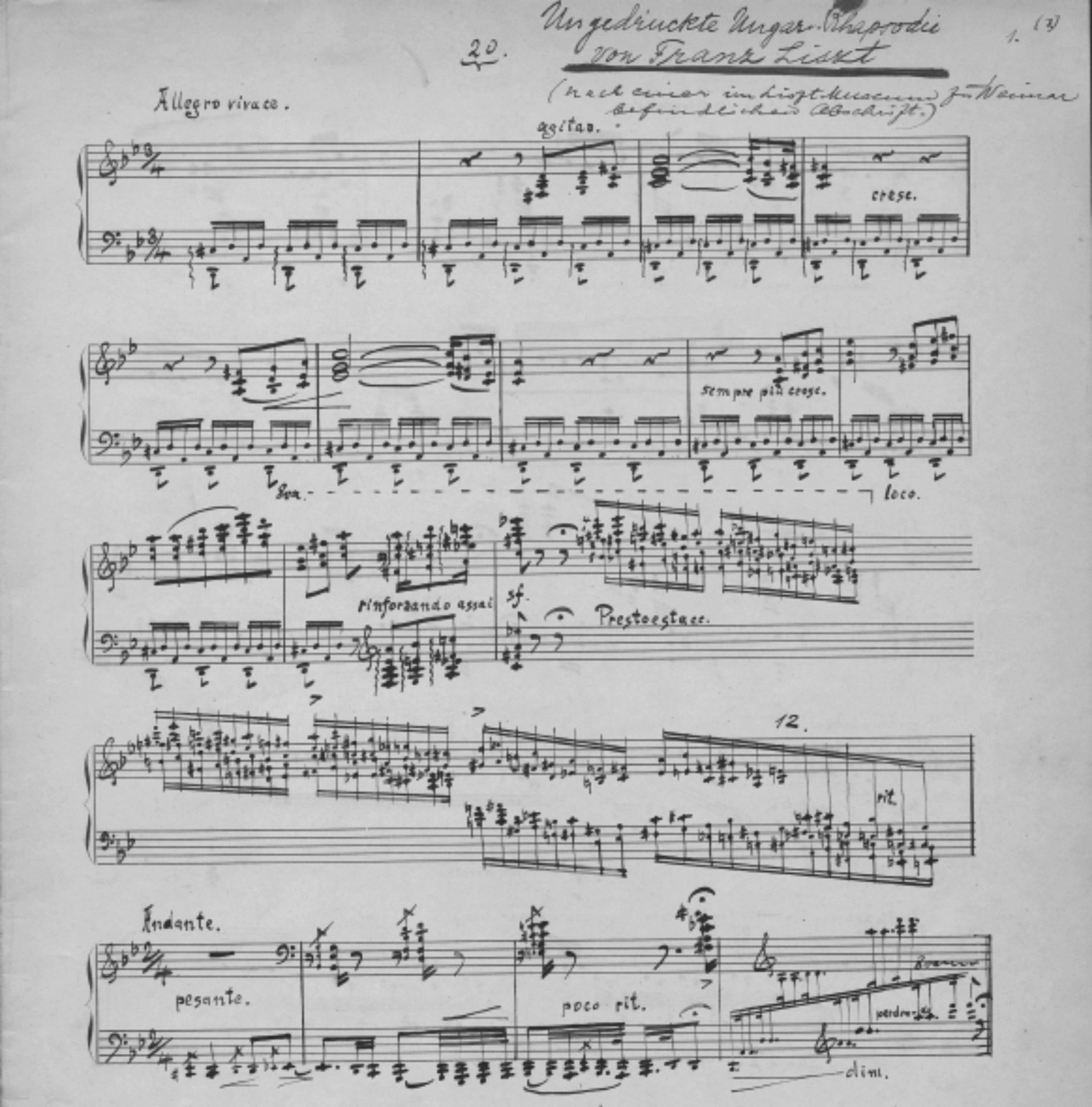
Acting on his belief in the importance of Liszt's music, Busoni set about to preserve the compositions for future generations. In 1900 Busoni announced his planned participation in an authoritative collected edition of Liszt's compositions by the Franz Liszt Stiftung, founded in 1888 by the Grand Duke Carl Alexander. This was the first attempt at a complete edition, supported by the Stiftung, and aided by Peter Raabe's cataloguing of Liszt's Weimar manuscripts in 1910–11. Between 1907 and 1936, 34 volumes of Liszt's compositions were published by Breitkopf & Härtel. In addition to Busoni, the editors included students of Liszt, such as Eugen d'Albert and José Vianna da Motta, among others.Footnote 41 Busoni was responsible for editing three volumes of etudes, Mephisto Waltz no. 1, S. 514, Totentanz, S. 126, Polonaise no. 2 (to which he added a cadenza), S. 223, Fantasie über Themen aus Mozarts Figaro und Don Giovanni, S. 697, Hungarian Rhapsody no. 1, S. 244, Heroic March in Hungarian Style, S. 231, the cadenza to the Liszt-Gounod Faust Waltz, the Hungarian Rhapsody, S. 244 No. 20 (Fig. 1), and the Scherzo in G Minor.Footnote 42 Busoni employed a range of editorial approaches, from a critical edition of a single source via multiple variants, to a highly edited performance edition, to arrangement, re-composition and completion. It is unclear why he employed so many approaches, but the pieces that feature arranged sections are usually ones that Busoni performed regularly. With a scholarly commitment not normally attributed to him, Busoni looked for unpublished manuscripts and variant versions of Liszt's piano works for his own study and to publish in the collected Liszt edition. For instance, he describes his joy at discovering several unpublished pieces, including a variant version of ‘Venezi e Napoli’, S. 159, from Années de pèlerinage, book II:
Singular circumstances recently made it possible for me to track down four lost pieces by Liszt, which had been printed, but never published;Footnote 43 evidently the original version of the later Venezi e Napoli! The pieces are brilliant. The first incorporates the ‘Tasso’ theme.Footnote 44
Liszt, Hungarian Rhapsody no. 20, ed. Busoni, Staatsbibliothek zu Berlin, Preussischer Kulturbesitz, Musikabteilung mit Mendelssohn Archiv, N. Mus. Nachl. 4, 87.

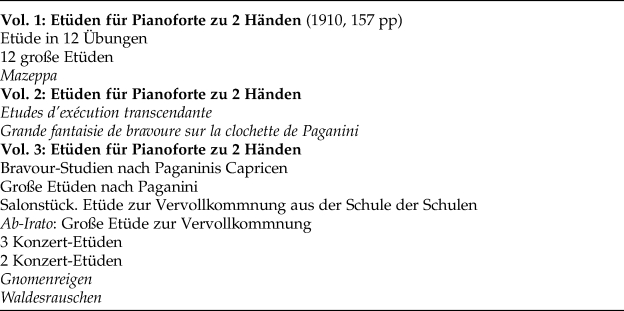
In his edition of the etudes, Busoni included scholarly notes at the beginning of the volume, dutifully noting variants, as was typical of critical editions.Footnote 45 He also set about to clear up issues of dating and chronology.Footnote 46 However, as he did previously in his edition of the first volume of Bach's Well Tempered Clavier, he did not seek to create a single definitive version, but included complete variant versions of the same piece.Footnote 47 In some cases, he added his own alternate variants in separate staves (see Table 3). Surprisingly, his editions of the etudes include little commentary about performance issues when compared to his edition of Bach's Well Tempered Clavier, vol. 1 (1894) and Inventions (1892) published just a few years earlier.
Liszt Etudes Edited by Busoni

By contrast, his edition of the Réminiscences de ‘Don Juan’, S. 418, is a critical-instructive edition, with plenty of performance commentary as well as musical passages adapted by Busoni and written on separate staves under Liszt's original version (Ex. 1).Footnote 48 For instance, during the opening bars, Busoni adds rests in bar one in the inner voices in the treble to create crisper octave articulations. In bar two, he includes a trill in the bass, where Liszt suggested a tremolando, and then continues it to the final beat, where he elongates the descending scalar passage. While Liszt favours downward trill motion, Busoni prefers upward motion, as in bar three. In the commentary at the bottom of the page, Busoni discusses the symbolic meaning of the themes and chords, while calling for a forceful opening. Busoni also suggested structural cuts, such as 39 bars of variation two.Footnote 49 In addition, he based some of his alterations on the two-piano version. Busoni also made connections to Mozart explicit by including melodies and text from Mozart's opera, as well as noting the dramatic situations in which the passages originally occurred.Footnote 50 He considered it essential for the interpreter to understand the dramatic implications of Liszt's compilation of themes. This understanding is reflected in his Welte piano roll recording of the piece, which maintains a clear counterpoint of the Mozartian themes throughout the performance.Footnote 51
Liszt, Réminiscences de ‘Don Juan’, S. 418, ed. Busoni, bars 1–4

If Busoni was interested in preserving Liszt's music as editor, he was equally interested in disseminating it to general audiences as pianist and conductor through festivals and recitals. Busoni's series of six recitals devoted entirely to Liszt's piano music in Berlin in 1911 (the centennial of Liszt's birth) was unprecedented, and his vision for Liszt festivals was unusual at the time, as he expressed to one of his Weimar Master class pupils, H.W. Draber in 1910:Footnote 52
When will there be a decent Liszt festival? With the oratorios, symphonies, and complete works for piano and orchestra, interspersed with works for two pianos and a Lieder recital? – I believe that 1911, the hundredth anniversary of his birth will bring forth something of the sort. N.B. I believe you could coordinate something here.Footnote 53
As a pianist, he exposed audiences to new repertoire of Liszt. For instance, although both of Liszt's piano concertos had been performed previously with the Boston Symphony Orchestra, the Totentanz and Rhapsodie Espagnole had not.Footnote 54 Busoni was the first to do so. Even his choice of a Liszt concerto was considered fairly unusual for the orchestra that was better known for its renditions of German classics. One reviewer from Washington DC noted the special novelty of Liszt's Concerto No. 2, which Busoni performed with Arthur Nikisch in 1892 on an orchestral tour:
Last evening he played the Liszt Concerto No. 2 which has not been played here before, as far as can be learned. Liszt's other concerto has been played on several occasions, and is more frequently found on concert programmes though regarded as less in accord with the composer's best style.Footnote 55
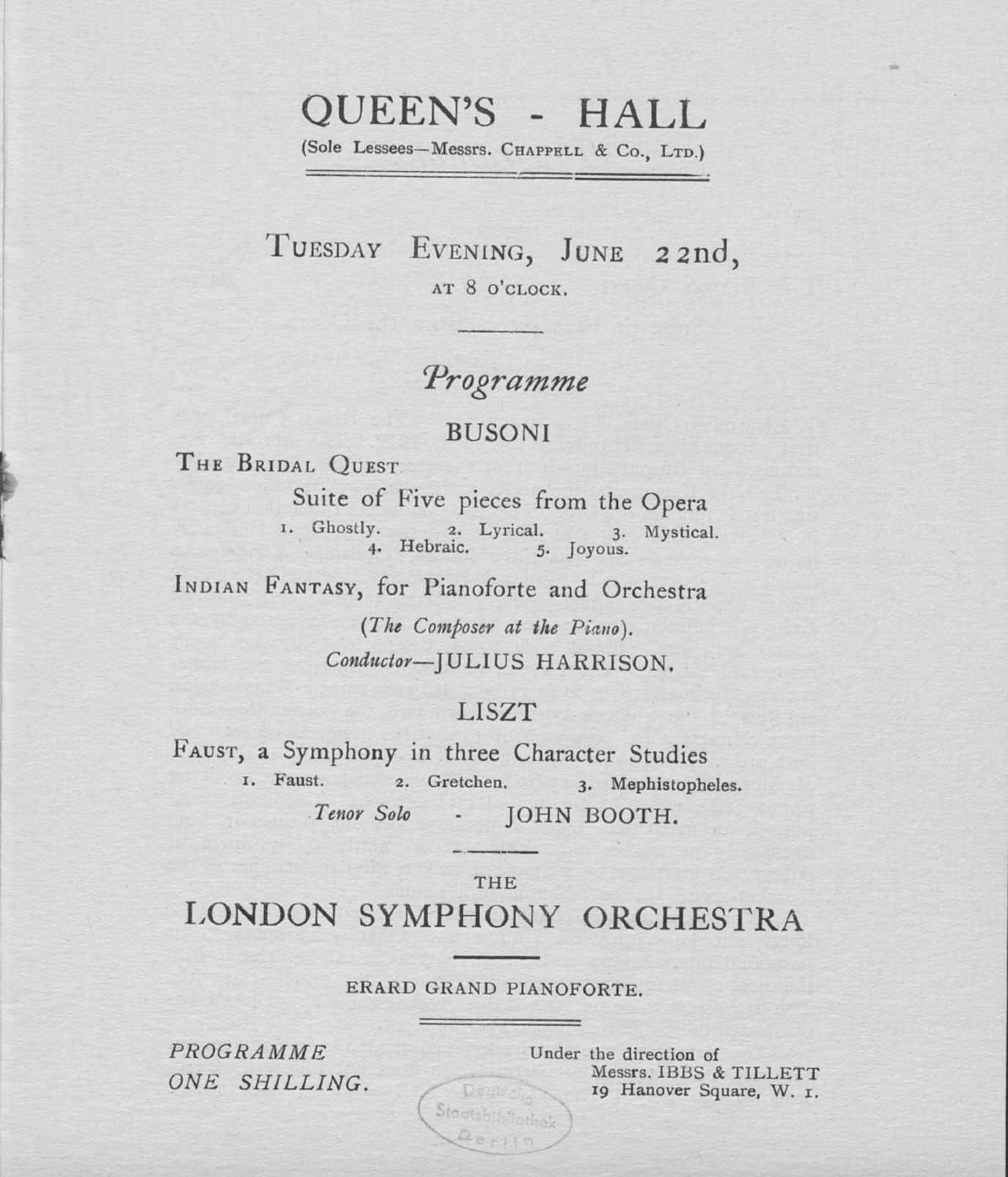
As a conductor, Busoni led multiple performances of Liszt's music in the 1910s and early 1920s, when Liszt's symphonic music was not widely programmed. After his conducting career began to take off, Busoni conducted the Faust Symphony in various locations in Italy on tour with the orchestra of the Liceo musicale di Bologna in spring 1914 and with London Symphony Orchestra in 1920 after the end of World War I (see Fig. 2).Footnote 56 Busoni, for his part, was pleased with the results of his reforming efforts with the orchestra in Bologna. He reported to Isidor Philipp that he had educated a city that had been enthralled with Wagner about the merits of Liszt: ‘The two premieres here went very well. The Faust Symphony was a revelation for the city, which was dedicated to the Wagnerian rite, and was shocked by the discovery of the origins of pleasure preceding their preferred master’.Footnote 57 He also programmed the tone poem Mazeppa in his Liceo symphonic concerts, such as on 5 May 1914 in Ferrara, and he conducted Les Préludes in Rome in 1916 while on tour as pianist and conductor.Footnote 58 Liszt's music also featured prominently in his Berlin contemporary orchestral concert music series with the Berlin Philharmonic from 1902–1909.
Pieces by Liszt Featured in Busoni's Berlin Symphonic Concerts:
15 November 1902, Liszt, Zweiter Mephisto-Walzer
11 January 1907, Liszt, Zwei Episoden aus Lenaus Faust
3 January 1908, Liszt, Tre Sonetti di Petrarca (orchestrated by Busoni, sung by Felix Senius)
2 January 1909, Liszt, ‘Salve Polonia’ (from Stanislaus).Footnote 59
For many audience members, especially in Italy, it was the first time they had heard Liszt's symphonic music. Those in other regions, such as London, claimed that Busoni revealed Liszt's music in a new way. One reviewer, for instance, wrote:
People have spoken of Busoni's admiration for Liszt as ‘unaccountable’, but when you hear Busoni conduct the ‘Faust’ Symphony, it is our contempt for Liszt which is unaccountable. The subtle reading of the score showed us the work in a new light, and Busoni made the London Symphony Orchestra play it with a sensitiveness which was quite wonderful.Footnote 60
Busoni, Programme, 22 June 1920, Staatsbibliothek zu Berlin, Preussischer Kulturbesitz, Musikabteilung mit Mendelssohn Archiv, Mus. Nachl. F. Busoni, E, 1920, 13A.

Busoni not only preserved and disseminated Liszt's music, but also saw it as a model for his own compositions. Busoni thought of Liszt as a man of great intelligence, and he patterned one of his opera heroes in Die Brautwahl (1911) after him. Leonhard, an artist working in jewellery and fine metals and a mentor of young artists, controlled the power of nature with his mind.Footnote 61 He foresaw the great masterpieces of the future. Busoni described Liszt as belonging not only to the artistic greats, but also to a small circle of intellectual visionaries and elites interested in culture, art, literature and religion.Footnote 62 In addition, the chorus in the final movement of the piano concerto (1904) bears homage to Liszt's chorus in the final movement of his Faust Symphony, even if Busoni considered his idea of keeping the chorus invisible (offstage) an improvement.Footnote 63
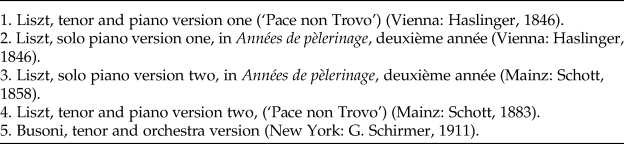
Liszt's emphasis on colour and unique forms based on the blending of the poetic idea with music, and his technique of adaptation/re-composition in which boundaries between new pieces and arrangements were blurred, also became models for Busoni's own compositions. Busoni expanded on these characteristics in his own music, adding to it an emphasis on counterpoint, and expanding harmonic and timbral possibilities. While editing Liszt's works, Busoni observed his composition process, including the reworking not only of superficial details, but also of main musical material.Footnote 64 These practices of re-composition and arrangement fascinated Busoni, who did the same in his own compositions, and he even tried to improve upon Liszt's multiple versions. A direct connection can be seen in both composers’ reworking of the Sonetto 104 del Petrarca. Liszt created two solo piano versions and two versions for piano and tenor (see Table 4). Busoni later created his own version for orchestra and voice. In the second piano version, which he created during the Weimar years, Liszt expanded expressive and colouristic possibilities through changes in harmony, register, tempo and texture.Footnote 65 Instead of beginning with constantly undulating pedal tones in the bass that support triadic right-hand progressions, he made the opening more dramatic in the second version with octaves and tenths ascending sequentially in an agitated tempo before the music dissolves into a dreamy adagio cadenza. Liszt also altered the register of the melody, splitting it between two hands. Busoni's version for orchestra and voice (published in 1911), although relatively faithful to the pitches of Liszt's second version for tenor and piano, which Liszt created near the end of his life during the years he gave the Weimar master classes, thus represents a conflation of ideas; Busoni adds timbral effects through the scoring. For instance, the opening of Liszt's second version contrasts the high and low registers of the piano, which creates an impression of call and response. Busoni mirrors this through colouristic contrast by alternating strings and winds in his orchestral score, and also alternating clarinets and bassoons versus oboes, while preserving the registral contrasts already present in Liszt's version.Footnote 66
Versions of the Sonetto 104 del Petrarca

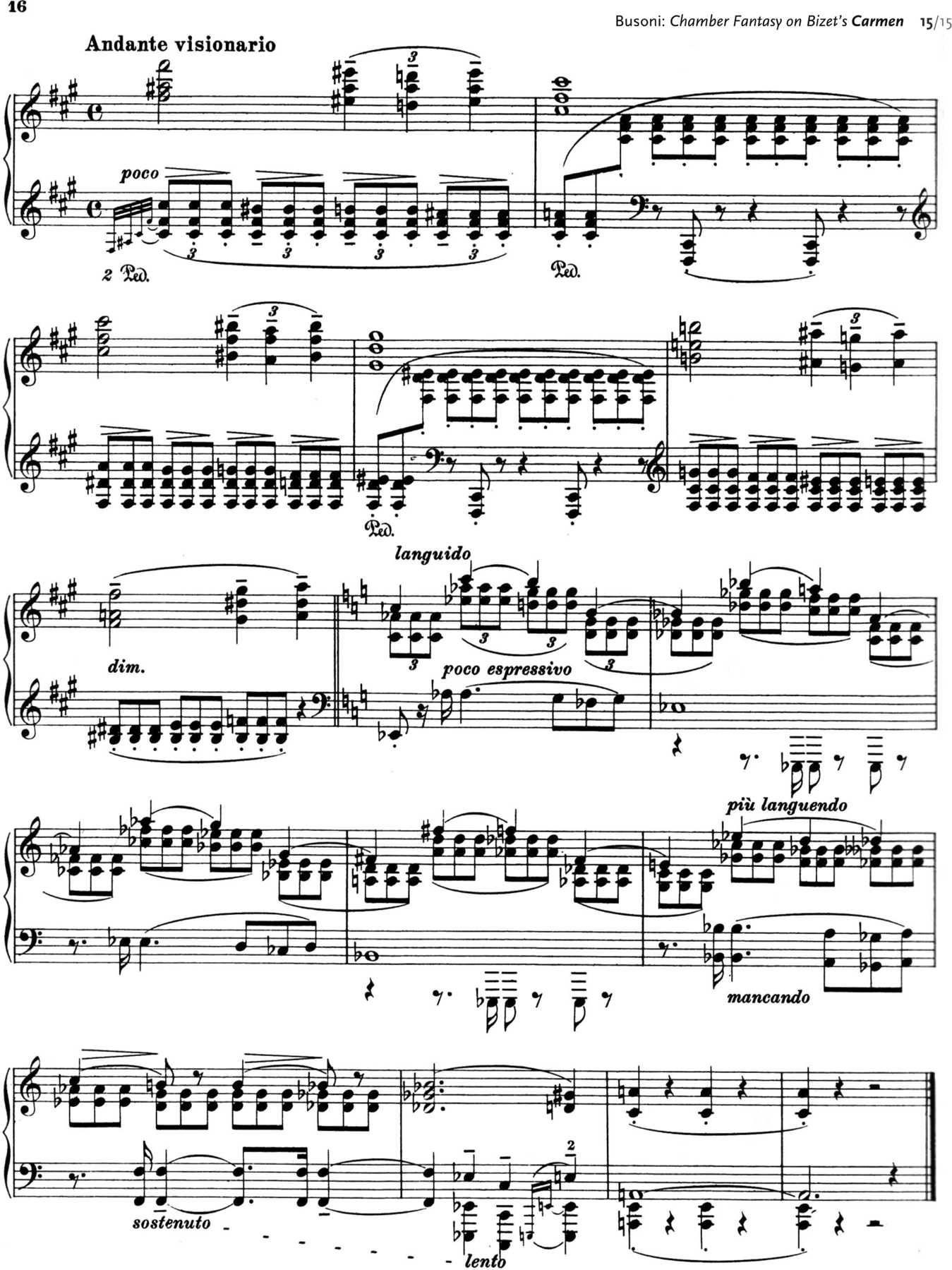
Busoni learned much about form, harmony, thematic transformation and sonority from his study of Liszt's music, and he set about to expand upon these elements. One example can be observed in the ways in which his fantasy on Bizet's Carmen, the Kammer-Fantasie über Carmen (Sonatina super Carmen) (1920/1921), was inspired by Liszt's Réminiscences de ‘Don Juan’, S. 418. Liszt composed his piece in 1841, but later, in 1877, produced a two-piano version. Busoni initially conceived of his piece in 1917 while he was preparing his critical edition of the Réminiscences de ‘Don Juan’. In the preface, Busoni noted that one could produce a similar piece using themes from Carmen. Footnote 67 He envisioned a similar tripartite structure in which the Fate theme would pervade the first part, the Habanera music the middle section, and arena music the finale. Yet Busoni's eventual realization of his plan, in 1921, depicts a blending of the Lisztian bravura opera fantasy from his virtuoso years, and a serious tone poem for piano influenced by the Weimar years, with Bizet's Carmen serving as a poetic muse. Busoni's composition, subtitled a sonatina, bears some resemblance to Liszt's Faust Symphony, S. 108, in terms of the multiplicity of themes (5) that interact and develop throughout. In addition, both pieces contain character vignettes (in this case, Don Jose and Carmen). Busoni's piece features the Fate motive, and quotes from four contrasting sections in Bizet's opera: the playful opening instrumental accompaniment for the act IV scene I chorus, A deux Cuartos! (presented in A major, C major, D major and F major); Don Jose's Act II canzonetta, La fleur que tu m'avais jetée (D-flat major), into which is interwoven Carmen's Fate motive; Carmen's flirty Act I Habanera music, L'amour est un oiseau rebelle (D-flat major and D minor/major); and the Act IV arena march music, Les voici! (A major and F-sharp minor). To this Busoni adds a newly composed coda (F-sharp minor and A-minor) featuring the Fate motive.
The composition thus reuses memorable themes from Bizet's Carmen. Yet it presents Busoni's own interpretation of the opera. The themes appear in a different order and with different moods than in their original context, as they are transformed from light-hearted virtuosic tunes to serious and sombre suggestions of fate and futurism. Liszt's influence can be heard in the thematic transformations as well as the unique formal structure, chromaticism and virtuosity. Thematic transformation occurs throughout, with the greatest amount of fragmentation occurring just before the coda. Harmonically, the piece is tripartite – it begins in A major and there is a return to A/F-sharp minor at the end of the composition. However, four main stylistic and textural shifts obscure the harmonic structure: (i) the middle-section, centres on the key of D-flat major (a third relationship to A, if considered enharmonically), and acts like a slow lyrical movement; (ii) Don Jose's canzonetta appears in a Lisztian etude style replete with hand crossings and virtuosic arpeggiations and chords; (iii) vague hints of the Fate motive portend impending doom; (iv) the following Habanera, a character sketch of Carmen, is a virtuoso tour de force that dissolves into parallel octaves and brilliant arena music that explores the range of the piano. The virtuosity dissipates as the Fate motive reasserts itself and takes over in a mysterious and quiet ending.
As can be seen in Example 2, the Fate theme is transformed rhythmically and harmonically as it descends sequentially and chromatically over seventh chords. The theme passes from high to low registers and back again, before eventually becoming mere pulsation in A minor. The piece then dissolves into silence. Busoni's extension of Lisztian ideas can thus be heard in the counterpoint, the enriched harmonies, the play with register, and with colour in the slow and mysterious coda.
Busoni, Chamber Fantasy on Bizet's Carmen, coda

The Weimar Master Classes
Busoni not only felt connected to the progressive compositional ideas that Liszt pioneered in Weimar, he also respected and emulated his unique pedagogical methods, which included teaching holistically in informal master class settings. When the Grand Duke Carl Alexander of Weimar invited him to lead a piano master class in Weimar, as Liszt had done two decades earlier, the Grand Duke proved to be not only a patron, but also a tutor in the ways of Liszt.Footnote 68 He had attended Liszt's master classes, and he revealed many of the details to his selected successor, Busoni. He shared information about the character of Liszt as well, describing him as a noble prince of the piano characterized by a magnetic personality and intelligence.Footnote 69 In addition, Busoni was acquainted with many Liszt pupils, including William Dayas, Emil Sauer, Arthur Friedheim and José Vianna da Motta.Footnote 70 Given Busoni's public admiration for Liszt's music, it would be surprising if they did not discuss his pedagogical work.
Busoni was not the first to follow Liszt's example by leading a master class, yet Liszt and Busoni were unusual in their emphasis on aesthetic ideals over technical acumen. Even before Liszt's classes, teaching in group classes was not uncommon in conservatory settings such as the Hoch Conservatory in Frankfort-on-the-Main, the New England Conservatory, where Busoni taught in 1891–92, and the Leipzig Conservatory, among others, where group classes were seen as models of efficiency.Footnote 71 Moreover, master teachers such as Hans von Bülow, Theodor Leschetitzky, and others were gradually adopting master class teaching styles. Bülow held his master classes in Frankfurt-am-Main during the spring and summer months of 1884 to 1887. As both a piano student of Liszt's and the first husband of his daughter, Cosima, Bülow was a direct heir to Liszt in several senses. Yet his approach differed considerably in that his daily classes were for profit and they heavily emphasized technique.Footnote 72 Leschetitzky's master classes, which took place in Vienna from 1878–1915 at five p.m. on Wednesday afternoons, were not intimate affairs, but rather, recitals, serving as solutions for dealing with an overabundance of ‘would-be-students’.Footnote 73 Beginning with 50 people, and growing to more than 200, students would squeeze into his salon. Technical shortcomings were identified and discussed in detail, leading to the elusive concept of ‘Leschetitzky's method’.
Busoni was thus participating in a format for piano education that was proving increasingly popular and very effective for mass-producing students. Yet Liszt's model, which Busoni adopted, differed in its intent to nourish the human imagination and ideals rather than to impart technique to many. Busoni saw his classes as continuing the long lineage of composer pianists – ‘geniuses’, as he called them – and as a means to communicate his ideals about the future of music.
Although Busoni never attended any of Liszt's classes himself, they provided him (via the lens of the Grand Duke and other Liszt master class pupils) with a model for music pedagogy. Liszt's master classes were intimate events, offered free of charge to a small group of followers, as Liszt focused on the education of the whole musician.Footnote 74 They took place three times per week from four to six p.m. from June to mid-September, and visitors in arts, literature or science were welcome. The classes, which took place in the Hofgärtnerei, in what is now known as Goethe Park, with two pianos, were informal. Sometimes he paced while a student played, and sometimes he sat at one piano while the student played at the other piano – teaching by example. He did not choose the repertoire for students, but had students stack scores in a pile, from which he selected pieces for the afternoon. Liszt specifically avoided discussions of technique, or ‘dirty laundry’ as he called it, focusing instead on aesthetics and interpretation. Alan Walker notes: ‘It was all part of Liszt's well-known view that piano playing must never be confused with finger dexterity, that piano playing involved the whole person, and to improve the one you must improve the other’.Footnote 75 He often told students to sit straight and tall.Footnote 76 Apart from that, he had no set method, and the understanding was that those who needed technical advice should seek help elsewhere. Carl Lachmund asserts that Liszt's classes were for those who had already reached a high level of artistry and proficiency. Instead of technique, he tended to focus on the musical aspects of a piece.Footnote 77 His classes were supplemented by social hours, often ending at a restaurant, or with weekend coffee hours in which a musical programme was followed by coffee.Footnote 78 They also had whist parties after the lessons, and enjoyed readings of Jean-Jacques Rousseau and other authors.
Busoni followed in Liszt's footsteps by leading an intimate summer (July–September) master class free of charge that was focused on aesthetic ideals (see Fig. 3).Footnote 79 The students were largely handpicked, and received short, but warm invitations in May 1900 for the first master class. Some were invited in person as Busoni met them during his travels.Footnote 80 Maud Allan describes the atmosphere as otherworldly, as students were surrounded by the aura of a city steeped in history that included Johann Wolfgang von Goethe, Friedrich Schiller, Johann Gottfried Herder, Johann Nepomuk Hummel and Liszt. She likened it to a religious meeting:
There was no fixed programme. But though there was a delightful spontaneity about these afternoons, we only gave our very best. In fact, in one respect they were not unlike a Quakers’ meeting, when only those who feel inspired rise to speak. But there the comparison ceases.Footnote 81
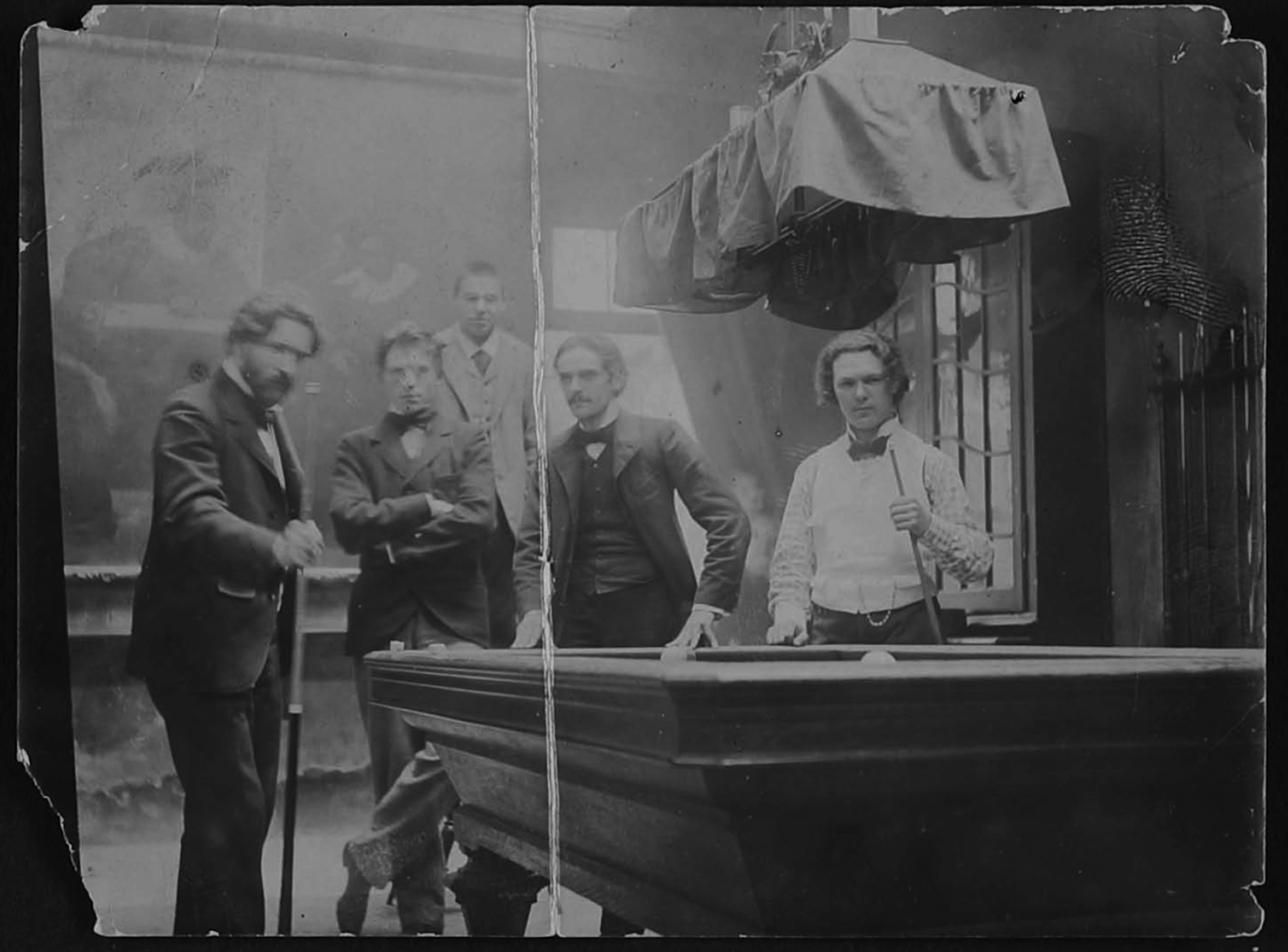
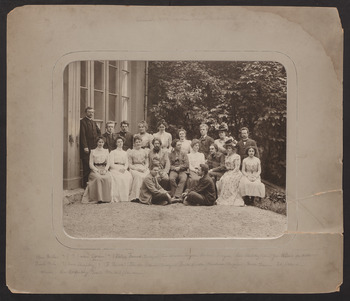
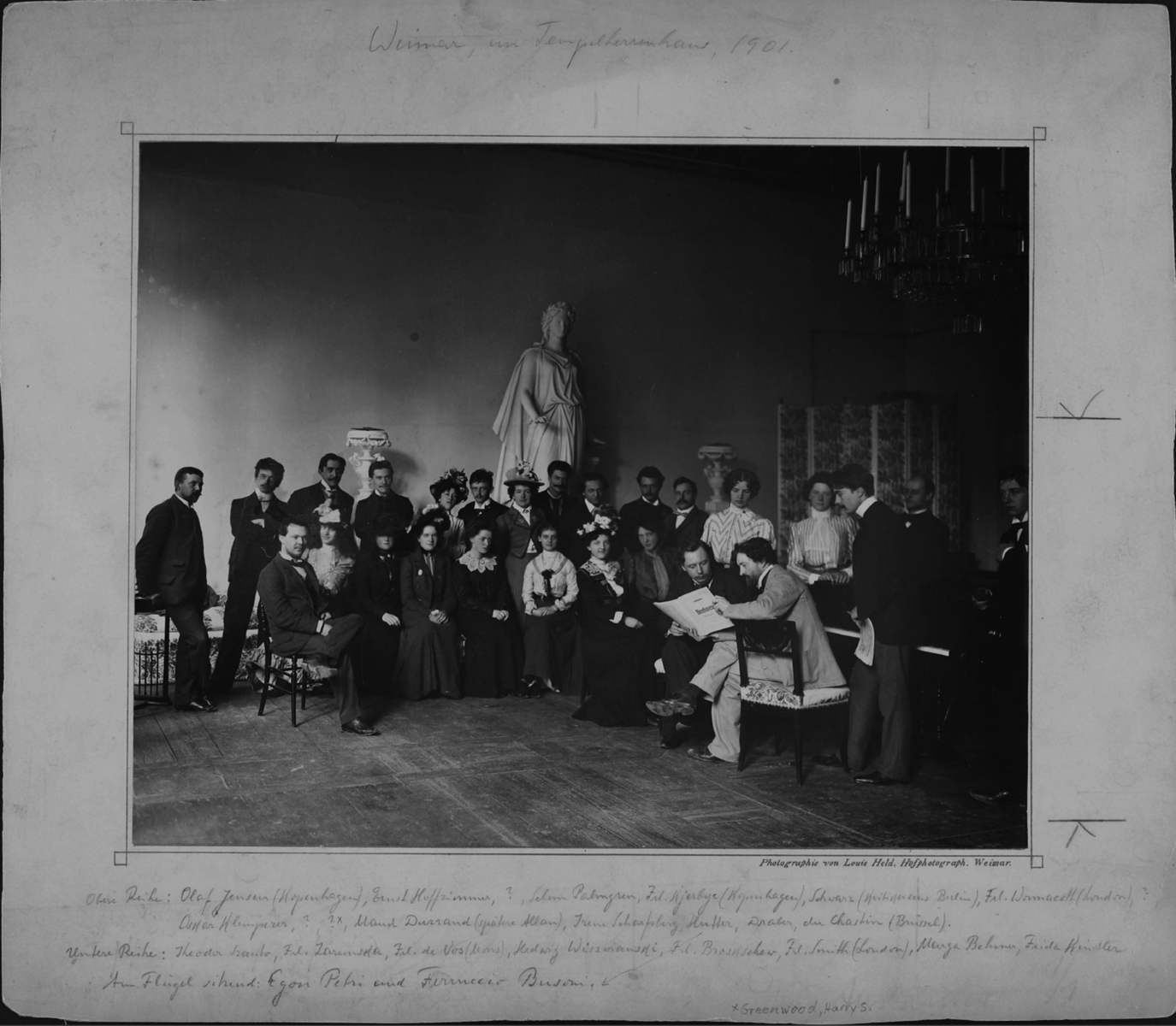
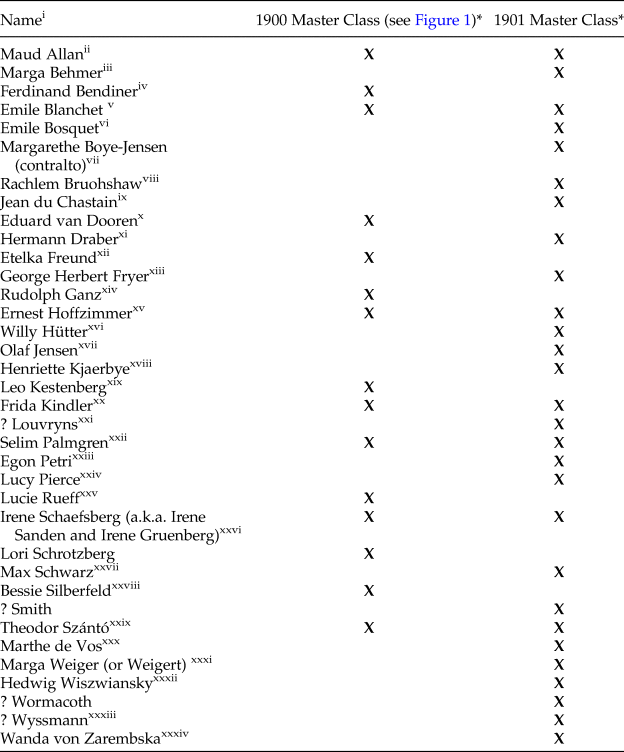
Busoni cultivated intimacy by meeting with students outside of the bi-weekly master class sessions (usually Tuesday and Friday afternoons) almost every day of the week informally for walks in the park or coffee hours.Footnote 82 The students were also notorious for their pranks and games, in which Busoni sometimes participated (see Fig. 4). Busoni's first class was smaller than Liszt's, with fewer than 15 pupils in 1900 (see Figs. 5 and 6) and about 28 the second summer.Footnote 83 Although we might never be able to document everyone who attended, including guests, Table 5 documents the traceable participants.Footnote 84 Busoni also invited guests to perform or attend, including Teresa Carreño (1853–1917), Oscar Klemperer (1877–1940), Hermann Draber (1878–1942), Martin Wegelius (1846–1906), an organist from Boston named Wetzler, and Ernst Lochbrunn from the Stern Conservatory (Berlin).Footnote 85 Busoni and his invited guests performed formally about once per week, such as during a two-piano recital (Busoni and da Motta) on 7 August 1900 that featured Liszt's Faust Symphony and Beethoven's ninth symphony arranged for two pianos by Liszt.Footnote 86
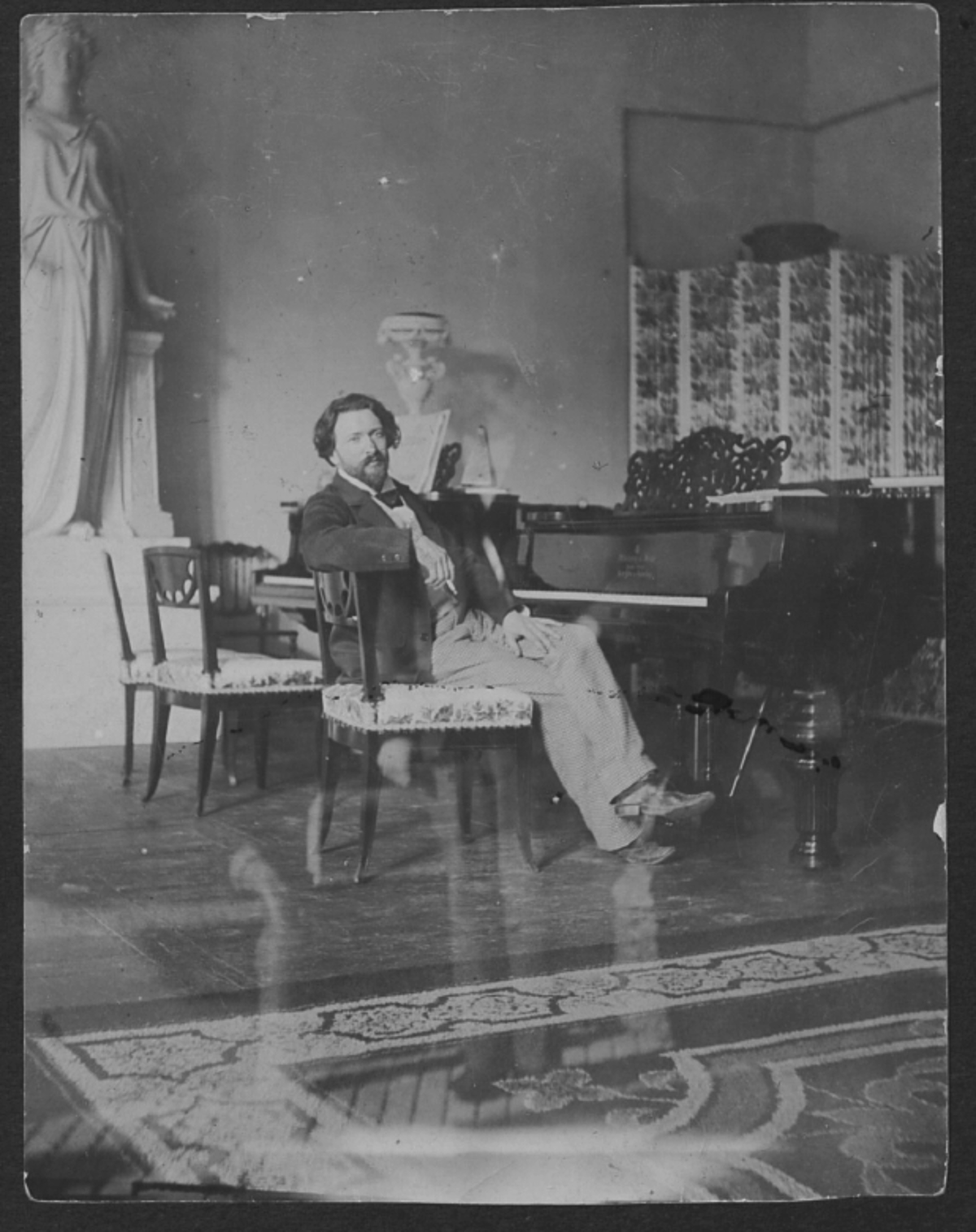
Photograph of Busoni in the Weimar Tempeherrenhaus in 1900, Staatsbibliothek zu Berlin, Preussischer Kulturbesitz, Musikabteilung mit Mendelssohn Archiv, Mus. Nachl. F. Busoni, PI, 79

Photograph of Busoni playing billiards with van Doren, Kestenberg, Bendiner and Szanto in Weimar in 1900, Staatsbibliothek zu Berlin, Preussischer Kulturbesitz, Musikabteilung mit Mendelssohn Archiv, Mus. Nachl. F. Busoni, PI, 75

Busoni's first Weimar Master class (1900) in Weimar, Staatsbibliothek zu Berlin, Preussischer Kulturbesitz, Musikabteilung mit Mendelssohn Archiv, Mus. Nachl. F. Busoni, P II 50. Last Row (from left to right): Martin Wegelius, Eduard van Dooren, ?, Teresa Carreño, Etelka Freund, a singer from Weimar, George Herbert Fryer, Lori Schrotzberg, Jose Vianna da Motta. Middle Row: Maud Allan, Irene Schaefsberg, Lucie Rueff, Ferruccio Busoni, Theodor Szántó, Frida Kindler, Ferdinand Bendiner, Gerda Busoni, Bessie Silberfeld. Front Row: Leo Kestenberg, Émile Blanchet

Busoni's second Weimar Master class (1901) in Weimar, Staatsbibliothek zu Berlin, Preussischer Kulturbesitz, Musikabteilung mit Mendelssohn Archiv, Mus. Nachl. F. Busoni, P II 49

Busoni's Master Class Pupils

* An x indicates attendance at that particular master class
i The fact that many of the female attendees’ careers were cut short by marriage was a given at the time period. Etelka Freund, for instance, married in 1910 and did not resume her career again until 1936. Bessie Silberfeld was considered such an amazing prodigy that a study was done of her physiognomy to try to understand her greatness, yet she married Joel (Julius) Pitzele in 1906. Uncle Joseph, ‘Child Culture: Precious and Promising’, The Phrenological Journal and Science of Health 107 (1898), 18, https://babel.hathitrust.org/cgi/pt?id=mdp.39015074625396;view=1up;seq=27 (accessed 15 March 2017). Reports of her performing again do not surface until the 1920s (Her husband died in 1925). Even so, several went on to have significant careers, and they articulated their indebtedness to Busoni, who remained in contact even after the master class. Freund began a successful concert career in 1901 with Busoni conducting the Berlin Philharmonic. The mammoth programme included Beethoven's Concerto No. 3 in C Minor, op. 37, Brahms's Concerto No. 1 in D Minor, op. 15, and Liszt's Rhapsodie Espagnole, S. 254 (in Busoni's version for piano and orchestra). Freund's career was cut short by her marriage in 1910. She only began performing again in 1936 at her husband's retirement. On the other hand, marriage seemed to bolster the careers of men. Ganz got married on 12 July 1900 and left for Chicago in August 1900. A letter from Busoni in Weimar dated 16 July 1900 stated that they were waiting expectantly for him in Weimar. Apparently, he and his new bride were coming to the master class before Ganz's departure for America: ‘We have been expecting you for a long time, and I look forward to your art and to the manuscripts’ (Wir erwarte Sie schon lange und ich freue mich auf ihre Ankunft und auf die Manuscripte). Busoni, letter of 16 July 1900 to Ganz, Monographic, 1900, Manuscript/Mixed Material, Library of Congress, www.loc.gov/resource/molden.1149.0/?sp=1 (accessed 12 February 2017).
ii Allan (1873–1956) was a Canadian pianist who discovered her talent for dancing and acting when interacting with Busoni.
iii Behmer studied at the Conservatory in Cologne. Mirus described her as very talented and stated that she showed much progress during the master class. He considered one of her best performances to be of an E-flat minor Fugue by Bach. Mirus, ‘Die Meisterschule von Busoni zu Weimar’, 463–4.
iv There is one letter between Bendiner (1879–?) and Busoni dated 26 June 1899 in the Staatsbibliothek Berlin. He was educated in Budapest and Berlin and he won the King Francis-Joseph Prize.
v Blanchet (1877–1943) studied with Busoni in Weimar and Berlin, taught at the Lausanne Conservatory (1904–17), and composed. Busoni dedicated An die Jugend (mvt. IV) to him.
vi Bosquet was from Brussels, and he won the Third International Anton Rubinstein Competition in Vienna in 1900. Afterwards, he concertized in Russia and Belgium. He wrote a book in 1904 entitled: Technique moderne du pianiste virtuose: Moderne Technik des Klavier virtuosen and became an honorary professor of the Royal Conservatory of Brussels. He was also a juror for the international Frederic Chopin Piano Competition in 1949 and 1955.
vii Boye-Jensen was a singer from Copenhagen who had studied with Julius Stockhausen. She gave recitals and performed ‘Mon coeur s'ouvre a ta Voix’ from Camille Saint-Saen's Samson et Dalila, with the Boston Symphony Orchestra on 11 March 1899. She was the wife of pianist Olaf Jensen, who was attending the class.
viii Bruohshaw was a pianist from London. She specialized in the music of Beethoven and Bach – especially Bach transcriptions.
ix Chastain was a Belgian concert pianist who performed Bach organ transcriptions during the master class. For a review of one of his performances see ‘Jean du Chastain (piano) and Joan Hammond (soprano), accompanied by Joan Singleton’, Musical News 30 (18 July 1940) www.concertprogrammes.org.uk/html/search/verb/GetRecord/5032 (accessed 10 February 2017).
x Van Dooren was born in Neuss, Germany.
xi Hermann Draber (1878–1942) was a flautist and a pianist.
xii Freund (1879–1977), who was one of Busoni's most talented master class pupils, studied with Brahms in Vienna in 1895 and with Busoni during the first Weimar master class. When Bosquet won the Rubinstein prize in summer 1900, Busoni opined that his victory was only due to a policy barring female contestants. Freund began a successful concert career in 1901 with Busoni conducting the Berlin Philharmonic (Beethoven's C minor Concerto, Brahms's D minor Concerto, and Liszt's Rhapsodie Espagnole in Busoni's version for piano and orchestra), but it was cut short in 1910 by her marriage to an electrical engineer. She only began performing again in 1936 at her husband's retirement. See ‘Etelka Freund’ http://arbiterrecords.org/music-resource-center/etelka-freund/ (accessed 10 February 2017). Busoni wrote to her brother, Robert Freund, about her progress: ‘Last Sunday for the first time she held and moved a small but very discerning public. I believe that the most critical moment has passed and that the path before her is smooth; she needs only to practice steadily. I am happy to be able to report to you these results with good conscience. A sudden interruption and return to the home atmosphere does not seem to me the thing to do now. Regressions can hardly be feared, but should not be excluded with certainty. Therefore, I have urged that Etel come to Berlin for a while and am happy to understand that you consented to my wishes. At least I want to complete the preparation of her Berlin programs’. Busoni, letter to Robert Freund, 12 September 1900 in ‘Etelka Freund’ http://arbiterrecords.org/music-resource-center/etelka-freund/.
xiii Fryer (1877–1957) was a British pianist who studied at the Royal Academy of Music from 1893–1898. He made his London debut on 17 November 1898, and then toured throughout Europe, Canada, the United States, Australia, South Africa, and India. From 1917–1947, he was a Professor of Piano at the Royal Conservatory of Music. His students include Cyril Smith, George Malcolm, and Constant Lambert.
xiv Ganz (1877–1972) was a Swiss-born pianist, conductor, composer, and piano teacher who attended part of the 1900 master class. He studied piano with Robert Freund and composition with Charles Blanchet at the Lausanne Conservatory. He began studying with Busoni in Berlin in 1899 and worked with him for one year. Ganz made his debut at Berlin's Beethovensaal on 7 December 1899 with the Berlin Philharmonic (Chopin 1, Beethoven 5, Liszt Hungarian Fantasy) four months later he made his conducting debut with the Berlin Philharmonic. Florenz Ziegfeld happened to be in Berlin at the time (May 1900) and invited him to join the piano department at the Chicago Musical College. Ganz married 12 July 1900 and left for Chicago in August 1900. A letter from Busoni in Weimar dated 16 July 1900 asks when he will be coming – he was expected for part of the master class. Ganz actively promoted French music and new music. In 1906 he went back to Berlin where he presumably came back into contact with Busoni. His students include: Edward Collins, Edna Gunnar Peterson, Leo Miller, Mollie Margolies, Charles Haubiel, and Edward Ballantine.
xv Hoffzimmer (1877–1957), born in Germany, studied with Victor Staub and William Dayas. He attended both master classes and also studied with Busoni in Berlin until 1904. He premiered works by several composers, including Palmgren. He also went on recital tours, including one with singer Lillian Sanderson in which they performed the lieder of August Bungert.
xvi Hütter studied at the Conservatory in Bucharest.
xvii Jensen was a pianist from Copenhagen and the husband of Margarethe Boye-Jensen, a singer. He studied with Busoni in Berlin and attended the second Weimar master class.
xviii Kjaerbye was from Denmark.
xix Kestenberg (1882–1962) was a music educator and pianist of Hungarian birth. He studied with Theodor Kullak, but in 1898 received a free ticket to a Busoni recital at the Berlin Singakademie. After that he studied with Busoni (at his Weimar master class in 1900) and composition with Felix Draeseke in Berlin. He became Busoni's secretary, and in 1904 he followed Busoni to Berlin. He then taught at the Stern and Klindworth-Scharwenka Conservatories in Berlin beginning in 1908 and performed regularly. He first fled to Prague and then to Tel-Aviv during the 1930s. There he conducted orchestras and continued his educational activities. Some of his most famous pupils include Menahem Pressler and Alexis Weissenberg.
xx Kindler (1879–1964), who attended both master classes, was the sister of Hans Kindler, a cellist and long-time friend of Busoni. Weigert remembers that she performed Liszt's Piano Concerto nr. 2 in A Major, S. 125, during the 1901 master class. Weigert, ‘Busoni at Weimar in 1901’, 52. She married Bernard van Dieren on 1 January 1910, a man who would become one of Busoni's favourite composition pupils. For a review of Kindler's playing see ‘A Verhaeren: Recital by Carlo Liten and Frida Kindler, 1917’ http://digital.lib.uiowa.edu/cdm/ref/collection/tc/id/43091 (19 March 2015). Her concert agent was E.L. Robinson, and she was a friend of Kaikhosru Shapurji Sorabji.
xxi Louvryne was a pianist from Brussels who studied only a short time with Busoni, but experienced a remarkable breakthrough because of his instruction.
xxii Palmgren (1878–1951) was a Finnish pianist and composer who studied in Helsingfors, and he was one of the last Liszt pupils. He specialized in the music of Liszt, Weber and Chopin, and was called the ‘Finnish Chopin’. He studied at the Conservatory in Helsinki from 1895 to 1899 and then continued his piano studies with Ansorge and Busoni. See Selim Palmgren, Miniature Essays (London: J. and W. Chester, 1922). During the master class, Palmgren performed Chopin's Scherzo in B Minor and Liszt's Rigoletto opera fantasy. Selim Palmgren, ‘I Liszts och Busonis Weimar’, Festskrift tilla gnad Amos Anderson 3 (1948), 226.
xxiii Petri (1881–1962) was a talented player of both violin and piano, but it was after the Weimar master class that he decided to dedicate himself to piano. He helped Busoni edit the collected Bach edition in Switzerland during World War I. His students include Victor Borge, Gunnar Johansen, Earl Wild, and John Ogdon.
xxiv Pierce participated in both the Weimar and Vienna master classes. She joined the Royal Manchester College of Music Faculty in 1912, where she was initially a student. She also studied with Friedheim, Backhaus and Petri, and she won the Dayas gold medal in 1909, and the Halle Memorial Scholarship, 1906–09. For more information, see Charles Beauclerk, Piano Man: Life of John Ogdon (New York: Simon & Schuster, 2014); Michael Kennedy, The History of the Royal Manchester College of Music, 1893–1972 (Manchester: Manchester University Press, 1971).
xxv Rueff (1877–1943), from Paris, performed the Bach-Busoni Chaconne during the master class.
xxvi Schaefsberg, also a pupil of Dayas, was a British concert pianist, and she attended both classes. She performed Beethoven's Sonata nr. 28 in A Major, Op. 101, in the 1901 master class, and later went on to become an accompanist, vocal coach, dancer and piano teacher in New York. Weigert, ‘Busoni at Weimar in 1901’, 50. She sometimes performed under the name Irene Sanden, and was the first wife of Louis Gruenberg.
xxvii Schwarz studied five years with Karl Klindworth and wrote a dissertation on Johann Christian Bach. He helped found the Raff Conservatorium in Frankfurt together with Max Fleisch and Bertrand Roth. He also taught Frederic Lamond.
xxviii Silberfeld (1884–1964) was a child prodigy mentioned in a letter to Ganz. She studied in New York with William M. Semlacher and in Berlin with Jedliezka. Her younger sister, Mamie, was also a pianist.
xxix Szántó (1877–1934) was a pianist and composer. He studied with Busoni from 1898 to 1901, attending both Weimar master classes, and studying with him privately. During the second master class, he performed only once, playing Beethoven's Piano Sonata nr. 31 in A-Flat Major, op. 110. He championed the music of Zoltán Kodály, Frederic Delius and Béla Bartók, was a friend of Ravel, and was also noted for his Bach arrangements.
xxx DeVos was a Belgian pianist who loved the music of Franck. Mirus described her as an ‘exceptionally intelligent pianist’ and stated that her performance of Franck's variations and fugue ‘was one of the best performances of Busoni's pupils’. Mirus, ‘Die Meisterschule von Busoni zu Weimar’, 463–5.
xxxi Weigert received her concert diploma at the conservatoire in Cologne before attending the master class in 1901. Weigert claims she was the youngest of the students in 1901. She performed Liszt's Piano Concerto no. 1 in E-Flat Major, S. 124 and Beethoven's Piano Concerto no. 4 in G Major, Op. 58.
xxxii Wiszwiansky was a Polish pianist who, according to Mirus, played the Konzertstück by Weber brilliantly in the master class.
xxxiii Wyssmann was from The Netherlands.
xxxiv Von Zarembska was a pianist from Brussels and the daughter of two musicians, Johanna Wenzel and Jules Zarembski, the latter of whom studied with Franz Liszt. Mirus stated: ‘The young lady has a real pianistic talent and temperament and will make excellent with further serious study and mature into an excellent pianist’ (Die junge Dame besitzt ein echt pianistisches Talent und Temperament und wird bei weiterem ernsten Studium hervorragendes leisten und zu einer ausgezeichneten Pianistin heranreifen): Mirus, ‘Die Meisterschule von Busoni zu Weimar’. Reviews of her playing can be found in Signale für die musikalische Welt 65 (9 Dec. 1906), Die Musik 6: 21, and Le Guide musical: revue internationale de la musique et des théâtres. For a concert programme showing a recital in which she performed works by Chopin in Dusseldorf see http://dfg-viewer.de/show/?set[mets]=http://%3A//digital.ub.uni-duesseldorf.de%2Foai%2F%3Fverb%3DGetRecord%26metadataPrefix%3Dmets%26identifier%3D4733139 (accessed 5 March 2017).
In Busoni's master class, students arose to play when they felt like it. Some days a dozen people would perform, on other afternoons as few as two played.Footnote 87 Busoni emphasized musicality, and he often demonstrated passages spontaneously at the piano as well; group discussion was considered integral to the educational process.Footnote 88 Ernest Hoffzimmer remembers that Busoni sometimes sight-read pieces that students brought to class, such as the Concerto No. 5 by Saint Saëns, to introduce students to new repertoire.Footnote 89 In addition, Petri remembers that Busoni would also play spontaneously for hours in the evenings at his house.Footnote 90 When Busoni did talk about technique, he stressed that most physical problems are rooted in the mind. In this, he foresaw the theory of much twentieth-century piano instruction.Footnote 91 Petri notes that Busoni did not offer concrete technical solutions, but he did teach students how to think.Footnote 92
Also like Liszt, Busoni sought to make his students complete musicians, not just pianists. He promoted improvisation, composition, conducting and other skills to complement piano playing. Most of all, he promoted his musical ideals. In addition, he advised his students to be well-read in fields outside of music. One of his students, Draber, stated that he made young people see music as a boundless kingdom of heaven, remote from the everyday world, his own life testifying to the fact that first you must be a human being and an artist, then everything else will come right.Footnote 93 An article in the Rheinische Musikzeitung described the conversations as all-inclusive – delving into politics, religion and more.Footnote 94
During classes, he stressed several Lisztian ideals, including that of form and colour. He usually considered pieces in their entirety, and he talked about their ‘architectural’ shape. He asked students to strive after ideals of clarity of line, attention to colour, and intellectual objectivity. Busoni was known to talk frequently about the use of the pedal, which he used unconventionally to achieve unique colours.Footnote 95 Moreover, he helped shape repertoire choices by promoting the music of pianist-composers and urging students to explore new pieces. Repertoire ranged from Bach to Busoni, with special emphasis on Bach-Busoni transcriptions and the music of Liszt. Leo Kestenberg, for instance, worked on the Bach-Busoni Chaconne and some organ chorale preludes as well as Liszt's concertos and Totentanz. Lucie Rueff also performed the Bach-Busoni Chaconne during the master class, and Marga Behmer performed an E-flat minor fugue by Bach.Footnote 96 Jean du Chastain performed Bach organ transcriptions during the master class, although the arranger is not specified. Egon Petri performed Liszt's Weinen Klagen, Sorgen, Zagen Variations, S. 179.Footnote 97
Coda
Busoni modelled his career as a composing virtuoso on Liszt – who also improvised, composed, edited and taught – going against the trend of increasing specialization being cultivated in many contemporary conservatories. He believed in the vision of Zukunftsmusik promoted by Liszt in Weimar in terms of poetic instrumental music characterized by new harmonies, colours and sounds. At the same time, he was impressed by Liszt's pedagogical approach in Weimar, which educated the whole person and aimed at producing complete musicians, such as Bülow, who were consummate conductors, pianists and creators. Busoni called multi-talented individuals such as Liszt geniuses: ‘Such pianoforte geniuses were Beethoven, Chopin, and Liszt; they perceived new means, solved the problems of new effects, created ‘improbable difficulties’ and wrote a literature of their own’.Footnote 98
Busoni followed in Liszt's footsteps as a composer-arranger-musical authority-pedagogue, even as he moved from the nineteenth century to the twentieth as a virtuoso and a composer. The time spent in Weimar allowed him to learn first-hand more about Liszt's life, music and pedagogy. In turn, Busoni sought to build upon Liszt's Weimar legacy through an expansion of instrumental, formal and harmonic possibilities and by teaching holistically, something he continued to do in his piano master classes in Vienna (1907–08) and Basel (1909 and 1910), and his composition master class at the Akademie der Künste in Berlin (1921–24). As Douglas Bomberger argues, ‘schools were in some ways better suited to the conservative agenda’, and the master class setting allowed for a more progressive approach.Footnote 99
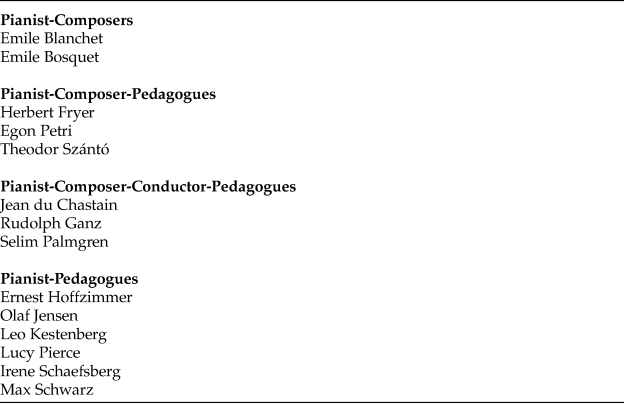
Many of Busoni's Weimar master-class students continued Liszt's legacy as in their value systems, repertoire choices and multi-faceted careers (see Table 6). In addition to performing, Kestenberg, for instance, became a major figure in German musical life, eventually initiating a thorough reform of music education, including the addition of composition master classes to promote progressive ideals in music.Footnote 100 Rudolph Ganz, a Swiss-born pianist who pursued a multi-faceted career of conducting, composing, teaching and performing in Chicago after attending a brief part of the master class, became an advocate of new music.Footnote 101 Petri went on to teach piano in Zakopane Poland, at the Royal Northern College of Music (Manchester), Cornell University and Mills College, in Oakland California, where he reportedly talked frequently about timbral possibilities on the piano and creative pedalling techniques.Footnote 102
The Multi-Faceted Careers of Busoni's Weimar Master Class Pupils

Busoni also taught about Liszt to his composition mentees, some of whom he coached informally for decades. He encouraged them to follow in his footsteps in rejecting Wagner as a progenitor of the future of music and to embrace Liszt and his ideals of Zukunftsmusik. The music of Bach, Mozart and Liszt permeated discussions, and many ended up composing music featuring unique structures informed by extra-musical ideas, coupled with counterpoint, attention to instrumental colour, and experimental harmonies.Footnote 103 Busoni was, for instance, instrumental in shifting Jean Sibelius's allegiance away from Wagner and toward Liszt. Busoni began mentoring Sibelius when he taught at the Helsinki Music Institute from 1888–1890, and then continued mentoring him and promoting his music through the early 1920s. It was in 1894 that Sibelius discovered Liszt's Faust Symphony, while visiting Busoni in Berlin, and he considered it to express many of the artistic ideals he was searching after.Footnote 104 Through the lens of Busoni, Liszt became an inspiration for many of Sibelius's own symphonic poems and symphonies that blended the poetic and the musical through thematic transformation, unique forms and instrumental colour. This melding of the poetic and the musical can also be heard in the compositions of Edgard Varèse, who studied composition with Busoni in Berlin from 1907 or 1908 to 1913, even if his pieces are more experimental in sound and style.Footnote 105 Varèse relied on extra-musical ideas to inspire his combination of timbres, harmonies, rhythms and motives, into larger structures in pieces such as Hyperprism and Octandre.
Busoni thus patterned his career after Liszt and promoted Liszt's music and ideals, helping establish Weimar as a complement to Bayreuth. For many, Wagner represented the future progressive direction of music, but Busoni held a different opinion. He was an important, if little remembered, voice calling for a reconsideration of Liszt's importance. He is joined by other Liszt followers, such as Richard Strauss, who is noted for his tone poems that expand upon Liszt's melding of the instrumental and the poetic. Despite his criticisms of Liszt's compositions, Arnold Schoenberg also found some inspiration in his vision for the music of the future. In his essay on Liszt (1911), for instance, Schoenberg praised Liszt's musical vision and, as James Wright has shown, he was heavily indebted to Liszt's innovations in form, thematic transformation, and use of augmented harmonies.Footnote 106
Busoni joins these and other composers who built upon Liszt's vision to forge a new future of music. As James Deaville, Michael Saffle and others have shown in a recent volume, Liszt's legacy has now reached well beyond Europe and has influenced not only piano and symphonic music, but also the development of newer genres such as film music.Footnote 107 Busoni contributed to this dissemination of Liszt's music, taking it on tour to the US and to other countries, such as Italy, where it was not well known. Even in Germany, he programmed lesser-known pieces by Liszt, and endlessly promoted Liszt's vision of Zukunftsmusik. Moreover, he tirelessly promoted the quickly disappearing model of the polyglot: pianist-composer-conductor-arranger-editor. Through his programming, editing, teaching and composing, he hoped to open the minds of those who followed to the ways in which Liszt's ideas could serve as a foundation for future musical experiments and interpretations. In the process, he expanded the legacy of Liszt followers and promoted an alternative system of musical values based on Liszt.