The most recent State-of-the-Science Statement on Improving End-of-Life Care identified investigation of the reliability and validity of reports by informants as an important research direction (National Institute of Health, 2004). Informant reports about subjective states, such as psychological functioning, were identified as a special focus. This study examines the extent to which patients and carers agree about two aspects of psychological functioning, cognition and depression, in palliative patients with advanced cancer.
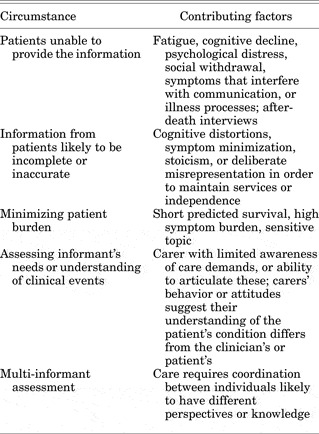
There are many reasons (see Table 1) why palliative care clinicians and researchers seek information about patients from lay (Bakitas et al., Reference Bakitas, Ahles and Skalla2008) or professional informants (Brunelli et al., Reference Brunelli, Constantini and Di Giulio1998; Nekolaichuk et al., Reference Nekolaichuk, Bruera and Spachynski1999).
Five circumstances in which palliative researchers and clinicians seek the views of informants

The current study focuses on lay informants who are family caregivers. Such informants may act as a proxy for the patient or as a collateral source of information. Proxies are asked to respond as a substitute or surrogate for the patient to questions such as, “Would your husband say he feels depressed?” Carers with enduring powers of attorney serve as proxies in enacting the patient's wishes in financial and legal decisions (Fins et al., Reference Fins, Maltby and Friedmann2005). Because the task of a proxy is to accurately reflect the voice of the individual being represented, the validity of the proxy's judgment can be assessed by the extent to which it agrees with the patient's self-report (McPherson & Addington-Hall, Reference McPherson and Addington-Hall2003; Pickard & Knight, Reference Pickard and Knight2005). Discrepancies between reports provided by proxies and patients are likely because proxies may not share all dimensions of the patients' experience, and they may have difficulty inhibiting their own judgments. Proxy judgments are most appropriate when patients are unable to provide information and when attempting to minimize patient burden.
In contrast, collateral sources provide their own assessment of whether the patient is experiencing a particular symptom or condition, for example, “Do you think your husband is depressed?” (e.g., Yates et al., Reference Yates, Labrecque and Pfab1998; Cacchione et al., Reference Cacchione, Powlishta and Grant2003; Pickard & Knight, Reference Pickard and Knight2005). Because reports provided by collateral sources represent the informant's perspective rather than the patient's, the extent to which they differ from patients' self-reports is not relevant to their validity. Discrepancies between patient reports and reports by collateral sources may arise for many reasons. For example, collateral sources may not have access to all dimensions of the patients' experience, may be free of the biases that distort the patient's responses, or may have other biases (e.g., Yates et al., Reference Yates, Labrecque and Pfab1998). The collateral source perspective is most appropriate when information from the patient is likely to be incomplete or inaccurate, when insight into caregivers' needs or understanding is sought, and when using a multi-informant approach to assessment.
When carers of palliative patients are exercising their enduring powers of medical attorney, they are explicitly asked to adopt the perspective of the patient. Few other clinical questions directed to them ask them to respond as a proxy. Although it was argued, above, that it is generally not appropriate to evaluate the validity of information from collateral sources by examining its agreement with information from patients, palliative care may be a special case. It is an empirical questions whether proxy and collateral source perspectives differ in palliative care. It is also unclear whether palliative clinicians treat them differently. In palliative care, there may be little difference between proxy and collateral source perspectives. Most palliative caregivers have a long history of interaction with the patient and access to most dimensions of patients' experience, and an unusual level of patient dependence or openness may allow caregivers vicarious experience of the patient's emotional and psychological states. Indeed, previous research suggests that agreement between cancer patients and carers who adopt a collateral source perspective is as great or greater than agreement between cancer patients and carers who adopt a proxy perspective (Lobchuk et al., Reference Lobchuk, McClement and Daeninck2007). Moreover, in clinical practice, it appears that collateral source information is often substituted for information from the patient when patients are unable to provide this information themselves and when clinicians attempt to minimize patient burden.
The current study examines the extent of agreement between information obtained from palliative patients and their caregivers who were asked to adopt a collateral source perspective. The study focuses on two domains of psychological functioning, cognition and depression, and two measurement contexts, when direct observation of patient performance is compared with carer report and when subjective reports from patients and carers are compared.
METHOD
Participants
All participants had advanced cancer and had been referred to a specialist palliative care service. The health system in which the study took place allows such referrals for patients requiring end-of-life care and other patients with life-limiting illnesses who require management of complex symptoms or multidisciplinary coordination for complex circumstances.
Inclusion criteria were fluency in English, age over 18 years, and a judgment by their primary medical specialist that they were in the palliative phase of their illness, had no cognitive impairment likely to preclude informed consent, and were sufficiently robust to tolerate a 40-minute research interview.
One hundred fifteen patients attending outpatient oncology and palliative care clinics at two teaching hospitals in Adelaide, Australia, were identified as being eligible. A research nurse who was not associated with patient care approached 103 of these patients. Four patients declined to participate (3.9%), 15 were recruited to the study but did not participate due to physical decline (14.6%), and 84 participated in the study (81.6%).
Sixty-six of these 84 patients had carers who were recruited as collateral sources of information about the patient. Most carers were the patient's husband (21%), wife (52%), or daughter (19%) and were in daily contact with the patient (89%). All carers had lengthy relationships with the patient (M = 35 years, range 2–66 years). More than 90% of the patients and carers were Caucasian.
The relevant university and health service ethics committees approved the study, and all participating patients and carers provided informed consent.
Measures
Data were collected by the research nurse immediately after the patients' scheduled clinic visit. Four measures were completed.
Cognitive Decline
Mini-Mental State Examination (MMSE; Folstein et al., Reference Folstein, Folstein and McHugh1975)
This screening test for cognitive impairment involves a series of tasks that assess patients' orientation to time and place, registration, recall, attention, calculation, and language processing. Patients' performance is scored using a standard protocol. In patients with high school education, a total score less than 24/30 suggests that the patient is cognitively impaired.
Cognitive Decline subscale of the Psychogeriatric Assessment Scale (PAS-CD; Jorm & Mackinnon, Reference Jorm and Mackinnon1995)
This 10-item questionnaire screens for impairments in the patient's everyday cognitive functioning. Informants are asked to respond as collateral sources, giving their own judgments about the frequency and severity of impairments: “I would like to ask you … whether ______'s memory has become any worse in these areas compared to earlier in life.” Scores of 4/10 and above suggest that the patient is cognitively impaired.
Symptoms of Depression
Geriatric Depression Scale (GDS; Yesavage et al., Reference Yesavage, Brink and Rose1982–1983)
This 30-item self-report measure screens for the presence or absence of nonsomatic symptoms included in the DSM-IV diagnostic criteria for a major depressive episode (depressed affect, anhedonia, psychomotor agitation, worthlessness, concentration problems) during the previous week. A score of 0–9 is considered normal, 10–19 suggests mild depression, and a score over 20 suggests severe depression.
Geriatric Depression Scale-Collateral Source (GDS-CS; Nitcher et al., Reference Nitcher, Burke and Roccaforte1993)
This uses items, responses, and scoring parallel to those in the GDS but is completed by informants who are asked to respond as collateral sources: “Circle the best answer for how you think the patient has felt in the last week.”
RESULTS
The relationship between patient-completed and carer-completed measures was examined in four ways: the correlation between total scores in the sample, agreement about the prevalence of impaired psychological functioning and of specific symptoms in the sample, agreement concerning whether particular patients showed impaired psychological functioning, and agreement about the presence or absence of a specific symptom for a particular patient.
Correlation between Scores across the Sample
There was a no association between carer subjective reports of cognitive decline using the PAS-CD and patient's observed cognitive function during the MMSE, r(51) = 0, p > .05. However, there was a strong positive correlation between carer and patient reports for depression, r(51) = .64, p < .001. Despite this, carer reports accounted for less than 40% of the variance in scores on the patient-completed measures of cognition and depression.
Thus, there was insufficient correspondence to allow substitution of information from carers for information from patients when estimating mean scores for the sample.
Prevalence of Impaired Function and Specific Symptoms in the Sample
Estimates of the prevalence of cognitive impairment in the sample were more than three times higher when they were based on carer subjective judgments (24.1%) rather than on patients' cognitive performance in the MMSE (7.4%). Because there is no one-to-one correspondence between items on the MMSE and the PAS-CD, there was no attempt to examine agreement on the prevalence of impairment in particular cognitive functions.
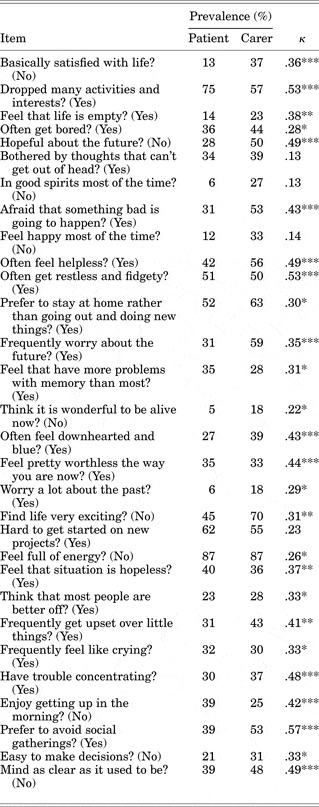
Estimates of the prevalence of severe depression in the sample were about five times higher when these were based on carer reports (15.9%) than when they were based on patient reports (3.2%). Similarly, prevalence rates calculated from carer reports were similar to or higher than those based on patient reports for most symptoms of depression (Table 2). However, a small number of GDS items, mainly relating to anhedonia, provided exceptions to this rule. There was therefore no consistent relationship between carer and patient reports for specific symptoms of depression.
Agreement for prevalence of depression symptoms in sample and presence of symptoms for individual patients in patient reports and carer reports (N = 66)

*p≤.05, **p≤.01, ***p≤.001.
Thus, there was insufficient correspondence to allow substitution of information from carers for information from patients when estimating the prevalence of impairment and the prevalence of specific symptoms in this sample.
Presence of Impaired Function in Individual Patients
In the majority of cases, patients' cognitive performance and carers' subjective reports of cognitive decline led to the same judgments about whether or not the patient was cognitively impaired (69.7% agreement, Fishers Exact test, p > .05). Despite this, the level of disagreement (almost one in three patients) was too high for most clinical applications, and the cases likely to have clinical significance were overrepresented among disagreements. There was very low agreement for cases in which at least one source of information indicated that cognitive decline was present (5.9% agreement).
Overall, there was high agreement between carer and patient subjective reports about whether a given patient showed severe symptoms of depression (86.5% agreement, Fishers Exact test, p > .05). However, the cases likely to have clinical significance were overrepresented among disagreements. There was low agreement for cases in which at least one informant indicated that severe symptoms were present (22.2% agreement for severe depression judgments).
Thus, the large number of cases in which information from carers and patients agreed in assessment of cognitive impairment and depression reflects the low base rate of these impairments in the sample. There was a high level of agreement that impairment was not present for the majority of patients. However, there was low agreement when at least one informant indicated that impairment was present.
Presence of Specific Symptoms for Individual Patients
Because there is no one-to-one correspondence between items on the MMSE and the PAS-CD, there was no attempt to examine agreement on impairment in particular cognitive functions.
There was a significant association between carer and patient reports concerning the presence or absence of most of the 30 symptoms assessed by the GDS and GDS-CD (Table 2). However, in every case, the size of the kappa statistic indicated that the level of agreement was low to moderate. Thus, there was no empirical justification for substituting carer reports for patient reports when determining whether a patient showed any of the symptoms assessed by the GDS.
DISCUSSION
There are many circumstances in which palliative care clinicians and researchers seek information about a patient from a family caregiver (Table 1). This study assessed the extent of agreement between objective assessment of the patient's behavior and carers' subjective reports (cognition), and patients' and carers' subjective reports (depression). In both cases, carers were serving as collateral sources of information.
Results were generally similar across the different measures of agreement included in this study. In research contexts the correlation between scores and agreement about the percentage of patients “in the clinical range” may be the most relevant measures. In clinical contexts, agreement about the presence or absence of impairment and the ways in which the impairment presents in individual patients may be the most relevant measures. Findings from the current study suggest that agreement is not sufficiently high on any of these measures to justify information from collateral sources being substituted for information from palliative patients.
Results were also similar across the two measurement contexts. Discrepancies between the two sources of information about cognition cannot be dismissed as an artifact of the different dimensions of cognition being assessed, because discrepancies were also found when patients and carers completed parallel forms of the same depression scale. Similarly, although disagreements concerning depression may have reflected a lower level of self-enhancing biases in carer reports than in patients' self-reports (Nitcher et al., Reference Nitcher, Burke and Roccaforte1993), disagreements were also found in contexts in which self-enhancing biases were unlikely to apply. That is, discrepancies were also found when carer reports were compared with direct observation of patient performance in the MMSE. The extent to which disagreements reported in this research are specific to the measurement contexts and domains of psychological functioning under investigation is unclear. However, previous research indicates that informants are more accurate in reporting objective states, such as mobility, than subjective states, such as cognition and depression (National Institute of Health, 2004).
Because carers adopted a collateral source perspective, patients' reports are not the “gold standard” in assessing their validity. The current findings do not imply that information from the patient is more accurate than information from caregivers acting as collateral sources. Indeed, the prevalence of depression calculated from patient reports in the present study was considerably lower than that documented in most previous research that identified depression using structured clinical interviews (Reeve, Lloyd-Williams & Dowrick, Reference Reeve, Lloyd-Williams and Dowrick2008).
Although both proxy and collateral source reports can be useful, appropriate interpretation of the information they yield relies on clinicians and researchers being aware of the “viewpoint on which they are encouraging caregivers to base their estimates” (Lobchuk et al., 2007, p. 132). Currently, there appears to be confusion between proxy and collateral source perspectives. First, in many research and clinical contexts, no information is supplied about whether the informant was acting as a proxy or a collateral source (e.g., Nekolaichuk et al., Reference Nekolaichuk, Bruera and Spachynski1999; Pickard & Knight, Reference Pickard and Knight2005). Second, the label “proxy” often conflates both proxy and collateral source perspectives or is mistakenly used when the informant is responding as a collateral source (e.g., National Institute of Health, 2004; Kutner et al., Reference Kutner, Bryant and Beaty2006). Third, information from collateral sources is often used in circumstances in which a proxy perspective is more relevant (e.g., Lobchuk et al., Reference Lobchuk, McClement and Daeninck2007).
The present findings indicate that palliative care is not a special case in which the differences between information from patients, proxies, and collateral sources can be ignored. Thus, in palliative care, as in other contexts, use of a collateral source perspective by informants is most appropriate when information from the patient is likely to be incomplete or inaccurate, when insight into caregivers' needs or understanding is sought, and when using a multi-informant approach to assessment. In contrast, when patients are unable to provide information and when one is attempting to minimize patient burden, it is most appropriate to explicitly ask informants to adopt the perspective of a proxy.
ACKNOWLEDGMENTS
This research was funded by the National Health and Medical Research Council, Australia. This research would not have been possible without the contribution to recruitment and data collection of our dedicated research nurse, Libby Heinsohn-Deer. We also thank Tim Price and Roger Hunt for their assistance in recruitment. Finally, we thank the patients, family caregivers, and staff at Lyell McEwin and The Queen Elizabeth Hospitals, South Australia, for their generosity in contributing precious time and energy.