Introduction
The U.S. Civil War involved a remarkable degree of mass public mobilization. Millions of white northerners fought and many were killed in a war that ultimately resulted in the most significant transformation of racial politics in U.S. history. The role of slavery in causing the war is indisputable: conflict over the expansion of slavery led to the formation of a new party system, and views about slavery were highly salient among party elites at the onset of the war. How party elites were able to mobilize the northern mass public to participate in a war over slavery is less clear. A recent study by Kalmoe (Reference Kalmoe2020) finds that partisanship strongly motivated northern white men to participate in wartime violence, likely through individual partisan motives and social and organizational mechanisms (such as cue-following, peer pressure from co-partisans, etc.) in communities where one party predominated. Other studies by historians and social scientists have also identified partisan mobilization patterns and political motives among soldiers.
However, existing scholarship has not disentangled partisanship from racial attitudes in a systematic way. By “racial attitudes,” we mean views about the status of Black Americans, including views about the issues of slavery and racial equality in the civic and political domain. Given the salience of slavery in the cleavage between the political parties, it is plausible that views about these issues were related to partisanship in the public. If this is the case, partisan differences in enlistment patterns may be ultimately explained by attitudinal differences over race rather than partisan mobilization mechanisms. We tackle this lingering question directly here. We build on work by historians who have argued that northern soldiers were not motivated by antislavery and egalitarian views, bringing novel evidence to bear on this claim. Through multiple empirical tests, we find that partisanship better explains divergent patterns of enlistment and wartime behavior in northern communities than attitudes toward slavery or Black political equality.
The article proceeds as follows. We begin by reviewing existing literature on war motivations among party elites and the mass public. Existing scholarship convincingly shows that views on slavery were highly salient among party elites. The literature on mass public motivations shows that political motives were relevant among soldiers, but it has not systematically assessed the relative weight of partisanship and views on the status of Black Americans in mass war participation. Our two empirical sections offer such an assessment. First, we examine motivations for mass public behavior, using support for referenda on Black suffrage and votes for the short-lived Free Soil party as measures of support for Black political equality and national antislavery policies, respectively. We assess how well these measures account for county-level war participation compared to Republican partisanship, finding that the latter consistently offers a much better explanation. Second, we examine communication between party elites and the mass public as an indirect test of which considerations elites thought would motivate (or inhibit) mass war participation. In a representative sample of northern newspapers, we find that slavery-related rhetoric did not predominate Republican newspapers’ discussions of war aims or blame for the war, especially before the Emancipation Proclamation when abolition implications were still avoidable. This suggests Republican elites thought invoking antislavery views would be ineffective for mass mobilization relative to invoking threats to “the Union.”
Our findings offer both theoretical and empirical contributions. First, the findings underscore that the motivations of party elites and the mass public need not align for partisanship to effectively mobilize the public. Party elites and activists can pursue dramatic political change requiring public support—even mass violence—without needing a large base of pre-existing ideological support by attaching their aims to the wheels of partisan conflict. Second, the findings contribute to our understanding of politics during the enormously consequential Civil War and Reconstruction eras. We confirm and extend the argument in historical scholarship that while controversies over slavery and racial equality were central causes of elite political conflict and the war itself, attitudes about these issues did not drive the white public’s initial participation in the northern war effort. We underscore that partisanship provided the missing link and speculate on how these findings should inform interpretations of the war’s aftermath.
War motivations among white northerners
Motivations among party elites
As histories of the Civil War era have long recounted, conflict over slavery led to the emergence of a new party system and ultimately to the war itself (see, e.g., Potter Reference Potter1977; Stampp Reference Stampp1981; McPherson Reference McPherson2003 [1982]). Earlier party elites’ efforts to keep slavery off the national agenda—which may have postponed the war (Holt Reference Holt1978)—gradually collapsed during the 1830s–50s. By the 1850s, the Whig-Democrat party system itself was fraying. The Liberty party of the 1840s was the first antislavery partisan organization, but it was extremely marginal in electoral politics. The Free Soil party, which adopted much weaker antislavery positions, found more success during 1848–53. While issues such as temperance and immigration were salient among elites during this period of party transitions, slavery repeatedly emerged as the most salient issue and eventually defined the cleavage between Republicans and Democrats (Ashworth Reference Ashworth2012, chaps. 3–5). The divide over slavery was so salient in the emerging partisan alignment that it regularly sparked acts of violence on the floor of Congress (Freeman Reference Freeman2018).
For the politicians who organized the new Republican party in 1854, opposition to the westward expansion of slavery was the crucial issue of concern (Richardson Reference Richardson2014, chap. 1). The party’s first platform, written that year, contained 13 planks, of which 10 concerned the slavery issue. The 1856 platform was once again dominated by the issue, with a focus on the ongoing violence in the slavery-related conflict in Kansas. The 1860 platform devoted 10 out of 17 planks to various aspects of the conflict over slavery. Slavery was not the only issue that Republican elites focused on: as the party coalesced, they also prioritized support for the Homestead Act and internal improvements, among other economic policies (Ashworth Reference Ashworth2012, chap. 6). As Graham Alexander Peck (Reference Peck2017) has argued, Republican leaders forged an “antislavery nationalism” that sought to fuse their antislavery commitments—limited and fractured as they were—with their economic program, the latter of which they anticipated would find more robust support among the northern public.
There was, of course, significant ideological variation among Republican elites. Roughly speaking, they could be grouped into four factions: “radicals” who argued that all federal action enabling slavery should be ended, “moderates” who focused on the nonextension of slavery and believed that this would eventually lead to the institution’s end, “conservatives” who believed southerners’ intransigence on westward expansion of slavery was forcing national conflict on the issue, and former Democrats who had split with the party on the issue of nonextension or more generally because of its failure to accommodate sufficient dissent on slavery (Foner Reference Foner1995; Reference Foner2010; Ashworth Reference Ashworth2012). In short, the extent of and reasons for Republican elites’ antislavery commitments varied. However, it is clear that the salience of slavery was high for party elites, and that it was their primary motivating factor during the political conflict that culminated in the war.
The victory of the Republican party in 1860 sparked southern secession, with southern Democratic leaders clearly stating that the preservation and expansion of slavery as their goal (Dew Reference Dew2002). As the war proceeded, the Republican party, pushed by their radical faction and responding to the actions of enslaved people who crossed army lines, shifted to a policy of nationwide emancipation (Foner Reference Foner2010). The politics of slavery and race also played a significant role in interparty competition in the North. While northern Democratic leaders had clashed with their southern colleagues on the issue of slavery’s expansion, white supremacy remained a bedrock principle for across sectional lines (Lynn Reference Lynn2019). Particularly in the later years of the war, northern Democrats used racist appeals to attack Republicans (Weber Reference Weber2008). In short, views about slavery and race played a central role in the conflict among northern party elites prior to and during the war.Footnote 1
Motivations among the mass public
At the onset of the war, northern political leaders were aware that partisanship would affect—and possibly imperil—efforts to mobilize soldiers. Republicans in government were asking northern Democratic voters to fight and kill their erstwhile southern Democratic allies in defense of an election that empowered their partisan opponents. Some northern Democratic leaders, such as defeated presidential candidate Stephen Douglas, sought to blunt this partisan dynamic and encourage bipartisan support for the war (Chicago Daily Tribune 1862). The Lincoln administration, for its part, made concerted efforts to appoint Democratic politicians as top generals. Despite such efforts, partisanship distinguished war participation: over the course of the war, Democrats were less willing to fight and Republicans were more willing to do so. Northern leaders recognized that party loyalties among voters remained strong and potent, given continuities among Democrats and the anti-Democratic faction holding over from the prior party system (T. B. Alexander Reference Alexander1981; Holt Reference Holt1978; Kalmoe Reference Kalmoe2020; Silbey Reference Silbey1977).
In a study comparing town-level enlistment rates and local voting patterns in Massachusetts, economists Dora Costa and Matthew Kahn (Reference Costa and Kahn2008) find systematic evidence for the role of partisanship in enlistment. Towns that voted more for Lincoln in 1860 contributed significantly more recruits. Vote choice and local economic conditions together explained one-third of variance in local enlistment rates. Once in the military, fewer than 10% of soldiers deserted, but partisanship partly distinguished those who did: with individual-level data from a random sample of U.S. military units, Costa and Kahn find higher desertion rates for soldiers from Democratic counties.
Political scientist Nathan Kalmoe (Reference Kalmoe2020) analyzes county-level data on a national scale, finding similar partisan influences on local enlistment rates, desertion rates once in service, and even death rates among those serving. He also reports substantial partisan gaps in voting among soldiers compared to their home states. Importantly, Kalmoe characterizes the war’s partisan violence not just as an individual partisan motive, but rather as a combination of several additional factors: ordinary partisans following cues from trusted political leaders, citizens being persuaded and pressured by their partisan neighbors, persuasive rhetoric from local partisan leaders in places where one party predominated, and differential ease of enlistment when local Republican leaders created more opportunities by staging recruitment rallies. Few appeals for backing the war and enlisting were explicit in naming partisanship as the reason to fight—most cited patriotic support for the Union and defense of the constitution—but partisanship determined who saw the war in those high-minded terms.
What motivated the disproportionately Republican volunteers to enlist and fight in the war? Historian James McPherson’s (Reference McPherson1997) analysis finds political motives among the many reasons why soldiers enlisted. McPherson examines letters and wartime diaries from 1,000 soldiers who enlisted early in the war (selected through quota-like methods). He finds that 49% of Union officers and 36% of enlisted men discussed the political issues at stake in the war. Other motivations included patriotic fervor and pressures to exhibit masculine virtues of duty and honor. Among several factors that sustained war participation among soldiers (as opposed to desertion), he identifies politics as a primary motivation: “to shoot as they had voted” (p. 92).Footnote 2 However, McPherson mostly does not distinguish partisan motives from other political views, including antislavery, beyond noting metaphorical and literal calls to shoot down antiwar northern Democrats the way soldiers shot down rebel southern Democrats. From electoral returns, he estimates roughly 60% of Union combatants were Republicans before the war and notes that soldiers cast nearly 80% of their 1864 votes for Lincoln.
Other historians have argued that ideological motives were central to Union soldiers’ participation in the war, too. Drawing likewise on diaries, letters, and other personal writings, accounts by Earl Hess (Reference Hess1988) and Randall Jimerson (Reference Jimerson1994) argue that northern soldiers fought to defend lofty principles such as liberty, republicanism, and democracy and that they expressed deeply negative attitudes towards southerners (see also Cimbala Reference Cimbala and Sheehan-Dean2019). Chandra Manning’s (Reference Manning2007) analysis of regimental newspapers shows that while many white Union soldiers adopted antislavery positions, such views developed during their war participation rather than motivating it.Footnote 3 McPherson similarly finds that emancipation was a minority position among soldiers early on, but that support grew as the war progressed (1997, 118-23).Footnote 4 He finds that a large minority of Union soldiers opposed emancipation and even regretted enlisting once it became a war aim. As McPherson writes, “[T]he cause of Union united soldiers; the cause of emancipation divided them” (121).
These studies make clear that partisanship corresponded with greater Civil War mobilization among white northerners and that they expressed political motives in writing. These studies also offer some evidence that race-related views were not significant factors motivating mass northern enlistment, in contrast with motives relating to slave ownership in white southern military participation in the rebellion (Hall, Huff, and Kuriwaki Reference Hall, Huff and Kuriwaki2019). But existing scholarship has not yet systematically distinguished the role of partisanship from racial attitudes, i.e., the possibility that the apparent effects of partisanship simply reflect variation in attitudes toward slavery and Black Americans’ status more generally. Analyses based on soldiers’ accounts are limited in another way, too: while we might accept soldiers’ self-described motives, a fuller accounting of motivations would also compare their views to those who didn’t fight to see whether combatants were really a distinct group. In the next two sections, we provide empirical evidence to address these lingering questions. Drawing on novel and systematic evidence, we show that partisanship, rather than antislavery or pro-Black political equality attitudes, explains enlistment patterns in the northern mass public.
War participation, partisanship, and attitudes in the mass public
In this section, we examine county-level relationships between partisanship, attitudes about the status of Black Americans, and war participation. We use two proxies for attitudes in the mass public: support for Black suffrage in pre-war referenda during 1847-60 and support for the Free Soil party during 1848-53. We argue that these provide reasonable measures of attitudes toward Black political equality and antislavery attitudes, respectively. Neither measure is perfect, but each offers certain advantages and the two together enable more robust analysis. Importantly, since these tests draw on aggregate data, they enable us to make inferences about communities rather than individuals, including intense social pressures to enlist directed at people who lived in predominantly Republican places, for example, even if they did not regularly vote for that party.
A note on scope: our analysis focuses on white northern men. This is not to ignore the crucial contributions of Black soldiers or women to the Union war effort. Indeed, Black men comprised 10% of U.S. armies and substantially contributed to the victory over the rebels and the peculiar institution they fought to expand (Du Bois Reference Du Bois2014 [1935]; Foner Reference Foner2014 [1988]; Hahn Reference Hahn2009, chap. 2). Most northern Black men were disenfranchised, and so they are not captured in our measures of local voting behavior. Despite the United States’ refusal to recognize their political and social rights, scores of Black men from free states enlisted, making up a quarter of the U.S. Army’s Black soldiers (Costa and Kahn Reference Costa and Kahn2008). The other three-quarters were newly emancipated freedmen who lived in the South, outside our geographic focus.Footnote 5 Soldier-historian George Washington Williams, author of the first history of Black war service, wrote that Black troops “were eager to establish their freedom and vindicate their manhood” (Reference Williams1888, 79, 99; see also Parker Reference Parker, Lawrence, Crooms-Robinson, Darling-Hammond, Michael, Gates, Jaynes and Steele2012, 431–34; Mendez Reference Mendez2019). Some also fought to free their still-enslaved spouses, parents, and children (Berlin, Reidy, and Rowland Reference Berlin, Patrick Reidy and Rowland1998). Women—white and Black—also played vital roles in military hospitals, local aid societies, farms and factories, political lobbying, and more (see, e.g., Schultz Reference Schultz2004; Giesberg Reference Giesberg2009; Blanton and Wike Reference Blanton and Cook Wike2002). Since women were disenfranchised and excluded from formal military service, our sources of evidence are limited in explaining their participation. Thus, given sharply different motivations across groups by race and sex and the limitations of our analytical approach, we focus on white men’s war participation here.
Support for Black suffrage
Our first proxy for mass public attitudes is support for Black suffrage in several referenda that took place during 1847-60. These referenda were part of a long struggle against racial exclusion in the north, spearheaded by Black activists and supported by many white abolitionists (Masur Reference Masur2021; Sinha Reference Sinha2016; Kantrowitz Reference Kantrowitz2012). Starting in the 1780s, northern states had gradually restricted the franchise to white men, such that by 1840 only four New England states permitted Black men to vote on equal terms.Footnote 6 Growing Black and abolitionist activism on equal suffrage during the 1840s–60s pressured several constitutional conventions and state legislatures to address the issue (Bateman Reference Bateman2018, chap. 4; Masur Reference Masur2021, 211). In five states, conventions or legislatures held referenda on Black suffrage before the Civil War: New York (1846 and 1860), Wisconsin (1846, 1849, and 1857), Connecticut (1847), Michigan (1850), and Iowa (1857).Footnote 7 The referenda revealed stark opposition to equal suffrage among northern white men: all but one failed, with rates of opposition ranging from 59% to 86%.Footnote 8
We argue that pro-suffrage vote shares offer a useful measure of attitudes toward Black political equality at the county level. These referenda enabled enfranchised white men to directly express their preferences about the political equality of free Black men in their states. Certainly, the conflict over Black suffrage was only one dimension of a broader struggle for racial equality, and some supporters of suffrage may have opposed equality in other domains.Footnote 9 Pro-suffrage vote shares in these referenda, nevertheless, offer the only direct measure of county-level support for some aspect of racial equality in the pre-war period (and a particularly important one, as reflected in abolitionist and egalitarian activists’ emphasis on suffrage).
Vote choice in suffrage referenda was meaningfully distinct from partisanship. Northern politicians had engaged in some position-taking on Black suffrage since the 1840s, with Whigs and Republicans tending to be more supportive than Democrats (Bateman Reference Bateman2019). However, during referenda elections where voters could directly express their preferences, party elites tended to avoid vocal support of equal suffrage.Footnote 10 Historical accounts and statistical estimates suggest that Democratic voters were consistently opposed to Black suffrage while Whig and Republican voters were often split (Bateman Reference Bateman2019, 477–79; Kirschner Reference Kirschner1996, 20–21; Dykstra Reference Dykstra1993, 185–93; McManus Reference McManus1979, 45–48; Field Reference Field1982, chap. 4). Thus, while there was some overlap between Republican and pro-suffrage voters, the latter constituted a subset of the electorate that was more supportive of Black political equality.
Support for Free Soil party
Our second proxy for mass public attitudes is support for the Free Soil party during 1848–53. The party was formed in 1848 as a coalition of abolitionist Liberty party members and some antislavery politicians from the major parties (Foner Reference Foner1995, 124; Brooks Reference Brooks2016, chap. 5). Despite some abolitionist involvement, the party did not adopt the movement’s goals of immediate abolition or racial egalitarianism (Earle Reference Earle2004, chaps. 6–7). Rather, it represented “the lowest common denominator of antislavery, designed to appeal to the widest constituency” (Sinha Reference Sinha2016, 483). Free Soil platforms opposed federal protections for slavery and its extension in the territories, offering an explicit antislavery position in contrast to Whigs or Democrats.Footnote 11 Outside of the enslaving states, Free Soil presidential candidates tallied 13.8% of the vote in 1848 and 6.4% in 1852.
In 1854, as the Whig party collapsed, Free Soilers joined former northern Whigs and some Democrats to form the Republican party. As discussed above, the new party opposed the extension of slavery into the territories, but also emphasized other issues such as homesteading. Earle (Reference Earle2004) argues that Free Soilers gained support within the Republican Party by reframing their message from the evils of slavery to the more popular issue of keeping Black enslavement out of western territories. After the 1856 presidential election, Republicans absorbed most voters from the short-lived nativist and anti-Catholic Know-Nothing party as well.Footnote 12
We argue that Free Soil vote shares offer a useful measure of antislavery attitudes at the county level. The elections contested by the Free Soil party during 1848–53 offered enfranchised men the opportunity to support a party that centered a narrow but clear set of antislavery positions. These positions were much stronger than what either major party offered, and Free Soil leaders publicly sought to be “a persistent third-party bloc … for antislavery stand-taking” (Brooks Reference Brooks2016, 181). Importantly, the party’s status as a third party forced voters to choose between their existing partisan attachments and antislavery views, and thus Free Soil support indicates not only some opposition to slavery but also a prioritization of this preference over others.
Despite all the upheaval among party elites during this era, there was a high degree of continuity in county-level voting behavior between the Democrat–Whig–Free Soil party system of 1848–53 and the Democratic–Republican system that consolidated after 1860. Kalmoe (Reference Kalmoe2020, 44–46) shows that combined Whig and Free Soil votes in the 1848 and 1852 elections are highly correlated with Republican/Know Nothing votes in 1856 and Republican/Constitutional Union votes in 1860 (reflecting an “enduring anti-Democratic coalition”). Free Soil supporters, in other words, roughly constituted a subset of the Republican party’s electoral base that held stronger antislavery views.Footnote 13
This county-level continuity in voting behavior also gives us more confidence about using Free Soil votes from 1848–53 as a measure of attitudes that persisted through the onset of the Civil War. A notable exception to our continuity claim lies in New York, where the Free Soil ticket received a high level of support in 1848 but not afterwards. We account for this exception in Appendix A.Footnote 14
Triangulation
Our two measures directly capture the views of local voters—a population of white men that largely overlapped with the pool of potential military recruits—and each measure undeniably implicates racial attitudes, respectively, about slavery in the South and about the political rights of Black Americans in the North. However, we acknowledge some limits to these measures as well. For example, Free Soil votes inarguably represented alignment against slavery’s westward expansion in most northern electorates, but the party also gained votes from strategic local alliances with other factions in some places, especially in New York state. Likewise, votes on Black suffrage represent a stronger measure of local racial egalitarianism than mere opposition to Black enslavement elsewhere, the latter of which was often motivated by considerations ambivalent to the status of Black Americans, and sometimes hostile toward them. Nevertheless, these are the best available systematic measures of public views related to race and slavery during this period. Particularly given the high-turnout elections of the mid-19th century, these electoral returns offer rare, albeit limited, insight into the prevalence of antislavery and egalitarian views at the local level.
Using both measures strengthens our analysis, as each offers distinct advantages in two ways. First, the measures tap into distinct attitudes. Pro-suffrage votes indicate support for an issue—political rights for free Black men in the North—that was related to but distinct from the conflict over Black enslavement in the South. As discussed above, the Free Soil party did not endorse the robust racial egalitarianism promoted by some abolitionists. While many supporters of abolition and racial equality would likely have voted for the Free Soil party, the party’s supporters may also have included voters who opposed these claims.Footnote 15 Using both measures enables the assessment of different kinds of racial attitudes.
Second, the measures reflect distinct relationships to partisanship. Suffrage referenda did not ask voters to weigh their racial views against their attachments to parties in the way that elections contested by the Free Soil party did. A voter who held pro-Black views but did not prioritize them highly may have chosen to stick with their traditional party attachment during 1848–53 while supporting Black suffrage in a referendum. This partial overlap is reflected in the correlation between pro-suffrage and Free Soil vote shares, which is positive but not especially high (+0.50).Footnote 16 Using both measures enables the assessment of differentially prioritized racial attitudes.
Data sources
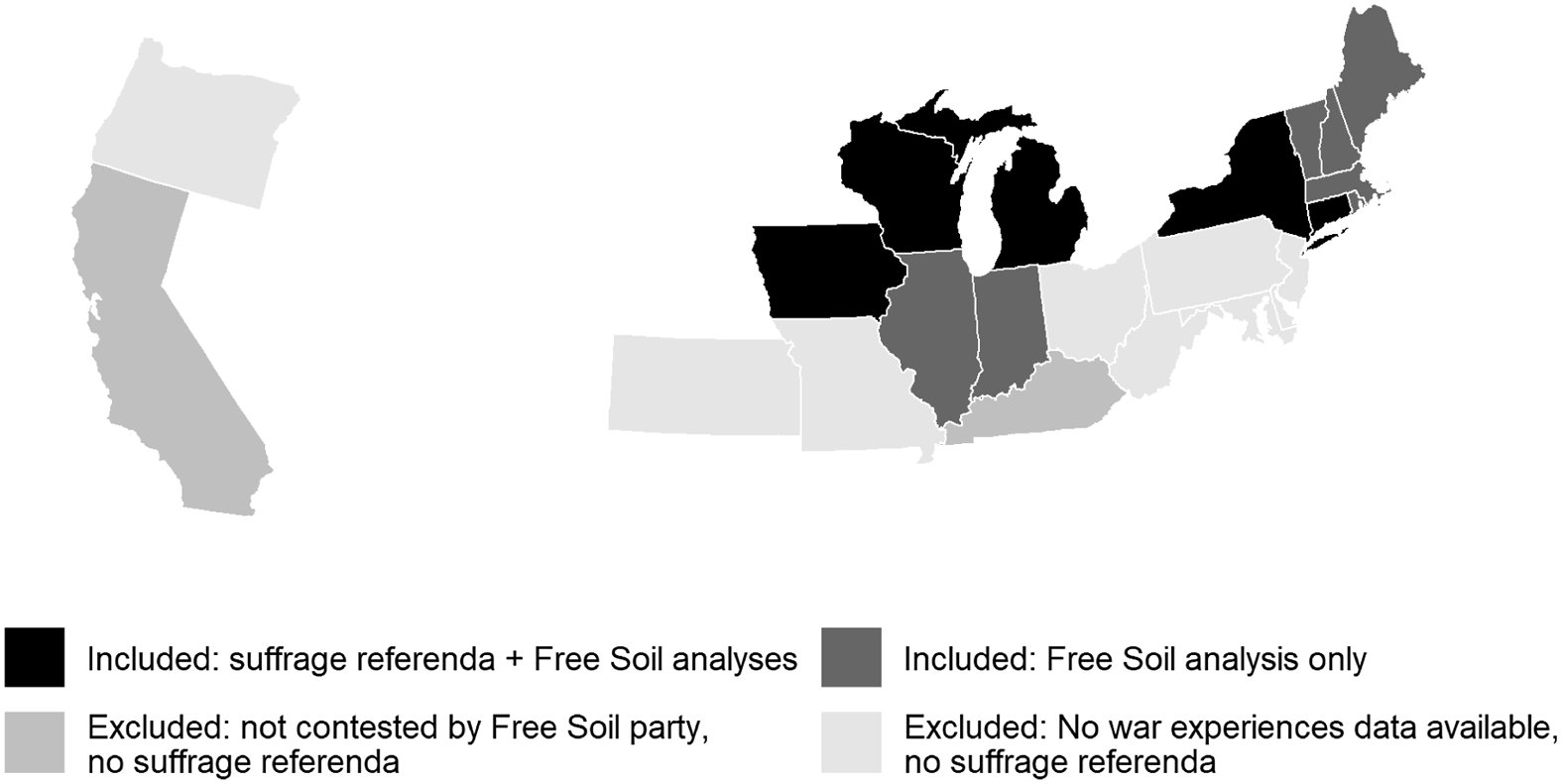
Our data are drawn from multiple sources. Figure 1 shows the availability of data for each type of analysis across Union states, and more details are provided in Appendix A.
Data availability across Union states

For county-level data on soldiers’ wartime experiences, we draw on Kalmoe’s (Reference Kalmoe2020) geolocation of soldier-level data from the American Civil War Research Database, which covers 15 out of 24 Union states.Footnote 17 Our measures of war participation are enlistment rate among whites (i.e., total white volunteers in a county as a proportion of military-age males) and white desertion rate (proportion of white soldiers who deserted).
For Republican vote shares, we collected county-level election returns from the ICPSR (1999) dataset. Following Kalmoe (Reference Kalmoe2020), we measure county-level Republican party support by constructing an index of the proportion of votes received by Republican candidates in presidential, gubernatorial, and congressional elections (where data is available) during 1856–60.
For pro-suffrage referenda, we collected county-level election returns for all the referenda held during 1846-62.Footnote 18 Our analysis uses data from five referenda: Connecticut in 1847, Michigan in 1850, Wisconsin in 1857, Iowa in 1857, and New York in 1860. In states where there were multiple referenda, we choose those that took place closest to the war. This decision is bolstered by the high county-level correlation across referenda: +0.81 for the 1860 and 1846 referenda in New York and +0.82 for the 1857 and 1846 referenda in Wisconsin.Footnote 19 The total number of counties with available pre-war referenda data is 221.Footnote 20
For Free Soil vote shares, we collected county-level election returns from the ICPSR (1999) dataset. These data cover 433 counties in 12 states. This excludes three out of the 15 states where wartime experience data are available: Minnesota, which was not a state until 1858, and California and Kentucky, which were not seriously contested by the Free Soil party.Footnote 21 We measure county-level Free Soil support by constructing an index of the proportion of votes received by Free Soil candidates in presidential, gubernatorial, and congressional elections that the party contested during 1848-53.Footnote 22
Finally, we collected data on county population, immigrant population, and wealth per capita from the 1860 Census.
Analysis
To assess how well attitudes toward Black political equality explain volunteer enlistment compared to Republican partisanship, we estimated three linear regression models predicting total volunteer enlistment. Each model has a different specification of independent variables: one with the Republican vote index, one with pro-suffrage vote share, and one with both. These models include observations from counties in the five states where suffrage referenda data are available.Footnote 23 All models use robust standard errors, are weighted by the number of voting-age males in 1860, and include controls for county population, proportion immigrant, and wealth per capita in 1860.
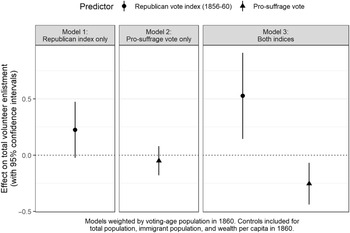
Figure 2 shows the results of these models. The Republican vote index has a moderately positive relationship with enlistment (p = 0.08). Pro-suffrage vote share, on the other hand, does not have a clear relationship with enlistment. When including both Republican and pro-suffrage support as independent variables, the coefficient for the Republican vote index is positive (p = 0.01) while that of pro-suffrage vote share is negative (p = 0.01). These findings suggest that Republican partisanship better explains enlistment than favorable attitudes toward Black political equality. In other words, counties with particularly high rates of pro-suffrage support were not more likely to contribute volunteer soldiers than Republican counties more generally. The persistence of a positive coefficient on the Republican vote index after controlling for pro-suffrage support indicates that there may have been more mobilization in strongly Republican counties populated by racial moderates.
Pro-suffrage/Republican vote shares and enlistment

To assess how well antislavery attitudes explain volunteer enlistment compared to Republican partisanship, we estimated a similar set of three linear regression models. Each model has a different specification of independent variables: one with the Republican vote index, one with the Free Soil vote index, and one with both. These models include observations from counties in the 12 states where Free Soil and war participation data are available. We use robust standard errors and the same weighting and controls.
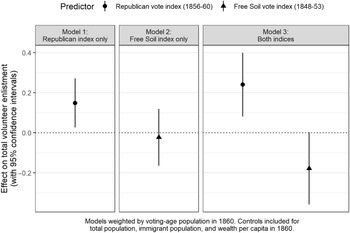
Figure 3 shows the results of these models. The Republican vote index has a positive relationship with enlistment (p = 0.02), while the Free Soil vote index has no clear relationship. When including both vote indices as independent variables, a positive coefficient for the Republican vote index persists (p = 0.003), while the Free Soil vote index has a negative coefficient (p = 0.05).Footnote 24 These findings suggest that Republican partisanship better explains war participation than antislavery attitudes. In other words, counties with higher rates of antislavery attitudes were not more likely to contribute volunteer soldiers than Republican counties more generally.
Free soil/Republican vote shares and enlistment

In sum, we find that neither pro-Black political equality nor antislavery attitudes directly corresponded with county-level enlistment patterns, while Republican partisanship did. The relationship between local Republican votes and local enlistment persists even after we account for competing race-related views.
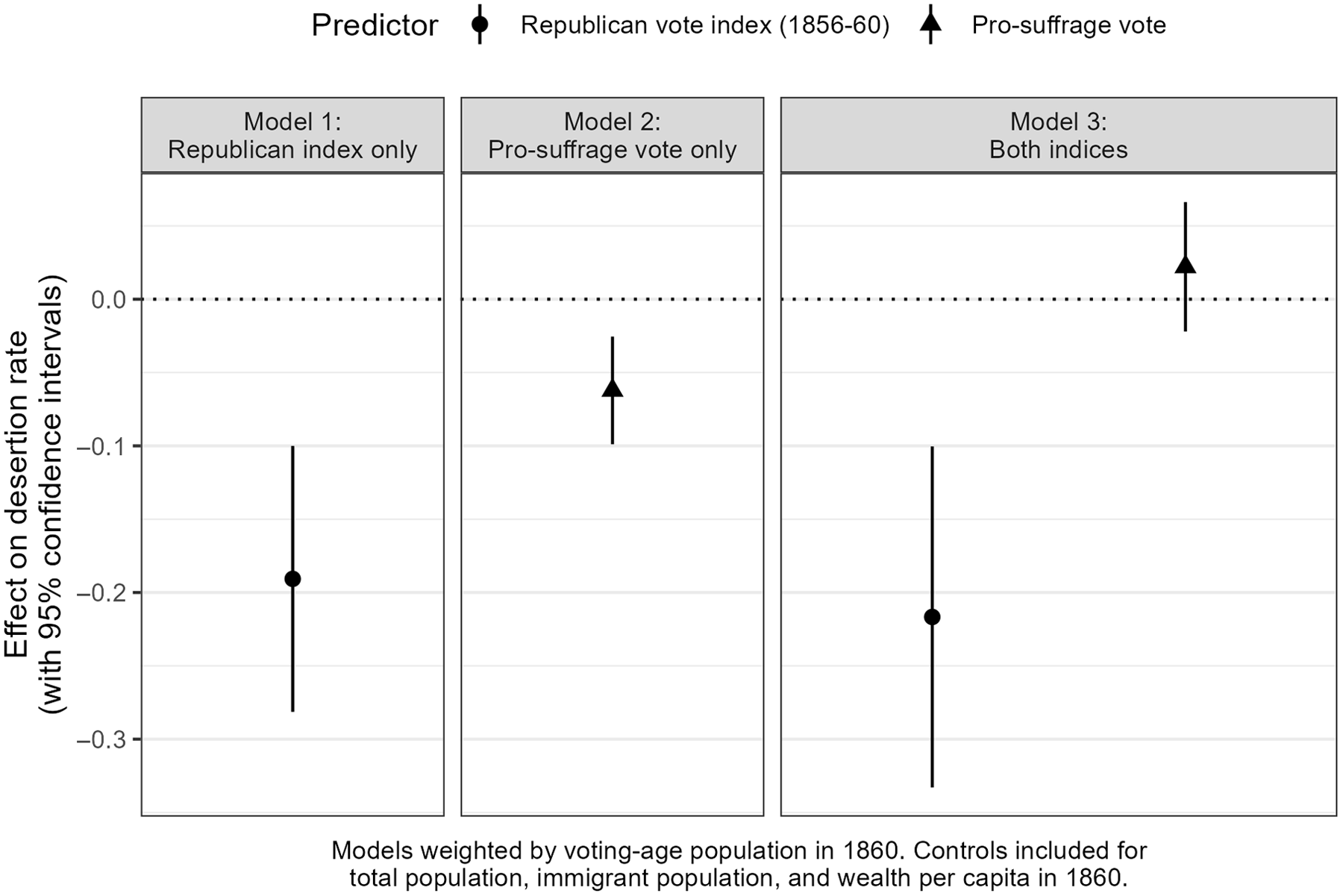
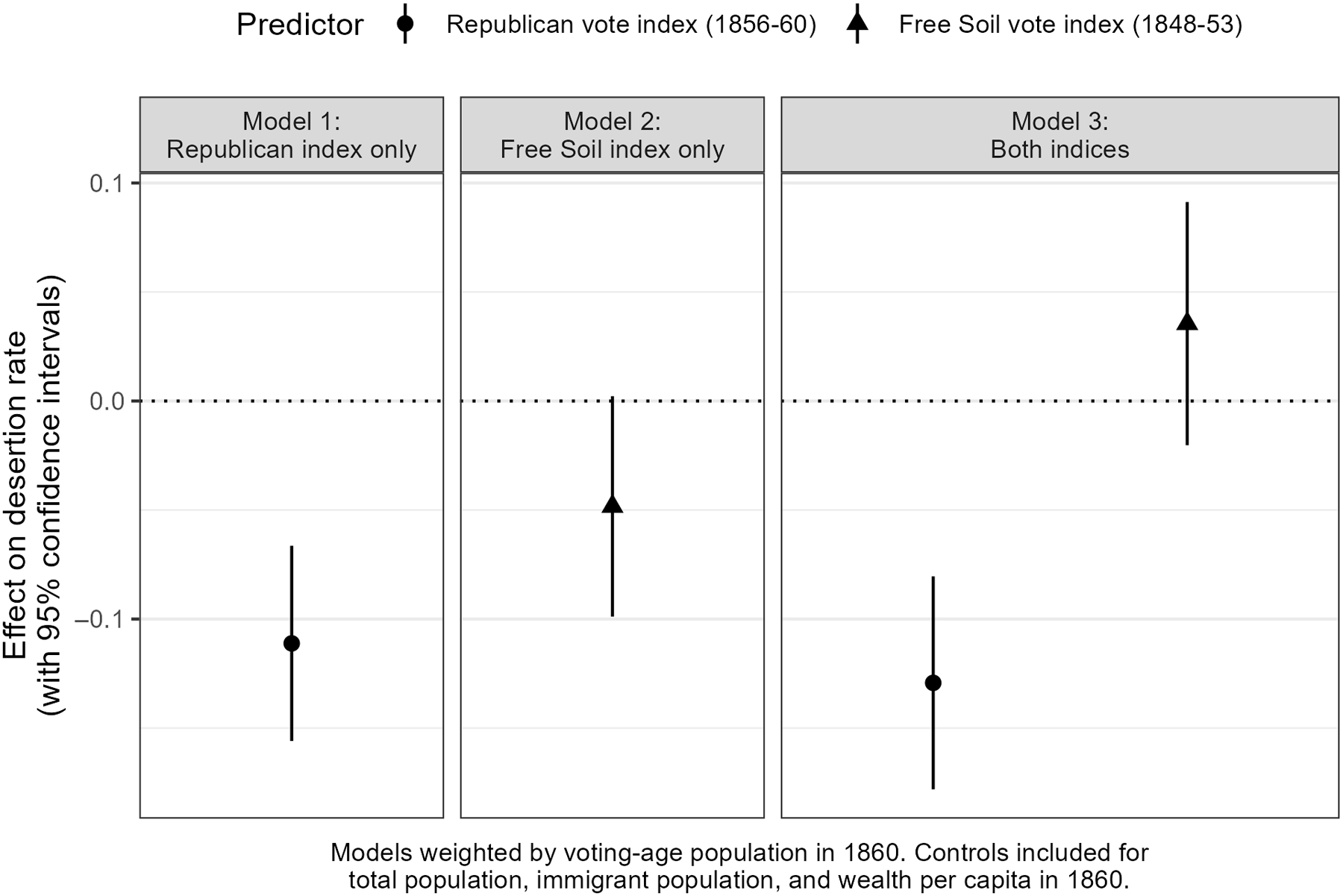
As an additional measure of war participation, we examined rates of desertion among white soldiers. Lower rates indicate greater commitment to war participation among white soldiers from that county. We estimated additional models using the same specifications as those discussed above, this time predicting white desertion rates. Note that these models look for explanations for wartime behavior beyond partisan selection effects on enlistment. Figure 4 shows that the Republican vote index (p<0.001) and pro-suffrage vote share (p = 0.001) each have a negative relationship with white desertion rates. However, when including both variables in one model, a negative coefficient persists for the Republican vote index (p<0.001) while there is no longer a clear relationship between pro-suffrage vote share and desertion. Similarly, Figure 5 shows that both the Republican vote index (p<0.001) and the Free Soil vote index (p = 0.06) each have negative relationships with desertion rates. However, when including both indices in one model, only the Republican vote index has a clear negative relationship (p<0.001). These findings suggest that while soldiers from counties with higher levels of pro-suffrage or antislavery views were less likely to desert, Republican partisanship still offers a better explanation than these attitudes.
Pro-suffrage/Republican vote shares and desertion

Free Soil/Republican vote shares and desertion

How partisan elites viewed public war motives
Perceptions that northern soldiers primarily saw the Civil War as an antislavery crusade may be grounded in anecdotal accounts like the following excerpt from a letter from Dr. S.G. Perkins (1st Vermont Cavalry Regiment) to the Rutland Herald in July 1862, anticipating the theme of violent moral balance (but certainly not the reconciliation) of Lincoln’s Second Inaugural two years later:
We can never end this war, nor will full and complete success crown our arms, till we make common cause with the negro, arm him, and trust him as a weaker brother, and by a combination of terror and extermination, destroy the race of slaveholders on this continent. I know this will be a terrible course—bloody and horrible. But by what sort of cataclysm can any one expect the two hundred years of torture and wrong… to be closed? … To the hands of the North have been committed the sword and flame of avenging justice.
But were Perkins’ evocative antislavery motives shared broadly by other potential recruits?
Here, we examine communication between party elites and the mass public to learn which considerations elites thought would motivate (or inhibit) mass war participation most. This indirect evidence shows us both what considerations party elites expected would shape public willingness to fight and what messages they actually employed to accomplish that (de)mobilization. In that way, the frames elites used in their public campaigns are plausible candidates for the frames that aligned most with motives for public behavior (see, e.g., Sides, Tesler, and Vavreck Reference Sides, Tesler and Vavreck2018).
We analyze a representative sample of northern newspapers, which were mostly partisan at the time. Newspapers captured the messages party elites strategically aimed at a local mass audience, and they probably represented what local party leaders said through other media as well. What they wrote reflected a mix of their own views and what they thought would convince their audiences; the latter aspect captures our interests here, while the former plausibly biases our tests toward finding more of the antislavery views prevalent among party elites.
We assess the extent of newspapers’ focus on Black enslavement in three ways: 1) their descriptions of explicit war aims; 2) whether they cast blame for the war on enslavers, abolitionists, or neither; and, more diffusely, 3) their stated advocacy about partial or total emancipation. We find that antislavery views were not a focal point in northern partisan war news nor advocacy for war mobilization. In fact, the war’s opponents were far more likely to highlight the war’s antislavery implications than its advocates.
These newspaper tests provide another opportunity for potential antislavery sentiment to appear as a key motivator, but it does not. The results suggest elites did not expect public antislavery sentiment was prevalent enough to systematically boost war participation, and that, in practice, pro-war elites generally did not attempt to motivate Union enlistment with antislavery appeals.
Coding methods
To generate a selection of news content representing what ordinary northerners read, we apply probability sampling to a population list of Civil War-era newspapers. We briefly summarize selection and coding methods here, with more details in Appendix B. We began with Rowell’s American Newspaper Directory, an 1868 census of newspapers. The directory includes the year the paper began publishing, partisan leanings (if any), and circulation by town and state. We probabilistically selected 24 general-interest newspapers founded before 1861,Footnote 25 four from each of six regions, with paper selection weighted by circulation within each region.Footnote 26
Our sample includes 7 Democratic papers, 12 Republican papers, and 5 independent papers. We picked seven dates for analysis, corresponding with new calls for troops and elections, while also spaced evenly throughout the war with two dates per year. These regular intervals provide snapshots of news content throughout the war. Our unit of analysis is an issue, i.e., the contents of a newspaper on a single date. From 24 newspapers across seven dates during the war, we have a total of 164 issues (only 4 issues are missing).
Research assistants independently coded the content of each page of the sampled newspaper issues. We analyzed the characteristics of each issue as an aggregation of page-level variables. We compare Republican papers—which were always pro-war—with Democratic papers that began with support for the war before turning to opposition (mostly from 1863 onward).
War aims
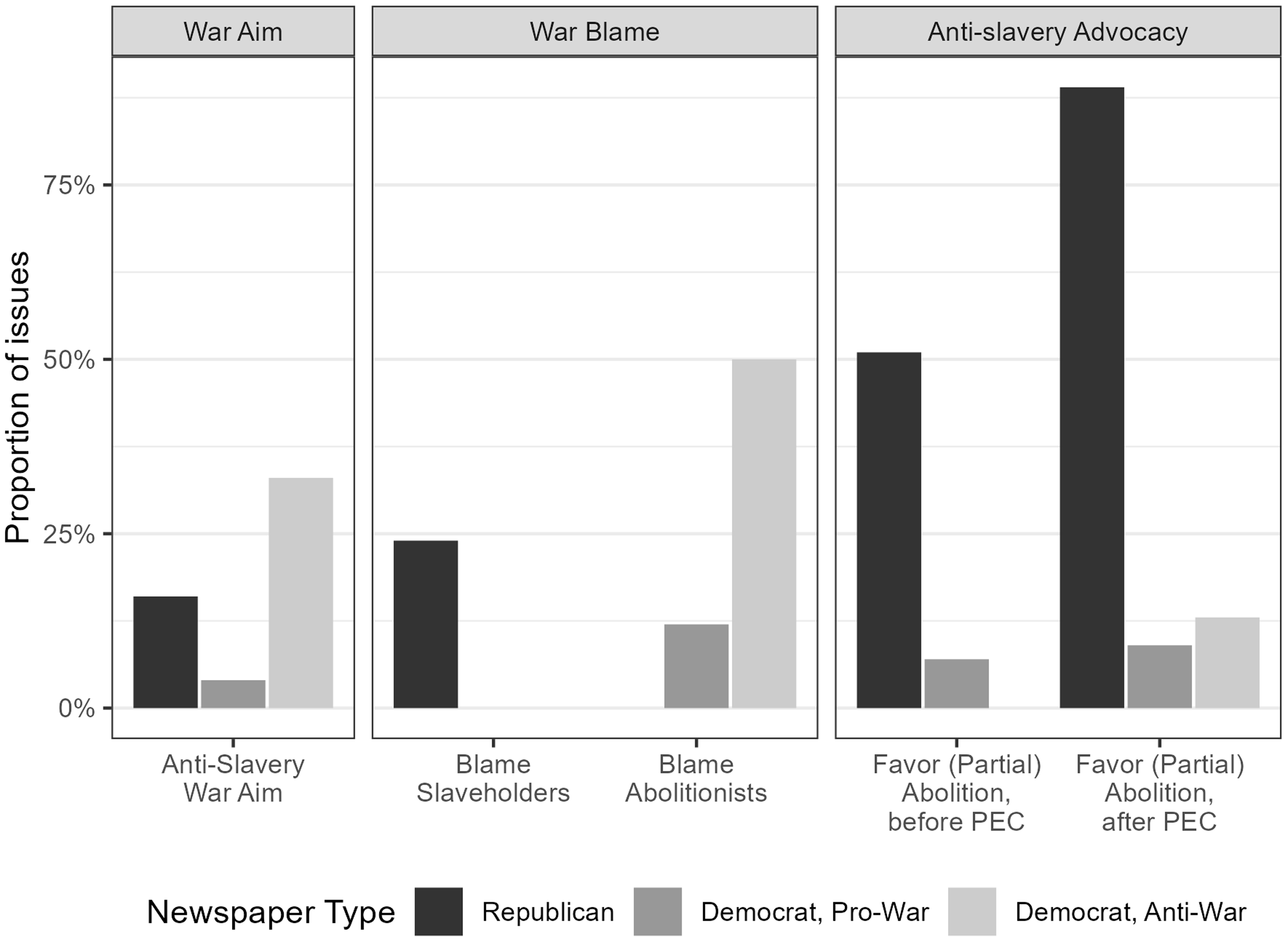
How many newspapers described ending slavery as the war’s primary aim (whether they favored that aim or not)? As Figure 6 shows, an antislavery aim was cited by 16% of Republican papers, 4% of pro-war Democratic papers, and a whopping 33% of antiwar Democratic papers. In other words, war opponents were much likelier to highlight the war’s antislavery implications than proponents.
Prevalence of slavery-related rhetoric in sample of newspapers

Far and away, the most stated war aim involved the lofty goals of restoring the Union, maintaining the Constitution, or so on. Republicans invoked such ideas to mean sustaining a Lincoln administration whose legitimate governance was threatened by rebellion. 74% of Republican newspapers included rhetoric making that war aim clear. Among Democratic newspapers, 68% cited this aim when they were pro-war, but only 50% did when they moved against the war.
War blame
Another way slavery might be invoked in blame cast for the war’s carnage. Blaming slaveholders could just be an accurate analysis of the war’s origins rather than a sign of antislavery views, but antislavery views would certainly motivate that target for blame. Republican papers blamed enslavers in 24% of their issues while Democratic papers in the sample never did. For example, the Republican Chicago Tribune wrote: “While all deplore the war, the sentiment is universal that this wicked slaveholder’s rebellion must be put down at any cost of treasure and life” (July 24, 1862). In contrast, Republicans never blamed abolitionists, pro-war Democratic papers blamed them 12% of the time, and antiwar Democratic papers blamed them 50% of the time. Once again, war opponents were more likely to invoke groups for or against enslavement than war supporters.
More often, newspapers cast blame on the South and secessionists generally. Republicans were far likelier to do so (67%) than Democrats (27%), even in issues where Democratic papers somewhat supported the war (40%). Some issues blamed both sides: Republican papers never did so, but Democratic papers sometimes did when they supported the war (20%) and more so when they opposed it (33%).
Democratic papers sometimes blamed Republicans, in 8% of issues when they supported the war and 67% when they opposed the war. Republicans did not reciprocate, however, with only 4% blaming Democrats, preferring to focus on the regional target. Republican newspapers did often note the intersection of region and party: 23% specifically noted that the rebellion was led by Southern Democrats, a point that only 4% of Democratic papers made.
Antislavery advocacy
Finally, we examine more diffuse linkages, providing the maximum opportunity for connections between war support and antislavery to shine through. Namely, does the newspaper advocate an end to slavery, even if this is not explicitly linked to the war? For this assessment, we consider rhetoric before and after Lincoln proposed the preliminary Emancipation Proclamation (PEC) in September 1862, effectively changing the nature of the war. Notably, over half of white U.S. military enlistments had already occurred before then, and the draft began in 1863 to make up for the relative shortage of additional volunteers, changing the enlistment calculus.
Half of Republican papers mentioned some support for at least partial abolition before the PEC, and 89% did on the dates after. In contrast, roughly 10% or fewer Democratic papers endorsed abolition before or after the PEC. That certainly reflects the stark partisan divides on enslavement among the party elites who funded, edited, and wrote for their party’s newspapers. It might also provide some mechanisms for motivating enlistment among ordinary partisans, but it would be a far more indirect route for influence than those examined above. A plausible interpretation for pro-emancipation rhetoric in Republican newspapers is that party elites did not presuppose support for emancipation among ordinary partisans—as evidenced by their lack of stating it as a war aim—but rather were sending cues about the party’s changing position on the issue.
Discussion
Overall, we find little evidence in northern newspaper rhetoric that party elites saw antislavery messaging as an effective way to mobilize white enlistment in Union armies and war support more generally. It was the war’s Democratic opponents in the North who alleged an antislavery motive as a criticism of the war effort, accusing Republicans of aiming to replace white supremacy with social, economic, and political equality. If anything, then, party elites on both sides expected that racist attitudes would reduce enlistment more than antislavery attitudes would increase it, and the rhetoric they used to mobilize for and against the war reflected those perceptions of public views.Footnote 27
Our argument about partisanship is not that pro-war newspapers explicitly identified partisanship as a justification—indeed, we find that they did not do so, focusing instead on the righteous cause of saving the Union and casting blame on southern secessionists. Rather, the critical role of partisanship was that Republican elites far more consistently conveyed these righteous messages to ordinary Republican partisans than Democratic elites did to their own followers, encouraging the divergent enlistment patterns we noted in the previous section.
Discussion and Conclusion
Our findings show that partisanship, rather than attitudes about slavery or racial egalitarianism, motivated ordinary white northerners to participate in the Civil War’s mass violence. Communities that were especially opposed to slavery, as measured by support for the Free Soil party in 12 states during 1848–53, were not especially likely to contribute more volunteers during the war after accounting for local Republican votes. Communities that were more supportive of Black political equality, as measured by pro-suffrage referenda votes in five state elections held during 1847–60, were not especially likely to do so either. Rather, Republican partisanship defined the communities that most supported war effort in terms of volunteer enlistment and lack of desertion. Furthermore, wartime newspapers show that Republican party elites avoided making antislavery appeals as they sought to mobilize war participation; instead, they appealed to the restoration of the Union and the Constitution. It was actually anti-war Democrats who described the war’s antislavery implications most. These results show elite perceptions of public views: Republican leaders apparently viewed patriotic values as better bets for mobilizing the northern public than antislavery appeals, while anti-war Democratic leaders saw emphasizing abolition as a powerful opportunity to mobilize against the war.
While we do not explore the bases of antebellum mass partisanship in this article, existing research offers ample evidence for strong partisan identity even in the absence of attitudinal congruence on key issues. Extensive scholarship has argued that mass partisanship is a social identity rather than a response to party performance or a reflection of issue preferences (Huddy and Bankert Reference Huddy and Bankert2017). Bensel (Reference Bensel2004) finds that social relationships and ethnocultural identities, mediated by sociological context, were crucial to mid-19th century voting behavior. We expect that such factors undergirded the partisanship of antebellum voters.Footnote 28
We do not deny the broader role of antislavery or racially egalitarian views in Civil War-era politics. Indeed, the sustained activism of abolitionists and advocates of racial egalitarianism played a crucial role in creating new cleavages in the party system and later pushing the Republican party toward emancipation and radical Reconstruction policies (and some abolitionists surely saw the war as an opportunity for antislavery action; see, e.g., McPherson Reference McPherson1997).Footnote 29 Instead, what our findings highlight are distinctions in the motivations of activists, party elites, and the mass public. Activists played an important role, not by transforming mass public attitudes directly, but rather by fueling the transformation of political parties.Footnote 30 This, in turn, enabled the mobilization of partisans in the mass public—many of whom did not hold antislavery or racial egalitarian views—to fight in a war that ended slavery.Footnote 31 There is some evidence that participating in the conflict itself increased antislavery and racial egalitarian attitudes among white northern soldiers (Manning Reference Manning2007; Weaver Reference Weaver2022). Many Republican voters may have come to see abolition as important means for accomplishing their war aims once Republican leaders showed the way, similar to modern opinion leadership dynamics (see, e.g., Lenz Reference Lenz2012; Zaller Reference Zaller1992). However, our evidence shows that two types of pre-war racial attitudes cannot explain patterns of mass mobilization among northern white men, in contrast with the potency of pre-war Republican partisanship.
Likewise, we recognize that group attitudes certainly do motivate violence in other cases. The long history of white supremacist violence in the U.S. clearly shows that racial attitudes can be the proximate cause of individual participation in political violence. In the Civil War, however, the mass mobilization of northern white combatants emerged more from partisan mobilization differences rather than race-relaetd views.
Our findings invite a re-assessment of the role of partisanship and public opinion in the failed potential of Reconstruction to advance an “abolition-democracy” that would pursue racial equality through redistribution and advancement of civil and political rights (Du Bois Reference Du Bois2014 [1935]). Historical accounts often point to northern public opinion, characterized by a longstanding opposition to racial equality, as a key reason for Republican politicians’ retreat from policies advancing the civil and political rights of African Americans (see, e.g., Foner Reference Foner2014 [1988]; Richardson Reference Richardson2007; Simpson Reference Simpson2016; E. B. Alexander Reference Alexander, Baker and Donald2020; Jenkins and Peck Reference Jenkins and Peck2021). On the one hand, our findings underscore that support for abolitionist and egalitarian claims was limited in the northern white public. Prior to the war, restrictive “black laws” were common in the north (Masur Reference Masur2021), the Free Soil and Liberty parties never achieved more than 15% of the northern vote, and state legislatures and electorates consistently disenfranchised Black people. We have further shown that white northerners’ participation in the war was not generally driven by views about slavery or race, despite slavery’s central role in causing the war and its abolition through war.
On the other hand, our analysis suggests that political parties can be a potent force through which politicians and activists heighten conflict and pursue social and political change. The war created an opportunity for activists and enslaved people to push public policy toward abolition. Republican elites successfully motivated mass participation of ordinary partisan communities in the war’s mass violence, including those who had not expressed support for abolition or racial egalitarianism. In other words, our analysis is a reminder that public opinion is not the fixed constraint on the course of action available to politicians as it is sometimes imagined to be. Assessments of the Republican party’s Reconstruction policies should thus consider not only the party’s response to northern public opinion, but also its failure to mobilize and persuade the northern mass public, especially Republican partisans.
Most broadly, our analysis underscores the potency of partisanship to create or enable dramatic social transformation. Even when political conflicts drive toward particular goals, ordinary people may be mobilized by partisan attachments without being motivated by those goals. Thus, for activists and elites pursuing political change, expanding the scope of partisan conflict to incorporate their issue of concern provides an opportunity to mobilize the mass public without undertaking mass persuasion. This is a particularly significant mode of change for those concerned with the rights of disenfranchised or minority groups. Partisanship holds immense potential: it can be deployed in lethal ways, in defense of the oppressed or the oppressor—or both.
Supplementary material
To view supplementary material for this article, please visit https://doi.org/10.1017/rep.2022.19
Acknowledgements
We thank Aaron Sheehan-Dean, Jonathan Earle, Michael Weaver, Matthew D. Nelsen, Margaret Brower, Warren Snead, and anonymous reviewers for their feedback. We are grateful to Michael Weaver, Annakathryn Welch at the Archives of Michigan, and Lee Grady at the Wisconsin Historical Society for help in locating suffrage referenda data, and to Cole Catherine Dunnam for assistance in tabulating these data. Thanks to librarians at the Library of Congress, St. Louis Public Library, Cincinnati Public Library, Wisconsin Historical Society, American Antiquarian Society, New Hampshire State Library, Iowa State Library, Boston Public Library, and Monmouth College for newspaper access, and to Tim Klein and Elias Shammas for their newspaper content coding. This research was supported by the Northwestern University/American Bar Foundation Doctoral Fellowship and the Manship School of Mass Communication at Louisiana State University.