


Introduction
There is abundant evidence showing that poor quality of relationships between adolescents and their caregivers is related to depressive symptoms (see Green and Goldwyn, Reference Green and Goldwyn2002). According to Alloy, Abramson, Smith, Gibb and Neeren (Reference Alloy, Abramson, Smith, Gibb and Neeren2006), negative cognitive patterns such as low self-esteem, self-criticism, dysfunctional attitudes, negative cognitive styles, and rumination may mediate the relation between parenting variables and symptoms of depression. In a similar vein, negative cognitive styles (Margolese, Markiewicz and Doyle, Reference Margolese, Markiewicz and Doyle2005) and dysfunctional attitudes (Roberts, Gotlib and Kassel, Reference Roberts, Gotlib and Kassel1996) were found to mediate the relation between attachment variables and depression.
Beck (Reference Beck1964) has noted that the impact of parents on depression might be at the schematic level of cognition. According to Young (Reference Young1994), schemas are information processing structures concerning beliefs about the self, others, and the future. Schemas originate from early experiences with primary caregivers and are further established in peer relations during childhood and adolescence (Mash and Dozois, Reference Mash, Dozois, Mash and Barkley2003). There is considerable support for an association between early relational experiences and early maladaptive schemas (e.g. Muris, Reference Muris2006) and that schemas are related to symptoms of psychopathology such as depression in adulthood (Riso, du Toit, Stein and Young, Reference Riso, du Toit, Stein and Young2007) and adolescents (van Vlierberghe, Braet, Bosmans, Rosseel and Bögels, Reference van Vlierberghe, Braet, Bosmans, Rosseel and Bögels2010). Schemas may also mediate the relationship between attachment and depression. More specifically, schemas pertaining to the domain of rejection and disconnection (i.e. one's needs for security, safety, stability, nurturance, empathy sharing of feelings, acceptance and respect are not met) have been found to mediate the association between attachment variables and symptoms of psychopathology in young adults (Bosmans, Braet and van Vlierberghe, Reference Bosmans, Braet and van Vlierberghe2010). Moreover, Shah and Waller (Reference Shah and Waller2000) found evidence to suggest that schemas belonging to the domains of disconnection and rejection, impaired autonomy and performance, and overvigilance and inhibition, mediated the relation between parenting practices and depression in an adult depressed group.
The aim of the present study was to further investigate the relations between quality of attachment relationships of adolescents with parents and peers, maladaptive schemas, and symptoms of depression. We hypothesized that the schema domains (and maladaptive schemas) would mediate the relation between quality of attachment relationships and symptoms of depression.
Method
Participants
A total of 222 adolescents (84 boys, 138 girls) aged 12 to 18 years (mean age = 14.7 year, SD = 1.6) were recruited from three secondary schools in the southern part of The Netherlands. In total, 32% (N = 71) of the participants attended pre-vocational secondary education, 26% (N = 57) attended higher general secondary education, and 42% (N = 94) attended pre-university secondary education. With respect to children's ethnicity, 98% (N = 217) of the participants were Caucasian. Parents and children first received information about the study and, after obtaining informed consent, children completed the questionnaires during regular classes. The teacher and a research assistant were available to provide assistance and to ensure confidential and independent responding. More than 95% (222 out of 232) of the children and parents agreed to participate and provided useable data. The study protocol was approved by a local Institutional Review Board.
Measures
Maladaptive schemas. The 75-item version of the Young Schema Questionnaire (YSQ; Young and Brown, Reference Young and Brown1990) is a self-report questionnaire that assesses 15 primary maladaptive schemas (Young, Klosko and Weishaar, Reference Young, Klosko and Weishaar2003). For the YSQ-A, items were rephrased so as to be comprehensible and appropriate for an adolescent life style. The YSQ-A was back-translated, sent to the original author and subsequently approved (van Vlierberghe et al., Reference van Vlierberghe, Braet, Bosmans, Rosseel and Bögels2010). Each item is scored on a Likert type scale from 1 (completely untrue of me) to 6 (describes me perfectly). There are five items for each schema, and each schema score is calculated by obtaining the average of these five items. Factor analytic research on the schema domains of the YSQ-A has favoured a five-factor model (van Vlierberghe et al., Reference van Vlierberghe, Braet, Bosmans, Rosseel and Bögels2010), which was used in the current study: “disconnecting and rejection” (schemas: mistrust/abuse, emotional deprivation, defectiveness/shame, social isolation/alienation, abandonment/instability and emotional inhibition); “impaired autonomy” (schemas: dependency/incompetence, vulnerability to harm/illness, enmeshment/undeveloped self, failure to achieve); “impaired limits” (schemas: entitlement/grandiosity and insufficient self-control/discipline); “other-directedness” (schemas: subjugation and self-sacrifice); and “overvigilance/inhibition” (schemas: emotional inhibition, unrelenting standards).
Caregiver and peer relationships. The Inventory of Parent and Peer Attachment (IPPA; Armsden and Greenberg, Reference Armsden and Greenberg1987; Dutch version: Muris, Meesters, van Melick and Zwambag, Reference Muris, Meesters, van Melick and Zwambag1991) is a 53-item self-report instrument that assesses positive and negative affective and cognitive dimensions of adolescents’ relationships with their parents (28 items) and close friends (25 items). Participants are asked to rate the degree to which each item is true for them on a five-point Likert-type scale ranging from “almost always or always true” to “almost never or never true”. The IPPA consists of three scales: trust (e.g. degree of mutual understanding and respect in the attachment relationship), communication (e.g. extent and quality of spoken communication), and alienation (e.g. feelings of anger and interpersonal alientation). The IPPA has proven to be reliable in terms of internal consistency (Cronbach alpha ranges from .79 to .86) and its validity has been supported by medium size correlations with parental bonding (e.g. Armsden and Greenberg, Reference Armsden and Greenberg1987; Gullone and Robinson, Reference Gullone and Robinson2005; Muris et al., Reference Muris, Meesters, van Melick and Zwambag1991).
Depression. The Beck Depression Inventory (BDI-II; Beck, Steer and Brown, Reference Beck, Steer and Brown1996; Dutch version: Van der Does, Reference Van Der Does2002) is a 21-item self-report measure of depressive symptomatology designed for adolescents and adults. Each item assesses a specific depression symptom or attitude that represents the DSM-IV depressive symptomatology, and is presented in a forced choice format ranging from 0 to 3 in terms of severity. Reliability and validity of the BDI-II in adolescents are satisfactory (Ambrosini, Metz, Bianchi, Rabinovich and Undie, Reference Ambrosini, Metz, Bianchi, Rabinovich and Undie1991; Van der Does, Reference Van Der Does2002).
Data analysis
The Statistical Package for Social Sciences (SPSS) was used for computing descriptive statistics, internal consistency ratings, carrying out t-tests for exploring gender differences on the schema scales, and performing regression analyses for the mediation analysis. Depression scores as indexed with the BDI-II were not normally distributed (i.e. skewness = 1.66, kurtosis = 3.87). A root-square transformation was successful in “normalizing” the depression scores (i.e. skewness = .15, kurtosis = −.19) and was used in the mediation analyses.
Mediation was assessed by examining indirect effects as employed by Preacher and Hayes’ (Reference Preacher and Hayes2008) bootstrapping procedure (with n = 5000 bootstrap resamples). Bootstrapping circumvents the normality assumption applied to the indirect effect, which holds for the causal steps approach to mediation by Baron and Kenny (Reference Baron and Kenny1986) and the use of the Sobel test (normal-theory based). Moreover, the model specified by Preacher and Hayes (Reference Preacher and Hayes2008) enables a determination of which mediator(s) is responsible for the mediating effect. In assessing indirect effects, 95% (bias-corrected) confidence intervals for the parameter estimates of the indirect effects were calculated. A parameter estimate of an indirect effect is significant if the case zero is not contained in the confidence intervals. A stepwise approach was used in which the starting point was a model with schema domains as mediators. In the case that a schema domain emerged as a significant mediator, the mediating effects of the schemas comprising that domain were investigated. Multicollinearity in the regression analysis was examined by means of the variance inflation factor (VIF), which should normally be below 10.
Results
Preliminary analyses
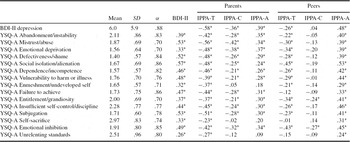
The internal consistency ratings of the schema scales were moderate to good (see Table 1).
General descriptive statistics, internal consistency ratings, and correlations between self-report questionnaires

Notes: BDI-II = Beck Depression Inventory; YSQ-A = Young Schema Questionnaire for Adolescents IPPA = Inventory of Parent and Peer Attachment. IPPA-T = IPPA-Trust; IPPA-C = IPPA-Communication; IPPA-A = IPPA Alienation; *p < .001.
Relations between indices of quality of attachment relations with parents and peers, maladaptive schemas, and symptoms of depression
All maladaptive schemas showed significant associations with symptoms of depression (see Table 1). Most indices reflecting quality of attachment relationships were also significantly associated with symptoms of depression, with communication with peers being the only exception. The associations between indices of quality of attachment relationships and maladaptive schemas are also presented in Table 1. Trust in parents and peers were significantly related to most schemas, with correlations for parents being somewhat higher than for peers. Communication with parents, but to a lesser extent with peers, was also related to schemas. Finally, alienation from parents and peers was related to schemas, with correlations for peers being somewhat stronger than for parents. Thus, the indices of quality of attachment relationship were associated with maladaptive schemas in adolescents but seem to differ somewhat in magnitude for parents compared to peers.
Mediation of maladaptive schema domains and schemas in the relation between quality of attachment relations and symptoms of depression
In assessing whether maladaptive schema domains and schemas mediate the relation between indices of quality of relationships and symptoms of depression, the unique contribution of these variables in explaining variance in depression scores was examined first. A regression analysis was carried out with the six IPPA scales (for parents and peers) as predictor variables and symptoms of depression as dependent variable (alpha at 1%). Trust in parents (β = −.38, t = −4.31, p < .001) and alienation from peers (β = .31, t = 4.45, p < .001) were significant predictors of depressive symptoms while controlling for the remaining variables. Variance inflation factors (VIF) ranged between 1.76 and 2.91, indicating that multicollinearity did not influence the results.
We conducted two bootstrapping mediation analyses with the five schema domains (see Young et al., Reference Young, Klosko and Weishaar2003) as mediators and symptoms of depression as the dependent variable. In the first mediation analysis, trust in parents was the independent variable (controlling for the effects of alienation from peers), whereas in the second mediation analysis, alienation from peers was the independent variable (controlling for the effects of trust in parents). The schema domain disconnection and rejection was found to significantly mediate the relation between trust in parents and symptoms of depression [95% CI (.03 – .20)]. The total model accounted for 49% of the variance in depression scores. We further assessed which schemas within the schema domain disconnection and rejection were responsible for the mediating effect. The schemas mistrust [95% CI (.01 – .15)] and social isolation [95% CI (.01 –.12)] significantly mediated the relation between trust in parents and depressive symptoms. In the second bootstrapping mediation analysis, alienation from peers was the independent variable. The schema domains “rejection and disconnection” [95% CI (.01 – .16)] and “other directedness” [95% CI (.01 – .05)] were significantly associated with symptoms of depression and were both found to mediate the relation between alienation from peers and depressive symptoms. The total model accounted for 49% of the variance. Within the schema domains “rejection and disconnection” and “other directedness”, the schemas social isolation [95% CI (.02 – .15)] and self-sacrifice [95% CI (.01 – .08)] significantly mediated the relation between alienation from peers and symptoms of depression.
In the light of possible multicollinearity, we ran a series of linear regression analyses with depression scores as the dependent variables and the schema domains or first order schemas in subsequent analyses as the independent variables. Variance inflation factors (VIF) ranged between 1.29 and 3.15, indicating that multicollinearity did not influence the results.
Discussion
This study examined the relationships between indices of quality of attachment relationships with parents and peers, maladaptive schemas, and symptoms of depression in a sample of non-clinical adolescents. A mediation model was hypothesized, with schema domains and maladaptive schemas as mediators in the relation between indices of quality of attachment relationships and symptoms of depression. The disconnection and rejection domain was a significant mediator in the relation between trust in parents and depressive symptoms as well as between alienation from peers and symptoms of depression. This finding concurs with the findings of Bosmans et al. (Reference Bosmans, Braet and van Vlierberghe2010), who found that schemas regarding expectations to be rejection or disconnected mediated the association between attachment anxiety and attachment avoidance dimensions and psychopathology. At the level of schemas, social isolation and mistrust (specific for parents) were significant mediators in the current study. The other directedness domain was a significant mediator in the relation between alienation from peers and depressive symptoms, with self-sacrifice being the schema responsible for the mediating effect.
Self-sacrifice and social isolation may act together in facilitating depression by feeling alone and alienated from the world but at the same time not being able to care for the emotional needs of oneself due to a tendency to put others’ needs first (Lumley and Harkness, Reference Lumley and Harkness2007). Individuals with social isolation are more likely to feel isolated and are less likely to reach out to others for help. In this context, Rubin and Mills (Reference Rubin and Mills1988) have identified two distinct forms of social isolation. Passive isolation (a behavioural reflection of social anxiety and the belief to be rejected by others) was stable across childhood and was related to peer rejection, negative social self-perceptions, and predicted depression and loneliness over time. Active isolation by others (rambunctious behaviour and being disliked) was associated with externalizing difficulties and aggression but was not predictive of future problems. Thus, the social isolation schema might reflect passive isolation.
For the relation between trust in parents and symptoms of depression, the schema mistrust/abuse was also a significant mediator. Thus, in the absence of a mutual understanding and respect in the attachment relationship between adolescents and parents, adolescents may develop the expectation that other people will humiliate or harm them, and may develop a general sense of suspiciousness towards other people (Young, Reference Young1994). This suspicion may in turn inhibit their ability to form close relationships and may be associated with symptoms of depression.
The findings of the current study may have clinical implications. Cognitive-behaviour therapy is often used as a treatment for juvenile depression. The results from the current study suggest that, in addition to focusing on the adolescent, one should also focus on parental bonds (i.e. interaction between youngsters and parents). For example, Diamond, Siqueland and Diamond (Reference Diamond, Siqueland and Diamond2003) described an attachment-based family treatment (ABFT), which is a brief, manualized treatment model tailored to the specific needs of depressed adolescents and their families, such as repairing relational ruptures and rebuilding trustworthy relationships. However, in addition to targeting the parental bonds, the mediation analyses imply that treatment could also be focused on schemas. Here, schema-focused therapy might be a new direction to change maladaptive schemas in adolescents, by combining interpersonal techniques and experiential techniques within a cognitive-behavioural framework (Young et al., Reference Young, Klosko and Weishaar2003).
This study suffered from a number of shortcomings. First, the study is cross-sectional in nature, making it impossible to draw any conclusion about cause-effect relationships. As all measures were concurrent, mediated relations should be interpreted in terms of indirect associations (Little, Bovaird and Card, Reference Little, Bovaird and Card2007). It might therefore be possible that causal direction may be opposite. In this context, ratings derived from retrospective methods that have been used in studies of the relationship between early relational experiences and schemas may confound each other. That is, the constructs of attachment to parents and early maladaptive schemas appear to have common elements in that they partly refer to the same experiences and perhaps the stored memory structures of these experiences. More specifically, some of the items of the YSQ-A (the emotional deprivation items) may be indicative of attachment experiences rather than what a person thinks and believes. Furthermore, it may be that how one perceives and influences attachment relationships may be the result of an expression of maladaptive schemas. Longitudinal research may shed some light on relationships between family factors, maladaptive schemas, and symptoms of depression over time. In this context, longitudinal research has shown that social support decreases the risk for depression, but this effect is specific to parental support during early adolescence. Depressive symptoms may in turn decrease peer support but not parental support (Stice, Ragan and Randall, Reference Stice, Ragan and Randall2004). Second, the results of the current study warrant replication in non-clinical as well as clinical samples. Finally, the study relied solely on self-report questionnaires. Future research should include other methods, such as observational procedures, to obtain information about the quality of the interaction between youngsters and their parents. Despite these limitations, the present study adds to our understanding of how quality of relationships with parents and peers may contribute to explaining (variance in) depressive symptoms by considering maladaptive schemas as cognitive vulnerability for depression.



Comments
No Comments have been published for this article.