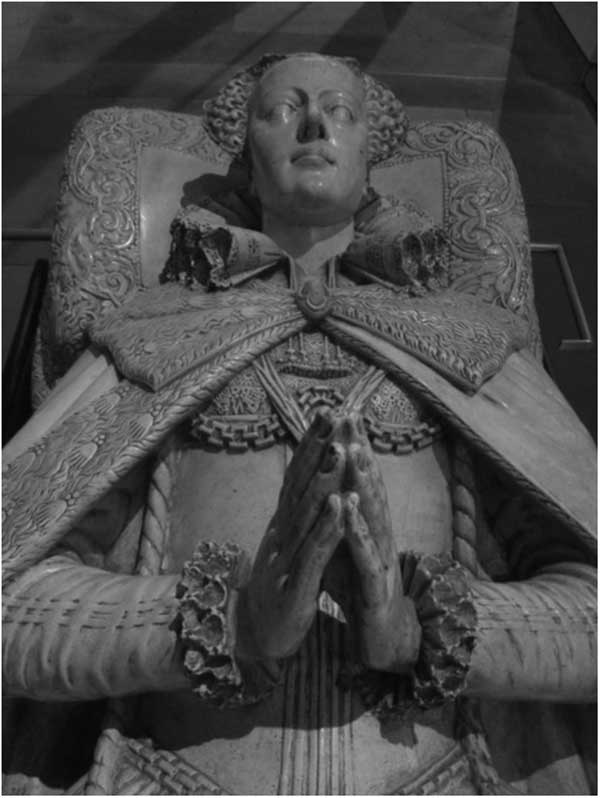
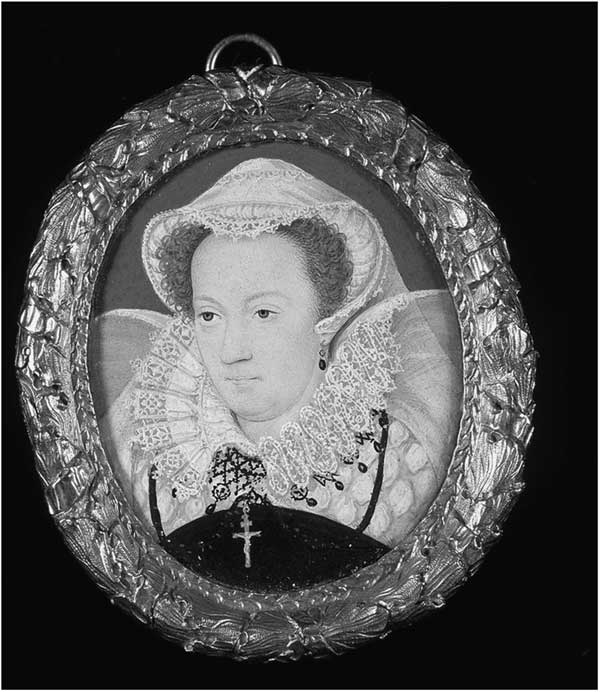
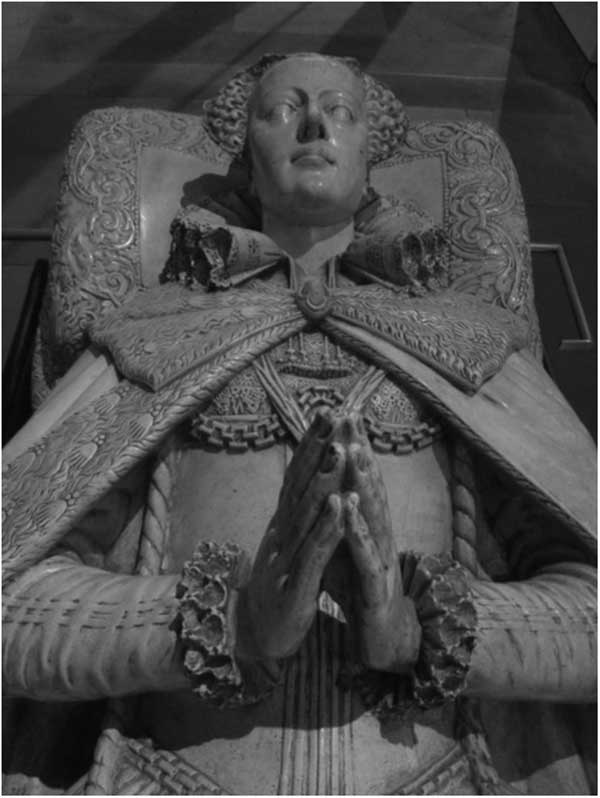
From the mid-nineteenth century up until the early-twentieth the full-length portrait of Mary Queen of Scots that remains to this day in the Hardwick Hall collection was generally viewed not only as a rare ad vivam representation of the Scottish queen in captivity—specifically in the year 1578, as inscribed in the painting—but also as the seminal basis for a whole series of subsequent likenesses of Mary known as ‘Sheffield types’, including, most conspicuously, the effigy of her tomb at Westminster Abbey (Fig. 1–2).Footnote 1 As both the Sheffield and Westminster images are packed with dynastic as well as religious symbolism, it is fitting that they might visually represent the beginning and end, as it were, of Mary’s time in England.Footnote 2 But after it was discovered that Nicholas Hilliard painted two miniatures of Mary in a similar costume and with similar facial features and demeanour (Fig. 3), Hilliard’s undated work has been cast instead as the model for the entire series of images; and the 1578 date is now typically dismissed as ‘fanciful’ in favour of a theory that the full-length portraits themselves were created in the Jacobean era as part of a political campaign to resurrect the king’s mother’s reputation (see Appendix for a comparison of the three images).Footnote 3
Mary, Queen of Scots. 1578. Panel, 193.5 by 112 cm. National Trust, Hardwick Hall © NTPL/John Hammond.

Tomb of Mary, Queen of Scots, by William and Cornelius Cure II. Rance marble, white marble, touchstone, and gilding. View of effigy. Westminster Abbey, The Royal Collection © Her Majesty Queen Elizabeth II.
Mary, Queen of Scots, by Nicholas Hilliard. c.1592. Watercolour on vellum, 4.4 by 3.8 cm. The Royal Collection, Windsor © Her Majesty Queen Elizabeth II.
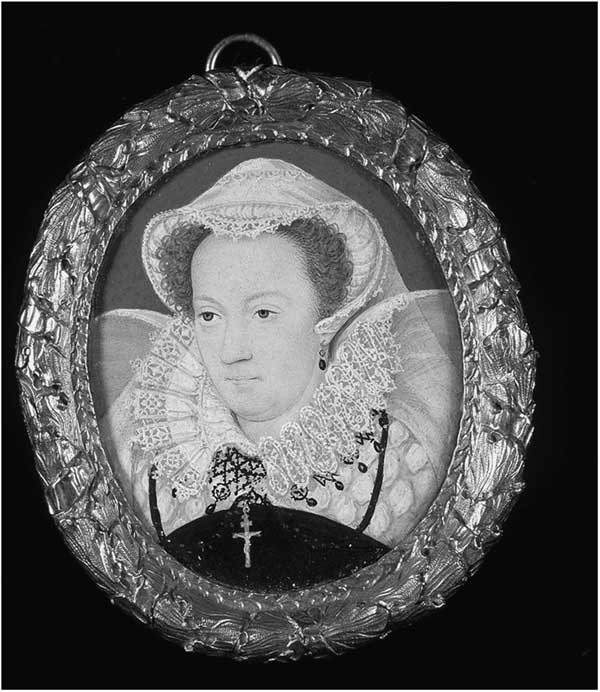
Recently I discovered evidence that suggests that the older view was correct and that the Hilliard was in fact based on the Sheffield portrait, rather than vice-versa.Footnote 4 In this present study I turn to the question of whether the Sheffield is also the source of the tomb image. Using Exchequer records that show the progress of the tomb’s gestation and comparing them to accounts of Hardwick Hall that relate to portraits of the Scottish queen, I will here attempt to prove that a specific full-length portrait from Hardwick Hall served again as the basis for that culminating effigial image of Mary that has come in certain ways to symbolise James’s effort to reinforce the legitimacy of his dynasty, while strengthening Mary’s image as a pious Catholic and an innocent victim.
When he came to the English throne, in the midst of elaborate funereal tributes to Elizabeth, James evidently soon discovered a need to stress his connection to Mary in order to underline his hereditary claim as an undeniable birthright.Footnote 5 It was this need for balance that best explains the elaborate second burial of Mary at Westminster Abbey. Tellingly, an early estimate of £2,000 for the project implies that James had planned from the start to make the monument more than double the cost of the one he would simultaneously erect for Elizabeth (which indeed cost just less than £1,000), both of which took years to complete, and the former more than a decade.Footnote 6
Meanwhile, Giovanni Carlo Scaramelli, the Venetian ambassador, proclaimed that upon James’s accession pictures of Elizabeth were ‘hidden everywhere, and Mary Stuart’s shown instead with declaration that she suffered for no cause other than her religion’.Footnote 7 Scaramelli had no doubt exaggerated the situation, but his description suggests why images of Mary produced at the time might portray Catholic messages. Even though James had no intention of following his mother’s faith, he, and those serving him, may have determined early on that the best way to enhance Mary’s reputation was to commend her in some way for her religious commitment. Along with so many of her ardent supporters, Mary had so insisted throughout her life that she had indeed suffered for her faith as arguably to leave no alternative.
In this light it is notable that both images of Mary that scholars have cast as models for her tomb convey some aspect of Mary’s Catholicism. In the Hilliard miniature, for example, she wears a prominent cross. In the full-length Sheffield portraits she wears not only a necklace with a cross but also another one around her waist as part of an elaborate rosary. Both depictions emphasise her devoutness, and they do so in relative proportion, it would seem, with the opportunities presented by the available pictorial space. In the Sheffield, however, there is, within the elaborate inscription of the date, a reference to Mary’s captivity and, within the rosary, an image of an unjustly accused biblical Susanna, which moves the viewer from expressions of piety into the realm of religious politics.
The men James officially put in charge of seeing Mary’s monument to fruition, namely, Robert Cecil, (eventual) earl of Salisbury, secretary of state; Thomas Sackville, (eventual) earl of Dorset, lord treasurer; and Henry Howard, earl of Northampton, lord privy seal, well reflected the king’s financial commitment as well as his political interests in his mother’s rehabilitation effort. Sackville, of course, was there to make smooth the necessary financial arrangements.Footnote 8 By putting Cecil also (and solely, in this case) in charge of the monument for Elizabeth, James had, through this trusted advisor, the means to make sure the two monuments served his carefully planned re-balancing effort. Northampton too was close to the king, and was similarly well trusted: but he was also a crypto-Catholic strongly affiliated with Mary, who, as Peter Sherlock recently notes, had ‘corresponded with [her] during the 1580s, owned some five portraits of her, and had been imprisoned repeatedly by Elizabeth on account of his identification with [her] cause’.Footnote 9 Northampton, furthermore, would outlive both Sackville (d. 1608) and Cecil (d. 1612), and thus was the only one of the three to see Mary’s monument through to completion. He also wrote her epitaph; and, by the time the gilders were finally putting the finishing touches on the monument (in 1614), he had officially (if secretly) reconciled with the Catholic Church.Footnote 10
Under these circumstances it would seem appropriate that Northampton was the one, as evidence discussed below suggests, who had sought out and obtained an image for Mary’s effigy at the time that her tomb was under construction. To discover where Northampton found the particular image of Mary he chose for the sculpture, we turn now to the accounts of Hardwick Hall, the former residence of Elizabeth Talbot, aka Bess of Hardwick, where the goldsmith and painter Rowland Lockey, the former apprentice of Hilliard, who had served Bess in the 1590s, had returned, in 1608, to work for her son, baron William Cavendish of Hardwick:
Jan. 1609/10
To Mr Lockeyes man for goinge wth the Queene of Scottes
Picture to my Lo: of Arrundells & twoe Porters to carry it 3 [s]Footnote 11
…
21 June 1613
To Mr Lockey men that brought the Scotche queenes picture[,] iis2 [s]
To Mr Lockey for the Scotche Queenes picture presented to my lord privy seale
nyne pounds 9 [l]
for the frame and guilding yt[,] xs10 [s]Footnote 12
In discussing these and related records, Erna Auerbach argues that they all refer to ‘oil paintings in large’.Footnote 13 Several others have specifically identified the ‘Scotche quenes picture’ as the original Sheffield type.Footnote 14 To this I would only wish to add a further revision and conjecture: that the ‘Queene of Scottes’ picture that was ‘going’ out in 1609 referred to the same painting (or painting type) as the one that was ‘brought’ back to Hardwick Hall in June 1613, and that it had been used, in the meantime, as the model for the image of Mary in her tomb.
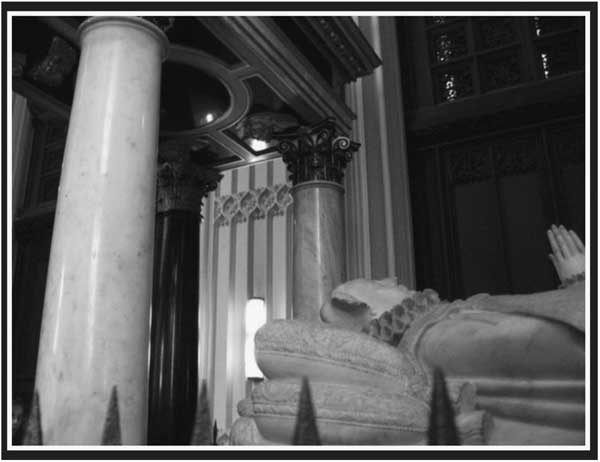
Payments from the royal treasury to Cornelius and William Cure II, the sculptors of Mary’s monument, tend to confirm the scenario suggested above.Footnote 15 On 26 November 1607 Cornelius received a payment of £120 for ‘220 foot of touchstone’ and ‘20 foot of Raunce stone … towards the framing, making, and finishing of a tomb for Queen Mary, late Queen of Scotland, according to a plot thereof drawn’.Footnote 16 Exactly what Cornelius completed before his death in 1608 is not clear, but there is notable use of rance marble and touchstone in, for example, the pillars of the monument (Fig. 4).Footnote 17
Detail, Tomb of Mary, Queen of Scots, view of rance and touchstone pillars.
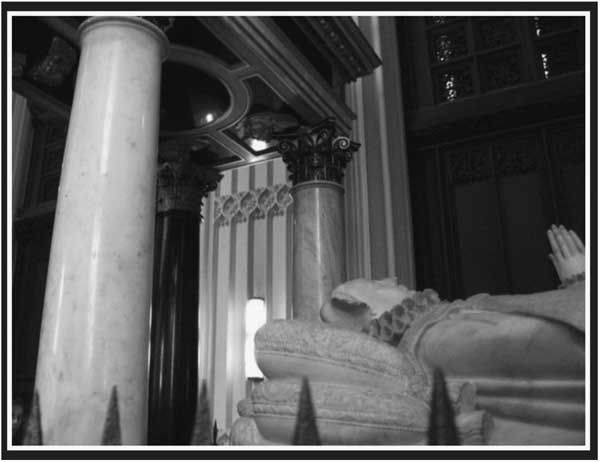
Significantly, when William, Cornelius’s nephew who carried on the project in his uncle’s stead, received his first payment, on 17 January 1610 (‘by order dated the last of December 1609’), it was for ‘five stones of white marble, containing 136 feet’.Footnote 18 It was in the same month he was paid for this white marble that a painting of Mary had left Hardwick Hall in the hands of two porters. It was decidedly white marble stone, rather than a red-hued rance or the black touchstone, into which William had cast Mary’s likeness.
William Cure II received his final payment for his work on Mary’s tomb on 31 August 1613 (fulfilling an order of 31 July).Footnote 19 This was at roughly the same time (21 June) that ‘Lockey’s men’ were also paid for transporting a painting of the Scottish queen to Hardwick Hall. There are possible variations or contingencies to ponder when dealing with circumstantial evidence of this kind, but given the timing and the project at hand, it seems hardly farfetched to contend that the Hall and Exchequer accounts jointly describe a situation where a painting of Mary that had gone out in January 1609/10—when the materials for the sculpture were purchased and ready— had served its purpose by late summer 1613 and would now, fittingly, be brought back. A closer look at this evidence, particularly the people and places involved, further suggests that this specific Sheffield type portrait, rather than the Hilliard miniature, had served as the model for Mary’s image in her tomb.
The ‘lord privy seale’ mentioned in the Hardwick accounts was of course James’s favorite, Northampton, co-director of the tomb. ‘[M]y lo: of Arundell’, it turns out, could only have been Thomas Howard (fourteenth earl of Arundel, fourth earl of Surrey, and first earl of Norfolk), the grandson of Northampton’s executed brother, another Thomas Howard, the fourth duke of Norfolk. Northampton was closely associated with Arundel in his political life and left him the greater part of his estate after his death.Footnote 20 Finally, the place to which ‘Mr Lockeyes man … and twoe Porters [were most likely] going wth the Queene of Scottes Picture’ was the newly restored and recently refurnished Arundel House in the Strand (i.e., ‘Arrundells’) in Westminster. If sometime prior to 1610 Northampton had asked his relative to obtain the painting for him—or he became aware that Arundel had the painting from Hardwick in his possession—he could have easily shown the work to the sculptor or left it at the abbey for the latter to copy as he fashioned Mary’s image in stone. Arundel House, which stood between the Strand and the Thames, was less than a mile away.
On the same day that ‘Lockey’s men’ were paid for transporting a painting of Mary, presumably back to Hardwick Hall, the painter Lockey was himself awarded the grand fee of nine pounds for a ‘picture of the Scotche quene’ and an additional ten shillings for providing a gilded frame for it. It was the largest commission he would earn at the Hall for a single work in oils. Because it was to be ‘presented to my lord privy seale’ (Northampton) there seems here to be further confirmation that the Sheffield type at Hardwick had been the model for the tomb, since the painting could now unambiguously be linked to the man who had overseen the most extraordinary monument to Mary of the time and who had also commissioned a copy of the portrait for his own collection.
As James must have realised, Northampton relished the chance to memorialise Mary for personal and political reasons. Cecil’s involvement, as suggested above, however, ‘was indicative of the project’s political dimension’, as Jennifer Woodward aptly describes it.Footnote 21 Surely the son of the man, William Cecil, lord Burghley, who had been singled out over and over as a deviously treacherous villain by Mary’s supporters, would not wish to oversee any partisan endorsement of his father’s long-time enemy unless there were compelling political reasons to do so. Yet, on 6 December 1609, just one month before the Hardwick copy of the Sheffield was delivered to Arundel House, a portrait of ‘the Queene mother of Scotland’ from the Lumley collection was delivered to Cecil, by ‘my La. Lumley’s man’.Footnote 22 This, it turns out, was possibly another copy of the Sheffield portrait, one that may still be part of the Hatfield collection.Footnote 23 Thus there is some suggestive evidence here that, despite their religious and political differences, Cecil and Northampton might have agreed on the matter of what portrait of Mary should serve as a model for the tomb.
Simply for the fact that Northampton had as many as four paintings of Mary to choose from it is worth probing a bit into the question of why he, perhaps in consultation with James and the other tomb designers, chose a specific Sheffield image of Mary for her grand memorial. For purely practical reasons, it would seem a sculptor of a life-sized effigy would likely have preferred a full-length painting as a working model, and it may have been the case, despite the potentially overruling evidence of Northampton’s ample collection, that this particular portrait type was the easiest one to locate at the time (as none of the other paintings of Mary in his collections were listed as ‘at large’, i.e., full-length). But even if so, Nigel Llewellyn has encouraged art historians to view ‘tomb-makers and patrons … as actors participating in a cultural process’ and the monuments themselves as ‘play[ing] a role in the mourning ritual which both confirmed the final physical death of the Natural Body and maintained the social presence of the subject’s Political Body’.Footnote 24 The Sheffield, with its 1578 date, mention of Mary’s captivity, and Susanna image contained perhaps the most potent political message of any representation of Mary before the tomb itself, a message, it turns out, that spoke out to James; to Mary’s coreligionists in the British Isles, such as Northampton; as well as to the most powerful Catholic rulers across the European continent.
Among the several obvious signifiers of Mary’s Catholicism within the Sheffield series of portraits are the Latinate system of dating in their upper right-hand corners, the crosses depicted around Mary’s neck, and especially the cross-shaped rosaries featured at her waist (as noted above). In each of the Sheffields the rosary has as its centerpiece an image of ‘Susanna and the Elders’ that is inscribed around the edges with the biblical words Angustiae Undique (‘beset on all sides’; Daniel 13.22). It was primarily through the Susanna image that Mary was portrayed as an innocent victim of persecution who nonetheless remained steadfast in her Catholic faith. In prior studies I have shown that this biblical symbol was not only a feature of the Sheffield series of portraits, it was also deeply engrained in the propaganda of her most ardent supporters, and, perhaps most notably, promulgated throughout England and the European continent in a whole complex of musical works. The point was to create through the biblical example something of a motto for Mary as an imprisoned and later executed figure, one that would emblematize her role as a martyred figurehead in post-Reformation religious struggles.Footnote 25 What remains here to be discussed is the extent to which Mary had developed this image herself and how far it was directed toward James, her son.
Probably the most compelling evidence of Mary’s personal involvement with the Susanna image once appeared embroidered on hangings of her Bed of State, where under a canopied image of the queen praying before a cross the key word of the motto, Undique, was noted in contemporary descriptions, along with some thirty other devices.Footnote 26 Susan Frye correctly, I believe, links the Undique motto to Susanna, the biblical heroine who famously resorted trustfully to prayer for relief from the deceitful threats of two lustful elders (Daniel 13.42-44).Footnote 27 Furthermore, Mary was well known to have designed the Bed of State devices herself and they functioned, as Michael Bath has convincingly shown, as ‘an iconography that was both deeply personal and also a process of self-fashioning[,] … a body of recognized symbols … meant to define her public persona’.Footnote 28
When the young biblical prophet Daniel took the stage for his phenomenal debut it was to prove Susanna’s innocence of adultery at trial, all of which was generally viewed as the triumphant answer to the latter’s prayers (Daniel 13.45-46).Footnote 29 In her letters Mary confirmed that of prime political importance to her was a particular symbol of Susanna at prayer, which would at once reflect the importance of her piety and cast James as her Daniel-like saviour. Well before 1578, she had coupled a theme of concern for James with a commitment to the Catholic faith, which she hoped would be conveyed to the French king, and to others.Footnote 30 By late 1577 this had crystallised into a view that she was ‘not holding my liberty so dear; nor my own pleasure in such estimation, as the bringing back of this island to the Catholic Church, and the preservation of my rights for my son; which are the two points for which I desire to live, and am content to suffer the treatment which I receive in this captivity’.Footnote 31
In spring of 1577/78 Mary saw firm signs that her ‘two points’ might be jointly realised. First, Pope Gregory XIII had agreed to fund a scheme to abduct her son, which Mary had alluded to in earlier letters.Footnote 32 Before the project had gotten underway, secondly, John Stewart, the Catholic earl of Atholl, had led a successful coup d’etat in Scotland to oust the Protestant James Douglas, fourth earl of Morton, Mary’s long-time enemy, from his regency.Footnote 33 Then, finally, on 10 March 1577/78, James declared his majority, making a public announcement by the 12th to this effect and calling for a meeting of Parliament on July 10th to make the change in his status official.Footnote 34
On 30 April 1578 Mary sent new instructions to her ambassador John Lesley, bishop of Ross, emphasizing the significance of James’s change in status.Footnote 35 That day she also wrote letters to Albert V, duke of Bavaria and the Holy Roman Emperor, Rudolf II, whom Lesley was scheduled to meet on a mission to drum up support for Mary among Catholic princes.Footnote 36 For his audience with the emperor on 18 October, Lesley prepared a short treatise on the political situation in Scotland dated 1578.Footnote 37 It concluded, as David McNaught Lockie has noted, with the view that ‘Mary’s release from prison [would be achieved] through the intercession of her son’.Footnote 38
Equating Mary’s case with that of ‘Susanna and the Elders’ was something Mary’s supporters found useful from the time of her first trials in England through her death and martyrdom, as has been established elsewhere.Footnote 39 But in 1578 the image was perhaps at its most potent, for the newly vested king was auspiciously in a position now to end the injustice of his mother’s prison sentence in a manner eerily reminiscent of the way Daniel had saved Susanna.
Daniel’s youthfulness is emphasised in nearly all versions of the Susanna story.Footnote 40 In the Syriac tradition he is presented as a boy of twelve.Footnote 41 In the later fourteenth century adaptation of the Susanna story in alliterative stanzas, The Pistil of Swete Susan, well known in Scotland, Daniel’s age is also cited as twelve, although just at the time of a thirteen birthday.Footnote 42 The point of specifying the age apparently arose in a patristic wish to link Daniel to the twelve-year-old Christ at the Temple (Luke 2.43).Footnote 43
Born on 19 June 1566 James would only turn twelve in 1578.Footnote 44 Technically, then, 1579 was the more appropriate year to mark a parallel to Daniel. But when James himself declared his majority Mary may have decided the time was ripe to promote the image. The whole concluding passage of the Susanna story was, in any case, quite close to what Mary wished to project for the sake of a new relationship she contemplated with her recently empowered son, as it proclaimed that ‘innocent blood was saved’ and Daniel ‘became great in the sight of the people from that day, and thenceforward’ (Daniel 13.61-5).
In 1581 the Scottish Catholic author Nicol Burne would explicitly cast James as ‘the protectore of al innocencie, quha delyeurit Susanna from the fals accusationer of hir enemies’ and referred to Mary as ‘zour darrest mother our Soueraine the Queuis grace, ane maist constant mentenar of the trueth’ in this ‘disputation’ in defence of the ‘true and Catholick Religion’.Footnote 45 Perhaps it was through the determined hopes held by those such as Burne that a double portrait of 1583 would appear with the royal crown placed squarely between Mary and James that symbolised the joint sovereignty plan Lesley had mooted in 1578.Footnote 46 But, if so, this gesture would nearly be the last of its kind. By 1584—with James’s Catholic-leaning advisor, Esmé Stewart, duke of Lennox’s conversion to Protestantism, return to France, and demise; the collapse of the so-called English Enterprise; the English discovery of the Throckmorton plot; and the Bond of Association—Mary had probably all but abandoned the idea that her son would ever save her.
James, for his part, would go on to sign the Treaty of Berwick, on 6 July 1586, which bound him just months before Mary’s execution to a peace agreement with Elizabeth. Ultimately, through the means of this treaty and other diplomatic maneuvers, James was able to secure his accession with notable ease more than a decade later. But, as Susan Doran reveals, it was by no means certain that James at the time ‘had done little to save Mary’; or that he ‘wanted her to die’; or that, in J. D. Mackie’s assessment, he had ‘allowed himself to be soothed by soft words and hard cash’.Footnote 47 James, as Doran points out, was outmaneuvered in his attempts to save his mother’s life, and, in an effort to retaliate, tried to resurrect the ‘Auld Alliance’ with France as well as a new alliance with Denmark in order to exact revenge on Elizabeth after the fact, abandoning the effort only after finding insufficient support for engaging England in open warfare.
Privately, James may well have held a grudge. Publically, his position was, as Doran argues, consistent with honour codes of the time, and he could thus be approached accordingly.Footnote 48 A long imprisoned Jesuit lay brother and English recusant, Thomas Pounde, for example, wrote directly to James in 1604 to plead that he had been ‘held in prison … partlie for good testimonies of my Christian Compassion of the Queen your Mothers wronges’. Pounde then exclaimed, ‘Behold your blessed Mothers Innocent blood, for hatred of her Religion shedd, doth Crie for mercie to me, for my pity towardes her, and can I be unpittied of the kinge her sonne?’Footnote 49 When his case came before the Star Chamber, Pounde branded his own countrymen who had prosecuted Catholics during Elizabeth’s reign as ‘Hamans and Susanna’s Judges’, perhaps in a pointed reference to Mary’s use of biblical imagery in her propaganda.Footnote 50 Pounde expressed views he seemed to assume would coincide with James’s. But the king needed a better kindred spirit, such as Northampton, to express his own anger and reassert thereby an honourable position vis-à-vis his mother.
In certain ways Northampton and James shared the condition of having long to repress their revengeful desires. Northampton was the son and brother of two of the most prominent men (Surrey and Norfolk) to be executed in England in recent memory and it was only natural that he would take a special interest in a prominent woman who shared their tragic fate, especially as he was her coreligionist and her son’s favorite.Footnote 51
Long before James’s English accession, Sir William Cecil had cast Northampton (then lord Howard) as a ‘dangerous’ man, due no doubt to his familial ties and his commitment to Mary.Footnote 52 Despite these ‘dangerous’ connections, Northampton managed not only to survive Elizabeth’s reign but also to thrive in James’s thanks to his consistent policy of acting with circumspection and advising those around him to do likewise.Footnote 53 His most important move in this regard was to start a political relationship with Cecil’s son, Robert, to orchestrate a smooth accession for James in the early years of the seventeenth century.Footnote 54 This was a signal accomplishment and by the time he wrote his will on 14 June 1614 (that was proved four days later) Northampton could declare that, in addition to his earldom, he was ‘Baron of Warnehill, Lord privie Seale, Lord warden of the Cinque portes, knighte of the moste noble order of the garter, Chancellor of the universitie of Cambridge, and one of the kinges Maties most honorable privie Councell’.Footnote 55
How Northampton negotiated his complex position as a crypto-Catholic, servant of James, and supporter of Mary is best reflected in the epitaph that he signed and had inscribed on the tomb in Westminster Abbey. Here Northampton exemplified the strategies of diversion and restraint so often noticed in James’s efforts to rehabilitate his mother—offering up an impassioned view of her as a grandly tragic victim of cruel Fortune, as it were. Northampton never explicitly mentioned the Catholic faith, although he commended Mary for her piety. But he was unsparing of her enemies. Spread throughout the text were references to false accusations, ‘unjust treatment’ and even ‘murder’, all of which conveys in sum a palpable undercurrent of enduring bitterness within the conciliatory frame.Footnote 56 Even more pronounced was the sentiment found in Northampton’s original drafts of the epitaph. Prompted one suspects by recollections of the ‘subtile and entrapping combinacions and practises of [his] enemyes’, Northampton’s original impulse was to take a few ad hominum swipes at the ‘perifidious ambition’ of the Scottish regents and the falsity of Elizabeth in his eulogistic verses for Mary.Footnote 57 As much as the irenic qualities of the inscribed verses themselves probably betray the overriding influence of James, Northampton’s royal patron, James Emerson Phillips aptly characterised the earlier drafts as ‘scarcely less martyrological’ than those of the most extreme pro-Marian polemicists of the era.Footnote 58
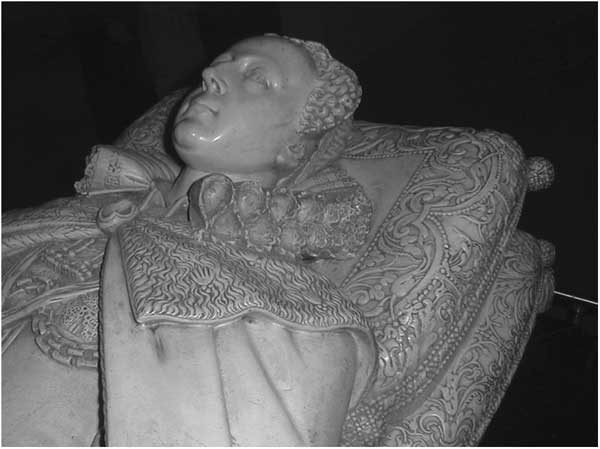
Much of what the tomb conveyed visually has rightly been credited to James’s wish to use the monument to legitimise and substantiate his position as a ruling monarch of a new empire.Footnote 59 But it is perhaps worthwhile to consider the Sheffield portrait—at least in Northampton’s hands—as something of a first draft for the sculpted depiction of Mary. Along with the precise details they have in common, both likenesses emphasise Mary’s piety and innocence. In the Sheffield she is undeniably Catholic, as the crosses and rosary clearly convey. In the tomb her religion is by no means clear. Rather, Mary’s representation as an innocent victim is reflected in the angels with palm branches in the arches and the well-planned contrasts of black and white stone. Her piety is expressed in her generalised, if poignant, recumbent pose with hands clasped in prayer. But there is, nonetheless, a strangely empty space at the opening of a clasp that holds the two sides of her royal mantle, which almost surely would have held a symbolic element of some kind (Fig. 5).
Detail, Tomb of Mary, Queen of Scots, view of mantle and empty clasp.
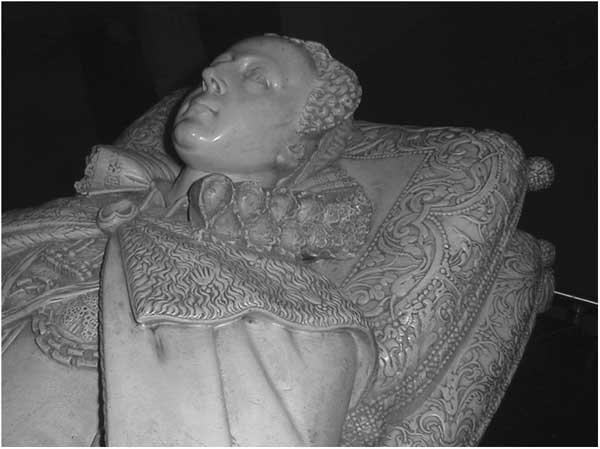
It is possible, of course, that this clasp once held a cross, which would have confirmed Mary’s Catholic faith. A more individualised gesture, if politically more daring because of what Mary’s enemies would have seen as a ‘papal stain’, would have been to include there an Agnus Dei (either represented in stone or an actual artefact), as by all accounts Mary wore one on the day of execution.Footnote 60 But if Northampton was in search of a symbol confirming Mary’s innocence, as emphasised in the epitaph, he would have had to look no further than the miniature of Susanna and the Elders, which appears so prominently at Mary’s waist in the Sheffield types. No doubt the little picture of Susanna and the Elders would have been difficult to cast in marble. But Northampton might easily have instructed the sculptor to render Susanna in some other fashion. In his richly detailed description of Mary’s Westminster effigy, Sir George Scharf suggested that something had been removed from the now empty space, which is of course a distinct possibility.Footnote 61 But second thoughts about his more incendiary comments in verse and prose alternatively suggest, however, that, if, among the many other possibilities, the clasp was to include a depiction of Susanna, Northampton might have decided that political as well as practical needs would best be served if he instructed the sculptor simply to leave the small but provocative image out, especially since it might serve as a double-edged sword, reminding the king of his earlier failure to stand when needed as Daniel, Mary’s saviour.
Appendix
A comparison of the Hilliard, Sheffield, and Westminster images of Mary Queen of Scots
With the understanding that a full-length portrait of Mary was in (or near) the hands of the tomb’s designers at the same time the white marble for her effigy was purchased, it is worth looking back at the nineteenth century theory of image modeling discussed above, as it was based on telltale details of similarity discovered in the Sheffield portraits and the tomb. This, however, involved a one-to-one comparison. To test the Hilliard theory we must now contend with three images: the Sheffield, the Hilliard, and the tomb sculpture (Fig. 6–8).
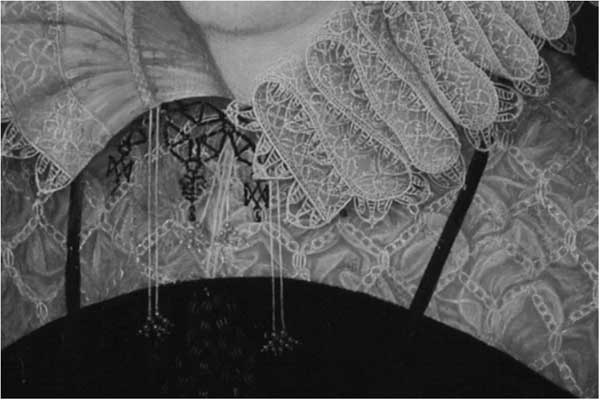
Detail of Fig. 1, Sheffield ruff, with four tassels and black necklace.

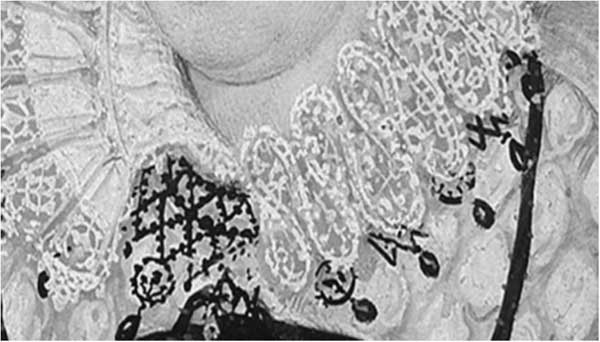
Detail of Fig. 3, Hilliard ruff, with black necklace.
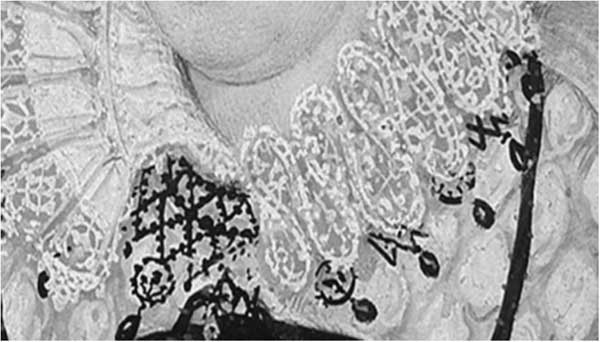
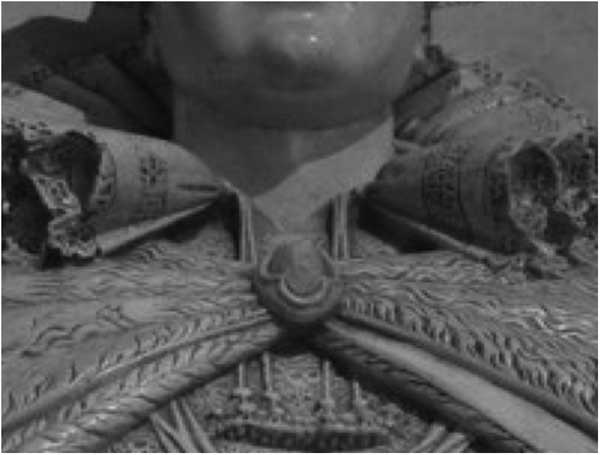
Detail of Fig. 2, Westminster ruff, with four tassels.

As Scharf noted in 1896, details on the effigy of Mary’s face, cap, and ruff appeared to be direct copies of the features depicted in the Sheffield portrait. He called attention most particularly to the ruff, which he found to be ‘exactly the same’ in the Sheffield as the one sculpted onto Mary’s likeness in the tomb, mentioning in particular a ‘peculiar’ shared feature at the front edge of ‘four long strings with tassels of small balls hang[ing] down in front’.Footnote 62 This detail, common to the Sheffield portrait (Fig. 6) and the tomb version (Fig. 8), does not appear in Hilliard’s miniature (Fig. 7).Footnote 63 Meanwhile, in both the Hilliard and the Sheffield Mary wears a black necklace (Fig. 6–7). Each necklace has a design of ‘two letters M combined’ and a ‘small black crown’ (though they are not identical in arrangement).Footnote 64 Neither version appears in the tomb portrayal. If we suppose that Hilliard was the model for both the Sheffield and the tomb, as some modern scholars have argued, we are forced to believe that the copyist/artist had before him not one but two models, both the Hilliard and the tomb, and he must therefore have prepared his presumed Sheffield only after the tomb was completed. Otherwise we could not account for the Sheffield displaying one feature in common only with the tomb (string and ball clusters) and another (the black necklace) that it had in common only with the Hilliard. Although it is not absolutely impossible to imagine circumstances where this might have happened, it does not really seem likely to have been the case. The weight of evidence and logic suggests strongly that the Sheffield type served as the model for both the Hilliard and the tomb.