


In an extensive review of research on Chicano voting behavior, Garcia and Arce (1988) argue that no consensus exists on whether ethnicity impacts voting patterns. They note, “strong cultural attachments have been found to be associated with either political isolation and distance, or heightened ethnic group consciousness and politicization…[and] current research efforts are still sorting out their directional effects” (130). Almost 20 years later, there exists a widespread assumption that the directional effects have been sorted out: ethnic voting persists among Latinos and ethnic attachment results in greater political participation. However, there is no nationally representative research that validates this claim.
This article tests whether ethnicity impacts Latino1
This article describes Latinos or Hispanics as those persons living (permanently) in the United States and whose ancestry can be traced to any of the Spanish-speaking countries of North, Central, or South America, and excludes those of (European) Spanish and Brazilian decent. This definition of Latinos is consistent with most scholarly research.
This is despite numerous case studies available in court transcripts of expert witness testimony that strongly support the findings that Latino voters are mobilized by Latino candidates (e.g., Garza v. Los Angeles County, Ruiz v. Santa Maria, Martinez v. Bush).
During the 1960s and 1970s, Latino elected officials and Latino voters were not visible to the “mainstream.” Pachon and DeSipio note that, “while there were Hispanic elected officials and Latino community activism, no one spoke of ‘Latino’ politics or the ‘Hispanic’ vote in national politics” (1992, 212). In 1973, an enumeration of Spanish surnamed elected officials counted just 10 Latinos elected to any level of office in New York, and just 13 in Florida (Lemus 1973). In 2006, the National Association of Latino Elected and Appointed Officials (NALEO) counted 66 in New York and 125 in Florida and over 6,000 Latinos holding elected office throughout the United States. It is clear that the electoral landscape has changed—our understanding of American politics has not evolved so rapidly.
Beyond examining the mobilizing effect for Latino voters, this article provides an important look at the impact of Latino candidates on White, Black, and Asian American voters across the country. The most consistent finding across each election examined here is that Latino voters witness higher rates of voter turnout and majority support for Latino candidates in co-ethnic candidate elections; for non-Latinos this is not the case. The pattern of mobilization for Latinos uncovered in this research represents a divergence from traditional findings.
I argue that previous empirical studies understate the effect that competitive Latino candidates have on Latino voting. Building on shared group consciousness and minority empowerment, the case is made that in some circumstances, Latinos should be more likely to vote, and to vote in favor of the co-ethnic candidate. In 2001 and again in 2003, Latino candidates contested mayoral elections in America's largest cities—Los Angeles, Houston, New York, Denver, and San Francisco. Although none of the five Latino mayoral hopefuls won their respective elections,1
Although Antonio Villaraigosa was elected mayor of Los Angeles in 2005 and Fernando Ferrer won the New York City Democratic primary in 2005 (and ultimately lost to incumbent Mayor Michael Bloomberg).
Each of the five races reviewed here has a unique political and cultural environment making the results more broadly applicable than a case study of one election. Further, they represent a challenge to the conventional wisdom that Latinos vote heavily Democrat (Uhlaner and Garcia 2005), as the Latino candidates in this study were Democrat, Republican, and Green party members, and held a broad array of political ideologies. In addition to political differences, the candidates were of Mexican, Puerto Rican, and Cuban background. Some were immigrants themselves; others had immigrant parents or grandparents. Thus, these five cities provide an ideal setting to test whether shared ethnicity between a Latino candidate and voter is a mobilizing factor. As Latino citizenship, registration, and voter mobilization drives increase in cities across the country, we should not be surprised to find similar electoral contexts influencing Latino participation and candidate preference.
REDEVELOPING A THEORY OF ETHNIC POLITICS
The premise that Latinos are less likely to participate than non-Latinos is now widely accepted and has been repeatedly demonstrated across time and in a variety of contexts (Calvo and Rosenstone 1989; Huntington 2004). In the face of this accumulated evidence, more recent works indicate that, at least in some circumstances, Latinos are likely to turnout at rates higher than the turnout rates of other racial and ethnic groups (Barreto, Segura, and Woods 2004; Kaufmann 2003). Generally, these studies build on evidence that racialized contexts may lead more Latinos to become interested and involved in politics (de la Garza, Menchaca, and DeSipio 1994; Pantoja, Ramírez, and Segura 2001; Pantoja and Woods 1999). Most of these analyses find that changes in several measures of Latino participation are in part the result of the electoral environment, but they still conclude that Latinos are, on average, less likely to engage politically after taking account of the demographic and naturalization factors.
Similarly, this article holds that if the right electoral context is present, Latinos will be more likely to participate. A confluence of two factors leads to the expectation that the electoral context was suitable for this increase in Latino voting. The first factor was a combination of issues and circumstances covering the latter half of the 1990s, arguably part of a national anti-immigrant movement. The second factor was the prominent and viable candidacy of a Latino contestant for a top of the ticket post: city Mayor. Further, in four of the five1
In Denver, first-time Latino candidates for U.S. Senate and Congress may have helped generate this same feeling, although this case does represent an interesting contrast to the other four cities, given that a Latino had been elected mayor during the 1980s.
The Ethnic-Candidate Paradigm
This article relies on an “ethnic-candidate” paradigm of American politics established in the twentieth century (Dahl 1961; Wolfinger 1965) and advances this for Latinos in the twenty-first century. As the Latino population grows across the country and more Latino candidates run for mayor, statewide office and the U.S. Senate, scholars and pundits alike will need a firm understanding of the dynamics at play within the Latino community, and also between the Latino and non-Latino communities. It is not enough to simply state that co-ethnic candidates matter. We need a sound theory for understanding why they matter, so we can identify cases and sort out results. Two factors exist in American politics today that make co-ethnic candidates salient to Latino voters. First, by definition people who self-identify as Latino are members of a common ethnic group, and for a variety of reasons, ethnicity is a salient political issue for Latino voters (for a full development of this argument see Sanchez 2006). Second, with regard to campaigns, candidate characteristics are increasingly emphasized and matter to voters. The convergence of a growing Latino electorate and a campaign system that focuses on candidate traits provides the foundation for exploring the impact of shared ethnicity and co-ethnic candidates.
However, if the concept of shared ethnicity is immaterial to Latino voters, co-ethnic candidates should have no impact on voting calculi. I argue that shared ethnicity is an important component of Latino political incorporation for five reasons: (1) Latinos share a Latin American heritage and culture including the prevalence of Spanish; (2) they draw on a shared immigrant experience; (3) continued discrimination against Latinos highlights their commonality (Masuoka 2006; Sanchez 2006); (4) ethnic candidates typically focus on co-ethnics as their base, reinforcing the bond (Leighley 2001; Tate 1991); and (5) Spanish surname candidate on the ballot cues known traits in typically low-information environments (Jacobsen 1987; Wolfinger 1965).
Shared ethnicity and ethnic attachment are only half of the story. For co-ethnic candidates to influence Latino voting behavior, it must be demonstrated that candidate characteristics, beyond their policy statements or partisanship, matter to voters. Among the earliest explanations of vote preference, Downs (1957) argues that voters will evaluate the competing candidate policy positions, leaving little room for affect or candidate appeal. However campaign practices have changed over the past 50 years. DeFrancesco Soto and Merolla (2006) point out that modern campaigns rely heavily on Spanish language and Latino-targeted ads to get out the vote, often emphasizing a candidate's connection to the Latino community. I argue that there are five reasons why candidate traits play a major role in voting behavior: (1) the diminishing role of political parties (Wattenberg 1994); (2) the rise of candidate centered elections (Tedin and Murray 1981); (3) candidate appeals for “groups” of voters (Popkin 1991); (4) media focus on ethnicity of candidates (Reeves 1990); and (5) the continuing lack of minority representation (Bowler and Segura 2005). This model of understanding the American electorate continues to build on the heuristics literature. Popkin notes that voters constantly rely on information shortcuts when deciding whether and how to vote. With respect to Latinos, Pantoja, Nicholson, and Segura (2006) find that candidate-based cues are very important, especially among low-information voters. I argue that co-ethnic candidates themselves represent an important heuristic device by signaling their shared ethnicity to Latino voters.
Ethnic Politics Renewed: Latinos and the 1990s
According to DeSipio (1996), instead of relying on ethnicity, Latino voter participation may be more likely influenced by traditional socioeconomic and demographic predictors of political participation. He argues that “ethnicity will come to play less of a role in their political decision-making than will other societal divisions,” (8). Although ethnicity is likely to have “no distinct impact” in this model, there is the chance that it could emerge in “unique circumstances” or in response to “ethnic-based discrimination,” but the conclusion is that “these scenarios are unlikely” (9). DeSipio is correct in establishing these criteria as necessary for the development of ethnicity as a central component of the politicization of Latinos, yet he underestimates the likelihood of its occurrence. The ethnically charged context found in California, Texas, New York, and Colorado during the 1990s, culminating in the 2001 and 2003 mayoral elections, offers such an example. Although some states experienced more discrimination and protest related to “Latino issues” than others, many examples abound in each of these four states, part of a larger national anti-immigration trend that swelled in the 1990s (Fry 2001; Nelson 1994). Indeed such a context exists in other states from Idaho to Arizona to Iowa, which witnessed the rise of anti-immigrant groups in response to a growing Latino and immigrant population. As viable Latino candidates emerge elsewhere, it is reasonable to suspect that the political environment may foster similar contentious periods of ethnic politics.
Although the examples of “anti-Latino” ballot measures from California are typically the best known, ethnically charged environments existed in Colorado, Texas, and New York as well. First, all four of these states witnessed an immigrant-based protest movement in response to the 1996 Welfare Reform Act that restricted many immigrants from receiving state and federal benefits. In addition, local issues drew attention to the Latino community as the “other.” Charges of police brutality in the Latino community, English-only workplace policies, school segregation, the roundup of undocumented immigrants, and new waves of immigration from Latin America all highlighted the shared ethnicity of Latinos in these four states.
A clear result of this array of issues is that, given elite and media attention to these issues, Latinos are more likely to side with other Latinos on matters of political significance, even ones with whom they have only the term “Latino” in common. Latinos were targeted without regard to age, generational status, citizenship, language skills, and national origin. As such, these issues and the political climate they engendered had the result of making Latinos more cohesive as a political force and more likely to weigh in on political issues directly affecting them. This description of events ties in nicely with the notion of ethnic identification or shared group consciousness, which has recently enjoyed something of a rebirth (Masuoka 2006). For a time, many scholars echoed Dahl's (1961) sentiment that the “strength of ethnic ties as a factor in local politics surely must recede.” However, research in subsequent decades continued to evidence the importance of group identification in understanding minority political behavior. Although the weight of this research focused on the experience of African Americans, more recently scholars have taken up the question of how Latino group identity may affect political engagement (e.g., Sanchez 2006).
The concept of group consciousness is rooted in attempts to resolve the question of relatively high Black political participation in the face of limited political resources (Miller et al. 1981). The standard measures of resources—income, education, and organizational membership—could not explain the participatory activities of groups disadvantaged in these areas. With standard participation models unable to account for high levels of minority participation, several authors settled on the concept of group identity as the missing ingredient. In short, the idea was simply that members of minority groups who shared an identity would be more likely to participate if they saw their group as politically disadvantaged. This theory fits the position of Latinos in the 1990s/2000s quite well.
In an early attempt to apply this theory to Latino populations, Garcia et al. (1991) begin with the premise that “ethnicity may provide a structuring basis for values, opinions and attitudes,” but do not go so far as to suggest it directly influences participation. In more recent work, Leighley (2001) extends the shared group context argument to the Latino electorate and identified three contextual influences that reduce the costs and increase the benefits of voting for Latinos. These are elite mobilization, relational goods, and racial/ethnic context, the latter two of which are directly applicable in this framework. Most studies of participation continue to focus on individual level measures such as demographic characteristics, which perform poorly for minority groups. Leighley explains the deficiencies of traditional SES-driven models of turnout for Latino populations: “our theories of participation assumed to be generalizable across racial and ethnic groups are tested primarily on Anglos and typically ignore the contextual characteristics emphasized in theories of minority participation, while theories of group mobilization are rarely tested empirically in a systematic fashion across racial and ethnic groups” (2001, 6).
Leighley argues that Latino turnout might be higher when co-ethnic candidates are on the ballot because “minority candidates direct more resources toward mobilizing groups,” or because “minority candidates changes individuals' calculations of the (potential) benefits or costs of voting” (2001, 43). Unfortunately, “no systematic evidence on the effects of political empowerment on Latino mobilization and participation has been documented” (2001, 43), suggesting the relevance of the empirical findings contained in this article.
The importance of the concepts discussed previously, surrounding group identity and group consciousness, is clearly demonstrated in studies of minority office holding and its effect on minority political behavior. At least since Browning, Marshall, and Tabb's (1984) seminal work, we have known that cities with minority representation on city councils or in the Mayor's office exhibit more policy responsiveness in terms of minority contracting and municipal employment. With respect to Latinos, Espino (2007) finds despite the institutional pressures of Congress, Latino elected officials demonstrate a commitment to voting for pro-Latino policies. Their arguments, that as minorities gain access to power in governing institutions, they obtain political representation, provide a basis for understanding minority political behavior. Widely understood as the “empowerment” or “incorporation” hypothesis, this suggests similarly that minority communities are more likely to be involved in politics when minority candidates have a meaningful opportunity to be elected (Bobo and Gilliam 1990; Gilliam 1996).
Building on existing scholarship on minority political empowerment, research on mayoral elections are the most relevant here. Although many studies have been conducted of Black mayoral candidates, they are frequently conducted in isolation of one another. For example, with respect to Chicago, Pinderhughes (1987) finds that the Harold Washington candidacy leads to greater political participation in predominantly Black wards and offers a rich contextual history of race relations in Chicago. Elsewhere, Sonenshein (1993) documents the persistence of racial politics during the Bradley years in Los Angeles. In Philadelphia, Keiser (1990) estimates that Black voters uniformly supported Goode in 1983 making him the first Black mayor, but confines his theory and analysis to just Philadelphia. Similar research on African-American empowerment in mayoral elections exists for Atlanta, Cleveland, New Orleans, New York, San Francisco, Memphis, and many more cities. Despite the lack of cohesiveness, the literature on Black mayoral politics established the premise that, due to patronage, city contracts, and group pride, Black political representation resulted in a sense of Black empowerment and mobilization. Tate (1991) brings the scattered mayoral analysis together in her work on Black mobilization and the Presidential candidacy of Jesse Jackson. Her review of previous mayoral elections including Cleveland and Chicago, and the candidacy of Jackson, leads her to conclude that “blacks turn out and vote in greater numbers when a black is competing for elective office because of group loyalty, pride, and increased interest” (1161). Not only are Black voters more interested and aware, but Tate states that Black candidates “often campaign more intensively and spend greater resources in black communities” (1161).
With respect to Latino political empowerment, far fewer studies exist with even less cohesiveness. Hill, Moreno, and Cue (2001) find that Cuban-American candidates for mayor in Miami have resulted in greater mobilization and heightened ethnic politics, yet provide little in the way of comparisons outside of South Florida. In Denver, Hero and Clarke (2003) find evidence for a Black–Latino coalition in the elections of Peña and Webb, the cities first Latino and Black mayors, although they do not connect the findings to San Antonio, El Paso, or Miami, other major cities with Latino mayoral victories. Brichetto and de la Garza (1985) and Fraga (1988) provide a descriptive account of Chicano political mobilization in the 1981 election of Henry Cisneros, and more recently Manzano and Vega (2006) find continued evidence of ethnically polarized voting in the Castro election, yet none of these analyses go beyond San Antonio. The closest to a unifying theory of Latino empowerment is probably a descriptive article by Muñoz and Henry (1986) comparing Latino voting patterns in Denver and San Antonio mayoral elections and finding similarities in ethnic-based mobilization of Latino voters.
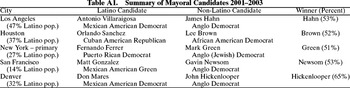
The elections reported in this analysis help bridge the gap of previous work. Most important to the research design is that in none of the five cities, did a Latino Democrat face off against an Anglo Republican, a situation that would make it difficult to disentangle partisan and ethnic loyalties, given Latinos' sustained preference for the Democratic Party (Cain, Kiewiet, and Uhlaner 1991). The Latino candidates in the analysis were members of the Democratic, Republican, and Green Parties, whereas their opponents' partisanship is held constant, all being Democrats (in four of the five cities—the exception is New York—the mayoral election is not a partisan contest). The non-Latino opponents are also diverse, one being an African American; one Jewish American; and the others, Anglo Protestants. Given the differences among the cities, the elections included are an ideal setting to test the effects of shared ethnicity on Latino voter mobilization and vote choice. An important note to the cases analyzed in this article is that all five of the Latino candidates were viable and received important endorsements, donations, and media attention. Latino voters, like all voters, are unlikely to be mobilized by a poorly run campaign, with few resources, and little hope of success, regardless of the candidate's ethnicity. Further, other important facets of the campaign, such as scandal or unpopular policy positions, will likely mediate the impact of shared ethnicity or partisanship, as was the case for Cruz Bustamante in California's 2003 recall election (see DeSipio and Masuoka 2005). However, if across all five contests in different parts of the country, with different Latino populations, ethnicity appears to be a politically relevant variable, we have something more than just anecdotal evidence. Indeed, we will have a systematic and rigorous test of the shared ethnicity hypothesis, which will inform new waves of research in Latino politics in the twenty-first century.
Hypotheses
Given the expectation that a co-ethnic candidate will spur increased Latino participation (among registered voters), we should also expect to find that Latinos will greatly support the co-ethnic candidacy. The two phenomena would seem to be inextricably linked together. Incredibly, despite the growth in the number of Latino candidates over the past 3 decades, few scholarly efforts have been made to understand the impact of co-ethnic candidates on both turnout and voting preferences, even as a mountain of evidence pointing to racial bloc voting in VRA lawsuits accumulates (see, e.g., Abosch, Barreto, and Woods, 2007; Engstrom and Brischetto 1997; Grofman 1993). Instead, studies suggest that ethnicity is not a determinant of vote choice. At most, ethnicity is thought to have an indirect influence of vote choice, by influencing partisanship (Graves and Lee 2000).
On the contrary, I argue that ethnicity should play a significant role and that Latinos will be more likely to support their co-ethnic candidate in the 2001 and 2003 mayoral elections. Given the combination of a politicized shared group experience, and the presence of a coethnic candidate, Latinos should not be expected to pass up an opportunity to elect that candidate. Because the mayoral elections are nonpartisan in nature (or one case a partisan primary), it is possible to sidestep the Graves and Lee finding that the ethnicity effect is mediated by partisanship. If ethnicity only influenced partisanship, rather than directly influencing candidate preference, there would be no discernible difference among Latino votes for Hahn and Villaraigosa, Ferrer and Green, or Mares and Hickenlooper—because all six contestants were Democrats. On the other hand, Sanchez, a Republican, and Gonzalez, a Green, both faced Democratic opponents and should be the lesser preferred candidates if the arguments advanced by Graves and Lee (2000) and Cain and Kiewiet (1984) are still true today.
The two specific questions this paper explores are oriented toward elections with top-of-the-ticket viable co-ethnic candidates. Although Latino candidates are present on the ballot in many elections, this theoretical position is premised on the notion that top-of-the-ticket candidates are more important to ethnic mobilization. Viable top-of-the-ticket candidates are key because they garner more media attention, have higher name recognition, and represent an important role for minority communities as the “executive” office holder.1
Thus, we would expect similar findings with respect to Latino turnout and candidate preference when a Latino candidate is running for President (or Vice President), U.S. Senator, Governor, or Mayor. In addition, this assumption may hold true for lower ballot offices in a community where a Latino candidate would be the first Latino elected to an office such as Congress, State Legislature, or City Council.
H1: Latinos are significantly more likely to vote in favor of Latino candidates.
H2: Latinos will have significantly higher rates of voting in an election with a co-ethnic candidate.
I examine these questions, respectively, by estimating whether high-percentage Latino precincts experience higher or lower voter turnout when a Latino candidate is running; whether turnout in these precincts is higher than that in low-percentage Latino precincts; and by estimating whether heavily Latino precincts favor the co-ethnic candidate. The data are aggregated at the precinct level, making interpretation about individual Latino voters difficult. Despite this limitation, this research presents an important analysis on the role of ethnicity in voter turnout and candidate preference in heavily Latino jurisdictions. I now turn to a discussion of the analytical approach, the data, and a presentation of the estimates.
DATA AND METHODOLOGY
The units of analysis are the individual precincts in each of the five cities noted previously: Los Angeles, Houston, New York, San Francisco, and Denver.1
Due to space considerations, a full summary of the five elections and candidates is not possible in this format; however, readers interested in more background on these five cases can read a brief summary compiled by the author, and posted online: http://faculty.washington.edu/mbarreto/research/mayoral.html
This would not have been possible without assistance tracking down data from John Mollenkopf in the case of New York City, Rich DeLeon for San Francisco, Richard Murray for Houston, Rocky Rushing for Denver, and Harry Pachon for Los Angeles.
Data were merged together at the precinct level so that vote totals, candidate percentages, and demographic characteristics of each precinct were alongside one another in a consistent fashion. In full the total number of observations stands at 6,776 precincts, which represents all complete precincts in the five cities (see Appendix, Table A2). There are two important methodological notes that accompany this research. First, because the unit of analysis is the precinct and not the individual voter, this research offers more about the institution of the precinct or political jurisdiction than individual patterns of political behavior.
The ecological inference problem, first noted by Robinson (1950), stems from the attempt to infer individual-level behavior from aggregate data. That is, if we find that high-density Latino precincts maintain a positive and significant relationship with voting, we cannot, to a certainty, report that Latinos in general are voting at higher rates, even if this may be our underlying argument. Rather, we can only know that heavily Latino precincts demonstrate higher rates of overall turnout than sparsely Latino precincts. To correct for this shortcoming, Goodman (1953) and King (1997) have both developed methods for dealing with ecological inference; however, neither provide the researcher with the ability to conduct a multivariate analysis of turnout or candidate preference. To this extent, the first cut of data analysis employs a double-equation variation of King's ecological inference technique to identify voting patterns by race and ethnicity in each city. Although these techniques are used by the courts in evaluating claims of racial block voting, alone, they may not suffice for social scientists interested in voting patterns, independent of partisanship, age, income, and education. For this reason, I also conduct a multivariate analysis with aggregate-level data, to determine if race variables maintain a significant relationship after additional control variables are included. Further, to get a spatial sense of the relationship between Latino candidates and the four main racial or ethnic groups in each city, scatterplots are presented for vote preference by precinct.
Second, it is important to note that the basis for examining percentage of Latinos within a precinct relies on data for both registered voters and voting age population (VAP). Where possible, registered voter estimates are used to assess the Latino percentage within a precinct; however such data were not available for all five cities, and U.S. Census VAP data were substituted. Thus, although the findings here may suggest that Latinos will participate at higher rates than non-Latinos in certain electoral circumstances, this may be confined to the registered voting population. Previous studies of Latino politics have noted the low rates of voting vis-à-vis the adult population and adult, citizen population (DeSipio 1996; Pachon 1998, 1999). In recent work, Ramírez (2005, 2007) demonstrates the effectiveness of registration and mobilization drives by Latino civic organizations; however, additional studies are necessary to determine what impact, if any, the presence of Latino candidates has on narrowing the registration gap for Latinos.
The Need for a Comparison Election
Assessing Latino voter turnout in a single mayoral election is interesting by itself; indeed doing so is the primary focus of this article. However, a second, “base” election is useful both to provide a point of comparison for the Latino electorate, and to fully test the hypotheses. Thus, for each mayoral election containing a Latino candidate, a second election in which no Latino candidate was present is included.
In all five cases, the comparison election is a citywide mayoral election so that local dynamics remain constant (i.e., same precinct boundaries and locations, uniformity in processing precinct-level results). For all cities except New York, the comparison election is the previous mayoral election to the “Latino” election—1997 in Los Angeles, 1999 in Houston, San Francisco, and Denver. In New York, the Latino candidate (Ferrer) did not win the primary, providing for a “non-Latino election” in the general election that same year, 2001.1
In this case, the turnout bias should be in favor of the general election to elect the mayor of New York instead of the Democratic primary. Scholars have found for decades that turnout is significantly lower in primary elections as compared to general elections or runoff elections.
For example, if the standardized coefficient for percent Latino in the 1999 Houston mayoral election was −.1052 and −.0672 in 2001, the net change would be positive .0380. Even if the constant in 1999 was 25 and in 2001 was 40, the standardized coefficient reports the normalized contribution for the percent Latino variable, independent of the constant (or turnout rate citywide) for both elections.
Variables and Design
To examine the hypotheses, I offer several approaches in an effort to test these expectations from a variety of analytical positions. Several estimates are presented, each specified with slightly different goals in mind, and two dependent variables are always used: Voter Preference and Voter Turnout. In the first sequence of models, Voter Preference is the number of votes cast for the respective Latino candidate divided by the total number of votes cast for Mayor within each precinct. In the second set of models, the dependent variable is Voter Turnout and measured simply as the number of total votes cast divided by the total number of registered voters within the precinct. In all vote preference models, the two-person runoff election was used.
Both of these dependent variables—Voter Preference and Voter Turnout—are continuous variables, ranging theoretically from 0 to 100, and robust ordinary least-squares regression techniques are used in the estimates of both.
I bring a variety of well-known measures to bear on the estimates of voter turnout and voter preference, and these independent variables are consistent for both the models. The key predictor, of course, is Percent Latino. As stated earlier, this is measured in two ways: either (1) as the total number of Latinos registered to vote within each precinct, divided by the total number of registered voters; or (2) as the total number of Latino adults residing within each precinct, divided by the total adult population.1
Percent Latino is based on registration in Los Angeles and New York and is based on voting age population in Houston, Denver, and San Francisco. For the first method, voter registration records were merged with a Spanish Surname list, which is based on the 1990 Census and is constructed by tabulating the responses to the Hispanic-origin question. Each surname is categorized by the percentage of individuals that identified themselves as “Hispanic.” Each surname is then given a numeric value for the probability that persons with the surname are Hispanic. The list contains over 25,000 surnames and is reliable at 94% confidence. For the second method, U.S. Census voting age population data were gathered at the census tract level for each city and merged in with precinct boundaries.
A number of control variables are included as well. Racial and ethnic variables include Percent White, Percent Black, and Percent Asian and are all based on voting age population data. Additional demographic variables include Percent Republican, and Percent Over 50. Each of these measures is derived from the list of registered voters or Census Bureau and is measured as the percentage within each respective precinct. Two additional demographic variables are taken from census tract level information—College and Income. College is a calculation of the proportion of individuals within the census tract with at least a college degree, and Income measures the median household income within the census tract. Finally, consistent with King's critique of Goodman, related to heteroskedasticity and variance of unit size, I also control for total voter registration (Registered) within each precinct.
RESULTS: THE MOBILIZATION OF LATINO VOTERS
Vote Preference Scatterplots: Latino Candidates and Homogenous Precincts
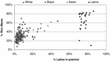
For each of the five cities, data are brought together for the percentage of the vote won by the Latino candidate, and what percentage each racial or ethnic group comprises of the precinct. With these variables, it is possible to create a simple array depicting the relationship between Latino voters and Latino candidates. However, given that we have data for four major racial and ethnic groups, it is possible to disaggregate the non-Latino population to determine whether Latino candidates have a mobilizing, demobilizing, or indefinite effect on White, Black, and Asian American voters. These results are displayed in Figures 1 to 5.
The first cut at the data is the simplest: an X-Y scatterplot that charts the percentage of the vote won by a Latino candidate (Y axis) and the percentage of Latinos within the precinct (X axis). Although the X axis represents the percentage of Latinos, I have superimposed homogenous racial precincts for White, Black, and Asian communities on the same axis, creating four types of precincts, heavily Latino, heavily White, heavily Black, and heavily Asian,1
Heavily White and heavily Black precincts are those with a population of 80% or more homogenous. For Asian-American precincts, those identified as 50% or more Asian population were considered heavily Asian due to small sample size considerations. Heavily Latino precincts are those with a population over 80% Latino in all cities except San Francisco, where the threshold is lower due to the small number of observations, and instead majority Latino is used.
Across all five elections two trends are observable: first, heavily Latino precincts tend to cluster together, exhibiting very similar patterns for candidate preference, and second, heavily Latino precincts display high rates of support for the Latino candidate, with few exceptions. Just as heavily Latino precincts tend to cluster together, so too do heavily Black and heavily White precincts. The interesting phenomenon is that non-Latino support for Latino candidates is not at all consistent, changing from less than 10% support to more than 80% support from one city to another, given the relevant history of each group in these five cities. Beyond these generalizations, there are also some interesting differences among the cities, which merit discussion.
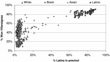
In Los Angeles, the 77 heavily Latino precincts are clustered close together, all voting strongly in favor of the Latino candidate, Antonio Villaraigosa. Villaraigosa garnered a minimum of 72% and a maximum of 91% of the vote in the Latino precincts, while his support in non-Latino precincts fluctuated greatly. Among non-Latino precincts, Villaraigosa received anywhere between 8% and 84% of the vote, according to Figure 1. For example, heavily Black precincts are clustered near the bottom left corner of the graph, almost universally providing less than 20% of the vote to the Latino candidate. White precincts in Los Angeles are also grouped together, although they demonstrate a moderate range of support from about 25% to 65% for the Latino. The few Asian American concentrated precincts remain scattered. As the Latino population within a precinct increases, so too does the support for Villaraigosa, in a reasonably linear fashion.

Vote for Latino Candidate by Racial/Ethnic Composition of Precinct, Los Angeles 2001
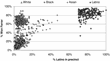
For Houston, the results are both similar and different from those in Los Angeles. What is immediately noticeable is that the linear pattern evident in Figure 1 is not present in Figure 2. The precinct results appear to be “all over the map,” with the exception of heavily Latino parts of the city. Among the 64 heavily Latino precincts in Houston, 57 are clustered in the upper right portion of the scatterplot, signifying majority support for the Latino candidate, Orlando Sanchez. In only two heavily Latino precincts did Sanchez, a Republican, collect less than 35% of the vote. Among non-Latino precincts, there is not such a clear pattern, with Sanchez winning more than 90% of the vote and also losing more than 90% of the vote. Here, Houston displays remarkably similar patterns to Los Angeles, even though the two Latino candidates are different. The Republican Latino candidate drew strong support from both Latinos and Whites, but received virtually no support among heavily Black precincts in Houston.

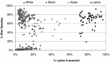
Vote for Latino Candidate by Racial/Ethnic Composition of Precinct, New York City 2001
In New York City, the results conform to those in Los Angeles, at least at first glance. Looking at the 134 high concentration Latino precincts (Figure 3), the Latino candidate, Fernando Ferrer, received between 71% and 97% percent of the vote. There are no outliers among Latino precincts, with all precincts over 65% Latino clustered closely together, demonstrating congruity in their voting patterns. Although the relationship between percentage of Latino and vote for Ferrer is clearly linear, there is much variance in the non-Latino vote. For example, in precincts with less than a 10% Latino population, Ferrer received as little as 2% and as much as 97% of the vote in the Democratic primary election. In sharp contrast to Los Angeles and Houston, Figure 3 reveals that a Latino–Black coalition was behind the Puerto Rican candidate in New York, with heavily White precincts offering little support to the Ferrer. Overall, precincts are clustered tightly by race and ethnicity with respect to their voting patterns in New York.

Vote for Latino Candidate by Racial/Ethnic Composition of Precinct, Houston 2001
San Francisco has fewer heavily Latino precincts than any of the other cities; however, the same pattern emerges with respect to their voting patterns (Figure 4). Majority Latino precincts in San Francisco all demonstrated strong support for the Latino candidate, Matt Gonzalez of the Green Party. In the 21 heavily Latino precincts, Gonzalez never received less than two-thirds of the vote, and as much as 83%. In fact, his highest vote totals in the entire city came from heavily Latino precincts. Six of the 21 Latino precincts gave Gonzalez more than 80% of the vote. In contrast, in only 2 out of 540 non-Latino precincts did Gonzalez receive 80% of the vote. San Francisco does not demonstrate quite as much racial clustering, although many patterns are observable among non-Latinos. Most notably, heavily Black precincts tended to vote against Gonzalez. Only 1 of the 22 Black precincts in San Francisco voted for Gonzalez, and there he only received 51% of the vote (Figure 4). Asian-American precincts were also concentrated around the 45% or less area, with only 3 of the 91 heavily Asian precincts voting in favor of Gonzalez. White concentration precincts on the other hand varied widely in their support levels for the Latino candidate. Precincts from Gonzalez's county supervisor district, which are among the most liberal, gave him strong support, whereas other heavily White precincts voted in favor of his White opponent.

Vote for Latino Candidate by Racial/Ethnic Composition of Precinct, San Francisco 2003
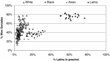
The final scatterplot is for Denver, and although there are some notable outliers, high-concentration Latino precincts tended to vote in favor of the Latino candidate, Don Mares. Of the 34 heavily Latino precincts in Denver, 27 voted in favor of Mares and 7 voted for the non-Latino candidate, Hickenlooper. Generally, the Latino precincts are clustered together, and a linear pattern is present with Mares's support level increasing as the precinct becomes more Latino. In particular, two heavily Latino precincts reported very low levels of support for the Latino candidate, found in the lower right portion of Figure 5. Despite these two cases, Mares did appear to mobilize the Latino community even while trailing in the polls by more than 20 points throughout the election. Further, Denver shows Latino and White precincts at odds, both clustered in opposite corners of the graph in Figure 5. Of the 128 heavily White precincts in Denver, only 3 voted in favor of the Latino candidate. Among Black precincts, support for Mares was moderate to low, a change from the Peña elections in Denver when Black support for the Latino candidate was very high (Hero 1992).

Vote for Latino Candidate by Racial/Ethnic Composition of Precinct, Denver 2003
Vote Preference Regression Estimates for Latino Candidates
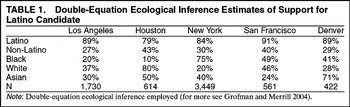
The graphs in Figure 5 illustrate that heavily Latino precincts show consistent support for Latino candidates. However, it is difficult to know how Latinos in mixed or non-Latino precincts voted by looking at the scatterplots. Using ecological inference technique, we can provide point estimates for candidate support by race and ethnicity, to give us a sense for how each of the diverse Latino candidate faired among Latino voters overall. Because we do not have accurate data on what percentage of the electorate was Latino in each city—the exact measure needed for precise vote preference estimates—a double-equation version of King's ecological inference that takes account of non voting is used to fine-tune the independent variable, percent Latino (for more on this technique see Grofman and Merrill 2004). The double-equation ecological inference results for each of the five cities are presented in Table 1.

Overall, Latino candidates received strong support from Latino voters, without regard for party. The estimates indicate that Latino voters greatly preferred the Latino candidates in all five cities, whereas non-Latino support was mixed. In Los Angeles, Denver, and San Francisco, the Latino candidate received about 90% of the Latino vote. In New York 84% of Latinos supported a co-ethnic for mayor and in Houston the Latino Republican candidate received 75% of the Latino vote. As a general finding, the Latino population always preferred the Latino candidate, whereas non-Latinos as a group never voted in favor of the Latino. Among non-Latinos, some differences do exist as noted earlier.
These results clearly demonstrate the importance of ethnicity in understanding Latino political participation for a variety of newfound reasons. First, the data are not limited to one geographic location, but instead span five different cities from coast to coast. Second, the cities represent diverse Latino populations consisting of large Mexican, Puerto Rican, Dominican, Salvadoran, and Colombian populations. Third, the candidates themselves also reflect the diversity of the Latino population coming from Cuban, Mexican, and Puerto Rican ancestry. Fourth, as previously noted, none of the elections featured a Latino Democrat versus an Anglo Republican; instead they featured Latino candidates from the Democratic, Republican, and Green Parties, all running against Democratic opponents. Finally, with the inclusion of Denver, the elections are not exclusively first opportunities for Latinos to win the office of mayor (given Peña's victories in the 1980s).
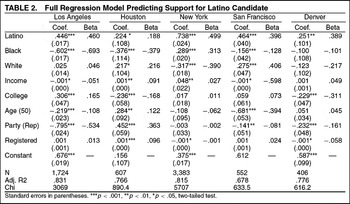
In addition to the bivariate analysis reported in Table 1, a more detailed multivariate regression was undertaken for each city to determine if the effects of ethnicity hold, after controlling for age, education, income, and most important, partisanship (see Table 2). Graves and Lee (2000) suggest that ethnicity is not a determinant of vote choice; rather, the issue of partisanship is so strong a predictor that ethnicity has no direct effect. At most, ethnicity is thought to have an indirect influence on vote choice, by influencing partisanship. Instead, the data here suggest that ethnicity does in fact have a direct effect on vote choice beyond that of partisanship.

For all five cities, heavily Latino precincts were statistically more likely to vote for the Latino candidate, and the standardized beta coefficients suggest that ethnicity was a robust predictor of vote preference (Table 2). This finding, consistent with Kaufmann's analysis of mayoral elections, supports the empowerment hypothesis that suggests “in-group identification is a powerful electoral cue” (2003, 116).
In fact, percent Latino is the only variable that is both statistically significant and positive across all five models. In comparison, percent Black is negative in four of the five models (the exception is New York), and percent White is positive twice (Houston, San Francisco) and negative three times. Thus, while Latinos are consistent supporters of Latino candidates, other coalition partners (African Americans or Anglos) may come and go depending on the local context (note the omitted racial category in the multivariate analysis is Asian and/or Other). This strengthens the finding that ethnicity matters for Latinos, because other groups of voters do not show consistent results in elections when Latino candidates are present. However, this may also be the result of non-Latino opponents playing the “race card,” and dampening the Latino candidates' citywide appeal, as suggested by Reeves (1990).
Finally, the partisan dynamics in each of these elections provides more assurances that party identification is not driving the results. In Los Angeles, New York, and Denver, both candidates in the runoff are registered with the Democratic Party. Because the two candidates were both Democrats, it is possible that Latinos in these three cities were free to vote for the Latino candidate and that the same situation would not hold were a Republican candidate present. However, if partisanship or ideology were the driving force, we would still expect Latino voters to evaluate both Democratic candidates with respect to the issues and policies at play, resulting in a more equal split between the two candidates. Multiple surveys of Latino registered voters have found strong ties to the Democratic Party, but a split in ideological tendencies with roughly equal thirds identifying as liberal, moderate and conservative (Tomás Rivera Policy Institute [TRPI] 2000; Pew Hispanic 2004). Thus, we might expect conservative Latinos to select the more conservative Democrat, liberal Latinos to select the more liberal Democrat, and moderate Latinos to split their vote between the two Democrats, resulting in something close to a 50–50 split between the Latino and non-Latino candidates. Because of the overwhelming support for Villaraigosa, Ferrer, and Mares among Latinos, ethnicity should be considered as a primary determinant of vote choice when a co-ethnic candidate is present.
In the other two cities, Houston and San Francisco, we would expect partisanship to work against the non-Democratic Latino candidates. Among the heavily Mexican-American Latino populations in these two cities, recent literature would suggest that Democratic candidates would have the edge (Uhlaner and Garcia 2005). Indeed, evidence from both cities suggests that Latinos in Houston and San Francisco vote Democrat. In 2000, the Democratic presidential candidate Al Gore won 70% of the vote in Houston's heavily Latino precincts, and in 2002 Democratic Governor Gray Davis won more than 80% of the vote in San Francisco's heavily Latino precincts. However, the results here show that, even controlling for Democratic partisanship, heavily Latino precincts were statistically more likely to vote for the non-Democratic Latino candidates in these cities. This is consistent with recent work by Nuño (2007) that suggests Latinos can be compelled to vote Republican, but only if they are mobilized by Latino Republicans, which was certainly the case in Houston.
Voter Turnout: Comparing Latino and Non-Latino Elections
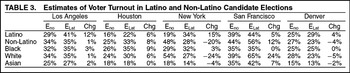
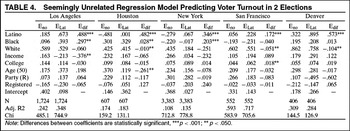
Tables 3 and 4 contain the turnout results for the Latino candidate election and non-Latino candidate election. To assess the impact that Latino candidates have on turnout, two estimates are provided, similar to the candidate preference estimates. First, ecological inference is used to calculate the turnout rate, among registered, for each racial and ethnic group across all five cities. Second, for both elections, multivariate regression is performed with coefficients and standardized beta estimates reported, to provide a comparison between the two elections. Such analysis allows us to answer two compelling questions about Latino political participation. First, when a Latino candidate is present, do heavily Latino precincts vote at elevated rates, as compared to an election with no Latino candidate? Second, in an election with a Latino candidate, do heavily Latino precincts witness higher turnout compared to precincts that are predominantly White or Black? To answer the first question we can compare standardized beta's for percent Latino in election 1 and election 2, within each city. To answer the second question, we can compare standardized beta's for different racial and ethnic groups, within the Latino candidate election only.


At first blush, Table 3 confirms the Latino voter turnout hypotheses. The first column within each city, denoted by Eno, represents the estimated turnout rate for each group in the election with no Latino candidate, whereas the second column (ELat) represents the election when a Latino candidate was running for mayor. Across all five cities, Latino voter turnout is estimated to be higher in the election with a Latino candidate present. In contrast, there was no consistent pattern among changes in turnout for non-Latinos. However, each election also reflects a different level of competitiveness and public interest; thus we can not read too much into the bivariate results. A more accurate analysis is detailed in Table 4, which reports the results for multivariate regression for both Latino and non-Latino candidate elections.
For each city, two regression models were estimated simultaneously—one for the election with no Latino candidate (Eno) and a second for the election featuring a Latino candidate (ELat). Using Zellner's (1962) seemingly unrelated regression, we can estimate both models together, and then test for significant differences between coefficients and cross-equation parameter restrictions. For ease of comparability, standardized beta coefficients are reported in Table 4. The betas in Table 4 allow us to make two important comparisons: (1) to compare the results for percent Latino across time and (2) to compare the results for percent Latino to percent Black and percent White at a single point in time.
Comparing coefficients across models helps to further demonstrate that different electoral circumstances may lead to quite different results. Cross-model comparisons are often used to measure differences in institutions and political environments, most notably in Verba, Nie, and Kim (1978). In this research, the models presented contain the same independent variables, and in both, the dependent variables measure voter turnout. Thus, we can be confident in the differences comparing across the two elections.
First, after controlling for a variety of other factors, heavily Latino precincts significantly increased voter turnout when a Latino candidate was running for office in all five cities. Although this is consistent with the ecological inference analysis in Table 3, by comparing standardized beta coefficient, we are neutralizing the potential bias of competitive elections in Latino candidate years, by standardizing the slope of the equation. Although the unstandardized coefficients might be misleading, the standardized betas represent the magnitude of the effect after normalizing all the independent variables within the model. In addition, using linear combinations of parameters tests, we can determine whether the change between betas is statistically significant. Even if the coefficients for a given variable in model Eno and model ELat are both significant, it does not necessarily mean that the difference between the two is a statistically significant change, and the postestimation utilities employed allow us to conduct such a test. With this level of statistical analysis, we can say with certainty that as a precinct becomes more Latino, the likelihood of turnout greatly increases in an election with a Latino candidate.
Without regard to the partisanship of the Latino candidates or the local context surrounding the campaigns in the five different cities, Latino precincts witnessed the largest and most consistent increases in voter turnout during Latino candidate elections. In fact, none of the other variables in the models changed by as much, or in as consistent a pattern from the non-Latino election to the Latino candidate election. Although Latino candidates may have either mobilizing or demobilizing effects for other groups of voters, these data reveal that shared ethnicity has a strong mobilizing effect for Latino voters.
These results contradict most research in this area, but complement other studies (Gilliam and Kaufmann 1998; Kaufmann 2003) that show that Black voter turnout in Los Angeles was higher than average when a Black candidate was present, and that Latinos in Denver voted at higher rates than non-Latinos when a Latino candidate was present. It also lends support to the notion Garcia and Arce (1988) posited, that Latino turnout may be similar and sometimes higher than that of non-Latinos as a result of “situational factors such as local personalities and ethnically defined political races, local issues compelling to Chicanos, historical patterns, and sophisticated organizational activities.“
In two cities, Los Angeles and Denver, the standardized betas for Latino precincts are the largest of any group, suggesting their turnout rate was the highest. This marked the first time in Los Angeles that Latino voter turnout exceeded that of Blacks or Whites, whereas in Denver, Latino turnout had also been quite high during the Peña elections in the 1980s, and here again in the Mares election in 2003. In New York and San Francisco, the betas for Latino precincts are higher than for Black precincts, but only about half the size of the betas for White precincts. Interestingly, these two cities displayed opposite patterns with respect to the Black and White vote for the Latino candidates (see Table 3). Given the high levels of participation by White votes, this might be suggestive of either supportive or backlash mobilization in response to the Latino candidate. White voters in New York may have turned out to vote against Ferrer, whereas in San Francisco liberal White voters were part of the Gonzalez coalition. In contrast, Latino-concentrated precincts in Houston reported far lower betas than those for Black-or White-concentrated precincts. Although the Sanchez candidacy did have a mobilizing effect on Latinos, the historically low turnout rates in the Latino community in Houston may have prohibited record high turnout. Although Sanchez did well among Latino voters, it is possible that a Latino Democrat would have been more successful at mobilizing Latino voters in Houston, where most Latino registered voters are Democrats.
Overall, the evidence from the Latino candidate election is mixed, when viewed in a vacuum. Among heavily Latino precincts, voter turnout was the highest, in the middle, and also the lowest across the five cities. However, when we compare across two elections, the picture is much clearer. In every instance, Latino precincts witnessed a significant increase in voter turnout in the election with a Latino candidate. Further, even where Latinos had lower rates of voting than non-Latinos, such as Houston, the differential was substantially smaller in the Latino candidate election.
Latino Candidates and Non-Latino Turnout
The previous discussion has mostly focused on the effects of Latino candidates for heavily Latino precincts. In part this is due to Latino precincts exhibiting the clearest patterns of vote growth between Eno and ELat; however, patterns are also observable among non-Latinos. First, in all five of the “Latinoless” elections, White precincts demonstrate the most robust standardized betas, suggesting they had the highest rates of turnout. This is consistent with extant literature that finds Whites participating at higher rates than Blacks, Latinos, and Asian Americans (among the comparative studies, Verba, Schlozman, and Brady 1995). However, heavily White precincts registered a net deficit in turnout in the election with a Latino candidate. Calculating the change in the standardized beta between elections, White precincts demonstrated less robust betas in all five elections with Latino candidates. In part, this is a result of higher than average turnout in the non-Latino elections, making it more difficult for Whites to grow their turnout rates in the Latino elections. However, it may also be the flipside of the coin that leads scholars to decry low rates of participation among Latinos. This article argues that coethnic candidates are important mobilizing instrument because they help engage minority communities, increase the opportunity to be mobilized, and perhaps increase the level of interest in elections. For Whites, elections that feature viable Latino (or Black) candidates may slightly reduce their level of interest and participation rates. This finding is consistent with Barreto, Segura, and Woods's (2004) research, that White turnout is lower in majority-Latino districts than in majority-White districts. This is not to say that White turnout will plummet in an election with a Latino candidate, rather, that their turnout may be higher during an election featuring two White candidates—the inverse of the theory described here.
African Americans show less consistent patterns than Latinos or Whites in the ten elections under study. In Los Angeles and Houston, there appears to be a mobilizing effect, although many pundits observed that Blacks were mobilized in opposition to the Latino candidacy in these two cities (Fleck 2001; Sonenshein and Pinkus 2002). This would be consistent with the results of the scatterplots as well as Table 2 which both show heavily Black precincts voting against the Latino candidates. In Los Angeles, the Anglo candidate James Hahn had strong ties to the African American community, and his father, Kenneth Hahn, was a county supervisor in a traditionally black district. In Houston, the non-Latino candidate Lee Brown was an African American who was quite popular among Houston's Black community and leadership. If Black voters in these two cities viewed the Latino candidate as a potential threat to Black representation, it is reasonable to expect increased turnout in heavily Black precincts. In New York, a high percentage of Blacks supported Ferrer in the Democratic runoff, and like Latinos, their turnout rate dropped in the all-White general election between Green and Bloomberg. In San Francisco, Black concentrated precincts were marginally less likely to vote in the Gonzalez election and in Denver Black precincts exhibited an increase in turnout during the Mares election. Without a consistent pattern, it is difficult to expand much on the implications for Black-Brown political relationships. If anything, the data here suggest that Black-Brown dynamics are mediated by local context, absent an overwhelming national issue that might unite or divide these two communities.
The demographic control variables in the models perform as expected, with age, income and education positive and significant predictors of turnout. Age and education are positive in all 10. of the models estimated, while income is a positive predictor in nine.
CONCLUSION
During March, April and May 2006, more than 3 million Latinos took to the streets to protest immigration proposals passed by the House, and to call for respect and equality for documented and undocumented immigrants living in the United States. Without regard to nativity, immigrant status, generation, or age, Latinos of all backgrounds participated in the immigration rallies in 2006. The implication was clear: shared ethnicity was an overwhelming mobilizing force for many in the Latino community. In this article, the notion that shared ethnicity directly influences Latino vote choice was consistently found to be true. Additionally, when a viable co-ethnic candidate is present, Latinos will turnout to vote at heightened rates, and in some instances vote at rates greater than those of other ethnic and racial groups—including whites. Through a detailed analysis of 10 elections in five cities, this research found shared ethnicity to be an important predictor of Latino political participation. Precincts with larger proportions of Latino registrants were more likely to evidence high rates of turnout when a Latino candidate was running for office, and to vote for the Latino candidate.
Although previous research examined the effect of one Latino candidate in isolation, either for a single congressional district (Cain and Kiewiet 1984), statewide office but limited to one state (Graves and Lee 2000), or for mayoral candidates, but in just one city (Barreto, Villarreal, and Woods 2005; Hill, Moreno, and Cue 2001; Manzano and Vega 2006), this study is the first to bring together multiple data sets from across the country to test the systematic effect of Latino candidates on political participation. To some degree, previous analysis is limited to the extent that the factors present in one city or state may not be present in other areas throughout the nation. In contrast, the data employed here are broad in scope, and the implications derived from this effort are far reaching.
First, unlike the voluminous array of research on political participation, this research shows that in some circumstance Latinos will turnout to vote. Second, this research calls into question the finding that race and ethnicity are less relevant determinants of candidate preference (Graves and Lee 2000) or ethnic political participation generally (DeSipio 1996). Specifically, the data demonstrate that voter preferences may be directly influenced by ethnicity. This confirms anew a prevailing theme that is borrowed from the empowerment literature (Bobo and Gilliam 1990; Tate 1993), that the presence of co-ethnic candidates will influence minority electoral participation.
This article reveals that Latino voter turnout is not predestined to such low levels that research over the last 40 years suggests. In most of the previous research, no viable Latino candidates were present at the top of the ticket and Latino voters may not have felt in touch with the predominantly Anglo candidates running for office. The mayoral elections reviewed here provide a broad context to test this scenario for Latino voter turnout. In fact, this research finds that although heavily Latino precincts are unlikely to have high levels of turnout when no Latino candidate is running, the presence of a viable Latino candidate uniformly results in increased voter turnout in Latino precincts.
The implications of these results should not be limited to the five cities discussed. The 2006 Current Population Survey reveals that minority populations are growing throughout the United States and many large urban centers have (or will soon have) a majority minority population. Future mayoral elections, as well as statewide elections that feature co-ethnic candidates should be expected to mobilize the Latino electorate, in a manner similar to that chronicled here, and lead to high levels of voter turnout. Though the argument can be extended beyond the scope of city elections. Already, research has demonstrated a mobilizing effect for Latino voters living in overlapping majority-Latino legislative districts, which are typically represented by Latino office holders (Barreto, Segura, and Woods 2004). Although it is true that the effect of ethnicity as a mobilizing agent may be stronger in local (often nonpartisan) elections when candidate attributes draw more attention from the media and voters, we should also witness a mobilizing effect for Latino candidates for Governor, U.S. Senate, or President.
As the political landscape changes in the twenty-first century and Spanish-surname candidates become the norm in American elections, pundits and scholars alike will need to revisit the question of Latino and minority participation. The number of Latinos elected to municipal office in the United States increased from 987 in 1984 to 1,624 in 2006, a 64% increase. Cities such as Phoenix, San Diego, Dallas, Jacksonville, Milwaukee, Boston, Las Vegas, and Washington DC have growing Latino populations, and each has at least one prominent Latino-elected municipal official. Other large cities, such as San Antonio, El Paso, and Miami have already documented Latino mobilization through the election of Latino mayors. However, as Latino candidates become more and more prominent, it is possible that the salience of ethnicity will recede. This is difficult to forecast because the politics of ethnicity is a two-way street, with both the campaign and the individual voter relying on ethnic cues. Demographic projections suggest that immigration and naturalization among Latinos will continue, providing a growing Latino electorate with a sizable component of first-generation Americans. Further, given the perceived success of Spanish-language outreach and advertising by presidential candidates in 2000 and 2004, all campaigns are likely to continue engaging the Latino voter through ethnic means (DeFrancesco Soto and Merolla 2006). Although Latino candidates may focus more on winning a coalition of voters through nonethnic campaigns, their candidacies and campaigns are likely to continue resonating with Latino voters.
APPENDIX


A previous version of this paper was presented at the 2006 Midwest Political Science Association annual conference. Research in this article was supported by the University of California President's dissertation fellowship; the Ford Foundation dissertation fellowship for minorities; the UC MEXUS dissertation grant; the UCI Center for the Study of Democracy; and the University of Washington Institute for Ethnic Studies in the United States. Throughout the course of revisions, helpful feedback was provided by Nathan Woods, Gary Segura, Ricardo Ramírez, Harry Pachon, Stephen Nuño, Fernando Guerra, Mario Villarreal, Francisco Pedraza, Naomi Murakawa and Christopher Adolph. This article originated as a component of my doctoral dissertation and a debt of gratitude is owed to Bernie Grofman, Louis DeSipio, Katherine Tate, and Carole Uhlaner for their careful review and suggestions. Finally, Stephen Nicholson provided unwavering support and sage advice on font selection. Any remaining errors are mine alone.




Comments
No Comments have been published for this article.