Introduction
Obtaining accurate hemodynamic data is of vital importance during cardiac catheterisation of paediatric patients with CHD. These data inform surgical planning and often guide management in critically ill patients failing to convalesce. While practice varies among institutions, in the previous two decades, paediatric catheterisation laboratories have largely transitioned from operator-directed sedation towards general anaesthesia administered by an anaesthesiologist. Reference Lam, Lin, Alexy and Aronson1,Reference O’Byrne, Millenson and Steven2 This has followed the trend of more complex and longer interventional procedures being performed as alternatives to surgery.
Anaesthetic agents are well-known to affect both myocardial performance and vascular resistance. Reference Pilkington, Taboada and Martinez3 This may impact whether hemodynamic data obtained at the time of cardiac catheterisation can be interpreted to accurately reflect the physiology of an awake state. Given differential effects on pulmonary vascular resistance (PVR) and systemic vascular resistance (SVR), the choice of anaesthetic agent has the potential to result in clinically significant differences in hemodynamic measurements for CHD patients, particularly among those with shunting lesions.
While prior studies in paediatric patients have examined the hemodynamic effect of intravenous agents administered as moderate or deep sedation, less is understood concerning the hemodynamic implications of general anaesthesia in the setting of an intracardiac shunt. Reference Oklü, Bulutcu, Yalçin, Ozbek, Cakali and Bayindir4–Reference Akin, Esmaoglu, Guler, Demircioglu, Narin and Boyaci6 Furthermore, a comparison of the hemodynamic effects of two widely employed general anaesthesia strategies, inhaled volatile anaesthesia (IA) and total intravenous anaesthesia to our knowledge has not previously been reported. As most paediatric catheterizations are now performed using general anaesthesia, understanding the hemodynamic implications of anaesthetic approach among children with dynamic intracardiac physiology is critically important in the interpretation of intracardiac hemodynamic assessments and clinical decision-making.
We conducted a secondary analysis of a publicly available dataset comparing the relative differences in hemodynamics among single ventricle patients undergoing cardiac catheterisation facilitated with either a moderate sedation or general anaesthesia approach. Furthermore, we conducted a prospective study of patients undergoing elective hemodynamic assessment to compare the hemodynamic effects of IA (sevoflurane) versus total intravenous anaesthesia (dexmedetomidine and propofol). Together, our objective was to identify relationships between hemodynamics and the anaesthetic strategy employed to highlight the possible impact on clinical decision-making among children with pre-existing cardiac disease.
Materials and method
Study 1: Retrospective analysis of hemodynamic assessment of infants following Stage 1 palliation
From 2005 through 2009, study participants from 15 centres meeting the inclusion criteria of hypoplastic left heart syndrome or related single, morphologic systemic right ventricular anatomy were considered for enrolment in the Paediatric Heart Network Single Ventricle Reconstruction trial, with 549 patients ultimately randomised and undergoing either a modified Blalock-Taussig-Thomas shunt or a right ventricle to pulmonary artery conduit (Sano modification) as the source of pulmonary blood flow at Stage 1 palliation. Both trial design and results of the primary analysis have previously been reported. Reference Ohye, Sleeper and Mahony7,Reference Ohye, Gaynor and Ghanayem8 Hemodynamic data obtained by cardiac catheterisation following Stage 1 palliation and prior to Stage 2 palliation were recorded as a component of this trial, along with calculations including pulmonary vascular resistance indexed to body surface area (PVRi) and the ratio of pulmonary to systemic blood flow (Qp/Qs). Further calculations were derived using study-reported pulmonary artery (PA) pressure (the highest of right PA or left PA, if neither then main PA used where available) and atrial pressure (lowest value of study-reported capillary wedge pressure, pulmonary vein pressure, or systemic ventricular atrial pressure). Qp was derived from the study-reported PVRi and estimated pulmonary artery and atrial pressures (Qp = (PA pressure – atrial pressure)/PVRi), while Qs was derived from the calculated Qp and the study-reported Qp/Qs. Systemic vascular resistance indexed to body surface area (SVRi) was derived from estimated Qs and study-reported mean arterial and atrial pressures. Finally, anaesthetic conditions under which hemodynamic data were obtained were reported in the original study as either moderate sedation or general anaesthesia.
Study 1 Statistical analysis
Intracardiac hemodynamic comparisons were made with respect to anaesthetic approach, both among those who were discharged following Stage 1 palliation with either a modified Blalock-Taussig-Thomas shunt or Sano as pulmonary blood flow source. Categorical variables are described as counts and percent of total, with comparisons by Chi-square and Fisher’s exact testing where appropriate. Continuous variables are described as median (interquartile range) and compared using Mann–Whitney U or Kruskal–Wallis testing, with Bonferroni correction for multiple comparisons where appropriate. Statistical analysis for this portion was performed with R (v4.4.0). Institutional review board approval and informed consent were obtained at participating centres during the Single Ventricle Reconstruction trial; this secondary analysis of publicly available, de-identified data were also acknowledged by the Vanderbilt University Institutional Review Board (IRB#190822).
Study 2 Prospective analysis of hemodynamic assessments of children with pre-existing heart disease
Patients aged 6 months to 18 years presenting to the paediatric catheterisation laboratory for percutaneous closure of a patent ductus arteriosus or endomyocardial biopsy after orthotopic heart transplant under general anaesthesia were eligible for enrolment. The Institutional Review Board at Vanderbilt University approved this study (IRB #171298). Exclusion criteria included subjects actively treated for pulmonary hypertension, allergy, adverse reaction, or medical contraindication to receiving sevoflurane, propofol, or dexmedetomidine, and need for inotropic or vasopressor support. Eligible subjects and legal guardians were approached prior to catheterisation, and written informed consent was obtained. Demographic data including pre-procedure medications and diagnoses were recorded.
Study 2 Anaesthesia procedures
Induction of anaesthesia was performed with inhaled sevoflurane with additional intravenous administration of rocuronium 0.7–1 mg/kg and fentanyl 1–2 mcg/kg following peripheral intravenous catheter placement. Endotracheal intubation was then performed. In the first phase of hemodynamic measurements, general anaesthesia was maintained using 0.75–1.5 minimum alveolar concentration of sevoflurane (IA) to sustain a bispectral index measurement of 40–60. The percent of inhaled oxygen was maintained between 21–30% and end-tidal CO2 was maintained between 35–40 mmHg throughout the procedure. A full right and left heart catheterisation without angiography was then performed and hemodynamic measurements obtained. Oxygen consumption (VO2) was estimated using the LaFarge method as described previously. Reference LaFarge and Miettinen9
A transition period was then performed between IA and total intravenous anaesthesia during which a dose of IV midazolam (0.05–0.1 mg/kg) was administered, followed by an IV dexmedetomidine bolus of 0.5 mcg/kg over five minutes and then a continuous infusion at 1.0–1.5 mcg/kg/hr, initiation of a propofol infusion at a rate of 100–150 mcg/kg/min (without bolus), and finally sevoflurane was discontinued and the exhaled percent of sevoflurane was monitored until less than 0.2%. During the transition period, bispectral index was monitored and maintained within the range of 40–60. Bolus doses of propofol could be administered as needed to maintain adequate depth of anaesthesia during both the transition period and throughout the use of total intravenous anaesthesia. The length of transition time for each patient was recorded. Hemodynamics were then repeated with a brief left and right heart catheterisation using total intravenous anaesthesia.
Study 2 Hemodynamics
Baseline non-invasive assessment of vital signs prior to anaesthesia induction and less than 120 minutes prior to IA pressure measurements were obtained, including blood pressure, heart rate, height, and weight. After induction of IA pressure, measurements were obtained in the right atrium, right ventricle, a branch of the pulmonary artery, a pulmonary capillary wedge, descending aorta, and the left ventricle (left ventricular end diastolic pressure). Oxygen saturations were measured in the superior vena cava (mixed venous saturation), a branch pulmonary artery, and the descending aorta. For calculations, pulmonary venous saturation was assumed to be the same as the aortic saturation. These measurements were used to calculate Qp, Qs, SVRi, PVRi, and Qp/Qs. Anaesthetic management of hemodynamics during both the IA and total intravenous anaesthesia phases consisted of volume resuscitation to account for cumulative fluid deficits associated with nil per os status and avoidance of bolus vasopressors, as per standard institutional practice.
Study 2 Statistical analysis
The primary exposure in this study was IA versus total intravenous anaesthesia. The primary outcome was the hemodynamic data obtained during each phase of anaesthesia, which included blood pressure (mmHg), heart rate (bpm), SVRi (Wood Units × m2), PVRi (Wood Units × m2), left ventricular end diastolic pressure (mmHg), and Qp/Qs. Paired data were analysed using the Wilcoxon signed-rank test. Linear regression was used to analyse the correlation between continuous variables. All data analysis for this study was performed using Stata IC 15 (Statacorp, College Station, Texas).
Results
Study 1
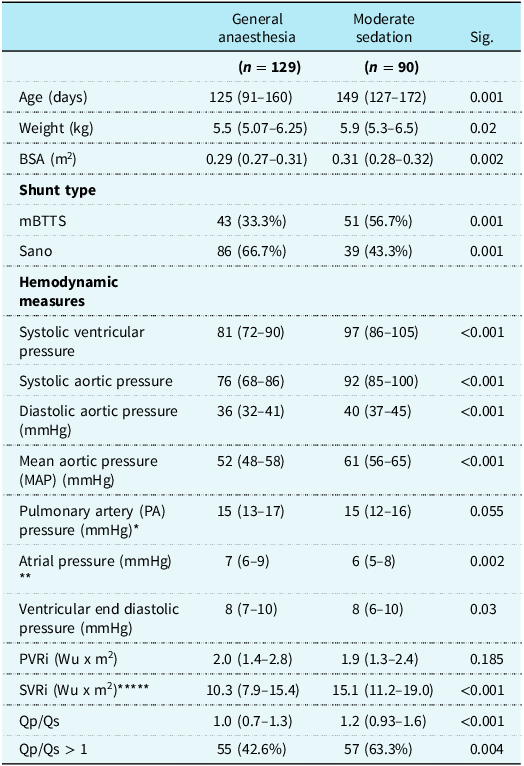
Of 549 subjects randomised in the SVRs trial, 71% (n = 390) of infants underwent cardiac catheterisation following Stage 1 palliation and prior to Stage 2 palliation; of these, 56% (n = 219) reported values sufficient for calculating endpoints of interest, thus excluding 31% (n = 171) with incomplete data from further analysis. Moderate sedation was utilised in 90 (41%) subjects and general anaesthesia in the remaining 129 (59%) subjects. A summary of demographics and study measures with respect to anaesthetic type are summarised in Table 1. Subgroup comparisons with respect to size and type of pulmonary blood flow source demonstrated significantly higher Qp/Qs irrespective of Sano conduit size (≤5.0 mm v. ≥ 6.0 mm, Figure 1) among patients receiving moderate sedation for their hemodynamic catheterizations. Infants with mBTTS ≥ 4.0 mm demonstrated a Qp/Qs that was significantly higher under moderate sedation relative those with mBTTS ≤ 3.5 mm receiving moderate sedation (1.55 [1.0–2.0] v. 1.1 [0.78–1.33], p = 0.006, Figure 2), differences that were not apparent in comparing Qp/Qs with respect to modified Blalock-Taussig-Thomas shunt size among patients receiving general anaesthesia. The use of moderate sedation at catheterisation was associated with a greater than two-fold odds of a reported Qp/Qs > 1 (OR 2.12, 95%CI 1.18–3.87, p = 0.013), independent of shunt type, PVRi, and patient size at catheterisation.
Boxplot demonstrating Qp/Qs with respect to both anaesthetic strategy and RV-PA shunt size among infants with hypoplastic left heart syndrome undergoing cardiac catheterisation following Stage 1 palliation.

Boxplot demonstrating Qp/Qs with respect to both anaesthetic strategy and mBTTS shunt size among infants with HLHS undergoing cardiac catheterisation following Stage 1 palliation.

Demographic and hemodynamic measures both measured directly and derived from values reported among patients following Stage 1 palliation with respect to anaesthetic strategy employed during cardiac catheterisation

* PA pressure: Highest of right PA or left PA, if neither then main PA used where available; **Atrial pressure: Lowest of reported CWP, pulmonary vein or systemic ventricular atrial pressure; ***Qp estimate is derived from reported Qp/Qs and estimated PA and atrial pressures; *****SVRi estimate is derived from estimated Qs, atrial pressure, and reported mean arterial pressure.
Continuous variables reported as median (IQR), categorical covariates as frequency (%). Comparisons performed by Mann–Whitney U test or Chi-square testing where appropriate.
BSA= body surface area; mBTTS= modified Blalock-Taussig-Thomas shunt; MAP= mean aortic pressure; PA= pulmonary artery; PVRi= indexed pulmonary vascular resistance; SVRi= indexed systemic vascular resistance; Qp/Qs= ratio of pulmonary (Qp) to systemic (Qs) blood flow.
Study 2
Over the course of the two-year study period, 25 subjects were prospectively enrolled and included both patients following orthotopic heart transplant (n = 13) and those with a patent ductus arteriosus (n = 12). Among orthotopic heart transplant patients, 54% were female, and the median age was 10.3 years (interquartile range 6.6–15.3). Antihypertensive therapy was reported in 91% of orthotopic heart transplant patients at baseline, and all received morning dose per routine practice prior to catheterisation. Among the patent ductus arteriosus patients, 75% were female, and the median age was 2.0 years (1.0–3.8 years). None of the patent ductus arteriosus patients were on outpatient medications prior to catheterisation. Under general anaesthetic conditions using inhaled volatile anaesthesia, systolic blood pressure was significantly lower while receiving IA compared to baseline (70 [66–78] vs. 108 [106–114] mmHg, p < 0.001, Figure 3). Conversely, after transition to total intravenous anaesthesia, there were no differences observed in systolic blood pressure from baseline (109 [99–116] vs. 108 [106–114] mmHg, p = 0.61). Median SVRi was significantly lower using IA compared with total intravenous anaesthesia (11.1 [8.1–14.3] versus 21.0 [17.2–22.2] Wood Units × m2, p < 0.001), while PVRi did not differ between IA and total intravenous anaesthesia (1.2 [0.7–1.7] versus 1.3 [1.0–1.9] Wood units × m2, p = 0.058, Figure 4). The median transition period between IA and total intravenous anaesthesia was 13 (range 9–20) minutes.
Systolic blood pressure for the entire cohort measured before (Pre-anes) and during each anaesthesia phase. Median and interquartile range are reported for each phase.

Vascular resistance for the entire cohort obtained during each anaesthesia phase with median and interquartile range.

In the patent ductus arteriosus patient subgroup, Qp/Qs was significantly lower during IA versus total intravenous anaesthesia (p = 0.003, Figure 5a). Furthermore, a positive correlation was demonstrated between the Qp/Qs while using IA and the magnitude of change in the Qp/Qs once transitioned to total intravenous anaesthesia (R 2 = 0.4, p = 0.03, Figure 5b). In the orthotopic heart transplant patient subgroup, left ventricular end diastolic pressure was significantly lower while using IA than while using total intravenous anaesthesia (p = 0.002, Figure 6a), and similarly to Qp/Qs, there was a positive correlation between left ventricular end diastolic pressure measured while using IA and the magnitude of change in left ventricular end diastolic pressure after transitioning to total intravenous anaesthesia (R 2 = 0.39, p = 0.03, Figure 6b). There was a significant association between younger age and lower SVRi in all patients, though this association was amplified while receiving IA (R 2 = 0.57, p < 0.001) versus receiving total intravenous anaesthesia (R 2 = 0.2, p = 0.03). Changes in PVRi were smaller and only weakly correlated with age using either anaesthesia protocol. There was no observed association between age and PVRi change between anaesthesia phases (Figure 7).
( a ) Changes in Qp/Qs for PDA patients transitioning from IA to TIVA anaesthesia phases. ( b ) Change in Qp/Qs using IV anaesthesia compared with Qp/Qs while using inhaled anaesthesia.

( a ) Left ventricular end diastolic pressure (LVEDP) for OHT patients during each anaesthesia phase. ( b ) Relationship between baseline LVEDP measured while using IA and the increase in LVEDP after transition to IVA (R 2 = 0.39, p = 0.03).

Scatterplots describing the relationship between age and vascular resistance while receiving ( a ) IA, or ( b ) TIVA. Scatterplots describing the relationship between age and both changes in ( c ) SVRi and ( d ) PVRi while transitioning from IA to TIVA.

Discussion
Cardiac catheterisation remains the gold standard for the description of intracardiac hemodynamics and provides valuable data to inform clinical decision-making in the care of critically ill children with CHD. Here, we demonstrate that anaesthetic considerations may play an important role in modulating these hemodynamic investigations and warrant careful consideration when interpreting study results. We demonstrated significantly higher SVRi and Qp/Qs among patients with a univentricular circulation undergoing catheterisation facilitated by moderate sedation relative to those undergoing catheterisation under GA. Furthermore, we demonstrated significant differences in hemodynamics measured during cardiac catheterisation while using different modalities of general anaesthesia (IA versus total intravenous anaesthesia). Taken together, these data reflect the importance of careful consideration of anaesthetic choice and associated changes in hemodynamics. More closely replicating an awake, unanesthetized state may provide more clinically relevant data to more effectively guide clinical decision-making.
The first phase of this study analysed a retrospective analysis of hemodynamic data among a group of infants with hypoplastic left heart syndrome following Stage 1 palliation and prior to Stage 2 palliation, leveraging the fact that anaesthetic approach (general anaesthesia or moderate sedation) was a data point of interest collected in the original Single Ventricle Reconstruction trial. Hemodynamic data of infants with single ventricle physiology are obtained frequently not only to determine candidacy for proceeding with Stage 2 palliation, but also in the setting of infants demonstrating clinical evidence of circulatory imbalance in favour of pulmonary blood flow, leading to a low cardiac output state. Reference Barnea, Santamore, Rossi, Salloum, Chien and Austin10,Reference Barnea, Austin, Richman and Santamore11 The assessment of Qp/Qs in this setting may serve as a means to objectively define relative pulmonary and systemic blood flow rates, with imbalances serving as a potential interventional target to augment either cardiac output (Qs) or pulmonary blood flow (Qp). This study demonstrates an association between significantly lower SVRi during the use of general anaesthesia relative to moderate sedation. Pulmonary vascular resistance was unaffected by anaesthetic strategy in the same patient population. Conversely, in the setting of relatively higher SVRi and comparable PVRi, shunt-dependent flows theoretically increase. Reference Nakazawa, Takao, Chon, Shimizu, Kanaya and Momma12 Furthermore, differences in pulmonary diastolic runoff between shunt types are also an important consideration and may contribute to a relative increase in early postoperative hemodynamic instability among modified Blalock-Taussig-Thomas shunt relative to their Sano counterparts, particularly in light of a significantly higher incidence of post-Stage 1 cardiopulmonary resuscitation in the modified Blalock-Taussig-Thomas shunt group reported within the original Single Ventricle Reconstruction trial. Reference Ohye, Sleeper and Mahony7 We demonstrate that independent of shunt type, patient size, and PVRi, the use of moderate sedation as compared to general anaesthesia was associated with a greater than two-fold increase in the odds of a Qp/Qs > 1. Among the Sano subgroup specifically, moderate sedation was associated with significantly higher Qp/Qs irrespective of Sano size. Among the modified Blalock-Taussig-Thomas shunt subgroup receiving moderate sedation, relatively higher Qp/Qs was observed among patients with shunt sizes ≥ 4.0 mm compared to their ≤3.5 mm counterparts, a finding not replicated among those receiving general anaesthesia. The impact of general anaesthesia on hemodynamics is even further highlighted when comparing the choice of general anaesthesia type (IA versus total intravenous anaesthesia) in Study 2, where nearly every patent ductus arteriosus patient showed an increase in the degree of left-to-right shunting under total intravenous anaesthesia as compared with IA. The only patients in whom there was not a marked increase in shunting were those who had very small, highly restrictive patent ductus arteriosus with no measurable shunt in either condition. There were no patients with a Qp/Qs ≥ 2 using IA, while nearly half demonstrated a Qp/Qs ≥ 2 using total intravenous anaesthesia. While these data would not necessarily alter the decision to close a patent ductus arteriosus, such differences could alter management decisions in other populations such as shunt-dependent or other single ventricle patients. The large difference in shunting in the patent ductus arteriosus cohort of Study 2 can also be attributed to significantly higher SVRi using total intravenous anaesthesia versus IA. Similar to Study 1, PVRi was not significantly different between anaesthesia phases. In Study 2, we also observed a strong correlation between the degree of left-to-right shunt while using IA and the magnitude of the increase in shunt observed after changing to total intravenous anaesthesia. Consequently, these collective findings suggest that acquiring hemodynamic data during general anaesthesia with IA may significantly underestimate the true Qp/Qs imbalance present in awake patients due to the impact of IA on SVRi.
While the systemic ventricular end diastolic pressure was comparable between the general anaesthesia and moderate sedation subgroups in Study 1, all orthotopic heart transplant patients in Study 2 demonstrated increases in left ventricular end diastolic pressure when transitioned from IA to total intravenous anaesthesia. Furthermore, there was a strong correlation between higher left ventricular end diastolic pressure using IA and larger increases in left ventricular end diastolic pressure between phases; we suspect this is also related to increases in SVRi using total intravenous anaesthesia as compared with IA. As the slope of the relationship between SVRi and left ventricular end diastolic pressure steepens in a failing ventricle, the transition between anaesthetic agents, therefore, may constitute a dynamic assessment of left ventricular diastolic function for this patient population. Reference Schulman, Herman, Edwards, Ziady and Uretsky13
The impact of general anaesthesia on SBP was minimised and more closely matched baseline non-invasive SBP measurements while patients received total intravenous anaesthesia compared to IA. Moreover, the decrease in SVRi while under general anaesthesia was also decreased using total intravenous anaesthesia compared to IA, mirroring the changes in SBP. Together with the well-known ability of sevoflurane to reduce SVRi, these findings collectively would suggest that SBP is a reasonable surrogate for baseline SVRi. Reference Rödig, Keyl, Wiesner, Philipp and Hobbhahn14 The PVRi neither differed between anaesthesia subgroups in Study 1, nor when measured under IA versus total intravenous anaesthesia in Study 2, and both studies demonstrated the mode of anaesthesia disproportionately impacted SVRi over PVRi. As SBP under total intravenous anaesthesia closely matched SBP prior to anaesthesia in Study 2, it can be argued that the higher Qp/Qs and left ventricular end diastolic pressure obtained under total intravenous anaesthesia more closely reflect an awake physiologic state.
We also observed a trend towards an inverse correlation between the change in SVRi from one anaesthesia phase to the other and the age of the patient, though this did not reach statistical significance. Smaller IA-induced changes with increasing age imply that the degree of Qp/Qs underestimation under IA may be greatest in the youngest patients, including infants with hypoplastic left heart syndrome undergoing cardiac catheterisation prior to Stage 2 palliation analysed retrospectively in the first study of the series reported here. Thus, the choice of anaesthetic agent is of particular importance in shunted single ventricle patients.
A well-established clinical approach to management of the low SVRi state associated with IA is to increase SVRi using intermittent bolus dosing of a vasoconstricting agents such as ephedrine or phenylephrine. Reference Lonjaret, Lairez, Minville and Geeraerts15 This approach is complicated by the need to establish “stable” hemodynamics during all phases of data collection in the catheterisation laboratory. Our data suggest that IA results in relatively significant hypotension during paediatric cardiac catheterisation procedures. This hypotension and the need to respond to it by adding vasoactive agents may induce a significant bias to the hemodynamic data obtained. The utility of this approach for acquiring the best hemodynamic data may also be limited by the direct myocardial depressant effects of IA. Reference Ebert, Harkin and Muzi16 Finally, understanding the age-dependent effects of IA on SVRi and blood pressure and the availability of IV alternatives that may have less effect on hemodynamics may help obtain data that more reflect the awake state.
These studies were subject to a number of limitations. Study 1 was retrospective and as such did not permit more closely modulating anaesthetic approaches in patients in series as was the case for Study 2. Furthermore, we acknowledge that this study is limited by an absence of more clearly defined anaesthetic approaches beyond “moderate sedation” and “general anesthesia,” thus rendering unclear whether general anaesthesia in this study incorporated total intravenous anaesthesia, IA, or both. This study relies upon the assumption that moderate sedation more closely approximates the hemodynamics of an awake state at rest. Finally, SVRi values were derived from existing hemodynamic data, making a number of assumptions. Study 2 was limited by the sequence in which anaesthetics were administered, as we were unable to examine the hemodynamic effects of a transition from total intravenous anaesthesia to IA. In some patients, we observed a transient spike in SBP during the dexmedetomidine bolus, as has been previously described. Reference Jooste, Muhly and Ibinson5 Some of this increase in pressure may have represented a rebound effect from turning off the inhaled sevoflurane. This effect did not persist longer than 10 minutes, and blood pressure plateaued by the time the exhaled sevoflurane approached zero. Starting with total intravenous anaesthesia would have required a much longer transition period to allow for the metabolism of IV agents. The prolonged anaesthesia time that would have been required for this approach represented an unacceptable added risk. The combination of dexmedetomidine and propofol was chosen because both agents are used routinely in our catheterisation laboratory. Dexmedetomidine has been shown to have little effect on SVRi and PVRi at standard doses. Reference Jooste, Muhly and Ibinson5,Reference Chaitanya, Arivazhagan and Sinha17 Propofol is known to decrease SVRi and PVRi but was chosen for our study due to the ability to rapidly titrate the depth of anaesthesia. Reference Pilkington, Taboada and Martinez3,Reference Akin, Esmaoglu, Guler, Demircioglu, Narin and Boyaci6 The combination of these two agents showed markedly higher SVRi and similar PVRi to inhaled sevoflurane. Finally, hemodynamic calculations in Study 2 relied upon an estimate of VO2 for each study participant; while this estimate is a well-described source of variation introduced into hemodynamic calculations such as Qp, Qs, and vascular resistance during cardiac catheterisation, the relationship between Qp and Qs remains constant and independent of this estimate. Reference Rutledge, Bush and Shekerdemian18
In conclusion, these findings collectively suggest that acquiring hemodynamic data during general anaesthesia with IA compared to moderate sedation or use of a total intravenous anaesthesia may significantly underestimate the true Qp/Qs imbalance present in awake patients due to the impact of IA on SVRi. These data reflect the importance of careful consideration of anaesthetic conditions during assessment of intracardiac hemodynamics and suggest that more closely replicating an awake, unanesthetized state may provide more relevant measurements to guide clinical decision-making.
Acknowledgements
The NIH/NHLBI Paediatric Heart Network Single Ventricle Reconstruction Trial dataset was used in preparation of this work. Data were downloaded from: https://www.pediatricheartnetwork.com/pud_login.asp?study_id=SVR on 4/25/2019.
Financial support
This research received no specific grant from any funding agency, commercial, or not-for-profit sectors.
Competing interests
The authors have no financial or non-financial conflicts of interest to disclose.
Ethical standards
The authors assert that all procedures contributing to this work comply with the ethical standards of the relevant national guidelines on human experimentation and with the Helsinki Declaration of 1975, as revised in 2008, and has been approved by the Vanderbilt University Institutional Review Board.